

|
시장보고서
상품코드
2156962
산업용 개스킷 : 시장 점유율 분석, 업계 동향과 통계, 성장 예측(2026-2031년)Industrial Gaskets - Market Share Analysis, Industry Trends & Statistics, Growth Forecasts (2026 - 2031) |
||||||
 Mordor Intelligence
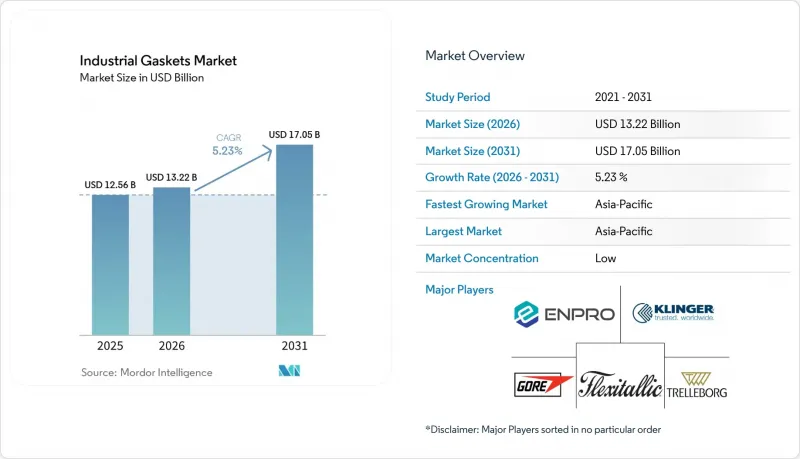
에 따르면 산업용 개스킷 시장 규모는 2025년에 125억 6,000만 달러로 평가되며, 2026년 132억 2,000만 달러에서 2031년까지 170억 5,000만 달러에 달할 것으로 예측되고 있으며, 예측 기간(2026-2031년)에 CAGR은 5.23%에 달할 전망입니다.
전 세계 산업용 개스킷 시장의 동향 및 인사이트
산업용 정유소 및 석유화학 플랜트의 생산 능력 확대
산업용 정유소 및 석유화학 플랜트의 생산 능력 확대는 각 프로젝트에서 다수의 밀폐형 플랜지 연결이 필요하므로 산업용 개스킷 시장 전체의 새로운 수요를 지원하고 있습니다. 인도의 각 정유사는 2026년 12월까지 완공될 예정인 파니파트, 구자라트, 바라우니 프로젝트를 포함하여 기존 시설의 확장을 추진하고 있습니다. 이 3개 프로젝트의 총 투자액은 7,500억 인도 루피(약 89억 달러)에 달하며, 정유소 공정 유닛에서 인증된 실 부품에 대한 수요를 끌어올리고 있습니다. 타스니(Tasnee)는 2026년 7월, 알주바이르에 위치한 사우디 에틸렌 앤 폴리에틸렌 컴퍼니(SEPC)의 에틸렌 증산 프로젝트(5억 달러)를 완료했습니다. 이로 인해 올레핀 생산 능력이 18% 증가했으며, 확장된 크래킹 트레인 전체에 걸쳐 설치 단계에서의 수요가 발생했습니다. 이러한 시설은 일반적으로 고압 및 부식성 환경에서 가동되므로 기본 제품보다 세미메탈릭 및 메탈릭 등급의 제품이 선호됩니다. 신규 건설에 따른 수요는 기존에 산업용 개스킷 시장을 지탱해 온 유지보수 및 수리 수요를 더욱 보완해 줄 것입니다.
휘발성 배출 규제 준수 및 저누출 실 요구 사항
휘발성 배출 규제의 준수와 저누출 실 요구 사항으로 인해 석유 및 가스 시설에서 실 어셈블리의 조기 교체가 촉진되고 있습니다. 미국 환경보호청(EPA)은 2025년 7월에 발령된 잠정 최종 규정을 통해 석유 및 천연가스 배출 규정에 기반한 특정 요구 사항의 이동 기한을 연장했습니다. 모니터링 요건으로 인해 플랜지 연결부 및 관련 공정 장비에서 신뢰할 수 있는 성능의 중요성이 더욱 커지고 있습니다. ASME B16.20, 미국석유협회(API) 6A 및 미국 환경보호청(EPA)의 신규 배출원 성능 기준(OOOOb 및 OOOOr)은 많은 설비의 성능 및 모니터링 환경을 규정하고 있습니다. Teadit사는 2024년, 저배출 용도를 위한 실링 옵션으로 나선형 가스켓을 소개했습니다. 사업자는 문서화된 저누출 제품을 사용함으로써 유지보수 기록, 규제 당국의 심사 및 사내 배출 관리 프로그램을 지원할 수 있습니다.
원자재 가격 및 공급 상황의 변동
산업용 개스킷 시장에서 원자재 가격 및 공급 상황의 변동은 제조 일정과 계약 가격에 압박을 가하고 있습니다. 팽창 흑연, PTFE 컴파운드, 스테인리스강 스트립은 일부 특수 제품 범주에 있으며, 중요한 원자재입니다. 리드타임이 길어짐에 따라 공급업체는 고객 주문을 이동하기 전에 더 많은 재고를 확보하고 운전 자금을 투입해야 할 수도 있습니다. 에틸렌-프로필렌-디엔-모노머(EPDM) 및 플루오로엘라스토머(FKM)의 가격 변동 또한 연질 개스킷 및 비금속 개스킷의 가격 책정을 복잡하게 만들 수 있습니다. 소규모 공급업체는 이러한 가격 변동을 흡수하기가 더 어려워질 수 있으며, 그 결과 구매자는 공급의 신뢰성이나 인증된 글로벌 조달처를 더욱 중요하게 여기게 될 가능성이 있습니다.
부문 분석
2025년, 세미메탈릭 개스킷은 정유소, 석유화학, 발전소의 연결부에서 사용된 데 힘입어 산업용 개스킷 시장 점유율의 47.88%를 차지했습니다. 나선형 구조는 금속 스트립과 충전재를 결합하여 작동 압력 및 플랜지의 움직임에 대응합니다. 이러한 설계 덕분에 미국 기계공학회(ASME) 규격 B16.5 클래스 600 이상이 지정된 시스템을 포함하여 가혹한 조건의 파이프라인 및 장비에서 사용할 수 있습니다. 링 조인트나 더블 재킷 개스킷과 같은 금속 제품은 유정 입구나 고압 증기 시스템에서 규모는 작지만 필수적인 용도로 사용되고 있습니다. 미국석유협회(API) 및 미국기계학회(ASME)의 요구 사항에 따라 이러한 용도에서 저비용 대체품의 실용화가 제한될 수 있습니다.
비금속 개스킷 시장은 2031년까지 연평균 성장률(CAGR) 5.86%로 확대될 것으로 예측됩니다. 팽창 PTFE와 플렉서블 흑연은 화학 처리, 수처리, 수소 관련 용도 및 식품 등급 용도에서 내화학성과 낮은 크리프 이완성을 제공합니다. 유연한 흑연은 발표된 연구에서 지속적인 수소 압력 하에서도 안정적인 성능을 발휘하는 것으로 입증되었습니다. 또한 소재 선정 요건이 변화함에 따라 각 공급업체들은 공정 용도를 위한 PFAS 프리 대체재 개발에도 주력하고 있습니다. KLINGER사는 관련 공정 용도를 위한 PFAS 프리 옵션으로 ‘Top-Chem’을 발표했습니다. 이러한 기술적 및 규정 준수상의 요구로 인해 단순한 원자재 비용을 기반으로 한 경쟁이 아닌 제품 차별화가 촉진되고 있습니다.
지역별 분석
아시아태평양은 2025년 산업용 개스킷 시장 점유율의 42.72%를 차지하고 있으며, 2031년까지 연평균 성장률(CAGR) 5.93%로 확대될 것으로 예측됩니다. 인도와 중국에서는 정유소, 석유화학 및 산업 분야의 확장에 힘입어 수요가 지원되고 있습니다. 인도의 정유 처리 능력은 연간 2억 5,800만 메트릭톤에서 2030년까지 3억-3억 1,000만 메트릭톤이라는 목표를 향해 확대되고 있습니다. 인디언 오일 코퍼레이션(Indian Oil Corporation Limited)의 3개 정유소 확장 프로그램은 2026년 12월까지 완료될 예정이며, 한편, 힌두스탄 석유공사(Hindustan Petroleum Corporation Limited)의 라자스탄주 바마에 위치한 연간 900만 메트릭톤 규모의 시설은 2026년 7월에 가동을 시작했습니다. 이러한 프로젝트로 인해 관련 파이프라인 및 공정 장비 규격을 준수하는 제품에 대한 새로운 수요가 발생하고 있습니다.
중국의 정유 및 석유화학 프로젝트는 통합형 부지내 반금속계 실링재에 대한 수요를 지속적으로 지원하고 있습니다. 일본과 한국은 자동차, 반도체 제조 장비 및 정밀 산업 제조 분야에서 기술적 수요를 창출하고 있습니다. 한국의 울산 및 여수 석유화학 클러스터도 정기 유지보수를 위한 조달을 지원하고 있습니다. 북미는 정유소 유지보수, LNG 투자 및 원자력 개발로 인해 여전히 중요한 지역적 수요 거점으로 남아 있습니다. 캐나다는 오일샌드 및 원자력발전소의 유지보수 수요에 기여하고 있으며, 멕시코는 석유화학 단지의 유지보수 수요를 창출하고 있습니다.
유럽에서는 산업 생산과 진화하는 소재 요구 사항이 수요를 형성하고 있습니다. 독일은 기계 제조 및 화학 처리 분야의 수요를 지원하고 있으며, 영국은 정유소 및 LNG 터미널 운영에 따른 수요를 지탱하고 있습니다. 북유럽의 용도에서는 저온 및 북극권 환경에 대응하는 특수 제품이 요구되고 있습니다. 남미에서는 브라질의 정유소 및 해양 자산과 관련된 수요가 있으며, 콜롬비아에서는 지역 정유소에 ‘Flexitallic Change’ 개스킷이 설치된 사례가 보고되고 있습니다. 중동에서는 사우디아라비아와 아랍에미리트의 석유화학 산업 다각화에 따른 프로젝트 수준의 수요가 지원되고 있습니다. 사우디아라비아에서 Tasnee사가 완공한 에틸렌 프로젝트는 이러한 추세를 여실히 보여주고 있습니다. 아프리카에서는 남아프리카공화국의 산업 및 광업 사업이 가장 안정적인 수요 기반을 제공하고 있습니다.
기타 혜택:
- 엑셀 형식의 시장 예측(ME) 시트
- 3개월간의 애널리스트 지원
자주 묻는 질문
목차
제1장 서론
- 조사 전제조건과 시장 정의
- 조사 범위
제2장 조사 방법
제3장 개요
제4장 시장 구도
- 시장 개요
- 시장 성장 촉진요인
- 시장 성장 억제요인
- 밸류체인 분석
- Porter's Five Forces 분석
제5장 시장 규모와 성장 예측
- 소재 유형별
- 제품 유형별
- 최종 용도 산업별
- 지역별
- 아시아태평양
- 중국
- 인도
- 일본
- 한국
- ASEAN 국가
- 기타 아시아태평양 국가
- 북미
- 미국
- 캐나다
- 멕시코
- 유럽
- 독일
- 영국
- 프랑스
- 이탈리아
- 북유럽 국가
- 기타 유럽 국가
- 남미
- 브라질
- 아르헨티나
- 기타 남미 국가
- 중동 및 아프리카
- 사우디아라비아
- 남아프리카공화국
- 기타 중동 및 아프리카 국가
- 아시아태평양
제6장 경쟁 구도
- 시장 집중도
- 전략적 동향
- 시장 점유율·순위 분석
- 기업 개요
- A.W. Chesterton Company
- Enpro Inc.
- Flexitallic Group
- Flowserve Corporation
- Freudenberg Sealing Technologies
- Goodrich Gasket Private Limited
- James Walker
- John Crane
- KLINGER Group
- Lamons
- NICHIAS Corporation
- PARKER HANNIFIN CORP
- Teadit Group
- Trelleborg AB
- W. L. Gore & Associates, Inc.
제7장 시장 기회와 향후 전망
KSAAccording to Mordor Intelligence, the industrial gaskets market size was valued at USD 12.56 billion in 2025 and is estimated to grow from USD 13.22 billion in 2026 to reach USD 17.05 billion by 2031, at a CAGR of 5.23% during the forecast period (2026-2031).
Global Industrial Gaskets Market Trends and Insights
Industrial Refinery and Petrochemical Capacity Expansion
Industrial refinery and petrochemical capacity expansion is supporting new demand across the industrial gaskets market because each project requires large numbers of sealed flanged connections. Indian refiners are expanding existing facilities, including projects at Panipat, Gujarat, and Barauni that are scheduled for completion by December 2026. The three projects represent a combined investment of INR 750 billion (approximately USD 8.9 billion) and have added demand for certified sealing components in refinery process units. Tasnee completed its USD 500 million Saudi Ethylene and Polyethylene Company (SEPC) ethylene expansion in Al Jubail in July 2026, which increased olefins capacity by 18% and created installation-stage requirements across the expanded cracking train. These facilities commonly operate at high pressure and in corrosive environments, which favors semi-metallic and metallic grades over basic products. New-build demand also supplements the maintenance and repair base that has historically supported the industrial gaskets market.
Fugitive-Emission Compliance and Low-Leakage Sealing Requirements
Fugitive-emission compliance and low-leakage sealing requirements are encouraging earlier replacement of sealing assemblies at oil and gas facilities. The U.S. Environmental Protection Agency extended implementation deadlines for selected requirements under its oil and natural gas emissions rule through an interim final rule issued in July 2025. Monitoring requirements increase the importance of reliable performance at flanged connections and related process equipment. ASME B16.20, American Petroleum Institute 6A, and U.S. Environmental Protection Agency New Source Performance Standards OOOOb and OOOOc shape the performance and monitoring environment for many installations. Teadit described spiral wound gaskets as a sealing option for low-emission service in 2024. Operators can use documented, low-leakage products to support maintenance records, regulatory reviews, and internal emission-management programs.
Raw Material Price and Availability Volatility
Raw material price and availability volatility put pressure on manufacturing schedules and contract pricing in the industrial gaskets market. Expanded graphite, PTFE compounds, and stainless-steel strips are important inputs for several specialty product categories. Longer lead times can require suppliers to carry more inventory and commit working capital before customer orders are fulfilled. Price movement in ethylene propylene diene monomer (EPDM) and fluoroelastomer (FKM) can also complicate pricing for soft and non-metallic gaskets. Smaller suppliers may find it harder to absorb these swings, which can lead buyers to place greater weight on supply reliability and qualified global sources.
Other drivers and restraints analyzed in the detailed report include:
- Power-Generation and Grid-Infrastructure Modernization
- Replacement Demand from Aging Process Equipment
- PFAS, Asbestos and Material-Substitution Compliance Costs
For complete list of drivers and restraints, kindly check the Table Of Contents.
Segment Analysis
Semi-metallic gaskets held 47.88% of the industrial gaskets market share in 2025, supported by their use in refinery, petrochemical, and power-generation connections. Spiral wound configurations combine a metal strip and filler material to respond to operating pressure and flange movement. This design supports their use in demanding pipelines and equipment, including systems specified to American Society of Mechanical Engineers B16.5 Class 600 and higher. Metallic products, including ring joint and double-jacketed gaskets, serve smaller but essential applications at wellheads and high-pressure steam systems. American Petroleum Institute and American Society of Mechanical Engineers requirements can restrict the practical use of lower-cost alternatives in those applications.
Non-metallic gaskets are projected to advance at a 5.86% CAGR through 2031. Expanded PTFE and flexible graphite provide chemical resistance and low creep relaxation in chemical processing, water treatment, hydrogen service, and food-grade applications. Flexible graphite has demonstrated stable performance under sustained hydrogen pressure in published research. Suppliers are also working on PFAS-free alternatives for process applications as material-selection requirements evolve. KLINGER has presented Top-Chem as a PFAS-free option for relevant process uses. These technical and compliance needs encourage product differentiation rather than competition based only on basic material cost.
Complete Report Scope:
- By Material Type
- Semi-Metallic Gaskets
- Non-Metallic Gaskets
- Metallic Gaskets
- By Product Type
- Spiral Wound Gaskets
- Soft Gaskets
- Ring Joint Gaskets
- Jacketed Gaskets
- Corrugated Gaskets
- Other Product Types
- By End-Use Industry
- Refineries
- Power Generation
- Chemical Processing
- Industrial Machinery
- Other End-Use Industries
- By Geography
- Asia-Pacific
- China
- India
- Japan
- South Korea
- ASEAN Countries
- Rest of Asia-Pacific
- North America
- United States
- Canada
- Mexico
- Europe
- Germany
- United Kingdom
- France
- Italy
- NORDIC Countries
- Rest of Europe
- South America
- Brazil
- Argentina
- Rest of South America
- Middle East and Africa
- Saudi Arabia
- South Africa
- Rest of Middle East and Africa
- Asia-Pacific
Geography Analysis
Asia-Pacific held 42.72% of the industrial gaskets market share in 2025 and is projected to advance at a 5.93% CAGR through 2031. India and China support demand through refinery, petrochemical, and industrial expansion. India's refinery capacity is moving from 258 million metric tons per annum toward a 300-310 million metric tons target by 2030. Indian Oil Corporation Limited's three-refinery expansion program is scheduled for completion by December 2026, while Hindustan Petroleum Corporation Limited's 9 million metric tons per annum Barmer Rajasthan facility was commissioned in July 2026. These projects create new requirements for products certified to relevant pipeline and process-equipment standards.
China's refining and petrochemical projects continue to support demand for semi-metallic sealing materials at integrated sites. Japan and South Korea contribute technical demand from automotive, semiconductor-process equipment, and precision industrial manufacturing. South Korea's Ulsan and Yeosu petrochemical clusters also support routine maintenance procurement. North America remains an important regional demand center because of refinery maintenance, LNG investment, and nuclear development. Canada contributes to oil-sands and nuclear maintenance demand, while Mexico adds needs from petrochemical complex maintenance.
Europe is shaped by industrial production and evolving materials requirements. Germany supports demand from machinery manufacturing and chemical processing, while the United Kingdom supports refinery and LNG-terminal activity. Nordic applications require specialized products for low-temperature and Arctic conditions. South America has demand linked to Brazilian refinery and offshore assets, while Colombia has recorded a Flexitallic Change gasket installation at a regional refining site. The Middle East supports project-level demand from petrochemical diversification in Saudi Arabia and the United Arab Emirates. Tasnee's completed ethylene project in Saudi Arabia illustrates this activity. South Africa's industrial and mining operations provide the most consistent demand base in Africa.
- A.W. Chesterton Company
- Enpro Inc.
- Flexitallic Group
- Flowserve Corporation
- Freudenberg Sealing Technologies
- Goodrich Gasket Private Limited
- James Walker
- John Crane
- KLINGER Group
- Lamons
- NICHIAS Corporation
- PARKER HANNIFIN CORP
- Teadit Group
- Trelleborg AB
- W. L. Gore & Associates, Inc.
Additional Benefits:
- The market estimate (ME) sheet in Excel format
- 3 months of analyst support
TABLE OF CONTENTS
1 Introduction
- 1.1 Study Assumptions and Market Definition
- 1.2 Scope of the Study
2 Research Methodology
3 Executive Summary
4 Market Landscape
- 4.1 Market Overview
- 4.2 Market Drivers
- 4.2.1 Industrial Refinery and Petrochemical Capacity Expansion
- 4.2.2 Fugitive-Emission Compliance and Low-Leakage Sealing Requirements
- 4.2.3 Power-Generation and Grid-Infrastructure Modernization
- 4.2.4 Replacement Demand From Aging Process Equipment
- 4.2.5 Hydrogen, LNG and Renewable-Energy Sealing Applications
- 4.3 Market Restraints
- 4.3.1 Raw Material Price and Availability Volatility
- 4.3.2 PFAS, Asbestos and Material-Substitution Compliance Costs
- 4.3.3 Adhesive Displacement in Electric-Vehicle Battery Enclosures
- 4.4 Value Chain Analysis
- 4.5 Porter's Five Forces Analysis
- 4.5.1 Threat of New Entrants
- 4.5.2 Bargaining Power of Suppliers
- 4.5.3 Bargaining Power of Buyers
- 4.5.4 Threat of Substitutes
- 4.5.5 Competitive Rivalry
5 Market Size and Growth Forecasts (Value)
- 5.1 By Material Type
- 5.1.1 Semi-Metallic Gaskets
- 5.1.2 Non-Metallic Gaskets
- 5.1.3 Metallic Gaskets
- 5.2 By Product Type
- 5.2.1 Spiral Wound Gaskets
- 5.2.2 Soft Gaskets
- 5.2.3 Ring Joint Gaskets
- 5.2.4 Jacketed Gaskets
- 5.2.5 Corrugated Gaskets
- 5.2.6 Other Product Types
- 5.3 By End-Use Industry
- 5.3.1 Refineries
- 5.3.2 Power Generation
- 5.3.3 Chemical Processing
- 5.3.4 Industrial Machinery
- 5.3.5 Other End-Use Industries
- 5.4 By Geography
- 5.4.1 Asia-Pacific
- 5.4.1.1 China
- 5.4.1.2 India
- 5.4.1.3 Japan
- 5.4.1.4 South Korea
- 5.4.1.5 ASEAN Countries
- 5.4.1.6 Rest of Asia-Pacific
- 5.4.2 North America
- 5.4.2.1 United States
- 5.4.2.2 Canada
- 5.4.2.3 Mexico
- 5.4.3 Europe
- 5.4.3.1 Germany
- 5.4.3.2 United Kingdom
- 5.4.3.3 France
- 5.4.3.4 Italy
- 5.4.3.5 NORDIC Countries
- 5.4.3.6 Rest of Europe
- 5.4.4 South America
- 5.4.4.1 Brazil
- 5.4.4.2 Argentina
- 5.4.4.3 Rest of South America
- 5.4.5 Middle East and Africa
- 5.4.5.1 Saudi Arabia
- 5.4.5.2 South Africa
- 5.4.5.3 Rest of Middle East and Africa
- 5.4.1 Asia-Pacific
6 Competitive Landscape
- 6.1 Market Concentration
- 6.2 Strategic Moves
- 6.3 Market Share (%)/Ranking Analysis
- 6.4 Company Profiles (includes Global Overview, Market Overview, Core Segments, Financials as available, Strategic Information, Products and Services, and Recent Developments)
- 6.4.1 A.W. Chesterton Company
- 6.4.2 Enpro Inc.
- 6.4.3 Flexitallic Group
- 6.4.4 Flowserve Corporation
- 6.4.5 Freudenberg Sealing Technologies
- 6.4.6 Goodrich Gasket Private Limited
- 6.4.7 James Walker
- 6.4.8 John Crane
- 6.4.9 KLINGER Group
- 6.4.10 Lamons
- 6.4.11 NICHIAS Corporation
- 6.4.12 PARKER HANNIFIN CORP
- 6.4.13 Teadit Group
- 6.4.14 Trelleborg AB
- 6.4.15 W. L. Gore & Associates, Inc.
7 Market Opportunities and Future Outlook
- 7.1 White-Space and Unmet-Need Assessment


