

|
시장보고서
상품코드
2157052
원자화 철분 : 시장 점유율 분석, 업계 동향과 통계, 성장 예측(2026-2031년)Atomized Iron Powder - Market Share Analysis, Industry Trends & Statistics, Growth Forecasts (2026 - 2031) |
||||||
 Mordor Intelligence
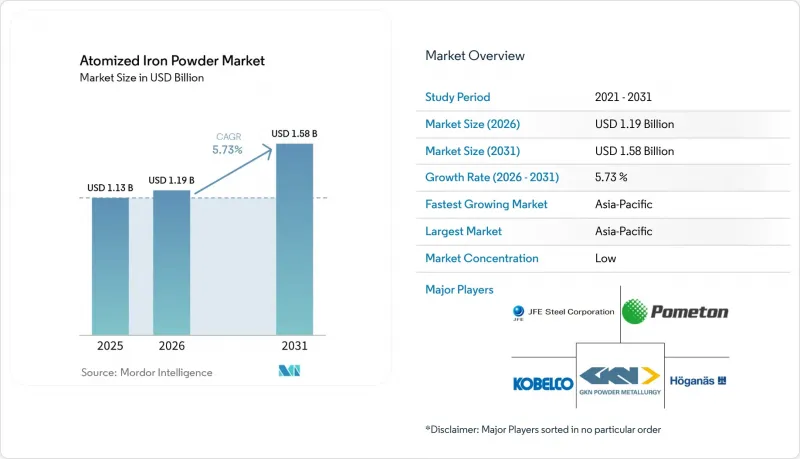
에 따르면 원자화 철분 시장 규모는 2025년에 11억 3,000만 달러로 평가되며, 2026년 11억 9,000만 달러에서 2031년까지 15억 8,000만 달러에 달할 것으로 예측되고 있으며, 예측 기간(2026-2031년)에 CAGR은 5.73%에 달할 전망입니다.
전 세계 원자화 철분 시장의 동향 및 인사이트
자동차 및 산업용 부품 분야에서 분말야금 기술의 채택 확대
분말야금 기술은 가공 공정을 줄이고, 재료 손실을 감소시키며, 대량 생산에서 재현성이 높은 치수 관리를 실현하여 복잡한 부품을 성형할 수 있으므로 분무 철분 시장에서 여전히 중요한 역할을 하고 있습니다. 2025년에는 북미 철분 출하량의 70% 이상이 자동차 용도로 사용될 것으로 예상되며, 이는 이 지역의 분말 공급업체들에게 자동차 프로그램이 여전히 주요 수요 기반임을 보여줍니다. 같은 해 이 지역의 승용차 1대당 평균 14.3kg의 분말야금 부품이 사용되었으며, 이는 단일 자동차 부품이 아닌 여러 기능 시스템에 걸쳐 사용되고 있음을 반영합니다. 기어, 구조용 브래킷, 오일 펌프 로터, 마찰 부품은 계속해서 분무 철분 시장에 광범위한 자동차 분야 기반과 확립된 제조 경로를 제공하고 있습니다. 기존의 구동계 구성이 변화하고 자동차 제조업체들이 부품 설계를 재검토함에 따라 수요는 하이브리드 파워트레인 부품, 터보차저 부품, 휴머노이드 로봇의 액추에이터로 이동하고 있습니다. 압축 강도와 비용이 여전히 중요시되는 분야에서는 철계 소재가 우위를 유지하고 있으며, 양산 규모에서 내구성이 높은 부품이 필요한 용도에서 그 역할이 계속해서 지원되고 있습니다.
전동화에 따른 연자성 철분말 부품의 수요
전기 모터 용도에서는 절연된 분말 입자를 사용하여 자기 코어를 형성하는 연자성 복합재료(SMC)를 통해 아토마이징 철분 시장의 확대가 진행되고 있습니다. 이러한 재료는 특정 모터 설계에서 3차원 자속 경로 및 넷 셰이프 성형을 가능하게 하여, 엔지니어들에게 기존의 적층 구조를 뛰어넘는 선택지를 제공하고 있습니다. 2026년 과학 연구에 따르면 마찰 교반 단조를 거친 Fe-3.5Si SMC 부품은 인장 강도가 650 MPa를 초과하고, 잔류 자력이 10 Oe 미만인 것으로 보고되었습니다. JFE 스틸 주식회사는 자사의 절연 피복 순철분을 사용한 축방향 갭형 모터의 프로토타입이 동등한 효율을 유지하면서도, 동등한 방사형 갭 설계에 비해 두께는 48% 얇고 무게는 40% 가볍다고 보고했습니다. Hoganas AB는 2026년 6월, 고주파 용도에서 코어 손실을 줄이는 것을 목적으로 수성 코팅을 적용한 ‘Somaloy 7P’를 발표했습니다. 고주파 용도에서는 재료 선정이 효율과 열 성능 모두에 영향을 미칩니다. 또한 국제전기기술위원회(IEC)의 자기 코어 성능 관련 요건에 따라 확립된 프리미엄 등급의 가치도 유지되고 있습니다. 이는 고객이 인증된 설계에 새로운 분말을 사용하기 전에 재료의 성능을 검증해야 하기 때문입니다.
분무화에 수반되는 높은 에너지 및 설비 비용
에너지 비용과 설비 비용은 아토마이징 철분 시장에서의 생산 능력 확대를 제약하고 있습니다. 특히 고정비를 대량 생산량으로 분산시킬 수 없는 소규모 생산 업체의 경우 그 영향이 두드러집니다. 수분 분무에는 고압 물과 열에너지가 필요하며, 가스 분무에는 불활성 가스와 전용 회수 시스템도 필요하므로 운영 요건이 더욱 복잡해집니다. 가스 분무 설비에서는 용융물 취급, 분급 장치, 그리고 분말의 품질을 보호하고 미세 입자를 안전하게 관리하기 위한 엄격한 분말 취급 관리가 요구됩니다. 이러한 요건으로 인해 급성장하는 최종 용도가 상업적 기회를 지원하고 있는 경우에도 프리미엄 등급을 목표로 하는 프로젝트의 투자 회수 기간은 길어집니다. 에너지 가격의 변동성이 커지고 있는 것은 특히 유럽 및 북미의 생산자들에게 큰 과제가 되고 있습니다. 왜냐하면 비용 상승분을 항상 신속하게 인증된 고객에게 전가할 수 있는 것은 아니기 때문입니다. 스크랩이나 수소를 원료로 하는 통합형 운영은 운영상의 위험을 어느 정도 완화할 수 있지만, 해당 시설에는 더 높은 초기 투자와 더 장기적인 계획 기간이 필요합니다.
부문별 분석
2025년, 물분무법은 분무 철분 시장의 68.43%를 차지하고 있으며, 이는 광범위한 설비 용량과 확립된 고객 인정을 반영합니다. 이 공정을 통해 프레스 및 소결 용도로 일반적으로 사용되는 불규칙한 형태의 분말이 생산됩니다. 45-150μm인 이 공정의 전형적인 입자 크기 범위는 전 세계 분말야금 수요의 상당 부분에서 여전히 중요한 위치를 차지하고 있습니다. 또한 물분무법은 대량 생산시 킬로그램당 비용 측면에서 우위를 점하고 있습니다. 이러한 특성 덕분에 자동차 및 산업용 공급망 전반에 걸쳐 물분무법은 분무 철분말 업계에서 중심적인 위치를 계속 차지하고 있습니다.
가스 분무법의 경우, 사용자들이 레이저 분말 베드 용융, 바인더 제팅, SMC 코어용 구형 분말을 요구함에 따라 2031년까지 연평균 성장률(CAGR) 6.56%로 확대될 것으로 예측됩니다. 2024년 'AIChE Journal'의 리뷰에 따르면 가스 분무법에서 30μm 미만의 분말 수율은 50% 미만에 그칠 가능성이 있는 반면, 물 분무법에서는 70%-80%에 달한다고 지적되고 있습니다. 이러한 수율 차이는 생산량 증가를 제한하는 한편, 엄격한 사양이 요구되는 소재에 대한 높은 가격 책정을 지원하고 있습니다. 고베제강소는 2026년, 자기 소둔용 고내열 절연 코팅을 적용한 ‘MAGMEL’ 시리즈를 확충했습니다. 이 개발은 신뢰성 높은 자기 특성이 요구되는 용도에서 안정적인 기판 분말에 대한 수요를 지원하는 것입니다.
지역별 분석
아시아태평양은 2025년 분무 철분말 매출 점유율의 60.65%를 차지하고 있으며, 2031년까지 연평균 성장률(CAGR) 6.77%로 확대될 것으로 예측됩니다. 중국의 철강에서 분말에 이르는 통합 생산 체제는 비용 경쟁력 있는 공급, 대규모 소결 부품 시장, 그리고 전기자동차 구동계 및 SMC 모터 코어 생산에 따른 지역 수요를 지원하고 있습니다. 일본과 한국에서는 소비자 가전 및 산업용 모터에 대한 첨단 소재 수요가 더해지고 있으며, JFE 스틸 주식회사의 절연 순철분은 더욱 얇고 가벼운 모터가 필요한 설계 분야에서 주목을 받고 있습니다. 인도에서는 자동차 제조 및 의약품 생산에 따른 수요가 증가하고 있으며, 아세안(ASEAN) 국가들로는 비용이 높은 동북아시아 지역의 산업 생산 능력이 이전되고 있습니다. 이러한 요인들이 맞물려, 분무 철분말 시장은 프리미엄 자성 소재 용도 외에도 표준 등급의 수요라는 폭넓은 기반을 구축하고 있습니다.
북미에서는 2025년 철·강 분말 출하량이 26만 8,880메트릭톤에 달했습니다. 내연기관 차량 및 하이브리드차량의 수요가 일부를 지원했으나, 일부 차량 프로그램에서 지연이 발생함에 따라 출하량은 전년보다 감소했습니다. 방위, 항공우주, 반도체 제조 장비, 데이터센터용 하드웨어는 특히 적층 제조(AM)용 재료의 인증이 중요한 분야에서 고등급 분말에 대한 추가적인 수요원이 되고 있습니다. 이 지역의 통합된 공급 기반은 인증된 소재의 가격 안정을 지원하고 있지만, 관세와 관련된 불확실성으로 인해 자동차 제조사와의 국내 조달에 관한 협의가 활발해지고 있습니다. 국제 자동차 태스크포스(IATF) 16949의 요구 사항 및 2026년 재료 규격 업데이트는 바인더 제트 공법 및 지향성 에너지 적층 공법 분야에서 공급업체의 승인 및 용도 평가를 계속해서 좌우하고 있습니다.
유럽은 기술적 공급 기반, 확립된 부품 제조업체, 그리고 저탄소 생산 프로그램을 통해 분무 철분 시장에서 확고한 입지를 구축하고 있습니다. Hoganas AB는 2026년 4월에 발표된 파트너십을 통해 FerraVolt사와 공동으로 수소 기반 제철을 추진하고 있으며, 이 회사의 노력은 유럽 생산자들이 원료의 변화와 하류 분말 용도를 어떻게 연결하고 있는지를 보여줍니다. 유럽의 자동차 수요는 내연기관용 수요의 감소와 하이브리드차량, 터보차저, 모터 부품으로의 용도 확대에 따라 변화하고 있으며, Hoganas AB는 2026년 3월에 개최된 인도 분말야금협회(Powder Metallurgy Association of India)의 PM26 회의에서 지속가능한 분말 및 성형에 관한 노력을 발표했습니다. 남미는 브라질의 소결 부품 제조 거점과 연계되어 있으며, 중동 및 아프리카에서는 사우디아라비아의 산업화 계획에 힘입어 자동차 이외의 분야에서 초기 단계의 수요가 나타나고 있습니다.
기타 혜택:
- 엑셀 형식의 시장 예측(ME) 시트
- 3개월간의 애널리스트 지원
자주 묻는 질문
목차
제1장 서론
- 조사 전제조건과 시장 정의
- 조사 범위
제2장 조사 방법
제3장 개요
제4장 시장 구도
- 시장 개요
- 시장 성장 촉진요인
- 시장 성장 억제요인
- 밸류체인 분석
- Porter's Five Forces 분석
제5장 시장 규모와 성장 예측
- 기술별
- 용도별
- 지역별
- 아시아태평양
- 중국
- 인도
- 일본
- 한국
- ASEAN 국가
- 기타 아시아태평양 국가
- 북미
- 미국
- 캐나다
- 멕시코
- 유럽
- 독일
- 영국
- 프랑스
- 이탈리아
- 북유럽 국가
- 기타 유럽 국가
- 남미
- 브라질
- 아르헨티나
- 기타 남미 국가
- 중동 및 아프리카
- 사우디아라비아
- 남아프리카공화국
- 기타 중동 및 아프리카 국가
- 아시아태평양
제6장 경쟁 구도
- 시장 집중도
- 전략적 동향
- 시장 점유율·순위 분석
- 기업 개요
- Anhui Xujing Crystal Powder NewMaterial Technology Co, LTD
- CNPC Powder North America Inc.
- FUKUDA METAL FOIL & POWDER CO., LTD.
- GKN Powder Metallurgy
- Hangzhou Yitong New Materials Co., Ltd.
- Hoganas AB
- JFE Steel Corporation
- Jiangxi Yuean Superfine Metal Co., Ltd.
- KOBE STEEL, LTD.
- Mitsui Kinzoku Co., Ltd.
- Pometon S.p.A.
- Porwal Metallurgicals
- Sandvik AB
- Shandong Iron and Steel Group Co., Ltd.
- SLM Metal Private Limited
제7장 시장 기회와 향후 전망
KSA 26.10.30According to Mordor Intelligence, the atomized iron powder market size was valued at USD 1.13 billion in 2025 and is estimated to grow from USD 1.19 billion in 2026 to reach USD 1.58 billion by 2031, at a CAGR of 5.73% during the forecast period (2026-2031).
Global Atomized Iron Powder Market Trends and Insights
Rising Powder Metallurgy Adoption in Automotive and Industrial Components
Powder metallurgy remains important to the atomized iron powder market because it forms complex parts with less machining, less material waste, and repeatable dimensional control in high-volume production. More than 70% of North American iron-powder shipments went to automotive applications in 2025, indicating that vehicle programs remained the principal demand base for regional powder suppliers. Passenger vehicles in the region used an average of 14.3 kg of powder-metallurgy components during that year, which reflects use across several functional systems rather than a single vehicle part. Gears, structural brackets, oil-pump rotors, and friction parts continue to give the atomized iron powder market a broad automotive base and a set of established manufacturing routes. Demand is rotating toward hybrid-powertrain parts, turbocharger components, and humanoid-robot actuators as conventional drivetrain content changes and vehicle makers revise component designs. Ferrous materials retain an advantage where compressive strength and cost remain important, supporting their continued role in applications that require durable components at a production scale.
Electrification Demand for Soft Magnetic Iron-Powder Components
Electric-motor applications are broadening the atomized iron powder market through soft magnetic composites (SMCs) which use insulated powder particles to create magnetic cores. These materials enable three-dimensional magnetic flux paths and net-shape fabrication for selected motor designs, giving engineers options beyond conventional laminated structures. A 2026 scientific study reported Fe-3.5Si SMC components with tensile strength above 650 MPa and coercivity below 10 Oe after friction-stir forging. JFE Steel Corporation reported that its insulation-coated pure-iron powder supported an axial-gap motor prototype that was 48% thinner and 40% lighter than comparable radial-gap designs at equivalent efficiency. Hoganas AB introduced Somaloy 7P in June 2026 with a water-based coating intended to reduce core losses in high-frequency applications, where material selection influences both efficiency and thermal performance. International Electrotechnical Commission requirements for magnetic-core performance also preserve the value of established premium grades, since customers must verify material performance before using new powders in qualified designs.
High Energy and Equipment Costs for Atomization
Energy and equipment costs limit capacity expansion in the atomized iron powder market, particularly for smaller producers that cannot spread fixed costs over large output volumes. Water atomization needs high-pressure water and thermal energy, while gas atomization also needs inert gas and specialized recovery systems that add to operating requirements. Gas-atomization equipment requires melt handling, classification equipment, and strict control of powder handling to protect powder quality and manage fine particles safely. These requirements create long payback periods for projects that target premium grades, even when the commercial opportunity is supported by fast-growing end uses. Higher energy-price volatility has been particularly difficult for European and North American producers because cost increases cannot always be passed through quickly to qualified customers. Integrated operations with scrap or hydrogen-based feedstocks can reduce some operating exposure, although their facilities require higher initial investment and longer planning horizons.
Other drivers and restraints analyzed in the detailed report include:
- Additive Manufacturing and Metal Injection Molding Adoption
- Closed-Loop Scrap Feedstock and Lower Material Waste
- Price Competition from Reduced and Electrolytic Iron Powders
For complete list of drivers and restraints, kindly check the Table Of Contents.
Segment Analysis
Water atomization held 68.43% of the atomized iron powder market share in 2025, reflecting extensive installed capacity and established customer approvals. It produces irregular powders commonly used in press-and-sinter applications. Its typical 45-150 μm particle range remains relevant to much of global powder-metallurgy demand. Water atomization also provides a cost-per-kilogram advantage for high-volume production. These attributes keep it central to the atomized iron powder industry across automotive and industrial supply chains.
Gas atomization is projected to advance at a 6.56% CAGR through 2031 as users seek spherical powders for laser powder-bed fusion, binder jetting, and SMC cores. A 2024 AIChE Journal review noted that sub-30 μm powder yields can remain below 50% for gas atomization, compared with 70%-80% for water atomization. This yield difference limits output growth and supports premium prices for tightly specified material. KOBE STEEL, LTD. expanded its MAGMEL range in 2026 with high-heat-resistant insulated coatings for magnetic annealing. The development supports demand for consistent base powders in applications that need reliable magnetic behavior.
Complete Report Scope:
- By Technology
- Water Atomization
- Gas Atomization
- By Application
- Powder Metallurgy
- Chemical Synthesis
- Electronic Materials
- Pharmaceutical
- Other Applications
- By Geography
- Asia-Pacific
- China
- India
- Japan
- South Korea
- ASEAN Countries
- Rest of Asia-Pacific
- North America
- United States
- Canada
- Mexico
- Europe
- Germany
- United Kingdom
- France
- Italy
- NORDIC Countries
- Rest of Europe
- South America
- Brazil
- Argentina
- Rest of South America
- Middle East and Africa
- Saudi Arabia
- South Africa
- Rest of Middle East and Africa
- Asia-Pacific
Geography Analysis
Asia-Pacific held 60.65% of the atomized iron powder revenue share in 2025 and is projected to advance at a 6.77% CAGR through 2031. China's integrated steel-to-powder operations support cost-competitive supply, a large sintered-parts base, and regional demand from electric-vehicle drivetrain and SMC motor-core production. Japan and South Korea add advanced materials demand from consumer electronics and industrial motors, while JFE Steel Corporation's insulated pure-iron powder has drawn interest for designs requiring thinner and lighter motors. India is gaining demand from automotive manufacturing and pharmaceutical production, and ASEAN countries receive industrial capacity transfers from higher-cost Northeast Asian locations. This mix gives the atomized iron powder market a broad base of standard-grade demand alongside premium magnetic-material applications.
In North America, iron and steel powder shipments reached 268,880 metric tons in 2025. Shipment volumes were lower than the prior year because some vehicle programs faced delays, although internal-combustion and hybrid demand provided partial support. Defense, aerospace, semiconductor equipment, and data-center hardware provide additional demand paths for higher-grade powder, especially where additive-manufacturing material qualifications are important. The region's integrated supply base supports pricing stability for qualified material, while tariff uncertainty strengthens domestic-sourcing discussions with automotive customers. International Automotive Task Force (IATF) 16949 requirements and 2026 material-standard updates continue to shape supplier approvals and application evaluation for binder jetting and directed energy deposition.
Europe holds a position in the atomized iron powder market because of its technical supply base, established component manufacturers, and low-carbon production programs. Hoganas AB is pursuing hydrogen-based ironmaking with FerraVolt through a partnership announced in April 2026, while its work illustrates how European producers are linking feedstock changes with downstream powder applications. European automotive demand is changing as internal-combustion demand declines and hybrid, turbocharger, and motor-component uses grow, and Hoganas AB presented sustainable powder and compaction work at the Powder Metallurgy Association of India's PM26 conference in March 2026. South America is linked to Brazil's sintered-parts manufacturing base, while the Middle East and Africa have early non-automotive demand supported by Saudi Arabia's industrialization agenda.
- Anhui Xujing Crystal Powder NewMaterial Technology Co, LTD
- CNPC Powder North America Inc.
- FUKUDA METAL FOIL & POWDER CO., LTD.
- GKN Powder Metallurgy
- Hangzhou Yitong New Materials Co., Ltd.
- Hoganas AB
- JFE Steel Corporation
- Jiangxi Yuean Superfine Metal Co., Ltd.
- KOBE STEEL, LTD.
- Mitsui Kinzoku Co., Ltd.
- Pometon S.p.A.
- Porwal Metallurgicals
- Sandvik AB
- Shandong Iron and Steel Group Co., Ltd.
- SLM Metal Private Limited
Additional Benefits:
- The market estimate (ME) sheet in Excel format
- 3 months of analyst support
TABLE OF CONTENTS
1 Introduction
- 1.1 Study Assumptions and Market Definition
- 1.2 Scope of the Study
2 Research Methodology
3 Executive Summary
4 Market Landscape
- 4.1 Market Overview
- 4.2 Market Drivers
- 4.2.1 Rising Powder Metallurgy Adoption in Automotive and Industrial Components
- 4.2.2 Electrification Demand for Soft Magnetic Iron-Powder Components
- 4.2.3 Additive Manufacturing and Metal Injection Molding Adoption
- 4.2.4 Closed-Loop Scrap Feedstock and Lower Material Waste
- 4.2.5 Digital Process Control for Narrower Particle-Size Distributions
- 4.3 Market Restraints
- 4.3.1 High Energy and Equipment Costs for Atomization
- 4.3.2 Price Competition from Reduced and Electrolytic Iron Powders
- 4.3.3 Qualification Risk from Powder Variability in Safety-Critical Components
- 4.4 Value Chain Analysis
- 4.5 Porter's Five Forces Analysis
- 4.5.1 Threat of New Entrants
- 4.5.2 Bargaining Power of Suppliers
- 4.5.3 Bargaining Power of Buyers
- 4.5.4 Threat of Substitutes
- 4.5.5 Competitive Rivalry
5 Market Size and Growth Forecasts (Value)
- 5.1 By Technology
- 5.1.1 Water Atomization
- 5.1.2 Gas Atomization
- 5.2 By Application
- 5.2.1 Powder Metallurgy
- 5.2.2 Chemical Synthesis
- 5.2.3 Electronic Materials
- 5.2.4 Pharmaceutical
- 5.2.5 Other Applications
- 5.3 By Geography
- 5.3.1 Asia-Pacific
- 5.3.1.1 China
- 5.3.1.2 India
- 5.3.1.3 Japan
- 5.3.1.4 South Korea
- 5.3.1.5 ASEAN Countries
- 5.3.1.6 Rest of Asia-Pacific
- 5.3.2 North America
- 5.3.2.1 United States
- 5.3.2.2 Canada
- 5.3.2.3 Mexico
- 5.3.3 Europe
- 5.3.3.1 Germany
- 5.3.3.2 United Kingdom
- 5.3.3.3 France
- 5.3.3.4 Italy
- 5.3.3.5 NORDIC Countries
- 5.3.3.6 Rest of Europe
- 5.3.4 South America
- 5.3.4.1 Brazil
- 5.3.4.2 Argentina
- 5.3.4.3 Rest of South America
- 5.3.5 Middle East and Africa
- 5.3.5.1 Saudi Arabia
- 5.3.5.2 South Africa
- 5.3.5.3 Rest of Middle East and Africa
- 5.3.1 Asia-Pacific
6 Competitive Landscape
- 6.1 Market Concentration
- 6.2 Strategic Moves
- 6.3 Market Share (%)/Ranking Analysis
- 6.4 Company Profiles (includes Global Overview, Market Overview, Core Segments, Financials as available, Strategic Information, Products and Services, and Recent Developments)
- 6.4.1 Anhui Xujing Crystal Powder NewMaterial Technology Co, LTD
- 6.4.2 CNPC Powder North America Inc.
- 6.4.3 FUKUDA METAL FOIL & POWDER CO., LTD.
- 6.4.4 GKN Powder Metallurgy
- 6.4.5 Hangzhou Yitong New Materials Co., Ltd.
- 6.4.6 Hoganas AB
- 6.4.7 JFE Steel Corporation
- 6.4.8 Jiangxi Yuean Superfine Metal Co., Ltd.
- 6.4.9 KOBE STEEL, LTD.
- 6.4.10 Mitsui Kinzoku Co., Ltd.
- 6.4.11 Pometon S.p.A.
- 6.4.12 Porwal Metallurgicals
- 6.4.13 Sandvik AB
- 6.4.14 Shandong Iron and Steel Group Co., Ltd.
- 6.4.15 SLM Metal Private Limited
7 Market Opportunities and Future Outlook
- 7.1 White-Space and Unmet-Need Assessment


