

|
시장보고서
상품코드
2157125
바이오매스 발전 : 시장 점유율 분석, 업계 동향과 통계, 성장 예측(2026-2031년)Biomass Power - Market Share Analysis, Industry Trends & Statistics, Growth Forecasts (2026 - 2031) |
||||||
 Mordor Intelligence
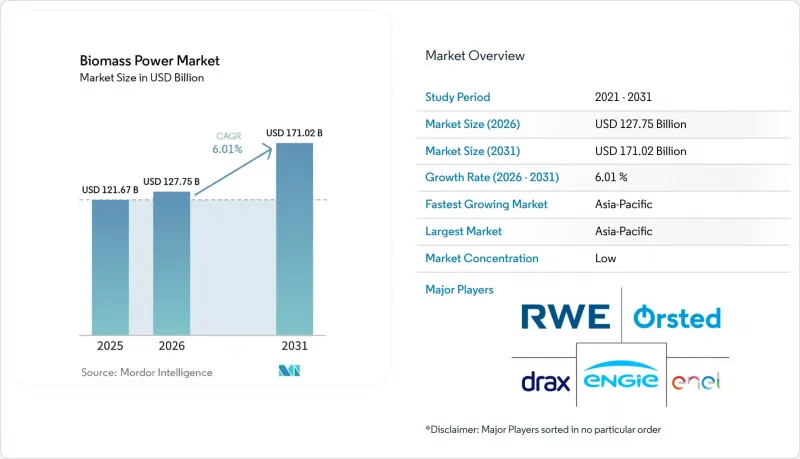
에 따르면 바이오매스 발전 시장 규모는 2025년 1,216억 7,000만 달러에서 2026년에는 1,277억 5,000만 달러로 확대하며, 2026-2031년에 CAGR 6.01%로 추이하며, 2031년에는 1,710억 2,000만 달러에 달할 것으로 예측됩니다.
세계 바이오매스 발전 시장의 동향과 인사이트
전력계통의 유연성을 실현하는 조절 가능한 재생에너지
바이오매스 발전 시장은 기상 조건에 관계없이 발전 일정을 조정할 수 있다는 장점이 있습니다. 재생에너지협회(Renewable Energy Association)가 2025년에 실시한 조사에 따르면 영국에서 바이오매스는 최대 5.5GW의 안정적인 발전 용량을 제공할 수 있는 것으로 밝혀졌습니다. 이는 영국내 가동중인 원자력 발전 용량의 90%에 해당합니다. 또한 같은 조사에서 2024년 3월까지 1년 동안 풍력발전 출력이 정격 용량의 11% 미만으로 떨어진 상태가 6시간 이상 지속된 사례가 30회 있었던 것으로 밝혀졌습니다. 바이오매스 발전 용량을 확보해 두면, 2028/29 회계연도에 영국의 용량 시장 비용을 9억 파운드 절감할 수 있을 것으로 보입니다. 오스트리아, 덴마크, 핀란드, 스웨덴, 독일은 충분한 저장 시설이나 기타 안정적인 발전 용량이 확보될 때까지 폐지될 조절 가능한 석탄 화력 발전 용량을 대체하기 위해, 유연성이 높은 바이오에너지를 각국의 탈탄소화 로드맵에 포함시키고 있습니다.
폐기물 관리 및 순환형 경제에 관한 규제
폐기물 관련 규제로 인해 도시 쓰레기, 농업·공업 폐수, 가축 분뇨는 에너지 원료로서의 가치가 높아지고 있습니다. 유럽 바이오가스 협회(European Biogas Association)의 보고에 따르면 2026년 바이오메탄에 대한 투자 약정액은 360억 유로에 달해 전년의 280억 유로를 상회했습니다. 이러한 투자 약정은 2030년까지 연간 90억 입방미터의 생산 능력을 달성하는 것을 목표로 하고 있습니다. 유기성 폐기물은 폐기물 처리의 해결책일 뿐만 아니라 연료원으로도 활용될 수 있습니다. 이를 통해 전용 에너지 작물이나 미활용 바이오매스를 사용하는 프로젝트에 비해 혐기성 소화 프로젝트의 원료 비용을 절감할 수 있습니다. 따라서 바이오매스 발전 시장에는 폐기물 정책, 지역 수거 시스템, 그리고 에너지 수요가 조화를 이룰 때 큰 기회가 창출됩니다.
원료의 지속가능성과 토지 이용 간의 경쟁
원료 인증과 토지 이용 간의 경쟁은 바이오매스 발전 시장에 여전히 뿌리 깊은 제약 요인으로 남아 있습니다. 세계자원연구소(WRI)의 조사에 따르면 에너지, 항공 연료, 산업용 화학물질 분야의 바이오매스 수요가 지속가능한 공급량을 초과할 가능성이 있는 것으로 밝혀졌습니다. 또한 전용 에너지 작물이 자연 생태계를 대체할 경우 간접적인 토지 이용 변화의 위험이 발생할 수 있다는 점도 지적되고 있습니다. 유럽연합 집행위원회(EC) 산하 공동연구센터는 유럽연합(EU)내 바이오매스의 에너지, 식량 및 재료 용도로 인한 경쟁적 수요에 대해 보고하고 있습니다. 이 센터의 보고서는 에너지 이용에 앞서 부가가치가 높은 계단식 이용을 우선시하는 거버넌스의 중요성을 강조하고 있습니다. 개발 사업자들은 장기적인 판매 계약과 자금 조달을 확보하기 위해 추적 가능한 밸류체인과 공인된 인증을 점점 더 필요로 하고 있습니다.
부문 분석
2025년, 고체 바이오매스는 바이오매스 발전 시장 점유율의 67.5%를 차지했습니다. 이러한 위상은 확립된 목질 펠릿 공급망, 전용 연소 설비, 그리고 북미 및 발트 국가에서 유럽 및 아시아로 이어지는 무역 경로가 반영된 결과입니다. 액체 바이오매스는 여전히 농업 및 산업 분야에 집중되어 있습니다. 2024년에는 브라질의 사탕수수 바가스(착즙 찌꺼기)가 해당국의 바이오에너지 발전 용량의 기반을 형성하는 데 기여했습니다. 고체 바이오매스는 연료 사양이 예측 가능한 대규모 발전소에 여전히 중요합니다. 그 장기적인 위상은 지속가능한 임업 관행, 인증, 그리고 잔여물의 확보 가능성에 좌우될 것입니다.
바이오가스는 2031년까지 연평균 성장률(CAGR) 9.3%로 성장할 것으로 예측됩니다. 바이오매스 발전 시장은 도시 쓰레기, 가축 분뇨, 농업 및 산업 폐수를 지역 원료로 활용할 수 있는 지역에서 혜택을 보고 있습니다. 유럽의 바이오메탄 생산 능력은 2026년 중반까지 연간 82억 입방미터에 달했습니다. 보고된 총량은 전년 대비 10억 입방미터 이상 증가했으며, 이는 360억 유로의 투자 약속에 힘입은 결과입니다. 이러한 원료는 에너지 전용 작물과 관련된 토지 이용 문제를 피할 수 있습니다. 이를 통해 폐기물을 원료로 하는 프로젝트는 새롭게 부상하고 있는 지속가능성 프레임워크와의 부합성을 더욱 높일 수 있습니다.
2025년에는 연소 방식이 매출 점유율의 62.3%를 차지했습니다. 직화식 보일러와 순환유동층 시스템은 공공 시설 및 산업 시설에서 여전히 확고한 선택지로 자리 잡고 있습니다. 연소 시스템은 고체 연료를 대규모로 활용할 수 있습니다. 석탄 화력 발전소의 폐쇄 일정이 진행됨에 따라 가스화 및 혼소 방식이 주목받고 있습니다. 이러한 방식은 석탄 화력 발전소에서 전환된 시설에서 터빈 및 송전망 연결 설비를 재사용할 수 있습니다. 매립 가스, 바이오매스 열병합 발전(CHP) 및 기타 전환 경로는 지역별 폐기물 흐름과 특정 에너지 수요에 대응하고 있습니다.
혐기성 소화 시장은 2031년까지 연평균 성장률(CAGR) 8.1%로 성장할 것으로 예측됩니다. 폐기물 처리 의무나 메탄 배출 규제로 인해 안정적인 원료 공급이 예상되는 지역에서는 바이오매스 발전 시장이 이 기술을 활용할 수 있습니다. 2025년에 발표된 동료 심사 연구에서는 동남아시아의 농업 잔여물에 대한 혐기성 소화 기술이 평가되었습니다. 이 연구에서는 경제성 모델을 바탕으로 인도네시아, 말레이시아, 베트남이 우선 도입 지역으로 선정되었습니다. 혐기성 소화 프로젝트는 폐기물 처리 수수료 외에도 전력 판매를 통한 수익을 얻을 수 있습니다. 이를 통해 단일 수입원에 대한 의존도가 낮아집니다. 또한 인프라 투자자들에게 프로젝트의 매력을 높이는 데에도 기여합니다.
지역별 분석
아시아태평양은 2025년 바이오매스 발전 시장 점유율의 39.2%를 차지하고 있으며, 2031년까지 연평균 성장률(CAGR) 7.9%로 성장할 것으로 예측됩니다. 중국의 바이오매스 발전 설비 용량은 47.4GW였습니다. 제공된 조사 초안에 따르면 신규 도입량은 2021년 2.3GW에서 2025년에는 200MW로 둔화되었습니다. 일본은 2025년에 50MW 규모의 발전소 2기를 가동할 예정이며, 추가 증설을 계획하고 있습니다. 인도의 바이오에너지 설비 용량은 2025 회계연도에 11.58 GW에 달했습니다. 또한 인도에서는 2025 회계연도에 약 2억 9,500만 메트릭톤의 바이오매스 잉여량이 있을 것으로 추정되어, 막대한 잠재적 자원 기반을 지원하고 있습니다.
유럽에서는 바이오매스 발전 시장을 단순한 바이오매스 발전이 아닌 CHP(열전병급), 바이오메탄 및 탄소 포집으로 재편하고 있습니다. 프랑스의 2025년 12월 DDADUE법은 유럽연합(EU)의 RED III 프레임워크 일부를 국내법에 반영했습니다. 이 법에 따라 2026년 중반부터 발전만을 목적으로 하는 특정 바이오매스 시설에 대한 공공 지원이 중단됩니다. 폴란드는 자브제 및 체스토호바에서의 CHP 전환, 그리고 폴라네츠에서의 바이오매스 물류 확대를 통해 투자를 유치하고 있습니다. 2025년 학술 리뷰에 따르면 바이오에너지는 유럽 총 에너지 공급량의 14%, 재생에너지 믹스의 60%를 차지하는 것으로 보고되었습니다. 이러한 전환에 따라 전력뿐만 아니라 열 공급, 폐기물 관리 또는 탄소 감축 효과를 초래하는 프로젝트가 우대받는 추세입니다.
북미와 남미에서는 임업 잔재물이나 사탕수수 바가스 같은 자원 기반이 바이오매스 발전 시장을 지원하고 있습니다. 제시된 조사 초안에 따르면 캐나다의 임업 잔재물을 이용한 바이오매스 발전 용량은 2,000MW를 초과합니다. 브라질은 2024년 기준으로 주로 사탕수수 바가스를 이용한 열병합 발전 방식으로 18 GW의 바이오에너지 발전 용량을 보유하고 있었습니다. 미국에서는 탄소 포집 및 저장(CCS)을 동반한 바이오에너지에 대한 관심이 높아지고 있습니다. 서아프리카에서는 코트디부아르의 46 MW 규모 ‘Biovea’ 프로젝트 제2 유닛이 2026년 7월에 상업 운전을 시작했습니다. 이 시설은 야자나무 잎자루와 껍질을 연료로 사용하며, 연간 3억 4,800만 kWh의 발전이 예상됩니다. 제시된 조사 초안에서는 모로코, 남아프리카공화국, 이집트가 향후 개발 후보지로 거론되고 있습니다.
기타 혜택:
- 엑셀 형식의 시장 예측(ME) 시트
- 3개월간의 애널리스트 지원
자주 묻는 질문
목차
제1장 서론
- 조사 전제조건과 시장 정의
- 조사 범위
제2장 조사 방법
제3장 개요
제4장 시장 구도
- 시장 개요
- 시장 성장 촉진요인
- 시장 성장 억제요인
- 공급망 분석
- Porter's Five Forces 분석
- 기술 동향
- 규제 상황
- 투자 분석
제5장 시장 규모와 성장 예측
- 원료별
- 기술별
- 용량별
- 용도별
- 지역별
- 북미
- 미국
- 캐나다
- 멕시코
- 유럽
- 독일
- 프랑스
- 이탈리아
- 스페인
- 영국
- 폴란드
- 러시아
- 기타 유럽 국가
- 아시아태평양
- 중국
- 인도
- 일본
- 한국
- 호주
- 인도네시아
- 베트남
- 태국
- 기타 아시아태평양 국가
- 남미
- 브라질
- 아르헨티나
- 칠레
- 기타 남미 국가
- 중동 및 아프리카
- 사우디아라비아
- 아랍에미리트
- 이집트
- 남아프리카공화국
- 모로코
- 기타 중동 및 아프리카 국가
- 북미
제6장 경쟁 구도
- 시장 집중도
- 전략적 동향
- 시장 점유율 분석
- 기업 개요
- Drax Group plc
- Orsted A/S
- ENGIE SA
- Enel SpA
- RWE AG
- EDF
- Vattenfall AB
- E.ON SE
- Veolia Environnement S.A.
- SUEZ
- Ameresco, Inc.
- Babcock & Wilcox Enterprises, Inc.
- Mitsubishi Heavy Industries, Ltd.
- Valmet Oyj
- ANDRITZ AG
- General Electric Company
- Siemens Energy AG
- Hitachi Zosen Corporation
- John Wood Group PLC
- Thermax Limited
- Sumitomo Heavy Industries, Ltd.
제7장 시장 기회와 향후 전망
KSA 26.10.30According to Mordor Intelligence, the biomass power market size is expected to grow from USD 121.67 billion in 2025 to USD 127.75 billion in 2026 and is forecast to reach USD 171.02 billion by 2031 at 6.01% CAGR over 2026-2031.
Global Biomass Power Market Trends and Insights
Dispatchable Renewable Power for Grid Flexibility
The Biomass power market benefits from generation that can be scheduled regardless of weather conditions. A 2025 study for the Renewable Energy Association found that biomass could provide up to 5.5 GW of firm capacity in Great Britain. This was equivalent to 90% of the country's operational nuclear capacity. The study also found that wind output fell below 11% of rated capacity for periods of 6 hours or longer on 30 occasions in the year to March 2024. Keeping biomass capacity available could reduce the United Kingdom Capacity Market costs by GBP 900 million in 2028/29. Austria, Denmark, Finland, Sweden, and Germany have included flexible bioenergy in national decarbonization pathways to replace retiring dispatchable coal capacity before enough storage and other firm capacity is available.
Waste Management and Circular Economy Mandates
Waste rules are making municipal waste, agro-industrial effluent, and livestock manure more valuable as energy feedstocks. The European Biogas Association reported EUR 36 billion in biomethane investment commitments in 2026, compared with EUR 28 billion in the prior year. These commitments target 9 billion cubic meters of annual production capacity by 2030. Organic waste can produce both a disposal solution and a fuel source. This can reduce feedstock costs for anaerobic digestion projects compared with projects using dedicated energy crops or virgin biomass. The Biomass power market, therefore, has an opportunity where waste policy, local collection systems, and energy demand are aligned.
Feedstock Sustainability and Competing Land Uses
Feedstock certification and competition for land remain persistent constraints for the Biomass power market. The World Resources Institute found that biomass demand across energy, aviation fuel, and industrial chemicals could exceed sustainable supply. It also found that dedicated energy crops can create indirect land-use-change risk when they displace natural ecosystems. The European Commission's Joint Research Centre documented competing demands from energy, food, and material uses of biomass in the European Union. Its report emphasized governance that gives priority to higher-value cascading uses before energy use. Developers increasingly need traceable supply chains and recognized certification to secure long-term offtake and financing.
Other drivers and restraints analyzed in the detailed report include:
- Industrial CHP Decarbonization
- Coal Plant Repurposing Through Biomass Co-Firing
- Solar, Wind, and Storage Cost Competition
For complete list of drivers and restraints, kindly check the Table Of Contents.
Segment Analysis
Solid biomass held 67.5% of Biomass power market share in 2025. Its position reflects established wood pellet supply chains, dedicated combustion assets, and trading links from North America and the Baltics to Europe and Asia. Liquid biomass remains concentrated in agro-industrial settings. Brazil's sugarcane bagasse contributed to the country's bioenergy capacity base in 2024. Solid biomass remains important for large plants with predictable fuel specifications. Its long-term position will depend on sustainable forestry practices, certification, and the availability of residues.
Biogas is forecast to grow at a 9.3% CAGR through 2031. The Biomass power market benefits where municipal waste, livestock manure, and agro-industrial effluent can be used as local feedstocks. European biomethane capacity reached 8.2 billion cubic meters per year by mid-2026. The reported total was more than 1 billion cubic meters higher than a year earlier, supported by EUR 36 billion in investment commitments. These feedstocks can avoid the land-use concerns associated with dedicated energy crops. This gives waste-based projects a stronger fit with emerging sustainability frameworks.
Combustion held 62.3% revenue share in 2025. Direct-fired boilers and circulating fluidized bed systems remain established options for utility and industrial facilities. Combustion systems can use solid fuels at large scale. Gasification and co-firing are receiving attention as coal retirement schedules advance. They can reuse turbines and grid interconnections at converted coal locations. Landfill gas, biomass CHP, and other conversion routes serve localized waste streams and specific energy needs.
Anaerobic digestion is forecast to grow at an 8.1% CAGR through 2031. The Biomass power market can use this technology where waste disposal obligations and methane control policies create steady feedstock availability. A 2025 peer-reviewed study assessed agricultural-residue anaerobic digestion in Southeast Asia. It identified Indonesia, Malaysia, and Vietnam as priority locations under its modeled economics. Anaerobic digestion projects can earn waste tipping fees as well as revenue from electricity sales. This reduces reliance on a single revenue source. It can also make the projects more attractive to infrastructure investors.
Complete Report Scope:
- By Feedstock
- Solid Biomass
- Biogas
- Liquid Biomass
- By Technology
- Combustion
- Gasification
- Anaerobic Digestion
- Co-firing
- Combined Heat and Power (CHP)
- Landfill Gas-to-Power
- Other Technologies
- By Capacity
- Below 1 MW
- 1-10 MW
- 10-50 MW
- 50-100 MW
- Above 100 MW
- By Application
- Residential
- Commercial
- Industrial
- Utility-Scale Power Generation
- By Geography
- North America
- United States
- Canada
- Mexico
- Europe
- Germany
- France
- Italy
- Spain
- United Kingdom
- Poland
- Russia
- Rest of Europe
- Asia-Pacific
- China
- India
- Japan
- South Korea
- Australia
- Indonesia
- Vietnam
- Thailand
- Rest of Asia-Pacific
- South America
- Brazil
- Argentina
- Chile
- Rest of South America
- Middle East and Africa
- Saudi Arabia
- United Arab Emirates
- Egypt
- South Africa
- Morocco
- Rest of Middle East and Africa
- North America
Geography Analysis
Asia-Pacific held 39.2% of Biomass power market share in 2025 and is forecast to grow at a 7.9% CAGR through 2031. China's installed biopower capacity was 47.4 GW. New additions slowed to 200 MW in 2025 from 2.3 GW in 2021, according to the supplied research draft. Japan commissioned 2 plants of 50 MW in 2025 and has additional capacity planned. India's installed bioenergy capacity reached 11.58 GW in fiscal 2025. India also had an estimated 295 million metric tons of biomass surplus in fiscal 2025, supporting a large potential resource base.
Europe is restructuring its Biomass power market toward CHP, biomethane, and carbon capture rather than standalone biomass electricity. France's December 2025 DDADUE legislation transposed parts of the European Union RED III framework. The legislation withdraws public support for certain electricity-only biomass installations from mid-2026. Poland is drawing investment through CHP conversions in Zabrze and Czestochowa and through biomass logistics expansion at Polaniec. A 2025 academic review reported that bioenergy represented 14% of Europe's total energy supply and 60% of its renewable energy mix. The shift favors projects that deliver heat, waste management, or carbon benefits alongside power.
North and South America give the Biomass power market resource bases in forest residues and sugarcane bagasse. Canada has more than 2,000 MW of forest-residue biomass power, according to the supplied research draft. Brazil had 18 GW of bioenergy capacity, mainly from sugarcane bagasse cogeneration, in 2024. Interest in bioenergy with carbon capture and storage is growing in the United States. In West Africa, Unit 2 of Cote d'Ivoire's 46 MW Biovea project began commercial operation in July 2026. The facility uses palm petioles and nutshells and is expected to generate 348 million kWh annually. Morocco, South Africa, and Egypt are identified in the supplied research draft as potential next locations for development.
- Drax Group plc
- Orsted A/S
- ENGIE SA
- Enel SpA
- RWE AG
- EDF
- Vattenfall AB
- E.ON SE
- Veolia Environnement S.A.
- SUEZ
- Ameresco, Inc.
- Babcock & Wilcox Enterprises, Inc.
- Mitsubishi Heavy Industries, Ltd.
- Valmet Oyj
- ANDRITZ AG
- General Electric Company
- Siemens Energy AG
- Hitachi Zosen Corporation
- John Wood Group PLC
- Thermax Limited
- Sumitomo Heavy Industries, Ltd.
Additional Benefits:
- The market estimate (ME) sheet in Excel format
- 3 months of analyst support
TABLE OF CONTENTS
1 INTRODUCTION
- 1.1 Study Assumptions and Market Definition
- 1.2 Scope of the Study
2 RESEARCH METHODOLOGY
3 EXECUTIVE SUMMARY
4 MARKET LANDSCAPE
- 4.1 Market Overview
- 4.2 Market Drivers
- 4.2.1 Dispatchable Renewable Power for Grid Flexibility
- 4.2.2 Waste-Management and Circular-Economy Mandates
- 4.2.3 Industrial CHP Decarbonization
- 4.2.4 Renewable Portfolio Standards and Net-Zero Incentives
- 4.2.5 Coal-Plant Repurposing Through Biomass Co-Firing
- 4.2.6 Low-Value Residue Monetization in Agricultural Regions
- 4.3 Market Restraints
- 4.3.1 Feedstock Sustainability and Competing Land Uses
- 4.3.2 Seasonal, Distributed Feedstock Logistics
- 4.3.3 Solar, Wind and Storage Cost Competition
- 4.3.4 Policy and Carbon-Credit Dependence
- 4.4 Supply-Chain Analysis
- 4.5 Porter's Five Forces Analysis
- 4.5.1 Bargaining Power of Suppliers
- 4.5.2 Bargaining Power of Buyers
- 4.5.3 Threat of New Entrants
- 4.5.4 Threat of Substitutes
- 4.5.5 Competitive Rivalry
- 4.6 Technology Outlook
- 4.7 Regulatory Landscape
- 4.8 Investment Analysis
5 MARKET SIZE AND GROWTH FORECASTS
- 5.1 By Feedstock
- 5.1.1 Solid Biomass
- 5.1.2 Biogas
- 5.1.3 Liquid Biomass
- 5.2 By Technology
- 5.2.1 Combustion
- 5.2.2 Gasification
- 5.2.3 Anaerobic Digestion
- 5.2.4 Co-firing
- 5.2.5 Combined Heat and Power (CHP)
- 5.2.6 Landfill Gas-to-Power
- 5.2.7 Other Technologies
- 5.3 By Capacity
- 5.3.1 Below 1 MW
- 5.3.2 1-10 MW
- 5.3.3 10-50 MW
- 5.3.4 50-100 MW
- 5.3.5 Above 100 MW
- 5.4 By Application
- 5.4.1 Residential
- 5.4.2 Commercial
- 5.4.3 Industrial
- 5.4.4 Utility-Scale Power Generation
- 5.5 By Geography
- 5.5.1 North America
- 5.5.1.1 United States
- 5.5.1.2 Canada
- 5.5.1.3 Mexico
- 5.5.2 Europe
- 5.5.2.1 Germany
- 5.5.2.2 France
- 5.5.2.3 Italy
- 5.5.2.4 Spain
- 5.5.2.5 United Kingdom
- 5.5.2.6 Poland
- 5.5.2.7 Russia
- 5.5.2.8 Rest of Europe
- 5.5.3 Asia-Pacific
- 5.5.3.1 China
- 5.5.3.2 India
- 5.5.3.3 Japan
- 5.5.3.4 South Korea
- 5.5.3.5 Australia
- 5.5.3.6 Indonesia
- 5.5.3.7 Vietnam
- 5.5.3.8 Thailand
- 5.5.3.9 Rest of Asia-Pacific
- 5.5.4 South America
- 5.5.4.1 Brazil
- 5.5.4.2 Argentina
- 5.5.4.3 Chile
- 5.5.4.4 Rest of South America
- 5.5.5 Middle East and Africa
- 5.5.5.1 Saudi Arabia
- 5.5.5.2 United Arab Emirates
- 5.5.5.3 Egypt
- 5.5.5.4 South Africa
- 5.5.5.5 Morocco
- 5.5.5.6 Rest of Middle East and Africa
- 5.5.1 North America
6 COMPETITIVE LANDSCAPE
- 6.1 Market Concentration
- 6.2 Strategic Moves
- 6.3 Market Share Analysis
- 6.4 Company Profiles (includes Global Level Overview, Market Level Overview, Core Segments, Financials as available, Strategic Information, Products and Services, Recent Developments)
- 6.4.1 Drax Group plc
- 6.4.2 Orsted A/S
- 6.4.3 ENGIE SA
- 6.4.4 Enel SpA
- 6.4.5 RWE AG
- 6.4.6 EDF
- 6.4.7 Vattenfall AB
- 6.4.8 E.ON SE
- 6.4.9 Veolia Environnement S.A.
- 6.4.10 SUEZ
- 6.4.11 Ameresco, Inc.
- 6.4.12 Babcock & Wilcox Enterprises, Inc.
- 6.4.13 Mitsubishi Heavy Industries, Ltd.
- 6.4.14 Valmet Oyj
- 6.4.15 ANDRITZ AG
- 6.4.16 General Electric Company
- 6.4.17 Siemens Energy AG
- 6.4.18 Hitachi Zosen Corporation
- 6.4.19 John Wood Group PLC
- 6.4.20 Thermax Limited
- 6.4.21 Sumitomo Heavy Industries, Ltd.
7 MARKET OPPORTUNITIES AND FUTURE OUTLOOK
- 7.1 White-Space and Unmet-Need Assessment


