

|
시장보고서
상품코드
2157126
풍력 터빈 브레이크 : 시장 점유율 분석, 업계 동향과 통계, 성장 예측(2026-2031년)Wind Turbine Brakes - Market Share Analysis, Industry Trends & Statistics, Growth Forecasts (2026 - 2031) |
||||||
 Mordor Intelligence
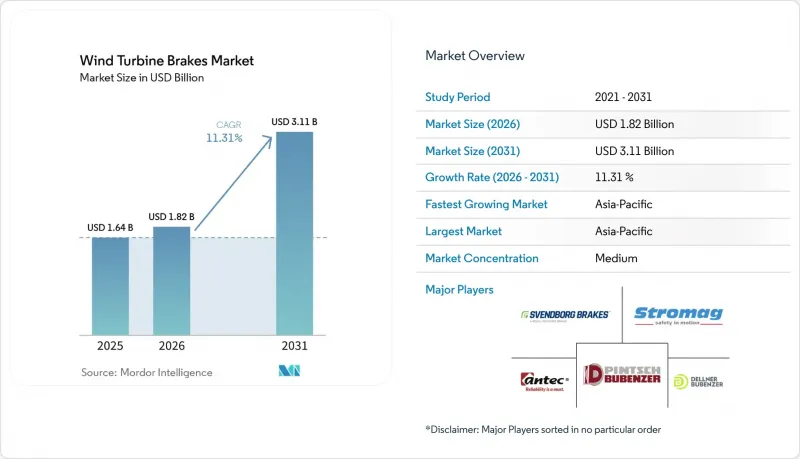
에 따르면 풍력 터빈 용브레이크 시장 규모는 2025년에 16억 4,000만 달러로 평가되며, 2026년 18억 2,000만 달러에서 2031년까지 31억 1,000만 달러에 달할 것으로 예측되고 있으며, 예측 기간(2026-2031년)에 CAGR은 11.31%에 달할 전망입니다.
전 세계 풍력 터빈용 브레이크 시장의 동향 및 인사이트
전 세계 풍력발전소의 설비 용량 확대
2025년 풍력발전의 신규 설치량은 159기가와트에 달해 사상 최고 수준을 기록했으며, 이에 따라 전 세계 풍력발전 설비 용량은 2,500기가와트를 돌파했습니다. 같은 해 전 세계에서 추가된 800기가와트의 재생에너지 설비 용량 중 풍력발전이 20%를 차지했습니다. 풍력 터빈 브레이크 시장은 이러한 설비 확충의 혜택을 받고 있습니다. 이는 새로운 터빈 1기당 주 요(yaw) 브레이크 회로와 로터 브레이크 회로가 필요하기 때문입니다. 또한 해상 풍력발전 플랫폼에서도 개별 피치 구동 장치용 브레이크 어셈블리가 추가되고 있습니다. 2025년에 설치된 풍력 터빈의 수는 57개국에서 28,395기에 달했으며, 이로 인해 기존 풍력 시장을 넘어 서비스 및 예비 부품 수요가 확대되었습니다. 풍력 터빈용 브레이크 시장은 신규 설치에 따른 장비 공급과 가동 개시 후 필요한 현지 유지보수 체계 모두로부터 혜택을 받고 있습니다.
해상 풍력 터빈의 대형화와 제동 하중의 증가
해상 풍력 터빈은 초기 프로젝트 설계를 특징지었던 10MW-15MW 범위를 넘어서는 추세입니다. MingYang사는 2025년에 ‘MySE 18.X-20MW’ 터빈을 설치했으며, 동방전기(Dongfang Electric)도 같은 해 26MW 프로토타입을 시험했습니다. 로터 직경이 250미터를 초과하면 축적되는 운동 에너지가 증가하여 제동 부품에 가해지는 부하도 커집니다. 이러한 변화에 대응하기 위해서는 더 높은 부하, 열 사이클 및 비상 정지 요건을 충족할 수 있는 제동 시스템이 필요합니다. 해상 프로젝트의 풍력 터빈용 브레이크 시장은 해상에서의 접근, 교체 및 고장시 비용이 더 많이 들기 때문에 기술적 장벽이 높습니다. 해상 풍력발전의 파이프라인도 이러한 추세를 지원하고 있으며, 2026년에는 24.5GW의 해상 풍력발전 용량이 가동을 시작할 것으로 예상되고, 22.3GW에 대해 최종 투자 결정(FID)이 내려질 것으로 예측됩니다.
설계된 브레이크 시스템의 높은 초기 비용
유틸리티급 터빈용 브레이크 어셈블리에는 제품 설계, 시험, 문서화 및 OEM 인증이 필요합니다. 이러한 요건들은 구매 장벽이 되며, 개발자들은 수명 주기 가치보다 초기 비용을 더 중시하는 경향이 있습니다. IEC 61400-1에서는 송전망 손실 시의 비상 정지 작동 및 해상 용도를 위한 기계식 브레이크의 이중화를 포함한 브레이크 시스템의 설계 요건이 규정되어 있습니다. 현지 조달 규정 및 수입 관세로 인해 남아시아, 동남아시아, 중동, 사하라 이남 아프리카 이외의 지역에서 공급되는 첨단 시스템의 비용이 증가할 가능성이 있습니다. 안전 기준에 의해 의무화되어 있으므로 사업자는 브레이크 시스템을 생략할 수 없습니다. 따라서 풍력 터빈용 브레이크 시장에서는 해당 제품이 장기적인 신뢰성이나 운영상의 위험을 초래하더라도 수요가 저가 제품으로 이동할 가능성이 있습니다.
부문 분석
2025년에는 유압 브레이크가 매출의 42.5%를 차지하며, 브레이크 유형 중 가장 큰 점유율을 기록했습니다. 이 점유율은 전 세계에 설치된 풍력발전 설비에서 요 제어 및 로터 용도로 확고히 자리 잡은 사용 실태를 반영합니다. 유압 유닛은 대형 해상 로터 시스템을 포함한 고부하 구성에 필요한 제동 토크를 공급할 수 있습니다. 또한 그 사용은 많은 나셀 설계에 이미 갖춰진 유압 인프라와도 호환됩니다. 유압 시스템에 대한 수요는 기존 터빈의 교체 수요에 의해 지속적으로 지원되고 있습니다. 기계식 브레이크는 유지보수 작업을 위한 로터 잠금 기능을 계속해서 제공하고 있습니다. 공기역학적 브레이크는 가변 속도·피치 제어식 터빈에서 피치-투-페더(pitch-to-feather) 조작을 주요 정지 기능으로 활용하고 있습니다. 유압식 또는 기계식 시스템은 해당 IEC 설계 요건에 따라 독립적인 백업 기능을 제공합니다. 중국 GB/T 47557-2026 표준에 규정된 공압 시스템을 포함한 기타 브레이크 유형은 보다 전문적인 용도에 대응하고 있습니다.
전기식 브레이크 시장 규모는 2026-2031년까지 연평균 성장률(CAGR) 12.7%로 확대될 것으로 예측됩니다. 이러한 성장은 신형 풍력 터빈에서 유압식 피치 실린더에서 영구자석식 피치 모터로의 전환에 따른 것입니다. 스프링 작동식 전자기 브레이크는 전원 공급이 중단되었을 때 작동하며, 디지털 모니터링 시스템과 연동되어 기능합니다. 풍력 터빈용 브레이크 업계에서는 전기식 작동으로 피치 구동 장치의 설계를 단순화할 수 있는 경우, 이러한 시스템이 점차 채택되고 있습니다. 중국의 GB/T 47557-2026은 공압식 및 전기식 제동 제어를 규정하고 있으며, 국내 요건을 IEC 규격에 부합시키고 있습니다. 이러한 체계는 중국내 전기 작동식 제동 장치의 사용을 촉진하고 있습니다. KTR사는 전기 기계식 EMB-STOP 시리즈와 유압식 KTR-STOP 시리즈를 모두 제공하고 있습니다. 이 회사가 두 가지 유형의 제품을 모두 출시하고 있다는 사실은 기술 전환기에도 유압식과 전기식 제동 시스템이 병행하여 작동할 수 있음을 보여줍니다.
지역별 분석
아시아태평양은 2025년에 매출의 31.2%를 차지할 것으로 예상되며, 2031년까지 연평균 성장률(CAGR) 13.8%로 성장할 것으로 전망됩니다. 이에 따라 이 지역은 본 예측안에서 풍력 터빈용 브레이크 시장 규모가 가장 크고, 지역별 성장률도 가장 높은 것으로 나타납니다. 중국에서는 2025년에 120.5GW의 풍력발전 설비가 도입되어(이 중 육상 풍력발전은 110 GW 이상), 누적 설비 용량은 640.5GW에 달했습니다. 인도에서는 2025년에 6.3GW가 추가되어 전년 대비 86% 증가했으며, 도입 설비 용량은 50 GW를 넘어섰습니다. 인도의 설비 용량은 2026년에 60 GW를 넘어설 것으로 예상됩니다. 중국의 GB/T 47557-2026 규격은 2026년 8월에 시행되어 터빈 제동 시스템의 적합 기준이 상향 조정되었습니다. 국내 제조사들은 2025년까지 중국 풍력발전용 브레이크 공급에서 65% 이상의 현지 조달률을 달성했습니다. 베트남은 2025년에 누적 풍력발전 용량 7.4GW에 도달했으며, 한국, 인도네시아, 호주도 중국과 인도에 이어 상당한 규모로 시장을 확대했습니다.
유럽은 대규모로 가동중인 풍력발전 설비군에 더해, 첨단인 해상 풍력 부문과 확대되는 리파워링 주기를 겸비하고 있으며, 수익 면에서 중요한 위치를 차지하고 있습니다. 독일은 2025년에 육상 및 해상 발전 용량을 5.7GW 증가시켰으며, 유럽연합(EU)은 두 분야를 합쳐 14GW를 가동했습니다. 영국에서는 2025년에 2,500기 이상의 해상 풍력 터빈이 가동 중이며, 해양 환경에 적합한 시스템에 대한 수요를 지원하고 있습니다. EU의 풍력발전량은 2025년 전력 공급에서 차지하는 비중 17%에서 2030년에는 25%로 상승할 것으로 예측됩니다. IEC 61400-1:2019+AMD1:2025 및 DIN EN 81-44는 유럽내 조달 과정에서 온도 정격, 재료 인증 및 모니터링 요건에 영향을 미치고 있습니다. 북미에서도 미국 연방 정부의 인센티브와 캐나다의 재생에너지 목표를 통해 수요가 지원되고 있습니다. 미국에서는 대규모 풍력발전소가 상태 모니터링 플랫폼을 도입하고 있으며, 이는 디지털로 연결된 브레이크 시스템의 활용을 촉진하고 있습니다.
남미, 중동 및 아프리카는 풍력 터빈 브레이크 시장에서 아직 발전 단계에 있는 지역입니다. 브라질은 풍력 자원과 정부의 입찰 프로그램을 통해 남미의 수요를 지원하고 있습니다. 아르헨티나와 칠레는 재생에너지 도입 의무를 통해 추가적인 수요를 창출하고 있습니다. 사우디아라비아와 아랍에미리트는 국가 에너지 다각화 프로그램의 일환으로 유틸리티 규모의 풍력발전 프로젝트를 가동하고 있습니다. 모로코는 1.4GW를 초과하는 풍력발전 설비 용량을 보유하고 있으며, 공급망 개발에서 지역내 기준점 역할을 수행하고 있습니다. 중동 및 아프리카에서는 대규모 프로젝트와 경쟁력 있는 에너지 비용에 힘입어 2025년에 다시 한번 설치량 신기록을 경신했습니다. 이 지역에서는 현지 서비스 네트워크를 바탕으로 한 비용 경쟁력 있는 제품이 선호되고 있습니다. 현지화 요건으로 인해 예측 기간 중 전문 공급업체들이 해당 지역내 제조 및 서비스와 관련된 제휴 관계를 구축할 가능성이 있습니다.
기타 혜택:
- 엑셀 형식의 시장 예측(ME) 시트
- 3개월간의 애널리스트 지원
자주 묻는 질문
목차
제1장 서론
- 조사 전제조건과 시장 정의
- 조사 범위
제2장 조사 방법
제3장 개요
제4장 시장 구도
- 시장 개요
- 시장 성장 촉진요인
- 시장 성장 억제요인
- 공급망 분석
- Porter's Five Forces 분석
- 기술 동향
- 규제 상황
- 투자 분석
제5장 시장 규모와 성장 예측
- 브레이크 유형별
- 용도별
- 지역별
- 북미
- 미국
- 캐나다
- 멕시코
- 유럽
- 독일
- 프랑스
- 이탈리아
- 스페인
- 영국
- 폴란드
- 러시아
- 기타 유럽 국가
- 아시아태평양
- 중국
- 인도
- 일본
- 한국
- 호주
- 인도네시아
- 베트남
- 태국
- 기타 아시아태평양 국가
- 남미
- 브라질
- 아르헨티나
- 칠레
- 기타 남미 국가
- 중동 및 아프리카
- 사우디아라비아
- 아랍에미리트
- 이집트
- 남아프리카공화국
- 모로코
- 기타 중동 및 아프리카 국가
- 북미
제6장 경쟁 구도
- 시장 집중도
- 전략적 동향
- 시장 점유율 분석
- 기업 개요
- Altra Industrial Motion Corp.
- Brembo S.p.A.
- Chr. Mayr GmbH+Co. KG
- Coremo Ocmea S.p.A.
- Dellner Brakes AB
- Friction Technology Limited
- Industrial Clutch Parts Ltd.
- Jiangxi Huawu Brake Co., Ltd.
- KTR Systems GmbH
- SIBRE-Siegerland Bremsen GmbH
- SIME Brakes S.r.l.
- Stromag GmbH
- Svendborg Brakes ApS
- Trebu Technology B.V.
- Twiflex Limited
제7장 시장 기회와 향후 전망
KSA 26.10.30According to Mordor Intelligence, the wind turbine brakes market size was valued at USD 1.64 billion in 2025 and estimated to grow from USD 1.82 billion in 2026 to reach USD 3.11 billion by 2031, at a CAGR of 11.31% during the forecast period (2026-2031).
Global Wind Turbine Brakes Market Trends and Insights
Global Wind-Farm Capacity Expansion
Wind additions reached 159 GW in 2025, a record level that lifted global installed wind capacity past 2,500 GW. Wind accounted for 20% of the 800 GW of renewable capacity added worldwide during that year. The wind turbine brakes market benefits from this buildout because each new turbine needs primary yaw and rotor brake circuits. Offshore platforms also add braking assemblies for individual pitch drives. The number of turbines installed in 2025 reached 28,395 across 57 countries, which broadened the service and spare-parts requirements beyond established wind markets. The wind turbine brakes market gains from both the equipment supplied with new installations and the local maintenance capacity needed after commissioning.
Offshore Turbine Scale-Up and Higher Braking Loads
Offshore turbines have moved beyond the 10 MW to 15 MW range that shaped earlier project designs. MingYang installed its MySE 18.X-20 MW turbine in 2025, while Dongfang Electric tested a 26 MW prototype during the same year. Rotor diameters above 250 meters increase stored kinetic energy and place heavier demands on braking components. This change requires brake systems that can meet higher loads, thermal cycles, and emergency-stop requirements. The wind turbine brakes market has a higher technical threshold in offshore projects because access, replacement, and failure costs are more demanding at sea. The offshore pipeline also supports this direction, with 24.5 GW of offshore capacity expected to enter operation in 2026 and final investment decisions forecast for 22.3 GW.
High Upfront Cost of Engineered Brake Systems
Utility-scale turbine brake assemblies require product design, testing, documentation, and original-equipment qualification. These requirements create a purchasing barrier where developers place greater weight on initial cost than lifecycle value. IEC 61400-1 requires braking-system design provisions that include emergency-stop operation during grid-loss events and mechanical braking redundancy for offshore applications. Local-content rules and import duties can increase the cost of advanced systems supplied from outside South and Southeast Asia, the Middle East, and Sub-Saharan Africa. Operators cannot omit braking systems because safety codes require them. The wind turbine brakes market may therefore see demand shift toward lower-cost products, even when those products create longer-term reliability and operating risks.
Other drivers and restraints analyzed in the detailed report include:
- Aging Turbine Fleet Replacement and Retrofit Demand
- Smart Brake Monitoring for Predictive Maintenance
- Volatile Steel, Friction-Material and Hydraulic-Component Costs
For complete list of drivers and restraints, kindly check the Table Of Contents.
Segment Analysis
Hydraulic brakes accounted for 42.5% of revenue in 2025, giving them the largest position among brake types. This share reflects established use in yaw and rotor applications across the global installed fleet. Hydraulic units can deliver the braking torque required for high-load configurations, including large offshore rotor systems. Their use also fits the hydraulic infrastructure already present in many nacelle designs. Hydraulic-system demand remains supported by replacement needs from existing turbines. Mechanical brakes continue to provide rotor-lock capability for maintenance access. Aerodynamic brakes use pitch-to-feather operation as a primary stopping function in variable-speed, pitch-controlled turbines. Hydraulic or mechanical systems provide independent backup under applicable IEC design requirements. Other brake types, including pneumatic systems addressed by China's GB/T 47557-2026 standard, serve more specialized applications.
Electric brakes are forecast to expand at 12.7% CAGR during 2026-2031. Their growth follows the shift from hydraulic pitch cylinders to permanent-magnet pitch motors in newer turbines. Spring-applied electromagnetic brakes activate when power is lost and work with digital monitoring systems. The wind turbine brakes industry is adopting these systems where electrical actuation can simplify pitch-drive design. China's GB/T 47557-2026 covers pneumatic and electrical braking control and aligns domestic requirements with IEC standards. This framework supports the use of electrically actuated braking equipment in China. KTR offers both the EMB-STOP electromechanical line and the hydraulic KTR-STOP line. Its position across both types shows that hydraulic and electric braking systems can operate alongside one another during the technology transition.
Complete Report Scope:
- By Brake Type
- Mechanical Brakes
- Hydraulic Brakes
- Electric Brakes
- Aerodynamic Brakes
- Other Brake Types
- By Application
- Onshore Wind Turbines
- Offshore Wind Turbines
- By Geography
- North America
- United States
- Canada
- Mexico
- Europe
- Germany
- France
- Italy
- Spain
- United Kingdom
- Poland
- Russia
- Rest of Europe
- Asia-Pacific
- China
- India
- Japan
- South Korea
- Australia
- Indonesia
- Vietnam
- Thailand
- Rest of Asia-Pacific
- South America
- Brazil
- Argentina
- Chile
- Rest of South America
- Middle East and Africa
- Saudi Arabia
- United Arab Emirates
- Egypt
- South Africa
- Morocco
- Rest of Middle East and Africa
- North America
Geography Analysis
Asia-Pacific held 31.2% of revenue in 2025 and is forecast to grow at 13.8% CAGR through 2031. This gives the region the largest wind turbine brakes market size and the fastest geographic growth rate in the draft forecast. China installed 120.5 GW of wind capacity in 2025, including more than 110 GW onshore, and reached 640.5 GW of cumulative capacity. India added 6.3 GW during 2025, an 86% increase from the prior year, while installed capacity exceeded 50 GW. India's capacity is expected to exceed 60 GW in 2026. China's GB/T 47557-2026 standard took effect in August 2026 and raises the compliance baseline for turbine braking systems. Domestic manufacturers had achieved localization above 65% in the Chinese wind-brake supply by 2025. Vietnam reached 7.4 GW of cumulative wind capacity in 2025, while South Korea, Indonesia, and Australia added depth beyond China and India.
Europe has a significant revenue position because it combines a large operational fleet with an advanced offshore sector and a growing repowering cycle. Germany added 5.7 GW of onshore and offshore capacity in 2025, while the European Union commissioned 14 GW across both applications. The United Kingdom operated more than 2,500 offshore turbines in 2025, supporting demand for systems suited to marine conditions. EU wind generation is projected to rise from 17% of electricity in 2025 to 25% in 2030. IEC 61400-1:2019+AMD1:2025 and DIN EN 81-44 influence temperature ratings, material certification, and monitoring requirements in European procurement. North America also supports demand through United States federal incentives and Canadian renewable targets. Larger wind farms in the United States have adopted condition-monitoring platforms, which supports the use of digitally connected brake systems.
South America, the Middle East, and Africa are earlier-stage areas within the wind turbine brakes market. Brazil anchors South American demand through its wind resources and government auction programs. Argentina and Chile contribute additional volume through renewable-energy mandates. Saudi Arabia and the United Arab Emirates are commissioning utility-scale wind projects under national diversification programs. Morocco had more than 1.4 GW of installed wind capacity and serves as a regional reference point for supply-chain development. Africa and the Middle East recorded another installation record in 2025, supported by large projects and competitive energy costs. These areas favor cost-competitive products backed by local service networks. Localization requirements may lead specialist suppliers to develop regional manufacturing or service partnerships during the forecast period.
- Altra Industrial Motion Corp.
- Brembo S.p.A.
- Chr. Mayr GmbH + Co. KG
- Coremo Ocmea S.p.A.
- Dellner Brakes AB
- Friction Technology Limited
- Industrial Clutch Parts Ltd.
- Jiangxi Huawu Brake Co., Ltd.
- KTR Systems GmbH
- SIBRE - Siegerland Bremsen GmbH
- SIME Brakes S.r.l.
- Stromag GmbH
- Svendborg Brakes ApS
- Trebu Technology B.V.
- Twiflex Limited
Additional Benefits:
- The market estimate (ME) sheet in Excel format
- 3 months of analyst support
TABLE OF CONTENTS
1 INTRODUCTION
- 1.1 Study Assumptions and Market Definition
- 1.2 Scope of the Study
2 RESEARCH METHODOLOGY
3 EXECUTIVE SUMMARY
4 MARKET LANDSCAPE
- 4.1 Market Overview
- 4.2 Market Drivers
- 4.2.1 Global Wind-Farm Capacity Expansion
- 4.2.2 Offshore Turbine Scale-Up and Higher Braking Loads
- 4.2.3 Aging Turbine Fleet Replacement and Retrofit Demand
- 4.2.4 Smart Brake Monitoring for Predictive Maintenance
- 4.2.5 Corrosion-Resistant Braking Requirements in Harsh Marine Environments
- 4.2.6 Localized Aftermarket Parts Availability in Emerging Wind Markets
- 4.3 Market Restraints
- 4.3.1 High Upfront Cost of Engineered Brake Systems
- 4.3.2 Volatile Steel, Friction-Material and Hydraulic-Component Costs
- 4.3.3 Offshore Access and Maintenance Logistics
- 4.3.4 Limited Field Data Interoperability Across OEM Platforms
- 4.4 Supply-Chain Analysis
- 4.5 Porter's Five Forces Analysis
- 4.5.1 Bargaining Power of Suppliers
- 4.5.2 Bargaining Power of Buyers
- 4.5.3 Threat of New Entrants
- 4.5.4 Threat of Substitutes
- 4.5.5 Competitive Rivalry
- 4.6 Technology Outlook
- 4.7 Regulatory Landscape
- 4.8 Investment Analysis
5 MARKET SIZE AND GROWTH FORECASTS
- 5.1 By Brake Type
- 5.1.1 Mechanical Brakes
- 5.1.2 Hydraulic Brakes
- 5.1.3 Electric Brakes
- 5.1.4 Aerodynamic Brakes
- 5.1.5 Other Brake Types
- 5.2 By Application
- 5.2.1 Onshore Wind Turbines
- 5.2.2 Offshore Wind Turbines
- 5.3 By Geography
- 5.3.1 North America
- 5.3.1.1 United States
- 5.3.1.2 Canada
- 5.3.1.3 Mexico
- 5.3.2 Europe
- 5.3.2.1 Germany
- 5.3.2.2 France
- 5.3.2.3 Italy
- 5.3.2.4 Spain
- 5.3.2.5 United Kingdom
- 5.3.2.6 Poland
- 5.3.2.7 Russia
- 5.3.2.8 Rest of Europe
- 5.3.3 Asia-Pacific
- 5.3.3.1 China
- 5.3.3.2 India
- 5.3.3.3 Japan
- 5.3.3.4 South Korea
- 5.3.3.5 Australia
- 5.3.3.6 Indonesia
- 5.3.3.7 Vietnam
- 5.3.3.8 Thailand
- 5.3.3.9 Rest of Asia-Pacific
- 5.3.4 South America
- 5.3.4.1 Brazil
- 5.3.4.2 Argentina
- 5.3.4.3 Chile
- 5.3.4.4 Rest of South America
- 5.3.5 Middle East and Africa
- 5.3.5.1 Saudi Arabia
- 5.3.5.2 United Arab Emirates
- 5.3.5.3 Egypt
- 5.3.5.4 South Africa
- 5.3.5.5 Morocco
- 5.3.5.6 Rest of Middle East and Africa
- 5.3.1 North America
6 COMPETITIVE LANDSCAPE
- 6.1 Market Concentration
- 6.2 Strategic Moves
- 6.3 Market Share Analysis
- 6.4 Company Profiles (includes Global Level Overview, Market Level Overview, Core Segments, Financials as available, Strategic Information, Market Rank/Share, Products and Services, Recent Developments)
- 6.4.1 Altra Industrial Motion Corp.
- 6.4.2 Brembo S.p.A.
- 6.4.3 Chr. Mayr GmbH + Co. KG
- 6.4.4 Coremo Ocmea S.p.A.
- 6.4.5 Dellner Brakes AB
- 6.4.6 Friction Technology Limited
- 6.4.7 Industrial Clutch Parts Ltd.
- 6.4.8 Jiangxi Huawu Brake Co., Ltd.
- 6.4.9 KTR Systems GmbH
- 6.4.10 SIBRE - Siegerland Bremsen GmbH
- 6.4.11 SIME Brakes S.r.l.
- 6.4.12 Stromag GmbH
- 6.4.13 Svendborg Brakes ApS
- 6.4.14 Trebu Technology B.V.
- 6.4.15 Twiflex Limited
7 MARKET OPPORTUNITIES AND FUTURE OUTLOOK
- 7.1 White-Space and Unmet-Need Assessment


