
|
시장보고서
상품코드
2100518
가변 주파수 드라이브(VFD) 시장 : 시장 점유율 분석, 업계 동향 및 통계, 성장 예측(2025-2030년)Variable Frequency Drives - Market Share Analysis, Industry Trends & Statistics, Growth Forecasts (2025 - 2030) |
||||||
 Mordor Intelligence
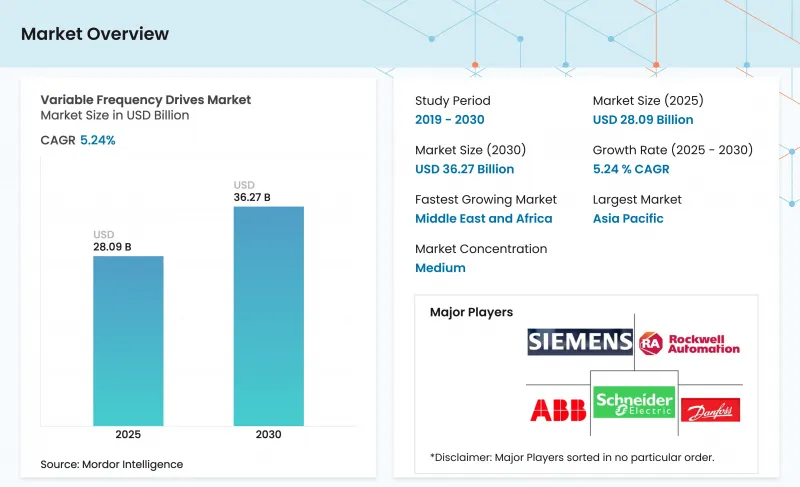
Mordor Intelligence에 의하면, 세계의 가변 주파수 드라이브(VFD) 시장 규모는 2025년에 280억 9,000만 달러로 평가되었고, 2030년까지 362억 7,000만 달러에 이를 전망이며, CAGR 5.24%로 확대될 것으로 예측됩니다.
본 보고서는 전압 유형별(저전압, 중전압, 고전압), 정격 출력별(마이크로, 저, 중, 고), 드라이브 유형별(AC 드라이브, DC 드라이브, 서보/벡터 드라이브 등), 용도별(펌프, 팬·블로어 등), 최종 사용자 산업별(인프라·건축, 식품 및 음료 가공 등), 지역별(북미, 남미 등)로 분류되어 있습니다.
세계의 가변 주파수 드라이브(VFD) 시장 동향 및 인사이트
모터 수준에서의 에너지 최적화를 추구하는 디지털 네이티브 공정 플랜트
디지털로 설계된 플랜트에서는 최신 VFD에 내장된 예측 분석을 활용하여, 모터의 부하를 생산 일정이나 실시간 전력 가격에 맞추어 조정하고 있습니다. 예를 들어, 록웰 오토메이션의 PowerFlex 755TS 플랫폼은 엣지 분석 기능을 통합하여 다중 모터 라인 전반에 걸쳐 에너지 사용량을 줄이면서 가동 중지 시간을 단축했습니다. 반도체 제조 및 제약 시설에서는 수율이 정밀한 속도 제어와 중단 없는 서비스 연결에 의존하기 때문에 도입이 앞서고 있습니다.
HVAC·수처리 분야의 가변 토크 효율에 관한 규제 의무화
효율화에 관한 법규제로 인해 펌프 및 공조기에 VFD 도입이 필수화되었습니다. 미국 에너지부가 제정한 2028년 발효 예정인 순환 펌프 관련 규제는 실질적으로 전자 정류 모터와 첨단 드라이브의 조합을 의무화하는 것이었습니다. 이에 앞서 Trane 등 OEM 각사는 규정을 준수하는 VFD공급을 확보하기 위해 Danfoss와 다년간의 구매 계약을 체결했습니다.
690V를 초과하는 전압에서의 EMI/고조파 규제 대응 비용 증가
규제 당국이 690V를 초과하는 설비에 대한 IEEE 519 제한치를 강화함에 따라, 전자기 간섭(EMI) 및 고조파 왜곡과 관련된 규정 준수 비용이 급증했습니다. 현재 중전압 프로젝트에서는 대용량 리액터, 멀티펄스 변압기, 차폐 케이블의 설치가 필요하며, 이로 인해 자재비, 시운전비, 설계비가 증가하여 드라이브 설치 비용이 15% 이상 높아질 가능성이 있습니다. 중소 제조업체는 적은 출하량으로 설계 및 인증에 드는 비용을 충당해야 하기 때문에 불균형적인 영향을 받고 있습니다. 이로 인해 신규 진입이 저해되고, 업계 재편이 가속화될 가능성이 있습니다.
부문 분석
1 kV 미만의 저전압 유닛은 중소규모 공장의 컨베이어, 믹서, HVAC 팬 제어를 담당하는 주력 제품으로 자리매김하고 있습니다. 2024년에는 매출의 62.4%를 차지하며 가변 주파수 드라이브(VFD) 시장의 기반을 형성했습니다. 비용 효율적인 설치, 풍부한 통합업체의 전문 지식, 그리고 탄탄한 공급업체의 제품 라인업이 그 시장 점유율을 유지했습니다. 이와 동시에, 제철소 및 지하 광산의 기존 시설 확장으로 인해 조달이 1-6 kV 솔루션으로 전환되면서, 중전압 부문을 연평균 성장률(CAGR) 6.8%로 견인했습니다. 995V 전력망으로 업그레이드하는 광산에서는 케이블 배선을 단축하고 전압 안정성을 향상시키기 위해 전용으로 설계된 드라이브가 채택되었습니다.
중전압 장비용 가변 주파수 드라이브(VFD) 시장 규모는 2030년까지 104억 달러에 달할 것으로 예측됩니다. 이는 재생에너지의 계통 연계에 따라 고조파 저감에 관한 계통 규정 요건이 엄격해지고 있는 것이 호재로 작용하고 있기 때문입니다. 각 벤더사는 이에 대응하여 아크 내성이 있는 케이스와 전체 고조파 왜곡을 3% 미만으로 저감하는 모듈식 액티브 프론트엔드 설계를 채택했습니다. 6kV를 초과하는 고전압 제품은 틈새 시장인 수력 펌프나 압연기 프로젝트에 채택되었으나, 높은 가격과 설치의 복잡성으로 인해 보급은 제한적인 수준에 그쳤습니다.
20kW 미만의 마이크로 드라이브는 공장 내 분산 제어 도입이 확대되고, 자율 주행 로봇 및 스마트 빌딩의 서브시스템에 소형 모터가 탑재되면서 7.2%라는 가장 높은 연평균 성장률(CAGR)을 기록했습니다. 다수의 센서가 탑재된 HVAC 구역 제어 시스템 및 식품 가공용 피더의 보급에 따라 출하 대수도 증가했습니다. 저출력(20-200 kW) 모델은 2024년 매출의 40.3%를 계속 차지하며, 화학 산업 및 상수도 유틸리티 분야의 원심 펌프와 축류 팬에 있어 필수적인 존재임을 입증했습니다.
개발사들은 방열판 용량을 확대하고 SiC 다이오드로 전환함으로써 주변 온도 작동 한계를 60°C 이상으로 높였습니다. 이는 사막 지대의 태양광 발전소에서 중요한 차별화 요소가 되고 있습니다. 600 kW를 초과하는 고출력급 가변 주파수 드라이브(VFD) 시장 점유율은 5% 미만에 그쳤으나, 각 판매 프로젝트에서 파워 모듈의 릴레이 및 고조파 필터 점검을 포함하는 장기 서비스 계약을 통해 상당한 애프터마켓 수익을 창출하고 있습니다.
지역별 분석
아시아태평양은 중국의 자동화 가전 공장 및 모터의 효율화 개조를 촉진한 인도의 생산 연계형 인센티브 제도의 뒷받침을 받아, 2024년 매출의 46.3%를 차지하며 계속해서 주도적인 위치를 유지했습니다. VEICHI 등 현지 유력 기업들은 지속적인 모니터링을 위한 클라우드 게이트웨이를 번들로 제공함으로써 수출 매출을 확대하고, 지역의 비용 경쟁력을 강화했습니다. 아세안(ASEAN) 국가들의 정부 리베이트 프로그램과 IE3 모터 의무화 정책이 기초적인 수요를 뒷받침하는 한편, 대만과 한국의 반도체 팹에서는 서보 드라이브 수주가 가속화되었습니다.
중동 및 아프리카은 7.3%라는 가장 높은 연평균 성장률(CAGR)이 예상되며, 각국의 해수 담수화 프로젝트와 구리 벨트 지대의 광산 전기화에 따라 높은 방진·방수 성능을 갖춘 견고한 중전압 드라이브에 대한 수요가 증가하고 있습니다. ACCIONA사의 슈카이크 3 프로젝트의 진전은 물 안보에 대한 요구가 수 메가와트 규모의 펌프용 드라이브 계약을 창출한다는 점을 여실히 보여주었습니다. 아프리카의 전력 사업자들은 자금 조달에 제약이 있음에도 불구하고, 개발 금융 기관을 활용하여 VFD를 많이 사용하는 수처리 설비의 업그레이드에 자금을 조달함으로써 해당 지역의 수주 잔고를 확대했습니다.
북미와 유럽에서는 노후화된 설비가 수명의 막바지에 다다르고, 더욱 엄격해진 효율 기준에 따라 업그레이드가 의무화됨에 따라 교체 주기에 따른 꾸준한 성장이 나타났습니다. 전력 회사의 리베이트 제도와 기업의 ESG 목표가 도입을 가속화했으며, 특히 요금 단계적 인상이 적극적인 탈탄소화 목표와 연계된 지역에서는 이러한 경향이 두드러졌습니다. 유럽의 분말 야금 공장에서는 고조파 배출 기준을 충족하기 위해 액티브 프론트엔드 드라이브가 채택된 반면, 미국 중서부에 위치한 화학 공장에서는 예측형 VFD 알고리즘을 활용해 모터의 부하를 조절함으로써 천연가스 가격 변동을 효과적으로 활용했습니다. 사이버 보안 강화 요건으로 인해 입찰 평가 기간은 길어졌지만, 결국 패치 관리 및 보안 인증서 갱신 패키지를 제공하는 벤더의 서비스 수익 확대로 이어졌습니다.
기타 혜택 :
- 엑셀 형식 시장 예측(ME) 시트
- 3개월간의 애널리스트 지원
자주 묻는 질문
목차
제1장 서론
제2장 조사 방법
제3장 주요 요약
제4장 시장 구도
제5장 시장 규모 및 성장 예측
제6장 경쟁 구도
제7장 시장 기회 및 향후 전망
AJY 26.08.11According to Mordor Intelligence, the global variable frequency drives market size was valued at USD 28.09 billion in 2025 and is forecast to reach USD 36.27 billion by 2030, advancing at a 5.24% CAGR.
This report is Segmented by Voltage Type (Low Voltage, Medium Voltage, High Voltage), Power Rating (Micro, Low, Medium, High), Drive Type (AC Drives, DC Drives, Servo/Vector Drives, and More), Application (Pumps, Fans and Blowers, and More), End-User Industry (Infrastructure and Buildings, Food and Beverage Processing, and More), and Geography (North America, South America, and More).
Global Variable Frequency Drives Market Trends and Insights
Digital-native process plants demanding motor-level energy optimisation
Digitally designed plants relied on predictive analytics inside modern VFDs to align motor load with production schedules and real-time electricity prices. Rockwell Automation's PowerFlex 755TS platform, for example, bundled edge analytics and delivered downtime cuts while trimming energy usage across multi-motor lines. Semiconductor fabrication and pharmaceutical facilities led adoption because yield depends on precise speed control and uninterrupted service connectivity.
Mandatory variable-torque efficiency rules in HVAC and water verticals
Efficiency legislation made VFD integration non-negotiable in pumps and air-handling units. The U.S. Department of Energy's 2028 circulator-pump rule in effect required electronically commutated motors paired with sophisticated drives. In anticipation, OEMs such as Trane locked multi-year purchase agreements with Danfoss to guarantee compliant VFD supply.
Rising EMI/harmonics compliance costs above 690 V
Compliance costs linked to electromagnetic interference and harmonic distortion rose sharply after regulators tightened IEEE 519 limits for installations above 690 V. Medium-voltage projects now require oversized reactors, multi-pulse transformers, and shielded cable runs, adding material, commissioning, and engineering expenses that can raise installed drive cost by more than 15%. Smaller manufacturers are disproportionately affected because the design and certification overhead must be spread across lower shipment volumes, which can deter new entrants and accelerate consolidation.
Other drivers and restraints analyzed in the detailed report include:
- Surge in low-latency Ethernet-enabled motors for Industry 4.0 retrofits
- Rapid build-out of desalination and water-reuse infrastructure
- Persistent shortage of power-electronics-grade SiC/GaN chips
For complete list of drivers and restraints, kindly check the Table Of Contents.
Segment Analysis
Low-voltage units below 1 kV remained the workhorse, controlling conveyors, mixers, and HVAC fans across small and mid-sized plants. In 2024 they captured 62.4% revenue, anchoring the variable frequency drives market. Cost-effective installation, plentiful integrator expertise, and abundant supplier catalogs sustained share. Parallelly, brownfield expansions in steel mills and underground mines shifted procurement toward 1-6 kV solutions, propelling the medium-voltage tier at a 6.8% CAGR. Mines upgrading to 995 V grids selected purpose-built drives to limit cable runs and improve voltage stability.
The variable frequency drives market size for medium-voltage equipment is forecast to reach USD 10.4 billion by 2030, benefiting from renewable energy in-feed, which heightens grid-code requirements for harmonic mitigation. Vendors responded with arc-resistant enclosures and modular active-front-end designs that cut total harmonic distortion below 3%. High-voltage products above 6 kV served niche hydro-pumping and rolling-mill projects; their uptake stayed limited by premium price tags and installation complexity.
Micro drives under 20 kW delivered the highest 7.2% CAGR as factories embraced distributed control, embedding small motors in autonomous mobile robots and smart building subsystems. Volume shipments climbed in tandem with sensor-rich HVAC zoning and food-processing feeders. Low-power (20-200 kW) models still underpinned 40.3% of 2024 revenue, proving indispensable to centrifugal pumps and axial fans across chemical and water utilities.
Developers enlarged heat-sink capacity and switched to SiC diodes to lift ambient operating limits beyond 60 °C, a critical differentiator in desert solar fields. The variable frequency drives market share for high-power classes above 600 kW remained below 5%, yet each sale generated sizable aftermarket revenue streams through long-term service agreements covering power-module relays and harmonic filter audits.
Complete Report Scope:
- By Voltage Type
- Low Voltage (<1 kV)
- Medium Voltage (1-6 kV)
- High Voltage (>6 kV)
- By Power Rating (kW)
- Micro (<20)
- Low (20-200)
- Medium (200-600)
- High (>600)
- By Drive Type
- AC Drives
- DC Drives
- Servo / Vector Drives
- Multilevel and Matrix Drives
- By Application
- Pumps
- Fans and Blowers
- Compressors
- Conveyors
- HVAC Systems
- Extruders and Mixers
- By End-user Industry
- Infrastructure and Buildings
- Food and Beverage Processing
- Energy and Power Generation
- Oil, Gas and Petrochemicals
- Mining and Metals
- Pulp and Paper
- Water and Wastewater
- Others
- By Geography
- North America
- United States
- Canada
- Mexico
- South America
- Brazil
- Argentina
- Rest of South America
- Europe
- United Kingdom
- Germany
- France
- Italy
- Russia
- Rest of Europe
- Asia-Pacific
- China
- India
- Japan
- South Korea
- Rest of Asia-Pacific
- Middle East and Africa
- Middle East
- Saudi Arabia
- UAE
- Turkey
- Rest of Middle East
- Africa
- South Africa
- Nigeria
- Rest of Africa
- Middle East
- North America
Geography Analysis
Asia-Pacific maintained leadership with 46.3% 2024 revenue, underpinned by China's automated appliance plants and India's production-linked incentive schemes that encouraged motor-efficiency retrofits. Local champions such as VEICHI scaled export sales by bundling cloud gateways for continuous monitoring, reinforcing regional cost competitiveness. Government rebate programs and mandatory IE3 motor policies in several ASEAN states sustained baseline demand, while semiconductor fabs in Taiwan and South Korea accelerated servo-drive orders.
The Middle East and Africa posted the highest 7.3% CAGR outlook as sovereign desalination pipelines and copper-belt mining electrification demanded rugged medium-voltage drives with high ingress protection. ACCIONA's Shuqaiq 3 milestone highlighted how water-security imperatives generate multi-megawatt pump-drive contracts. African utilities, though capital-constrained, tapped development-finance institutions to fund VFD-rich water-treatment upgrades, amplifying regional order books.
North America and Europe delivered steady replacement-cycle growth as older installations approached end-of-life and as stricter efficiency codes compelled upgrades. Utility rebate schemes and corporate ESG targets hastened adoption, especially where tariff escalation aligned with aggressive decarbonisation goals. European powder-metallurgy plants opted for active-front-end drives to meet harmonic quotas, while US Midwest chemical plants exploited natural-gas price volatility by modulating motor load with predictive VFD algorithms. Cyber-security hardening requirements extended bid evaluation timelines, yet ultimately enlarged service revenue for vendors offering patch-management and security-certificate renewal packages.
- ABB Ltd.
- Siemens AG
- Schneider Electric SE
- Danfoss A/S
- Rockwell Automation Inc.
- Mitsubishi Electric Corporation
- Yaskawa Electric Corporation
- Fuji Electric Co. Ltd.
- Eaton Corporation plc
- WEG Industries S.A.
- Nidec Corporation
- Toshiba Corporation
- Hitachi Ltd.
- Johnson Controls International plc
- Inovance Technology Co. Ltd.
- Delta Electronics Inc.
- Emerson Electric Co.
- LS Electric Co. Ltd.
- SEW-Eurodrive GmbH & Co KG
- Veichi Electric Co. Ltd.
- Control Techniques (Nidec)
- HARS Drives Co. Ltd.
- Vacon (Part of Danfoss)
- Parker Hannifin - SSD Drives
- Kollmorgen Corporation
- Bonfiglioli Riduttori S.p.A.
Additional Benefits:
- The market estimate (ME) sheet in Excel format
- 3 months of analyst support
TABLE OF CONTENTS
1 INTRODUCTION
- 1.1 Study Assumptions and Market Definition
- 1.2 Scope of the Study
2 RESEARCH METHODOLOGY
3 EXECUTIVE SUMMARY
4 MARKET LANDSCAPE
- 4.1 Market Overview
- 4.2 Market Drivers
- 4.2.1 Digital-native process plants demanding motor-level energy-optimisation
- 4.2.2 Mandatory variable torque efficiency rules in HVAC and water verticals
- 4.2.3 Surge in low-latency, Ethernet-enabled motors for Industry 4.0 retrofits
- 4.2.4 Rapid build-out of desalination and water-reuse infrastructure (Middle-East focus)
- 4.2.5 Electrification of underground mining fleets
- 4.2.6 Inflation-linked electricity tariffs accelerating ROI on VFD retrofits
- 4.3 Market Restraints
- 4.3.1 Rising EMI / harmonics compliance costs above 690 V class
- 4.3.2 Cap-ex squeeze in developing-world utilities
- 4.3.3 Cyber-hardening spend delaying refresh cycles of legacy drives
- 4.3.4 Persistent shortage of power-electronics grade SiC/GaN chips
- 4.4 Impact of Macroeconomic Factors
- 4.5 Investment Analysis
- 4.6 Value Chain Analysis
- 4.7 Regulatory Landscape
- 4.8 Technology Snapshot
- 4.9 Porter's Five Forces Analysis
- 4.9.1 Threat of New Entrants
- 4.9.2 Bargaining Power of Suppliers
- 4.9.3 Bargaining Power of Buyers
- 4.9.4 Threat of Substitutes
- 4.9.5 Degree of Competition
5 MARKET SIZE AND GROWTH FORECASTS (VALUE)
- 5.1 By Voltage Type
- 5.1.1 Low Voltage (<1 kV)
- 5.1.2 Medium Voltage (1-6 kV)
- 5.1.3 High Voltage (>6 kV)
- 5.2 By Power Rating (kW)
- 5.2.1 Micro (<20)
- 5.2.2 Low (20-200)
- 5.2.3 Medium (200-600)
- 5.2.4 High (>600)
- 5.3 By Drive Type
- 5.3.1 AC Drives
- 5.3.2 DC Drives
- 5.3.3 Servo / Vector Drives
- 5.3.4 Multilevel and Matrix Drives
- 5.4 By Application
- 5.4.1 Pumps
- 5.4.2 Fans and Blowers
- 5.4.3 Compressors
- 5.4.4 Conveyors
- 5.4.5 HVAC Systems
- 5.4.6 Extruders and Mixers
- 5.5 By End-user Industry
- 5.5.1 Infrastructure and Buildings
- 5.5.2 Food and Beverage Processing
- 5.5.3 Energy and Power Generation
- 5.5.4 Oil, Gas and Petrochemicals
- 5.5.5 Mining and Metals
- 5.5.6 Pulp and Paper
- 5.5.7 Water and Wastewater
- 5.5.8 Others
- 5.6 By Geography
- 5.6.1 North America
- 5.6.1.1 United States
- 5.6.1.2 Canada
- 5.6.1.3 Mexico
- 5.6.2 South America
- 5.6.2.1 Brazil
- 5.6.2.2 Argentina
- 5.6.2.3 Rest of South America
- 5.6.3 Europe
- 5.6.3.1 United Kingdom
- 5.6.3.2 Germany
- 5.6.3.3 France
- 5.6.3.4 Italy
- 5.6.3.5 Russia
- 5.6.3.6 Rest of Europe
- 5.6.4 Asia-Pacific
- 5.6.4.1 China
- 5.6.4.2 India
- 5.6.4.3 Japan
- 5.6.4.4 South Korea
- 5.6.4.5 Rest of Asia-Pacific
- 5.6.5 Middle East and Africa
- 5.6.5.1 Middle East
- 5.6.5.1.1 Saudi Arabia
- 5.6.5.1.2 UAE
- 5.6.5.1.3 Turkey
- 5.6.5.1.4 Rest of Middle East
- 5.6.5.2 Africa
- 5.6.5.2.1 South Africa
- 5.6.5.2.2 Nigeria
- 5.6.5.2.3 Rest of Africa
- 5.6.5.1 Middle East
- 5.6.1 North America
6 COMPETITIVE LANDSCAPE
- 6.1 Market Concentration
- 6.2 Strategic Moves
- 6.3 Market Share Analysis
- 6.4 Company Profiles (includes Global level Overview, Market level overview, Core Segments, Financials as available, Strategic Information, Market Rank/Share for key companies, Products and Services, and Recent Developments)
- 6.4.1 ABB Ltd.
- 6.4.2 Siemens AG
- 6.4.3 Schneider Electric SE
- 6.4.4 Danfoss A/S
- 6.4.5 Rockwell Automation Inc.
- 6.4.6 Mitsubishi Electric Corporation
- 6.4.7 Yaskawa Electric Corporation
- 6.4.8 Fuji Electric Co. Ltd.
- 6.4.9 Eaton Corporation plc
- 6.4.10 WEG Industries S.A.
- 6.4.11 Nidec Corporation
- 6.4.12 Toshiba Corporation
- 6.4.13 Hitachi Ltd.
- 6.4.14 Johnson Controls International plc
- 6.4.15 Inovance Technology Co. Ltd.
- 6.4.16 Delta Electronics Inc.
- 6.4.17 Emerson Electric Co.
- 6.4.18 LS Electric Co. Ltd.
- 6.4.19 SEW-Eurodrive GmbH & Co KG
- 6.4.20 Veichi Electric Co. Ltd.
- 6.4.21 Control Techniques (Nidec)
- 6.4.22 HARS Drives Co. Ltd.
- 6.4.23 Vacon (Part of Danfoss)
- 6.4.24 Parker Hannifin - SSD Drives
- 6.4.25 Kollmorgen Corporation
- 6.4.26 Bonfiglioli Riduttori S.p.A.
7 MARKET OPPORTUNITIES AND FUTURE OUTLOOK
- 7.1 White-space and Unmet-Need Assessment