

|
시장보고서
상품코드
2120623
제스처 인식 : 시장 점유율 분석, 업계 동향과 통계, 성장 예측(2026-2031년)Gesture Recognition - Market Share Analysis, Industry Trends & Statistics, Growth Forecasts (2026 - 2031) |
||||||
 Mordor Intelligence
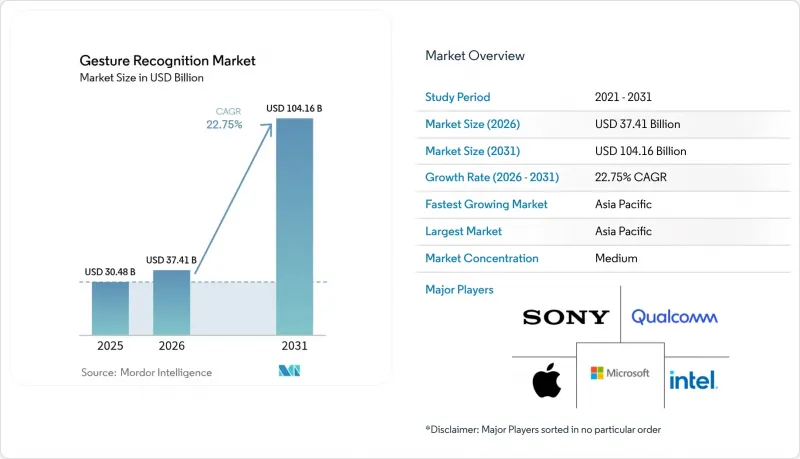
에 의하면, 제스처 인식 시장 규모는 2025년 304억 8,000만 달러에서 2026년에는 374억 1,000만 달러에 이르고, 2026-2031년 CAGR 22.75%로 성장을 지속하여 2031년에는 1,041억 6,000만 달러에 달할 것으로 예측됩니다.
본 보고서는 기술별(터치식 제스처 인식, 비접촉식 제스처 인식),구성 요소별(하드웨어, 소프트웨어), 제스처 유형별(온라인 동적 제스처, 오프라인 정적 제스처), 인증 방식별(생체 인증, 비생체 인증), 최종 사용자 산업별(소비자 가전, 자동차, 항공우주 및 방위 등), 지역별로 분류되어 있습니다. 시장 전망은 금액(달러) 기준으로 제시되어 있습니다.
전 세계 제스처 인식 시장 동향 및 인사이트
아시아 전역의 플래그십 스마트폰에 mm파 및 ToF 센서 보급
아시아에 기반을 둔 각 휴대폰 OEM 업체들은 현재 ST마이크로일렉트로닉스의 VL53L7CX와 같은 멀티존 ToF 모듈을 탑재하고 있으며, 주변 조명 조건에 영향을 받지 않고 mm 수준의 깊이 정확도를 실현하여, 열악한 조명 조건에서도 신뢰성 높은 공중 명령 입력을 가능하게 하고 있습니다. 이러한 전개는 관성 데이터와 레이더 데이터를 통합하여 사용자 인터페이스의 공간 제어를 실현하는 Ceva사의 MotionEngine Hex 펌웨어를 통해 스마트 TV로도 확대되고 있습니다. ToF 칩셋의 단가가 대량 생산 시 1달러 미만으로 떨어짐에 따라, 제스처 제어는 제스처 인식 시장에서 프리미엄 차별화 요소에서 표준 기능으로 전환되고 있습니다.
Euro NCAP 요건을 충족하기 위해 자동차 제조업체들의 차량 내 제스처 HUD 채택이 진행되고 있습니다.
2024년 7월에 시행된 ‘첨단 운전자 주의 산만 경고(ADDW)’ 규정에 따라, 각 OEM사는 인지 부하 경감을 의무화받게 되었으며, 유럽 모델에 카메라 기반 제스처 허브의 신속한 도입이 촉진되고 있습니다. BMW 7시리즈의 레벨 2/3 인증은 상용화 준비가 완료되었음을 나타내는 반면, 아우디의 3D 콕핏 인터페이스는 콘솔 상단에서 손을 스와이프하는 조작을 통해 멀티모달 인포테인먼트 선택 기능을 구현하고 있습니다. 150밀리초 미만의 응답 시간과 3% 미만의 오인식률을 보장할 수 있는 공급업체는 프로그램 수주를 확보할 전망이며, 이는 제스처 인식 시장의 성장 궤도를 더욱 공고히할 것입니다.
열대 지역의 햇빛 아래에서 시각 기반 시스템의 높은 오인식률
카메라 중심 알고리즘은 높은 럭스 환경의 배경에서 손의 윤곽을 식별하는 데 어려움을 겪고 있으며, 이는 야외 키오스크나 차량 호출 서비스 차량에서 오류가 급증하는 원인이 되고 있습니다. 조사에 따르면, 레이더 기반 대체 기술은 조명 조건에 관계없이 90% 이상의 정확도를 유지할 수 있는 것으로 나타났으며, 이에 따라 제스처 인식 시장에서 시스템 설계자들은 멀티센서 융합 기술의 도입을 추진하고 있습니다.
부문 분석
비접촉식 솔루션은 2025년 매출의 57.65%를 차지할 것으로 예상되며, 이는 최종 시장에서 위생, 운전자 안전, 몰입형 엔터테인먼트에 대한 중요성이 커지고 있음을 반영합니다. ToF, mm파 레이더, 초음파 어레이를 통한 부품 원가 절감에 힘입어, 터치리스 하위 부문은 2031년까지 연평균 성장률(CAGR) 23.65%로 성장하여 제스처 인식 시장 전체를 능가하는 속도를 보일 것으로 전망됩니다. 대조적으로, 정전용량식 터치 기반 제어는 비용 효율을 중시하는 소비자용 기기에서 여전히 중요성을 유지하고 있지만, 그 연평균 성장률(CAGR)은 한 자릿수에 그치고 있습니다. 교세라의 깊이 센서는 10cm 범위 내에서 100µm의 해상도를 실현하여, 외과 수술 수준의 정밀도가 요구되는 로봇 피킹 앤 플레이스(pick-and-place) 및 정형외과용 정렬 도구로의 활용을 가능하게 하고 있습니다. 앰비언트 인터랙션으로의 꾸준한 전환은 터치리스 방식이 접촉이 필요한 기존 방식보다 궁극적으로 제스처 인식 시장에서 더 큰 점유율을 차지할 것임을 시사합니다.
비접촉 기술의 확대는 공급업체 간의 힘의 균형에 변화를 가져오고 있습니다. 기존에 실리콘을 상품화해 온 센서 벤더들은 현재 AI 펌웨어, 데이터 모델, 개발자용 포털을 번들로 묶어 하드웨어의 이익률에 더해 지속적인 라이선스 수익도 얻고 있습니다. 이러한 재번들링은 현장에서의 무선(OTA)을 통한 성능 향상을 우선시하는 OEM의 우선순위와 부합하며, 제스처 인식 시장에서 비접촉 기술의 대규모 도입에 필요한 확장 가능한 경제성을 뒷받침하고 있습니다.
2025년 제스처 인식 시장 규모 중 하드웨어가 70.85%를 차지하고 있으며, 이는 렌즈, 레이더 프런트엔드, MCU 등의 본질적인 비용에 기인합니다. 그러나 컨텍스트 인식, 사용자 적응, 연합 학습을 실현하는 소프트웨어 플랫폼은 연평균 성장률(CAGR) 23.1%를 나타낼 것으로 예측되며, 이는 하드웨어 성장률을 350 베이시스 포인트 이상 상회하는 수치입니다. 인피니언의 ‘DEEPCRAFT Ready Models’는 일반적인 제스처에 대응하는 사전 학습된 신경망을 제공하여 통합 시간을 40% 단축하는 동시에, 해당 기업의 가치 곡선 상에서의 위치를 향상시키고 있습니다. 한편, 이마지모브의 비주얼 그래프 기반 머신러닝 도구는 모델 개발 주기를 몇 시간으로 단축하여, 중견 OEM 제조업체에게도 AI 최적화를 쉽게 접근할 수 있게 하고 있습니다.
수익 구조의 변화는 서비스 번들링의 기회를 창출하고 있습니다. 구체적으로는 예측 유지보수, 클라우드 기반 분석, 그리고 제스처를 계기로 한 디지털 구매를 통한 인앱 결제 등이 있습니다. 실리콘, 펌웨어, 라이프사이클 서비스를 통합적으로 제공할 수 있는 공급업체는 총소유비용(TCO)이 부품 가격보다 더 중요한 고려 사항이 된 상황에서 제스처 인식 시장에서 고객 충성도를 확보할 준비가 되어 있습니다.
지역별 분석
아시아태평양의 우위는 수직 통합된 공급망, 정부의 지원 자금, 그리고 얼리 어답터층에 의한 방대한 도입 기반에 의해 뒷받침되고 있습니다. 이 지역의 휴대폰 제조업체들은 10-12개월마다 새로운 플래그십 모델을 출시하고 있으며, 각 모델에는 더 높은 해상도의 ToF 어레이가 탑재됨에 따라 센서 벤더들에게 제스처 인식 시장 규모는 확대되고 있습니다. 일본의 대기업들은 자동차 용접 및 반도체 리소그래피 분야에서 XR(확장 현실) 기반의 기술 이전 플랫폼을 채택하고 있어, 고정밀 제스처 모델에 대한 수요를 뒷받침하고 있습니다. 한국의 웨이퍼 생산 능력은 부품의 안정적인 공급을 보장하고 있는 반면, 인도의 스마트 TV 보급으로 인해 중산층 가정에 터치리스 리모컨이 도입되면서 수익 피라미드가 확대되고 있습니다.
북미에서는 의료 분야의 구매력을 활용하여 수술실 및 진단센터로의 도입이 진행되고 있으며, 기기당 프리미엄 수익을 창출하고 있습니다. 공중 디스플레이를 도입한 병원에서는 교차 감염 발생 건수가 대폭 감소한 것으로 보고되었으며, 이로 인해 재입원에 따른 벌금이 줄어들어 제스처 인터페이스의 ROI가 향상되고 있습니다. 자동차 제조업체들은 2024년 이후 운전 중 주의 산만과 관련된 연방 지침을 준수하기 위해 제스처 기반의 운전자 모니터링 기능을 통합하고 있으며, 센서 탑재율을 단계적으로 높이고 있습니다.
유럽은 규제 측면에서 선도적인 역할을 하고 있습니다. 유로 NCAP의 지침에 따라 주의 산만 방지 기술의 탑재가 의무화되어, 고급차 및 대중차 부문 모두에서 도입이 가속화되고 있습니다. 독일공급업체들은 국내 자동차 제조업체와 공동으로 제스처 모듈을 개발하고 있으며, 하드웨어 조달의 세계화가 진행되는 가운데서도 지역 내 가치 확보를 공고히 하고 있습니다. 한편, GCC 국가들은 AI 주권 이니셔티브를 추진하며 터치리스 UI를 갖춘 공공 서비스용 키오스크에 자금을 지원하고 있어, 중동은 현재 기반에 비해 비약적으로 높은 성장 궤도에 올라 있습니다.
기타 혜택:
- 엑셀 형식 시장 예측(ME) 시트
- 3개월간 애널리스트 지원
자주 묻는 질문
목차
제1장 서론
제2장 조사 방법
제3장 주요 요약
제4장 시장 구도
제5장 시장 규모와 성장 예측
제6장 경쟁 구도
제7장 시장 기회와 향후 전망
LSH 26.09.08According to Mordor Intelligence, the gesture recognition market size is expected to grow from USD 30.48 billion in 2025 to USD 37.41 billion in 2026 and is forecast to reach USD 104.16 billion by 2031 at 22.75% CAGR over 2026-2031.
This report is Segmented by Technology (Touch-Based Gesture Recognition, Touchless Gesture Recognition), Component (Hardware, Software), Gesture Type (Online Dynamic Gestures, Offline Static Gestures), Authentication (Biometric, Non-Biometric), End-User Industry (Consumer Electronics, Automotive, Aerospace and Defense and More), and Geography. The Market Forecasts are Provided in Terms of Value (USD).
Global Gesture Recognition Market Trends and Insights
Proliferation of mm-wave and ToF sensors in flagship smartphones across Asia
Asia-based handset OEMs now embed multizone ToF modules such as STMicroelectronics' VL53L7CX to deliver millimeter-level depth accuracy without ambient-light restrictions, enabling reliable mid-air command input even under harsh illumination. The deployment extends to smart-TV handsets through Ceva's MotionEngine Hex firmware, which integrates inertial and radar data to deliver spatial control of user interfaces. As the cost of ToF chipsets falls below USD 1 per unit in volume lots, gesture control is transitioning from a premium differentiator to a default feature in the gesture recognition market.
Automaker adoption of in-cabin gesture HUDs to meet Euro NCAP mandates
The July 2024 Advanced Driver Distraction Warning regulation obliges OEMs to mitigate cognitive load, propelling rapid integration of camera-based gesture hubs in European models. BMW's Level 2/3 certification on the 7 Series demonstrates commercial readiness, while Audi's 3-D cockpit interface showcases multi-modal infotainment selection using above-console hand sweeps. Suppliers that can guarantee sub-150 ms response times and <3% false-trigger rates stand to win program awards, reinforcing the growth trajectory of the gesture recognition market.
High false-positive rates in sunlight for vision-based systems in tropical regions
Camera-centric algorithms struggle to resolve hand contours against high-lux backgrounds, driving error spikes in outdoor kiosks and ride-hailing vehicles. Research indicates radar-based alternatives maintain >90% precision independent of illumination, prompting system designers to adopt multi-sensor fusion in the gesture recognition market.
Other drivers and restraints analyzed in the detailed report include:
- Hospital demand for touch-free HMI to cut HAI risks in surgical suites
- Integration into XR wearables to unlock 6-DoF control for industrial training
- Absence of open interoperability standards inflating OEM integration cost
For complete list of drivers and restraints, kindly check the Table Of Contents.
Segment Analysis
Touchless solutions generated 57.65% of 2025 revenue, reflecting end-market emphasis on hygiene, driver safety, and immersive entertainment. The touchless sub-segment will compound at 23.65% through 2031, outpacing the broader gesture recognition market as ToF, mm-wave radar, and ultrasonic arrays reduce bill-of-materials cost. In contrast, capacitive touch-based controls retain relevance in cost-sensitive consumer devices, yet their CAGR trails at single-digits. Kyocera's depth sensor demonstrates 100 µm resolution within 10 cm, enabling robotic pick-and-place and orthopedic alignment tools that demand surgical-grade accuracy. The steady migration toward ambient interaction implies touchless modalities will ultimately hold a greater gesture recognition market share than their contact-dependent predecessors.
Touchless expansion is altering supplier power dynamics. Sensor vendors that historically commoditized silicon are now bundling AI firmware, data models, and developer portals, capturing recurring license fees on top of hardware margins. This re-bundling aligns with OEM priorities for field-upgradable over-the-air performance improvements and supports the scalable economics required for high-volume touchless adoption within the gesture recognition market.
Hardware contributed 70.85% of gesture recognition market size in 2025, driven by the intrinsic cost of lenses, radar front-ends, and MCUs. However, software platforms that deliver contextual awareness, user adaptation, and federated learning are forecast at a 23.1% CAGR-more than 350 bps above hardware growth. Infineon's DEEPCRAFT Ready Models supply pre-trained neural networks for common gestures, cutting integration time by 40% and repositioning the firm higher on the value curve. Meanwhile, Imagimob's visual graph-based ML tooling compresses model-development cycles to hours, democratizing AI optimization for mid-tier OEMs.
The revenue mix shift creates opportunities for service bundling: predictive maintenance, cloud-based analytics, and in-app monetization through gesture-initiated digital purchases. Suppliers able to orchestrate silicon, firmware, and lifecycle services are poised to command loyalty in the gesture recognition market as total cost of ownership eclipses component price considerations.
Complete Report Scope:
- By Technology
- Touch-based Gesture Recognition
- 2-D Multi-touch Panels
- Capacitive and Resistive Sensors
- Touchless Gesture Recognition
- 2-D Camera-based
- 3-D Depth and ToF
- Ultrasonic and mm-wave Radar
- Touch-based Gesture Recognition
- By Component
- Hardware (Sensors, Controllers, SoCs)
- Software (ML Algorithms, SDKs, Middleware)
- By Gesture Type
- Online Dynamic Gestures
- Offline Static Gestures
- By Authentication
- Biometric (Face, Iris, Palm-vein)
- Non-biometric (Motion, Pose)
- By End-user Industry
- Consumer Electronics
- Smartphones and Tablets
- Smart-TV and Set-top Boxes
- AR/VR and Wearables
- Automotive
- Driver Monitoring and Infotainment
- Aerospace and Defense
- Healthcare
- Surgical and Diagnostic Rooms
- Gaming and Entertainment
- Industrial and Robotics
- Other Industries
- Consumer Electronics
- By Geography
- North America
- United States
- Canada
- Mexico
- South America
- Brazil
- Argentina
- Rest of South America
- Europe
- United Kingdom
- Germany
- France
- Italy
- Rest of Europe
- Asia Pacific
- China
- Japan
- India
- South Korea
- New Zealand and Australia
- Rest of Asia Pacific
- Middle East and Africa
- GCC (Saudi Arabia, UAE, Qatar)
- Turkey
- South Africa
- North America
Geography Analysis
Asia Pacific's dominance rests on vertically integrated supply chains, supportive government funding, and an immense installed base of early-adopter consumers. Regional handset brands release new flagship lines every 10-12 months, each iteration embedding higher-resolution ToF arrays, thereby expanding the gesture recognition market size for sensor vendors. Japanese conglomerates employ XR-based skill-transfer platforms in automotive welding and semiconductor lithography, reinforcing demand for high-precision gesture models. South Korea's wafer capacity secures component continuity, while India's smart-TV expansion introduces touchless remotes into middle-income households, broadening the revenue pyramid.
North America leverages healthcare spending power for surgical suites and diagnostic centers, generating premium revenue per unit. Hospitals adopting mid-air displays report significant reductions in cross-contamination incidents, translating into lower readmission penalties and bolstering ROI for gesture interfaces. Automotive OEMs integrate gesture-based driver monitoring to comply with post-2024 federal guidelines on distracted driving, pushing incremental sensor attach rates.
Europe acts as a regulatory pacesetter. Euro NCAP directives mandate distraction-mitigation technologies, accelerating deployment across both luxury and mass-market vehicle classes. German suppliers co-develop gesture modules with domestic automakers, cementing regional value capture despite globalized hardware sourcing. Meanwhile, GCC nations pursue AI sovereignty initiatives that fund public-service kiosks with touchless UIs, giving the Middle East an outsized growth profile relative to its current base.
- Intel Corporation
- Qualcomm Technologies Inc.
- Apple Inc.
- Microsoft Corp.
- Sony Group Corp.
- Google LLC
- Meta Platforms Inc.
- Ultraleap Ltd.
- Microchip Technology Inc.
- Infineon Technologies AG
- Synaptics Inc.
- Elliptic Laboratories AS
- GestureTek Inc.
- Cognitec Systems GmbH
- Eyesight Technologies Ltd.
- PointGrab Ltd.
- Omron Corporation
- Jabil Inc.
- Leap Motion
Additional Benefits:
- The market estimate (ME) sheet in Excel format
- 3 months of analyst support
TABLE OF CONTENTS
1 INTRODUCTION
- 1.1 Study Assumptions and Market Definition
- 1.2 Scope of the Study
2 RESEARCH METHODOLOGY
3 EXECUTIVE SUMMARY
4 MARKET LANDSCAPE
- 4.1 Market Overview
- 4.2 Market Drivers
- 4.2.1 Proliferation of mm-wave and ToF sensors in flagship smartphones across Asia
- 4.2.2 Automaker adoption of in-cabin gesture HUDs to meet Euro NCAP distraction mandates
- 4.2.3 Hospital demand for touch-free HMI to cut HAI risks in surgical suites (US and Germany)
- 4.2.4 Integration into XR wearables to unlock 6-DoF control for industrial training (Japan)
- 4.2.5 Smart-TV vendors bundling air-gesture remotes to differentiate in price-eroding market
- 4.2.6 Government smart-city grants driving public-kiosk gesture UI roll-outs (GCC)
- 4.3 Market Restraints
- 4.3.1 High false-positive rates in sunlight for vision-based systems in tropical regions
- 4.3.2 Absence of open interoperability standards inflating OEM integration cost
- 4.3.3 "Always-on" gesture wake-word draining battery in sub-10 nm mobile SoCs
- 4.3.4 Data-privacy compliance hurdles for in-cabin video analytics under GDPR
- 4.4 Regulatory Outlook
- 4.5 Porter's Five Forces Analysis
- 4.5.1 Bargaining Power of Suppliers
- 4.5.2 Bargaining Power of Buyers
- 4.5.3 Threat of New Entrants
- 4.5.4 Threat of Substitutes
- 4.5.5 Intensity of Competitive Rivalry
5 MARKET SIZE AND GROWTH FORECASTS (VALUE)
- 5.1 By Technology
- 5.1.1 Touch-based Gesture Recognition
- 5.1.1.1 2-D Multi-touch Panels
- 5.1.1.2 Capacitive and Resistive Sensors
- 5.1.2 Touchless Gesture Recognition
- 5.1.2.1 2-D Camera-based
- 5.1.2.2 3-D Depth and ToF
- 5.1.2.3 Ultrasonic and mm-wave Radar
- 5.1.1 Touch-based Gesture Recognition
- 5.2 By Component
- 5.2.1 Hardware (Sensors, Controllers, SoCs)
- 5.2.2 Software (ML Algorithms, SDKs, Middleware)
- 5.3 By Gesture Type
- 5.3.1 Online Dynamic Gestures
- 5.3.2 Offline Static Gestures
- 5.4 By Authentication
- 5.4.1 Biometric (Face, Iris, Palm-vein)
- 5.4.2 Non-biometric (Motion, Pose)
- 5.5 By End-user Industry
- 5.5.1 Consumer Electronics
- 5.5.1.1 Smartphones and Tablets
- 5.5.1.2 Smart-TV and Set-top Boxes
- 5.5.1.3 AR/VR and Wearables
- 5.5.2 Automotive
- 5.5.2.1 Driver Monitoring and Infotainment
- 5.5.3 Aerospace and Defense
- 5.5.4 Healthcare
- 5.5.4.1 Surgical and Diagnostic Rooms
- 5.5.5 Gaming and Entertainment
- 5.5.6 Industrial and Robotics
- 5.5.7 Other Industries
- 5.5.1 Consumer Electronics
- 5.6 By Geography
- 5.6.1 North America
- 5.6.1.1 United States
- 5.6.1.2 Canada
- 5.6.1.3 Mexico
- 5.6.2 South America
- 5.6.2.1 Brazil
- 5.6.2.2 Argentina
- 5.6.2.3 Rest of South America
- 5.6.3 Europe
- 5.6.3.1 United Kingdom
- 5.6.3.2 Germany
- 5.6.3.3 France
- 5.6.3.4 Italy
- 5.6.3.5 Rest of Europe
- 5.6.4 Asia Pacific
- 5.6.4.1 China
- 5.6.4.2 Japan
- 5.6.4.3 India
- 5.6.4.4 South Korea
- 5.6.4.5 New Zealand and Australia
- 5.6.4.6 Rest of Asia Pacific
- 5.6.5 Middle East and Africa
- 5.6.5.1 GCC (Saudi Arabia, UAE, Qatar)
- 5.6.5.2 Turkey
- 5.6.5.3 South Africa
- 5.6.1 North America
6 COMPETITIVE LANDSCAPE
- 6.1 Market Concentration
- 6.2 Strategic Moves
- 6.3 Market Share Analysis
- 6.4 Company Profiles (includes Global-level Overview, Market-level Overview, Core Segments, Financials as available, Strategic Information, Market Rank/Share, Products and Services, Recent Developments)
- 6.4.1 Intel Corporation
- 6.4.2 Qualcomm Technologies Inc.
- 6.4.3 Apple Inc.
- 6.4.4 Microsoft Corp.
- 6.4.5 Sony Group Corp.
- 6.4.6 Google LLC
- 6.4.7 Meta Platforms Inc.
- 6.4.8 Ultraleap Ltd.
- 6.4.9 Microchip Technology Inc.
- 6.4.10 Infineon Technologies AG
- 6.4.11 Synaptics Inc.
- 6.4.12 Elliptic Laboratories AS
- 6.4.13 GestureTek Inc.
- 6.4.14 Cognitec Systems GmbH
- 6.4.15 Eyesight Technologies Ltd.
- 6.4.16 PointGrab Ltd.
- 6.4.17 Omron Corporation
- 6.4.18 Jabil Inc.
- 6.4.19 Leap Motion
7 MARKET OPPORTUNITIES AND FUTURE OUTLOOK
- 7.1 White-space and Unmet-need Assessment


