|
시장보고서
상품코드
1442588
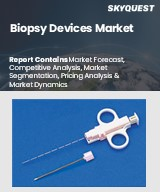
생검 기기 시장 평가 : 제품 유형별, 용도별, 최종 사용자별, 지역별, 기회 및 예측(2017-2031년)Biopsy Devices Market Assessment, By Product Type, By Application, By End-user, By Region, Opportunities and Forecast, 2017-2031F |
||||||
 Markets & Data
세계 생검 기기 시장 규모는 예측 기간 동안 연평균 8.03%의 연평균 복합 성장률(CAGR)로 성장하여 2023년 31억 달러에서 2031년에는 57억 4,000만 달러로 성장할 것으로 예상됩니다.
생검 기기 시장은 전 세계 암 발병률 증가, 생검 기기 설계 및 기능의 발전, 최소침습적 시술에 대한 수요 증가, 규제 지원 등의 성장 요인에 영향을 받아 성장할 것으로 예상됩니다. 또한, AI와 머신러닝의 통합은 생검 기기 산업의 지속적인 성장과 혁신에 있어 매우 중요한 역할을 할 것으로 예상됩니다. 전 세계적으로 암 환자 수 증가는 생검 기기 수요를 견인하는 주요 동인입니다. 의료 인프라의 확대, 진단 실험실 증가, 정확하고 신속한 진단을 통해 암 질병 부담을 줄이기 위한 정부의 지원도 생검 기기 시장 확대에 기여하는 요인입니다. 또한, 암에 대한 인식이 높아지고 진단 방법에 대한 접근이 용이해짐에 따라 시장 성장을 가속하고 있습니다.
한편, 생검 기기 사용에 따른 감염 위험과 미비한 의료 인프라는 시장 성장을 저해하는 요인 중 하나입니다. 생검 과정에서 감염이 확산될 가능성이 높아 의료진뿐만 아니라 환자들에게도 큰 문제가 되고 있습니다.
생검 기기의 발전
최근 생검 기기의 발전은 액체 생검과 뼈 생검 기기를 중심으로 진행되고 있습니다. 액체생검은 체액에서 종양 유래 정보를 분석하는 것으로, 마이크로포토닉스, 나노포토닉스, 마이크로플루이딕스 기술의 발전에 힘입어 최근 큰 진전을 이루고 있습니다. 이러한 기술은 순환 종양 RNA, 무세포 마이크로 RNA, 엑소좀과 같은 분석물을 검출할 수 있으며, 비침습성, 재현성, 빠른 결과 등 기존 조직 생검에 비해 몇 가지 이점을 제공합니다. 한편, 뼈 생검 기기는 검사를 위해 소량의 뼈 샘플을 채취하도록 설계되어 암과 같은 질병의 조기 발견 및 진단에 도움이 될 수 있습니다. 뼈 생검 기술의 최근 발전에는 혁신적인 장치 개발, 조직 채취 기술의 개선, 접근하기 어려운 종양 부위에 접근 할 수있는 자기 바늘의 탐색 등이 포함됩니다.
암 환자 증가
암 환자 수 증가는 질병의 조기 발견과 정확한 진단의 필요성으로 인해 생검 기기에 대한 수요를 증가시키고 있습니다. 유방암, 폐암, 백혈병 등 다양한 유형의 암 유병률 증가는 생검 기기 수요 시나리오에 긍정적인 영향을 미치고 있습니다. 암 환자 수 증가는 방사선 노출 증가, 부적절한 생활습관, 장시간 노동, 스트레스 증가, 흡연, 음주, 피임법 사용 등 여러 가지 요인에 기인합니다. 범미보건기구(PAN AMERICA HEALTH ORGANIZATION)에 따르면, 전 세계적으로 약 2,000만 명이 새로 암에 걸리고 1,000만 명이 암으로 인해 사망하고 있습니다. 이는 의료 시스템, 개인 및 지역사회에 큰 부담을 주고 있습니다. 안타깝게도 이 부담은 향후 20년 동안 60% 증가할 것으로 예상됩니다. 즉, 2040년까지 전 세계적으로 약 3,000만 명의 암 환자가 새로 발생할 수 있으며, 중저소득 국가에서 가장 큰 폭으로 증가할 것으로 예상됩니다.
북미가 주요 지역으로
북미는 높은 의료비 지출과 잘 구축된 R&D 생태계, 그리고 질병 조기 발견에 중점을 두고 있습니다. 또한, 북미는 강력한 의료 인프라, 확립된 보험 및 본인부담금 제도, 적극적인 규제 프레임워크를 갖추고 있어 이 지역의 강점을 더욱 강화하고 있습니다. 또한, 이 지역은 암 및 기타 만성질환의 유병률이 높아 생검 기기에 대한 수요가 높은 지역입니다. 또한, 북미에는 주요 시장 진출기업들이 존재하고 규제 당국의 승인에 중점을 두고 있는 것도 생검 기기 시장에서 북미의 우위에 기여하고 있습니다.
세계 생검 기기(Biopsy Device) 시장을 조사했으며, 시장 정의와 개요, 시장 규모 추이와 예측, 각종 부문별/지역별 상세 분석, 산업 구조, 시장 성장에 영향을 미치는 요인 분석, 사례 연구, 경쟁 구도, 주요 기업 프로파일 등의 정보를 정리하여 전해드립니다.
목차
제1장 조사 방법
제2장 프로젝트의 범위와 정의
제3장 주요 요약
제4장 세계의 생검 기기 시장 전망
- 시장 규모와 예측
- 제품 유형별
- 바늘 기반 생검
- 생검 유도 시스템
- 생검 겸자
- 생검침
- 기타
- 용도별
- 유방 생검
- 폐 생검
- 결장직장 생검
- 전립선 생검
- 기타
- 최종사용자별
- 병원
- 전문 종양 센터
- 진단센터
- 연구기관
- 지역별
- 북미
- 유럽
- 아시아태평양
- 남미
- 중동 및 아프리카
- 기업별 시장 점유율
제5장 세계의 생검 기기 시장 전망 : 지역별
- 북미
- 유럽
- 아시아태평양
- 남미
- 중동 및 아프리카
제6장 시장 매핑
- 제품 유형별
- 용도별
- 최종사용자별
- 지역별
제7장 거시환경과 산업 구조
- 수급 분석
- 수출입 분석
- 밸류체인 분석
- PESTEL 분석
- Porter의 Five Forces 분석
제8장 시장 역학
- 성장 촉진요인
- 성장 억제요인(과제·억제요인)
제9장 법규제 프레임워크·혁신
- 임상시험
- 특허 환경
- 규제 승인
- 혁신 및 신기술
제10장 주요 기업 상황
- 시장 리더 주요 5개사의 경쟁 매트릭스
- 시장 리더 주요 5개사의 시장 매출 분석
- 인수합병(M&A) 및 합작투자(해당하는 경우)
- SWOT 분석(참여 5개사)
제11장 가격 분석
제12장 사례 연구
제13장 주요 기업 전망
- Becton, Dickinson and Company
- Hologic Inc.
- Danaher Corporation
- Cook Medical
- Boston Scientific Corporation
- Argon Medical Devices
- B. Braun Melsungen AG
- Cardinal Health Inc.
- Medtronic PLC
- Olympus Corporation
제14장 전략적 제안
제15장 당사에 대해&면책사항
LSH 24.03.14Global biopsy devices market is projected to witness a CAGR of 8.03% during the forecast period 2024-2031, growing from USD 3.1 billion in 2023 to USD 5.74 billion in 2031. The biopsy devices market is anticipated to thrive under the influence of growth factors like the growing prevalence of cancer cases globally, design and working advancements in biopsy devices, rising demand for minimally invasive procedures, and regulatory support. Additionally, the integration of artificial intelligence and machine learning is expected to play a pivotal role in the continued growth and innovation of the biopsy devices industry. The rising number of cancer cases at the global level is a major driver that drives the demand for biopsy devices. Growing healthcare infrastructure, a rising number of diagnostic laboratories, and government support for reducing the cancer disease burden through precise and rapid diagnostics are some other factors contributing to the expansion of the biopsy devices market. Furthermore, growing cancer awareness among common people and easy access to diagnostic methods propels market growth.
However, risks of infections associated with the use of biopsy devices and underdeveloped healthcare infrastructure are some factors hindering the growth of this market. During the biopsy process, the chances of infection spreading are high, posing a significant challenge for healthcare professionals as well as the patient.
In May 2023, Argon Medical Devices announced the launch of SuperCore Advantage semi-automatic biopsy instrument which is the newest addition to the company's soft tissue biopsy product portfolio in the United States. The SuperCore Advantage is a disposable soft tissue biopsy instrument that provides a larger tissue sample for more accurate analysis.
Advancements in Biopsy Devices
Recent advancements have been made in biopsy devices, with a focus on liquid biopsies and bone biopsy devices. Liquid biopsies involve the analysis of tumor-derived information from body fluids and have seen significant progress in recent years, supported by the development of microphotonics, nanophotonics, and microfluidics technologies. These technologies enable the detection of analytes, such as circulating tumor RNA, cell-free micro-RNA, and exosomes, and offer several benefits over traditional tissue biopsies, including non-invasiveness, repeatability, and quick results. Meanwhile, bone biopsy devices are designed to remove small bone samples for examination, aiding in the early detection and diagnosis of diseases such as cancer. Recent advancements in bone biopsy technology include the development of innovative devices, improvements in tissue sampling techniques, and the exploration of magnetic needles that can access difficult-to-reach tumor sites.
In November 2023, Illumina Inc. introduced a new version of its TruSight Oncology 500 ctDNA assay, which is designed to provide genomic profiling for circulating tumor DNA (ctDNA) from the blood when tissue-based testing is not possible or to complement tissue-based testing. The new research assay, known as TruSight Oncology 500 ctDNA v2, is a distributed liquid biopsy assay that offers comprehensive genomic profiling (CGP) for ctDNA.
Growing Number of Cancer Cases
The growing number of cancer cases increases the demand for biopsy devices due to the need for early disease detection and accurate diagnosis. The rising prevalence of different types of cancers, such as breast cancer, lung cancer, and leukemia, is positively impacting the demand scenario for biopsy devices. The growing number of cancer cases is attributed to the growing exposure to radiation, inadequate lifestyle, longer working hours, increasing stress, smoking, alcohol consumption, use of contraception, and many more. According to the Pan America Health Organization, globally, around 20 million new cases of cancer and 10 million cancer-related deaths were reported. This puts a considerable burden on health systems, individuals, and communities. Unfortunately, it is predicted that this burden will increase by 60% over the next two decades. This means that by 2040, there could be about 30 million new cases of cancer worldwide, with the most significant increase happening in low- and middle-income countries.
Dominance of Needle-based Biopsy Guns Segment
The needle-based biopsy guns segment dominates the biopsy devices market, with the largest market share. Needle-based biopsy guns are preferred for their precise and minimally invasive tissue collection, aiding in the diagnosis of various medical conditions, especially cancers. Ongoing advancements in needle design for improved accuracy, enhanced safety features, and the integration of imaging technologies, such as ultrasound guidance, are contributing to the growth of this segment. Needle biopsies are minimally invasive procedures that can be performed quickly and with relatively low risk, making them preferable for both patients and healthcare providers. The increasing demand for the gentle and rapid procurement of cell samples for biopsy is also contributing to the growth of this segment.
In October 2023, Praxis Medical obtained 510(k) clearance from the US Food and Drug Administration (FDA) for its EndoCore Endobronchial ultrasound with transbronchial needle aspiration (EBUS-TBNA) fine needle biopsy device. This American medical device company has created the EndoCore EBUS-TBNA biopsy device to aid in the diagnosis and staging of lung cancer. The procedure involves inserting a long, flexible tiny needle through a bronchoscope to perform a biopsy and pathological analysis.
Breast Biopsy Segment to Dominate the Market
The breast cancer segment is expected to dominate the global biopsy devices market. Breast cancer, being the most prevalent type of cancer, takes up the major share in the biopsy device market. The increasing number of breast cancer screening programs and the emergence of liquid biopsy and promising clinical trials are driving this growth. Manufacturers are attempting efforts to cater to the significantly high demand for breast cancer biopsy devices. For instance, in March 2023, TransMed7, LLC announced the first clinical use of VacuPac, which is a new self-contained external vacuum-assist attachment. It comes with a SpeedBird Universal and a Concorde US from the SpeedBird and Concorde families of vacuum-assisted, Single Insertion - Multiple Collection (SIMC) breast biopsy devices. This announcement comes after the previous announcements made by TransMed7 in August 2022 and February 2023 about the first clinical uses of SpeedBird and Concorde biopsy devices. These announcements were made as part of the commercial launch of TransMed7's vacuum assisted, SIMC breast biopsy devices.
North America to be the Dominating Region
North America is the leading region in the biopsy devices market, which is due to several factors. The region has a high healthcare expenditure, a robust research and development ecosystem, and an emphasis on early disease detection. Additionally, North America benefits from a strong healthcare infrastructure, a well-established system for insurance and co-payment, and a proactive regulatory framework, which further reinforces its dominance. The region also has a high prevalence of cancer and other chronic diseases, leading to a robust demand for biopsy devices. Furthermore, the presence of key market players and a focus on regulatory approvals in North America contributes to its leading position in the biopsy devices market.
For instance, in September 2023, Limaca Medical received clearance from the United States Food and Drug Administration (FDA) for its Precision GI endoscopic ultrasound (EUS) biopsy device. The FDA granted the device a breakthrough device designation, and with this new approval, Limaca Medical's automated device can obtain biopsies for definitive pancreatic cancer and gastrointestinal cancer diagnoses more quickly and with less trauma than existing products.
Future Market Scenario (2024 - 2031F)
The regulatory emphasis on biopsy devices is evident in the FDA regulations, which classify biopsy devices used in gastroenterology and urology under three categories, gastroenterology-urology biopsy instruments, endoscopes and accessories, and endoscopic electrosurgical units and accessories. The development of liquid biopsies for cancer screening also requires careful planning to meet regulatory demands, with evolving regulatory pathways and the need for analytical and clinical validation studies. The regulatory strategies for liquid biopsy diagnostics depend on a framework developed by the US Food and Drug Administration, with evolving guidance documents and regulatory approval precedents. The complexity of regulatory permutations for liquid biopsy diagnostics is influenced by specific indications and companion diagnostic claims associated with the products. Conclusively, a rising number of regulatory-approved biopsy devices is anticipated to cultivate healthy competition in the market and contribute to its expansion.
For instance, in November 2023, Single Pass, Inc. announced that it has received a CE Mark under EU MDR for its Kronos Biopsy Closure device. The cautery device is useful in stopping bleeding caused by biopsy tools during co-axial biopsy procedures. It is most used in liver, kidney, lung, and breast biopsy procedures.
Key Players Landscape and Outlook
The key players in the biopsy devices market include both global as well as local companies that operate in the market through a vast network of distributors. Some of the major players in the global biopsy devices market are Becton, Dickinson and Company, Hologic Inc., Danaher Corporation, Cook Medical, Boston Scientific Corporation, Argon Medical Devices, and B. Braun Melsungen AG. These companies are mainly involved in the strategic product development, research, and approval process. Various mergers and acquisitions and collaborations have been observed in recent years, showing the activeness of the key market players.
In June 2023, Quest Diagnostics, a prominent provider of diagnostic information services, announced the completion of its acquisition of Haystack Oncology. The latter is a company that has developed a highly sensitive minimal-residual disease (MRD) testing technology, which is based on circulating tumor DNA (ctDNA). This technology can aid in the early detection of residual or recurring cancer and better inform therapy decisions. Quest plans to incorporate this MRD technology into the development of new blood-based clinical lab services for solid tumor cancers, which will be available starting in 2024.
In March 2023, OraSure collaborated with nRichDx to offer products for researchers who are developing urine-based liquid biopsy assays. Colli-Pee, a sample collection and preservation device, is created by OraSure's subsidiary Novosanis. This device uses a proprietary reagent that allows hygienic collection of a consistent, volumetric first-void urine sample. It also preserves cell-free nucleic acids, such as cfDNA and cfRNA. At the same time, the Revolution Sample Prep System, which has been developed by nRichDX in Irvine, CA, is a semi-automated cfDNA sample prep system. It can process up to 20 mL of urine in a single extraction.
Table of Contents
1. Research Methodology
2. Project Scope & Definitions
3. Executive Summary
4. Global Biopsy Devices Market Outlook, 2017-2031F
- 4.1. Market Size & Forecast
- 4.1.1. By Value
- 4.1.2. By Volume
- 4.2. By Product Type
- 4.2.1. Needle-based Biopsy Guns
- 4.2.1.1. Vacuum-assisted Biopsy (VAB) Devices
- 4.2.1.2. Fine Needle Aspiration Biopsy (FNAB) Devices
- 4.2.1.3. Core Needle Biopsy (CNB) Devices
- 4.2.2. Biopsy Guidance Systems
- 4.2.2.1. Manual
- 4.2.2.2. Robotic
- 4.2.3. Biopsy Forceps
- 4.2.3.1. General Biopsy Forceps
- 4.2.3.2. Hot Biopsy Forceps
- 4.2.4. Biopsy Needles
- 4.2.4.1. Disposable
- 4.2.4.2. Reusable
- 4.2.5. Others
- 4.2.1. Needle-based Biopsy Guns
- 4.3. By Application
- 4.3.1. Breast Biopsy
- 4.3.2. Lung Biopsy
- 4.3.3. Colorectal Biopsy
- 4.3.4. Prostate Biopsy
- 4.3.5. Others
- 4.4. By End-user
- 4.4.1. Hospitals
- 4.4.2. Specialized Oncology Centers
- 4.4.3. Diagnostic Centers
- 4.4.4. Research Institutes
- 4.5. By Region
- 4.5.1. North America
- 4.5.2. Europe
- 4.5.3. Asia-Pacific
- 4.5.4. South America
- 4.5.5. Middle East and Africa
- 4.6. By Company Market Share (%), 2023
5. Global Biopsy Devices Market Outlook, By Region, 2017-2031F
- 5.1. North America*
- 5.1.1. Market Size & Forecast
- 5.1.1.1. By Value
- 5.1.1.2. By Volume
- 5.1.2. By Product Type
- 5.1.2.1. Needle-based Biopsy Guns
- 5.1.2.1.1. Vacuum-assisted Biopsy (VAB) Devices
- 5.1.2.1.2. Fine Needle Aspiration Biopsy (FNAB) Devices
- 5.1.2.1.3. Core Needle Biopsy (CNB) Devices
- 5.1.2.2. Biopsy Guidance Systems
- 5.1.2.2.1. Manual
- 5.1.2.2.2. Robotic
- 5.1.2.3. Biopsy Forceps
- 5.1.2.3.1. General Biopsy Forceps
- 5.1.2.3.2. Hot Biopsy Forceps
- 5.1.2.4. Biopsy Needles
- 5.1.2.4.1. Disposable
- 5.1.2.4.2. Reusable
- 5.1.2.5. Others
- 5.1.3. By Application
- 5.1.3.1. Breast Biopsy
- 5.1.3.2. Lung Biopsy
- 5.1.3.3. Colorectal Biopsy
- 5.1.3.4. Prostate Biopsy
- 5.1.3.5. Others
- 5.1.4. By End-user
- 5.1.4.1. Hospitals
- 5.1.4.2. Specialized Oncology Centers
- 5.1.4.3. Diagnostic Centers
- 5.1.4.4. Research Institutes
- 5.1.5. United States*
- 5.1.5.1. Market Size & Forecast
- 5.1.5.1.1. By Value
- 5.1.5.1.2. By Volume
- 5.1.5.2. By Product Type
- 5.1.5.2.1. Needle-based Biopsy Guns
- 5.1.5.2.1.1. Vacuum-assisted Biopsy (VAB) Devices
- 5.1.5.2.1.2. Fine Needle Aspiration Biopsy (FNAB) Devices
- 5.1.5.2.1.3. Core Needle Biopsy (CNB) Devices
- 5.1.5.2.2. Biopsy Guidance Systems
- 5.1.5.2.2.1. Manual
- 5.1.5.2.2.2. Robotic
- 5.1.5.2.3. Biopsy Forceps
- 5.1.5.2.3.1. General Biopsy Forceps
- 5.1.5.2.3.2. Hot Biopsy Forceps
- 5.1.5.2.4. Biopsy Needles
- 5.1.5.2.4.1. Disposable
- 5.1.5.2.4.2. Reusable
- 5.1.5.2.5. Others
- 5.1.5.3. By Application
- 5.1.5.3.1. Breast Biopsy
- 5.1.5.3.2. Lung Biopsy
- 5.1.5.3.3. Colorectal Biopsy
- 5.1.5.3.4. Prostate Biopsy
- 5.1.5.3.5. Others
- 5.1.5.4. By End-user
- 5.1.5.4.1. Hospitals
- 5.1.5.4.2. Specialized Oncology Centers
- 5.1.5.4.3. Diagnostic Centers
- 5.1.5.4.4. Research Institutes
- 5.1.6. Canada
- 5.1.7. Mexico
- 5.1.1. Market Size & Forecast
All segments will be provided for all regions and countries covered
- 5.2. Europe
- 5.2.1. Germany
- 5.2.2. France
- 5.2.3. Italy
- 5.2.4. United Kingdom
- 5.2.5. Russia
- 5.2.6. Netherlands
- 5.2.7. Spain
- 5.2.8. Turkey
- 5.2.9. Poland
- 5.3. Asia-Pacific
- 5.3.1. India
- 5.3.2. China
- 5.3.3. Japan
- 5.3.4. Australia
- 5.3.5. Vietnam
- 5.3.6. South Korea
- 5.3.7. Indonesia
- 5.3.8. Philippines
- 5.4. South America
- 5.4.1. Brazil
- 5.4.2. Argentina
- 5.5. Middle East & Africa
- 5.5.1. Saudi Arabia
- 5.5.2. UAE
- 5.5.3. South Africa
6. Market Mapping, 2023
- 6.1. By Product Type
- 6.2. By Application
- 6.3. By End-user
- 6.4. By Region
7. Macro Environment and Industry Structure
- 7.1. Demand Supply Analysis
- 7.2. Import Export Analysis
- 7.3. Value Chain Analysis
- 7.4. PESTEL Analysis
- 7.4.1. Political Factors
- 7.4.2. Economic System
- 7.4.3. Social Implications
- 7.4.4. Technological Advancements
- 7.4.5. Environmental Impacts
- 7.4.6. Legal Compliances and Regulatory Policies (Statutory Bodies Included)
- 7.5. Porter's Five Forces Analysis
- 7.5.1. Supplier Power
- 7.5.2. Buyer Power
- 7.5.3. Substitution Threat
- 7.5.4. Threat from New Entrant
- 7.5.5. Competitive Rivalry
8. Market Dynamics
- 8.1. Growth Drivers
- 8.2. Growth Inhibitors (Challenges and Restraints)
9. Regulatory Framework and Innovation
- 9.1. Clinical Trials
- 9.2. Patent Landscape
- 9.3. Regulatory Approvals
- 9.4. Innovations/Emerging Technologies
10. Key Players Landscape
- 10.1. Competition Matrix of Top Five Market Leaders
- 10.2. Market Revenue Analysis of Top Five Market Leaders (in %, 2023)
- 10.3. Mergers and Acquisitions/Joint Ventures (If Applicable)
- 10.4. SWOT Analysis (For Five Market Players)
11. Pricing Analysis
12. Case Studies
13. Key Players Outlook
- 13.1. Becton, Dickinson and Company
- 13.1.1. Company Details
- 13.1.2. Key Management Personnel
- 13.1.3. Products & Services
- 13.1.4. Financials (As reported)
- 13.1.5. Key Market Focus & Geographical Presence
- 13.1.6. Recent Developments
- 13.2. Hologic Inc.
- 13.3. Danaher Corporation
- 13.4. Cook Medical
- 13.5. Boston Scientific Corporation
- 13.6. Argon Medical Devices
- 13.7. B. Braun Melsungen AG
- 13.8. Cardinal Health Inc.
- 13.9. Medtronic PLC
- 13.10. Olympus Corporation
Companies mentioned above DO NOT hold any order as per market share and can be changed as per information available during research work.