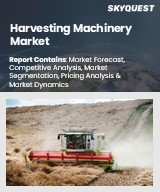
|
시장보고서
상품코드
1576083
수확기 시장 : 기기 유형별, 기술별, 동력원별, 지역별, 기회, 예측(2017-2031년)Harvesting Machinery Market Assessment, By Equipment Type, By Technology, By Power Source, By Region, Opportunities and Forecast, 2017-2031F |
||||||
 Markets & Data
세계 수확기 시장 규모는 예측기간인 2024-2031년에 6.75%의 연평균 복합 성장률(CAGR)로 확대될 것으로 예상되며, 2023년 1,701억 4,000만 달러에서 2031년에는 2,869억 달러로 성장할 것으로 예측됩니다. 이 시장은 식량 수요 증가와 더 나은 농업 기법의 필요성으로 인해 현저한 성장이 예상됩니다. 세계 인구가 증가함에 따라 식량 안보를 위해 식량 생산과 농업 생산성을 향상시켜야 합니다. 수확기는 농작물의 생산성을 향상시키고 작업 부담을 크게 줄입니다.
농업 기계화의 도입은 특히 대다수가 전통적인 농법에 의존하는 개발 도상국에서 급속히 진행되고 있습니다. 많은 사람들이 현대 기계를 도입하기 시작했습니다. 정밀농업의 소개로부터 선진지역의 수확기에는 사물인터넷, 전지구 측위시스템, 인공지능 등의 최신기술이 탑재되고 있으며, 데이터를 실시간으로 분석하여 최적의 수확기술을 결정할 수 있도록 되어 있습니다. 이러한 기술은 효율성을 높이고 자원 낭비를 최소화함으로써 지속 가능한 농업을 지원합니다.
그럼에도 불구하고 수확 설비에 걸리는 초기 비용은 크며 특히 개발 도상 지역의 특정 농가에게는 어려움이 동반 될 수 있습니다. 반면 정부 및 민간 부문은 보조금과 자금 지원을 제공하고 농업 기계의 사용을 장려합니다. 또한 지속가능성이라는 세계적 비전을 바탕으로 에너지 소비량이 적고 친환경 기계를 설계하기 위한 연구개발도 계속되고 있습니다.
이 보고서는 세계 수확기 시장에 대해 조사했으며, 시장 개요와 함께 장비 유형별, 기술별, 동력원별, 지역별 동향 및 시장 진출기업 프로파일 등의 정보를 제공합니다.
목차
제1장 프로젝트의 범위와 정의
제2장 조사 방법
제3장 주요 요약
제4장 고객의 목소리
제5장 세계의 수확기 시장 전망, 2017-2031년
- 시장 규모의 분석과 예측
- 시장 점유율 분석과 예측
- 시장 맵 분석, 2023년
- 기기 유형별
- 기술별
- 동력원별
- 지역별
제6장 북미 수확기 시장 전망, 2017-2031년
제7장 유럽의 수확기 시장 전망, 2017-2031년
제8장 아시아태평양 수확기 시장 전망, 2017-2031년
제9장 남미의 수확기 시장 전망, 2017-2031년
제10장 중동 및 아프리카 수확기 시장 전망, 2017-2031년
제11장 규제 상황
제12장 수요 공급 분석
제13장 수출입 분석
제14장 밸류체인 분석
제15장 Porter's Five Forces 분석
제16장 PESTLE 분석
제17장 거시경제지표
제18장 가격 분석
제19장 이익률 분석
제20장 시장 역학
제21장 시장 동향과 발전
제22장 사례 연구
제23장 경쟁 구도
- 시장 리더 톱 5의 경쟁 매트릭스
- 기업 생태계 분석(스타트업 vs 중소기업 vs 대규모 기업)
- 참가 기업 톱 5의 SWOT 분석
- 시장의 주요 참가 기업 톱 10의 정세
- John Deere Group
- CNH Industrial NV
- AGCO Corporation
- Kubota Corporation
- CLAAS KGaA mbH
- Mahindra & Mahindra Ltd.
- ISEKI & CO., LTD.
- Yanmar Holdings Co., Ltd.
- SDF SpA
- Maschinenfabrik Bernard Krone GmbH & Co. KG
제24장 전략적 제안
제25장 문의 및 면책사항
JHS 24.10.30Global harvesting machinery market is projected to witness a CAGR of 6.75% during the forecast period 2024-2031, growing from USD 170.14 billion in 2023 to USD 286.90 billion in 2031. The market is expected to witness tremendous growth on account of the rising need for food and the need for better agricultural methods. With the increase in the world's population, food production and agricultural productivity have to increase for food security reasons. Harvesting machinery enhances the productivity of crops and significantly reduces the workload involved.
The adoption of farming mechanization is growing quite rapidly, especially in developing countries where the majority of operators rely on traditional farming practices. Many of them have started embracing modern machines. With the introduction of precision farming, harvesting machines in developed regions are being equipped with modern technologies, such as the Internet of Things, Global Positioning System, and Artificial Intelligence, which enable the real-time analysis of data to determine the best possible harvesting technique. These technologies increase effectiveness and support sustainable agricultural practices by minimizing the waste of resources.
Nonetheless, the major upfront cost for harvesting equipment may present some difficulty for certain farmers, especially in developing areas. In response, government and private sectors are offering subsidies and financial assistance to encourage the use of farm machines. Moreover, there are continuing research and development activities to design machines that are less energy-intensive and environmentally friendly in accordance with the global vision of sustainability.
With companies introducing the latest harvesting equipment to the market to gain a competitive edge, in August 2024, GRIMME Landmaschinenfabrik GmbH & Co. KG launched the most recent version of the 45-meter cube bunker-capable 6-row REXOR 6300 beet harvester with the latest generation of cabs. The air-conditioned driver's seat, with a rotation angle of 30 degrees, provides an optimal view toward the collecting transport trailer, i.e., the clamp. Assertive lighting and the SideView camera package ensure that the operator has the best possible visibility around the machine during twilight and at night.
Rising Awareness Among Farmers Catalyzes Market Expansion
The growing consciousness regarding the advantages of harvesting equipment is a primary factor for market expansion. Markets that are still in their growth stages are seeing farmers realizing the extent to which farming mechanization can improve efficiency, reduce reliance on labor, and enhance yields. In addition, the expected long-term cost reductions and fast and efficient harvesting of crops are persuading more farm operators to adopt harvesting equipment.
In addition, education and outreach initiatives by the government, companies, and agricultural institutions are making farmers aware of the positive aspects of improved harvesting technologies. The increasing knowledge is making smaller farms find machinery as an essential tool in helping them survive in this dynamic market.
In April 2024, under its Diploma in Agricultural Machinery curriculum, Pakdee College of Commerce of Technology launched a first-of-its-kind Dual Programme in collaboration with Case IH, a brand of CNH Industrial N.V. In keeping with its long-standing mission to provide Thailand's agricultural talent with skills fit for the future, Case IH gave an Austoft 4000 sugarcane harvester to be used in the practical session being co-led by Pakdee and Case IH instructors. The course gives students a thorough understanding of contemporary harvester technology by covering a wide range of skills, from simple maintenance to complicated equipment assembly.
Integration of Smart Technologies to Influence Market Growth
The global market for harvesting machinery is evolving due to advancements in technology, which promotes efficiency and productivity in farming practices. The introduction of smart technologies, such as the Internet of Things, Global Positioning System, and Artificial Intelligence, leads to precision harvesting, where farmers can manage crops in real time. Installation of automated and semi-automatic machines cuts down on labor costs, increases the utility of the resources, and improves efficiency.
Furthermore, the progress made in sensors and artificial intelligence is making it possible for machines to adjust to various crops and field challenges, thus enhancing efficiency in different environments. These developments enhance productivity while fostering eco-friendly agriculture by preventing excess resource usage and pollution. The efficiency and environmental conservation of harvesting equipment will be improved with the evolving pace of technology.
In December 2023, Mahindra & Mahindra Ltd., under its brand name, Swaraj Tractors, introduced the next-gen Swaraj 8200 Smart Harvester, created to meet the requirements of farmers in India. Swaraj 8200 Smart Harvester presents an innovative Intelligent Harvesting System that provides real-time data on miles driven, fuel usage, harvested acres, and live position monitoring. Farmers benefit from increased profitability, improved decision-making, and operational efficiency as a result. An in-house engine that was developed and constructed for the harvester provides best-in-class fuel economy and complies with ecologically friendly BS-IV emission regulations.
Combine Harvesters to Hold a Significant Market Share
In the global harvesting machinery market, combined harvesters command a considerable portion of the market as they integrate several farming processes. They perform three very essential operations simultaneously, i.e., reaping, threshing, and winnowing, which makes the machines highly appropriate for harvesting cereal crops such as wheat, rice, corn, and others. Their effectiveness in minimizing manual work and time while maximizing crop output has favored their use in many large-scale farming undertakings.
The deployment of new technologies, such as GPS sensors and features of precision farming, have augmented their efficiency, making them the best option for farmers seeking to maximize productivity. As the demand for food continues to grow globally and mechanization advances in developing countries, the introduction of combined harvesters is expected to grow progressively during the forecast years.
In August 2024, the CR10 combine was introduced by New Holland Agriculture, a CNH Industrial N.V. brand, which is a revolutionary tool that will help farmers reduce their overall harvesting costs. A potent 12.9-liter FPT Cursor 13 engine with an astounding 635 hp powers the CR10. When combined with a large 455-bushel grain tank that can unload grain at a pace of 4.5 bushels per second, the CR10 exhibits exceptional efficiency during peak harvesting seasons.
North America to Dominate the Global Harvesting Machinery Market Share
North America is geographically in the first spot in the global harvesting machinery market due to its ability to employ modern techniques and advanced agricultural practices. The area has a significant number of commercial farms, enabling mechanization and increased labor productivity. Also, the market is boosted by the availability of major players and strong distribution channels in the region. In February 2024, John Deere Group, based in the United States, launched the S7 Series of combines, a line of harvesters that aims at delivering efficiency, quality of harvest, and ease of operations. The series consists of four models, S7 600, S7 700, S7 800, and S7 900. An enhanced grain loss monitoring system is another feature of the new S7 Series combines. Moreover, feature automation packages let operators focus on the task at hand and worry less about ground speed and settings, helping novice operators to become more productive in less time.
Moreover, government policies that encourage sustainable agriculture and innovation in farm equipment are contributing to the demand for harvesting machinery. As the need for precision agriculture and automated technologies increases, North America will continue to dominate the market while influencing trends in innovation and harvesting practices.
Future Market Scenario (2024 - 2031F)
With growing emphasis on the efficient use of resources and achieving the maximum possible yields, there will be a need for advanced harvesting solutions for specific crops and field conditions.
Companies are expected to give more attention to overall customer care and servicing to enhance customer fidelity and ensure the proper functioning of the machine.
The increasing need for multi-crop and multi-terrain adaptable machines is expected to impact product innovation, fueling the growth of the market.
Key Players Landscape and Outlook
The global harvesting machinery market is characterized by the presence of a mix of well-established manufacturers and emerging players, contributing to advancements in agricultural efficiency. Key players are focusing on innovation and integrating smart technologies, such as IoT and AI, to enhance machine performance, reduce labor dependence, and provide real-time data for improved decision-making. Furthermore, partnerships and acquisitions are becoming common strategies for entering new markets or strengthening their presence in existing ones. For instance, in August 2024, Yanmar Holdings Co., Ltd. acquired all the shares of CLAAS India, an Indian manufacturer of agricultural machinery, via its group company, Yanmar Coromandel Agrisolutions. Through the acquisition, Yanmar's agribusiness in India will grow faster as a result of the addition of a company that produces dependable and high-quality combine harvesters. This acquisition is expected to increase Yanmar's market share in India, enabling the company to provide a broader choice of products.
The outlook for the harvesting machinery market remains positive, driven by rising global food demand, advancements in precision agriculture, and the growing adoption of automation in farming operations. Emerging markets, especially in Asia-Pacific, are expected to present significant growth opportunities due to the increasing mechanization in agriculture. However, fluctuating commodity prices and high initial investment in machinery may pose challenges. Sustainable and energy-efficient machinery is expected to gain prominence as the industry aligns with environmental concerns.
Table of Contents
1. Project Scope and Definitions
2. Research Methodology
3. Executive Summary
4. Voice of Customer
- 4.1. Demographics (Income - Low, Mid and High; Geography; Nationality; etc.)
- 4.2. Market Awareness and Product Information
- 4.3. Brand Awareness and Loyalty
- 4.4. Factors Considered in Purchase Decision
- 4.4.1. Cost and Financing Options
- 4.4.2. Machine Performance and Efficiency
- 4.4.3. User-Friendliness
- 4.4.4. Technology and Features
- 4.4.5. Brand Reputation and Reliability
- 4.4.6. Maintenance and Support
- 4.4.7. Adaptability and Versatility
- 4.4.8. Warranty
- 4.4.9. After-Sales Services
- 4.4.10. Environmental Impact
- 4.4.11. Government Subsidies
- 4.5. Purchase Channel
- 4.6. Frequency of Purchase
- 4.7. Existing or Intended User
5. Global Harvesting Machinery Market Outlook, 2017-2031F
- 5.1. Market Size Analysis & Forecast
- 5.1.1. By Value
- 5.1.2. By Volume
- 5.2. Market Share Analysis & Forecast
- 5.2.1. By Equipment Type
- 5.2.1.1. Combine Harvesters
- 5.2.1.2. Forage Harvesters
- 5.2.1.3. Vegetable Harvesters
- 5.2.1.4. Fruit Harvesters
- 5.2.1.5. Others
- 5.2.2. By Technology
- 5.2.2.1. Manual Harvesters
- 5.2.2.2. Automated Harvesters
- 5.2.3. By Power Source
- 5.2.3.1. ICE
- 5.2.3.2. Electric
- 5.2.4. By Region
- 5.2.4.1. North America
- 5.2.4.2. Europe
- 5.2.4.3. Asia-Pacific
- 5.2.4.4. South America
- 5.2.4.5. Middle East and Africa
- 5.2.5. By Company Market Share Analysis (Top 5 Companies and Others - By Value, 2023)
- 5.2.1. By Equipment Type
- 5.3. Market Map Analysis, 2023
- 5.3.1. By Equipment Type
- 5.3.2. By Technology
- 5.3.3. By Power Source
- 5.3.4. By Region
6. North America Harvesting Machinery Market Outlook, 2017-2031F*
- 6.1. Market Size Analysis & Forecast
- 6.1.1. By Value
- 6.1.2. By Volume
- 6.2. Market Share Analysis & Forecast
- 6.2.1. By Equipment Type
- 6.2.1.1. Combine Harvesters
- 6.2.1.2. Forage Harvesters
- 6.2.1.3. Vegetable Harvesters
- 6.2.1.4. Fruit Harvesters
- 6.2.1.5. Others
- 6.2.2. By Technology
- 6.2.2.1. Manual Harvesters
- 6.2.2.2. Automated Harvesters
- 6.2.3. By Power Source
- 6.2.3.1. ICE
- 6.2.3.2. Electric
- 6.2.4. By Country Share
- 6.2.4.1. United States
- 6.2.4.2. Canada
- 6.2.4.3. Mexico
- 6.2.1. By Equipment Type
- 6.3. Country Market Assessment
- 6.3.1. United States Harvesting Machinery Market Outlook, 2017-2031F*
- 6.3.1.1. Market Size Analysis & Forecast
- 6.3.1.1.1. By Value
- 6.3.1.1.2. By Volume
- 6.3.1.2. Market Share Analysis & Forecast
- 6.3.1.2.1. By Equipment Type
- 6.3.1.2.1.1. Combine Harvesters
- 6.3.1.2.1.2. Forage Harvesters
- 6.3.1.2.1.3. Vegetable Harvesters
- 6.3.1.2.1.4. Fruit Harvesters
- 6.3.1.2.1.5. Others
- 6.3.1.2.2. By Technology
- 6.3.1.2.2.1. Manual Harvesters
- 6.3.1.2.2.2. Automated Harvesters
- 6.3.1.2.3. By Power Source
- 6.3.1.2.3.1. ICE
- 6.3.1.2.3.2. Electric
- 6.3.1.2.1. By Equipment Type
- 6.3.1.1. Market Size Analysis & Forecast
- 6.3.2. Canada
- 6.3.3. Mexico
- 6.3.1. United States Harvesting Machinery Market Outlook, 2017-2031F*
All segments will be provided for all regions and countries covered
7. Europe Harvesting Machinery Market Outlook, 2017-2031F
- 7.1. Germany
- 7.2. France
- 7.3. Italy
- 7.4. United Kingdom
- 7.5. Russia
- 7.6. Netherlands
- 7.7. Spain
- 7.8. Turkey
- 7.9. Poland
8. Asia-Pacific Harvesting Machinery Market Outlook, 2017-2031F
- 8.1. India
- 8.2. China
- 8.3. Japan
- 8.4. Australia
- 8.5. Vietnam
- 8.6. South Korea
- 8.7. Indonesia
- 8.8. Philippines
9. South America Harvesting Machinery Market Outlook, 2017-2031F
- 9.1. Brazil
- 9.2. Argentina
10. Middle East and Africa Harvesting Machinery Market Outlook, 2017-2031F
- 10.1. Saudi Arabia
- 10.2. UAE
- 10.3. South Africa
11. Regulatory Landscape
12. Demand Supply Analysis
13. Import and Export Analysis
14. Value Chain Analysis
15. Porter's Five Forces Analysis
16. PESTLE Analysis
17. Macro-economic Indicators
18. Pricing Analysis
19. Profit Margin Analysis
20. Market Dynamics
- 20.1. Market Drivers
- 20.2. Market Challenges
21. Market Trends and Developments
22. Case Studies
23. Competitive Landscape
- 23.1. Competition Matrix of Top 5 Market Leaders
- 23.2. Company Ecosystem Analysis (Startup v/s SME v/s Large-scale)
- 23.3. SWOT Analysis for Top 5 Players
- 23.4. Key Players Landscape for Top 10 Market Players
- 23.4.1. John Deere Group
- 23.4.1.1. Company Details
- 23.4.1.2. Key Management Personnel
- 23.4.1.3. Products and Services
- 23.4.1.4. Financials (As Reported)
- 23.4.1.5. Key Market Focus and Geographical Presence
- 23.4.1.6. Recent Developments/Collaborations/Partnerships/Mergers and Acquisition
- 23.4.2. CNH Industrial N.V.
- 23.4.3. AGCO Corporation
- 23.4.4. Kubota Corporation
- 23.4.5. CLAAS KGaA mbH
- 23.4.6. Mahindra & Mahindra Ltd.
- 23.4.7. ISEKI & CO., LTD.
- 23.4.8. Yanmar Holdings Co., Ltd.
- 23.4.9. SDF S.p.A.
- 23.4.10. Maschinenfabrik Bernard Krone GmbH & Co. KG
- 23.4.1. John Deere Group
Companies mentioned above DO NOT hold any order as per market share and can be changed as per information available during research work.