|
시장보고서
상품코드
1609463
비파괴 검사(NDT) 및 점검 시장 평가 : 기술별, 서비스별, 최종 사용자 산업별, 지역별 기회 및 예측(2018-2032년)Non-Destructive Testing and Inspection Market Assessment, By Technique, By Service, By End-use Industry, By Region, Opportunities and Forecast, 2018-2032F |
||||||
 Markets & Data
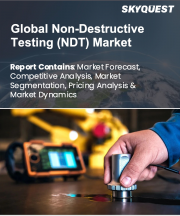
세계의 비파괴 검사(NDT) 및 점검 시장 규모는 2024년 135억 1,000만 달러로 평가되었고, 예측 기간 동안 CAGR 10.02%로 추이할 전망이며, 2032년에는 290억 달러 규모로 성장할 것으로 예측됩니다.
비파괴 검사(NDT) 및 점검은 항공우주, 자동차, 석유 및 가스 등 모든 산업의 장비 진단에서 중요한 역할을 수행합니다. 자동화, 프로세스 최적화, 데이터 관리 강화, 통신 및 프로세스 연결은 모두 이 산업 시프트에 의해 수용되고 있습니다. 이 결과, 인간의 개입은 더 적어지고, 시스템은 고급 소프트웨어 도구와 센서를 사용하여 일반적인 작동, 유지 보수, 모니터링 및 문제 해결을 자동화하도록 돕고 있습니다. 첨단 센서, 계측 기기, 로봇 공학, 자동화가 효과적인 시험과 검사를 지원할 것으로 예상됩니다.
직장의 안전성과 예방에 대한 주목도가 높아지고 있는 가운데, 정부는 업계 전체에서 운전 설비의 감사를 실시하게 되고 있습니다. AI의 도입은 시장에 큰 영향을 주고 있으며, 기계 학습과 AI의 NDT 분야에 대한 임베디드는 혁명적입니다. AI에 의해 구동되는 알고리즘은 방대한 양의 데이터를 조사해 동향을 발견하고 기존에는 생각할 수 없었던 정확도로 예측을 할 수 있습니다. NDT는 결함 검출 자동화, 정밀도 향상, 검사 신속화에 있어 AI를 적용함으로써 더욱 효과적입니다. AI 알고리즘은 대량의 데이터를 분석해 패턴과 이상을 파악하고 인위적 실수와 검사 시간을 배제함으로써 재료 전체의 무결성과 안전성에 대한 평가를 보다 실행 가능하고 직선적인 궤도에 올립니다.
이 보고서는 세계의 비파괴 검사(NDT) 및 점검 시장을 조사했으며, 시장 정의 및 개요, 시장 규모 추이 및 예측, 각종 구분, 지역 및 주요 국가별 상세 분석, 산업 구조, 시장 성장에 대한 영향요인 분석, 사례 연구, 경쟁 구도, 주요 기업 프로파일 등을 정리했습니다.
목차
제1장 프로젝트의 범위 및 정의
제2장 조사 방법
제3장 주요 요약
제4장 고객의 목소리
- 제품 및 시장 정보
- 브랜드인지 모드
- 구매 결정 시 고려되는 요소
- 프라이버시와 규제에 관한 인사이트
제5장 세계의 비파괴 검사(NDT) 및 점검 시장 전망
- 시장 규모의 분석 및 예측
- 시장 점유율의 분석 및 예측
- 기술별
- 서비스별
- 최종 사용자 산업별
- 지역별
- 기업 점유율 분석
- 시장 맵 분석
제6장 북미의 비파괴 검사(NDT) 및 점검 시장 전망
- 시장 규모의 분석 및 예측
- 시장 점유율의 분석 및 예측
- 국가별 시장 평가
- 미국
- 캐나다
- 멕시코
제7장 유럽의 비파괴 검사(NDT) 및 점검 시장 전망
- 독일
- 프랑스
- 이탈리아
- 영국
- 러시아
- 네덜란드
- 스페인
- 터키
- 폴란드
제8장 아시아태평양 비파괴 검사(NDT) 및 점검 시장 전망
- 인도
- 중국
- 일본
- 호주
- 베트남
- 한국
- 인도네시아
- 필리핀
제9장 남미의 비파괴 검사(NDT) 및 점검 시장 전망
- 브라질
- 아르헨티나
제10장 중동 및 아프리카의 비파괴 검사(NDT) 및 점검 시장 전망
- 사우디아라비아
- UAE
- 남아프리카
제11장 수급 분석
제12장 수출입 분석
제13장 밸류체인 분석
제14장 Porter's Five Forces 분석
제15장 PESTLE 분석
제16장 가격 분석
제17장 시장 역학
- 시장 성장 촉진요인
- 시장의 과제
제18장 시장 동향 및 전개
제19장 사례 연구
제20장 경쟁 구도
- 상위 5개사의 경쟁 매트릭스
- 상위 5개사의 SWOT 분석
- 상위 11사의 정세
- Creaform(AMETEK, Inc.)
- Applus Servicios Tecnologicos, SL
- Bureau Veritas, societe anonyme(SA)
- Intertek Group plc
- Olympus(Evident Corporation)
- Ashtead Technology(Ashtead Group)
- MISTRAS Group
- Comet Yxlon GmbH
- Vidisco Ltd.
- Nikon Industrial Metrology NV
제21장 전략적 제안
제22장 회사소개 및 면책사항
AJY 24.12.30Global non-destructive (NDT) testing and inspection market is projected to witness a CAGR of 10.02% during the forecast period 2025-2032, growing from USD 13.51 billion in 2024 to USD 29 billion in 2032.
Non-destructive testing and inspection play a crucial role in equipment diagnosis across industries, including aerospace, automotive, and oil and gas. Automation, process optimization, enhanced data management, communication, and process connectivity have all been embraced by this industrial shift. As a result, less human intervention is required, and systems are encouraged to use sophisticated software tools and sensors to automate general operation, maintenance, monitoring, and troubleshooting. Advanced sensors, instrumentation, robotics, and automation are anticipated to support effective testing and inspection.
The higher focus on workplace safety and prevention leads to governments auditing the operational equipment across the industries. The addition of artificial intelligence heavily influences the market. Incorporating machine learning and artificial intelligence (AI) into the NDT sector is revolutionary. Algorithms driven by AI can examine enormous volumes of data, spot trends, and produce forecasts with previously unheard-of precision. NDT becomes more effective with the application of artificial intelligence (AI) in automating defect detection, increasing accuracy, and speeding up inspections. The AI algorithms analyze large data masses to identify patterns and anomalies, eliminating human error and inspection times, thus taking assessments of entire materials regarding their integrity and safety into a more viable and straighter-line trajectory.
For instance, in September 2024, the Indian Institute of Technology (IIT) Kharagpur launched projects on AI-enabled Non-destructive Testing and Inspection for weld defect analysis. Led by the Centre of Excellence in Advanced Manufacturing Technology (CoEAMT) of the institute, iWeld, an AI-enabled NDT software, is an innovative solution developed for Garden Reach Shipbuilders & Engineers (GRSE) Kolkata, Ministry of Defence. The second solution, "iToFD", under a project funded by (TiH) of IIT Kharagpur, revolutionizes the detection and sizing of weld defects using ultrasonic time-of-flight diffraction (ToFD) data.
Expanding Industrial Equipment and Regulations to Fuel Market Growth
As industries adopt more sophisticated machinery and equipment, the complexity of components also rises. The sophisticated NDT methods could perform checks on complex configurations and materials without destruction. Digital radiography phased array ultrasonic testing and advanced eddy current testing have become part and parcel of requirements to be met for greater precision and efficiency in inspection. Sectors like aerospace, automotive, and, most importantly, energy increasingly turn to NDT as a means through which NDT offers assured integrity for their systems. For example, in aerospace, NDT is required to maintain safety in aircraft manufacturing standards, and even the most minor defective element can cause catastrophic failures.
The rise in safety regulations across various sectors is a major driver for the NDT market. Organizations like OSHA enforce strict compliance measures that require regular inspections to ensure workplace safety and product integrity. The need to adhere to these regulations compels industries to implement robust NDT practices to avoid penalties and ensure operational continuity. Other than OSHA, non-profit organizations and agencies like the Construction Industry Research and Information Association (CIRIA) also add workspace safety and security guidelines.
For instance, in January 2022, CIRIA introduced new guidelines for Non-destructive Testing and Inspection (NDT). By encouraging a more knowledgeable and, eventually, successful use of NDT techniques within the industry, this book seeks to raise an understanding of NDT in civil engineering and help the sector reach its full potential. From asset creation and construction to asset operation and disposal and decommissioning, the publication gives a broad overview of the application of NDT specifically for civil engineering structures (bridges, tunnels, retaining walls, culverts, and so forth) and the benefits it can offer at every stage of their life cycle.
Technological Advancements, Including IoT and AI Integration, to Shape the Market Dynamics
Non-destructive testing and inspection are majorly influenced by adding and integrating new technologies, especially the Internet of Things and predictive maintenance. AI-driven NDT has revolutionized data analysis by enabling the extraction of valuable insights from vast amounts of inspection data. Through machine learning algorithms, AI can recognize patterns, trends, and anomalies in NDT data that might be difficult or impossible for human inspectors to see.
With the integration of AI, NDT is capable of real-time monitoring, significantly enhancing the ability to detect and address issues as they occur. By continuously analyzing data from sensors and other monitoring devices, AI-powered systems can predict potential failures or defects in critical components. This predictive maintenance approach allows you to proactively address issues before they escalate into costly and hazardous problems, increasing safety and operational efficiency.
For instance, in August 2022, AI start-up ALEIA and Omexom NDT Engineering & Services (VINCI Energies SA), along with the acoustics lab Laboratoire d'Acoustique de l'Universite du Mans (LAUM) UMR CNRS, announced the launch of the AUTEND project, which aims to use AI to expedite nuclear power plant inspections. As the pace and volume of inspections at nuclear sites are quickly on the rise, the AUTEND project is designed to streamline and speed up the tasks of field analysts by utilizing AI technology for the automatic recognition of areas that need to be examined.
Manufacturing Segment Becomes the Biggest Segment with Advanced Technology and Upgrades
Based on the end-use industry, the manufacturing segment holds the largest share of the NDT and inspection market. The segment is propelled by constant product quality checks and technological advancements in manufacturing processes. The development of NDT methods is vital for ensuring that products comply with safety standards and are defect-free, and this can help manufacturers prevent costly recalls 3. Moreover, the increasing complexity of manufactured components necessitates advanced testing techniques and maintained operational integrity in various sectors, such as automotive and aerospace 24. As manufacturers focus on the reliability and efficiency of the final product, adopting NDT technologies is essential for optimizing processes and product safety, thus making them a dominant force in the NDT market.
For instance, in October 2023, the renowned surface damage assessment tool VXintegrity, which is available to all non-destructive testing (NDT) service providers in various industries, was updated by Creaform (AMETEK, Inc.) to the 3.0 version. The software update offers an easy-to-use method for those who own assets to gain access to FEA simulations for Level III evaluations and to use American Petroleum Institute (API) 579 standard tools for effortless Level I and II evaluations.
North America Leads the Non-Destructive Testing and Inspection Market
North America holds the major share of the market. This dominance is projected to continue as industries increasingly adopt NDT techniques for quality assurance and safety compliance. The region benefits from stringent safety regulations enforced by organizations like OSHA and PHMSA, which mandate regular inspections across various sectors, including oil and gas, aerospace, and manufacturing. These regulations enhance the demand for reliable NDT services to ensure compliance and operational safety. The presence of numerous training institutes and a skilled workforce in North America supports the effective implementation of NDT techniques. The availability of expertise ensures high-quality service delivery, making it an attractive region for NDT operations. Companies from the United States and Canada experiment with the NDT tools while targeting specific industries.
For instance, in October 2024, United States' NDT Global launched a new 56-inch ultrasonic inline inspection tool, developed in partnership with Aramco, to meet the specific inspection needs of large-diameter pipelines. The tool can navigate complex pipeline networks while delivering precise crack and metal loss detection.
Future Market Scenario (2025-2032F)
The rise of 3D imaging and digital radiography is likely to enhance defect detection and analysis in NDT, providing detailed visuals for better decision-making.
Robotic systems and drones are increasingly utilized for inspections in hazardous or hard-to-reach areas, improving efficiency and safety.
These technologies enable faster data processing and anomaly detection, allowing for proactive maintenance strategies in NDT.
The implementation of embedded sensors allows continuous asset assessment, facilitating immediate responses to detected anomalies.
Key Players Landscape and Outlook
The non-destructive testing and inspection market is characterized by a competitive landscape where key players adopt various strategies to enhance their market presence and meet the evolving demands of the maritime industry. A significant focus is on innovation and technological advancement, with companies investing in research and development to create efficient propulsion systems, including hybrid and electric solutions that comply with stringent environmental regulations. Many players are also pursuing strategic partnerships and collaborations to leverage complementary strengths, share resources, and accelerate the development of advanced technologies. Additionally, sustainability is emphasized as companies seek to reduce emissions and improve fuel efficiency in response to growing regulatory pressures and consumer demand for greener solutions.
For instance, in February 2022, Wartsila Corporation announced its collaboration with Solstad Offshore for fleet decarbonization, with a goal of achieving a 50% reduction in CO2 emissions by 2030. The agreement aims to identify, evaluate, and implement solutions that will enhance fuel efficiency and substantially decrease greenhouse gas (GHG) emissions from offshore vessels.
Table of Contents
1. Project Scope and Definitions
2. Research Methodology
3. Executive Summary
4. Voice of Customer
- 4.1. Product and Market Intelligence
- 4.2. Mode of Brand Awareness
- 4.3. Factors Considered in Purchase Decisions
- 4.3.1. Certification and Qualifications
- 4.3.2. Quality Management System
- 4.3.3. Technology and Equipment
- 4.3.4. Experience and Track Records
- 4.3.5. Compliance with Regulations
- 4.4. Consideration of Privacy and Regulations
5. Global Non-destructive Testing and Inspection Market Outlook, 2018-2032F
- 5.1. Market Size Analysis & Forecast
- 5.1.1. By Value
- 5.2. Market Share Analysis & Forecast
- 5.2.1. By Technique
- 5.2.1.1. Ultrasonic Testing
- 5.2.1.2. Visual Testing
- 5.2.1.3. Magnetic Particle
- 5.2.1.4. Liquid Penetration
- 5.2.1.5. Eddy-Current
- 5.2.1.6. Radiographic
- 5.2.1.7. Acoustic Emission
- 5.2.1.8. Others
- 5.2.2. By Service
- 5.2.2.1. Inspection Services
- 5.2.2.2. Equipment Rental Services
- 5.2.2.3. Calibration Services
- 5.2.2.4. Training Services
- 5.2.3. By End-use Industry
- 5.2.3.1. Manufacturing
- 5.2.3.2. Oil and Gas
- 5.2.3.3. Power Generation
- 5.2.3.4. Chemicals
- 5.2.3.5. Healthcare Equipment
- 5.2.3.6. Aerospace
- 5.2.3.7. Automotive
- 5.2.3.8. Others
- 5.2.4. By Region
- 5.2.4.1. North America
- 5.2.4.2. Europe
- 5.2.4.3. Asia-Pacific
- 5.2.4.4. South America
- 5.2.4.5. Middle East and Africa
- 5.2.5. By Company Market Share Analysis (Top 5 Companies and Others - By Value, 2024)
- 5.2.1. By Technique
- 5.3. Market Map Analysis, 2024
- 5.3.1. By Technique
- 5.3.2. By Service
- 5.3.3. By End-use Industry
- 5.3.4. By Region
6. North America Non-destructive Testing and Inspection Market Outlook, 2018-2032F*
- 6.1. Market Size Analysis & Forecast
- 6.1.1. By Value
- 6.2. Market Share Analysis & Forecast
- 6.2.1. By Technique
- 6.2.1.1. Ultrasonic Testing
- 6.2.1.2. Visual Testing
- 6.2.1.3. Magnetic Particle
- 6.2.1.4. Liquid Penetration
- 6.2.1.5. Eddy-Current
- 6.2.1.6. Radiographic
- 6.2.1.7. Acoustic Emission
- 6.2.1.8. Others
- 6.2.2. By Service
- 6.2.2.1. Inspection Services
- 6.2.2.2. Equipment Rental Services
- 6.2.2.3. Calibration Services
- 6.2.2.4. Training Services
- 6.2.3. By End-use Industry
- 6.2.3.1. Manufacturing
- 6.2.3.2. Oil and Gas
- 6.2.3.3. Power Generation
- 6.2.3.4. Chemicals
- 6.2.3.5. Healthcare Equipment
- 6.2.3.6. Aerospace
- 6.2.3.7. Automotive
- 6.2.3.8. Others
- 6.2.4. By Country Share
- 6.2.4.1. United States
- 6.2.4.2. Canada
- 6.2.4.3. Mexico
- 6.2.1. By Technique
- 6.3. Country Market Assessment
- 6.3.1. United States Non-destructive Testing and Inspection Market Outlook, 2018-2032F*
- 6.3.1.1. Market Size Analysis & Forecast
- 6.3.1.1.1. By Value
- 6.3.1.2. Market Share Analysis & Forecast
- 6.3.1.2.1. By Technique
- 6.3.1.2.1.1. Ultrasonic Testing
- 6.3.1.2.1.2. Visual Testing
- 6.3.1.2.1.3. Magnetic Particle
- 6.3.1.2.1.4. Liquid Penetration
- 6.3.1.2.1.5. Eddy-Current
- 6.3.1.2.1.6. Radiographic
- 6.3.1.2.1.7. Acoustic Emission
- 6.3.1.2.1.8. Others
- 6.3.1.2.2. By Service
- 6.3.1.2.2.1. Inspection Services
- 6.3.1.2.2.2. Equipment Rental Services
- 6.3.1.2.2.3. Calibration Services
- 6.3.1.2.2.4. Training Services
- 6.3.1.2.3. By End-use Industry
- 6.3.1.2.3.1. Manufacturing
- 6.3.1.2.3.2. Oil and Gas
- 6.3.1.2.3.3. Power Generation
- 6.3.1.2.3.4. Chemicals
- 6.3.1.2.3.5. Healthcare Equipment
- 6.3.1.2.3.6. Aerospace
- 6.3.1.2.3.7. Automotive
- 6.3.1.2.3.8. Others
- 6.3.1.2.1. By Technique
- 6.3.1.1. Market Size Analysis & Forecast
- 6.3.2. Canada
- 6.3.3. Mexico
- 6.3.1. United States Non-destructive Testing and Inspection Market Outlook, 2018-2032F*
All segments will be provided for all regions and countries covered
7. Europe Non-destructive Testing and Inspection Market Outlook, 2018-2032F
- 7.1. Germany
- 7.2. France
- 7.3. Italy
- 7.4. United Kingdom
- 7.5. Russia
- 7.6. Netherlands
- 7.7. Spain
- 7.8. Turkey
- 7.9. Poland
8. Asia-Pacific Non-destructive Testing and Inspection Market Outlook, 2018-2032F
- 8.1. India
- 8.2. China
- 8.3. Japan
- 8.4. Australia
- 8.5. Vietnam
- 8.6. South Korea
- 8.7. Indonesia
- 8.8. Philippines
9. South America Non-destructive Testing and Inspection Market Outlook, 2018-2032F
- 9.1. Brazil
- 9.2. Argentina
10. Middle East and Africa Non-destructive Testing and Inspection Market Outlook, 2018-2032F
- 10.1. Saudi Arabia
- 10.2. UAE
- 10.3. South Africa
11. Demand Supply Analysis
12. Import and Export Analysis
13. Value Chain Analysis
14. Porter's Five Forces Analysis
15. PESTLE Analysis
16. Pricing Analysis
17. Market Dynamics
- 17.1. Market Drivers
- 17.2. Market Challenges
18. Market Trends and Developments
19. Case Studies
20. Competitive Landscape
- 20.1. Competition Matrix of Top 5 Market Leaders
- 20.2. SWOT Analysis for Top 5 Players
- 20.3. Key Players Landscape for Top 10 Market Players
- 20.3.1. Creaform (AMETEK, Inc.)
- 20.3.1.1. Company Details
- 20.3.1.2. Key Management Personnel
- 20.3.1.3. Products and Services
- 20.3.1.4. Financials (As Reported)
- 20.3.1.5. Key Market Focus and Geographical Presence
- 20.3.1.6. Recent Developments/Collaborations/Partnerships/Mergers and Acquisition
- 20.3.2. Applus+ Servicios Tecnologicos, S.L
- 20.3.3. Bureau Veritas, societe anonyme (SA)
- 20.3.4. Intertek Group plc
- 20.3.5. Olympus (Evident Corporation)
- 20.3.6. Ashtead Technology (Ashtead Group)
- 20.3.7. MISTRAS Group
- 20.3.8. Comet Yxlon GmbH
- 20.3.9. Vidisco Ltd.
- 20.3.10. Nikon Industrial Metrology NV
- 20.3.1. Creaform (AMETEK, Inc.)
Companies mentioned above DO NOT hold any order as per market share and can be changed as per information available during research work.