|
시장보고서
상품코드
1624830
농업용 생물제제 시장 : 제품 유형별, 제품 원료별, 적용 방법별, 작물 유형별, 주요 지역별-업계 동향 및 예측(-2035년)Agricultural Biologicals Market by Type of Product, Source of Product, Mode of Application Type of Crop Treated and Key Geographical Regions : Industry Trends and Global Forecasts, Till 2035 |
||||||

세계의 농업용 생물제제 시장 규모는 2035년까지 예측 기간 동안 10%의 연평균 복합 성장률(CAGR)로 확대될 전망이며, 현재 151억 2,000만 달러에서 2035년까지 435억 3,000만 달러로 성장할 것으로 예측됩니다.
농업용 생물제제는 토양 비옥도, 생물학적 활성, 식물의 성장을 향상시키는 데 사용되는 다양한 제품(천연 유래 미생물, 식물 추출물, 익충 및 기타 유기물 유래)을 포함합니다. 이러한 제품은 친환경적이고 생태계에 유해한 잔류물을 남기지 않아 농가나 소비자의 건강에 대한 위험을 줄여줍니다. 농업용 생물 제제는 기존의 화학 비료나 농약에 대한 의존을 줄이는 것을 주된 목적으로 자주 사용되고 있습니다.
예를 들어, Novozymes와 같은 기업은 Bayer 및 이 분야에서 유명한 다른 기업과 공동으로 미생물 제품이 농약과 비료의 효과적인 대체품과 보충제 역할을 한다고 제안했습니다. 이 혁명은 다양한 수준에서 이해관계자에게 이익을 가져올 것으로 예상됩니다. 미래에 소비자들은 자신들의 음식이 안전하고 지속 가능한 방법으로 재배된 것이라는 보장을 얻게 될 것으로 생각됩니다. 또한 농가는 재생농업을 위한 새로운 도구를 이용할 수 있게 되고, 기후변화와 싸우기 위한 탄소격리 등 지속가능한 서비스를 통해 새로운 수입원을 개척할 수 있게 될 것으로 예상됩니다. 또한 유기농 작물에 대한 수요 증대, 지속가능한 농업관행에 대한 관심 증대, 천연자원 보호에 힘입어 농업용 생물제제 시장은 향후 10년간 안정적인 성장을 이룰 것으로 예상됩니다.
현재 200개 이상의 기업이 지속가능한 농업을 위한 농업용 생물제제를 제공하고 있으며, 2000년 이후에는 105개 기업 가까이가 이 분야에 진출하고 있습니다.
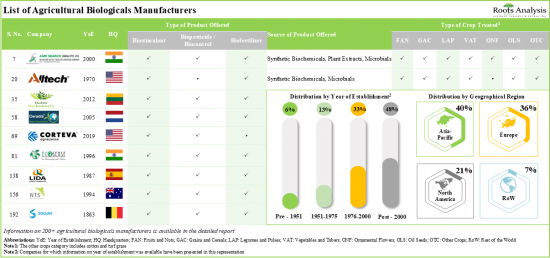
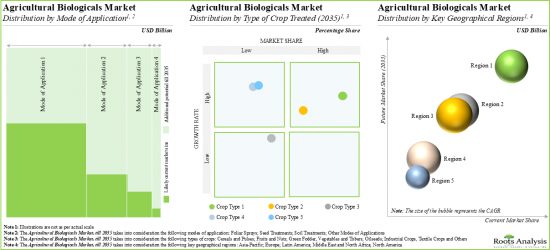
본 보고서에서는 세계의 농업용 생물제제 시장에 대해 조사했으며, 시장 개요와 함께 제품 유형별, 제품 원료별, 적용 방법별, 작물 유형별, 지역별 동향 및 시장 진출기업 프로파일 등 를 제공합니다.
목차
제1장 서문
제2장 조사 방법
제3장 경제 및 기타 프로젝트 특유의 고려 사항
제4장 주요 요약
제5장 서문
제6장 시장 상황
제7장 기업 경쟁력 분석
- 장의 개요
- 전제 및 주요 파라미터
- 조사 방법
- 기업 경쟁력 분석 : 북미의 농업용 생물제제 제조업체
- 기업 경쟁력 분석 : 유럽의 농업용 생물제제 제조업체
- 기업 경쟁력 분석 : 아시아태평양 및 기타 지역의 농업용 생물제제 제조업체
- 기업 경쟁력 분석 : 기타 농업용 생물제제 제조업체
제8장 기업 프로파일
제9장 파트너십 및 협업
제10장 특허 분석
제11장 Porter's Five Forces 분석
제12장 시장에 미치는 영향 분석 : 촉진요인, 억제요인, 기회, 과제
제13장 세계의 농업용 생물제제 시장
제14장 농업용 생물제제 시장 : 제품 유형별
제15장 농업용 생물제제 시장 : 제품 원료별
제16장 농업용 생물제제 시장 : 적용 방법별
제17장 농업용 생물제제 시장 : 작물 유형별
제18장 농업용 생물제제 시장 : 지역별
제19장 결론
제20장 주요 인사이트
- 장의 개요
- Vegalab
- Acadian Plant Health
- Jiahe Biology
제21장 부록 1 : 표 형식의 데이터
제22장 부록 2 : 기업 및 단체 일람
AJY 25.01.17AGRICULTURAL BIOLOGICALS MARKET: OVERVIEW
As per Roots Analysis, the global agricultural biologicals market is estimated to grow from USD 15.12 billion in the current year to USD 43.53 billion by 2035, at a CAGR of 10% during the forecast period, till 2035.
The market sizing and opportunity analysis has been segmented across the following parameters:
Type of Product
- Biopesticide / Biocontrol
- Biofertilizer
- Biostimulant
Source of Product
- Microbes
- Plant Extracts
- Other Sources
Mode of Application
- Foliar Sprays
- Seed Treatments
- Soil Treatments
- Other Application Methods
Type of Crop Treated
- Cereals and Pulses
- Fruits and Nuts
- Oilseeds
- Green Fodder, Vegetables and Tubers
- Industrial Crops, Textile Crops and Others
Key Geographical Regions
- North America
- Europe
- Asia-Pacific
- Rest of the World
AGRICULTURAL BIOLOGICALS MARKET: GROWTH AND TRENDS
Agricultural biologicals encompass a diverse array of products (derived from naturally occurring microorganisms, plant extracts, beneficial insects or other organic matter) used for enhancing soil fertility, biological activity, and the growth of plants. These products are environmentally friendly, leave no harmful residues in the ecosystem and mitigate risks to the health of farmers and consumers. Agricultural biologicals are frequently used with the primary objective of reducing the reliance on conventional chemical fertilizers and agrochemicals. For instance, companies like Novozymes, in collaboration with Bayer and other prominent companies in this domain, propose that their microbial products can serve as an effective alternative or supplement for agrochemicals and fertilizers. This revolution is expected to benefit stakeholders at various levels. In the future, consumers are likely to gain assurance that their food is cultivated in a safe and sustainable manner. Additionally, farmers are anticipated to have access to new tools for regenerative agriculture and can explore additional revenue streams through sustainable services, such as carbon sequestration to combat climate change. Further, driven by the rising demand for organically grown crops, growing focus on sustainable agricultural practices and preservation of natural resources, the agricultural biologicals market is anticipated to witness steady growth in the coming decade.
AGRICULTURAL BIOLOGICALS MARKET: KEY INSIGHTS
The report delves into the current state of the agricultural biologicals market and identifies potential growth opportunities within the industry. Some key findings from the report include:
1. Presently, over 200 companies claim to offer agricultural biologicals for sustainable farming; close to 105 such players have entered this domain post - 2000.
2. 40% of the agricultural biological providers offer all three kinds of products for various types of crops; over 85% of such players provide these products as foliar sprays.
3. In pursuit of building a competitive edge in this field, stakeholders are actively upgrading their existing capabilities and adding new competencies in order to enhance their respective product portfolios.
4. The growing interest in this domain is evident from the rise in partnership activity; in fact, 43 partnership deals related to agricultural biologicals were inked recently.
5. Since 2019, more than 1,300 patents have been filed / granted by various stakeholders in order to protect the intellectual property generated within this domain.
6. Driven by the increasing pace of innovation and partnership activity, the market for agricultural biologicals is poised to witness steady growth in the foreseeable future.
7. As a result of the growing demand for organic food products, the agricultural biologicals market is likely to grow at a CAGR of ~10% over the coming years.
8. The agricultural biologicals market is expected to be well distributed across different type of products, source of products, modes of application, type of crops treated and key geographical regions.
AGRICULTURAL BIOLOGICALS MARKET: KEY SEGMENTS
Currently, Biopesticide / Biocontrol Occupies the Largest Share of the Agricultural Biologicals Market
Based on the type of product, the market is segmented into biopesticides / biocontrols, biofertilizers and biostimulants. At present, biopesticide / biocontrol holds the maximum share of the agricultural biologicals market. It is worth highlighting that the agricultural biologicals market for biofertilizer is likely to grow at a relatively higher CAGR.
Plant Extract is the Fastest Growing Segment of the Agricultural Biologicals Market During the Forecast Period
Based on the source of product, the market is segmented into microbes, plant extracts and other sources. At present, microbes hold the maximum share within the agricultural biologicals market. This trend is unlikely to change in the near future.
Foliar Sprays is Likely to Dominate the Agricultural Biologicals Market During the Forecast Period
Based on the mode of application, the market is segmented into foliar sprays, seed treatments, soil treatments and other application methods. Currently, foliar spray holds the maximum share of the agricultural biologicals market. This trend is likely to remain the same in the forthcoming years. It is worth highlighting that the agricultural biologicals market for seed treatments is likely to grow at a relatively higher CAGR.
Currently, Cereals and Pulses Occupy the Largest Share of the Agricultural Biologicals Market
Based on the type of crop treated, the market is segmented into cereals and pulses, fruits and nuts, oilseeds, green fodder, vegetables and tubers, and industrial crops, textile crops and others. It is worth highlighting that, at present, cereals and pulses hold a larger share in the agricultural biologicals market. This trend is likely to remain the same in the coming decade.
North America Accounts for the Largest Share of the Market
Based on key geographical regions, the market is segmented into North America, Europe, Asia-Pacific, Middle East and North Africa, and Latin America. It is worth highlighting that, over the years, the market in the rest of the world is expected to grow at a higher CAGR.
Example Players in the Agricultural Biologicals Market
- AMVAC
- Andermatt
- BASF SE
- Bayer AG
- BioSafe Systems
- Brandt
- Chr. Hansen
- Certis Biologicals
- Corteva Agriscience
- FBSciences
- Grow Indigo
- Koppert Biological Systems
- Lallemand
- Nutri-Tech Solutions
- Novozymes
- PI Industries
- ProFarm
- SQM
- Stoller
- Syngenta
- UPL
- Vegalab
- Valent Biosciences
- Verdisian Life Sciences
Primary Research Overview
The opinions and insights presented in this study were influenced by discussions conducted with multiple stakeholders. The research report features detailed transcripts of interviews held with the following industry stakeholders:
- President, Vegalab
- Global Director, Acadian Plant Health
- Sales Representative, Jiahe Biology
AGRICULTURAL BIOLOGICALS MARKET: RESEARCH COVERAGE
- Market Sizing and Opportunity Analysis: The report features an in-depth analysis of the agricultural biologicals market, focusing on key market segments, including [A] type of product, [B] source of product, [C] mode of application, [D] type of crop treated and [E] key geographical regions.
- Market Landscape: A comprehensive evaluation of companies offering agricultural biologics, considering various parameters, such as [A] year of establishment, [B] company size (in terms of number of employees), [C] location of headquarters, [D] type of product offered, [E] type of biostimulant offered, [F] type of biopesticide / biocontrol offered, [G] type of biofertilizer offered, [H] source of product offered, [I] type of product formulation, [J] type of crop treated, [K] mode of application, [L] number of products offered and [M] most active players (based on number of products offered).
- Company Competitiveness Analysis: A comprehensive competitive analysis of companies offering agricultural biologicals, examining factors, such as [A] supplier strength and [B] product portfolio strength.
- Company Profiles: In-depth profiles of key industry players offering agricultural biologicals, focusing on [A] company overviews, [B] financial information (if available), [C] product portfolio, [D] recent developments and [E] an informed future outlook.
- Partnerships and Collaborations: An analysis of partnerships established in this sector, since 2020, covering distribution agreements, product development agreements, acquisitions, product development and commercialization agreements, research and development agreements, asset acquisitions, commercialization agreements, supply agreements, product development and distribution agreements, and product integration agreements.
- Patent Analysis: Detailed analysis of various patents filed / granted related to agricultural biologicals based on [A] publication year, [B] geographical region, [C] CPC symbols, [D] leading players (in terms of number of patents filled / granted) and [E] type of organization. It also includes [F] a patent benchmarking analysis and [G] a detailed valuation analysis.
- Porter's Five Forces: A qualitative analysis of the five competitive forces, including threats for new entrants, bargaining power of agricultural biologicals developers, bargaining power of end-users, threats of substitute products and rivalry among existing competitors under an insightful Porter's Five Forces framework.
- Market Impact Analysis: The report analyzes various factors such as drivers, restraints, opportunities, and challenges affecting the market growth.
KEY QUESTIONS ANSWERED IN THIS REPORT
- How many companies are currently engaged in this market?
- Which are the leading companies in this market?
- What kind of partnership models are commonly adopted by industry stakeholders?
- What factors are likely to influence the evolution of this market?
- What is the current and future market size?
- What is the CAGR of this market?
- How is the current and future market opportunity likely to be distributed across key market segments?
REASONS TO BUY THIS REPORT
- The report provides a comprehensive market analysis, offering detailed revenue projections of the overall market and its specific sub-segments. This information is valuable to both established market leaders and emerging entrants.
- Stakeholders can leverage the report to gain a deeper understanding of the competitive dynamics within the market. By analyzing the competitive landscape, businesses can make informed decisions to optimize their market positioning and develop effective go-to-market strategies.
- The report offers stakeholders a comprehensive overview of the market, including key drivers, barriers, opportunities, and challenges. This information empowers stakeholders to stay abreast of market trends and make data-driven decisions to capitalize on growth prospects.
ADDITIONAL BENEFITS
- Complimentary PPT Insights Packs
- Complimentary Excel Data Packs for all Analytical Modules in the Report
- 10% Free Content Customization
- Detailed Report Walkthrough Session with Research Team
- Free Updated report if the report is 6-12 months old or older
TABLE OF CONTENTS
1. PREFACE
- 1.1. Agricultural Biologicals Market Overview
- 1.2. Key Market Insights
- 1.3. Scope of the Report
- 1.4. Research Methodology
- 1.5. Frequently Asked Questions
- 1.6. Chapter Outlines
2. RESEARCH METHODOLOGY
- 2.1. Chapter Overview
- 2.2. Research Assumptions
- 2.3. Project Methodology
- 2.4. Forecast Methodology
- 2.5. Robust Quality Control
- 2.6. Key Market Segmentations
- 2.7. Key Considerations
- 2.7.1. Demographics
- 2.7.2. Economic Factors
- 2.7.3. Government Regulations
- 2.7.4. Supply Chain
- 2.7.5. COVID Impact / Related Factors
- 2.7.6. Market Access
- 2.7.7. Healthcare Policies
- 2.7.8. Industry Consolidation
3. ECONOMIC AND OTHER PROJECT SPECIFIC CONSIDERATIONS
- 3.1. Chapter Overview
- 3.2. Market Dynamics
- 3.2.1. Time Period
- 3.2.1.1. Historical Trends
- 3.2.1.2. Current and Forecasted Estimates
- 3.2.2. Currency Coverage
- 3.2.2.1. Overview of Major Currencies Affecting the Market
- 3.2.2.2. Impact of Currency Fluctuations on the Industry
- 3.2.3. Foreign Exchange Impact
- 3.2.3.1. Evaluation of Foreign Exchange Rates and their Impact on Market
- 3.2.3.2. Strategies for Mitigating Foreign Exchange Risk
- 3.2.4. Recession
- 3.2.4.1. Historical Analysis of Past Recessions and Lessons Learnt
- 3.2.4.2. Assessment of Current Economic Conditions and Potential Impact on the Market
- 3.2.5. Inflation
- 3.2.5.1. Measurement and Analysis of Inflationary Pressures in the Economy
- 3.2.5.2. Potential Impact of Inflation on the Market Evolution
- 3.2.1. Time Period
4. EXECUTIVE SUMMARY
5. INTRODUCTION
- 5.1. Chapter Overview
- 5.2. Sustainable Agriculture
- 5.3. Introduction to Agricultural Biologicals
- 5.3.1. Types of Agricultural Biologicals
- 5.3.1.1. Biostimulants
- 5.3.1.2. Biopesticides / Biocontrols
- 5.3.1.3. Biofertilizers
- 5.3.2. Advantages of Agricultural Biologicals
- 5.3.1. Types of Agricultural Biologicals
- 5.4. Future Perspectives
6. MARKET LANDSCAPE
- 6.1. Chapter Overview
- 6.2. Agricultural Biologicals Manufacturers: Overall Market Landscape
- 6.2.1. Analysis by Year of Establishment
- 6.2.2. Analysis by Company Size
- 6.2.3. Analysis by Year of Establishment and Company Size
- 6.2.4. Analysis by Location of Headquarters
- 6.2.5. Analysis by Company Size and Location of Headquarters
- 6.2.6. Analysis by Type of Product Offered
- 6.2.7. Analysis by Company Size and Type of Product Offered
- 6.2.8. Analysis by Source of Product Offered
- 6.2.9. Analysis by Type of Product Formulation
- 6.2.10. Analysis by Type of Crop Treated
- 6.2.11. Analysis by Mode of Application
- 6.2.12. Analysis by Number of Products Offered
- 6.2.13. Most Active Players: Analysis by Number of Products Offered
7. COMPANY COMPETITIVENESS ANALYSIS
- 7.1. Chapter Overview
- 7.2. Assumptions and Key Parameters
- 7.3. Methodology
- 7.4. Company Competitiveness Analysis: Agricultural Biologicals Manufacturers in North America
- 7.4.1. Very Small and Small Companies in North America
- 7.4.2. Mid-sized Companies in North America
- 7.4.3. Large and Very Large Companies in North America
- 7.5. Company Competitiveness Analysis: Agricultural Biologicals Manufacturers in Europe
- 7.5.1. Very Small and Small Companies in Europe
- 7.5.2. Mid-sized Companies in Europe
- 7.5.3. Large and Very Large Companies in Europe
- 7.6. Company Competitiveness Analysis: Agricultural Biologicals Manufacturers in Asia-Pacific and Rest of the World
- 7.6.1. Very Small and Small Companies in Asia-Pacific and Rest of the World
- 7.6.2. Mid-sized Companies in Asia-Pacific and Rest of the World
- 7.6.3. Large and Very Large Companies in Asia-Pacific and Rest of the World
- 7.7. Company Competitiveness Analysis: Other Agricultural Biologicals Manufacturers
8. COMPANY PROFILES
- 8.1. Chapter Overview
- 8.2. Leading Players in Agricultural Biologicals Market
- 8.2.1. Andermatt
- 8.2.1.1. Company Overview
- 8.2.1.2. Agricultural Biologicals Portfolio
- 8.2.1.3. Recent Developments and Future Outlook
- 8.2.2. Certis Biologicals
- 8.2.2.1. Company Overview
- 8.2.2.2. Agricultural Biologicals Portfolio
- 8.2.2.3. Recent Developments and Future Outlook
- 8.2.3. Corteva Agriscience
- 8.2.3.1. Company Overview
- 8.2.3.2. Financial Information
- 8.2.3.3. Agricultural Biologicals Portfolio
- 8.2.3.4. Recent Developments and Future Outlook
- 8.2.4. Nutri-Tech Solutions
- 8.2.4.1. Company Overview
- 8.2.4.2. Agricultural Biologicals Portfolio
- 8.2.4.3. Recent Developments and Future Outlook
- 8.2.5. Novozymes
- 8.2.5.1. Company Overview
- 8.2.5.2. Financial Information
- 8.2.5.3. Agricultural Biologicals Portfolio
- 8.2.5.4. Recent Developments and Future Outlook
- 8.2.6. ProFarm
- 8.2.6.1. Company Overview
- 8.2.6.2. Agricultural Biologicals Portfolio
- 8.2.6.3. Recent Developments and Future Outlook
- 8.2.7. SQM
- 8.2.7.1. Company Overview
- 8.2.7.2. Agricultural Biologicals Portfolio
- 8.2.7.3. Recent Developments and Future Outlook
- 8.2.8. UPL
- 8.2.8.1. Company Overview
- 8.2.8.2. Financial Information
- 8.2.8.3. Agricultural Biologicals Portfolio
- 8.2.8.4. Recent Developments and Future Outlook
- 8.2.9. Vegalab
- 8.2.9.1. Company Overview
- 8.2.9.2. Agricultural Biologicals Portfolio
- 8.2.9.3. Recent Developments and Future Outlook
- 8.2.1. Andermatt
- 8.3. Other Leading Players in Agricultural Biologicals Market
- 8.3.1. AMVAC
- 8.3.1.1. Company Overview
- 8.3.1.2. Agricultural Biologicals Portfolio
- 8.3.2. BASF
- 8.3.2.1. Company Overview
- 8.3.2.2. Agricultural Biologicals Portfolio
- 8.3.3. Bayer
- 8.3.3.1. Company Overview
- 8.3.3.2. Agricultural Biologicals Portfolio
- 8.3.4. BioSafe Systems
- 8.3.4.1. Company Overview
- 8.3.4.2. Agricultural Biologicals Portfolio
- 8.3.5. Brandt
- 8.3.5.1. Company Overview
- 8.3.5.2. Agricultural Biologicals Portfolio
- 8.3.6. Chr. Hansen
- 8.3.6.1. Company Overview
- 8.3.6.2. Agricultural Biologicals Portfolio
- 8.3.7. FBSciences
- 8.3.7.1. Company Overview
- 8.3.7.2. Agricultural Biologicals Portfolio
- 8.3.8. Grow Indigo
- 8.3.8.1. Company Overview
- 8.3.8.2. Agricultural Biologicals Portfolio
- 8.3.9. Koppert
- 8.3.9.1. Company Overview
- 8.3.9.2. Agricultural Biologicals Portfolio
- 8.3.10. Lallemand
- 8.3.10.1. Company Overview
- 8.3.10.2. Agricultural Biologicals Portfolio
- 8.3.11. PI Industries
- 8.3.11.1. Company Overview
- 8.3.11.2. Agricultural Biologicals Portfolio
- 8.3.12. Stoller
- 8.3.12.1. Company Overview
- 8.3.12.2. Agricultural Biologicals Portfolio
- 8.3.13. Syngenta
- 8.3.13.1. Company Overview
- 8.3.13.2. Agricultural Biologicals Portfolio
- 8.3.14. Valent Biosciences
- 8.3.14.1. Company Overview
- 8.3.14.2. Agricultural Biologicals Portfolio
- 8.3.15. Verdesian Life Sciences
- 8.3.15.1. Company Overview
- 8.3.15.2. Agricultural Biologicals Portfolio
- 8.3.1. AMVAC
9. PARTNERSHIPS AND COLLABORATIONS
- 9.1. Chapter Overview
- 9.2. Partnership Models
- 9.3. Agricultura Biologicals: Recent Partnerships and Collaborations
- 9.3.1. Analysis by Year of Partnership
- 9.3.2. Analysis by Type of Partnership
- 9.3.3. Analysis by Year and Type of Partnership
- 9.3.4. Analysis by Type of Partnership and Company Size
- 9.3.5. Analysis by Focus Area of Partnership
- 9.3.6. Analysis by Type of Partner
- 9.3.7. Most Active Players: Analysis by Number of Partnerships
- 9.3.8. Analysis by Geography
- 9.3.8.1. Local and International Agreements
- 9.3.8.2. Intracontinental and Intercontinental Agreements
10. PATENT ANALYSIS
- 10.1. Chapter Overview
- 10.2. Scope and Methodology
- 10.3. Agricultural Biologicals: Patent Analysis
- 10.3.1. Analysis by Patent Publication Year
- 10.3.2. Analysis by Patent Application Year
- 10.3.3. Analysis of Granted Patents and Patent Applications by Publication Year
- 10.3.4. Analysis by Patent Jurisdiction
- 10.3.5. Analysis by CPC Symbols
- 10.3.6. Analysis by Type of Applicant
- 10.3.7. Leading Industry Players: Analysis by Number of Patents
- 10.3.8. Leading Non-Industry Players: Analysis by Number of Patents
- 10.3.9. Leading Individual Assignees: Analysis by Number of Patents
- 10.4. Agricultural Biologicals: Patent Benchmarking Analysis
- 10.4.1. Analysis by Patent Characteristics
- 10.5. Agricultural Biologicals: Patent Valuation
- 10.6. Leading Patents by Number of Citations
11. PORTER'S FIVE FORCES ANALYSIS
- 11.1. Chapter Overview
- 11.2. Methodology and Assumptions
- 11.3. Key Parameters
- 11.3.1. Threats of New Entrants
- 11.3.2. Bargaining Power of End-Users
- 11.3.3. Bargaining Power of Product Developers
- 11.3.4. Threats of Substitute Products
- 11.3.5. Rivalry Among Existing Competitors
- 11.4. Concluding Remarks
12. MARKET IMPACT ANALYSIS: DRIVERS, RESTRAINTS, OPPORTUNITIES AND CHALLENGES
- 12.1. Chapter Overview
- 12.2. Market Drivers
- 12.3. Market Restraints
- 12.4. Market Opportunities
- 12.5. Market Challenges
- 12.6. Conclusion
13. GLOBAL AGRICULTURAL BIOLOGICALS MARKET
- 13.1. Chapter Overview
- 13.2. Assumptions and Methodology
- 13.3. Global Agricultural Biologicals Market, Historical Trends (since 2019) and Forecasted Estimates (till 2035)
- 13.3.1. Scenario Analysis
- 13.4. Key Market Segmentations
- 13.5. Dynamic Dashboard
14. AGRICULTURAL BIOLOGICALS MARKET, BY TYPE OF PRODUCT
- 14.1. Chapter Overview
- 14.2. Key Assumptions and Methodology
- 14.3. Agricultural Biologicals Market: Distribution by Type of Product, 2019, 2023 and 2035 (USD Billion)
- 14.3.1. Biopesticides / Biocontrols Market: Historical Trends (since 2019) and Future Estimates (till 2035) (USD Billion)
- 14.3.2. Biofertilizers Market: Historical Trends (since 2019) and Future Estimates (till 2035) (USD Billion)
- 14.3.3. Biostimulants Market: Historical Trends (since 2019) and Future Estimates (till 2035) (USD Billion)
- 14.4. Data Triangulation
- 14.4.1. Insights from Primary Research
- 14.4.2. Insights from Secondary Research
15. AGRICULTURAL BIOLOGICALS MARKET, BY SOURCE OF PRODUCT
- 15.1. Chapter Overview
- 15.2. Key Assumptions and Methodology
- 15.3. Agricultural Biologicals Market: Distribution by Source of Product, 2019, 2023 and 2035 (USD Billion)
- 15.3.1. Agricultural Biologicals Market for Microbes: Historical Trends (since 2019) and Future Estimates (till 2035) (USD Billion)
- 15.3.2. Agricultural Biologicals Market for Plant Extracts: Historical Trends (since 2019) and Future Estimates (till 2035) (USD Billion)
- 15.3.3. Agricultural Biologicals Market for Other Sources: Historical Trends (since 2019) and Future Estimates (till 2035) (USD Billion)
- 15.4. Data Triangulation
- 15.4.1. Insights based on Primary Research
- 15.4.2. Insights based on Secondary Research
16. AGRICULTURAL BIOLOGICALS MARKET, BY MODE OF APPLICATION
- 16.1. Chapter Overview
- 16.2. Key Assumptions and Methodology
- 16.3. Agricultural Biologicals Market: Distribution by Mode of Application, 2019, 2023 and 2035 (USD Billion)
- 16.3.1. Agricultural Biologicals Market for Foliar Sprays: Historical Trends (since 2019) and Future Estimates (till 2035) (USD Billion)
- 16.3.2. Agricultural Biologicals Market for Seed Treatments: Historical Trends (since 2019) and Future Estimates (till 2035) (USD Billion)
- 16.3.3. Agricultural Biologicals Market for Soil Treatments: Historical Trends (since 2019) and Future Estimates (till 2035) (USD Billion)
- 16.3.4. Agricultural Biologicals Market for Other Application Methods: Historical Trends (since 2019) and Future Estimates (till 2035) (USD Billion)
- 16.4. Data Triangulation
- 16.4.1. Insights based on Primary Research
- 16.4.2. Insights based on Secondary Research
17. AGRICULTURAL BIOLOGICALS MARKET, BY TYPE OF CROP TREATED
- 17.1. Chapter Overview
- 17.2. Key Assumptions and Methodology
- 17.3. Agricultural Biologicals Market: Distribution by Type of Crop Treated, 2019, 2023 and 2035 (USD Billion)
- 17.3.1. Agricultural Biologicals Market for Cereals and Pulses: Historical Trends (since 2019) and Future Estimates (till 2035) (USD Billion)
- 17.3.2. Agricultural Biologicals Market for Fruits and Nuts: Historical Trends (since 2019) and Future Estimates (till 2035) (USD Billion)
- 17.3.3. Agricultural Biologicals Market for Oilseeds: Historical Trends (since 2019) and Future Estimates (till 2035) (USD Billion)
- 17.3.4. Agricultural Biologicals Market for Green Fodder, Vegetables and Tubers: Historical Trends (since 2019) and Future Estimates (till 2035) (USD Billion)
- 17.3.5. Agricultural Biologicals Market for Industrial Crops, Textile Crops and Others: Historical Trends (since 2019) and Future Estimates (till 2035) (USD Billion)
- 17.4. Data Triangulation
- 17.4.1. Insights based on Primary Research
- 17.4.2. Insights based on Secondary Research
18. AGRICULTURAL BIOLOGICALS MARKET, BY GEOGRAPHY
- 18.1. Chapter Overview
- 18.2. Key Assumptions and Methodology
- 18.3. Agricultural Biologicals Market: Distribution by Key Geographical Regions, 2019, 2023 and 2035 (USD Billion)
- 18.3.1. Agricultural Biologicals Market for North America: Historical Trends (since 2019) and Future Estimates (till 2035) (USD Billion)
- 18.3.2. Agricultural Biologicals Market for Europe: Historical Trends (since 2019) and Future Estimates (till 2035) (USD Billion)
- 18.3.3. Agricultural Biologicals Market for Asia-Pacific: Historical Trends (since 2019) and Future Estimates (till 2035) (USD Billion)
- 18.3.4. Agricultural Biologicals Market for Latin America: Historical Trends (since 2019) and Future Estimates (till 2035) (USD Billion)
- 18.3.5. Agricultural Biologicals Market for Middle East and North Africa: Historical Trends (since 2019) and Future Estimates (till 2035) (USD Billion)
- 18.4. Data Triangulation
- 18.4.1. Insights based on Primary Research
- 18.4.2. Insights based on Secondary Research
19. CONCLUSION
20. EXECUTIVE INSIGHTS
- 20.1. Chapter Overview
- 20.2. Vegalab
- 20.2.1. Company Snapshot
- 20.2.2. Interview Transcript: President
- 20.3. Acadian Plant Health
- 20.3.1. Company Snapshot
- 20.3.2. Interview Transcript: Global Director
- 20.4. Jiahe Biology
- 20.4.1. Company Snapshot
- 20.4.2. Interview Transcript: Sales Representative