|
시장보고서
상품코드
1643957
재생 및 지속 가능한 실험용 플라스틱 제품 시장 : 플라스틱 유형별, 폴리머 유형별, 플라스틱 제품 유형별, 최종 사용자별, 지역별 : 2035년까지의 업계 동향과 세계 예측Renewable / Sustainable Laboratory Plasticware Market: Industry Trends and Global Forecasts, till 2035 - Distribution by Type of Plastic, Type of Polymer, Type of Plasticware, End User and Geography |
||||||

전 세계 지속 가능한 실험용 플라스틱 제품 시장 규모는 올해 4억 7천만 달러에서 2035년에는 26억 9천만 달러로 성장할 것으로 예상되며, 예측 기간인 2035년까지 연평균 19%의 성장률을 보일 것으로 추정됩니다.
지속 및 재생가능한 플라스틱 실험기구는 라이프사이클을 통해 환경에 미치는 영향을 줄이는 데 중점을 두고 설계된 실험기구를 말합니다. 본 실험 기구는 플라스틱 폐기물에 크게 기여하는 석유화학제품만을 원료로 하는 종래의 실험용 플라스틱에 대한 의존도를 낮추는 것을 목적으로 합니다. 조사에 의하면, 생물의학,과학 실험실에서는 연간 약 550만 톤의 플라스틱 폐기물이 발생하고 있습니다. 이것은 실험 기구의 생산에 환경 친화적인 재료를 채용하는 것이 시급하다는 것을 부각시키고 있습니다.
지속가능한 실험용 플라스틱 제품은 바이오 원료로부터 적어도 90% 인증된 플라스틱을 사용하여 제조됩니다. 이러한 환경 친화적인 옵션은 재활용성, 생분해성, 재사용성이 향상된 것도 특징입니다. 지속가능한 실험용 소모품의 채용은 과학연구 및 공업용 실험실 운영에 있어서의 생태 실적을 대폭 삭감할 뿐만 아니라, 증가하는 규제압력과 지속가능성의 목표에도 대응합니다. 게다가 지속가능한 실험기구를 채용함으로써 실험실 환경에서 필수적인 품질, 안전성, 성능의 최고 수준을 유지할 수 있습니다. 지속 가능한 실험 기구의 예로는 바이오 생분해성 실험용 플라스틱 기구, 재생 실험용 플라스틱, 기타 재활용 가능한 실험용품 등이 있습니다.
보다 환경 친화적인 솔루션의 필요성, 실험용 플라스틱 제품의 지속적인 혁신, 플라스틱 실험용품의 지속가능성에 대한 주목이 높아지면서 재생 및 지속 가능한 실험용 플라스틱 제품의 채용이 세계적으로 증가하고 있습니다. 게다가 친환경 실험 기구로의 전환은 선택이라기보다는 오히려 필수 사항이 되었으며, 이는 지속 가능한 관행의 통합을 더욱 촉진하고 향후 몇 년 동안 시장을 꾸준한 성장세로 이끌 것입니다.
본 보고서에서는 세계의 재생 및 지속 가능한 실험용 플라스틱 제품 시장에 대해 조사했으며, 시장 개요와 함께 플라스틱 유형별, 폴리머 유형별, 플라스틱 제품 유형별, 최종 사용자별, 지역별 동향, 시장 진출기업프로파일 등의 정보를 제공합니다.
목차
섹션 I: 보고서 개요
제1장 범위와 목적
제2장 조사 방법
제3장 시장 역학
제4장 거시경제지표
섹션 II: 질적 통찰력
제5장 주요 요약
제6장 소개
섹션 III: 시장 개요
제7장 시장 상황: 재생 및 지속 가능한 실험용 플라스틱 제품 공급자
섹션 IV: 기업 프로파일
제8장 기업 프로파일
- 장의 개요
- Corning
- Diversified Biotech
- Eppendorf
- Green Elephant Biotech
- Labcon
- Polycarbin
- QIAGEN
- Thermo Fisher Scientific
제5장 시장 동향과 전략 툴
제9장 재생 가능/지속가능한 실험용 플라스틱 제품 시장 : 진행중의 메가 동향 개요
제10장 밸류체인 분석
제6장 시장 기회 분석
제11장 시장에 미치는 영향 분석 : 촉진요인, 억제요인, 기회, 과제
제12장 세계의 재생 및 지속 가능한 실험용 플라스틱 제품 시장
제13장 재생 및 지속 가능한 실험용 플라스틱 제품 시장(플라스틱 유형별)
제14장 재생 및 지속 가능한 실험용 플라스틱 제품 시장(폴리머 유형별)
제15장 재생 및 지속 가능한 실험용 플라스틱 제품 시장(플라스틱 제품 유형별)
제16장 재생 및 지속 가능한 실험용 플라스틱 제품 시장(최종사용자별)
제17장 재생 및 지속 가능한 실험용 플라스틱 제품 시장(지역별)
제8장 기타 독점적 통찰
제18장 1차 조사로부터의 통찰
제9장 부록
제19장 표 형식의 데이터
제20장 기업·단체 일람
SHW 25.02.21SUSTAINABLE LABORATORY PLASTICWARE MARKET:
As per Roots Analysis, the global sustainable laboratory plasticware market size is estimated to grow from USD 0.47 billion in the current year to USD 2.69 billion by 2035, at a CAGR of 19% during the forecast period, till 2035.
The opportunity for the sustainable laboratory plasticware market has been distributed across the following segments:
- Type of Plastic
- Bioplastic
- Recycled Plastic
- Other Plastics
- Type of Polymer
- Polyethylene
- Polypropylene
- Polystyrene
- Other Polymers
- Type of Plasticware
- Pipette Tips
- Tubes
- Plates
- Racks
- Other Plasticwares
- End User
- Academic and Research Institutes
- Clinical and Environmental Testing Laboratories
- Pharmaceutical and Biotechnology Companies
- Other End Users
- Geography
- North America (US, Canada)
- Europe (Germany, France, Italy, UK, Netherlands, Spain)
- Asia-Pacific (China, India, Japan)
- Latin America (Argentina, Brazil)
- MENA (Egypt, Saudi Arabia and UAE)
RENEWABLE / SUSTAINABLE LABORATORY PLASTICWARE MARKET: GROWTH AND TRENDS
Sustainable / renewable plastic labware refers to lab products designed with an emphasis on reducing environmental impact throughout their life cycle. This labware aims to lower the dependency on traditional lab plastics, which are solely derived from petrochemicals contributing significantly to plastic waste. Research indicates that biomedical and scientific labs generate around 5.5 million tons of plastic waste annually. This highlights the urgent need for the adoption of eco-friendly materials for the production of labware.
Sustainable laboratory plasticwares are produced using at least 90% certified plastic from bio-based raw materials. These eco-friendly options also feature enhanced recyclability, biodegradability, and reusability. The adoption of sustainable lab consumables not only significantly reduces the ecological footprint of scientific research and industrial laboratory operations but also addresses the growing regulatory pressures and sustainability goals. Additionally, adopting sustainable labware maintains the highest standards of quality, safety, and performance essential in laboratory settings. Examples of sustainable labware include bio-based / biodegradable laboratory plasticware, recycled lab plastics, and other recyclable laboratory supplies.
Driven by the need for greener solutions, ongoing innovations in laboratory plasticware, and a rising focus on plastic labware sustainability, the adoption of renewable / sustainable laboratory plasticwares is increasing globally. Moreover, the shift toward eco-friendly labware has become a necessity rather than a choice, further driving the integration of sustainable practices and positioning the market for steady growth in the forthcoming years.
RENEWABLE / SUSTAINABLE LABORATORY PLASTICWARE MARKET: KEY INSIGHTS
The report delves into the current state of the renewable / sustainable laboratory plasticware market and identifies potential growth opportunities within the industry. Some key findings from the report include:
1.Several companies across the world are providing a diverse range of eco-friendly plastic labwares for various industrial applications, creating new avenues to reduce dependence on fossil fuels
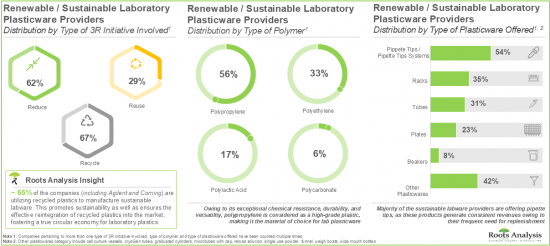
2.Close to 55% of the sustainable laboratory plasticware providers offer pipette tips / pipette tips systems made from different eco-friendly polymers, while adhering to the principles of the 3Rs (Reduce, Reuse, Recycle).
3.Sustainable / renewable laboratory plasticware market is experiencing significant growth, driven by increasing demand for eco-friendly labware and mounting regulatory pressure on laboratories to adopt sustainable materials.

4.Given the rising adoption of sustainable lab plastics and ongoing innovations in the domain, the renewable / sustainable laboratory plasticware market is anticipated to witness a growth of 19.0% till 2035.
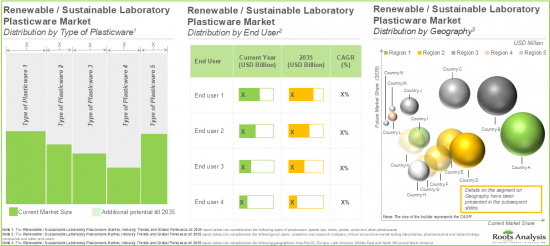
5.The market opportunity is projected to be well distributed across various segments, such as type of plasticware, end users and geography; Asia-Pacific is anticipated to grow at a higher CAGR during the forecast period.
RENEWABLE / SUSTAINABLE LABORATORY PLASTICWARE MARKET: KEY SEGMENTS
Recycled Plastics based Labware is the Fastest Growing Segment of the Renewable / Sustainable Laboratory Plasticware Market
Based on the type of plastic, the global market for renewable / sustainable laboratory plasticware is segmented into bioplastic, recycled plastic and other plastics. Currently, the majority share of the renewable / sustainable laboratory plasticware market is captured by bioplastic based labware segment. It is worth mentioning that the recycled plastics based labware segment is likely to grow at a relatively higher CAGR in the coming years.
Polypropylene is Likely to Dominate the Renewable / Sustainable Laboratory Plasticware Market During the Forecast Period
Based on the type of polymer, the global market for renewable / sustainable laboratory plasticware is distributed across various types of polymers, such as polyethylene, polypropylene, polystyrene and other polymers. Currently, the polypropylene segment holds a majority share of the market and is expected to grow at a substantial rate during the forecast period. This can be attributed to various properties of polypropylene, including chemical resistance, durability, and versatility across a wide range of laboratory applications, making it the preferred material for plasticware production.
Pipette Tips is Likely to Hold the Largest Share of the Renewable / Sustainable Laboratory Plasticware Market During the Forecast Period
Based on the type of plasticware, the global market for renewable / sustainable laboratory plasticware is segmented into pipette tips, tubes, plates, racks and other plasticwares. Currently, the pipette tips segment is likely to dominate and drive overall market growth. It is likely to witness substantial growth during the forecast period. This can be attributed to continuous revenues generated from pipette tips and substantial innovations to develop sustainable tips, including those made from compostable and recyclable materials.
Academic and Research Institutes Segment is Likely to Grow at a Relatively Faster Pace During the Forecast Period
Based on the end users, the global market for renewable / sustainable laboratory plasticware is segmented across academic and research institutes, clinical and environmental testing laboratories, pharmaceutical and biotechnology companies and other end users. While the pharmaceutical and biotechnology segment is expected to dominate the overall market, it is worth highlighting that the academic and research institutes segment is expected to grow at a relatively higher CAGR.
Europe Accounts for the Largest Share of the Market
Based on geography, the market is segmented into North America, Europe, Asia-Pacific, Latin America and Middle East and North Africa. In the current scenario, Europe is likely to capture the largest market share. However, the renewable / sustainable laboratory plasticware market in Asia-Pacific is expected to grow at a higher CAGR during the forecast period.
Example Players in the Renewable / Sustainable Laboratory Plasticware Market
- Accumax Lab Devices
- Agilent
- Biotix
- BRAND
- Corning
- Diversified Biotech
- Eppendorf
- Gilson
- Green Elephant Biotech
- Greiner Bio-One
- Labcon
- METTLER TOLEDO
- Polycarbin
- QIAGEN
- Thermo Fisher Scientific
RENEWABLE / SUSTAINABLE LABORATORY PLASTICWARE MARKET: RESEARCH COVERAGE
The report on renewable / sustainable laboratory plasticware market features insights into various sections, including:
- Market Sizing and Opportunity Analysis: An in-depth analysis of the renewable / sustainable laboratory plasticware market, focusing on key market segments, including [A] type of plastic, [B] type of polymer, [C] type of plasticware, [D] end user, and [E] geography.
- Market Impact Analysis: A thorough analysis of various factors, such as drivers, restraints, opportunities, and existing challenges that are likely to impact market growth.
- Renewable / Sustainable Laboratory Plasticware Providers Market Landscape: A comprehensive evaluation of companies offering renewable / sustainable laboratory plasticware, based on several relevant parameters, such as [A] year of establishment, [B] company size, [C] location of headquarters, [D] type of 3R initiative involved, [E] type of polymer, and [F] type of plasticware offered.
- Company Profiles: Elaborate profiles of prominent players engaged in this domain across various geographies, featuring details regarding [A] company overviews, [B] sustainable laboratory plasticware portfolio, [C] recent developments and [D] an informed future outlook.
- Megatrends: An evaluation of ongoing megatrends in sustainable plastic labware industry, including [A] adoption of bio-based and biodegradable materials, [B] technological innovations in material science, [C] optimizing the plastic content in labware, [D] shift towards reusable labware, [E] emphasis on circular economy initiatives and [F] the evolving regulatory guidelines.
- Value Chain Analysis: A detailed analysis of the value chain including various steps involved in the production of renewable / sustainable laboratory plasticwares, along with the stakeholders involved at each step.
KEY QUESTIONS ANSWERED IN THIS REPORT
- How many companies are currently engaged in this market?
- Which are the leading companies in this market?
- What factors are likely to influence the evolution of this market?
- What is the current and future market size?
- What is the CAGR of this market?
- How is the current and future market opportunity likely to be distributed across key market segments?
REASONS TO BUY THIS REPORT
- The report provides a comprehensive market analysis, offering detailed revenue projections of the overall market and its specific sub-segments. This information is valuable to both established market leaders and emerging entrants.
- Stakeholders can leverage the report to gain a deeper understanding of the competitive dynamics within the market. By analyzing the competitive landscape, businesses can make informed decisions to optimize their market positioning and develop effective go-to-market strategies.
- The report offers stakeholders a comprehensive overview of the market, including key drivers, barriers, opportunities, and challenges. This information empowers stakeholders to stay abreast of market trends and make data-driven decisions to capitalize on growth prospects.
ADDITIONAL BENEFITS
- Complimentary PPT Insights Packs
- Complimentary Excel Data Packs for all Analytical Modules in the Report
- 10% Free Content Customization
- Detailed Report Walkthrough Session with Research Team
- Free Updated report if the report is 6-12 months old or older
TABLE OF CONTENTS
SECTION I: REPORT OVERVIEW
1. SCOPE AND OBJECTIVES
- 1.1. Context
- 1.2. Project Objectives
2. RESEARCH METHODOLOGY
- 2.1. Research Assumptions
- 2.1.1. Market Landscape and Market Trends
- 2.1.2. Market Forecast and Opportunity Analysis
- 2.1.3. Comparative Analysis
- 2.2. Database Building
- 2.2.1. Data Collection
- 2.2.2. Data Validation
- 2.2.3. Data Analysis
- 2.3. Project Methodology
- 2.3.1. Project Commencement
- 2.3.2. Secondary Research
- 2.3.2.1. Annual Reports
- 2.3.2.2. Academic Research Papers
- 2.3.2.3. Company Websites
- 2.3.2.4. Investor Presentations and Regulatory Filings
- 2.3.2.5. White Papers
- 2.3.2.6. Industry Publications
- 2.3.2.7. Conferences and Seminars
- 2.3.2.8. Government Portals
- 2.3.2.9. Media and Press Releases
- 2.3.2.10. Newsletters
- 2.3.2.11. Industry and Paid Databases
- 2.3.2.12. Roots Proprietary Databases
- 2.3.3. Primary Research
- 2.3.4. Data Analysis and Interpretation
- 2.3.5. Market Forecast and Validation
- 2.3.6. Report Compilation
- 2.4. Research Ethics and Integrity
- 2.5. Analytical Tools and Databases
- 2.6. Robust Quality Control Framework
3. MARKET DYNAMICS
- 3.1. Forecast Methodology
- 3.1.1. Top-Down Approach
- 3.1.2. Bottom-Up Approach
- 3.1.3. Hybrid Approach
- 3.2. Market Assessment Framework
- 3.2.1. Total Addressable Market (TAM)
- 3.2.2. Serviceable Addressable Market (SAM)
- 3.2.3. Serviceable Obtainable Market (SOM)
- 3.2.4. Currently Acquired Market (CAM)
- 3.3. Forecasting Tools and Techniques
- 3.3.1. Qualitative Forecasting
- 3.3.2. Correlation
- 3.3.3. Regression
- 3.3.4. Extrapolation
- 3.3.5. Convergence
- 3.3.6. Sensitivity Analysis
- 3.3.7. Scenario Planning
- 3.3.8. Data Visualization
- 3.3.9. Time Series Analysis
- 3.3.10. Forecast Error Analysis
- 3.4. Key Considerations
- 3.4.1. Demographics
- 3.4.2. Economic Factors
- 3.4.3. Competitive Landscape
- 3.4.4. Government Regulations and Policies
- 3.4.5. R&D Investment
- 3.4.6. Technological Factors
- 3.4.7. Industry Consolidation
- 3.4.8. Supply Chain
- 3.4.9. Market Access
- 3.4.10. Pandemics / Unforeseen Disruptions Impact
4. MACRO-ECONOMIC INDICATORS
- 4.1. Market Dynamics
- 4.1.1. Time Period
- 4.1.1.1. Historical Trends
- 4.1.1.2. Current and Forecasted Estimates
- 4.2.2. Currency Coverage
- 4.2.2.1. Overview of Major Currencies Affecting the Market
- 4.2.2.2. Impact of Currency Fluctuations on the Industry
- 4.2.3. Foreign Exchange Impact
- 4.2.3.1. Evaluation of Foreign Exchange Rates and Their Impact on Market
- 4.2.3.2. Strategies for Mitigating Foreign Exchange Risk
- 4.2.4. Recession
- 4.2.4.1. Historical Analysis of Past Recessions and Lessons Learnt
- 4.2.4.2. Assessment of Current Economic Conditions and Potential Impact on the Market
- 4.2.5. Inflation
- 4.2.5.1. Measurement and Analysis of Inflationary Pressures in the Economy
- 4.2.5.2. Potential Impact of Inflation on the Market Evolution
- 4.2.6. Other Indicators
- 4.2.6.1. War Impact Analysis
- 4.2.6.2. Cross-border Dynamics
- 4.2.6.3. Consumer Spendings and Gross Domestic Product
- 4.2.6.4. Stock Market Performance
- 4.1.1. Time Period
SECTION II: QUALITATIVE INSIGHTS
5. EXECUTIVE SUMMARY
6. INTRODUCTION
- 6.1. An Overview of Renewable / Sustainable Laboratory Plasticware
- 6.2. Production Process of Renewable / Sustainable Laboratory Plasticware
- 6.3. Types of Renewable / Sustainable Plastics for Labware Production
- 6.4. Advantages of Renewable / Sustainable Laboratory Plasticwares
- 6.5. Applications of Renewable / Sustainable Laboratory Plasticwares
- 6.6. Key Challenges in Renewable / Sustainable Laboratory Plasticware Domain
- 6.7. Future Perspectives
SECTION III: MARKET OVERVIEW
7. MARKET LANDSCAPE: RENEWABLE / SUSTAINABLE LABORATORY PLASTICWARE PROVIDERS
- 7.1. Methodology and Key Parameters
- 7.2. Renewable / Sustainable Laboratory Plasticware Providers: Overall Market Landscape
- 7.2.1. Analysis by Year of Establishment
- 7.2.2. Analysis by Company Size
- 7.2.3. Analysis by Location of Headquarters
- 7.2.4. Analysis by Type of 3R Initiative Involved
- 7.2.5. Analysis by Type of Polymer
- 7.2.6. Analysis by Type of Plasticware Offered
SECTION IV: COMPANY PROFILES
8. COMPANY PROFILES
- 8.1. Chapter Overview
- 8.2. Corning
- 8.2.1. Company Overview
- 8.2.2. Company Mission
- 8.2.3. Company Footprint
- 8.2.4. Management Team
- 8.2.5. Contact Details
- 8.2.6. Operating Business Segments
- 8.2.7. Renewable / Sustainable Laboratory Plasticware Portfolio
- 8.2.8. Recent Developments and Future Outlook
- 8.3. Diversified Biotech
- 8.3.1. Company Overview
- 8.3.2. Company Mission
- 8.3.3. Company Footprint
- 8.3.4. Management Team
- 8.3.5. Contact Details
- 8.3.6. Renewable / Sustainable Laboratory Plasticware Portfolio
- 8.3.7. Recent Developments and Future Outlook
- 8.4. Eppendorf
- 8.4.1. Company Overview
- 8.4.2. Company Mission
- 8.4.3. Company Footprint
- 8.4.4. Management Team
- 8.4.5. Contact Details
- 8.4.6. Operating Business Segments
- 8.4.7. Renewable / Sustainable Laboratory Plasticware Portfolio
- 8.4.8. Recent Developments and Future Outlook
- 8.5. Green Elephant Biotech
- 8.5.1. Company Overview
- 8.5.2. Company Mission
- 8.5.3. Company Footprint
- 8.5.4. Management Team
- 8.5.5. Contact Details
- 8.5.6. Renewable / Sustainable Laboratory Plasticware Portfolio
- 8.5.7. Recent Developments and Future Outlook
- 8.6. Labcon
- 8.6.1. Company Overview
- 8.6.2. Company Mission
- 8.6.3. Company Footprint
- 8.6.4. Management Team
- 8.6.5. Contact Details
- 8.6.6. Renewable / Sustainable Laboratory Plasticware Portfolio
- 8.6.7. Recent Developments and Future Outlook
- 8.7. Polycarbin
- 8.7.1. Company Overview
- 8.7.2. Company Mission
- 8.7.3. Company Footprint
- 8.7.4. Management Team
- 8.7.5. Contact Details
- 8.7.6. Renewable / Sustainable Laboratory Plasticware Portfolio
- 8.7.7. Recent Developments and Future Outlook
- 8.8. QIAGEN
- 8.8.1. Company Overview
- 8.8.2. Company Mission
- 8.8.3. Company Footprint
- 8.8.4. Management Team
- 8.8.5. Contact Details
- 8.8.6. Operating Business Segments
- 8.8.7. Renewable / Sustainable Laboratory Plasticware Portfolio
- 8.8.8. Recent Developments and Future Outlook
- 8.9. Thermo Fisher Scientific
- 8.9.1. Company Overview
- 8.9.2. Company Mission
- 8.9.3. Company Footprint
- 8.9.4. Management Team
- 8.9.5. Contact Details
- 8.9.6. Operating Business Segments
- 8.9.7. Renewable / Sustainable Laboratory Plasticware Portfolio
SECTION V: MARKET TRENDS AND STRATEGIC TOOLS
9. RENEWABLE / SUSTAINABLE LABORATORY PLASTICWARE MARKET: OVERVIEW OF ONGOING MEGA TRENDS
- 9.1. Megatrends in the Renewable / Sustainable Laboratory Plasticware Market
- 9.1.1. Adoption of Bio-Based and Biodegradable Materials
- 9.1.2. Technological Innovations in Material Science
- 9.1.3. Optimizing the Plastic Content in Labware
- 9.1.4. Shift Towards Reusable Labware
- 9.1.5. Emphasis on Circular Economy Initiatives
- 9.1.6. Evolving Regulatory Guidelines
10. VALUE CHAIN ANALYSIS
SECTION VI: MARKET OPPORTUNITY ANALYSIS
11. MARKET IMPACT ANALYSIS: DRIVERS, RESTRAINTS, OPPORTUNITIES AND CHALLENGES
- 11.1. Market Drivers
- 11.2. Market Restraints
- 11.3. Market Opportunities
- 11.4. Market Challenges
12. GLOBAL RENEWABLE / SUSTAINABLE LABORATORY PLASTICWARE MARKET
- 12.1. Key Assumptions and Methodology
- 12.2. Global Renewable / Sustainable Laboratory Plasticware Market, Historical Trends (Since 2020) and Forecasted Estimates (Till 2035)
- 12.2.1. Multivariate Scenario Analysis
- 12.2.1.1. Conservative Scenario
- 12.2.1.2. Optimistic Scenario
- 12.2.1. Multivariate Scenario Analysis
- 12.3. Key Market Segmentations
13. RENEWABLE / SUSTAINABLE LABORATORY PLASTICWARE MARKET, BY TYPE OF PLASTIC
- 13.1. Key Assumptions and Methodology
- 13.2. Renewable / Sustainable Laboratory Plasticware Market: Distribution by Type of Plastic
- 13.2.1. Renewable / Sustainable Laboratory Plasticware Market for Bioplastics, Historical Trends (Since 2020) and Forecasted Estimates (Till 2035)
- 13.2.2. Renewable / Sustainable Laboratory Plasticware Market for Recycled Plastics, Historical Trends (Since 2020) and Forecasted Estimates (Till 2035)
- 13.2.3. Renewable / Sustainable Laboratory Plasticware Market for Other Plastics, Historical Trends (Since 2020) and Forecasted Estimates (Till 2035)
- 13.3. Data Triangulation and Validation
14. RENEWABLE / SUSTAINABLE LABORATORY PLASTICWARE MARKET, BY TYPE OF POLYMER
- 14.1. Key Assumptions and Methodology
- 14.2. Renewable / Sustainable Laboratory Plasticware Market: Distribution by Type of Polymer
- 14.2.1. Renewable / Sustainable Laboratory Plasticware Market for Polyethylene, Historical Trends (Since 2020) and Forecasted Estimates (Till 2035)
- 14.2.2. Renewable / Sustainable Laboratory Plasticware Market for Polypropylene, Historical Trends (Since 2020) and Forecasted Estimates (Till 2035)
- 14.2.3. Renewable / Sustainable Laboratory Plasticware Market for Polystyrene, Historical Trends (Since 2020) and Forecasted Estimates (Till 2035)
- 14.2.4. Renewable / Sustainable Laboratory Plasticware Market for Other Polymers, Historical Trends (Since 2020) and Forecasted Estimates (Till 2035)
- 14.3. Data Triangulation and Validation
15. RENEWABLE / SUSTAINABLE LABORATORY PLASTICWARE MARKET, BY TYPE OF PLASTICWARE
- 15.1. Key Assumptions and Methodology
- 15.2. Renewable / Sustainable Laboratory Plasticware Market: Distribution by Type of Plasticware
- 15.2.1. Renewable / Sustainable Laboratory Plasticware Market for Pipette Tips, Historical Trends (Since 2020) and Forecasted Estimates (Till 2035)
- 15.2.2. Renewable / Sustainable Laboratory Plasticware Market for Plates, Historical Trends (Since 2020) and Forecasted Estimates (Till 2035)
- 15.2.3. Renewable / Sustainable Laboratory Plasticware Market for Racks, Historical Trends (Since 2020) and Forecasted Estimates (Till 2035)
- 15.2.4. Renewable / Sustainable Laboratory Plasticware Market for Tubes, Historical Trends (Since 2020) and Forecasted Estimates (Till 2035)
- 15.2.5. Renewable / Sustainable Laboratory Plasticware Market for Other Plasticwares, Historical Trends (Since 2020) and Forecasted Estimates (Till 2035)
- 15.3. Data Triangulation and Validation
16. RENEWABLE / SUSTAINABLE LABORATORY PLASTICWARE MARKET, BY END USERS
- 16.1. Key Assumptions and Methodology
- 16.2. Renewable / Sustainable Laboratory Plasticware Market: Distribution by End Users
- 16.2.1. Renewable / Sustainable Laboratory Plasticware Market for Academic and Research Institutes, Historical Trends (Since 2020) and Forecasted Estimates (Till 2035)
- 16.2.2. Renewable / Sustainable Laboratory Plasticware Market for Clinical and Environmental Testing Laboratories, Historical Trends (Since 2020) and Forecasted Estimates (Till 2035)
- 16.2.3. Renewable / Sustainable Laboratory Plasticware Market for Pharmaceutical and Biotechnology Companies, Historical Trends (Since 2020) and Forecasted Estimates (Till 2035)
- 16.2.4. Renewable / Sustainable Laboratory Plasticware Market for Other End Users, Historical Trends (Since 2020) and Forecasted Estimates (Till 2035)
- 16.3. Data Triangulation and Validation
17. RENEWABLE / SUSTAINABLE LABORATORY PLASTICWARE MARKET, BY GEOGRAPHY
- 17.1. Key Assumptions and Methodology
- 17.2. Renewable / Sustainable Laboratory Plasticware Market: Distribution by Geography
- 17.2.1. Renewable / Sustainable Laboratory Plasticware Market in North America, Historical Trends (Since 2020) and Forecasted Estimates (Till 2035)
- 17.2.1.1. Renewable / Sustainable Laboratory Plasticware Market in the US, Historical Trends (Since 2020) and Forecasted Estimates (Till 2035)
- 17.2.1.2. Renewable / Sustainable Laboratory Plasticware Market in Canada, Historical Trends (Since 2020) and Forecasted Estimates (Till 2035)
- 17.2.2. Renewable / Sustainable Laboratory Plasticware Market in Europe, Historical Trends (Since 2020) and Forecasted Estimates (Till 2035)
- 17.2.2.1. Renewable / Sustainable Laboratory Plasticware Market in France, Historical Trends (Since 2020) and Forecasted Estimates (Till 2035)
- 17.2.2.2. Renewable / Sustainable Laboratory Plasticware Market in Germany, Historical Trends (Since 2020) and Forecasted Estimates (Till 2035)
- 17.2.2.3. Renewable / Sustainable Laboratory Plasticware Market in Italy, Historical Trends (Since 2020) and Forecasted Estimates (Till 2035)
- 17.2.2.4. Renewable / Sustainable Laboratory Plasticware Market in Netherlands, Historical Trends (Since 2020) and Forecasted Estimates (Till 2035)
- 17.2.2.5. Renewable / Sustainable Laboratory Plasticware Market in Spain, Historical Trends (Since 2020) and Forecasted Estimates (Till 2035)
- 17.2.2.6. Renewable / Sustainable Laboratory Plasticware Market in the UK, Historical Trends (Since 2020) and Forecasted Estimates (Till 2035)
- 17.2.3. Renewable / Sustainable Laboratory Plasticware Market in Asia-Pacific, Historical Trends (Since 2020) and Forecasted Estimates (Till 2035)
- 17.2.3.1. Renewable / Sustainable Laboratory Plasticware Market in China, Historical Trends (Since 2020) and Forecasted Estimates (Till 2035)
- 17.2.3.2. Renewable / Sustainable Laboratory Plasticware Market in India, Historical Trends (Since 2020) and Forecasted Estimates (Till 2035)
- 17.2.3.3. Renewable / Sustainable Laboratory Plasticware Market in Japan, Historical Trends (Since 2020) and Forecasted Estimates (Till 2035)
- 17.2.4. Renewable / Sustainable Laboratory Plasticware Market in Latin America, Historical Trends (Since 2020) and Forecasted Estimates (Till 2035)
- 17.2.4.1. Renewable / Sustainable Laboratory Plasticware Market in Argentina, Historical Trends (Since 2020) and Forecasted Estimates (Till 2035)
- 17.2.4.2. Renewable / Sustainable Laboratory Plasticware Market in Brazil, Historical Trends (Since 2020) and Forecasted Estimates (Till 2035)
- 17.2.5. Renewable / Sustainable Laboratory Plasticware Market in MENA, Historical Trends (Since 2020) and Forecasted Estimates (Till 2035)
- 17.2.5.1. Renewable / Sustainable Laboratory Plasticware Market in Egypt, Historical Trends (Since 2020) and Forecasted Estimates (Till 2035)
- 17.2.5.2. Renewable / Sustainable Laboratory Plasticware Market in Saudi Arabia, Historical Trends (Since 2020) and Forecasted Estimates (Till 2035)
- 17.2.5.3. Renewable / Sustainable Laboratory Plasticware Market in UAE, Historical Trends (Since 2020) and Forecasted Estimates (Till 2035)
- 17.2.1. Renewable / Sustainable Laboratory Plasticware Market in North America, Historical Trends (Since 2020) and Forecasted Estimates (Till 2035)
- 17.3. Market Dynamics Assessment: Renewable / Sustainable Laboratory Plasticware Market by Geography
- 17.3.1. Market Movement Analysis
- 17.3.2. Penetration-Growth (P-G) Matrix
- 17.4. Data Triangulation and Validation