

|
시장보고서
상품코드
1883720
펩타이드 치료제 시장 : 업계 동향 및 예측 - 투여 경로별, 치료 분야별, 지역별(-2040년)Peptide Therapeutics Market: Industry Trends and Global Forecasts, Till 2040 - Distribution by Type of Peptide, Route of Administration, Key Therapeutic Area and Geographical Regions |
||||||

펩타이드 치료제 시장 : 시장 개요
Roots Analysis의 분석에 따르면, 펩타이드 치료제 시장 규모는 현재 842억 달러로 평가되었고, 2035년까지 1,624억 달러로 성장할 전망이며, 예측 기간인 2035년까지 CAGR 6.8%로 추정됩니다.
펩타이드 치료제 시장
시장 규모 및 기회 분석은 다음 매개변수에 따라 세분화됩니다.
투여 경로별
- 정맥내 투여
- 경구
- 피하
- 국소
- 기타
주요 치료 분야별
- 대사성 질환
- 종양 질환
- 내분비 질환
- 소화기 및 위장 질환
- 기타
지리적 지역별
- 북미
- 유럽
- 아시아태평양
- 기타 지역
펩타이드 치료제 시장 : 성장 및 동향
펩타이드 치료제는 다양한 질병에 대응하기 위해 폴리펩타이드를 사용하여 개발된 약물의 일종입니다. 일반적으로 자연 발생 펩타이드는 성장 인자, 호르몬, 신경전달물질, 항감염제, 이온 채널의 리간드 역할을 합니다. 이러한 펩타이드는 대사 질환, 암, 호르몬 관련 치료의 치료에 일반적으로 사용되는 펩타이드 기반 치료법의 개발에 이용되어 왔습니다. 주목해야할 것은 100가지 이상의 펩타이드 기반 치료법이 각국에서 FDA 승인을 얻고 있다는 것입니다. 승인된 펩타이드 치료제의 예는 틸제파티드(Mounjaro(R)), 루테튬 Lu-177 비피보티드 테트라크세탄(Pluvicto(R)) 및 Lupkynis(TM) 등을 포함합니다. 당뇨병, 변형성 관절증, 비만, 자가면역질환, 류마티스성 관절염, 암 등 만성질환 유병률이 증가함에 따라 최근 질병 치료에 있어서 생물학적 제제 수요가 증가하고 있습니다.
재조합 단백질 및 펩타이드와 같은 생물학적 제제는 높은 표적 특이성, 양호한 안전성 프로파일, 저독성, 오프-타겟 효과의 가능성 감소 등 여러 장점을 제공합니다. 특히, 많은 제약 회사는 펩타이드 약물 복합체, 펩타이드 치료제, 세포 투과성 펩타이드 등 혁신적인 약물 복합체의 개발에 주력하여 광범위한 질병에 대한 대응을 도모하고 있습니다. 게다가, 이 분야에서의 최근의 진전에 의해 2형 당뇨병, 비만, 복수의 암 등의 질환에 대한 펩타이드 의약품의 인가 및 임상 용도가 실현되고 있습니다. 가까운 미래에, 시장은 현저한 성장을 달성할 가능성이 높다고 확신합니다.
펩타이드 치료제 시장 : 주요 인사이트
본 보고서는 펩타이드 치료제 시장의 현상을 상세하게 분석하여 업계 내 잠재적인 성장 기회를 파악합니다. 주요 조사 결과는 다음과 같습니다.
- 승인된 의약품 25개 품목, 개발 중인 후보품 280개 품목 이상을 가진 펩타이드 치료제는 현재 가장 빠르게 성장하는 의약품 클래스 중 하나이며 다양한 질병을 치료할 수 있습니다.
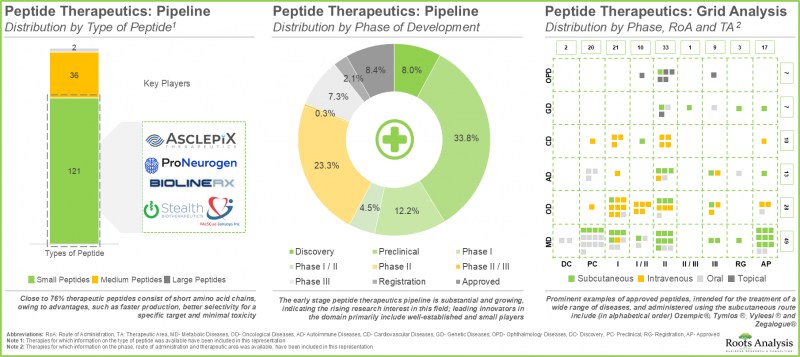
- 개발 파이프라인은 다양한 경로별 전달을 평가하는 다양한 펩타이드를 포함하며, 주로 대사성 및 종양 질환의 치료를 목적으로 합니다.
- 다수의 유망한 후보 치료제별 경쟁 격화를 받고, 혁신자 각사는 자사 제품이 임상적 및 상업적 양면에서 차별화되도록 많은 노력을 기울이고 있습니다.
- 세계 1,200건 이상의 펩타이드에 초점을 맞춘 임상시험이 등록되어 있으며, 현재 이러한 연구의 대부분은 대사성 질환의 치료를 목적으로 하는 제품 후보를 평가했습니다.
- 이 분야에 대한 관심 증가는 최근의 제휴 활동 증가에도 나타났으며, 대부분은 기술 및, 또는 제품 라이선싱에 초점을 맞추었습니다.
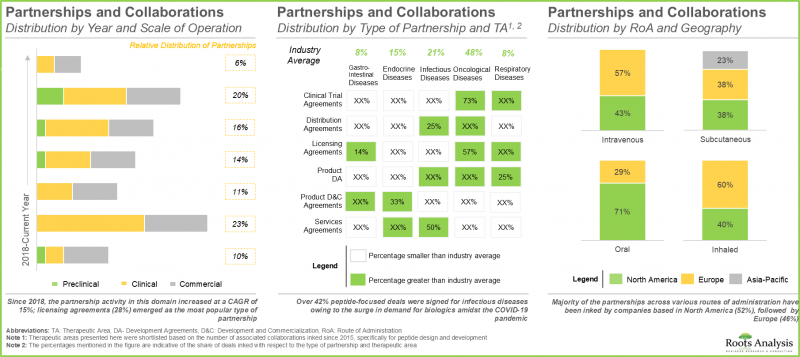
- 유망한 수익을 기대해 많은 공공 및 민간 부문의 투자자들이 200건 이상에 걸쳐 70억 달러 이상을 투자하고 있습니다.
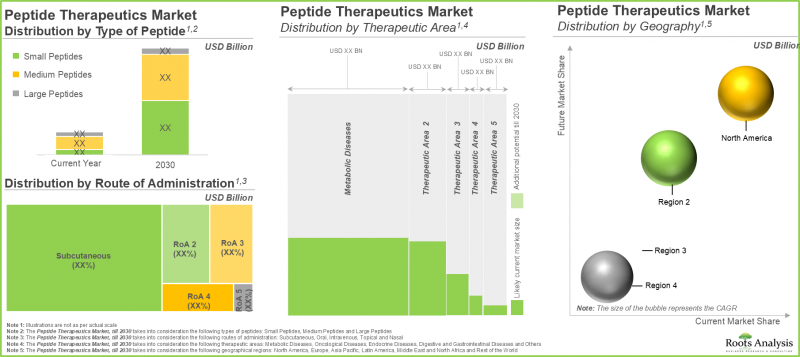
- 이러한 급성장 시장에서 수익성이 높은 기회를 활용하기 위해 여러 대형 제약 기업들은 독자적인 제품 개발부터 전략적 투자에 이르기까지 다양한 노력을 추진하고 있습니다.
- 유망한 개발 파이프라인과 기대되는 임상 결과를 배경으로 펩타이드 치료제 시장은 향후 10년간 연률 6.8%의 성장이 전망되고 있습니다.
펩타이드 치료제 시장 : 주요 부문
펩타이드 치료제 산업에서 중간 분자 펩타이드가 가장 큰 점유율을 차지합니다.
올해 중분자 펩타이드가 시장 점유율의 대부분(약 65%)을 차지했습니다. 이는 10-40 아미노산으로 구성된 중분자 펩타이드가 대형 단백질과 저분자 화합물 사이에서 효과적인 균형을 실현하고 있기 때문이라고 생각됩니다. 주목할 점은 표적 특이적 약제의 제조에 있어서 사용 증가에 의해 소분자 펩타이드가 예측 기간 동안 20% 이상의 CAGR을 나타낼 전망입니다.
피하 투여 경로가 펩타이드 치료제 시장 주도
전체 시장은 정맥내 투여, 경구 투여, 피하 투여, 국소 투여 등으로 분류됩니다. 올해 피하 투여 경로는 전체 시장의 65% 이상을 차지하고 있습니다. 피하 투여는 소화관이나 간(초회 통과 효과)을 경유하지 않기 때문에 치료 효과가 높아집니다. 비침습적 또는 표적 특이적 투여 경로에 대한 수요가 지속됨에 따라, 예측 기간 동안 외용 투여 경로는 약 30%의 연평균 복합 성장률(CAGR)을 보일 것으로 예측됩니다.
대사성 질환 부문이 펩타이드 치료제 시장에서 가장 큰 점유율을 차지할 전망
현재 대사성 질환 부문은 전체 시장의 60% 이상을 차지할 것으로 예측됩니다. 이것은 당뇨병과 비만과 같은 신진 대사 상태를 개선하는 펩타이드 기반 치료법에 대한 수요가 증가함에 기인합니다. 특히, 소화기 질환용 펩타이드 치료제 시장은 예측 기간 동안 25%라는 높은 CAGR로 확대될 전망입니다.
향후 수년간 북미가 펩타이드 치료제 산업 견인
본 부문에서는 북미, 유럽, 아시아태평양 등 다양한 지역에서 시장 분포를 밝혔습니다. 당사의 예측에 따르면, 북미는 올해 시장 점유율의 대부분을 차지하고 있으며, 이러한 추세는 앞으로도 변하지 않을 전망입니다. 미국 질병 예방관리센터의 보고서에 따르면 미국에서는 약 1억 2,900만 명이 당뇨병, 비만, 심장병, 고혈압 등의 만성 질환을 적어도 하나 이상 앓고 있습니다. 이것은 이 지역에서 펩타이드 치료제 수요 증가로 이어지고 있습니다. 주목할 점은 아시아태평양 시장이 예측 기간 동안 비교적 높은 CAGR로 성장할 가능성이 높다는 것입니다.
펩타이드 치료제 시장의 대표 기업 예
- Apellis Pharmaceuticals
- BioLineRx
- Eli Lilly
- FirstString Research
- Novo Nordisk
- Palatin Technologies
- RegeneRx Biopharmaceuticals
- Stealth BioTherapeutics
- Takeda
- Zealand Pharma
펩타이드 치료제 시장 : 조사 범위
- 시장 규모 및 기회 분석 : 본 보고서는 (A)펩타이드 유형, (B)투여 경로, (C)주요 치료 분야, (D)지리적 지역과 같은 주요 시장 부문에 초점을 맞추어 펩타이드 치료제 시장의 상세한 분석을 제공합니다.
- 시장 상황 : 현재 승인 또는 개발 단계에 있는 300종 이상의 펩타이드 기반 치료제에 대해 (A)개발 단계, (B)펩타이드 유형, (C)투여 경로, (D)주요 치료 분야, (E)설립 연도, (F)기업 규모, (G)본사 소재지 등 관련 매개변수에 따라 상세한 평가를 제공합니다.
- 기업 프로파일 : 본 분야에서 활동하는 주요 기업의 상세한 프로파일을 게재하고, (A)설립 연도, (B)본사 소재지, (C)펩타이드 상세, (D)최근 동향, (E)미래 전망에 초점을 맞추었습니다.
- 주요 제약 기업의 대처 : 치료용 펩타이드 분야에 진입하고 있는 주요 바이오 의약품 기업을 (A)아미노산 수, (B)투여 경로, (C)치료 분야 등 여러 파라미터에 따라 분석합니다.
- 제휴 및 협업 : 펩타이드 치료제 시장에 관련된 이해 관계자간의 제휴 및 협업에 대해, (A)제휴 연도, (B)제휴 형태, (C)제휴처 유형, (D)주요 참가 기업 등, 다양한 관련 파라미터에 근거한 인사이트가 풍부한 분석을 제공합니다.
- 자금 조달 및 투자 분석 : 펩타이드 치료제 개발 기업이 조달한 각종 자금 및 투자에 대해 (A)자금 조달 연도, (B)투자액, (C)자금 조달 형태, (D)지역별 분포, (E)가장 활발한 진출기업 등 관련 매개변수에 따라 종합적으로 검증합니다.
- 임상시험 분석 : 각종 치료용 펩타이드의 완료, 진행중, 계획중 임상시험에 대해, (A)시험 등록 연도, (B)개발 단계, (C)현재의 시험 상황, (D)등록 환자 집단 등의 관련 파라미터에 근거하여 상세하게 검증합니다.
- 사례 연구 1 : 펩타이드 치료제 시장 내에서 활동하는 서비스 제공업체의 역할에 초점을 맞춘 사례 연구입니다. 이 부문에 적극적으로 관여하는 다양한 CRO(수탁연구기관), CMO(수탁제조기관), 커스텀 펩타이드 제조업체에 대한 정보를 다룹니다.
- 사례 연구 2 : 신규 펩타이드 의약품의 주요 특징을 제시하고 개발 과정에서 용도 분야, 이점 및 주요 과제에 대한 정보를 제공하는 사례 연구입니다.
목차
제1장 서문
제2장 주요 요약
제3장 서문
- 장의 개요
- 펩타이드의 구조
- 펩타이드의 분류
- 펩타이드의 변형
- 펩타이드 치료제의 진화
- 펩타이드 치료제의 설계 및 개발
- 펩타이드 치료제의 장단점
- 펩타이드 치료제의 용도
- 장래의 전망
제4장 시장 개요
- 장의 개요
제4장 2. 펩타이드 치료제 : 시장 개요
- 개발 단계별 분석
- 펩타이드 유형별 분석
- 투여 경로별 분석
- 개발 단계 및 투여 경로별 분석
- 치료 분야별 분석
- 개발단계 및 치료 분야별 분석
- 투여 경로 및 치료 분야별 분석
- 개발 단계, 투여 경로, 치료 분야별 분석(그리드 표시)
제5장 경쟁 구도
제6장 기업 프로파일
- 장의 개요
- Apellis Pharmaceuticals
- BioLineRx
- Eli Lilly
- FirstString Research
- Novo Nordisk
- Palatin Technologies
- RegeneRx Biopharmaceuticals
- Stealth BioTherapeutics
- Takeda
- Zealand Pharma
제7장 대기업 제약회사의 펩타이드 치료제에 초점을 맞춘 대처
- 장의 개요
- 주요 제약 회사 : 펩타이드 치료제에 중점을 둔 노력
- 주요 파라미터의 벤치마크 분석
- 주요 제약 기업의 벤치 마크 분석
제8장 파트너십 및 협업
제9장 자금 조달 및 투자 분석
- 장의 개요
- 자금 조달의 유형
- 펩타이드 치료제 : 자금 조달 및 투자 분석
제10장 임상시험 분석
- 장의 개요
- 범위 및 조사 방법
- 펩타이드 치료제 : 임상시험 분석
제11장 임상적 및 상업적 매력 분석
- 장의 개요
- 조사 방법
- 관련 인사이트
- 임상 및 상업적 매력 분석 : 자가면역 질환
- 임상 및 상업적 매력 분석 : 중추신경계(CNS) 질환
- 임상 및 상업적 매력 분석 : 내분비 질환
- 임상 및 상업적 매력 분석 : 소화기 질환
- 임상 및 상업적 매력 분석 : 유전성 질환
- 임상 및 상업적 매력 분석 : 혈액 질환
- 임상 및 상업적 매력 분석 : 감염증
- 임상 및 상업적 매력 분석 : 염증성 질환
- 임상 및 상업적 매력 분석 : 대사성 질환
- 임상 및 상업적 매력 분석 : 종양성 질환
- 임상 및 상업적 매력 분석 : 안과 질환
- 임상 및 상업적 매력 분석 : 기타 질병
제12장 사례 연구 : 계약 서비스의 현황
- 장의 개요
- 서비스 제공업체의 역할
- 아웃소싱의 장점
- 아웃소싱에 따른 위험 및 과제
제13장 사례 연구 : 신규 펩타이드 치료제
- 장의 개요
- 신규 펩타이드 치료제의 개요
- 신규 펩타이드 치료제의 장점 및 용도
- 신규 펩타이드 치료제와 관련된 주요 과제
제14장 시장 예측 및 기회 분석
- 장의 개요
- 범위 및 제한
- 주요 전제 및 예측 조사 방법
- 세계의 펩타이드 치료제 시장(-2030년)
- 자가면역 질환
- 심혈관 질환
- 중추 신경계 질환
- 피부 질환
- 내분비 질환
- 소화기 질환
- 유전성 질환
- 혈액 질환
- 감염증
- 염증성 질환
- 대사성 질환
- 종양성 질환
- 안과 질환
- 기타
제15장 결론
- 장의 개요
제16장 부록 I : 승인 펩타이드 치료제 일람
제17장 부록 II : 표 형식 데이터
제18장 부록 III : 기업 및 조직 목록
AJY 25.12.15PEPTIDE THERAPEUTICS MARKET: OVERVIEW
As per Roots Analysis, the peptide therapeutics market is estimated to grow from USD 84.2 billion in the current year to USD 162.4 billion by 2035, at a CAGR of 6.8% during the forecast period, till 2035.
Peptide Therapeutics Market
The market sizing and opportunity analysis has been segmented across the following parameters:
Route of Administration
- Intravenous
- Oral
- Subcutaneous
- Topical
- Other
Key Therapeutic Area
- Metabolic Diseases
- Oncological Diseases
- Endocrine Diseases
- Digestive and Gastrointestinal Diseases
- Others
Geographical Regions
- North America
- Europe
- Asia-Pacific
- Rest of the World
Peptide Therapeutics Market: Growth and Trends
Peptide therapeutics are a class of medications developed with polypeptides to cater to various illnesses. Generally, naturally occurring peptides can serve as growth factors, hormones, neurotransmitters, anti-infectives, and ligands for ion channels. Such peptides have been utilized in creating peptide-based therapies that are commonly employed in treating metabolic diseases, cancer, and hormone-related treatments. It is noteworthy that more than 100 peptide-based therapies have been authorized by the FDA in various nations. Examples of recognized peptide therapeutics include Tirzepatide (Mounjaro(R)), Lutetium Lu-177 vipivotide tetraxetan (Pluvicto(R)), and Lupkynis(TM). Driven by the rising prevalence of chronic conditions, such as diabetes, osteoarthritis, obesity, autoimmune disorders, rheumatoid arthritis, and cancer, an increased demand for biologics in disease treatment has been observed in recent years.
Biologics such as recombinant proteins and peptides present multiple benefits, including heightened target specificity, good safety profiles, low toxicity, and reduced likelihood of off-target effects. Notably, many pharmaceutical firms are focusing on the advancement of innovative drug conjugates, including peptide drug conjugates, peptide therapeutics, and cell-penetrating peptides to address a wide array of diseases. Moreover, recent progress in this area has resulted in the authorization and clinical application of peptide medications for disorders such as type 2 diabetes, obesity, and several cancers. We are led to believe that the market is likely to achieve notable growth in the foreseeable future.
Peptide Therapeutics Market: Key Insights
The report delves into the current state of the peptide therapeutics market and identifies potential growth opportunities within industry. Some key findings from the report include:
- With 25 approved drugs and over 280 candidates under development, peptide therapeutics currently represent one of the fastest growing drug classes, capable of treating a diverse range of diseases.
- The pipeline features a variety of peptides being evaluated for delivery via different routes, and mostly intended for treating metabolic and oncological disorders
- In lieu of the growing competition from several viable candidate therapies, innovators are putting in significant efforts to ensure that their proprietary offerings are both clinically and commercially differentiated.
- Over 1,200 peptide focused clinical trials have been registered across the world; presently, most of these studies are evaluating product candidates intended for the treatment of metabolic diseases.
- The growing interest in this field is also evident in the increase in recent partnership activity; majority of the deals were focused on technology and / or product licensing.
- Foreseeing promising returns, many public and private sector investors have invested over USD 7 billion, across more than 200 instances.
- In order to tap into the lucrative opportunity in this rapidly growing market, several big pharma players have undertaken initiatives, ranging from proprietary product development to strategic investments, in this direction.
- With a promising development pipeline and encouraging clinical outcomes, the peptide therapeutics market is anticipated to grow at an annualized rate of 6.8%, over the next decade.
Peptide Therapeutics Market: Key Segments
Medium Size Peptides in the Peptide Therapeutics Industry Holds the Largest Share
In the current year, medium sized peptides capture the majority (close to 65% of the market) share. This is probably because medium-sized peptides (ranging from 10 to 40 amino acids) effectively strike a balance between larger proteins and smaller molecules. It is worth highlighting that, small peptides will grow at a CAGR of more than 20% during the forecast period, owing to the increasing usage in manufacturing target specific drugs.
Subcutaneous Route of Administration to Dominate the Peptide Therapeutics Market
The overall market is segmented into intravenous, oral, subcutaneous, topical, and others. In the current year, subcutaneous route of administration accounts for more than 65% of the overall market. The subcutaneous route can avoid the gastrointestinal tract and liver (first-pass metabolism), resulting in greater therapeutic effectiveness. Owing to the ongoing demand for non-invasive or target specific routes of administration, the topical route of administration is likely to grow at a CAGR of ~30% during the forecast period.
Metabolic Diseases Segment to Hold the Highest Peptide Therapeutics Market
Currently, the metabolic diseases segment is likely to capture more than 60% of the overall market share. This is attributed to the increasing need for peptide-based therapies aimed at addressing metabolic conditions like diabetes and obesity. Notably, the peptide therapeutics market for gastrointestinal diseases will expand with a higher CAGR of 25% during the forecast period.
North America to Propel in the Peptide Therapeutics Industry in the Coming Years
This segment highlights the distribution of market across various geographies, such as North America, Europe and Asia-Pacific. According to our projections, North America accounts for the majority of the market share in the current year, and this trend is unlikely to change in the future. According to the report of Centers for Disease Control and Prevention, nearly 129 million people in the United States have at least one or more chronic disease such as diabetes, obesity, heart disease, and hypertension. This is leading to growing demand for peptide therapeutics in this region. It is worth highlighting that the market in Asia-Pacific is likely to grow at a relatively higher CAGR during the forecast period.
Example Players in the Peptide Therapeutics Market
- Apellis Pharmaceuticals
- BioLineRx
- Eli Lilly
- FirstString Research
- Novo Nordisk
- Palatin Technologies
- RegeneRx Biopharmaceuticals
- Stealth BioTherapeutics
- Takeda
- Zealand Pharma
Peptide Therapeutics Market: Research Coverage
- Market Sizing and Opportunity Analysis: The report features an in-depth analysis of the peptide therapeutics market, focusing on key market segments, including [A] type of peptide, [B] route of administration, [C] key therapeutic area, [D] geographical regions.
- Market Landscape: provides a detailed assessment of over 300 peptide-based therapies that are currently approved or are in different stages of development, based on several relevant parameters, such as [A] phase of development, [B] type of peptide, [C] route of administration, [D] key therapeutic areas, [E] year of establishment, [F] company size, and [G] location of headquarters.
- Company Profiles: In-depth profiles of prominent players engaged in this domain, focusing on [A] year of establishment, [B] location of headquarters, [C] peptide details [D] recent developments and [E] an informed future outlook.
- Big Pharma Initiatives: An analysis of top big biopharma players engaged in the field of therapeutic peptides, based on several parameters, including [A] number of amino acids, [B] route of administration and [C] therapeutic area.
- Partnerships and Collaborations An insightful analysis of the partnerships and collaborations inked between stakeholders engaged in the peptide therapeutics market based on various relevant parameters, including [A] year of partnership, [B] type of partnership, [C] type of partner and [D] most active players.
- Funding and Investment Analysis: A comprehensive examination of various funding and investments raised by developers of peptide therapeutics, based on relevant parameters, including [A] such as year of funding, [B] amount invested [C] type of funding, [D] regional distribution, and [E] most active players.
- Clinical Trial Analysis: A detailed review of completed, ongoing, and planned clinical studies of various therapeutic peptides, based on relevant parameters, such as [A] trail registration year, [B] phase of development, [C] current trial status and [D] enrolled patient population.
- Case Study 1: A case study focused on the role of service providers that operate within the peptide therapeutics market and captures information on the various CROs, CMOs and custom peptide manufacturers that are actively involved in this segment of the peptide therapeutics market.
- Case Study 2: A case study presenting the key characteristics of novel peptides drugs, along with information on the applications, advantages and key challenges involved in their development processes.
Key Questions Answered in this Report
- How many companies are currently engaged in this market?
- Which are the leading companies in this market?
- What is the current global capacity of developers?
- What factors are likely to influence the evolution of this market?
- What is the current and future market size?
- What is the CAGR of this market?
- How is the current and future market opportunity likely to be distributed across key market segments?
Reasons to Buy this Report
- The report provides a comprehensive market analysis, offering detailed revenue projections of the overall market and its specific sub-segments. This information is valuable to both established market leaders and emerging entrants.
- Stakeholders can leverage the report to gain a deeper understanding of the competitive dynamics within the market. By analyzing the competitive landscape, businesses can make informed decisions to optimize their market positioning and develop effective go-to-market strategies.
- The report offers stakeholders a comprehensive overview of the market, including key drivers, barriers, opportunities, and challenges. This information empowers stakeholders to stay abreast of market trends and make data-driven decisions to capitalize on growth prospects.
Additional Benefits
- Complimentary PPT Insights Packs
- Complimentary Excel Data Packs for all Analytical Modules in the Report
- 15% Free Content Customization
- Detailed Report Walkthrough Session with Research Team
- Free Updated report if the report is 6-12 months old or older
TABLE OF CONTENTS
1. PREFACE
- 1.1. Scope of the Report
- 1.2. Research Methodology
- 1.3. Key Questions Answered
- 1.4. Chapter Outlines
2. EXECUTIVE SUMMARY
3. INTRODUCTION
- 3.1. Chapter Overview
- 3.2. Structure of Peptides
- 3.3. Classification of Peptides
- 3.4. Modification of Peptides
- 3.4.1. N-Terminal Modifications
- 3.4.2. Internal Modifications
- 3.4.3. C-Terminal Modifications
- 3.4.4. Other Modifications
- 3.5. Evolution of Peptide Therapeutics
- 3.6. Design and Development of Peptide Therapeutics
- 3.6.1. Traditional versus Novel Peptide Technologies
- 3.7. Advantages and Disadvantages of Peptide Therapeutics
- 3.8. Applications of Peptide Therapeutics
- 3.9. Future Perspectives
4. MARKET OVERVIEW
- 4.1. Chapter Overview
4.2. Peptide Therapeutics: Overall Market Overview
- 4.2.1. Analysis by Phase of Development
- 4.2.2. Analysis by Type of Peptide
- 4.2.3. Analysis by Route of Administration
- 4.2.4. Analysis by Phase of Development and Route of Administration
- 4.2.5. Analysis by Therapeutic Area
- 4.2.6. Analysis by Phase of Development and Therapeutic Area
- 4.2.7. Analysis by Route of Administration and Therapeutic Area
- 4.2.8. Analysis by Phase of Development, Route of Administration and Therapeutic Area (Grid Representation)
5. COMPETITIVE LANDSCAPE
- 5.1. Chapter Overview
- 5.2. Peptide Therapeutics: List of Developers
- 5.2.1. Analysis by Year of Establishment
- 5.2.2. Analysis by Company Size
- 5.2.3. Analysis by Geography
- 5.2.4. Analysis by Phase of Development and Geography (Logo Landscape)
- 5.2.5.Key Players: Analysis by Number of Product Candidates
- 5.3.Analysis by Company Size, Key Therapeutic Area and Geography (Heat Map Representation)
6. COMPANY PROFILES
- 6.1. Chapter Overview
- 6.2. Apellis Pharmaceuticals
- 6.2.1. Company Overview
- 6.2.2 Pipeline Details
- 6.2.2. Recent Developments and Future Outlook
- 6.3. BioLineRx
- 6.3.1. Company Overview
- 6.3.2. Pipeline Details
- 6.3.3. Recent Developments and Future Outlook
- 6.4. Eli Lilly
- 6.4.1. Company Overview
- 6.4.2. Financial Information
- 6.4.3. Pipeline Details
- 6.4.4. Recent Developments and Future Outlook
- 6.5. FirstString Research
- 6.5.1. Company Overview
- 6.5.2. Pipeline Details
- 6.5.3. Recent Developments and Future Outlook
- 6.6. Novo Nordisk
- 6.6.1. Company Overview
- 6.6.2. Financial Information
- 6.6.3. Pipeline Details
- 6.6.4. Recent Developments and Future Outlook
- 6.7. Palatin Technologies
- 6.7.1. Company Overview
- 6.7.2. Financial Information
- 6.7.3. Pipeline Details
- 6.7.4. Recent Developments and Future Outlook
- 6.8. RegeneRx Biopharmaceuticals
- 6.8.1. Company Overview
- 6.8.2. Pipeline Details
- 6.8.3. Recent Developments and Future Outlook
- 6.9. Stealth BioTherapeutics
- 6.9.1. Company Overview
- 6.9.2. Pipeline Details
- 6.9.3. Recent Developments and Future Outlook
- 6.10. Takeda
- 6.10.1. Company Overview
- 6.10.2. Financial Information
- 6.10.3. Pipeline Details
- 6.10.4. Recent Developments and Future Outlook
- 6.11. Zealand Pharma
- 6.11.1. Company Overview
- 6.11.2. Financial Information
- 6.11.3. Pipeline Details
- 6.11.4. Recent Developments and Future Outlook
7. PEPTIDE THERAPEUTICS FOCUSED INITIATIVES OF BIG PHARMA PLAYERS
- 7.1. Chapter Overview
- 7.2. Top Pharmaceutical Companies: Peptide Therapeutics Focused Initiatives
- 7.2.1. Analysis by Number of Amino Acids
- 7.2.2. Analysis by Route of Administration
- 7.2.3. Analysis by Therapeutic Area
- 7.3. Benchmark Analysis of Key Parameters
- 7.3.1. Spider Web Analysis: Pipeline Strength
- 7.3.2. Spider Web Analysis: Partnerships and Collaborations
- 7.3.3. Spider Web Analysis: Funding and Investments
- 7.3.4. Spider Web Analysis: Clinical Trials
- 7.4. Benchmark Analysis of Big Pharmaceutical Players
- 7.4.1. Spider Web Analysis: Novo Nordisk
- 7.4.2. Spider Web Analysis: Amgen
- 7.4.3. Spider Web Analysis: Takeda
- 7.4.4. Spider Web Analysis: Eli Lilly
- 7.4.5. Spider Web Analysis: Johnson and Johnson
8. PARTNERSHIPS AND COLLABORATIONS
- 8.1. Chapter Overview
- 8.2. Partnership Models
- 8.3. Peptide Therapeutics: List of Partnerships and Collaborations
- 8.3.1. Analysis by Year of Partnership
- 8.3.2. Analysis by Type of Partnership
- 8.3.3. Analysis by Year and Type of Partnership
- 8.3.4. Analysis by Focus Area
- 8.3.5. Analysis by Type of Partnership and Focus Area
- 8.3.6. Analysis by Type of Peptide
- 8.3.7. Analysis by Route of Administration
- 8.3.8. Analysis by Route of Administration and Geography
- 8.3.9. Analysis by Type of Partnership and Phase of Development
- 8.3.10. Analysis by Therapeutic Area
- 8.3.11. Analysis by Type of Partnership and Therapeutic Area
- 8.4. Most Active Players: Analysis by Number of Partnerships
- 8.5. Regional Analysis
- 8.5.1. Intracontinental and Intercontinental Agreements
- 8.5.2. Local and International Agreements
9. FUNDING AND INVESTMENT ANALYSIS
- 9.1. Chapter Overview
- 9.2. Types of Funding
- 9.3. Peptide Therapeutics: Funding and Investment Analysis
- 9.3.1. Analysis by Number of Funding Instances
- 9.3.2. Analysis by Amount Invested
- 9.3.3. Analysis by Type of Funding
- 9.3.4. Analysis by Year and Type of Funding
- 9.3.5. Analysis of Amount Invested by Geography
- 9.3.6. Most Active Players: Analysis by Number of Funding Instances and Amount Invested
- 9.3.7. Key Investors: Analysis by Number of Funding Instances
- 9.3.8. Analysis by Phase of Development
- 9.3.9. Analysis by Therapeutic Area
10. CLINICAL TRIAL ANALYSIS
- 10.1. Chapter Overview
- 10.2. Scope and Methodology
- 10.3. Peptide Therapeutics: Clinical Trial Analysis
- 10.3.1. Analysis by Trial Registration Year
- 10.3.2. Analysis by Trial Status
- 10.3.3. Analysis by Trial Phase
- 10.3.4. Analysis by Trial Recruitment Status
- 10.3.5. Analysis by Trial Registration Year and Enrolled Patient Population
- 10.3.6. Analysis by Study Design
- 10.3.7. Analysis by Type of Sponsor / Collaborator
- 10.3.8. Most Active Players: Analysis by Number of Registered Trials
- 10.3.9. Emerging Focus Area
- 10.3.10. Analysis by Therapeutic Area
- 10.3.11. Geographical Analysis by Number of Registered Trials
- 10.3.12. Geographical Analysis by Enrolled Patient Population
11. CLINICAL AND COMMERCIAL ATTRACTIVENESS ANALYSIS
- 11.1. Chapter Overview
- 11.2. Methodology
- 11.2.1. Assumptions and Key Parameters
- 11.3. Affiliated Insights
- 11.3.1. Clinical and Commercial Attractiveness Analysis: Autoimmune Diseases
- 11.3.2. Clinical and Commercial Attractiveness Analysis: Central Nervous System (CNS) Diseases
- 11.3.3. Clinical and Commercial Attractiveness Analysis: Endocrine Diseases
- 11.3.4. Clinical and Commercial Attractiveness Analysis: Gastrointestinal Diseases
- 11.3.5. Clinical and Commercial Attractiveness Analysis: Genetic Diseases
- 11.3.6. Clinical and Commercial Attractiveness Analysis: Hematological Diseases
- 11.3.7. Clinical and Commercial Attractiveness Analysis: Infectious Diseases
- 11.3.8. Clinical and Commercial Attractiveness Analysis: Inflammatory Diseases
- 11.3.9. Clinical and Commercial Attractiveness Analysis: Metabolic Diseases
- 11.3.10. Clinical and Commercial Attractiveness Analysis: Oncological Diseases
- 11.3.11. Clinical and Commercial Attractiveness Analysis: Ophthalmic Diseases
- 11.3.12. Clinical and Commercial Attractiveness Analysis: Other Diseases
12. CASE STUDY: CONTRACT SERVICES LANDSCAPE
- 12.1. Chapter Overview
- 12.1.1. Chapter Overview
- 12.2. Role of Service Providers
- 12.2.1. List of Peptide CROs
- 12.2.2. List of Platform Providers
- 12.2.3. List of Peptide CMOs
- 12.2.3.1. List of Custom Peptide Manufacturers
- 12.3. Advantages of Outsourcing
- 12.4. Risks and Challenges Associated with Outsourcing
13. CASE STUDY: NOVEL PEPTIDE THERAPEUTICS
- 13.1. Chapter Overview
- 13.2. Overview of Novel Peptide Therapeutics
- 13.3. Advantages and Applications of Novel Peptide Therapeutics
- 13.4. Key Challenges Associated with Novel Peptide Therapeutics
14. MARKET FORECAST AND OPPORTUNITY ANALYSIS
- 14.1. Chapter Overview
- 14.2. Scope and Limitations
- 14.3. Key Assumptions and Forecast Methodology
- 14.4. Global Peptide Therapeutics Market, till 2030
- 14.4.1. Global Peptide Therapeutics Market, till 2030: Distribution by Type of Peptide
- 14.4.2. Peptide Therapeutics Market, till 2030: Distribution by Number of Amino Acids
- 14.4.3. Peptide Therapeutics Market, till 2030: Distribution by Route of Administration
- 14.4.4. Peptide Therapeutics Market, till 2030: Distribution by Geography
- 14.4.5. Peptide Therapeutics Market, till 2030: Distribution by Key Therapeutic Area
- 14.5. Autoimmune Diseases
- 14.5.1. Value Creation Analysis
- 14.5.2. Sales Forecast for Approved Peptide Therapeutics
- 14.5.2.1. Tymlos (R)
- 14.5.3. Sales Forecast for Clinical Peptide Therapeutics
- 14.5.3.1. Ampion / DMI 9523
- 14.5.3.2. TBRIA
- 14.6. Cardiovascular Diseases
- 14.6.1. Value Creation Analysis
- 14.6.2. Sales Forecast for Approved Peptide Therapeutics
- 14.6.2.1. Giapreza (R)
- 14.7. CNS Diseases
- 14.7.1. Value Creation Analysis
- 14.7.2. Sales Forecast for Clinical Peptide Therapeutics
- 14.7.2.1. Nerinitide
- 14.7.2.2. Rybelsus (R)
- 14.8. Dermatological Diseases
- 14.8.1. Value Creation Analysis
- 14.8.2. Sales Forecast for Approved Peptide Therapeutics
- 14.8.2.1. Melgain
- 14.9. Endocrine Diseases
- 14.9.1. Value Creation Analysis
- 14.9.2. Sales Forecast for Approved Peptide Therapeutics
- 14.9.2.1. Parsabiv (R)
- 14.9.2.2. Lupykins
- 14.9.3. Sales Forecast for Clinical Peptide Therapeutics
- 14.9.3.1. Difelikefalin / KORSUVA / Oral CR845
- 14.10. Gastrointestinal Diseases
- 14.10.1. Value Creation Analysis
- 14.10.2. Sales Forecast for Approved Peptide Therapeutics
- 14.10.2.1. Gattex (R)
- 14.10.2.2. Trulance (R)
- 14.10.3. Sales Forecast for Clinical Peptide Therapeutics
- 14.10.3.1. Glepaglutide / ZP1848
- 14.10.3.2. Larazotide / INN-202
- 14.11. Genetic Diseases
- 14.11.1. Value Creation Analysis
- 14.11.2. Sales Forecast for Approved Peptide Therapeutics
- 14.11.2.1. Scenesse (R)
- 14.11.3. Sales Forecast for Clinical Peptide Therapeutics
- 14.11.3.1. Elamipretide / MTP-131
- 14.11.3.2. Ninlaro (R)
- 14.11.3.3. Vosoritide / BMN 111
- 14.11.3.4. Zilucoplan / RA101495
- 14.12. Hematological Diseases
- 14.12.1. Value Creation Analysis
- 14.12.2. Sales Forecast for Clinical Peptide Therapeutics
- 14.12.2.1. Pegcetacoplan / APL-2
- 14.13. Infectious Diseases
- 14.13.1. Value Creation Analysis
- 14.13.2. Sales Forecast for Approved Peptide Therapeutics
- 14.13.2.1. Solnatide
- 14.13.3. Sales Forecast for Clinical Peptide Therapeutics
- 14.13.3.1. Aikening / Albuvirtide
- 14.13.3.2. Reltecimod
- 14.14. Inflammatory Diseases
- 14.14.1. Value Creation Analysis
- 14.14.2. Sales Forecast for Clinical Peptide Therapeutics
- 14.14.2.1. Lupuzor
- 14.15. Metabolic Diseases
- 14.15.1. Value Creation Analysis
- 14.15.2. Sales Forecast for Approved Peptide Therapeutics
- 14.15.2.1. Adlyxin (R)
- 14.15.2.6. Imcivree (TM)
- 14.15.2.3. Mycapssa (R)
- 14.15.2.5. Ozempic (R)
- 14.15.2.4. Rybelsus (R)
- 14.15.2.7. Tanzeum (R)
- 14.15.2.8. Tresiba (R)
- 14.15.2.2. Trulicity (R)
- 14.15.2.10. Zegalogue (R)
- 14.15.3. Sales Forecast for Clinical Peptide Therapeutics
- 14.15.3.1. Imcivree (TM)
- 14.15.3.2. Ozempic
- 14.15.3.3. Tirzepatide / LY3298176
- 14.16. Oncological Diseases
- 14.16.1. Value Creation Analysis
- 14.16.2. Sales Forecast for Approved Peptide Therapeutics
- 14.16.2.1. Aplidin (R)
- 14.16.2.2. Lupron (R)
- 14.16.2.3. Lutathera (R)
- 14.16.2.4. Ninlaro (R)
- 14.16.3. Sales Forecast for Clinical Peptide Therapeutics
- 14.16.3.1. Balixafortide / POL6326
- 14.16.3.2. Dusquetide / SGX942
- 14.16.3.3. Motixafortide / BL-8040
- 14.17. Ophthalmic Diseases
- 14.17.1. Value Creation Analysis
- 14.17.2. Sales Forecast for Clinical Peptide Therapeutics
- 14.17.2.1. RGN-259 / GBT-201
- 14.17.2.2. Pegcetacoplan / APL-2
- 14.17.2.3. XG-102
- 14.19. Other Diseases
- 14.19.1. Value Creation Analysis
- 14.19.2. Sales Forecast for Approved Peptide Therapeutics
- 14.19.2.1. Lupron (R)
- 14.19.2.2. Vyleesi (TM)
- 14.19.2.3. Xylentra (TM)
- 14.19.3. Sales Forecast for Clinical Peptide Therapeutics
- 14.19.3.1. BP-101
- 14.19.3.2. Granexin
- 14.19.3.3. Ensereptide / PXL01
15. CONCLUDING REMARKS
- 15.1. Chapter Overview


