

|
시장보고서
상품코드
1919787
임상시험용 AI 시장 (-2040년) : 시험 단계별, 대상 치료 영역별, 최종 사용자별, 주요 지역별, 산업 동향 및 예측AI in Clinical Trials Market, till 2040: Distribution by Trial Phase, Target Therapeutic Area, End User and Key Geographical Regions: Industry Trends and Global Forecasts |
||||||

임상시험용 인공지능(AI) 시장 전망
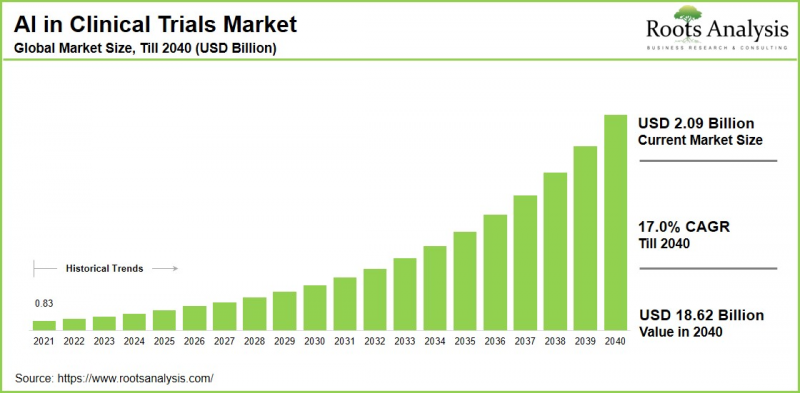
세계의 임상시험용 인공지능 시장 규모는 현재 20억 9,000만 달러에서 2040년까지 186억 2,000만 달러로 성장해, 예측기간 중(-2040년)의 CAGR은 17.0%로 추정되고 있습니다.
신규 치료법의 개발에는 많은 시간과 자금이 필요하며, 보통 10-15년이 걸립니다. 인간의 효능과 안전성을 평가하는데 있어서 필수적인 임상시험은 이 기간과 예산의 약 50-70%를 차지하지만, 설계상의 결함, 피험자 모집의 문제, 층별화의 오류, 높은 탈락율에 의해 많은 시험이 실패로 끝났습니다. 이 때문에 제약의 이해관계자는 이러한 과제를 경감하기 위해 방대한 데이터 세트를 처리하여 시험을 최적화하는 AI의 능력을 활용하여 AI의 도입을 가속화하고 있습니다.
특필해야할 것은 인공지능이 임상시험을 변화시키고 있다는 점입니다. 정밀한 매칭에 의한 환자 모집 가속, 디지털 트윈을 이용한 시험 설계의 정밀화, 전자 건강 기록(EHR)이나 화상 진단 등 다면적인 데이터 소스로부터의 안전성 및 유효성 시그널의 추출을 실현합니다. 또한 보고서 및 모니터링과 같은 일상 업무의 자동화도 진행하고 있습니다. 이상의 요인을 고려하면, 예측기간 동안 세계의 임상시험용 AI 시장은 현저한 성장이 예상됩니다.
고위 경영진을 위한 전략적 인사이트
임상시험용 AI의 주요 역할과 응용
AI는 환자 모집 및 시험 실시 시설의 선정에서 시험 설계, 데이터 관리, 결과 예측에 이르기까지 임상시험 전 과정에서 매우 중요한 역할을 합니다. 주요 응용 예로는 머신러닝을 활용한 전자 건강 기록(EHR)과 실세계 데이터 분석을 통한 정밀한 환자 매칭이 있습니다. 또한 스크리닝 실패를 줄이고 등록을 가속화하는 데에도 활용되고 있습니다. 또한 AI는 데이터 클리닝 자동화, 이상치 검출, 부작용 예측, 다양한 데이터 세트의 지속적인 분석을 통한 모니터링 강화를 실현합니다. 이를 통해 효율성을 높이고 비용을 절감하고 테스트 성공률을 높일 수 있으며 개별화된 의료 접근법을 지원할 수 있습니다.
임상시험용 AI 시장의 성장을 견인하는 주요 시장 성장 촉진요인
임상시험용 AI 시장은 전자건강기록 및 유전자 데이터 분석을 통한 환자 모집의 효율화 등 몇 가지 중요한 시장 성장 촉진요인에 의해 급속히 확대되고 있습니다. 이 접근법은 적절한 후보자의 식별을 가속화하고 시험 기간과 비용을 줄입니다. 예측 분석과 머신 러닝은 결과를 예측함으로써 테스트 설계를 최적화할 수 있게 해주며, 실제 세계 데이터 통합은 환자 행동에 대한 깊은 통찰력을 제공합니다. 또한 맞춤형 의료에 대한 수요 증가, 정밀 치료 성장, 엄청난 임상 데이터 세트 관리 요구가 이러한 기술의 채택을 촉진하고 있습니다.
임상시험용 AI 시장 : 업계 기업경쟁 구도
임상시험용 AI 시장의 경쟁 구도는 대기업과 중소기업의 공존을 특징으로 하는 격렬한 경쟁이 특징입니다. IQVIA, Medidata(Dassault Systemes), IBM Watson Health, Oracle Health Sciences, Phesi와 같은 주요 진출기업은 데이터 분석, 환자 매칭 및 시험 최적화를 위한 종합적인 플랫폼을 통해 주도적인 입장에 있으며, Pfizer 및 Novartis 등의 제약 기업과의 협업도 자주 이루어지고 있습니다.
AiCure, Deep 6 AI, Mendel.ai, Saama Technologies, Unlearn.ai, ConcertAI, Tempus AI 등 신흥기업은 실시간 모니터링 및 예측 모델링과 같은 틈새 솔루션으로 존재감을 높이고 있으며, 의약품 개발의 효율화 수요 증가로 경쟁을 격화시키고 있습니다.
임상시험용 AI의 진화 : 업계의 신흥 동향
이 분야의 새로운 추세에는 공정 자동화, 환자 매칭 향상, 예측 분석을 통한 상당한 비용 절감 및 기간 단축이 포함됩니다. 에이전트형 AI는 환자 모집부터 적응형 시험에서 실시간 위험 모니터링, 프로토콜 조정에 이르기까지 시험 워크플로우를 자율적으로 관리합니다. 생성형 AI와 달리 의사 결정을 독립적으로 수행하기 때문에 수작업을 줄이고 등록을 가속화합니다. 생성형 AI는 프로토콜 초안 작성, 모델 훈련용 합성 데이터 세트 생성, 전자 동의서(eConsent) 등 환자용 컨텐츠의 자동화를 실시합니다. 과거 데이터에서 시나리오를 시뮬레이션하여 테스트 설계를 최적화하고 개발 기간을 최대 50%, 비용을 25% 줄일 수 있습니다. 또한 디지털 트윈 기술은 AI와 과거 데이터를 사용하여 개별 환자의 반응을 시뮬레이션하여 보다 작지만 통계적으로 감지력이 높은 테스트를 가능하게 합니다.
주요 시장 과제
임상시험용 AI 시장은 GDPR(EU 개인정보보호규정) 및 HIPAA와 같은 엄격한 데이터 프라이버시 규제로 인한 민감한 환자 정보 취급의 어려움, 상당한 커스터마이징 및 상호 운용성 기준을 요하는 레거시 시스템과의 통합 과제 등 심각한 과제에 직면하고 있습니다. 기타 장벽으로는 실제 세계 데이터 세트에서 불완전성이나 바이어스 등의 데이터 품질의 문제, AI에 정통한 임상의의 부족 가운데 인프라 정비에 필요한 높은 초기 비용을 들 수 있습니다. 이러한 요인은 제약기업, 기술공급자, 규제당국이 연계하여 피험자 모집, 모니터링, 적응형 설계의 효율화에 있어서 AI의 가능성을 풀어내는 대처가 요구되고 있습니다.
임상시험용 AI 시장 : 주요 시장 세분화
시험 단계
- 제I상
- 제II상
- 제III상
대상 치료 영역
- 심혈관 질환
- 중추 신경계 질환
- 감염증
- 대사성 질환
- 종양성 질환
- 기타 질환
최종 사용자
- 제약 및 바이오테크놀러지 기업
- 기타
지역
- 북미
- 미국
- 캐나다
- 멕시코
- 기타 북미 국가
- 유럽
- 오스트리아
- 벨기에
- 덴마크
- 프랑스
- 독일
- 아일랜드
- 이탈리아
- 네덜란드
- 노르웨이
- 러시아
- 스페인
- 스웨덴
- 스위스
- 영국
- 기타 유럽 국가
- 아시아
- 중국
- 인도
- 일본
- 싱가포르
- 한국
- 기타 아시아 국가
- 라틴아메리카
- 브라질
- 칠레
- 콜롬비아
- 베네수엘라
- 기타 라틴아메리카 국가
- 중동 및 북아프리카
- 이집트
- 이란
- 이라크
- 이스라엘
- 쿠웨이트
- 사우디아라비아
- 아랍에미리트(UAE)
- 기타 중동 및 북아프리카 국가
- 세계 기타 지역
- 호주
- 뉴질랜드
- 기타 국가들
임상시험용 AI 시장 : 주요 시장 점유율에 대한 인사이트
치료 영역별 시장 점유율
세계 시장은 치료 영역별로 심혈관 질환, 중추 신경계 질환, 감염증, 대사성 질환, 종양 질환 및 기타 질병으로 분류됩니다. 당사의 추정에 따르면 현재 종양 질환이 시장의 대부분을 차지하고 있습니다. 이것은 암 임상시험의 규모가 크고 복잡하기 때문입니다. 이러한 테스트는 유전체 분석, 영상 진단 및 전자 건강 기록에서 광범위하고 다양한 데이터 세트를 생성하고 AI가 효율적으로 분석함으로써 환자 모집의 정확성을 향상시킵니다.
지역별 시장 점유율
당사의 추계에 따르면 현재 아시아태평양은 임상시험용 AI 시장의 큰 점유율을 차지하고 있습니다. 이는 암이나 당뇨병 등 만성질환의 부담이 증가하는 가운데, 대규모이고 다양한 환자 집단이 존재하고, 시험의 신속한 환자 모집이 가능하기 때문입니다. 또한 이 지역에서는 비용 효율적인 운영 체제 외에도 규제 체제 개선, 정부 인센티브, 확대하는 생명 공학 인프라가 성장을 추진하고 있습니다.
임상시험용 AI 시장의 대표적인 진입 기업
- AiCure
- Antidote Technologies
- Deep 6 AI
- Innoplexus
- IQVIA
- Median Technologies
- Medidata
- Mendel.ai
- Phesi
- Saama Technologies
- Signant Health
- Trials.ai
임상시험용 AI 시장 : 보고서의 커버 범위
이 보고서는 임상시험용 AI 시장에 대한 다음 섹션을 다룹니다.
- 시장 규모와 기회 분석 : 임상시험용 AI 시장의 상세한 분석. 주요 시장 부문인 (A) 시험 단계, (B) 대상 치료 영역, (C) 최종 사용자, (D) 주요 지역에 중점을 둡니다.
- 경쟁 구도 : 임상시험용 AI 시장 진출기업에 대해 (A) 설립 연도, (B) 기업 규모, (C) 본사 위치, (D) 소유 구조 등 여러 관련 매개 변수를 기반으로 종합적인 분석을 다룹니다.
- 기업 프로파일 : 임상시험용 AI 시장에 진입하는 주요 기업의 상세한 프로파일을 제공합니다. 내용은 (A) 본사 위치, (B) 기업 규모, (C) 기업 이념, (D) 사업 전개 지역, (E) 경영진, (F) 연락처, (G) 재무 정보, (H) 사업 부문, (I) 제품 포트폴리오, (J) 최근 동향 및 미래 전망을 포함합니다.
- 메가 트렌드 : 임상시험용 AI 업계에서 진행 중인 메가 트렌드를 평가합니다.
- 특허 분석 : 임상시험용 AI 분야에서 출원 및 등록된 특허에 관한 인사이트가 풍부한 분석. 관련 파라미터((A) 특허의 유형, (B) 특허 공개 연도, (C) 특허의 경과 연수, (D) 주요 진출기업)에 근거합니다.
- 최근 동향 : 임상시험용 AI 시장에서의 최근 동향의 개요와 (A) 이니셔티브의 연도, (B) 이니셔티브의 유형, (C) 지리적 분포, (D) 가장 활발한 진출기업 등 관련 매개변수에 기초한 분석을 다룹니다.
- Porter's Five Forces 분석 : 임상시험용 AI 시장에 존재하는 5가지 경쟁 요인(신규 참가자의 위협, 구매자의 협상력, 공급업체의 협상력, 대체품의 위협, 기존 경쟁자 간의 경쟁)에 대한 분석을 다룹니다.
- SWOT 분석 : 해당 분야의 강점, 약점, 기회, 위협을 명시하는 통찰력이 풍부한 SWOT 프레임워크입니다. 또한 하비볼 분석을 제공하여 각 SWOT 파라미터의 상대적인 영향도를 강조합니다.
- 밸류체인 분석 : 임상시험용 AI 시장과 관련된 다양한 단계와 이해 관계자에 대한 정보를 제공하는 종합적인 밸류체인 분석입니다.
이 보고서에서 답변을 얻을 수 있는 주요 질문
- 현재 시장 규모와 미래 시장 규모는 어느 정도인가?
- 이 시장의 주요 기업은?
- 이 시장의 진화에 영향을 줄 수 있는 성장 요인은 무엇인가?
- 이 업계를 형성하는 주요 제휴 및 자금 조달의 동향은 어떤 것인가?
- 2040년까지 높은 CAGR로 성장이 예상되는 지역은 어딘가?
- 현재 및 미래 시장 기회는 주요 시장 부문간에 어떻게 분포할 전망인가?
목차
제1장 서문
제2장 주요 요약
제3장 소개
- 장 개요
- AI의 진화
- AI의 서브필드
- 헬스케어 AI의 응용
- 임상시험용 AI의 응용
- AI 도입에 따른 과제
- 미래의 전망
제4장 경쟁 구도
- 장 개요
- 임상시험용 AI : AI 소프트웨어 및 서비스 제공업체의 현황
제5장 기업 프로파일
- 장 개요
- AiCure
- Antidote Technologies
- Deep 6 AI
- Innoplexus
- IQVIA
- Median Technologies
- Medidata
- Mendel.ai
- Phesi
- Saama Technologies
- Signant Health
- Trials.ai
제6장 임상시험 분석
- 장 개요
- 범위와 조사 방법
- 임상시험용 AI
제7장 파트너십 및 협업
- 장 개요
- 파트너십 모델
- 임상시험용 AI : 파트너십 및 협업
제8장 자금 조달 및 투자
- 장 개요
- 자금 조달의 유형
- 임상시험용 AI : 자금조달 및 투자
- 결론
제9장 대기업 제약회사의 대처
- 장 개요
- 범위와 조사 방법
- 이니셔티브 연도별 분석
- 대처 유형별 분석
- AI 응용 분야별 분석
- 대상 치료 영역별 분석
- 벤치마크 분석 : 주요 제약 회사
제10장 임상시험용 AI : 이용 사례
- 장 개요
- 이용 사례 1 : Roche와 AiCure의 콜라보레이션
- 이용 사례 2 : Takeda와 AiCure의 콜라보레이션
- 이용 사례 3 : Teva Pharmaceuticals와 Intel의 콜라보레이션
- 이용 사례 4 : 비공개 제약회사와 Antidote의 콜라보레이션
- 이용 사례 5 : 비공개 제약회사와 Cognizant의 콜라보레이션
- 이용 사례 6 : Cedars-Sinai Medical Center와 Deep 6 AI의 콜라보레이션
- 이용 사례 7 : GlaxoSmithKline(GSK)과 PathAI의 콜라보레이션
- 이용 사례 8 : Bristol Myers Squibb(BMS)와 Concert AI의 콜라보레이션
제11장 가치 창조 프레임워크 : 임상시험에서 미충족 요구에 대응하기 위한 전략 가이드
제12장 비용 절감 분석
제13장 시장 예측과 기회 분석
- 장 개요
- 주요 전제와 예측 조사 방법
- 세계의 임상시험용 AI
- 임상시험용 AI 시장 : 시험단계별
- 임상시험용 AI 시장 : 대상 치료 영역별
- 임상시험용 AI 시장 : 최종 사용자별
- 임상시험용 AI 시장 : 주요 지역별
제14장 결론
제15장 주요 인사이트
제16장 부록 I : 테이블 데이터
제17장 부록 II : 기업 및 조직 목록
JHS 26.02.09AI In Clinical Trials Market Outlook
As per Roots Analysis, the global artificial intelligence in clinical trials market size is estimated to grow from USD 2.09 billion in the current year to USD 18.62 billion by 2040, at a CAGR of 17.0% during the forecast period, till 2040.
Developing novel therapeutic interventions demands substantial time and financial resources, typically spanning about 10-15 years. Clinical trials, essential for evaluating efficacy and safety in humans, consume roughly 50-70% of this timeline and budget, yet many fail due to design flaws, recruitment issues, stratification errors, and high dropout rates. Therefore, pharma stakeholders are increasingly adopting AI to mitigate these hurdles, leveraging its capacity to process vast datasets for smarter trial optimization.
It is worth mentioning that artificial intelligence transforms clinical trials by accelerating patient recruitment through precise matching, refining trial designs via digital twins, and extracting safety and efficacy signals from multifaceted data sources like EHRs and imaging. Further, it automates the routine tasks such as reporting and monitoring. Overall, considering the above mentioned factors, the global AI in clinical trials market is expected to grow significantly during the forecast period.
Strategic Insights for Senior Leaders
Key Roles and Applications of AI in Clinical Trials
AI plays pivotal roles across clinical trials, from patient recruitment and site selection to trial design, data management, and outcome prediction. Key applications include using machine learning to analyze electronic health records and real-world data for precise patient matching. Further, it is used for reducing screen failures and accelerating enrollment. AI also automates data cleaning, detects anomalies, forecasts adverse events, and enhances monitoring through continuous analysis of diverse datasets. This enables improvement in efficiency, cutting costs, and boosting trial success rates while supporting personalized medicine approaches.
Prominent Drivers Propelling Growth of AI in Clinical Trials Market
The AI in clinical trials market is expanding rapidly due to several critical drivers, including enhanced patient recruitment through analysis of electronic health records and genetic data. This approach accelerates identification of suitable candidates and reduces trial timelines and costs. Predictive analytics and machine learning enable optimized trial designs by forecasting outcomes, while integration of real-world data provides deeper insights into patient behaviors. Further, rising demand for personalized medicine, growth in precision therapies, and the need to manage vast clinical datasets fuel adoption of such technologies.
AI in Clinical Trials Market: Competitive Landscape of Companies in this Industry
The competitive landscape of AI in clinical trials market is characterized by intense competition, featuring a combination of large and smaller firms. Key players such as IQVIA, Medidata (Dassault Systemes), IBM Watson Health, Oracle Health Sciences, and Phesi dominate through comprehensive platforms for data analytics, patient matching, and trial optimization, often collaborating with pharmaceutical firms like Pfizer and Novartis.
Emerging companies including AiCure, Deep 6 AI, Mendel.ai, Saama Technologies, Unlearn.ai, ConcertAI, and Tempus AI are gaining traction with niche solutions like real-time monitoring, and predictive modeling, intensifying competition amid rising demand for efficiency in drug development.
AI in Clinical Trials Evolution: Emerging Trends in the Industry
Emerging trends in this domain include automating processes, enhancing patient matching, and enabling predictive analytics to cut costs and timelines significantly. Agentic AI autonomously manages trial workflows, from patient recruitment to real-time risk monitoring and protocol adjustments in adaptive trials. Unlike generative AI, it executes decisions independently, reducing manual tasks and accelerating enrollment. Generative AI draft protocols, creates synthetic datasets for training models, and automates patient-facing content like eConsent. It optimizes trial design by simulating scenarios from historical data, potentially cutting development time by 50% and costs by 25%. Additionally, digital twins simulate individual patient responses using AI and historical data, enabling smaller trials with higher statistical power.
Key Market Challenges
The market for AI in clinical trials faces significant challenges, including stringent data privacy regulations like GDPR and HIPAA that complicate handling sensitive patient information, integration hurdles with legacy systems requiring substantial customization and interoperability standards. Additional barriers encompass data quality issues such as incompleteness and bias in real-world datasets, high upfront costs for infrastructure amid a shortage of AI-savvy clinicians. These factors necessitate collaborative efforts between pharma firms, tech providers, and regulators to unlock AI's potential in streamlining recruitment, monitoring, and adaptive designs.
AI In Clinical Trials Market: Key Market Segmentation
Trial Phase
- Phase I
- Phase II
- Phase III
Target Therapeutic Area
- Cardiovascular Disorders
- CNS Disorders
- Infectious Diseases
- Metabolic Disorders
- Oncological Disorders
- Other Disorders
End-user
- Pharmaceutical and Biotechnology Companies
- Other End-users
Geographical Regions
- North America
- US
- Canada
- Mexico
- Other North American countries
- Europe
- Austria
- Belgium
- Denmark
- France
- Germany
- Ireland
- Italy
- Netherlands
- Norway
- Russia
- Spain
- Sweden
- Switzerland
- UK
- Other European countries
- Asia
- China
- India
- Japan
- Singapore
- South Korea
- Other Asian countries
- Latin America
- Brazil
- Chile
- Colombia
- Venezuela
- Other Latin American countries
- Middle East and North Africa
- Egypt
- Iran
- Iraq
- Israel
- Kuwait
- Saudi Arabia
- UAE
- Other MENA countries
- Rest of the World
- Australia
- New Zealand
- Other countries
AI in clinical trials Market: Key Market Share Insights
Market Share by Therapeutic Area
Based on the therapeutic area, the global market is segmented into cardiovascular disorders, CNS disorders, infectious diseases, metabolic disorders, oncological disorders and other disorders. According to our estimates, currently, oncological disorders capture majority share of the market. This is due to the high volume and complexity of cancer trials; these trials generate vast, heterogeneous datasets from genomics, imaging, and electronic health records, which AI efficiently analyzes for precise patient recruitment.
Market Share by Geography
According to our estimates Asia-Pacific currently captures a significant share of the AI in clinical trials market. This is due to the massive, diverse patient population, offering rapid recruitment for trials amid rising chronic disease burdens like cancer and diabetes. Further, the region has cost-effective operations along with improving regulatory frameworks, government incentives, and expanding biotech infrastructure which fuels the growth.
Example Players in AI in Clinical Trials Market
- AiCure
- Antidote Technologies
- Deep 6 AI
- Innoplexus
- IQVIA
- Median Technologies
- Medidata
- Mendel.ai
- Phesi
- Saama Technologies
- Signant Health
- Trials.ai
AI in Clinical Trials Market: Report Coverage
The report on the AI in clinical trials market features insights on various sections, including:
- Market Sizing and Opportunity Analysis: An in-depth analysis of the AI in clinical trials market, focusing on key market segments, including [A] trial phase, [B] target therapeutic area, [C] end user, and [D] key geographical regions.
- Competitive Landscape: A comprehensive analysis of the companies engaged in the AI in clinical trials market, based on several relevant parameters, such as [A] year of establishment, [B] company size, [C] location of headquarters and [D] ownership structure.
- Company Profiles: Elaborate profiles of prominent players engaged in the AI in clinical trials market, providing details on [A] location of headquarters, [B] company size, [C] company mission, [D] company footprint, [E] management team, [F] contact details, [G] financial information, [H] operating business segments, [I] portfolio, [J] recent developments, and an informed future outlook.
- Megatrends: An evaluation of ongoing megatrends in the AI in clinical trials industry.
- Patent Analysis: An insightful analysis of patents filed / granted in the AI in clinical trials domain, based on relevant parameters, including [A] type of patent, [B] patent publication year, [C] patent age and [D] leading players.
- Recent Developments: An overview of the recent developments made in the AI in clinical trials market, along with analysis based on relevant parameters, including [A] year of initiative, [B] type of initiative, [C] geographical distribution and [D] most active players.
- Porter's Five Forces Analysis: An analysis of five competitive forces prevailing in the AI in clinical trials market, including threats of new entrants, bargaining power of buyers, bargaining power of suppliers, threats of substitute products and rivalry among existing competitors.
- SWOT Analysis: An insightful SWOT framework, highlighting the strengths, weaknesses, opportunities and threats in the domain. Additionally, it provides Harvey ball analysis, highlighting the relative impact of each SWOT parameter.
- Value Chain Analysis: A comprehensive analysis of the value chain, providing information on the different phases and stakeholders involved in the AI in clinical trials market.
Key Questions Answered in this Report
- What is the current and future market size?
- Who are the leading companies in this market?
- What are the growth drivers that are likely to influence the evolution of this market?
- What are the key partnership and funding trends shaping this industry?
- Which region is likely to grow at higher CAGR till 2040?
- How is the current and future market opportunity likely to be distributed across key market segments?
Reasons to Buy this Report
- Detailed Market Analysis: The report provides a comprehensive market analysis, offering detailed revenue projections of the overall market and its specific sub-segments. This information is valuable to both established market leaders and emerging entrants.
- In-depth Analysis of Trends: Stakeholders can leverage the report to gain a deeper understanding of the competitive dynamics within the market. Each report maps ecosystem activity across partnerships, funding, and patent landscapes to reveal growth hotspots and white spaces in the industry.
- Opinion of Industry Experts: The report features extensive interviews and surveys with key opinion leaders and industry experts to validate market trends mentioned in the report.
- Decision-ready Deliverables: The report offers stakeholders with strategic frameworks (Porter's Five Forces, value chain, SWOT), and complimentary Excel / slide packs with customization support.
Additional Benefits
- Complimentary Dynamic Excel Dashboards for Analytical Modules
- Exclusive 15% Free Content Customization
- Personalized Interactive Report Walkthrough with Our Expert Research Team
- Free Report Updates for Versions Older than 6-12 Months
TABLE OF CONTENTS
1. PREFACE
- 1.1. Scope of the Report
- 1.2. Research Methodology
- 1.3. Key Questions Answered
- 1.4. Chapter Outlines
2. EXECUTIVE SUMMARY
3. INTRODUCTION
- 3.1. Chapter Overview
- 3.2. Evolution of AI
- 3.3. Subfields of AI
- 3.4. Applications of AI in Healthcare
- 3.4.1. Drug Discovery
- 3.4.2. Drug Manufacturing
- 3.4.3. Marketing
- 3.4.4. Diagnosis and Treatment
- 3.4.5. Clinical Trials
- 3.5. Applications of AI in Clinical Trials
- 3.6. Challenges Associated with the Adoption of AI
- 3.7. Future Perspective
4. COMPETITIVE LANDSCAPE
- 4.1. Chapter Overview
- 4.2. AI in Clinical Trials: AI Software and Service Providers Landscape
- 4.2.1. Analysis by Year of Establishment
- 4.2.2. Analysis by Company Size
- 4.2.3. Analysis by Location of Headquarters
- 4.2.4. Analysis by Company Size and Location of Headquarters (Region-wise)
- 4.2.5. Analysis by Key Offering
- 4.2.6. Analysis by Business Model
- 4.2.7. Analysis by Deployment Option
- 4.2.8. Analysis by Type of AI Technology
- 4.2.9. Analysis by Application Area
- 4.2.10. Analysis by Potential End-user
5. COMPANY PROFILES
- 5.1. Chapter Overview
- 5.2. AiCure
- 5.2.1. Company Overview
- 5.2.2. AI-based Clinical Trial Offerings
- 5.2.3. Recent Developments and Future Outlook
- 5.3. Antidote Technologies
- 5.3.1. Company Overview
- 5.3.2. AI-based Clinical Trial Offerings
- 5.3.3. Recent Developments and Future Outlook
- 5.4. Deep 6 AI
- 5.4.1. Company Overview
- 5.4.2. AI-based Clinical Trial Offerings
- 5.4.3. Recent Developments and Future Outlook
- 5.5. Innoplexus
- 5.5.1. Company Overview
- 5.5.2. AI-based Clinical Trial Offerings
- 5.5.3. Recent Developments and Future Outlook
- 5.6. IQVIA
- 5.6.1. Company Overview
- 5.6.2. Financial Information
- 5.6.3. AI-based Clinical Trial Offerings
- 5.6.4. Recent Developments and Future Outlook
- 5.7. Median Technologies
- 5.7.1. Company Overview
- 5.7.2. Financial Information
- 5.7.3. AI-based Clinical Trial Offerings
- 5.7.4. Recent Developments and Future Outlook
- 5.8. Medidata
- 5.8.1. Company Overview
- 5.8.2. Financial Information
- 5.8.3. AI-based Clinical Trial Offerings
- 5.8.4. Recent Developments and Future Outlook
- 5.9. Mendel.ai
- 5.9.1. Company Overview
- 5.9.2. AI-based Clinical Trial Offerings
- 5.9.3. Recent Developments and Future Outlook
- 5.10. Phesi
- 5.10.1. Company Overview
- 5.10.2. AI-based Clinical Trial Offerings
- 5.10.3. Recent Developments and Future Outlook
- 5.11. Saama Technologies
- 5.11.1. Company Overview
- 5.11.2. AI-based Clinical Trial Offerings
- 5.11.3. Recent Developments and Future Outlook
- 5.12. Signant Health
- 5.12.1. Company Overview
- 5.12.2. AI-based Clinical Trial Offerings
- 5.12.3. Recent Developments and Future Outlook
- 5.13. Trials.ai
- 5.13.1. Company Overview
- 5.13.2. AI-based Clinical Trial Offerings
- 5.13.3. Recent Developments and Future Outlook
6. CLINICAL TRIAL ANALYSIS
- 6.1. Chapter Overview
- 6.2. Scope and Methodology
- 6.3. AI in Clinical Trials
- 6.3.1. Analysis by Trial Registration Year
- 6.3.2. Analysis by Number of Patients Enrolled
- 6.3.3. Analysis by Trial Phase
- 6.3.4. Analysis by Trial Status
- 6.3.5. Analysis by Trial Registration Year and Status
- 6.3.6. Analysis by Type of Sponsor
- 6.3.7. Analysis by Patient Gender
- 6.3.8. Analysis by Patient Age
- 6.3.9. Word Cloud Analysis: Emerging Focus Areas
- 6.3.10. Analysis by Target Therapeutic Area
- 6.3.11. Analysis by Study Design
- 6.3.11.1. Analysis by Type of Patient Allocation Model Used
- 6.3.11.2. Analysis by Type of Trial Masking Adopted
- 6.3.11.3. Analysis by Type of Intervention
- 6.3.11.4. Analysis by Trial Purpose
- 6.3.12. Most Active Players: Analysis by Number of Clinical Trials
- 6.3.13. Analysis of Clinical Trials by Geography
- 6.3.14. Analysis of Clinical Trials by Geography and Trial Status
- 6.3.15. Analysis of Patients Enrolled by Geography and Trial Registration Year
- 6.3.16. Analysis of Patients Enrolled by Geography and Trial Status
7. PARTNERSHIPS AND COLLABORATIONS
- 7.1. Chapter Overview
- 7.2. Partnership Models
- 7.3. AI in Clinical Trials: Partnerships and Collaborations
- 7.3.1. Analysis by Year of Partnership
- 7.3.2. Analysis by Type of Partnership
- 7.3.3. Analysis by Year and Type of Partnership
- 7.3.4. Analysis by Application Area
- 7.3.5. Analysis by Target Therapeutic Area
- 7.3.6. Analysis by Type of Partner
- 7.3.7. Most Active Players: Analysis by Number of Partnerships
- 7.3.8. Analysis by Geography
- 7.3.8.1. Local and International Agreements
- 7.3.8.2. Intercontinental and Intracontinental Agreements
8. FUNDING AND INVESTMENTS
- 8.1. Chapter Overview
- 8.2. Types of Funding
- 8.3. AI in Clinical Trials: Funding and Investments
- 8.3.1. Analysis by Year of Funding
- 8.3.2. Analysis by Amount Invested
- 8.3.3. Analysis by Type of Funding
- 8.3.4. Analysis by Year and Type of Funding
- 8.3.5. Analysis by Type of Funding and Amount Invested
- 8.3.6. Analysis by Application Area
- 8.3.7. Analysis by Geography
- 8.3.8. Most Active Players: Analysis by Number of Funding Instances and Amount Raised
- 8.3.9. Leading Investors: Analysis by Number of Funding Instances
- 8.4. Concluding Remarks
9. BIG PHARMA INITIATIVES
- 9.1. Chapter Overview
- 9.2. Scope and Methodology
- 9.3. Analysis by Year of Initiative
- 9.4. Analysis by Type of Initiative
- 9.5. Analysis by Application Area of AI
- 9.6. Analysis by Target Therapeutic Area
- 9.7. Benchmarking Analysis: Big Pharma Players
10. AI IN CLINICAL TRIALS: USE CASES
- 10.1. Chapter Overview
- 10.2. Use Case 1: Collaboration between Roche and AiCure
- 10.2.1. Roche
- 10.2.2. AiCure
- 10.2.3. Business Needs
- 10.2.4. Objectives Achieved and Solutions Provided
- 10.3. Use Case 2: Collaboration between Takeda and AiCure
- 10.3.1. Takeda
- 10.3.2. AiCure
- 10.3.3. Business Needs
- 10.3.4. Objectives Achieved and Solutions Provided
- 10.4. Use Case 3: Collaboration between Teva Pharmaceuticals and Intel
- 10.4.1. Teva Pharmaceuticals
- 10.4.2. Intel
- 10.4.3. Business Needs
- 10.4.4. Objectives Achieved and Solutions Provided
- 10.5. Use Case 4: Collaboration between Undisclosed Pharmaceutical Company and Antidote
- 10.5.1. Antidote
- 10.5.2. Business Needs
- 10.5.3. Objectives Achieved and Solutions Provided
- 10.6. Use Case 5: Collaboration between Undisclosed Pharmaceutical Company and Cognizant
- 10.6.1. Cognizant
- 10.6.2. Business Needs
- 10.6.3. Objectives Achieved and Solutions Offered
- 10.7. Use Case 6: Collaboration between Cedars-Sinai Medical Center and Deep 6 AI
- 10.7.1. Cedars-Sinai Medical Center
- 10.7.2. Deep 6 AI
- 10.7.3. Business Needs
- 10.7.4. Objectives Achieved and Solutions Offered
- 10.8. Use Case 7: Collaboration between GlaxoSmithKline (GSK) and PathAI
- 10.8.1. PathAI
- 10.8.2. GlaxoSmithKline (GSK)
- 10.8.3. Business Needs
- 10.8.4. Objectives Achieved and Solutions Provided
- 10.9. Use Case 8: Collaboration between Bristol Myers Squibb (BMS) and Concert AI
- 10.9.1. Concert AI
- 10.9.2. Bristol Myers Squibb (BMS)
- 10.9.3. Business Needs
- 10.9.4. Objectives Achieved and Solutions Provided
11. VALUE CREATION FRAMEWORK: A STRATEGIC GUIDE TO ADDRESS UNMET NEEDS IN CLINICAL TRIALS
12. COST SAVING ANALYSIS
13. MARKET FORECAST AND OPPORTUNITY ANALYSIS
- 13.1. Chapter Overview
- 13.2. Key Assumptions and Forecast Methodology
- 13.3. Global AI in Clinical Trials Market
- 13.3.1. AI in Clinical Trials Market: Distribution by Trial Phase
- 13.3.1.1. AI in Clinical Trials Market for Phase I
- 13.3.1.2. AI in Clinical Trials Market for Phase II
- 13.3.1.3. AI in Clinical Trials Market for Phase III
- 13.3.2. AI in Clinical Trials Market: Distribution by Target Therapeutic Area
- 13.3.2.1. AI in Clinical Trials Market for Cardiovascular Disorders
- 13.3.2.2. AI in Clinical Trials Market for CNS Disorders
- 13.3.2.3. AI in Clinical Trials Market for Infectious Diseases
- 13.3.2.4. AI in Clinical Trials Market for Metabolic Disorders
- 13.3.2.5. AI in Clinical Trials Market for Oncological Disorders
- 13.3.2.6. AI in Clinical Trials Market for Other Disorders
- 13.3.3. AI in Clinical Trials Market: Distribution by End-user
- 13.3.3.1. AI in Clinical Trials Market for Pharmaceutical and Biotechnology Companies
- 13.3.3.2. AI in Clinical Trials Market for Other End-users
- 13.3.4. AI in Clinical Trials Market: Distribution by Key Geographical Regions
- 13.3.4.1. AI in Clinical Trials Market in North America
- 13.3.4.2. AI in Clinical Trials Market in Europe
- 13.3.4.3. AI in Clinical Trials Market in Asia-Pacific
- 13.3.4.4. AI in Clinical Trials Market in Middle East and North Africa
- 13.3.4.5. AI in Clinical Trials Market in Latin America
- 13.3.1. AI in Clinical Trials Market: Distribution by Trial Phase
14. CONCLUSION
15.. EXECUTIVE INSIGHTS
- 15.1. Chapter Overview
- 15.2. Company A
- 15.2.1. Company Snapshot
- 15.2.2. Interview Transcript: Danielle Ralic, Co-Founder, Chief Executive Officer and Chief Technology Officer
- 15.3. Company B
- 15.3.1. Company Snapshot
- 15.3.2. Interview Transcript: Wout Brusselaers, Founder and Chief Executive Officer
- 15.4. Company C
- 15.4.1. Company Snapshot
- 15.4.2. Interview Transcript: Dimitrios Skaltsas, Co-Founder and Executive Director
- 15.5. Company D
- 15.5.1. Company Snapshot
- 15.5.2. Interview Transcript: R. A. Bavasso, Founder and Chief Executive Officer
- 15.6. Company E
- 15.6.1. Company Snapshot
- 15.6.2. Interview Transcript: Troy Bryenton (Chief Technology Officer), Michael Shipton (Chief Commercial Officer), Darcy Forman (Chief Delivery Officer), Grazia Mohren (Head of Marketing)


