

|
시장보고서
상품코드
2055601
일회용 다운스트림 바이오공정 시장(제2판) : 제품 유형, 사업 규모, 최종사용자, 지역별 동향, 예측(-2035년)Single Use Downstream Bioprocessing Market (2nd Edition) by Type of Product, Scale of Operation, End User, and Geographical Regions - Trends and Forecast Till 2035 |
||||||

일회용 다운스트림 바이오공정 시장 : 개요
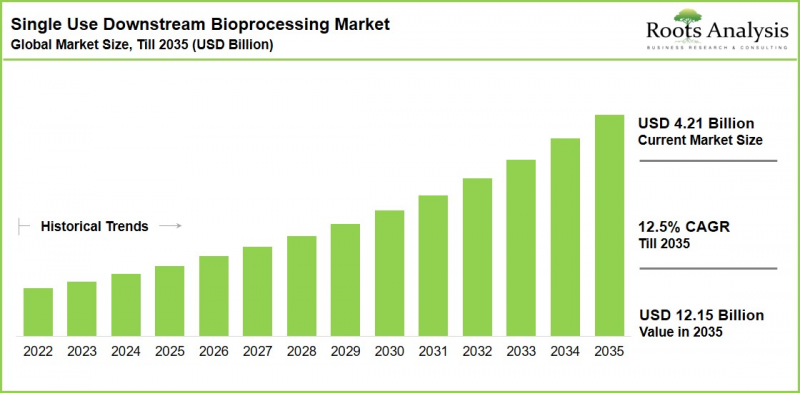
세계의 일회용 다운스트림 바이오공정 시장 규모는 2035년까지 연평균 복합 성장률(CAGR) 12.5%로 확대되어 현재 42억 1,000만 달러에서 2035년에는 121억 5,000만 달러에 이를 것으로 추정되고 있습니다.
일회용 다운스트림 바이오공정 시장 : 성장 및 동향
일회용 다운스트림 바이오공정 시스템은 제약 기업 및 CDMO(의약품 개발, 제조 수탁 기관)에 생산 수요의 변동에 따라 생산 규모를 유연하게 확대, 축소할 수 있는 환경을 제공함으로써, 의약품 제조 방식을 혁신하고 있습니다. 이러한 시스템은 세척, 멸균, 유지보수 및 공정 맞춤화에 따른 가동 중단 시간을 대폭 줄여주는 동시에, CIP(현장 세척) 및 SIP(현장 증기 멸균) 검증과 같은 에너지 집약적인 절차를 없애줍니다. 주요 기술적 진보로는 프리팩트형 크로마토그래피 컬럼, 접선 유동 여과 어셈블리, 일회용 막 흡착체 등이 있습니다.
바이오의약품 제조 분야에서 일회용 기술의 도입은 꾸준히 증가하고 있으며, 특히 최근 들어 다운스트림 바이오공정 분야에서 그 성장세가 두드러지고 있습니다. 기존의 스테인리스 시스템과 비교했을 때, 일회용 솔루션은 설비 투자 비용 절감, 시설 설계 및 시운전 기간 단축 등 여러 가지 장점이 있습니다. 또한, 이러한 시스템은 프로젝트 리드타임을 최대 8개월 단축할 수 있을 뿐만 아니라, 신속한 확장 및 프로세스 맞춤 설정을 지원하는 등 운영상의 유연성을 한층 높여줍니다.
그 결과, 자체 생산 기업과 CDMO 모두 소규모의 맞춤형 배치 크기를 효율적으로 관리하고 빈번한 제품 전환에 대응하기 위해 일회용 시스템의 도입을 가속화하고 있습니다. 도입률 상승과 지속적인 기술 발전에 힘입어, 일회용 다운스트림 바이오공정 시장은 예측 기간 동안 강력한 성장세를 유지할 것으로 전망됩니다.
성장 요인: 시장 확대를 전략적으로 촉진하는 요인
바이오의약품, 백신, 첨단 치료제의 파이프라인 확장이 유연하고 효율적인 후공정 솔루션에 대한 수요를 이끌고 있습니다. 그 결과, 여과, 크로마토그래피, 무균 샘플링 등 주요 정제 공정은 점점 더 일회용 방식으로 전환되고 있으며, 이를 통해 공정 전환 시간 단축, 제품 순도 향상, 오염 위험 감소가 가능해졌습니다.
일회용 크로마토그래피 컬럼 및 여과 시스템과 같은 기술은 신뢰성과 품질을 향상시키고, 복잡한 생체 분자의 처리를 한층 더 강화합니다. 동시에, 업계에서 지속가능성과 비용 최적화에 대한 관심이 높아짐에 따라, 설비 투자 감소 및 시설 리드타임 단축과 같은 이점으로 인해 일회용 시스템의 도입이 가속화되고 있습니다. 이러한 장점 덕분에 일회용 기술은 업무 효율화와 시장 출시 기간 단축을 실현하는 최적의 접근 방식으로 자리매김하고 있습니다.
시장의 과제: 진전을 가로막는 중대한 장벽
일회용 바이오공정 시장은 도입이 확대되고 있음에도 불구하고 몇 가지 과제에 직면해 있습니다. 일회용 부품에서 유래한 추출물 및 용출물에 대한 우려는 제품의 품질 및 규정 준수에 잠재적인 위험을 초래합니다. 또한, 확장성이나 기계적 강도의 한계로 인해 대규모 상업 생산에 활용하기 어려울 수 있습니다. 공급망에 대한 의존도와 부품 부족의 위험 또한 생산 운영의 지속성에 추가적인 영향을 미칩니다. 특히 지속가능성의 중요성이 커지는 가운데, 플라스틱 폐기물 처리에 관한 환경 문제도 여전히 중요한 과제로 남아 있습니다. 게다가, 서로 다른 일회용 시스템 간의 표준화와 호환성에 대한 필요성은 제조업체들에게 계속해서 통합상의 과제를 안겨주고 있습니다.
본 보고서에서는 전 세계 일회용 다운스트림 바이오공정 시장을 조사했으며, 시장 개요, 배경, 시장 영향요인 분석, 시장 규모 추이 및 전망, 각종 분류별 상세 분석, 경쟁 현황, 주요 기업 프로파일 등을 정리했습니다.
목차
제1장 배경
제2장 조사 방법
제3장 시장 역학
제4장 거시경제 지표
제5장 주요 요약
제6장 서론
제7장 시장 구도 : 일회용 크로마토그래피 시스템
제8장 시장 구도 : 일회용 여과 시스템
제9장 시장 구도 : 일회용 샘플링 시스템
제10장 시장 구도 : 일회용 커넥터
제11장 제품 경쟁력 분석
제12장 기업 개요 : 일회용 다운스트림 바이오공정 제품/시스템 프로바이더
제13장 특허 분석
제14장 브랜드 포지셔닝 매트릭스
제15장 수급 분석
제16장 시장 영향 분석
제17장 세계의 일회용 다운스트림 바이오공정 시장
제18장 일회용 다운스트림 바이오공정 시장 : 사업 규모별
제19장 일회용 다운스트림 바이오공정 시장 : 기기 유형별
제20장 일회용 다운스트림 바이오공정 시장 : 최종사용자별
제21장 북미의 일회용 다운스트림 바이오공정 시장 기회
제22장 유럽의 일회용 다운스트림 바이오공정 시장 기회
제23장 아시아태평양의 일회용 다운스트림 바이오공정 시장 기회
제24장 세계 기타 지역의 일회용 다운스트림 바이오공정 시장 기회
제25장 인접 시장 분석
제26장 결론
제27장 경영 임원 인사이트
제28장 부록 1 : 표 형식 데이터
제29장 부록 2 : 기업 및 조직 리스트
LSH 26.06.19Single Use Downstream Bioprocessing Market: Overview
As per Roots Analysis, the global single use downstream bioprocessing market is estimated to grow from USD 4.21 billion in the current year to USD 12.15 billion by 2035, at a CAGR of 12.5% during the forecast period, till 2035.
Single Use Downstream Bioprocessing Market: Growth and Trends
Single-use downstream bioprocessing systems are transforming pharmaceutical manufacturing by enabling both pharmaceutical companies and contract development and manufacturing organizations (CDMOs) to flexibly scale operations whether scaling out, up, or down in response to fluctuating production demands. These systems significantly reduce downtime associated with cleaning, sterilization, maintenance, and process customization, while eliminating energy-intensive procedures such as clean-in-place (CIP) and steam-in-place (SIP) validation. Key technological advancements include pre-packed chromatography columns, tangential flow filtration assemblies, and disposable membrane adsorbers.
The adoption of single-use technologies in biopharmaceutical manufacturing has witnessed consistent growth, with downstream bioprocessing experiencing particularly strong momentum in recent years. Compared to traditional stainless-steel systems, single-use solutions offer several advantages, including lower capital expenditure and faster facility design and commissioning timelines. These systems also help reduce project lead times by up to eight months while providing greater operational flexibility to support rapid scale-up and process customization.
As a result, both in-house manufacturers and CDMOs are increasingly integrating single-use systems to efficiently manage smaller, personalized batch sizes and accommodate frequent product changeovers. Supported by rising adoption rates and ongoing technological advancements, the single-use downstream bioprocessing market is expected to sustain a strong growth trajectory over the forecast period.
Growth Drivers: Strategic Enablers of Market Expansion
The expanding pipeline of biologics, vaccines, and advanced therapies is driving demand for flexible and efficient downstream processing solutions. Consequently, key purification steps such as filtration, chromatography, and aseptic sampling are increasingly shifting toward single-use formats, enabling faster changeovers, higher product purity, and reduced contamination risks.
Technologies such as disposable chromatography columns and filtration systems further enhance the processing of complex biomolecules with improved reliability and quality. In parallel, the industry's growing focus on sustainability and cost optimization is accelerating the adoption of single-use systems, given their lower capital investment and reduced facility lead times. These advantages are positioning single-use technologies as a preferred approach for streamlining operations and accelerating time-to-market.
Market Challenges: Critical Barriers Impeding Progress
The single-use bioprocessing market faces several challenges despite its growing adoption. Concerns around extractables and leachables from disposable components pose potential risks to product quality and regulatory compliance. Additionally, limitations in scalability and mechanical strength can restrict their use in large-volume commercial manufacturing. Supply chain dependencies and the risk of component shortages further impact operational continuity. Environmental concerns related to plastic waste disposal also remain a key issue, particularly as sustainability gains importance. Moreover, the need for standardization and compatibility across different single-use systems continues to present integration challenges for manufacturers.
Single Use Downstream Bioprocessing Market: Key Trends
The report delves into the current state of the single use downstream bioprocessing market and identifies potential growth opportunities within industry. Some key trends in the report include:
Accelerating Downstream Processing with Ready-to-Use Chromatography Solutions
The increasing adoption of single-use chromatography technologies is transforming downstream processing economics by replacing labor-intensive column packing procedures with pre-packed, pre-validated disposable columns and membrane adsorbers. This transition addresses the biopharmaceutical industry's growing need to minimize cross-contamination risks while significantly reducing the operational burden associated with cleaning validation of conventional stainless-steel systems In addition, next-generation membrane adsorbers provide substantially higher flow rates compared to traditional resin-based systems. They are increasingly being deployed in flow-through polishing applications for the rapid removal of viruses and DNA impurities, without the limitations of diffusive mass transfer.
These advancements are enhancing the operational flexibility of multi-product manufacturing facilities by enabling faster changeovers between monoclonal antibodies, viral vectors, and other biologics, thereby reducing turnaround times from weeks to days. Furthermore, the incorporation of RFID-enabled smart columns facilitates automated monitoring of cycle counts and resin utilization history, supporting streamlined regulatory compliance while optimizing the lifecycle management of high-value purification media prior to disposal.
Enhancing Product Recovery with Intelligent Single-Use Filtration Platforms
The single-use tangential flow filtration (TFF) market has progressed from manual, open-system operations to highly automated, closed-system platforms. Advanced single-use sensors integrated directly within the fluid pathway enable real-time monitoring and precise control of transmembrane pressure (TMP) and flow rates, thereby minimizing membrane fouling during the concentration of high-viscosity biologics.
To address the increasing demand for high-concentration biologic formulations, manufacturers are introducing innovative single-use filter capsules with scalable architectures capable of delivering consistent linear performance from laboratory-scale development through commercial manufacturing. These solutions simplify complex diafiltration workflows, improve product recovery rates, and enhance operator safety by reducing exposure to highly potent drug substances, a particularly critical requirement within the rapidly expanding antibody-drug conjugate (ADC) market.
Single Use Downstream Bioprocessing Market: Key Segments
Single Use Downstream Bioprocessing Market Analysis by Scale of Operation: Commercial Segment Leads Market Share
The global single use downstream bioprocessing market is segmented by scale of operation into preclinical, clinical, and commercial categories. Among these, the commercial segment is projected to dominate, accounting for approximately 85% of the total market share by 2035. This leadership position is primarily driven by the transition toward continuous manufacturing of approved therapeutics to address increasing commercial demand. As products progress from regulatory approval to large-scale production, there is a significant shift from small-batch manufacturing to high-volume output, thereby accelerating the demand for single use consumables and reinforcing the dominance of the commercial segment.
Operational Efficiency Drives Adoption of Single Use Chromatography Systems
Based on market forecasts, single use chromatography systems are expected to capture over 35% of the total market share by 2035. This growth is largely attributed to the rising need for flexible, multi-product manufacturing environments and the critical importance of minimizing cross-contamination risks in biopharmaceutical production. Additionally, single use centrifugation systems are anticipated to witness substantial growth over the forecast period. This expansion is supported by ongoing technological advancements that enable improved processing of high cell density cultures, particularly in applications such as cell and gene therapy harvesting.
Europe Maintains Leadership in the Global Market
Europe currently represents the largest regional market, contributing approximately 35% of the overall revenue share. This dominance can be attributed to the region's well-established biopharmaceutical manufacturing infrastructure and progressive regulatory landscape. Furthermore, the strong presence of leading industry players, including Sartorius Stedim Biotech and Merck, which have developed extensive manufacturing capabilities and implemented integrated single use platforms, has strengthened Europe's position. These efforts have also facilitated the standardization of single use technologies across global supply chains.
Asia-Pacific Emerged as the Fastest Growing Regional Market
The Asia-Pacific region is expected to register the highest growth rate during the forecast period, driven by its evolution into a key global biomanufacturing hub. The increasing adoption of hybrid manufacturing facilities combining traditional stainless-steel systems with single use technologies has enhanced operational flexibility and resilience. Moreover, the surge in greenfield investments across countries such as China and India is accelerating market growth. Manufacturers in the region are increasingly bypassing conventional infrastructure in favor of single use systems to localize production, optimize supply chains, and reduce time-to-market.
Example Players in Single Use Downstream Bioprocessing Market
- 3M
- CPC (Colder Products Company)
- Cytiva Lifesciences
- Merck KGaA
- Repligen
- Sartorius
- Tezalon Biotech
- Thermo Fisher Scientific
Single Use Downstream Bioprocessing Market: Research Coverage
- Market Sizing and Opportunity Analysis: The report features an in-depth analysis of the single use downstream bioprocessing market, focusing on key market segments, including [A] type of chromatography [B] type of product, [C] scale of operation, [D] end user, and [E] geographical regions.
- Single Use Chromatography Systems Market Landscape: A detailed assessment of the overall single use downstream bioprocessing market landscape, along with information on several relevant parameters, such as [A] product / device dimensions, [B] flow rate, [C] volume, [D] working pressure, [E] mode of operation, [F] weight, [G] key features, [H] elution method compatibility, [I] scale of operation, [J] application area, [K] year of establishment, [L] company size and [M] location of headquarters.
- Single Use Filtration Systems Market Landscape: A detailed assessment of the overall single use filtration systems market landscape, along with information on several relevant parameters, such as [A] filter pore size, [B] type of membrane construction material, [C] type of connector used, [D] maximum temperature, [E] working pressure, [F] type of filter, [G] scale of operation, [H] key features, [I] application area, [J] year of establishment, [K] company size, and [L] location of headquarters.
- Single Use Sampling Systems Market Landscape: A detailed assessment of the overall single use sampling systems market landscape, along with information on several relevant parameters, such as [A] type of sampling unit, [B] method of sterilization, [C] key features, [D] volume, [E] tubing material, [F] year of establishment, [G] company size, and [H] location of headquarters.
- Single Use Connectors Market Landscape: A detailed assessment of the overall single use connectors market landscape, along with information on several relevant parameters, such as [A] type of valve / gender, [B] pack size, [C] operating temperature, [D] termination size, [E] material of construction, [F] application area, [G] year of establishment, [H] company size and [I] location of headquarters.
- Product Competitiveness Analysis: An in-depth product competitiveness analysis of single use downstream bioprocessing market based on various relevant parameters, such as [A] company strength, and [B] product strength.
- Company Profiles: In-depth profiles of key companies based in North America, Europe and Asia-Pacific based on several parameters such as [A] year of establishment, [B] location of headquarters, [C] product portfolio, [D] recent developments and [E] an informed future outlook.
- Patent Analysis: A detailed analysis of the patents that have been filed / granted based on important parameters such as, [A] type of patent, [B] publication year, [C] application year, [D] number of granted patents and patent applications, [E] patent jurisdiction, [F] CPC symbols, [G] patent age, [H] type of applicant, and [I] individual patent assignees (in terms of size of intellectual property portfolio).
- Brand Positioning Matrix: A comprehensive evaluation of the brand positioning matrix is conducted based on key parameters such as [A] price, [B] quality, [C] product differentiation, [D] target customer segment, [E] competitive intensity, [F] perceived value, [G] brand equity, and [H] market positioning relative to competitors.
- Demand and Supply Analysis: A comprehensive assessment of demand and supply dynamics is conducted based on key parameters such as [A] market demand trends, and [B] demand-supply gap, [F] pricing trends, [G] distribution channels, and [H] key market participants. This analysis facilitates the identification of potential imbalances, growth opportunities, and strategic interventions to optimize market equilibrium.
- Market Impact Analysis: An in-depth analysis of the factors that can impact the growth of the market. It also features identification and analysis of key drivers, potential restraints, emerging opportunities, and existing challenges in this domain.
Key Questions Answered in this Report
- Which are the leading companies in the single use downstream bioprocessing market?
- Which region dominates the single use downstream bioprocessing market?
- What are the key trends observed in the single use downstream bioprocessing market?
- What factors are likely to influence the evolution of this market?
- What are the primary challenges faced by single use downstream bioprocessing product and system providers?
- What is the current and future market size?
- What is the CAGR of this market?
- How is the current and future market opportunity likely to be distributed across key market segments?
Reasons to Buy this Report
- The report provides a comprehensive market analysis, offering detailed revenue projections of the overall market and its specific sub-segments. This information is valuable to both established market leaders and emerging entrants.
- The report offers stakeholders a comprehensive overview of the market, including key drivers, barriers, opportunities, and challenges. This information empowers stakeholders to stay abreast of market trends and make data-driven decisions to capitalize on growth prospects.
- The report can aid businesses in identifying future opportunities in any sector. It also helps in understanding if those opportunities are worth pursuing.
- The report helps in identifying customer demand by understanding the needs, preferences, and behavior of the target audience in order to tailor products or services effectively.
- The report equips new entrants with requisite information regarding a particular market to help them build successful business strategies.
- The report allows for more effective communication with the audience and in building strong business relations.
Additional Benefits
- Complementary PPT Insights Pack
- Complimentary Excel Data Packs for all Analytical Modules in the Report
- 15% Free Content Customization
- Detailed Report Walkthrough Session with Research Team
- Free Updated report if the report is 6-12 months old or older
TABLE OF CONTENTS
1 BACKGROUND
- 1.1. Context
- 1.2. Project Objectives
2. RESEARCH METHODOLOGY
- 2.1. Chapter Overview
- 2.2. Research Assumptions
- 2.2.1. Market Landscape and Market Trends
- 2.2.2. Market Forecast and Opportunity Analysis
- 2.2.3. Comparative Analysis
- 2.3. Database Building
- 2.3.1. Data Collection
- 2.3.2. Data Validation
- 2.3.3. Data Analysis
- 2.4. Project Methodology
- 2.4.1. Secondary Research
- 2.4.1.1. Annual Reports
- 2.4.1.2. Academic Research Papers
- 2.4.1.3. Company Websites
- 2.4.1.4. Investor Presentations
- 2.4.1.5. Regulatory Filings
- 2.4.1.6. White Papers
- 2.4.1.7. Industry Publications
- 2.4.1.8. Conferences and Seminars
- 2.4.1.9. Government Portals
- 2.4.1.10. Media and Press Releases
- 2.4.1.11. Newsletters
- 2.4.1.12. Industry Databases
- 2.4.1.13. Roots Proprietary Databases
- 2.4.1.14. Paid Databases and Sources
- 2.4.1.15. Social Media Portals
- 2.4.1.16. Other Secondary Sources
- 2.4.2. Primary Research
- 2.4.2.1. Types of Primary Research
- 2.4.2.1.1. Qualitative Research
- 2.4.2.1.2. Quantitative Research
- 2.4.2.1.3. Hybrid Approach
- 2.4.2.2. Advantages of Primary Research
- 2.4.2.3. Techniques for Primary Research
- 2.4.2.3.1. Interviews
- 2.4.2.3.2. Surveys
- 2.4.2.3.3. Focus Groups
- 2.4.2.3.4. Observational Research
- 2.4.2.3.5. Social Media Interactions
- 2.4.2.4. Key Opinion Leaders Considered in Primary Research
- 2.4.2.4.1. Company Executives (CXOs)
- 2.4.2.4.2. Board of Directors
- 2.4.2.4.3. Company Presidents and Vice Presidents
- 2.4.2.4.4. Research and Development Heads
- 2.4.2.4.5. Technical Experts
- 2.4.2.4.6. Subject Matter Experts
- 2.4.2.4.7. Scientists
- 2.4.2.4.8. Doctors and Other Healthcare Providers
- 2.4.2.5. Ethics and Integrity
- 2.4.2.5.1. Research Ethics
- 2.4.2.5.2. Data Integrity
- 2.4.2.1. Types of Primary Research
- 2.4.3. Analytical Tools and Databases
- 2.4.1. Secondary Research
- 2.5. Robust Quality Control
3. MARKET DYNAMICS
- 3.1. Chapter Overview
- 3.2. Forecast Methodology
- 3.2.1. Top-down Approach
- 3.2.2. Bottom-up Approach
- 3.2.3. Hybrid Approach
- 3.3. Market Assessment Framework
- 3.3.1. Total Addressable Market (TAM)
- 3.3.2. Serviceable Addressable Market (SAM)
- 3.3.3. Serviceable Obtainable Market (SOM)
- 3.3.4. Currently Acquired Market (CAM)
- 3.4. Forecasting Tools and Techniques
- 3.4.1. Qualitative Forecasting
- 3.4.2. Correlation
- 3.4.3. Regression
- 3.4.4. Extrapolation
- 3.4.5. Convergence
- 3.4.6. Sensitivity Analysis
- 3.4.7. Scenario Planning
- 3.4.8. Data Visualization
- 3.4.9. Time Series Analysis
- 3.4.10. Forecast Error Analysis
- 3.5. Key Considerations
- 3.5.1. Demographics
- 3.5.2. Government Regulations
- 3.5.3. Reimbursement Scenarios
- 3.5.4. Market Access
- 3.5.5. Supply Chain
- 3.5.6. Industry Consolidation
- 3.5.7. Pandemic / Unforeseen Disruptions Impact
- 3.6. Limitations
4. MACRO-ECONOMIC INDICATORS
- 4.1. Chapter Overview
- 4.2. Market Dynamics
- 4.2.1. Time Period
- 4.2.1.1. Historical Trends
- 4.2.1.2. Current and Forecasted Estimates
- 4.2.2. Currency Coverage
- 4.2.2.1. Major Currencies Affecting the Market
- 4.2.2.2. Factors Affecting Currency Fluctuations
- 4.2.2.3. Impact of Currency Fluctuations on the Industry
- 4.2.3. Foreign Currency Exchange Rate
- 4.2.3.1. Impact of Foreign Exchange Rate Volatility on the Market
- 4.2.3.2. Strategies for Mitigating Foreign Exchange Risk
- 4.2.4. Recession
- 4.2.4.1. Assessment of Current Economic Conditions and Potential Impact on the Market
- 4.2.5. Inflation
- 4.2.5.1. Measurement and Analysis of Inflationary Pressures in the Economy
- 4.2.5.2. Potential Impact of Inflation on the Market Evolution
- 4.2.6. Interest Rates
- 4.2.6.1. Interest Rates and Their Impact on the Market
- 4.2.6.2. Strategies for Managing Interest Rate Risk
- 4.2.7. Commodity Flow Analysis
- 4.2.7.1. Type of Commodity
- 4.2.7.2. Origins and Destinations
- 4.2.7.3. Value and Weights
- 4.2.7.4. Modes of Transportation
- 4.2.8. Global Trade Dynamics
- 4.2.8.1. Import Scenario
- 4.2.8.2. Export Scenario
- 4.2.8.3. Trade Policies
- 4.2.8.4. Strategies for Mitigating the Risks Associated with Trade Barriers
- 4.2.8.5. Impact of Trade Barriers on the Market
- 4.2.9. War Impact Analysis
- 4.2.9.1. Russian-Ukraine War
- 4.2.9.2. Israel-Hamas War
- 4.2.10. COVID Impact / Related Factors
- 4.2.10.1. Global Economic Impact
- 4.2.10.2. Industry-specific Impact
- 4.2.10.3. Government Response and Stimulus Measures
- 4.2.10.4. Future Outlook and Adaptation Strategies
- 4.2.11. Other Indicators
- 4.2.11.1. Fiscal Policy
- 4.2.11.2. Consumer Spending
- 4.2.11.3. Gross Domestic Product
- 4.2.11.4. Employment
- 4.2.11.5. Taxes
- 4.2.11.6. Stock Market Performance
- 4.2.11.7. Cross-Border Dynamics
- 4.2.1. Time Period
- 4.3. Conclusion
5. EXECUTIVE SUMMARY
- 5.1. Executive Summary: Market Landscape
- 5.2. Executive Summary: Market Trends
- 5.3. Executive Summary: Market Forecast and Opportunity Analysis
6. INTRODUCTION
- 6.1. Overview of Single Use Downstream Bioprocessing Technology
- 6.2. Type of Single Use Downstream Bioprocessing Technology
- 6.3. Differences between Conventional and Emerging Downstream Bioprocessing Technology
- 6.4. Advantages of Single Use Downstream Bioprocessing Technology
- 6.5. Applications of Single Use Downstream Bioprocessing Technology
- 6.6. Key Challenges Associated with Single Use Downstream Bioprocessing Technology
- 6.7. Future Perspective
7. MARKET LANDSCAPE: SINGLE USE CHROMATOGRAPHY SYSTEMS
- 7.1. Methodology and Key Parameters
- 7.2. Single Use Chromatography Systems: Overall Market Landscape
- 7.2.1. Analysis by Product / Device Dimensions
- 7.2.2. Analysis by Flow Rate
- 7.2.3. Analysis by Volume
- 7.2.4. Analysis by Working Pressure
- 7.2.5. Analysis by Mode of Operation
- 7.2.6. Analysis by Weight
- 7.2.7. Analysis by Key Features
- 7.2.8. Analysis by Elution Method Compatibility
- 7.2.9. Analysis by Scale of Operation
- 7.2.10. Analysis by Application Area
- 7.3. Single Use Chromatography Systems: Developer Landscape
- 7.3.1. Analysis by Year of Establishment
- 7.3.2. Analysis by Company Size
- 7.3.3. Analysis by Location of Headquarters
- 7.3.4. Leading Developers: Analysis by Number of Single Use Chromatography Systems
8. MARKET LANDSCAPE: SINGLE USE FILTRATION SYSTEMS
- 8.1. Methodology and Key Parameters
- 8.2. Single Use Filtration Systems: Overall Market Landscape
- 8.2.1. Analysis by Filter Pore Size
- 8.2.2. Analysis by Type of Membrane Construction Material
- 8.2.3. Analysis by Type of Connector Used
- 8.2.4. Analysis by Maximum Temperature
- 8.2.5. Analysis by Working Pressure
- 8.2.6. Analysis by Type of Filter
- 8.2.7. Analysis by Scale of Operation
- 8.2.8. Analysis by Key Features
- 8.2.9. Analysis by Application Area
- 8.3. Single Use Filtration Systems: Developer Landscape
- 8.3.1. Analysis by Year of Establishment
- 8.3.2. Analysis by Company Size
- 8.3.3. Analysis by Location of Headquarters
- 8.3.4. Leading Developers: Analysis by Number of Single Use Filtration Systems
9. MARKET LANDSCAPE: SINGLE USE SAMPLING SYSTEMS
- 9.1. Methodology and Key Parameters
- 9.2. Single Use Sampling Systems: Overall Market Landscape
- 9.2.1. Analysis by Type of Sampling Unit
- 9.2.2. Analysis by Method of Sterilization
- 9.2.3. Analysis by Key Features
- 9.2.4. Analysis by Volume
- 9.2.5. Analysis by Tubing Material
- 9.3. Single Use Sampling Systems: Developer Landscape
- 9.3.1. Analysis by Year of Establishment
- 9.3.2. Analysis by Company Size
- 9.3.3. Analysis by Location of Headquarters
- 9.3.4. Leading Developers: Analysis by Number of Single Use Sampling Systems
10. MARKET LANDSCAPE: SINGLE USE CONNECTORS
- 10.1. Methodology and Key Parameters
- 10.2. Single Use Connectors: Overall Market Landscape
- 10.2.1. Analysis by Type of Valve / Gender
- 10.2.2. Analysis by Pack size
- 10.2.3. Analysis by Operating Temperature
- 10.2.4. Analysis by Termination Size
- 10.2.5. Analysis by Material of Construction
- 10.2.6. Analysis by Application Area
- 10.3. Single Use Connectors: Developer Landscape
- 10.3.1. Analysis by Year of Establishment
- 10.3.2. Analysis by Company Size
- 10.3.3. Analysis by Location of Headquarters
- 10.3.4. Leading Developers: Analysis by Number of Single Use Connectors
11. PRODUCT COMPETITIVENESS ANALYSIS
- 11.1. Methodology and Key Parameters
- 11.2. Scoring Criteria
- 11.3. Single Use Chromatography Systems: Product Competitiveness Analysis
- 11.3.1. Single Use Chromatography Systems Offered by Developers Headquartered in North America (Peer Group I)
- 11.3.2. Single Use Chromatography Systems Offered by Developers Headquartered in Europe and Rest of the World (Peer Group II)
- 11.4. Single Use Filtration Systems: Product Competitiveness Analysis
- 11.4.1. Single Use Filtration Systems Offered by Developers Headquartered in North America (Peer Group I)
- 11.4.2. Single Use Filtration Systems Offered by Developers Headquartered in Europe and Rest of the World (Peer Group II)
- 11.5. Single Use Sampling Systems: Product Competitiveness Analysis
- 11.5.1. Single Use Sampling Systems Offered by Developers Headquartered in North America (Peer Group I)
- 11.5.2. Single Use Sampling Systems Offered by Developers Headquartered in Europe and Rest of the World (Peer Group II)
- 11.6. Single Use Connectors: Product Competitiveness Analysis
- 11.6.1. Single Use Connectors Offered by Developers Headquartered in North America (Peer Group I)
- 11.6.2. Single Use Connectors Offered by Developers Headquartered in Europe and Rest of the World (Peer Group II)
12. COMPANY PROFILES: SINGLE USE DOWNSTREAM BIOPROCESSING PRODUCT / SYSTEM PROVIDERS
- 12.1. Chapter Overview
- 12.2. 3M
- 12.2.1. Company Overview
- 12.2.2. Financial Information
- 12.2.3. Company Offerings
- 12.2.4. Product Portfolio
- 12.2.5. Roots Analysis View
- 12.3. Asahi KASEI
- 12.3.1. Company Overview
- 12.3.2. Financial Information
- 12.3.3. Company Offerings
- 12.3.4. Product Portfolio
- 12.3.5. Roots Analysis View
- 12.4. CPC (Colder Products Company)
- 12.4.1. Company Overview
- 12.4.2. Financial Information
- 12.4.3. Company Offerings
- 12.4.4. Product Portfolio
- 12.4.5. Roots Analysis View
- 12.5. Cytiva Lifesciences
- 12.5.1. Company Overview
- 12.5.2. Financial Information
- 12.5.3. Company Offerings
- 12.5.4. Product Portfolio
- 12.5.5. Roots Analysis View
- 12.6. Merck KGaA
- 12.6.1. Company Overview
- 12.6.2. Financial Information
- 12.6.3. Company Offerings
- 12.6.4. Product Portfolio
- 12.6.5. Roots Analysis View
- 12.7. Sartorius
- 12.7.1. Company Overview
- 12.7.2. Financial Information
- 12.7.3. Company Offerings
- 12.7.4. Product Portfolio
- 12.7.5. Roots Analysis View
- 12.8. Tezalon Biotech
- 12.8.1. Company Overview
- 12.8.2. Company Offerings
- 12.8.3. Product Portfolio
- 12.8.4. Roots Analysis View
- 12.9. Thermo Fisher Scientific
- 12.9.1. Company Overview
- 12.9.2. Financial Information
- 12.9.3. Company Offerings
- 12.9.4. Product Portfolio
- 12.8.5. Roots Analysis View
13. PATENT ANALYSIS
- 13.1. Chapter Overview
- 13.2. Scope and Methodology
- 13.3. Single use Downstream Bioprocessing: Patent Analysis
- 13.3.1. Analysis by Patent Publication Year
- 13.3.2. Analysis by Type of Patent and Publication Year
- 13.3.3. Analysis by Patent Application Year
- 13.3.4. Analysis by Patent Jurisdiction
- 13.3.5. Analysis by CPC Symbols
- 13.3.6. Analysis by Type of Applicant
- 13.3.7. Leading Players: Analysis by Number of Patents
- 13.3.8. Leading Inventors: Analysis by Number of Patents
- 13.4. Patent Benchmarking Analysis
- 13.4.1. Analysis by Patent Characteristics
- 13.5. Patent Valuation
14. BRAND POSITIONING MATRIX
- 14.1. Chapter Overview
- 14.2. Scope and Methodology
- 14.3. Key Parameters
- 14.4. Brand Positioning Matrix: Single Use Filtration System Providers
- 14.4.1. Brand Positioning Matrix: 3M
- 14.4.2. Brand Positioning Matrix: Sartorius
- 14.4.3. Brand Positioning Matrix: Tezalon Biotech
- 14.5. Brand Positioning Matrix: Single Use Filtration System Providers
- 14.5.1. Brand Positioning Matrix: Merck KGaA
- 14.5.2. Brand Positioning Matrix: Sartorius
- 14.5.3. Brand Positioning Matrix: Thermo Fisher Scientific
- 14.5.4. Brand Positioning Matrix: Cytiva Lifesciences
- 14.5.5. Brand Positioning Matrix: Tezalon Biotech
- 14.5.6. Brand Positioning Matrix: Asahi Kasei
- 14.6. Brand Positioning Matrix: Single Use Sampling System Providers
- 14.6.1. Brand Positioning Matrix: Koefitt
- 14.6.2. Brand Positioning Matrix: Advanced Microdevices
- 14.6.3. Brand Positioning Matrix: W. L. Gore & Associates
- 14.7. Brand Positioning Matrix: Single Use Connector Provider
- 14.7.1. Brand Positioning Matrix: CPC (Colder Products Company)
- 14.7.2. Brand Positioning Matrix: Cytiva Lifesciences
- 14.7.3. Brand Positioning Matrix: Merck KGaA
15. DEMAND AND SUPPLY ANALYSIS
- 15.1. Chapter Overview
- 15.2. Key Assumptions and Methodology
- 15.3. Global Demand for Biologics, till 2035
- 15.3.1. Demand Vs Supply Scenario 1
- 15.3.2. Demand Vs Supply Scenario 2
- 15.3.3. Demand Vs Supply Scenario 3
- 15.4. Concluding Remarks
16. MARKET IMPACT ANALYSIS
- 16.1. Chapter Overview
- 16.2. Market Drivers
- 16.3. Market Restraints
- 16.4. Market Opportunities
- 16.5. Market Challenges
- 16.6. Conclusion
17. GLOBAL SINGLE USE DOWNSTREAM BIOPROCESSING MARKET
- 17.1. Chapter Overview
- 17.2. Key Assumptions and Methodology
- 17.3. Global Single Use Downstream Bioprocessing Market, Historical Trends (since 2022) and Forecasted Estimates (till 2035)
- 17.3.1. Scenario Analysis
- 17.3.1.1. Conservative Scenario
- 17.3.1.2. Optimistic Scenario
- 17.3.1. Scenario Analysis
- 17.4. Key Market Segmentation
18. SINGLE USE DOWNSTREAM BIOPROCESSING MARKET, BY SCALE OF OPERATION
- 18.1. Chapter Overview
- 18.2. Key Assumptions and Methodology
- 18.2.1. Single Use Downstream Bioprocessing Market: Distribution by Scale of Operation
- 18.2.1.1. Single Use Downstream Bioprocessing Market for Preclinical and Clinical Operation, Historical Trends (Since 2022) and Forecasted Estimates (till 2035)
- 18.2.1.2. Single Use Downstream Bioprocessing Market for Commercial Operation, Historical Trends (Since 2022) and Forecasted Estimates (till 2035)
- 18.2.1. Single Use Downstream Bioprocessing Market: Distribution by Scale of Operation
- 18.3. Data Triangulation and Validation
19. SINGLE USE DOWNSTREAM BIOPROCESSING MARKET, BY TYPE OF EQUIPMENT
- 19.1. Chapter Overview
- 19.2. Key Assumptions and Methodology
- 19.2.1. Single Use Downstream Bioprocessing Market: Distribution by Type of Equipment
- 19.2.1.1. Single Use Downstream Bioprocessing Market for Single Use Chromatography Systems, Historical Trends (Since 2022) and Forecasted Estimates (till 2035)
- 19.2.1.2. Single Use Downstream Bioprocessing Market for Single Use Filtration Systems, Historical Trends (Since 2022) and Forecasted Estimates (till 2035)
- 19.2.1.3. Single Use Downstream Bioprocessing Market for Single Use Connectors, Historical Trends (Since 2022) and Forecasted Estimates (till 2035)
- 19.2.1.4. Single Use Downstream Bioprocessing Market for Single Use Sampling Systems, Historical Trends (Since 2022) and Forecasted Estimates (till 2035)
- 19.2.1.5. Single Use Downstream Bioprocessing Market for Single Use Centrifugation Systems, Historical Trends (Since 2022) and Forecasted Estimates (till 2035)
- 19.2.1.6. Single Use Downstream Bioprocessing Market for Other Single Use Systems, Historical Trends (Since 2022) and Forecasted Estimates (till 2035)
- 19.2.1. Single Use Downstream Bioprocessing Market: Distribution by Type of Equipment
- 18.3. Data Triangulation and Validation
20. SINGLE USE DOWNSTREAM BIOPROCESSING MARKET, BY END USER
- 20.1. Chapter Overview
- 20.2. Key Assumptions and Methodology
- 20.2.1. Single Use Downstream Bioprocessing Market: Distribution by End User
- 20.2.1.1. Single Use Downstream Bioprocessing Market for Pharma and Biopharmaceutical Companies, Historical Trends (Since 2022) and Forecasted Estimates (till 2035)
- 20.2.1.2. Single Use Downstream Bioprocessing Market for CROs and CMOs, Historical Trends (Since 2022) and Forecasted Estimates (till 2035)
- 20.2.1.3. Single Use Downstream Bioprocessing Market for Other End Users, Historical Trends (Since 2022) and Forecasted Estimates (till 2035)
- 20.2.1. Single Use Downstream Bioprocessing Market: Distribution by End User
- 20.3. Data Triangulation and Validation
21. MARKET OPPORTUNITIES FOR SINGLE USE DOWNSTREAM BIOPROCESSING IN NORTH AMERICA
- 21.1. Key Assumptions and Methodology
- 21.2. Single Use Downstream Bioprocessing Market in North America: Historical Trends (Since 2022) and Forecasted Estimates (Till 2035)
- 21.2.1. Single Use Downstream Bioprocessing Market in the US: Historical Trends (Since 2022) and Forecasted Estimates (Till 2035)
- 21.2.2. Single Use Downstream Bioprocessing Market in Canada: Historical Trends (Since 2022) and Forecasted Estimates (Till 2035)
- 21.2.3. Penetration Growth (P-G) Matrix
- 21.2.4. Market Movement Analysis
- 21.3. Data Triangulation and Validation
22. MARKET OPPORTUNITIES FOR SINGLE USE DOWNSTREAM BIOPROCESSING IN EUROPE
- 22.1. Key Assumptions and Methodology
- 22.2. Single Use Downstream Bioprocessing Market in Europe: Historical Trends (Since 2022) and Forecasted Estimates (Till 2035)
- 22.2.1. Single Use Downstream Bioprocessing Market in Germany: Historical Trends (Since 2022) and Forecasted Estimates (Till 2035)
- 22.2.2. Single Use Downstream Bioprocessing Market in the UK: Historical Trends (Since 2022) and Forecasted Estimates (Till 2035)
- 22.2.3. Single Use Downstream Bioprocessing Market in France: Historical Trends (Since 2022) and Forecasted Estimates (Till 2035)
- 22.2.4. Single Use Downstream Bioprocessing Market in Russia: Historical Trends (Since 2022) and Forecasted Estimates (Till 2035)
- 22.2.5. Single Use Downstream Bioprocessing Market in Italy: Historical Trends (Since 2022) and Forecasted Estimates (Till 2035)
- 22.2.6. Single Use Downstream Bioprocessing Market in Spain: Historical Trends (Since 2022) and Forecasted Estimates (Till 2035)
- 22.2.7. Single Use Downstream Bioprocessing Market in Rest of Europe: Historical Trends (Since 2022) and Forecasted Estimates (Till 2035)
- 22.2.8. Penetration Growth (P-G) Matrix
- 22.2.9. Market Movement Analysis
- 22.3. Data Triangulation and Validation
23. MARKET OPPORTUNITIES FOR SINGLE USE DOWNSTREAM BIOPROCESSING IN ASIA-PACIFIC
- 23.1. Key Assumptions and Methodology
- 23.2. Single Use Downstream Bioprocessing Market in Asia-Pacific: Historical Trends (Since 2022) and Forecasted Estimates (Till 2035)
- 23.2.1. Single Use Downstream Bioprocessing Market in China: Historical Trends (Since 2022) and Forecasted Estimates (Till 2035)
- 23.2.2. Single Use Downstream Bioprocessing Market in India: Historical Trends (Since 2022) and Forecasted Estimates (Till 2035)
- 23.2.3. Single Use Downstream Bioprocessing Market in Japan: Historical Trends (Since 2022) and Forecasted Estimates (Till 2035)
- 23.2.4. Single Use Downstream Bioprocessing Market in Australia: Historical Trends (Since 2022) and Forecasted Estimates (Till 2035)
- 23.2.6. Single Use Downstream Bioprocessing Market in Rest of Asia-Pacific: Historical Trends (Since 2022) and Forecasted Estimates (Till 2035)
- 23.2.7. Penetration Growth (P-G) Matrix
- 23.2.8. Market Movement Analysis
- 23.3. Data Triangulation and Validation
24. MARKET OPPORTUNITIES FOR SINGLE USE DOWNSTREAM BIOPROCESSING IN REST OF THE WORLD
- 24.1. Key Assumptions and Methodology
- 24.2. Single Use Downstream Bioprocessing Market in Rest of the World: Historical Trends (Since 2022) and Forecasted Estimates (Till 2035)
- 24.2.1. Single Use Downstream Bioprocessing Market in Brazil: Historical Trends (Since 2022) and Forecasted Estimates (Till 2035)
- 24.2.2. Single Use Downstream Bioprocessing Market in Argentina: Historical Trends (Since 2022) and Forecasted Estimates (Till 2035)
- 24.2.3. Single Use Downstream Bioprocessing Market in Other Countries: Historical Trends (Since 2022) and Forecasted Estimates (Till 2035)
- 24.2.4. Penetration Growth (P-G) Matrix
- 24.2.5. Market Movement Analysis
- 24.3. Data Triangulation and Validation


