

|
시장보고서
상품코드
2106266
펄스 전기장 절제술 시장 동향 : 치료 영역, 제품 컴포넌트, 적용 분야, 절제원, 주요 지역별 및 주요 기업의 판매 예측(-2035년)Pulsed Field Ablation Market by Therapeutic Area, Product Components, Application Area, Source of Ablation, Key Geographical Regions, and Sales Forecast of Leading Players - Trends and Forecast till 2035 |
||||||

펄스 전기장 절제술 시장 : 개요
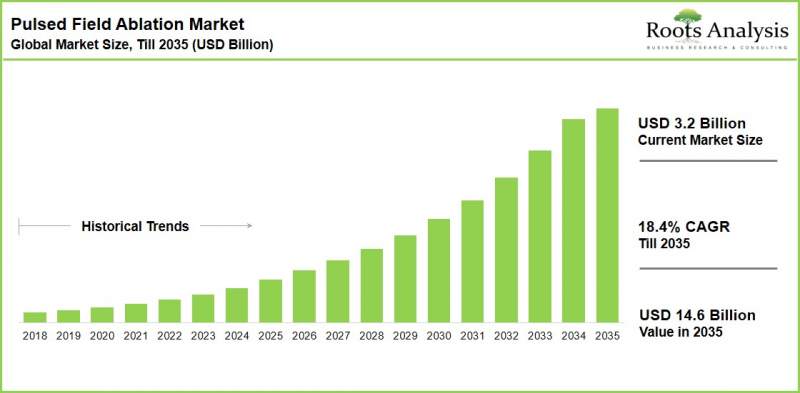
Roots Analysis의 조사에 따르면 세계의 펄스 전기장 절제술 시장 규모는 올해 32억 달러에서 2035년에는 146억 달러로 성장할 것으로 추정되고 있으며, 예측 기간 중 CAGR은 약 18.4%에 달할 전망입니다.
펄스 전기장 절제술 시장 : 성장 및 동향
펄스 전기장 절제술(PFA)은 단시간의 고전압 전기 펄스를 사용하여 표적 조직에 비가역적인 전기천공을 유발하는 비열성 심장 절제술입니다. 열 또는 냉 에너지에 의존하며, 식도나 횡격막 신경과 같은 주변 조직을 손상시킬 위험이 있는 고주파 절제술이나 냉동 절제술과 달리, PFA는 주변 조직을 보존하면서 심근 세포를 선택적으로 표적으로 삼습니다. 이러한 안전성의 차이 덕분에 PFA는 지난 수년간 전기생리학 분야에서 가장 빠르게 보급된 기술 중 하나가 되었습니다.
PFA를 지원하는 임상적 근거는 여러 플랫폼과 시술 워크플로우에 걸쳐 지속적으로 확대되고 있습니다. Boston Scientific의 FARAPULSE 시스템은 치료를 받은 심방세동 환자에서 높은 증상 개선률을 보여주고 있습니다. 또한 Medtronic, Biosense Webster, 신생 기업 등이 개발한 여러 시스템이 미국, 유럽, 아시아 국가에서 규제 당국의 승인 및 인가를 획득했습니다. 이러한 승인의 확대에 따라 임상 도입이 가속화되고 있으며, 병원들의 PFA 전용 전기생리학 검사·치료실 투자도 촉진되고 있습니다.
또한 PFA와 AI를 활용한 전기생리학적 워크플로우의 융합도 새로운 주목 분야로 떠오르고 있습니다. AI 툴은 환자 선정 개선, 표준 폐정맥 격리를 넘어선 병변 처치 유도, 시술 계획의 효율화를 위해 점점 더 많이 활용되고 있습니다. AI 툴의 통합을 통해 시술자는 시술 시간을 관리하면서 보다 일관된 치료 성과를 달성할 수 있게 됩니다.
동시에, 의료기기 수입에 영향을 미치는 관세 및 무역 정책의 변화에 따라 여러 제조사가 PFA 제너레이터, 카테터, 관련 부품의 생산을 미국이나 유럽 지역내 또는 인근 지역으로 이전하는 움직임을 보이고 있습니다. 이를 통해 국경을 넘는 관세 부담이나 공급망 혼란에 따른 위험을 경감할 수 있습니다.
성장의 원동력: 시장 확대를 지원하는 요인
펄스 필드 어블레이션 시장의 성장은 전 세계에서 증가하는 심방세동의 부담에 의해 주도되고 있습니다. Heart Rhythm Society의 기사에 따르면 심방세동은 전 세계에서 약 4,000만 명에게 영향을 미치고 있으며, 환자 수는 2050년까지 60% 증가할 가능성이 있습니다. 웨어러블 기기 및 원격 모니터링 기술의 보급으로 심방세동의 검출 정확도가 향상됨에 따라 리듬 제어 치료가 필요한 확진 환자 수도 증가하고 있으며, 이는 시술 수요의 지속적인 확대로 이어지고 있습니다.
특히 PFA의 조직 선택성과 비열적 메커니즘은 합병증을 줄이고 수술 시간을 단축하므로 기존의 열 절제 기술을 대체할 수 있는 대안으로서 채택을 촉진하는 핵심적인 차별화 요소가 되고 있습니다. 순환기 분야 외에도, 의료기기 개발 기업은 간, 췌장, 전립선, 신장, 폐 등 중요한 해부학적 구조 부근에서 조직 선택적인 종양 절제를 위해 PFA 플랫폼을 응용하고 있습니다.
전기생리학 검사실 인프라 확충, 전기천공법을 기반으로 한 치료법의 보급 확대, 보험 급여 체계 개선 또한 이 시장의 장기적인 성장 전망을 더욱 지원하고 있습니다.
펄스 전기장 절제술 시장의 세분화
시장 규모 및 시장 기회 분석은 다음 구분에 따라 세분화되어 있습니다.
치료 분야별
- 심혈관 질환
- 피부 질환
- 종양성 질환
- 호흡기 질환
제품 구성 요소별
- 카테터
- 발전기
적용 분야별
- 절제술
- 절제술 및 매핑
절제술 에너지원별
- 펄스 필드 에너지
- 펄스 필드 에너지 및 냉동 절제술 에너지
- 펄스 필드 에너지 및 고주파 에너지
지역별
- 북미
- 미국
- 캐나다
- 유럽
- 독일
- 영국
- 프랑스
- 이탈리아
- 스페인
- 기타 유럽
- 아시아태평양
- 중국
- 일본
- 한국
- 호주
이 보고서에서는 전 세계 펄스 전기장 절제술 시장을 조사하여, 시장 개요, 배경, 시장 영향 요인 분석, 시장 규모 추이 및 전망, 각종 분류·지역/주요 국가별 상세 분석, 경쟁 구도, 주요 기업 개요 등을 종합적으로 다루고 있습니다.
목차
제1장 서문
제2장 조사 방법
제3장 시장 역학
제4장 거시경제 지표
제5장 개요
제6장 서론
제7장 시장 구도
제8장 제품 경쟁력 분석
제9장 기업 개요 : 북미에 기반을 둔 mRNA 백신 개발 기업
제10장 기업 개요 : 유럽에 기반을 둔 mRNA 백신 개발 기업
제11장 기업 개요 : 아시아태평양에 기반을 둔 mRNA 백신 개발 기업
제12장 대형 제약회사 구상
제13장 스타트업 건전성 지표
제14장 임상시험 분석
제15장 제휴·협력 관계
제16장 자금조달·투자
제17장 특허 분석
제18장 FDA 승인 전략
제19장 아웃소싱 : GO/NO-GO 프레임워크
제20장 시장 영향 분석
제21장 세계의 mRNA 백신 시장
제22장 mRNA 백신 시장 : 대상 질환별
제23장 mRNA 백신 시장 : 지역별
제24장 시장 기회 분석 : 북미
제25장 시장 기회 분석 : 유럽
제26장 시장 기회 분석 : 아시아태평양
제27장 결론
제28장 이그제큐티브 인사이트
제29장 부록 1 : 표형식 데이터
제30장 부록 2 : 기업 및 조직 리스트
KSA 26.08.19PULSED FIELD ABLATION MARKET: OVERVIEW
As per Roots Analysis, the global pulsed field ablation market is estimated to grow from USD 3.2 billion in the current year to USD 14.6 billion by 2035, reflecting a compound annual growth rate (CAGR) of approximately 18.4% during the forecast period.
Pulsed Field Ablation Market: Growth and Trends
Pulsed field ablation (PFA) is a non-thermal cardiac ablation modality that uses short, high-voltage electrical pulses to induce irreversible electroporation in target tissue. Unlike radiofrequency and cryoablation, which rely on heat or cold energy and carry a risk of collateral injury to structures such as the esophagus and phrenic nerve, PFA selectively targets myocardial cells while sparing surrounding tissue. This safety differentiation has made PFA one of the fastest-adopted technologies in electrophysiology over the past few years.
Clinical evidence supporting PFA continues to expand across multiple platforms and procedural workflows. For instance, Boston Scientific's FARAPULSE system has demonstrated strong symptomatic relief rates in treated atrial fibrillation patients. Moreover, several other systems from Medtronic, Biosense Webster, and emerging players have secured regulatory clearances in the US, Europe, and Asian countries. This growing base of approvals is accelerating clinical adoption and encouraging hospitals to invest in dedicated PFA-capable electrophysiology labs.
Further, the convergence of PFA with artificial intelligence-enabled electrophysiology workflows is an emerging area of interest. AI tools are increasingly being applied to improve patient selection, guide lesion delivery beyond standard pulmonary vein isolation, and streamline procedural planning. The integration of AI tools helps operators achieve more consistent outcomes while managing procedure time.
At the same time, evolving tariff and trade policies affecting medical device imports are prompting several manufacturers to localize or near-shore production of PFA generators, catheters, and related components within the US and Europe. This will help to reduce exposure to cross-border duties and supply chain disruption.
Growth Drivers: Factors Fueling Market Expansion
Growth in the pulsed field ablation market is driven by the rising global burden of atrial fibrillation. According to a Heart Rhythm Society article, atrial fibrillation affects around 40 million people worldwide, and the number of cases is likely to increase by 60% in 2050. As detection improves through wearable and remote monitoring technologies, the diagnosed patient pool requiring rhythm-control therapy continues to expand, creating sustained procedural demand.
Notably, PFA's tissue selectivity and non-thermal mechanism are core differentiators supporting its adoption over conventional thermal ablation techniques as it reduces complications and shortens procedure times. Beyond cardiology, device developers are adapting PFA platforms for tissue-selective tumour ablation near sensitive anatomical structures, such as liver, pancreas, prostate, kidney, and lung.
Expanding electrophysiology lab infrastructure and growing adoption of electroporation-based therapy and improving reimbursement frameworks are further reinforcing the long-term growth outlook of the market.
Market Challenges: Critical Barriers Hindering Progress
Despite strong growth momentum, the pulsed field ablation market faces several adoption barriers. PFA consoles and single-use catheters require a significantly higher upfront and per-procedure cost compared with established radiofrequency and cryoablation systems. High treatment expenses create affordability challenges for smaller hospitals, ambulatory surgical centres, and cost-constrained health systems.
Many public and smaller private hospitals also lack the capital budgets, dedicated electrophysiology labs, and procedural volumes needed to justify a new PFA platform. Therefore, the lack of dedicated labs is slowing broader rollout outside high-volume tertiary centres. Continued competition from well-established thermal ablation technologies, along with the need for further procedural standardization across newer PFA platforms, adds additional friction to near-term market expansion.
Pulsed Field Ablation Market: Key Insights
The report delves into the current state of the pulsed field ablation market and identifies potential growth opportunities within the industry, particularly from a distributor and channel-partner perspective. Some key findings include:
- Device manufacturers rely predominantly on direct sales forces and dedicated clinical specialist teams to commercialize pulsed field ablation systems in mature markets such as the US and Western Europe, which limits the near-term role of third-party distributors in these geographies.
- In Asia-Pacific, and Latin America manufacturers lacking established commercial infrastructure are increasingly relying on regional and national distribution partners to navigate local regulatory pathways and build hospital relationships, creating a distinct entry point for specialty medical device distributors.
- The extension of pulsed field technology into interventional oncology is creating new distribution entry points beyond electrophysiology, opening the door to distributors with existing interventional radiology and oncology channel relationships.
- Region-specific device registration requirements, including China's NMPA and Japan's PMDA pathways, extend onboarding timelines for new distribution partners even after a device secures its first regulatory approval in the US or Europe.
- Manufacturers are increasingly near-shoring or localizing production of generators and catheters in the US and Europe in response to evolving tariff and trade policy, a shift that is reshaping distributor sourcing strategies and inventory planning.
- Post-market evidence generation requirements, including registry participation and outcomes tracking, are pushing manufacturers to favour distribution partners capable of supporting structured data collection, particularly in newer expansion markets.
- Consolidation among large, established electrophysiology equipment distributors is raising the bar for entry, though niche regional distributors with condition-specific or catheter lab-specific expertise continue to find opportunities in underserved geographies.
Pulsed Field Ablation Market Segments
The market sizing and opportunity analysis has been segmented across the following parameters:
By Therapeutic Area
- Cardiovascular Disorders
- Dermatological Disorders
- Oncological Disorders
- Respiratory Disorders
By Product Components
- Catheters
- Generators
By Application Area
- Ablation
- Ablation and Mapping
By Source of Ablation
- Pulsed Field Energy
- Pulsed Field and Cryoablation Energy
- Pulsed Field and Radiofrequency Energy
By Geographical Regions
- North America
- US
- Canada
- Europe
- Germany
- UK
- France
- Italy
- Spain
- Rest of Europe
- Asia-Pacific
- China
- Japan
- South Korea
- Australia
Pulsed Field Ablation Market: Key Segments
Cardiovascular Disorders Leads the Target Indication Segment
Based on our market assessment, the cardiovascular disorders segment currently accounts for the majority of the pulsed field ablation market and is expected to retain its leadership position throughout the forecast period. This dominance stems from the fact that PFA devices have achieved their highest level of clinical validation, regulatory approval, and commercial adoption in the treatment of atrial fibrillation and related arrhythmias. Growing procedural volumes, expanding electrophysiology infrastructure, and the availability of multiple commercially approved platforms continue to reinforce cardiovascular applications as the primary revenue-generating segment.
In contrast, the oncological disorders segment is expected to register the highest CAGR during the forecast period. This highest growth is supported by the transition of pulsed field technology from a predominantly cardiac tool towards a broader tissue-selective treatment platform. As irreversible electroporation continues to demonstrate promising outcomes in liver, pancreatic, prostate, kidney, and lung tumours, device manufacturers, research institutions, and healthcare providers are directing increasing investment toward this emerging application.
Catheter Dominates the Product Component Segment
Based on the product components, the catheter sub-segment is expected to continue capturing the majority of pulsed field ablation market revenue. This is primarily attributed to the single-use, consumable nature of PFA catheters, which follow a recurring, per-procedure revenue model in contrast to generators.
As the market matures, next-generation catheters that integrate mapping and ablation functionality into a single platform are expected to command higher average selling prices, which further accelerate this segment growth.
Ablation Remains the Leading Application, While Ablation and Mapping Gains Momentum
By application area, ablation-only configurations currently hold the largest share of the market. This highest share reflects the early focus on pulmonary vein isolation procedures where speed, reproducibility, and reduced fluoroscopy time are prioritized over integrated mapping. The shift toward treating more complex and persistent arrhythmia substrates will likely accelerate growth in the ablation and mapping segment. This growth is further fueled by hospital investments in integrated, single-platform electrophysiology ecosystems.
Pulsed Field Energy Dominates the Source of Ablation Segment
Based on the source of ablation, pure pulsed field energy platforms currently capture the majority of market share. This dominance is driven by the fundamental safety advantage pulsed field energy offers over thermal modalities. Notably, the standardization benefits of single-platform ecosystems that integrate catheter design, waveform optimization, and mapping compatibility, reduce training complexity for operators, making it a preferable choice in clinical settings.
North America Leads, While Asia-Pacific Emerges as the Fastest-Growing Region
According to our market projections, North America is expected to maintain its leadership in the pulsed field ablation market through 2035. This dominance is supported by early commercialization advantage, a dense concentration of electrophysiology-capable hospitals, rapid FDA-driven regulatory clearances, and a well-structured reimbursement framework for atrial fibrillation ablation procedures.
Asia-Pacific, on the other hand, is projected to register the highest CAGR during the forecast period. This growth is driven by rapidly improving healthcare infrastructure, growing investment in cardiac catheterization laboratories, expanding electrophysiology training programs, and a large, aging population base with a significant untreated atrial fibrillation burden across markets such as China, India, and South Korea.
Example Players in Pulsed Field Ablation Market
- AccuPulse Medical
- Acutus Medical
- Adagio Medical
- AngioDynamics
- Arga Medtech
- AtriAN Medical
- Biosense Webster (Johnson & Johnson MedTech)
- Boston Scientific
- CardioFocus
- CathRx
- CRC EP
- Galvanize Therapeutics
- Gradient Medical
- Hangzhou Dinova EP Technology
- Kardium
- Medtronic
- Mirai Medical
- Pulse Biosciences
Expert Interview and Industry Insights
The opinions and insights presented in this study were shaped by discussions conducted with multiple stakeholders across the pulsed field ablation ecosystem. The research report features detailed transcripts of interviews held with the following industry stakeholders:
- Co-Founder and Chief Executive Officer, Small Company, Switzerland
- Chief Medical Officer, Very Large Company, US
- Chief of Cardiac Surgery and Co-Director, Very Large Company, US
- Senior Vice President and President, Cardiac Rhythm Management and Diagnostics, Very Large Company, US
- President, and Vice President of Preclinical and Clinical Research and Medical Affairs, Very Large Company, New Zealand
- Managing Director, Large Company, US
- Managing Director, Very Large Company, US
- Director, Ventricular Tachycardia Program, Very Large Company, US
- Co-Director, Translational Research and Research Fellowship, Very Large Company, US
- Cardiologist, Very Large Company, US
PULSED FIELD ABLATION MARKET: RESEARCH COVERAGE
- Market Sizing and Opportunity Analysis: The report features an in-depth analysis of the pulsed field ablation market, focusing on key market segments, including therapeutic area, product components, application area, source of ablation, and geographical regions.
- Pulsed Field Ablation Devices Landscape: A detailed assessment of the overall device landscape, featuring information on parameters such as type of product component, application area, source of ablation, and regulatory approval status. Additionally, it features analysis of device developers based on year of establishment, company size, and location of headquarters.
- Company Profiles: In-depth profiles of prominent players engaged in offering pulsed field ablation systems, featuring information on year of establishment, location of headquarters, company size, management team, product portfolio, and key initiatives.
- Recent Developments: A detailed analysis of recent developments in this industry, including partnerships and collaborations, funding and investments, regulatory approvals, and product launches.
- Patent Analysis: An analysis of patents filed and granted related to pulsed field ablation devices, based on parameters such as type of patent, application and publication year, jurisdiction, CPC symbols, type of applicant, and patent valuation.
- Global Events Analysis: An in-depth assessment of global pulsed field ablation events, covering event trends by year, type, platform, and geography, along with analyses of key organizers, participating companies, speaker profiles, and emerging discussion themes to identify evolving industry priorities and networking opportunities.
- Strategic Partner Analysis: A comprehensive assessment of potential partnership opportunities for pulsed field ablation device developers, featuring a likelihood-based evaluation of cardiac mapping and navigation device companies based on predefined assumptions, key parameters, and proprietary partner selection methodology.
- Market Impact Analysis: The report also covers analyses of drivers, restraints, opportunities, and challenges affecting market growth.
Key Questions Answered in this Report
- Which are the leading companies in the pulsed field ablation market?
- Which region dominates the pulsed field ablation market, and which region is growing the fastest?
- What are the key trends observed in the pulsed field ablation market?
- What factors are likely to influence the evolution of this market?
- What are the primary challenges faced by pulsed field ablation device developers and distributors?
- What is the current and future market size?
- What is the CAGR of this market?
- How is the current and future market opportunity likely to be distributed across key market segments?
- What distribution models are manufacturers using across mature and emerging markets?
Reasons to Buy this Report
This report has been specifically developed to support distributors, channel partners, and business development teams evaluating entry into the pulsed field ablation market.
- Comprehensive Secondary Research: Extensive analysis of company disclosures, regulatory databases, clinical trial registries, investor presentations, scientific literature, and industry publications to evaluate market trends, competitive landscape, and commercialization strategies.
- Primary Research Validation: Insights validated through interviews with senior executives, electrophysiologists, cardiac surgeons, and industry experts to strengthen market assumptions and forecast accuracy.
- Market and Commercial Analysis: Evaluation of product segmentation, revenue models (capital equipment and consumables), distribution channels, and regional commercialization strategies across key markets.
- Regulatory and Regional Assessment: Analysis of country-specific regulatory pathways, reimbursement environment, and market-entry considerations across North America, Europe, and Asia-Pacific.
- Forecasting Framework: Market forecasts developed using historical trends, demand analysis, primary validation, and scenario-based (conservative, base, and optimistic) forecasting, incorporating recent clinical evidence and regulatory developments.
Additional Benefits
- Complementary Insights Pack
- Complementary Excel Data Packs for all Analytical Modules in the Report
- 15% Free Content Customization
- Detailed Report Walkthrough Session with Research Team
- Free Updated report if the report is 6-12 months old or older
TABLE OF CONTENTS
1. PREFACE
- 1.1. Introduction
- 1.2. Market Share Insights
- 1.3. Key Market Insights
- 1.4. Report Coverage
- 1.5. Key Questions Answered
- 1.6. Chapter Outlines
2. RESEARCH METHODOLOGY
- 2.1. Chapter Overview
- 2.2. Research Assumptions
- 2.2.1. Market Landscape and Market Trends
- 2.2.2. Market Forecast and Opportunity Analysis
- 2.2.3. Comparative Analysis
- 2.3. Database Building
- 2.3.1. Data Collection
- 2.3.2. Data Validation
- 2.3.3. Data Analysis
- 2.4. Project Methodology
- 2.4.1. Secondary Research
- 2.4.1.1. Annual Reports
- 2.4.1.2. Academic Research Papers
- 2.4.1.3. Company Websites
- 2.4.1.4. Investor Presentations
- 2.4.1.5. Regulatory Filings
- 2.4.1.6. White Papers
- 2.4.1.7. Industry Publications
- 2.4.1.8. Conferences and Seminars
- 2.4.1.9. Government Portals
- 2.4.1.10. Media and Press Releases
- 2.4.1.11. Newsletters
- 2.4.1.12. Industry Databases
- 2.4.1.13. Roots Proprietary Databases
- 2.4.1.14. Paid Databases and Sources
- 2.4.1.15. Social Media Portals
- 2.4.1.16. Other Secondary Sources
- 2.4.2. Primary Research
- 2.4.2.1. Types of Primary Research
- 2.4.2.1.1. Qualitative Research
- 2.4.2.1.2. Quantitative Research
- 2.4.2.1.3. Hybrid Approach
- 2.4.2.2. Advantages of Primary Research
- 2.4.2.3. Techniques for Primary Research
- 2.4.2.3.1. Interviews
- 2.4.2.3.2. Surveys
- 2.4.2.3.3. Focus Groups
- 2.4.2.3.4. Observational Research
- 2.4.2.3.5. Social Media Interactions
- 2.4.2.4. Key Opinion Leaders Considered in Primary Research
- 2.4.2.4.1. Company Executives (CXOs)
- 2.4.2.4.2. Board of Directors
- 2.4.2.4.3. Company Presidents and Vice Presidents
- 2.4.2.4.4. Research and Development Heads
- 2.4.2.4.5. Technical Experts
- 2.4.2.4.6. Subject Matter Experts
- 2.4.2.4.7. Scientists
- 2.4.2.4.8. Doctors and Other Healthcare Providers
- 2.4.2.5. Ethics and Integrity
- 2.4.2.5.1. Research Ethics
- 2.4.2.5.2. Data Integrity
- 2.4.2.1. Types of Primary Research
- 2.4.3. Analytical Tools and Databases
- 2.4.1. Secondary Research
- 2.5. Robust Quality Control
3. MARKET DYNAMICS
- 3.1. Chapter Overview
- 3.2. Forecast Methodology
- 3.2.1. Top-down Approach
- 3.2.2. Bottom-up Approach
- 3.2.3. Hybrid Approach
- 3.3. Market Assessment Framework
- 3.3.1. Total Addressable Market (TAM)
- 3.3.2. Serviceable Addressable Market (SAM)
- 3.3.3. Serviceable Obtainable Market (SOM)
- 3.3.4. Currently Acquired Market (CAM)
- 3.4. Forecasting Tools and Techniques
- 3.4.1. Qualitative Forecasting
- 3.4.2. Correlation
- 3.4.3. Regression
- 3.4.4. Extrapolation
- 3.4.5. Convergence
- 3.4.6. Sensitivity Analysis
- 3.4.7. Scenario Planning
- 3.4.8. Data Visualization
- 3.4.9. Time Series Analysis
- 3.4.10. Forecast Error Analysis
- 3.5. Key Considerations
- 3.5.1. Demographics
- 3.5.2. Government Regulations
- 3.5.3. Reimbursement Scenarios
- 3.5.4. Market Access
- 3.5.5. Supply Chain
- 3.5.6. Industry Consolidation
- 3.5.7. Pandemic / Unforeseen Disruptions Impact
- 3.6. Limitations
4. MACRO-ECONOMIC INDICATORS
- 4.1. Chapter Overview
- 4.2. Market Dynamics
- 4.2.1. Time Period
- 4.2.1.1. Historical Trends
- 4.2.1.2. Current and Forecasted Estimates
- 4.2.2. Currency Coverage
- 4.2.2.1. Major Currencies Affecting the Market
- 4.2.2.2. Factors Affecting Currency Fluctuations in the Industry
- 4.2.2.3. Impact of Currency Fluctuations on the Industry
- 4.2.3. Foreign Currency Exchange Rate
- 4.2.3.1. Impact of Foreign Exchange Rate Volatility on the Market
- 4.2.3.2. Strategies for Mitigating Foreign Exchange Risk
- 4.2.4. Recession
- 4.2.4.1. Assessment of Current Economic Conditions and Potential Impact on the Market
- 4.2.4.2. Historical Analysis of Past Recessions and Lessons Learnt
- 4.2.5. Inflation
- 4.2.5.1. Measurement and Analysis of Inflationary Pressures in the Economy
- 4.2.5.2. Potential Impact of Inflation on the Market Evolution
- 4.2.6. Interest Rates
- 4.2.6.1. Interest Rates and Their Impact on the Market
- 4.2.6.2. Strategies for Managing Interest Rate Risk
- 4.2.7. Commodity Flow Analysis
- 4.2.7.1. Type of Commodity
- 4.2.7.2. Origins and Destinations
- 4.2.7.3. Values and Weights
- 4.2.7.4. Modes of Transportation
- 4.2.8. Global Trade Dynamics
- 4.2.8.1. Import Scenario
- 4.2.8.2. Export Scenario
- 4.2.8.3. Trade Policies
- 4.2.8.4. Strategies for Mitigating the Risks Associated with Trade Barriers
- 4.2.8.5. Impact of Trade Barriers on the Market
- 4.2.9. War Impact Analysis
- 4.2.9.1. Russia-Ukraine War
- 4.2.9.2. Israel-Hamas War
- 4.2.10. COVID Impact / Related Factors
- 4.2.10.1. Global Economic Impact
- 4.2.10.2. Industry-specific Impact
- 4.2.10.3. Government Response and Stimulus Measures
- 4.2.10.4. Future Outlook and Adaptation Strategies
- 4.2.11. Other Indicators
- 4.2.11.1. Fiscal Policy
- 4.2.11.2. Consumer Spending
- 4.2.11.3. Gross Domestic Product
- 4.2.11.4. Employment
- 4.2.11.5. Taxes
- 4.2.11.6. Stock Market Performance
- 4.2.11.7. Cross Border Dynamics
- 4.2.1. Time Period
- 4.3. Conclusion
5. EXECUTIVE SUMMARY
6. INTRODUCTION
- 6.1. Chapter Overview
- 6.2. mRNA Vaccines
- 6.2.1. Advantages of mRNA Vaccines
- 6.2.2. Key Applications of mRNA Vaccines
- 6.3. mRNA Vaccines
- 6.3.1. Advantages of mRNA Vaccines
- 6.3.2. Key Applications of mRNA Vaccines
- 6.4. mRNA Delivery Routes
- 6.5. mRNA Delivery Strategies
- 6.6. Key Challenges Associated with mRNA Vaccines
- 6.7. Future Perspectives
7. MARKET LANDSCAPE
- 7.1. Chapter Overview
- 7.2. mRNA Vaccines: Overall Market Landscape
- 7.2.1. Analysis by Status of Development
- 7.2.2. Analysis by Type of Drug Candidate
- 7.2.3. Analysis by Type of Program
- 7.2.4. Analysis by Type of Delivery System
- 7.2.5. Analysis by Type of Molecule Encoded
- 7.2.6. Analysis by Route of Administration
- 7.2.7. Analysis by Therapeutic Area
- 7.3. mRNA Vaccines: Developer Landscape
- 7.3.1. Analysis by Year of Establishment
- 7.3.2. Analysis by Company Size
- 7.3.3. Analysis by Location of Headquarters
- 7.3.4. Most Active Developers: Analysis by Number of Drugs Developed
8. PRODUCT COMPETITIVENESS ANALYSIS
- 8.1. Chapter Overview
- 8.2. Assumptions and Key Parameters
- 8.3. Methodology
- 8.4. mRNA Vaccines: Product Competitiveness Analysis
- 8.4.1. mRNA Vaccines Developed by Players based in North America
- 8.4.2. mRNA Vaccines Developed by Players based in Europe
- 8.4.3. mRNA Vaccines Developed by Players based in Asia-Pacific and Rest of the World
9. COMPANY PROFILES: mRNA VACCINE DEVELOPERS BASED IN NORTH AMERICA
- 9.1. Chapter Overview
- 9.2. Leading Developers in mRNA Vaccines Market based in North America
- 9.2.1. Arcturus Therapeutics
- 9.2.1.1. Company Overview
- 9.2.1.2. Financial Information
- 9.2.1.3. mRNA Vaccines Portfolio
- 9.2.1.4. Recent Developments and Future Outlook
- 9.2.2. Immorna
- 9.2.2.1. Company Overview
- 9.2.2.2. mRNA Vaccines Portfolio
- 9.2.2.3. Recent Developments and Future Outlook
- 9.2.3. Moderna
- 9.2.3.1. Company Overview
- 9.2.3.2. Financial Information
- 9.2.3.3. mRNA Vaccines Portfolio
- 9.2.3.4. Recent Developments and Future Outlook
- 9.2.4. Providence Therapeutics
- 9.2.4.1. Company Overview
- 9.2.4.2. Financial Information
- 9.2.4.3. mRNA Vaccines Portfolio
- 9.2.4.4. Recent Developments and Future Outlook
- 9.2.5. Innovac Therapeutics
- 9.2.5.1. Company Overview
- 9.2.5.2. mRNA Vaccines Portfolio
- 9.2.5.3. Recent Developments and Future Outlook
- 9.2.6. Kernal Biologics
- 9.2.6.1. Company Overview
- 9.2.6.2. Financial Information
- 9.2.6.3. mRNA Vaccines Portfolio
- 9.2.6.4. Recent Developments and Future Outlook
- 9.2.7. Recode Therapeutics
- 9.2.7.1. Company Overview
- 9.2.7.2. Financial Information
- 9.2.7.3. mRNA Vaccines Portfolio
- 9.2.7.4. Recent Developments and Future Outlook
- 9.2.8. Rejuvenation Technologies
- 9.2.8.1. Company Overview
- 9.2.8.2. Financial Information
- 9.2.8.3. mRNA Vaccines Portfolio
- 9.2.8.4. Recent Developments and Future Outlook
- 9.2.9. RNAimmune
- 9.2.9.1. Company Overview
- 9.2.9.2. Financial Information
- 9.2.9.3. mRNA Vaccines Portfolio
- 9.2.9.4. Recent Developments and Future Outlook
- 9.2.10. Turn Biotechnologies
- 9.2.10.1. Company Overview
- 9.2.10.2. Financial Information
- 9.2.10.3. mRNA Vaccines Portfolio
- 9.2.10.4. Recent Developments and Future Outlook
- 9.2.11. Strand Therapeutics
- 9.2.11.1. Company Overview
- 9.2.11.2. Financial Information
- 9.2.11.3. mRNA Vaccines Portfolio
- 9.2.11.4. Recent Developments and Future Outlook
- 9.2.1. Arcturus Therapeutics
10. COMPANY PROFILES: mRNA VACCINE DEVELOPERS BASED IN EUROPE
- 10.1. Chapter Overview
- 10.2. Leading Developers in mRNA Vaccines Market based in North America
- 10.2.1. BioNTech
- 10.2.1.1. Company Overview
- 10.2.1.2. Financial Information
- 10.2.1.3. mRNA Vaccines Portfolio
- 10.2.1.4. Recent Developments and Future Outlook
- 10.2.2. CureVac
- 10.2.2.1. Company Overview
- 10.2.2.2. Financial Information
- 10.2.2.3. mRNA Vaccines Portfolio
- 10.2.2.4. Recent Developments and Future Outlook
- 10.2.3. Ethris
- 10.2.3.1. Company Overview
- 10.2.3.2. mRNA Vaccines Portfolio
- 10.2.3.3. Recent Developments and Future Outlook
- 10.2.1. BioNTech
11. COMPANY PROFILES: mRNA VACCINE DEVELOPERS BASED IN ASIA-PACIFIC
- 11.1. Chapter Overview
- 11.2. Leading Developers in mRNA Vaccines Market based in North America
- 11.2.1. Suzhou Abogen Biosciences
- 11.2.1.1. Company Overview
- 11.2.1.2. mRNA Vaccines Portfolio
- 11.2.1.3. Recent Developments and Future Outlook
- 11.2.2. Gennova Biopharmaceuticals
- 11.2.2.1. Company Overview
- 11.2.2.2. Financial Information
- 11.2.2.3. mRNA Vaccines Portfolio
- 11.2.2.4. Recent Developments and Future Outlook
- 11.2.3. RNACure
- 11.2.3.1. Company Overview
- 11.2.3.2. mRNA Vaccines Portfolio
- 11.2.3.3. Recent Developments and Future Outlook
- 11.2.4. Walvax
- 11.2.4.1. Company Overview
- 11.2.4.2. Financial Information
- 11.2.4.3. mRNA Vaccines Portfolio
- 11.2.4.4. Recent Developments and Future Outlook
- 11.2.1. Suzhou Abogen Biosciences
12. BIG PHARMA INITIATIVES
- 12.1. Chapter Overview
- 12.2. Scope and Methodology
- 12.3. mRNA Vaccines Market: Big Player Initiatives
- 12.3.1. Analysis by Year of Initiative
- 12.3.2. Analysis by Type of Initiative
- 12.3.3. Analysis by Year and Type of Initiative
- 12.3.4. Analysis by Type of Partnership
- 12.3.5. Analysis by Type of Expansion
- 12.3.6. Analysis by Year of Initiative and Company
- 12.3.7. Big Pharma Players: Analysis by Number of Initiatives
- 12.4. Benchmarking Analysis: Big Pharma Players
- 12.4.1. Spider Web Analysis: Bayer
- 12.4.2. Spider Web Analysis: Pfizer
- 12.4.3. Spider Web Analysis: Sanofi
- 12.5. Concluding Remarks
13. START-UP HEALTH INDEXING
- 13.1. Chapter Overview
- 13.2. Start-ups focused on mRNA Vaccines
- 13.3. Benchmarking of Start-ups
- 13.4. Startup-Health Indexing
- 13.4.1. Analysis by Location of Headquarters
- 13.4.2. Analysis by Company Strength
- 13.4.3. Analysis by Pipeline Maturity
- 13.4.4. Analysis by Pipeline Strength
- 13.4.5. Analysis by Financial Support
- 13.4.6. Analysis by Investor Strength
- 13.4.7. Analysis by Partnership Activity
- 13.4.8. Start-ups Health Indexing: Roots Analysis Perspective
14. CLINICAL TRIAL ANALYSIS
- 14.1. Chapter Overview
- 14.2. Scope and Methodology
- 14.3. mRNA Vaccines: Clinical Trial Analysis
- 14.3.1. Analysis by Trial Registration Year
- 14.3.2. Analysis of Number of Patients Enrolled by Trial Registration Year
- 14.3.3. Analysis by Trial Phase
- 14.3.4. Analysis of Number of Patients Enrolled by Trial Phase
- 14.3.5. Analysis by Trial Status
- 14.3.6. Analysis by Trial Registration Year and Trial Status
- 14.3.7. Analysis by Patient Gender
- 14.3.8. Analysis by Study Design
- 14.3.8.1. Analysis by Type of Allocation
- 14.3.8.2. Analysis by Type of Intervention Model
- 14.3.8.3. Analysis by Type of Masking
- 14.3.8.4. Analysis by Trial Purpose
- 14.3.9. Analysis by Type of Sponsor / Collaborator
- 14.3.10. Analysis by Geography
- 14.3.10.1. Analysis of Clinical Trials by Geography
- 14.3.10.2. Analysis of Clinical Trials by Geography and Trial Status
- 14.3.10.3. Analysis of Patients Enrolled by Geography and Trial Status
15. PARTNERSHIPS AND COLLABORATIONS
- 15.1. Chapter Overview
- 15.2. Partnership Models
- 15.3. mRNA Vaccines Market: Partnerships and Collaborations
- 15.3.1. Analysis by Year of Partnership
- 15.3.2. Analysis by Type of Partnership
- 15.3.3. Analysis by Year and Type of Partnership
- 15.3.4. Analysis by Therapeutic Area
- 15.3.5. Most Active Players: Analysis by Number of Partnerships
- 15.3.6. Analysis by Geography
- 15.3.6.1. Intercontinental and Intracontinental Agreements
- 15.3.6.2. Local and International Agreements
16. FUNDING AND INVESTMENTS
- 16.1. Chapter Overview
- 16.2. Funding Models
- 16.3. mRNA Vaccines Market: Funding and Investment Analysis
- 16.3.1. Analysis by Year of Funding
- 16.3.1.1. Cumulative Year-wise Trend of Funding Instances
- 16.3.1.2. Cumulative Year-wise Trend of Amount Invested
- 16.3.2. Analysis by Type of Funding
- 16.3.2.1. Analysis of Funding Instances
- 16.3.2.2. Analysis of Amount Invested
- 16.3.3. Analysis by Year and Type of Funding
- 16.3.4. Analysis by Amount Raised by Year and Type of Funding
- 16.3.5. Analysis by Therapeutic Area
- 16.3.6. Most Active Players: Analysis by Number of Funding Instances
- 16.3.7. Most Active Players: Analysis by Amount Raised
- 16.3.8. Analysis by Geography
- 16.3.9. Most Active Players: Analysis by Number of Funding Instances
- 16.3.10. Most Active Players: Analysis by Amount Invested
- 16.3.1. Analysis by Year of Funding
- 16.4. Summary of Funding and Investments
17. PATENT ANALYSIS
- 17.1. Chapter Overview
- 17.2. Scope and Methodology
- 17.3. mRNA Vaccines: Patent Analysis
- 17.3.1. Analysis by Type of Patent
- 17.3.2. Analysis by Patent Publication Year
- 17.3.3. Analysis by Type of Patent and Publication Year
- 17.3.4. Analysis by Patent Application Year
- 17.3.5. Analysis by Patent Jurisdiction
- 17.3.6. Analysis by CPC Symbols
- 17.3.7. Analysis by Type of Applicant
- 17.3.8. Leading Industry Players: Analysis by Number of Patents
- 17.3.9. Leading Non-Industry Players: Analysis by Number of Patents
- 17.3.10. Leading Inventors: Analysis by Number of Patents
- 17.4. Patent Benchmarking Analysis
- 17.4.1. Analysis of Patent Characteristics
- 17.5. Patent Valuation
- 17.6. Leading Patents by Number of Citations
18. FDA APPROVAL STRATEGIES
- 18.1. Chapter Overview
- 18.2. Methodology
- 18.3. Key Parameters
- 18.4. General Reasons for Failure of Trials Focused on mRNA Vaccines
- 18.5. Benchmarking Analysis: Distribution of Key Strategies by mRNA Vaccines
19 OUTSOURCING: GO / NO-GO FRAMEWORK
- 19.1. Chapter Overview
- 19.2. Outsourcing: Go / No-Go Framework
- 19.3. mRNA Vaccines Outsourcing: Go / No-Go Framework
- 19.3.1. Key Parameters and Assumptions
- 19.3.2. Methodology
- 19.3.3. Results and Interpretations
- 19.3.3.1. Outsourcing: Go / No-Go Framework for Small Companies
- 19.3.3.2. Outsourcing: Go / No-Go Framework for Mid-Sized Companies
- 19.3.3.3. Outsourcing: Go / No-Go Framework for Large Companies
20. MARKET IMPACT ANALYSIS
- 20.1. Chapter Overview
- 20.2. Market Drivers
- 20.3. Market Restraints
- 20.4. Market Opportunities
- 20.5. Market Challenges
- 20.6. Conclusion
21. GLOBAL mRNA VACCINES MARKET
- 21.1. Chapter Overview
- 21.2. Assumptions and Methodology
- 21.3. Global mRNA Vaccines Market, Historical Trends (Since 2024) and Forecasted Estimates (Till 2035)
- 21.3.1. Scenario Analysis
- 21.3.1.1. Conservative Scenario
- 21.3.1.2. Optimistic Scenario
- 21.3.1. Scenario Analysis
- 21.4. Key Market Segmentations
22. mRNA VACCINES MARKET, BY TARGET INDICATION
- 22.1. Chapter Overview
- 22.2. Key Assumptions and Methodology
- 22.3. mRNA Vaccines Market: Distribution by Target Indication
- 22.3.1. mRNA Vaccines Market for RSV Infection, Historical Trends (Since 2024) and Forecasted Estimates (Till 2035)
- 22.3.2. mRNA Vaccines Market for Metastatic / R/ R Head and Neck Cancer, Historical Trends (Since 2024) and Forecasted Estimates (Till 2035)
- 22.3.3. mRNA Vaccines Market for Influenza, Historical Trends (Since 2024) and Forecasted Estimates (Till 2035)
- 22.3.4. mRNA Vaccines Market for Norovirus Acute Gastroenteritis, Historical Trends (Since 2024) and Forecasted Estimates (Till 2035)
- 22.3.5. mRNA Vaccines Market for Mononucleosis, Historical Trends (Since 2024) and Forecasted Estimates (Till 2035)
- 22.4. Data Triangulation and Validation
23. mRNA VACCINES MARKET, BY GEOGRAPHICAL REGIONS
- 23.1. Chapter Overview
- 23.2. Key Assumptions and Methodology
- 23.3. mRNA Vaccines Market: Distribution by Geographical Regions
- 23.3.1. mRNA Vaccines Market in North America, Historical Trends (Since 2024) and Forecasted Estimates (Till 2035)
- 23.3.1.1. mRNA Vaccines Market in the US, Historical Trends (Since 2024) and Forecasted Estimates (Till 2035)
- 23.3.1.2. mRNA Vaccines Market in Canada, Historical Trends (Since 2024) and Forecasted Estimates (Till 2035)
- 23.3.2. mRNA Vaccines Market in Europe, Historical Trends (Since 2024) and Forecasted Estimates (Till 2035)
- 23.3.2.1. mRNA Vaccines Market in Germany, Historical Trends (Since 2024) and Forecasted Estimates (Till 2035)
- 23.3.2.2. mRNA Vaccines Market in the France, Historical Trends (Since 2024) and Forecasted Estimates (Till 2035)
- 23.3.2.3. mRNA Vaccines Market in Italy, Historical Trends (Since 2024) and Forecasted Estimates (Till 2035)
- 23.3.2.4. mRNA Vaccines Market in UK, Historical Trends (Since 2024) and Forecasted Estimates (Till 2035)
- 23.3.2.5. mRNA Vaccines Market in Spain, Historical Trends (Since 2024) and Forecasted Estimates (Till 2035)
- 23.3.2.6. mRNA Vaccines Market in Rest of Europe, Historical Trends (Since 2024) and Forecasted Estimates (Till 2035)
- 23.3.3. mRNA Vaccines Market in Asia-Pacific, Historical Trends (Since 2024) and Forecasted Estimates (Till 2035)
- 23.3.3.1. mRNA Vaccines Market in China, Historical Trends (Since 2024) and Forecasted Estimates (Till 2035)
- 23.3.3.2. mRNA Vaccines Market in Japan, Historical Trends (Since 2024) and Forecasted Estimates (Till 2035)
- 23.3.3.3. mRNA Vaccines Market in Australia, Historical Trends (Since 2024) and Forecasted Estimates (Till 2035)
- 23.3.3.4. mRNA Vaccines Market in South Korea, Historical Trends (Since 2024) and Forecasted Estimates (Till 2035)
- 23.3.4. Penetration Growth (P-G) Matrix
- 23.3.5. Market Movement Analysis
- 23.3.1. mRNA Vaccines Market in North America, Historical Trends (Since 2024) and Forecasted Estimates (Till 2035)
- 23.4. Data Triangulation and Validation
24. MARKET OPPORTUNITY ANALYSIS: NORTH AMERICA
- 24.1. mRNA Vaccines Market in North America: Distribution by Target Indication
- 24.1.1. mRNA Vaccines Market in North America for RSV Infection, Historical Trends (Since 2024) and Forecasted Estimates (Till 2035)
- 24.1.2. mRNA Vaccines Market in North America for Metastatic / R/ R Head and Neck Cancer, Historical Trends (Since 2024) and Forecasted Estimates (Till 2035)
- 24.1.3. mRNA Vaccines Market in North America for Influenza, Historical Trends (Since 2024) and Forecasted Estimates (Till 2035)
- 24.1.4. mRNA Vaccines Market in North America for Norovirus Acute Gastroenteritis, Historical Trends (Since 2024) and Forecasted Estimates (Till 2035)
- 24.1.5. mRNA Vaccines Market in North America for Mononucleosis, Historical Trends (Since 2024) and Forecasted Estimates (Till 2035)
25. MARKET OPPORTUNITY ANALYSIS: EUROPE
- 25.1. mRNA Vaccines Market in Europe: Distribution by Target Indication
- 25.1.1. mRNA Vaccines Market in Europe for RSV Infection, Historical Trends (Since 2024) and Forecasted Estimates (Till 2035)
- 25.1.2. mRNA Vaccines Market in Europe for Metastatic / R/ R Head and Neck Cancer, Historical Trends (Since 2024) and Forecasted Estimates (Till 2035)
- 25.1.3. mRNA Vaccines Market in Europe for Influenza, Historical Trends (Since 2024) and Forecasted Estimates (Till 2035)
- 25.1.4. mRNA Vaccines Market in Europe for Norovirus Acute Gastroenteritis, Historical Trends (Since 2024) and Forecasted Estimates (Till 2035)
- 25.1.5. mRNA Vaccines Market in Europe for Mononucleosis, Historical Trends (Since 2024) and Forecasted Estimates (Till 2035)
26. MARKET OPPORTUNITY ANALYSIS: ASIA-PACIFIC
- 26.1. mRNA Vaccines Market in Asia-Pacific: Distribution by Target Indication
- 26.1.1. mRNA Vaccines Market in Asia-Pacific for RSV Infection, Historical Trends (Since 2024) and Forecasted Estimates (Till 2035)
- 26.1.2. mRNA Vaccines Market in Asia-Pacific for Metastatic / R/ R Head and Neck Cancer, Historical Trends (Since 2024) and Forecasted Estimates (Till 2035)
- 26.1.3. mRNA Vaccines Market in Asia-Pacific for Influenza, Historical Trends (Since 2024) and Forecasted Estimates (Till 2035)
- 26.1.4. mRNA Vaccines Market in Asia-Pacific for Norovirus Acute Gastroenteritis, Historical Trends (Since 2024) and Forecasted Estimates (Till 2035)
- 26.1.5. mRNA Vaccines Market in Asia-Pacific for Mononucleosis, Historical Trends (Since 2024) and Forecasted Estimates (Till 2035)
27. CONCLUDING REMARKS
28. EXECUTIVE INSIGHTS
- 28.1. Chapter Overview
- 28.2. Company A
- 28.2.1. Company Snapshot
- 28.2.2. Interview Transcript: Business Development Manager
- 28.3. Company B
- 28.3.1. Company Snapshot
- 28.3.2. Interview Transcript: Senior Director, Business Development
- 28.4. Company C
- 28.4.1. Company Snapshot
- 28.4.2. Interview Transcript: Team Leader
- 28.5. Company D
- 28.5.1. Company Snapshot
- 28.5.2. Interview Transcript: Director of Advanced Drug Delivery
- 28.6. Company E
- 28.6.1. Company Snapshot
- 28.6.2. Interview Transcript: Deputy Director
- 28.7. Company F
- 28.7.1. Company Snapshot
- 28.7.2. Interview Transcript: Co-founder and Chief Executive Officer
- 28.8. Company G
- 28.8.1. Company Snapshot
- 28.8.2. Interview Transcript: Co-founder
- 28.9. Company H
- 28.9.1. Company Snapshot
- 28.9.2. Interview Transcript: Chief Executive Officer
- 28.10. Company I
- 28.10.1. Company Snapshot
- 28.10.2. Interview Transcript: Chief Executive Officer
- 28.11. Company J
- 28.11.1. Company Snapshot
- 28.11.2. Interview Transcript: Chief Executive Officer
- 28.12. Company K
- 28.12.1. Company Snapshot
- 28.12.2. Interview Transcript: Chief Executive Officer
- 28.13. Company L
- 28.13.1. Company Snapshot
- 28.13.2. Interview Transcript: President
- 28.14. Company M
- 28.14.1. Company Snapshot
- 28.14.2. Interview Transcript: Medical Professional


