

|
시장보고서
상품코드
2107345
줄기세포 치료 시장 : 줄기세포 채취원별, 유래별, 유형별, 분화계별, 투여 경로별, 치료 분야별, 최종사용자별, 지역별 - 동향 및 세계 예측(-2035년)Stem Cell Therapy Market by Source of Stem Cell, Origin of Stem Cell, Type of Stem Cell, Lineage of Stem Cell, Route of Administration, Therapeutic Area, End Users and Geographical Regions - Trends and Global Forecast Till 2035 |
||||||

줄기세포 치료 시장 : 개요
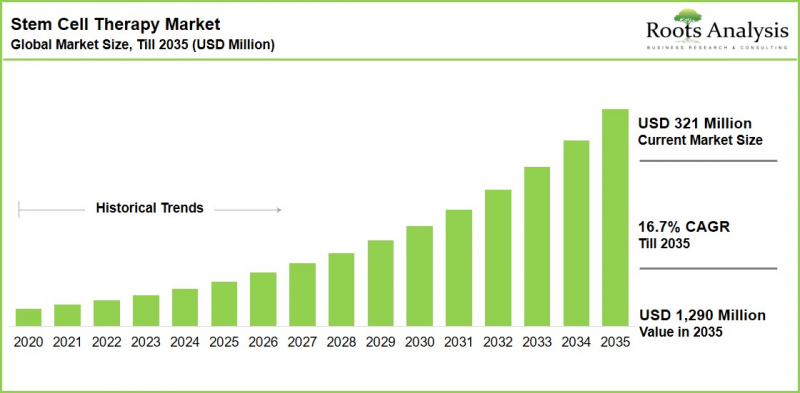
세계의 줄기세포 치료 시장 규모는 올해 3억 2,100만 달러에서 2035년까지 12억 9,000만 달러로 성장하여, 예측 기간 전체에 걸쳐 CAGR 16.7%를 기록할 것으로 추정됩니다.
줄기세포 치료 시장 : 성장 및 동향
줄기세포 치료는 재생의료 분야에서 가장 유망한 분야 중 하나입니다. 이러한 치료법은 단순히 증상을 관리하는 데 그치지 않고, 손상된 조직을 대체하고 장기 기능을 회복시키며, 질병의 근본 원인을 해결하는 줄기세포의 타고난 능력을 활용하고 있습니다. 최근 데이터에 따르면, 현재 전 세계 인구의 50% 이상이 어떤 형태의 만성 질환을 앓고 있으며, 이러한 부담으로 인해 지속가능하고 질병의 경과를 변화시킬 수 있는 치료법에 대한 대안을 모색하는 움직임이 강화되고 있습니다. 1950년대에 최초의 골수 이식이 이루어진 이래, 세포 생물학 및 재생 의학의 발전으로 인해 줄기세포를 이용한 치료법 개발이 가속화되고 있습니다. 이러한 치료법들은 광범위한 질환 적응증에서 충족되지 않은 의료적 요구를 해결하도록 설계되었습니다.
지금까지 약 25건의 줄기세포 치료법이 미국 식품의약국(USFDA)으로부터 규제 당국의 승인을 획득했습니다. 대표적인 예로는 EYE-01M, Alofisel(R), MACI, Stempeucel(R), Strimvelis(R) 등이 있습니다. 또한, 전 세계 120개 이상의 기업에서 280건 이상의 줄기세포 기반 제품 후보가 개발의 다양한 단계에서 평가되고 있습니다. 이러한 진전은 전 세계 52,000명 이상의 환자를 대상으로 한 540건 이상의 진행 중이거나 완료된 임상시험으로 구성된 활발한 임상 파이프라인에 의해 뒷받침되고 있습니다. 줄기세포 치료의 적용 범위는 현재 25개 이상의 다양한 치료 분야에 걸쳐 있으며, 그중에서도 심혈관질환, 신경 질환, 근골격계 질환, 자가면역 및 염증성 질환이 임상적·상업적으로 주목받는 주요 분야로 부상하고 있습니다.
또한, 재생의학에 대한 규제 당국의 지원 강화도 시장에 긍정적인 영향을 미치고 있습니다. 예를 들어, 미국 식품의약국(USFDA)은 2025년 9월, 세포 치료 분야의 적응형 임상시험 설계 및 신속 승인 절차를 촉진하기 위한 지침을 발표했습니다. 지속적인 자본 유입, 확대되는 위탁 제조(CMO) 생태계, 그리고 신경퇴행성 질환, 심혈관질환, 자가면역 질환 등 각 적응증에서 나타난 후기 임상시험의 긍정적인 결과가 줄기세포 치료의 장기적인 상업적 잠재력에 대한 신뢰를 높이고 있습니다.
성장의 원동력 : 시장 확장을 뒷받침하는 요인
시장 성장을 뒷받침하는 것은, 기존의 약리학적 개입으로는 치유보다는 주로 대증 요법적인 효과만 얻을 수 있는 만성·퇴행성 질환의 전 세계적 부담이 증가하고 있다는 점입니다. 그 결과 발생하는 미충족 의료 수요가 조직이나 장기의 기능을 회복시킬 수 있는 세포 기반 재생의료 플랫폼에 대한 지속적인 투자를 이끌고 있습니다. 이러한 추세는 북미, 유럽, 일본의 각 규제 당국이 첨단 치료법 및 세포 기반 치료법에 특화된 신속 심사 절차와 적응형 임상시험 체계를 도입하는 등 규제 환경이 점점 더 호전되고 있는 점에 의해 더욱 강화되고 있습니다.
또한, 줄기세포 제조 생태계의 성숙이 진행되고 있는 점도 추가적인 추진력이 되고 있습니다. 아울러 전문 위탁 개발·제조 기관(CDMO)을 이용할 수 있게 됨에 따라, 소규모 개발 기업이라도 독자적인 제조 인프라를 구축해야 하는 부담 없이 생산 규모를 확대할 수 있게 되었습니다. 미국 국립보건원(NIH)이나 캘리포니아 재생의학 연구소(CIRM) 등의 기관을 통한 정부 및 자선 단체의 자금 지원도 초기 단계의 연구를 지속적으로 견인하고 있습니다. 한편, 벤처 캐피털의 투자 확대는 유망한 학술적 발견을 임상 단계의 자산으로 발전시키는 데 일조하고 있습니다.
시장의 과제 : 진전을 가로막는 중대한 장벽
이러한 밝은 전망에도 불구하고, 줄기세포 치료 시장은 여전히 몇 가지 구조적인 과제에 직면해 있습니다. 주요 과제 중 하나는 줄기세포 기반 제품의 개발 및 제조 과정에서 발생하는 기술적·운영상의 복잡성입니다. 이러한 치료법에는 전문적인 인프라, 엄격한 품질 관리, 그리고 고도의 기술을 갖춘 인력이 필요하며, 이로 인해 중소기업의 개발이 어려워지고 파이프라인의 진전이 지연되고 있습니다.
보험 급여의 불확실성, 치료법 개발 및 시행에 드는 높은 비용, 그리고 지역별로 달라지는 규제 요건이 시장 진입 및 상용화 전략을 더욱 복잡하게 만들고 있습니다. 또한, 이 분야가 배아 줄기세포 확보와 관련된 윤리적 고려 사항과 역사적으로 연결되어 온 점은 특정 지역에서의 도입 속도에 지속적으로 영향을 미치고 있으며, 성체 줄기세포 유래 제품에 대한 상대적인 상업적 선호도를 강화하고 있습니다. 이러한 요인들을 종합해 보면, 시장에 진입하는 기업들 사이에서 명확하게 정의된 제조 파트너십, 견고한 규제 전략, 그리고 차별화된 임상적 포지셔닝의 필요성이 부각되고 있습니다.
줄기세포 치료 시장 : 주요 인사이트
본 보고서는 줄기세포 치료 시장의 현황을 상세히 분석하고, 시장 참여자들에게 잠재적인 성장 기회를 제시합니다. 주요 조사 결과는 다음과 같습니다:
- 만성 질환 및 퇴행성 질환의 부담 증가와 기존 치료 패러다임의 한계를 배경으로, 현재 120개 이상의 업계 내외 기업이 줄기세포를 활용한 치료법 개발에 매진하고 있으며, 개발의 다양한 단계에 있는 280건 이상의 제품 후보를 평가하고 있습니다.
- 지금까지 25건 가까운 줄기세포 치료법이 규제 당국의 승인을 받았으며, 그 대표적인 예로는 EYE-01M, Alofisel(R), MACI, Stempeucel(R), Strimvelis(R) 등이 있으며, 이는 기초 연구에서 임상 응용에 이르는 전환 경로가 점차 성숙해가고 있음을 반영합니다.
- 중간엽 줄기세포는 뛰어난 면역 조절 특성, 분리 용이성, 그리고 여러 치료 분야에 걸친 폭넓은 적용 가능성 덕분에 현재 파이프라인에서 가장 광범위하게 연구되고 있는 세포 유형입니다.
- 현재 줄기세포 치료제 개발자들은 심혈관질환, 신경계 질환, 근골격계 질환, 자가면역 및 염증성 질환을 주요 중점 분야로 삼고 있으며, 이 분야들이 합쳐져 파이프라인 활동의 대부분을 차지하고 있습니다.
- 지금까지 새로운 줄기세포 치료법을 평가하는 540건 이상의 임상시험이 등록되었으며, 52,000명 이상의 환자가 등록되었습니다. 이러한 연구의 대부분은 미국 전역의 기관에서 수행되고 있습니다.
- 정부 및 자선 단체는 줄기세포 치료 관련 프로젝트를 수행하는 연구 기관에 6억 달러 이상의 보조금을 지급하고 있으며, 이는 이 분야에 대한 공공 부문의 지속적인 노력을 강조하고 있습니다.
- 현재 다양한 지역에 거점을 둔 80개 이상의 업계 및 비업계 사업자가 줄기세포 치료제 개발 기업의 특정 요구를 충족시키는 수탁 개발·제조(CDMO) 서비스를 제공하고 있습니다.
- 골수 유래 성체 줄기세포 기반 제품은 중장기적으로 시장을 계속 독점할 것으로 예상되는 반면, 새롭고 최소침습적인 투여 경로별 치료법의 채택은 꾸준히 증가할 것으로 전망됩니다.
- 새로운 줄기세포 치료 후보에 대한 견고한 파이프라인, 지속적인 연구개발 투자, 그리고 규제 명확화가 진행되고 있다는 점을 고려할 때, 줄기세포 치료 시장은 2035년까지 지속적인 두 자릿수 성장을 이룰 유리한 위치에 있습니다.
줄기세포 치료 시장의 세분화
시장 규모 및 기회 분석은 다음 매개변수를 기반으로 세분화되었습니다:
줄기세포 채취 출처별
- 동종 요법
- 자가 요법
줄기세포 유래별
- 성체 줄기세포
- 배아 줄기세포
줄기세포 유형별
- 조혈모세포
- 중간엽 줄기세포
- 전구세포
- 기타
줄기세포 분화 계통별
- 지방 조직 유래 줄기세포
- 골수 유래 줄기세포
- 제대혈 유래 줄기세포
투여 경로별
- 관절 내
- 관상동맥 내
- 근육 내
- 심근 내
- 척수강 내
- 정맥 내
- 외과적 이식
- 기타
치료 분야별
- 자가면역·염증성 질환
- 심혈관계 질환
- 대사성 질환
- 근골격계 질환
- 종양성 질환
- 신경계 질환
- 안과 질환
- 기타
최종사용자별
- 외래 수술 센터
- 병원
- 전문 클리닉
지역별
- 북미
- 유럽
- 아시아태평양
- 기타 지역
목차
제1장 서문
제2장 조사 방법
제3장 시장 역학
제4장 거시경제 지표
제5장 주요 요약
제6장 소개
제7장 시장 구도
제8장 기업 개요
제9장 주요 치료 분야
제10장 상대적인 경쟁과 성장 평가
제11장 학술 연구 조성금 분석
제12장 임상시험 분석
제13장 줄기세포 제조 시장 구도와 계약 서비스 파트너를 평가하기 위한 KPI
제14장 줄기세포 치료 개발 기업과 CMO : 기회 평가
제15장 주요 상업화 전략
제16장 세계의 줄기세포 치료 시장
제17장 줄기세포 치료 시장(줄기세포 채취원별)
제18장 줄기세포 치료 시장(줄기세포 유래별)
제19장 줄기세포 치료 시장(줄기세포 유형별)
제20장 줄기세포 치료 시장(분화계별)
제21장 줄기세포 치료 시장(투여 경로별)
제22장 줄기세포 치료 시장(치료 분야별)
제23장 줄기세포 치료 시장(최종사용자별)
제24장 줄기세포 치료 시장(지역별)
제25장 결론
제26장 경영진 인사이트
제27장 부록 I : 표형식 데이터
제28장 부록 II : 기업 및 조직 리스트
KSM 26.08.13STEM CELL THERAPY MARKET: OVERVIEW
As per Roots Analysis, the global stem cell therapy market is estimated to grow from USD 321 million in the current year to USD 1,290 million by 2035, registering a CAGR of 16.7% across the forecast period.
Stem Cell Therapy Market: Growth and Trends
Stem cell therapies represent one of the most promising frontiers within regenerative medicine. These therapies harness the innate ability of stem cells to replace damaged tissue, restore organ function and address the root cause of disease, rather than merely managing its symptoms. As per the recent data, more than 50% of the global population is currently living with some form of chronic illness, a burden that has intensified the search for durable, disease-modifying treatment alternatives. Since the first bone marrow transplant in the 1950s, advances in cell biology and regenerative medicine have accelerated the development of stem cell-based therapies. These interventions are designed to address unmet needs across a broad range of disease indications.
To date, close to 25 stem cell therapies have secured regulatory approval from the USFDA. Some notable examples include EYE-01M, Alofisel(R), MACI, Stempeucel(R) and Strimvelis(R). Additionally, more than 280 stem cell-based product candidates are being evaluated across various stages of development by over 120 industry players worldwide. Their progress is supported by an active clinical pipeline comprising more than 540 ongoing and completed trials involving over 52,000 patients globally. The applicability of stem cell therapies now spans more than 25 distinct therapeutic areas, with cardiovascular, neurological, musculoskeletal and autoimmune / inflammatory disorders emerging as the primary areas of clinical and commercial focus.
The market has also benefited from heightened regulatory support for regenerative therapies. For instance, the USFDA released guidance in September 2025 to promote adaptive trial designs and accelerated approval pathways for cell-based treatments. Continued capital inflows, an expanding contract manufacturing ecosystem, and positive late-stage clinical results across neurodegenerative, cardiovascular, and autoimmune indications are strengthening confidence in the long-term commercial potential of stem cell therapies.
Growth Drivers: Factors Fueling Market Expansion
Market growth is being propelled by the rising global burden of chronic and degenerative disorders for which conventional pharmacological interventions offer largely palliative, rather than curative, benefit. The consequent unmet need is driving sustained investment into cell-based regenerative platforms capable of restoring tissue and organ function. This momentum is further reinforced by an increasingly favorable regulatory climate, with agencies across North America, Europe and Japan introducing expedited review pathways and adaptive trial frameworks tailored specifically to advanced and cell-based therapies.
Additional impetus is being provided by the growing maturity of the stem cell manufacturing ecosystem. Further, the availability of specialized contract development and manufacturing organizations (CDMOs) is enabling smaller developers to scale production without the burden of establishing proprietary manufacturing infrastructure. Government and philanthropic funding from organizations such as the National Institutes of Health (NIH) and the California Institute for Regenerative Medicine continues to drive early-stage research. Meanwhile, growing venture capital investment is helping advance promising academic discoveries into clinical-stage assets.
Market Challenges: Critical Barriers Hindering Progress
Despite the encouraging outlook, the stem cell therapy market continues to contend with several structural challenges. A major challenge is the technical and operational complexity of developing and manufacturing stem cell-based products. These therapies require specialized infrastructure, stringent quality control, and highly skilled personnel, making development difficult for smaller companies and slowing pipeline advancement.
Reimbursement uncertainty, the high cost of therapy development and administration, and evolving regulatory expectations across geographies further complicate market entry and commercialization strategies. Additionally, the field's historical association with ethical considerations around embryonic stem cell sourcing continues to influence the pace of adoption in certain regions, reinforcing the relative commercial preference for adult stem cell-derived products. Collectively, these factors underscore the need for well-defined manufacturing partnerships, robust regulatory strategy and differentiated clinical positioning among market participants.
Stem Cell Therapy Market: Key Insights
The report delves into the current state of the stem cell therapy market and identifies potential growth opportunities for the market players. Some key findings include:
- Driven by the rising burden of chronic and degenerative disorders and the limitations of conventional treatment paradigms, more than 120 industry and non-industry players are currently engaged in the development of stem cell-based therapies, evaluating over 280 product candidates across various stages of development.
- Close to 25 stem cell therapies have received regulatory approval to date; notable examples include EYE-01M, Alofisel(R), MACI, Stempeucel(R) and Strimvelis(R), reflecting a maturing translational pathway from bench to bedside.
- Mesenchymal stem cells represent the most extensively investigated cell type within the current pipeline, owing to their favorable immunomodulatory profile, ease of isolation and broad applicability across multiple therapeutic areas.
- Cardiovascular, neurological, musculoskeletal and autoimmune / inflammatory disorders are presently the primary focus areas for stem cell therapy developers, collectively accounting for a majority of pipeline activity.
- More than 540 clinical trials evaluating novel stem cell therapies, enrolling over 52,000 patients, have been registered to date; a majority of these studies are being conducted at centers across the US.
- Over USD 600 million has been awarded in the form of grants by government and philanthropic bodies to research institutes engaged in stem cell therapy-related projects, underscoring sustained public sector commitment to this field.
- More than 80 industry and non-industry players, based across different regions, presently offer contract development and manufacturing services catering to the specific needs of stem cell therapy developers.
- Products based on bone marrow-derived adult stem cells are anticipated to continue dominating the market over the mid-to-long term, while adoption of therapies administered via novel and minimally invasive routes is expected to rise steadily.
- Given the robust pipeline of novel stem cell therapy candidates, sustained R&D investment and improving regulatory clarity, the stem cell therapy market is well-positioned to witness sustained double-digit growth through 2035.
Stem Cell Therapy Market Segments
The market sizing and opportunity analysis has been segmented across the following parameters:
By Source of Stem Cell
- Allogeneic Therapies
- Autologous Therapies
By Origin of Stem Cell
- Adult Stem Cells
- Embryonic Stem Cells
By Type of Stem Cell
- Hematopoietic Stem Cells
- Mesenchymal Stem Cells
- Progenitor Cells
- Others
By Lineage of Stem Cell
- Adipose Tissue Derived Stem Cells
- Bone Marrow Derived Stem Cells
- Cord Blood Derived Stem Cells
By Route of Administration
- Intraarticular
- Intracoronary
- Intramuscular
- Intramyocardial
- Intrathecal
- Intravenous
- Surgical Implantation
- Others
By Therapeutic Area
- Autoimmune / Inflammatory Disorders
- Cardiovascular Disorders
- Metabolic Disorders
- Musculoskeletal Disorders
- Oncological Disorders
- Neurological Disorders
- Ophthalmic Disorders
- Others
By End Users
- Ambulatory Surgery Centers
- Hospitals
- Specialty Clinics
By Geographical Regions
- North America
- Europe
- Asia-Pacific
- Rest of the World
Stem Cell Therapy Market: Key Segments
Allogeneic Therapies Poised to Gain Share of the Market in Future
Based on Roots Analysis market assessment, autologous approaches continue to command a high share of ongoing clinical activity owing to their favorable immunological profile, allogeneic "off-the-shelf", stem cell therapies are gaining momentum on account of their scalability, cost-efficiency and shorter turnaround time to patient administration. This shift is expected to play an important role in shaping commercial strategy among developers seeking to optimize manufacturing economics.
Mesenchymal Stem Cell (MSC)-Based Therapies Lead the Market
Based on the Roots Analysis market report, mesenchymal stem cell (MSC)-based therapies currently hold the highest share as it represents the most active area of pipeline development. This growing pipeline of mesenchymal stem cell-based drugs reflects their well-documented immunomodulatory and regenerative properties. Additionally, relative ease of isolation from multiple tissue sources, and broad applicability across autoimmune, orthopedic and cardiovascular indications.
North America Expected to Retain Market Leadership
North America is projected to remain the largest regional market for stem cell therapies through 2035. This dominance is supported by a well-established regenerative medicine ecosystem, a high concentration of therapy developers and CDMOs, favorable reimbursement dynamics for advanced therapies, and continued grant funding from bodies such as the NIH.
Asia-Pacific to Emerge as a Highest Growing Regional Market
The Asia-Pacific stem cell therapy market is anticipated to register higher CAGR over the forecast period. This growth is driven by an expanding base of domestic developers, increasing clinical trial activity, improving regulatory clarity in key markets such as Japan and South Korea, and rising healthcare investment across the region.
Example Players in Stem Cell Therapy Market
- Anterogen
- Athersys
- CHA Biotech
- Cytopeutics
- Hope Biosciences
- Mesoblast
- Pluristem Therapeutics
- Takeda Pharmaceutical
- TICEBA
Expert Interview and Industry Insights
The opinions and insights presented in this study have been influenced by discussions conducted with multiple industry stakeholders. The research report features detailed transcripts of interviews held with, among others, the following industry representatives:
- Founder and Chief Executive Officer, Seraxis
- Chief Executive Officer, Xcelthera
- Co-Founder and Chief Scientist, Kadimastem
- Director and Chief Operating Officer, Heartseed
- Director and Chairman, Department of Cardiac Surgery, University of Rostock
- President, Bio Elpida
- Professor and American Red Cross Chair in Transfusion Medicine, University of Minnesota
- Manager of Business Development, Waisman Biomanufacturing
- Department Leader, Cell Therapy Innovation and Development, YposKesi
STEM CELL THERAPY MARKET: RESEARCH COVERAGE
- Market Sizing and Opportunity Analysis: An in-depth, top-down analysis of the global stem cell therapy market, covering key segments including source of stem cell, origin of stem cell, type of stem cell, lineage of stem cell, route of administration, therapeutic area, end users and geographical regions.
- Market Introduction: A review of the historical evolution of stem cell research, classification of stem cells (by source, origin and potency), modes of administration, applications and associated development challenges, alongside a summary of regulatory guidelines across North America, Europe and Japan.
- Market Landscape: A comprehensive assessment of the marketed and clinical-stage stem cell therapy pipeline, analyzed by phase of development, source, origin, type, lineage and potency of stem cell, target indication, therapeutic area and route of administration, supported by tree map, heptagon, grid and world map representations of industry activity.
- Company Profiles: In-depth profiles of prominent players engaged in the stem cell therapy domain, featuring information on year of establishment, location of headquarters, company size, product portfolio and recent developments.
- Key Therapeutic Areas: A disease-specific assessment of over 20 target indications spanning autoimmune / inflammatory, cardiovascular, dermatological, metabolic, oncological and neurological disorders, including epidemiology, current treatment options and the corresponding stem cell therapy pipeline.
- Assessment of Relative Competition and Growth: A proprietary 2X2 framework evaluating existing competition and growth opportunity across established and emerging therapeutic areas, within both established and emerging geographies.
- Academic Grants Analysis: An analysis of grants awarded by the National Institutes of Health (NIH) for stem cell therapy-related research, based on year of award, amount awarded, funding mechanism, therapeutic area, and recipient organization, along with a multivariate grant attractiveness analysis.
- Clinical Trial Analysis: An analysis of completed, ongoing and planned clinical trials, based on trial registration year, phase, recruitment status, sponsor / collaborator type, study design, patient enrollment, therapeutic area and geography.
- Stem Cell Manufacturing Landscape and CDMO Evaluation: A review of the contract manufacturing landscape for stem cell therapies, featuring information on industry and non-industry CDMOs (by year of establishment, company size, scale of manufacturing, services offered and location), along with a KPI framework for evaluating prospective manufacturing partners.
- Developers and CMOs: Opportunity Assessment: A gap analysis comparing the clinical and commercial capabilities of therapy developers against the availability of contract manufacturing capacity, across North America, Europe and Asia-Pacific / Rest of the World.
- Key Commercialization Strategies: An assessment of strategies adopted by developers before and after therapy approval, including profiles of key approved stem cell therapies and an evaluation of opportunities and challenges associated with unapproved therapies.
- Market Sizing and Forecast, By Segment and Geography: Historical trends (since 2020) and forecasted estimates (till 2035) for the global stem cell therapy market, distributed by source, origin, type and lineage of stem cell, route of administration, therapeutic area, end users and geographical regions, supported by conservative, base and optimistic scenario analyses.
Key Questions Answered in this Report
- What is the current, and expected future, size of the stem cell therapy market?
- What is the anticipated CAGR of the stem cell therapy market during the forecast period, till 2035?
- Which are the leading companies engaged in the development of stem cell therapies?
- Which source, origin and type of stem cell is likely to dominate the market during the forecast period?
- Which therapeutic area offers the most attractive growth opportunity for stem cell therapy developers?
- Which region is likely to lead the stem cell therapy market, and which region is expected to grow the fastest?
- What are the key drivers, restraints, opportunities and challenges shaping this market?
- What is the prevailing contract manufacturing landscape for stem cell therapy developers, and which KPIs matter most when selecting a manufacturing partner?
Reasons to Buy this Report
This report is designed to give distributors, channel partners, and investors a decisive analytical edge in a fast-consolidating market. Its core differentiators include:
- The report provides a comprehensive, top-down market analysis, offering detailed revenue projections for the overall market and its specific sub-segments, valuable to both established market leaders and emerging entrants.
- It offers stakeholders a comprehensive overview of the market, including key drivers, barriers, opportunities and challenges, empowering data-driven strategic decision-making.
- It aids businesses in identifying and validating future growth opportunities across therapeutic areas and geographies.
- It supports the identification of unmet patient and customer demand by mapping the needs, preferences and behavior of key stakeholder groups.
- It equips new entrants with the requisite market intelligence to design and execute successful go-to-market and commercialization strategies.
- It enables more effective communication with investors, partners and other stakeholders, supporting the development of stronger business relationships.
Additional Benefits
- Complementary PPT Insights Pack
- Complementary Excel Data Packs for all Analytical Modules in the Report
- 15% Free Content Customization
- Detailed Report Walkthrough Session with Research Team
- Free Updated report if the report is 6-12 months old or older
TABLE OF CONTENTS
1. PREFACE
- 1.1. Introduction
- 1.2. Market Share Insights
- 1.3. Key Market Insights
- 1.4. Report Coverage
- 1.5. Key Questions Answered
- 1.6. Chapter Outlines
2. RESEARCH METHODOLOGY
- 2.1. Chapter Overview
- 2.2. Research Assumptions
- 2.2.1. Market Landscape and Market Trends
- 2.2.2. Market Forecast and Opportunity Analysis
- 2.2.3. Comparative Analysis
- 2.3. Database Building
- 2.3.1. Data Collection
- 2.3.2. Data Validation
- 2.3.3. Data Analysis
- 2.4. Project Methodology
- 2.4.1. Secondary Research
- 2.4.1.1. Annual Reports
- 2.4.1.2. Academic Research Papers
- 2.4.1.3. Company Websites
- 2.4.1.4. Investor Presentations
- 2.4.1.5. Regulatory Filings
- 2.4.1.6. White Papers
- 2.4.1.7. Industry Publications
- 2.4.1.8. Conferences and Seminars
- 2.4.1.9. Government Portals
- 2.4.1.10. Media and Press Releases
- 2.4.1.11. Newsletters
- 2.4.1.12. Industry Databases
- 2.4.1.13. Roots Proprietary Databases
- 2.4.1.14. Paid Databases and Sources
- 2.4.1.15. Social Media Portals
- 2.4.1.16. Other Secondary Sources
- 2.4.2. Primary Research
- 2.4.2.1. Types of Primary Research
- 2.4.2.1.1. Qualitative Research
- 2.4.2.1.2. Quantitative Research
- 2.4.2.1.3. Hybrid Approach
- 2.4.2.2. Advantages of Primary Research
- 2.4.2.3. Techniques for Primary Research
- 2.4.2.3.1. Interviews
- 2.4.2.3.2. Surveys
- 2.4.2.3.3. Focus Groups
- 2.4.2.3.4. Observational Research
- 2.4.2.3.5. Social Media Interactions
- 2.4.2.4. Key Opinion Leaders Considered in Primary Research
- 2.4.2.4.1. Company Executives (CXOs)
- 2.4.2.4.2. Board of Directors
- 2.4.2.4.3. Company Presidents and Vice Presidents
- 2.4.2.4.4. Research and Development Heads
- 2.4.2.4.5. Technical Experts
- 2.4.2.4.6. Subject Matter Experts
- 2.4.2.4.7. Scientists
- 2.4.2.4.8. Doctors and Other Healthcare Providers
- 2.4.2.5. Ethics and Integrity
- 2.4.2.5.1. Research Ethics
- 2.4.2.5.2. Data Integrity
- 2.4.2.1. Types of Primary Research
- 2.4.3. Analytical Tools and Databases
- 2.4.1. Secondary Research
- 2.5. Robust Quality Control
3. MARKET DYNAMICS
- 3.1. Chapter Overview
- 3.2. Forecast Methodology
- 3.2.1. Top-down Approach
- 3.2.2. Bottom-up Approach
- 3.2.3. Hybrid Approach
- 3.3. Market Assessment Framework
- 3.3.1. Total Addressable Market (TAM)
- 3.3.2. Serviceable Addressable Market (SAM)
- 3.3.3. Serviceable Obtainable Market (SOM)
- 3.3.4. Currently Acquired Market (CAM)
- 3.4. Forecasting Tools and Techniques
- 3.4.1. Qualitative Forecasting
- 3.4.2. Correlation
- 3.4.3. Regression
- 3.4.4. Extrapolation
- 3.4.5. Convergence
- 3.4.6. Sensitivity Analysis
- 3.4.7. Scenario Planning
- 3.4.8. Data Visualization
- 3.4.9. Time Series Analysis
- 3.4.10. Forecast Error Analysis
- 3.5. Key Considerations
- 3.5.1. Demographics
- 3.5.2. Government Regulations
- 3.5.3. Reimbursement Scenarios
- 3.5.4. Market Access
- 3.5.5. Supply Chain
- 3.5.6. Industry Consolidation
- 3.5.7. Pandemic / Unforeseen Disruptions Impact
- 3.6. Limitations
4. MACRO-ECONOMIC INDICATORS
- 4.1. Chapter Overview
- 4.2. Market Dynamics
- 4.2.1. Time Period
- 4.2.1.1. Historical Trends
- 4.2.1.2. Current and Forecasted Estimates
- 4.2.2. Currency Coverage
- 4.2.2.1. Major Currencies Affecting the Market
- 4.2.2.2. Factors Affecting Currency Fluctuations
- 4.2.2.3. Impact of Currency Fluctuations on the Industry
- 4.2.3. Foreign Currency Exchange Rate
- 4.2.3.1. Impact of Foreign Exchange Rate Volatility on the Market
- 4.2.3.2. Strategies for Mitigating Foreign Exchange Risk
- 4.2.4. Recession
- 4.2.4.1. Assessment of Current Economic Conditions and Potential Impact on the Market
- 4.2.4.2. Historical Analysis of Past Recessions and Lessons Learnt
- 4.2.5. Inflation
- 4.2.5.1. Measurement and Analysis of Inflationary Pressures in the Economy
- 4.2.5.2. Potential Impact of Inflation on the Market Evolution
- 4.2.6. Interest Rates
- 4.2.6.1. Interest Rates and Their Impact on the Market
- 4.2.6.2. Strategies for Managing Interest Rate Risk
- 4.2.7. Commodity Flow Analysis
- 4.2.7.1. Type of Commodity
- 4.2.7.2. Origins and Destinations
- 4.2.7.3. Values and Weights
- 4.2.7.4. Modes of Transportation
- 4.2.8. Global Trade Dynamics
- 4.2.8.1. Import Scenario
- 4.2.8.2. Export Scenario
- 4.2.8.3. Trade Policies
- 4.2.8.4. Strategies for Mitigating the Risks Associated with Trade Barriers
- 4.2.8.5. Impact of Trade Barriers on the Market
- 4.2.9. War Impact Analysis
- 4.2.9.1. Russian-Ukraine War
- 4.2.9.2. Israel-Hamas War
- 4.2.10. COVID Impact / Related Factors
- 4.2.10.1. Global Economic Impact
- 4.2.10.2. Industry-specific Impact
- 4.2.10.3. Government Response and Stimulus Measures
- 4.2.10.4. Future Outlook and Adaptation Strategies
- 4.2.11. Other Indicators
- 4.2.11.1. Fiscal Policy
- 4.2.11.2. Consumer Spending
- 4.2.11.3. Gross Domestic Product
- 4.2.11.4. Employment
- 4.2.11.5. Taxes
- 4.2.11.6. Stock Market Performance
- 4.2.11.7. Cross Border Dynamics
- 4.2.1. Time Period
- 4.3. Conclusion
5. EXECUTIVE SUMMARY
6. INTRODUCTION
- 6.1. Chapter Overview
- 6.2. Overview of Stem Cell Therapies
- 6.2.1. Historical Evolution of Stem Cell Research
- 6.2.2. Classification of Stem Cells
- 6.2.2.1. Based on Source of Stem Cell
- 6.2.2.2. Based on Origin of Stem Cell
- 6.2.2.3. Based on Potency of Stem Cell
- 6.2.3. Administration of Stem Cell Therapies
- 6.2.4. Applications of Stem Cell Therapies
- 6.2.5. Challenges Associated with Development of Stem Cell Therapies
- 6.3. Regulatory Guidelines for Stem Cell Therapies
- 6.3.1. Current Scenario
- 6.3.2. Regulatory Guidelines in North America
- 6.3.3. Regulatory Guidelines in Europe
- 6.3.4. Regulatory Guidelines in Japan
- 6.4. Prevalent Trends Related to Stem Cell Therapies
- 6.4.1. Emerging Focus Areas
- 6.4.2. Key Historical Trends
- 6.4.3. Geographical Activity
- 6.5. Growth Drivers and Roadblocks
7. MARKET LANDSCAPE
- 7.1. Chapter Overview
- 7.2. Stem Cell Therapies: Marketed and Development Pipeline
- 7.2.1. Analysis by Phase of Development
- 7.2.2. Analysis by Source of Stem Cell
- 7.2.3. Analysis by Origin of Stem Cell
- 7.2.4. Analysis by Type of Stem Cell
- 7.2.5. Analysis by Lineage of Stem Cell
- 7.2.6. Analysis by Potency of Stem Cell
- 7.2.7. Analysis by Target Indication
- 7.2.8. Analysis by Therapeutic Area
- 7.2.9. Analysis by Route of Administration
- 7.3. Stem Cell Therapies: Additional Information
- 7.3.1. Information on Dosage and Commercial Rights
- 7.3.2. Information on Designations Awarded
- 7.4. Stem Cell Therapies: List of Technology Platforms
- 7.5. Stem Cell Therapies: List of Therapy Developers
- 7.5.1. Analysis by Year of Establishment
- 7.5.2. Analysis by Company Size
- 7.5.3. Analysis by Location of Headquarters
- 7.5.4. Analysis by Company Size and Location of Headquarters
- 7.5.5. Leading Drug Developers: Analysis by Number of Stem Cell Therapies
- 7.5.6. Leading Drug Developers: 4D Bubble Analysis based on Strength of Pipeline, Target Indication and Company Size
- 7.6. Heptagon Representation: Analysis by Phase of Development and Key Therapeutic Area
- 7.7. Grid Representation: Analysis by Phase of Development, Source of Stem Cell and Therapeutic Area
- 7.8. Tree Map Representation: Analysis by Therapeutic Area and Size of the Company
- 7.9. World Map Representation: Analysis of Regional Activity
8. COMPANY PROFILES
- 8.1. Chapter Overview
- 8.1.1. Anterogen
- 8.1.1.1. Company Overview
- 8.1.1.2. Product Portfolio
- 8.1.1.3. Recent Developments and Future Outlook
- 8.1.2. Athersys
- 8.1.3. CHA Biotech
- 8.1.4. Cytopeutics
- 8.1.5. Hope Biosciences
- 8.1.6. Mesoblast
- 8.1.7. Pluristem Therapeutics
- 8.1.8. Takeda Pharmaceutical
- 8.1.9. TICEBA
- 8.1.1. Anterogen
9. KEY THERAPEUTIC AREAS
- 9.1. Chapter Overview
- 9.2. Autoimmune / Inflammatory Disorders
- 9.2.1. Crohn's Disease
- 9.2.1.1. Disease Description
- 9.2.1.2. Epidemiology
- 9.2.1.3. Current Treatment Options
- 9.2.1.4. Side Effects of Current Treatment Options
- 9.2.1.5. Stem Cell Therapies for Crohn's Disease
- 9.2.2. Ulcerative Colitis
- 9.2.2.1. Disease Description
- 9.2.2.2. Epidemiology
- 9.2.2.3. Current Treatment Options
- 9.2.2.4. Side Effects of Current Treatment Options
- 9.2.2.5. Stem Cell Therapies for Ulcerative Colitis
- 9.2.1. Crohn's Disease
- 9.3. Cardiovascular Disorders
- 9.3.1. Critical Limb Ischemia
- 9.3.1.1. Disease Description
- 9.3.1.2. Epidemiology
- 9.3.1.3. Current Treatment Options
- 9.3.1.3.1. Pharmacological Interventions
- 9.3.1.3.2. Endovascular Treatments
- 9.3.1.3.3. Surgical Interventions
- 9.3.1.4. Stem Cell Therapies for Critical Limb Ischemia
- 9.3.2. Heart Failure
- 9.3.2.1. Disease Description
- 9.3.2.2. Epidemiology
- 9.3.2.3. Current Treatment Options
- 9.3.2.3.1. Pharmacological Interventions
- 9.3.2.3.2. Therapeutic Devices
- 9.3.2.3.3. Surgical Interventions
- 9.3.2.4. Stem Cell Therapies for Heart Failure
- 9.3.3. Myocardial Infarction
- 9.3.3.1. Disease Description
- 9.3.3.2. Epidemiology
- 9.3.3.3. Current Treatment Options
- 9.3.3.3.1. Pharmacological Interventions
- 9.3.3.3.2. Surgical Interventions
- 9.3.3.4. Stem Cell Therapies for Myocardial Infarction
- 9.3.1. Critical Limb Ischemia
- 9.4. Dermatological Disorders
- 9.4.1. Acne Vulgaris
- 9.4.1.1. Disease Description
- 9.4.1.2. Epidemiology
- 9.4.1.3. Current Treatment Options
- 9.4.1.4. Side Effects of Current Treatment Options
- 9.4.1.5. Stem Cell Therapies for Acne Vulgaris
- 9.4.1. Acne Vulgaris
- 9.5. Metabolic Disorders
- 9.5.1. Diabetes
- 9.5.1.1. Disease Description
- 9.5.1.2. Associated Health Risks / Complications
- 9.5.1.3. Epidemiology
- 9.5.1.4. Disease Diagnosis
- 9.5.1.5. Current Treatment Options
- 9.5.1.5.1. Insulin Therapies
- 9.5.1.5.2. Non-Insulin Therapies
- 9.5.1.6. Side Effects of Current Treatment Options
- 9.5.1.7. Stem Cell Therapies for Diabetes
- 9.5.2. Non-alcoholic Steatohepatitis (NASH)
- 9.5.2.1. Disease Description
- 9.5.2.2. Epidemiology
- 9.5.2.3. Current Treatment Options
- 9.5.2.4. Stem Cell Therapies for NASH
- 9.5.1. Diabetes
- 9.6. Oncological Disorders
- 9.6.1. Bladder Cancer
- 9.6.1.1. Disease Description
- 9.6.1.2. Epidemiology
- 9.6.1.3. Current Treatment Options
- 9.6.1.4. Stem Cell Therapies for Bladder Cancer
- 9.6.2. Breast Cancer
- 9.6.2.1. Disease Description
- 9.6.2.2. Epidemiology
- 9.6.2.3. Current Treatment Options
- 9.6.2.4. Stem Cell Therapies for Breast Cancer
- 9.6.3. Colorectal Cancer
- 9.6.3.1. Disease Description
- 9.6.3.2. Epidemiology
- 9.6.3.3. Current Treatment Options
- 9.6.3.4. Side Effects of Current Treatment Options
- 9.6.3.5. Stem Cell Therapies for Colorectal Cancer
- 9.6.4. Kidney Cancer
- 9.6.4.1. Disease Description
- 9.6.4.2. Epidemiology
- 9.6.4.3. Current Treatment Options
- 9.6.4.4. Stem Cell Therapies for Kidney Cancer
- 9.6.5. Liver Cancer
- 9.6.5.1. Introduction
- 9.6.5.2. Epidemiology
- 9.6.5.3. Current Treatment Options
- 9.6.5.4. Stem Cell Therapies for Liver Cancer
- 9.6.6. Lung Cancer
- 9.6.6.1. Disease Description
- 9.6.6.2. Epidemiology
- 9.6.6.3. Current Treatment Options
- 9.6.6.4. Side Effects of Current Treatment Options
- 9.6.6.5. Stem Cell Therapies for Lung Cancer
- 9.6.7. Ovarian Cancer
- 9.6.7.1. Disease Description
- 9.6.7.2. Epidemiology
- 9.6.7.3. Current Treatment Options
- 9.6.7.4. Stem Cell Therapies for Ovarian Cancer
- 9.6.8. Pancreatic Cancer
- 9.6.8.1. Disease Description
- 9.6.8.2. Epidemiology
- 9.6.8.3. Current Treatment Options
- 9.6.8.4. Stem Cell Based Therapies for Pancreatic Cancer
- 9.6.1. Bladder Cancer
- 9.7. Neurological Disorders
- 9.7.1. Alzheimer's Disease
- 9.7.1.1. Disease Description
- 9.7.1.2. Epidemiology
- 9.7.1.3. Symptoms of the Disease
- 9.7.1.4. Causes of Alzheimer's Disease
- 9.7.1.5. Stages of Alzheimer's Disease
- 9.7.1.6. Current Treatment Options
- 9.7.1.7. Stem Cell Therapies for Alzheimer's Disease
- 9.7.2. Parkinson's Disease
- 9.7.2.1. Disease Description
- 9.7.2.2. Epidemiology
- 9.7.2.3. Current Treatment Options
- 9.7.2.3.1. Pharmacological Management of Parkinson's Disease
- 9.7.2.3.2. Non-Pharmacological Management of Parkinson's Disease
- 9.7.2.3.3. Management of Parkinson's Disease Using Dietary Supplements
- 9.7.2.4. Stem Cell Therapies for Parkinson's Disease
- 9.7.1. Alzheimer's Disease
10. ASSESSMENT OF RELATIVE COMPETITION AND GROWTH
- 10.1. Chapter Overview
- 10.2. Assumptions and Methodology
- 10.3. Analysis of Relative Competition and Growth Opportunities
- 10.3.1. Established Therapeutic Areas in Emerging Regions
- 10.3.2. Established Therapeutic Areas in Established Regions
- 10.3.3. Emerging Therapeutic Areas in Emerging Regions
- 10.3.4. Emerging Therapeutic Areas in Established Regions
11. ACADEMIC GRANTS ANALYSIS
- 11.1. Chapter Overview
- 11.2. Scope and Methodology
- 11.3. Stem Cell Therapies: Analysis of Grants Awarded by the National Institutes of Health (NIH)
- 11.3.1. Analysis by Year of Award
- 11.3.2. Analysis by Amount Awarded
- 11.3.3. Analysis by Administering Institute Center
- 11.3.4. Analysis by Funding Institute Center
- 11.3.5. Analysis by Support Period
- 11.3.6. Analysis by Funding Institute Center and Support Period
- 11.3.7. Most Popular NIH Spending Categorizations
- 11.3.8. Analysis by Funding Mechanism
- 11.3.9. Emerging Focus Areas
- 11.3.10. Analysis by Source of Stem Cell
- 11.3.11. Analysis by Origin of Stem Cell
- 11.3.12. Analysis by Type of Stem Cell
- 11.3.13. Analysis by Lineage of Stem Cell
- 11.3.14. Analysis by Potency of Stem Cell
- 11.3.15. Analysis by Therapeutic Area
- 11.3.16. Analysis by Type of Grant Application
- 11.3.17. Popular NIH Departments
- 11.3.18. Analysis by Study Section
- 11.3.19. Analysis by Types of Recipient Organizations
- 11.3.20. Popular Recipient Organizations
- 11.3.21. Analysis by Grant Mechanism
- 11.3.22. Prominent Program Officers
- 11.3.23. Regional Distribution of Recipient Organizations
- 11.4. Grant Attractiveness Analysis
12. CLINICAL TRIAL ANALYSIS
- 12.1. Chapter Overview
- 12.2. Scope and Methodology
- 12.3. Stem Cell Therapies: Clinical Trial Analysis
- 12.3.1. Analysis by Trial Registration Year
- 12.3.2. Analysis by Trial Phase
- 12.3.3. Analysis by Number of Patients Enrolled by Trial Registration Year
- 12.3.4. Analysis by Study Design
- 12.3.5. Analysis by Trial Recruitment Status
- 12.3.6. Analysis by Sponsor / Collaborator
- 12.3.7. Leading Industry Sponsors: Based on Number of Registered Trials
- 12.3.8. Analysis by Trial Focus
- 12.3.9. Analysis by Type of Stem Cell
- 12.3.10. Analysis by Therapeutic Area
- 12.3.11. Analysis by Type of Stem Cell and Therapeutic Area
- 12.3.12. Geographical Analysis by Number of Clinical Trials
- 12.3.13. Geographical Analysis by Trial Recruitment Status
- 12.3.14. Geographical Analysis by Enrolled Patient Population
13. STEM CELL MANUFACTURING MARKET LANDSCAPE AND KPIs FOR EVALUATING CONTRACT SERVICES PARTNERS
- 13.1. Chapter Overview
- 13.2. Stem Cell Therapy Manufacturing
- 13.2.1. Need for Stem Cell Therapy Contract Manufacturing
- 13.2.2. Advantages of Outsourcing Stem Cell Therapy Manufacturing
- 13.2.3. Guidelines for Selecting a Contract Manufacturing Organization (CMO) Partner
- 13.2.4. Stem Cell Therapy CMOs: List of Industry Players
- 13.2.4.1. Analysis by Year of Establishment
- 13.2.4.2. Analysis by Company Size
- 13.2.4.3. Analysis by Scale of Stem Cell Manufacturing
- 13.2.4.4. Analysis by Location of Headquarters
- 13.2.4.5. Analysis by Location of Manufacturing Facilities
- 13.2.4.6. Analysis by Types of Services Offered
- 13.2.4.7. Analysis by Source and Origin of Stem Cell
- 13.2.5. Stem Cell Therapy CMOs: List of Non-industry Players
- 13.2.5.1. Analysis by Year of Establishment
- 13.2.5.2. Analysis by Scale of Stem Cell Manufacturing
- 13.2.5.3. Analysis by Location of Headquarters
- 13.2.5.4. Analysis by Location of Manufacturing Facilities
- 13.2.5.5. Analysis by Types of Services Offered
- 13.2.5.6. Analysis by Source and Origin Stem Cell
- 13.3. Stem Cell Therapy Manufacturing: KPI Analysis
- 13.3.1. KPI Definitions
- 13.3.1.1. Financial Indicators
- 13.3.1.1.1. Big Pharma Perspective
- 13.3.1.1.2. Contract Manufacturers' Perspective
- 13.3.1.2. Process and Capability Indicators
- 13.3.1.2.1. Big Pharma Perspective
- 13.3.1.2.2. Contract Manufacturers' Perspective
- 13.3.1.3. Market Reputation Indicators
- 13.3.1.3.1. Big Pharma Perspective
- 13.3.1.3.2. Contract Manufacturers' Perspective
- 13.3.1.1. Financial Indicators
- 13.3.1. KPI Definitions
- 13.4. Concluding Remarks
14. STEM CELL THERAPY DEVELOPERS AND CMOs: OPPORTUNITY ASSESSMENT
- 14.1. Chapter Overview
- 14.2. Therapy Developers and CMOs in North America
- 14.2.1. Gap Analysis by Scale of Stem Cell Manufacturing
- 14.2.2. Gap Analysis by Source of Stem Cell
- 14.2.3. Gap Analysis by Origin of Stem Cell
- 14.3. Therapy Developers and CMOs in Europe
- 14.3.1. Gap Analysis by Scale of Stem Cell Manufacturing
- 14.3.2. Gap Analysis by Source of Stem Cell
- 14.3.3. Gap Analysis by Origin of Stem Cell
- 14.4. Therapy Developers and CMOs in Asia-Pacific and Rest of the World
- 14.4.1. Gap Analysis by Scale of Stem Cell Manufacturing
- 14.4.2. Gap Analysis by Source of Stem Cell
- 14.4.3. Gap Analysis by Origin of Stem Cell
- 14.5. Concluding Remarks
15. KEY COMMERCIALIZATION STRATEGIES
- 15.1. Chapter Overview
- 15.2. Successful Drug Launch Strategy: ROOTS Framework
- 15.3. Successful Drug Launch Strategy: Product Differentiation
- 15.4. Commonly Adopted Commercialization Strategies based on Stage of Product Development
- 15.5. Key Approved Stem Cell Therapies: Profiles
- 15.5.1. CARTISTEM(R)
- 15.5.2. HiQCell(R)
- 15.5.3. Prochymal(R)
- 15.5.4. Strimvelis(R)
- 15.6. Key Commercialization Strategies Adopted by Stem Cell Therapy Developers
- 15.6.1. Strategies Adopted before Therapy Approval
- 15.6.1.1. Participation in Global Events
- 15.6.1.2. Collaboration with Stakeholders and Pharmaceutical Firms
- 15.6.1.3. Seeking Approval for Multiple Target Indications
- 15.6.1.4. Seeking Special Therapy Designations and Other Credentials
- 15.6.1.5. Leveraging Uniqueness to Establish Competitive Edge
- 15.6.1.6. Anticipation of Likely Market Dynamics and Trends
- 15.6.1.7. Outsourcing Manufacturing Operations
- 15.6.2. Strategies Adopted Post Therapy Approval
- 15.6.2.1. Geographical Expansion
- 15.6.2.2. Participation in Global Events
- 15.6.2.3. Patient Assistance Programs
- 15.6.2.4. Miscellaneous Programs
- 15.6.1. Strategies Adopted before Therapy Approval
- 15.7. Opportunities and Challenges with Unapproved Therapies
- 15.8. Concluding Remarks
16. GLOBAL STEM CELL THERAPY MARKET
- 16.1. Chapter Overview
- 16.2. Key Assumptions and Methodology
- 16.3. Stem Cell Therapy Market, Historical Trends (Since 2020) and Forecasted Estimates (Till 2035)
- 16.3.1. Scenario Analysis
- 16.3.1.1. Conservative Scenario
- 16.3.1.2. Base Scenario
- 16.3.1.3. Optimistic Scenario
- 16.3.2. Key Market Segmentations
- 16.3.1. Scenario Analysis
- 16.4. Data Triangulation and Validation
17. STEM CELL THERAPY MARKET, BY SOURCE OF STEM CELL
- 17.1. Chapter Overview
- 17.2. Key Assumptions and Methodology
- 17.3. Stem Cell Therapy Market: Distribution by Source of Stem Cell
- 17.3.1. Stem Cell Therapy Market for Allogeneic Therapies, Historical Trends (Since 2020) and Forecasted Estimates (Till 2035)
- 17.3.2. Stem Cell Therapy Market for Autologous Therapies, Historical Trends (Since 2020) and Forecasted Estimates (Till 2035)
- 17.4. Data Triangulation and Validation
18. STEM CELL THERAPY MARKET, BY ORIGIN OF STEM CELL
- 18.1. Chapter Overview
- 18.2. Key Assumptions and Methodology
- 18.3. Stem Cell Therapy Market: Distribution by Origin of Stem Cell
- 18.3.1. Stem Cell Therapy Market for Adult Stem Cells, Historical Trends (Since 2020) and Forecasted Estimates (Till 2035)
- 18.3.2. Stem Cell Therapy Market for Embryonic Stem Cells, Historical Trends (Since 2020) and Forecasted Estimates (Till 2035)
- 18.4. Data Triangulation and Validation
19. STEM CELL THERAPY MARKET, BY TYPE OF STEM CELL
- 19.1. Chapter Overview
- 19.2. Key Assumptions and Methodology
- 19.3. Stem Cell Therapy Market: Distribution by Type of Stem Cell
- 19.3.1. Stem Cell Therapy Market for Hematopoietic Stem Cells, Historical Trends (Since 2020) and Forecasted Estimates (Till 2035)
- 19.3.2. Stem Cell Therapy Market for Mesenchymal Stem Cells, Historical Trends (Since 2020) and Forecasted Estimates (Till 2035)
- 19.3.3. Stem Cell Therapy Market for Progenitor Cells, Historical Trends (Since 2020) and Forecasted Estimates (Till 2035)
- 19.3.4. Stem Cell Therapy Market for Other Stem Cells, Historical Trends (Since 2020) and Forecasted Estimates (Till 2035)
- 19.4. Data Triangulation and Validation
20. STEM CELL THERAPY MARKET, BY LINEAGE OF STEM CELL
- 20.1. Chapter Overview
- 20.2. Key Assumptions and Methodology
- 20.3. Stem Cell Therapy Market: Distribution by Lineage of Stem Cell
- 20.3.1. Stem Cell Therapy Market for Adipose Tissue Derived Stem Cells, Historical Trends (Since 2020) and Forecasted Estimates (Till 2035)
- 20.3.2. Stem Cell Therapy Market for Bone Marrow Derived Stem Cells, Historical Trends (Since 2020) and Forecasted Estimates (Till 2035)
- 20.3.3. Stem Cell Therapy Market for Cord Blood Derived Stem Cells, Historical Trends (Since 2020) and Forecasted Estimates (Till 2035)
- 20.4. Data Triangulation and Validation
21. STEM CELL THERAPY MARKET, BY ROUTE OF ADMINISTRATION
- 21.1. Chapter Overview
- 21.2. Key Assumptions and Methodology
- 21.3. Stem Cell Therapy Market: Distribution by Route of Administration
- 21.3.1. Stem Cell Therapy Market for Intraarticular Therapies, Historical Trends (Since 2020) and Forecasted Estimates (Till 2035)
- 21.3.2. Stem Cell Therapy Market for Intracoronary Therapies, Historical Trends (Since 2020) and Forecasted Estimates (Till 2035)
- 21.3.3. Stem Cell Therapy Market for Intramuscular Therapies, Historical Trends (Since 2020) and Forecasted Estimates (Till 2035)
- 21.3.4. Stem Cell Therapy Market for Intramyocardial Therapies, Historical Trends (Since 2020) and Forecasted Estimates (Till 2035)
- 21.3.5. Stem Cell Therapy Market for Intrathecal Therapies, Historical Trends (Since 2020) and Forecasted Estimates (Till 2035)
- 21.3.6. Stem Cell Therapy Market for Intravenous Therapies, Historical Trends (Since 2020) and Forecasted Estimates (Till 2035)
- 21.3.7. Stem Cell Therapy Market for Surgical Implants, Historical Trends (Since 2020) and Forecasted Estimates (Till 2035)
- 21.3.8. Stem Cell Therapy Market for Other Routes of Administration, Historical Trends (Since 2020) and Forecasted Estimates (Till 2035)
- 21.4. Data Triangulation and Validation
22. STEM CELL THERAPY MARKET, BY THERAPEUTIC AREA
- 22.1. Chapter Overview
- 22.2. Key Assumptions and Methodology
- 22.3. Stem Cell Therapy Market: Distribution by Therapeutic Area
- 22.3.1. Stem Cell Therapy Market for Autoimmune / Inflammatory Disorders, Historical Trends (Since 2020) and Forecasted Estimates (Till 2035)
- 22.3.2. Stem Cell Therapy Market for Cardiovascular Disorders, Historical Trends (Since 2020) and Forecasted Estimates (Till 2035)
- 22.3.3. Stem Cell Therapy Market for Metabolic Disorders, Historical Trends (Since 2020) and Forecasted Estimates (Till 2035)
- 22.3.4. Stem Cell Therapy Market for Musculoskeletal Disorders, Historical Trends (Since 2020) and Forecasted Estimates (Till 2035)
- 22.3.5. Stem Cell Therapy Market for Oncological Disorders, Historical Trends (Since 2020) and Forecasted Estimates (Till 2035)
- 22.3.6. Stem Cell Therapy Market for Neurological Disorders, Historical Trends (Since 2020) and Forecasted Estimates (Till 2035)
- 22.3.7. Stem Cell Therapy Market for Ophthalmic Disorders, Historical Trends (Since 2020) and Forecasted Estimates (Till 2035)
- 22.3.8. Stem Cell Therapy Market for Others, Historical Trends (Since 2020) and Forecasted Estimates (Till 2035)
- 22.4. Data Triangulation and Validation
23. STEM CELL THERAPY MARKET, BY END USERS
- 23.1. Chapter Overview
- 23.2. Key Assumptions and Methodology
- 23.3. Stem Cell Therapy Market: Distribution by End Users
- 23.3.1. Stem Cell Therapy Market for Ambulatory Surgery Centers, Historical Trends (Since 2020) and Forecasted Estimates (Till 2035)
- 23.3.2. Stem Cell Therapy Market for Hospitals, Historical Trends (Since 2020) and Forecasted Estimates (Till 2035)
- 23.3.3. Stem Cell Therapy Market for Specialty Clinics, Historical Trends (Since 2020) and Forecasted Estimates (Till 2035)
- 23.4. Data Triangulation and Validation
24. STEM CELL THERAPY MARKET, BY GEOGRAPHICAL REGIONS
- 24.1. Chapter Overview
- 24.2. Key Assumptions and Methodology
- 24.3. Stem Cell Therapy Market: Distribution by Geographical Regions
- 24.3.1. Stem Cell Therapy Market in North America, Historical Trends (Since 2020) and Forecasted Estimates (Till 2035)
- 24.3.2. Stem Cell Therapy Market in Europe, Historical Trends (Since 2020) and Forecasted Estimates (Till 2035)
- 24.3.3. Stem Cell Therapy Market in Asia-Pacific, Historical Trends (Since 2020) and Forecasted Estimates (Till 2035)
- 24.3.4. Stem Cell Therapy Market in Rest of the World, Historical Trends (Since 2020) and Forecasted Estimates (Till 2035)
- 24.4. Market Dynamics Assessment
- 24.4.1. Market Movement Analysis
- 24.4.2. Penetration-Growth (P-G) Matrix
- 24.5. Data Triangulation and Validation


