

|
시장보고서
상품코드
2112599
박테리오파지 요법 시장 : 표적 질환별, 투여 경로별, 표적 세균별, 지역별 - 동향과 예측(-2035년)Bacteriophage Therapy Market by Target Indication, Route of Administration, Targeted Bacteria, and Geographical Regions - Trends and Forecast Till 2035 |
||||||

박테리오파지 치료제 시장: 개요
세계의 박테리오파지 요법 시장 규모는 올해 6,650만 달러에서 2035년까지 2억 6,680만 달러로 성장할 것으로 추정되고 있으며, 예측 기간 중 CAGR은 약 16.7%에 달할 전망입니다.
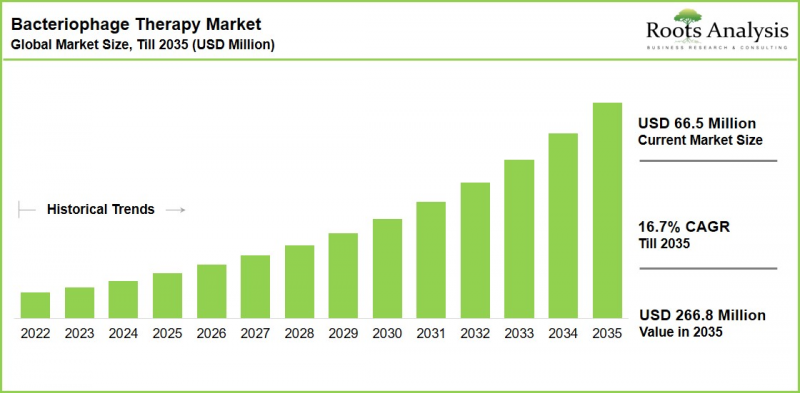
박테리오파지 치료 시장: 성장 및 동향
항생제 내성(AMR)의 급속한 확산으로 인해 기존의 항생제로는 효과를 볼 수 없게된 감염병에 대처할 수 있는 새로운 항감염 전략의 필요성이 가속화되고 있습니다. 특히 세계보건기구(WHO)의 추정에 따르면 AMR은 연간 약 127만 명의 사망과 직접적인 관련이 있으며, 이 수치는 대책을 강구하지 않으면 급격히 증가할 것으로 예측됩니다. 내성률의 증가에 더해, 혁신적인 항균제의 접근성이 제한적이고 마이크로바이옴의 불균형에 대한 우려가 커지면서, 기존의 치료 패러다임에는 중대한 결함이 있다는 사실이 드러났습니다. 의료제도에서 정밀한 항균 접근법이 점점 더 중요시되는 가운데, 박테리오파지 요법은 복잡하고 약제 내성을 가진 세균 감염증을 치료할 수 있는 유망한 대체요법으로서 다시 주목받고 있습니다.
박테리오파지 요법은 유익한 미생물 군집을 유지하면서 병원균을 선택적으로 제거하는 천연 유래 바이러스를 사용하며, 광범위 항생제와는 근본적으로 다른 표적화된 작용 기전을 제공합니다. 감염 부위에서 자가 증식하고, 세균의 생물막을 파괴하며, 새롭게 나타나는 세균의 내성과 함께 진화하는 그 능력은 특히 지속성, 재발성 및 다제내성 감염증에 대해 명확한 치료상 이점을 제공합니다. 이러한 특성으로 인해 파지 요법은 미래 감염증 관리의 양상을 변화시킬 가능성을 지닌 보완적 치료법으로서의 위상을 확립하고 있습니다.
시장은 학술 주도 연구 분야에서 규제 당국의 참여 확대, 공공 자금 및 산업계의 전략적 투자에 힘입어 급속히 발전하는 임상 및 상업 분야로 전환되고 있습니다. 일부 생명공학 기업은 효능 향상, 표적 박테리아 범위의 확대, 내성 발현 최소화를 목표로 유전자 변형 파지 플랫폼, 병원체 특이적 파지 칵테일 및 병용 요법의 개발을 추진하고 있습니다. 임상적 근거가 지속적으로 강화되고 제조 기술이 성숙해짐에 따라 박테리오파지 치료제는 차세대 정밀 항감염 치료에서 점점 더 중요한 역할을 할 것으로 기대됩니다.
성장의 원동력: 시장 확장을 지원하는 요인
다제내성 세균 감염증의 확산으로 인해 기존 항생제의 한계가 드러나면서, 혁신적인 항균 요법이 시급히 요구되고 있습니다. AMR(항생제 내성)과 관련된 사망률이 지속적으로 상승하고 있는 데다, 항생제 치료 실패의 증가와 신규 항균제 부족이 맞물리면서 박테리오파지를 기반으로 한 치료법에 대한 관심이 급속히 높아지고 있습니다. 병원체 특이적인 작용 기전, 본래의 마이크로바이옴을 유지하는 능력, 그리고 내성 균주에 대항할 가능성을 겸비한 파지 요법은 전 세계적인 AMR 위기에 대처하기 위한 유망한 해결책으로 자리매김하고 있습니다.
또한 합성생물학, 유전체 공학, 생물정보학, 그리고 AI를 활용한 파지 발견 분야의 급속한 진전이 차세대 박테리오파지 치료제 개발을 근본적으로 변화시키고 있습니다. 첨단 공학 플랫폼을 통해 최적화된 파지 칵테일의 설계는 물론, 더 광범위한 세균에 대한 효과, 치료 성능 향상, 내성 발생 가능성 저감을 실현한 유전자 변형 파지의 개발이 가능해졌습니다. 이러한 혁신으로 인해 개발 기간이 단축되고, 제조의 일관성이 향상되며, 맞춤형 감염증 치료의 기회가 확대되고 있으며, 그 결과 투자자의 신뢰가 높아지고 시장 성장이 가속화되고 있습니다.
시장이 해결해야 할 과제: 진전을 가로막는 중대한 장벽
박테리오파지 치료제에 대한 전 세계에서 통일된 규제 경로의 부재는 여전히 시장 성장의 큰 장벽으로 작용하고 있습니다. 기존의 승인 체계는 주로 기존 의약품에 맞춰 설계되어 있으며, 파지 기반 제품이 지닌 높은 적응성과 극히 특이적인 특성에 충분히 대응하지 못하는 경우가 많습니다. 이러한 규제상의 불확실성은, 특히 맞춤형 정밀 파지 치료의 경우 개발 위험을 높이고, 승인까지의 기간을 연장하며, 규정 준수 요건을 더욱 엄격하게 만들고 있습니다.
또한 박테리오파지 치료제의 상업적 규모의 생산에는 제품의 순도, 효능 및 로트 간 균일성을 확보하기 위해 엄격하게 관리된 제조 공정이 요구됩니다. 파지에 고유한 생물학적 변동성에 더해, 견고한 품질관리와 확장 가능한 정제 기술이 필요하므로 생산의 복잡성과 비용이 증가합니다. 이러한 과제는 환자마다 다른 처방이 요구되는 맞춤형 파지 칵테일의 경우, 유연한 제조 능력과 신속한 납기가 요구되므로 더욱 심각해집니다.
박테리오파지 치료제 시장: 주요 인사이트
이 보고서에서는 박테리오파지 치료제 시장의 현황을 상세히 분석하고, 특히 판매 대리점 및 채널 파트너의 관점에서 업계내 잠재적인 성장 기회를 파악하고 있습니다. 주요 인사이트는 다음과 같습니다. :
- 전략적 제휴를 통해 박테리오파지 치료제 개발이 가속화되고 있습니다. 각 기업은 학술기관, 병원, 정부 기관과 제휴하여 파지 라이브러리 확충, 임상적 유효성 검증, 규제 당국에 대한 신청 지원을 수행하고 있으며, 이를 통해 개발 기간을 단축하는 동시에 맞춤형 파지 요법을 위한 임상 샘플 접근성을 개선하고 있습니다.
- 정부 및 비희석 자금 지원이 시장내 혁신을 지속적으로 강화하고 있습니다. 공공 기관은 항생제 내성(AMR) 대책의 일환으로 박테리오파지 치료 프로그램을 적극적으로 지원하고 있습니다.
- BiomX는 황색포도상구균(Staphylococcus aureus)을 대상으로 한 파지 치료 프로그램을 추진하기 위해, 의료 기술 기업 컨소시엄(MTEC)을 통해 미국 국방보건국(DHA) 및 해군부로부터 약 4,000만 달러의 비희석 자금을 조달받았습니다.
- 민간 투자는 박테리오파지 치료제의 후기 임상 개발을 지원하고 있습니다. 예를 들어 BiomX는 낭포성 섬유증 환자의 만성 녹농균 감염을 대상으로 하는 BX004의 2b상 임상시험 프로그램을 추진하기 위해 약 1,200만 달러를 조달했습니다. 이는 파지 기반 치료법에 대한 투자자들의 신뢰가 지속되고 있음을 반영합니다.
- 업계 재편을 통해 박테리오파지 기술의 역량이 강화되고 있습니다. BiomX의 Adaptive Phage Therapeutics(APT) 인수와 같은 전략적 인수를 통해 지적 재산권, 맞춤형 파지 요법에 대한 전문 지식, 파지 뱅크 자원이 확대되어 장기적인 제품 개발이 지원되고 있습니다.
- 임상적 이정표 달성을 통해 박테리오파지 치료법의 상용화 전망이 개선되고 있습니다. 각 기업은 ‘컴패셔네이트 유스(Compassionate Use, 특별 사용)’ 프로그램에서 관리형 임상시험으로 전환하고 있으며, BiomX사는 BX004의 제IIb상 임상시험에서 환자에 대한 투여를 시작했습니다. 이는 파이프라인의 성숙도와 규제 당국과의 협력 강화를 반영하고 있습니다.
박테리오파지 치료제 시장 세분화
Roots Analysis는 전 세계 박테리오파지 치료제 시장을 다음 매개변수를 바탕으로 분류하고 있습니다. :
대상 적응증별
- 세균성 이질
- 장 감염
- 위장관 감염
- 다발성 감염
- 인공관절 감염증(PJI)
- 요로 감염
투여 경로별
- 정맥내
- 경구
- 직장
- 국소
표적 세균별
- 대장균
- 녹농균
- 살모넬라
- 황색포도상구균
- 연쇄상구균
- 기타
지역별
- 북미
- 유럽
- 아시아태평양
- 기타 지역
박테리오파지 치료제 시장: 주요 부문 분석
요로 감염 부문이 박테리오파지 치료 시장을 주도
당사의 시장 평가에 따르면 요로 감염 부문은 박테리오파지 치료 시장에서 가장 큰 점유율을 차지하고 있습니다. 이러한 주도적 지위는 특히 대장균(Escherichia coli)에 기인한 재발성 및 다제내성 요로감염의 전 세계 유병률이 높은 데다, 항생제의 보조 요법 또는 대체요법으로서 파지 요법을 지원하는 임상적 증거가 증가하고 있기 때문입니다.
한편, 인공관절 감염(PJI) 부문은 예측 기간 중 가장 높은 연평균 성장률(CAGR)을 기록할 것으로 예상됩니다. 이러한 급속한 성장은 전 세계에서 증가하고 있는 정형외과 임플란트 수술 건수에 더해, 기존 항생제로는 근절하기 어려운 세균 바이오필름에 박테리오파지가 침투하여 그 구조를 파괴하는 독특한 능력 덕분입니다.
경구 투여가 가장 큰 점유율을 차지하고, 외용 부문이 가장 빠른 성장세를 기록
투여 경로별로 보면 현재 경구 부문이 박테리오파지 치료 시장의 대부분을 차지하고 있습니다. 이러한 우위는 위내 환경을 통과할 때 파지의 생존율을 향상시키는 장용성 코팅 및 마이크로캡슐화된 파지 제제의 발전에 힘입은 것입니다.
한편, 외용 부문은 만성 상처 감염, 당뇨병성 족부 궤양, 수술 후 감염의 유병률 증가를 배경으로 비교적 높은 연평균 성장률(CAGR)을 기록할 것으로 전망됩니다.
북미가 시장을 계속 주도하고, 아시아태평양이 가장 빠르게 성장하는 지역으로 부상
당사의 시장 예측에 따르면 예측 기간 중 북미는 세계 시장 매출에서 가장 큰 점유율을 유지할 것으로 전망됩니다. 이러한 높은 점유율은 첨단인 임상 개발 생태계, 견실한 자금 조달 환경, 그리고 Locus Biosciences, Adaptive Phage Therapeutics, Armata Pharmaceuticals와 같은 파지 치료 전문 기업의 존재에 힘입은 것입니다.
한편, 아시아태평양은 2035년까지 더 높은 연평균 성장률(CAGR)을 기록하며 성장할 것으로 예측됩니다. 이러한 높은 성장률은 항생제 내성(AMR) 부담의 증가, 생명공학 역량의 확대, 그리고 중국, 인도, 일본, 한국, 호주에서 감염병 관리에 대한 정부의 관심 고조에 힘입어 견인되고 있습니다.
박테리오파지 요법 시장의 주요 기업 예
- Adaptive Phage Therapeutics
- ContraFect
- Eliava BioPreparations
- Micreos
- NPO Microgen
- Phagelux AgriHealth
- Pherecydes Pharma
전문가 인터뷰 및 업계 인사이트
본 조사에서 제시된 견해와 인사이트는 여러 이해관계자와의 논의를 바탕으로 합니다. 본 조사 보고서에는 다음 업계 관계자들과의 인터뷰에 대한 상세한 기록이 수록되어 있습니다. :
- 프랑스, 중소기업 최고경영자(CEO)
- 이스라엘, 소규모 기업, 데이터 사이언스 부문 책임자, 수석 이사
- 프랑스, 초대형 기업, 프로젝트 리더
- 독립 컨설턴트
- 그리스 중소기업, 창업자 겸 최고경영자(CEO)
- 공동 창업자 겸 최고경영자(CEO), 스위스 중소기업
- 미국 중견 기업, 최고재무책임자
- 최고 과학 책임자, 미국·소규모 기업
- 미국 소규모 기업의 공동 창업자
- 미국 대기업, 연구원 겸 수석 연구원
- 생산 전문가, 포르투갈의 소규모 기업
- 의학 교수, 초대형 기업, 미국
- 독립 연구원
목차
제1장 서문
제2장 조사 방법
제3장 시장 역학
제4장 거시경제 지표
제5장 개요
제6장 서론
제7장 박테리오파지 요법 : 시장 구도
제8장 박테리오파지 요법 : 개발 기업의 현황
제9장 기업 및 의약품의 개요
제10장 임상시험 분석
제11장 특허 분석
제12장 출판물 벤치마크 분석
제13장 학술연구 보조금 분석
제14장 자금조달과 투자 분석
제15장 파트너십과 협력 관계
제16장 스타트업 건전성 지표
제17장 세계의 박테리오파지 요법 시장
제18장 박테리오파지 요법 시장(대상 적응증별)
제19장 박테리오파지 요법 시장(투여 경로별)
제20장 박테리오파지 요법 시장(표적 세균별)
제21장 박테리오파지 요법 시장(지역별)
제22장 결론
제23장 경영진 인사이트
제24장 부록 I : 표형식 데이터
제25장 부록 II : 기업 및 조직 리스트
KSA 26.08.24BACTERIOPHAGE THERAPY MARKET: OVERVIEW
As per Roots Analysis, the global bacteriophage therapy market is estimated to grow from USD 66.5 million in the current year to USD 266.8 million by 2035, reflecting a compound annual growth rate (CAGR) of approximately 16.7% during the forecast period.
Bacteriophage Therapy Market: Growth and Trends
The rapid rise of antimicrobial resistance (AMR) has accelerated the need for novel anti-infective strategies capable of addressing infections that no longer respond to conventional antibiotics. Notably, the World Health Organization estimates that AMR is directly associated with approximately 1.27 million deaths annually, a figure projected to rise sharply if left unaddressed. Escalating resistance rates, coupled with the limited availability of innovative antibacterial agents and growing concerns regarding microbiome disruption, have exposed significant gaps in existing treatment paradigms. As healthcare systems increasingly prioritize precision antimicrobial approaches, bacteriophage therapy has gained renewed attention as a promising alternative capable of addressing complex and drug-resistant bacterial infections.
Bacteriophage therapeutics employ naturally occurring viruses that selectively eliminate pathogenic bacteria while preserving beneficial microbial flora, offering a targeted mechanism of action that differs fundamentally from broad-spectrum antibiotics. Their ability to self-amplify at the infection site, disrupt bacterial biofilms and evolve alongside emerging bacterial resistance provides a distinct therapeutic advantage, particularly for persistent, recurrent and multidrug-resistant infections. These characteristics have positioned phage therapy as a complementary modality with the potential to reshape future infectious disease management.
The market has transitioned from an academically driven research field to a rapidly advancing clinical and commercial landscape, supported by increasing regulatory engagement, public-sector funding and strategic industry investment. Several biotechnology companies are advancing engineered phage platforms, pathogen-specific phage cocktails and combination therapies designed to improve efficacy, broaden bacterial coverage and minimize resistance development. As clinical evidence continues to strengthen and manufacturing technologies mature, bacteriophage therapeutics are expected to play an increasingly important role in the next generation of precision anti-infective therapies.
Growth Drivers: Factors Fueling Market Expansion
The growing prevalence of multidrug-resistant bacterial infections has exposed the limitations of conventional antibiotics, creating an urgent need for innovative antimicrobial modalities. The continued rise in AMR-related mortality, combined with increasing antibiotic treatment failures and the scarcity of novel antibacterial drugs, is accelerating interest in bacteriophage-based therapeutics. Their pathogen-specific mechanism of action, ability to preserve the native microbiome and potential to combat resistant bacterial strains position phage therapy as a promising solution for addressing the global AMR crisis.
Additionally, rapid progress in synthetic biology, genome engineering, bioinformatics and AI-enabled phage discovery is transforming the development of next-generation bacteriophage therapeutics. Advanced engineering platforms are enabling the design of optimized phage cocktails and genetically enhanced bacteriophages with broader bacterial coverage, improved therapeutic performance and reduced resistance potential. These innovations are shortening development timelines, improving manufacturing consistency and expanding opportunities for personalized anti-infective therapies, thereby strengthening investor confidence and accelerating market growth.
Market Challenges: Critical Barriers Hindering Progress
The absence of globally harmonised regulatory pathways for bacteriophage therapeutics remains a significant barrier to market growth. Existing approval frameworks are primarily tailored to conventional pharmaceuticals and often fail to accommodate the adaptive and highly specific nature of phage-based products. This regulatory uncertainty increases development risk, extends approval timelines and raises compliance requirements, particularly for customised and precision phage therapies.
Further, commercial-scale production of bacteriophage therapeutics requires highly controlled manufacturing processes to ensure product purity, potency and batch-to-batch consistency. The inherent biological variability of phages, coupled with the need for robust quality control and scalable purification technologies, increases production complexity and costs. These challenges are further amplified for personalised phage cocktails, where patient-specific formulations demand flexible manufacturing capabilities and rapid turnaround times.
Bacteriophage Therapy Market: Key Insights
The report delves into the current state of the bacteriophage therapy market and identifies potential growth opportunities within the industry, particularly from a distributor and channel-partner perspective. Some key insights include:
- Strategic collaborations are accelerating bacteriophage therapeutic development. Companies are partnering with academic institutions, hospitals, and government organizations to expand phage libraries, validate clinical efficacy, and support regulatory submissions, thereby shortening development timelines and improving access to clinical samples for personalized phage therapy.
- Government and non-dilutive funding continue to strengthen innovation in the market. Public agencies are actively supporting bacteriophage therapy programs to combat antimicrobial resistance (AMR).
- BiomX has received approximately USD 40 million in non-dilutive funding from the US Defense Health Agency (DHA) and the Department of Navy through the Medical Technology Enterprise Consortium (MTEC) to advance its Staphylococcus aureus phage therapy programs.
- Private investments are supporting late-stage clinical development of bacteriophage therapeutics. For instance, BiomX raised approximately USD 12 million to advance its BX004 Phase IIb program for chronic Pseudomonas aeruginosa infections in cystic fibrosis patients, reflecting sustained investor confidence in phage-based therapies.
- Industry consolidation is strengthening bacteriophage technology capabilities. Strategic acquisitions, such as BiomX's acquisition of Adaptive Phage Therapeutics (APT), have expanded intellectual property, personalized phage therapy expertise, and phage bank resources, supporting long-term product development.
- Clinical milestones are improving commercialization prospects for bacteriophage therapeutics. Companies are advancing from compassionate-use programs to controlled clinical trials, with BiomX initiating Phase IIb patient dosing for BX004, reflecting a maturing pipeline and stronger regulatory engagement.
Bacteriophage Therapy Market Segments
Roots Analysis segments the global bacteriophage therapy opportunity across the following parameters:
By Target Indication
- Bacterial Dysentery
- Enteric Infections
- Gastrointestinal Infections
- Multiple Infections
- Prosthetic Joint Infection (PJI)
- Urinary Tract Infections
By Route of Administration
- Intravenous
- Oral
- Rectal
- Topical
By Targeted Bacteria
- Escherichia coli
- Pseudomonas aeruginosa
- Salmonella
- Staphylococcus aureus
- Streptococcus
- Others
By Geographical Regions
- North America
- Europe
- Asia-Pacific
- Rest of the World
Bacteriophage Therapy Market: Key Segments Insight
Urinary Tract Infections Segment Leads the Bacteriophage Therapy Market
Based on our market assessment, the urinary tract infections segment holds the highest share of the bacteriophage therapy market. This leadership is driven by the high global prevalence of recurrent and multidrug-resistant UTIs, particularly those caused by Escherichia coli, coupled with growing clinical evidence supporting phage therapy as an adjunct or alternative to antibiotics.
On the other hand, the prosthetic joint infection (PJI) segment is projected to witness the highest CAGR during the forecast period. This accelerated growth is attributed to the increasing volume of orthopedic implant procedures worldwide and the unique ability of bacteriophages to penetrate and disrupt bacterial biofilms that are difficult to eradicate using conventional antibiotics.
Oral Route Captures the Largest Share and Topical Segment to Register Fastest Growth
Based on route of administration, the oral segment currently captures the majority of the bacteriophage therapy market. This dominance is supported by advances in enteric-coated and microencapsulated phage formulations that improve phage survival through the gastric environment.
Meanwhile, the topical segment is likely to grow at a relatively higher CAGR, fueled by the rising prevalence of chronic wound infections, diabetic foot ulcers, and surgical site infections.
North America Maintains Market Leadership and Asia-Pacific Emerges as the Fastest-Growing Region
According to our market projections, North America is expected to retain the highest share of global market revenue through the forecast period. This highest share is driven by an advanced clinical development ecosystem, strong funding environment, and the presence of specialized phage therapy companies including Locus Biosciences, Adaptive Phage Therapeutics, and Armata Pharmaceuticals.
Meanwhile, Asia-Pacific is projected to grow at a higher CAGR through 2035. This highest growth is driven by rising AMR burden, expanding biotechnology capabilities, and growing government focus on infectious disease management across China, India, Japan, South Korea, and Australia.
Example Players in Bacteriophage Therapy Market
- Adaptive Phage Therapeutics
- ContraFect
- Eliava BioPreparations
- Micreos
- NPO Microgen
- Phagelux AgriHealth
- Pherecydes Pharma
Expert Interview and Industry Insights
The opinions and insights presented in this study were influenced by discussions conducted with multiple stakeholders. The research report features detailed transcripts of interviews held with the following industry stakeholders:
- Chief Executive Officer, Small Company, France
- Senior Director, Head of Data-Science, Small Company, Israel
- Project Leader, Very Large Company, France
- Independent Consultant
- Founder and Chief Executive Officer, Small Company, Greece
- Co-Founder and Chief Executive Officer, Small Company, Switzerland
- Chief Financial Officer, Mid-sized Company, US
- Chief Scientific Officer, Small Company, US
- Co-Founder, Small Company, US
- Staff Scientist & Principal Investigator, Very Large Company, US
- Production Specialist, Small Company, Portugal
- Professor of Medicine, Very Large Company, US
- Independent Researcher
BACTERIOPHAGE THERAPY MARKET: RESEARCH COVERAGE
- Market Sizing and Opportunity Analysis: The report features an in-depth analysis of the bacteriophage therapy market, focusing on key market segments, including target indication, route of administration, targeted bacteria, and geographical regions.
- Bacteriophage Therapy: Market Landscape: Historical evolution and biology of bacteriophages, applications, advantages, and limitations of bacteriophage therapy, along with an assessment of the drug pipeline by phase of development, therapeutic area, targeted bacterial strain, target disease indication, type of therapy, and route of administration.
- Developer Landscape: A detailed assessment of the developer landscape, based on parameters such as year of establishment, company size, and location of headquarters.
- Company and Drug Profiles: In-depth profiles of prominent players engaged in offering bacteriophage therapeutics, featuring information on company overview, financials, pipeline, and recent developments.
- Clinical Trial Analysis: An analysis of registered clinical trials by registration year, enrolled patient population, trial status, trial phase, study design, type of sponsor / collaborator, and geography.
- Patent Analysis: An analysis of patents filed / granted related to bacteriophage therapy, based on parameters such as publication year, application year, jurisdiction, CPC symbols, type of applicant, patent benchmarking, and patent valuation.
- Publication Benchmarking Analysis: An analysis of scientific publications by year, article type, popular keywords, publishers, journals, and journal impact factor.
- Academic Grants Analysis: An analysis of academic grants awarded, based on parameters such as year of award, amount awarded, administering institute, support period, and recipient organization.
- Funding and Investments Analysis: A detailed analysis of funding instances and amounts raised, by year, type of funding, investor, and geography.
- Partnerships and Collaborations: A detailed analysis of partnerships and collaborations, by year, type of partnership, therapeutic area, application area, and geography.
- Start-up Health Indexing: A proprietary benchmarking framework for start-up developers, based on pipeline strength, pipeline maturity, indication diversity, patent count, funding amount, and partnership activity.
- Market Impact Analysis: The report analyzes various factors such as drivers, restraints, opportunities, and challenges affecting market growth, including a Penetration-Growth (P-G) Matrix across geographies.
- Executive Insights: Verbatim transcripts of interviews held with CEOs, senior scientists, and independent researchers active in the bacteriophage therapy domain.
Key Questions Answered in this Report
- Which are the leading companies in the bacteriophage therapy market?
- Which target indication and targeted bacteria segment dominate the bacteriophage therapy market?
- Which region dominates the bacteriophage therapy market, and which region is growing the fastest?
- What are the key trends observed in the bacteriophage therapy market?
- What factors are likely to influence the evolution of this market?
- What are the primary challenges faced by bacteriophage therapy developers?
- What is the current and future market size, and what is the CAGR of this market?
- How is the current and future market opportunity likely to be distributed across key market segments?
- Which companies are the most active in terms of clinical trials, patents, funding, and partnerships?
Reasons to Buy this Report
This report has been specifically developed to support distributors, channel partners, and business development teams evaluating entry into the Bacteriophage Therapy market.
- The report provides a comprehensive market analysis, offering detailed revenue projections of the overall market and its specific sub-segments, valuable to both established market leaders and emerging entrants.
- The report offers stakeholders a comprehensive overview of the market, including key drivers, barriers, opportunities, and challenges, empowering data-driven decisions to capitalize on growth prospects.
- The report can aid businesses in identifying future opportunities in any sector, and in understanding whether those opportunities are worth pursuing.
- The report helps in identifying customer demand by understanding the needs, preferences, and behavior of the target audience, in order to tailor products or services effectively.
- The report equips new entrants with the requisite information regarding this market to help them build successful business strategies.
- The report allows for more effective communication with the audience and in building strong business relations.
Additional Benefits
- Complementary Insights Pack
- Complementary PPT Insights Pack
- Complementary Excel Data Packs for all Analytical Modules in the Report
- 15% Free Content Customization
- Detailed Report Walkthrough Session with Research Team
- Free Updated report if the report is 6-12 months old or older
TABLE OF CONTENTS
1. PREFACE
- 1.1. Introduction
- 1.2. Market Share Insights
- 1.3. Key Market Insights
- 1.4. Report Coverage
- 1.5. Key Questions Answered
- 1.6. Chapter Outlines
2. RESEARCH METHODOLOGY
- 2.1. Chapter Overview
- 2.2. Research Assumptions
- 2.2.1. Market Landscape and Market Trends
- 2.2.2. Market Forecast and Opportunity Analysis
- 2.2.3. Comparative Analysis
- 2.3. Database Building
- 2.3.1. Data Collection
- 2.3.2. Data Validation
- 2.3.3. Data Analysis
- 2.4. Project Methodology
- 2.4.1. Secondary Research
- 2.4.1.1. Annual Reports
- 2.4.1.2. Academic Research Papers
- 2.4.1.3. Company Websites
- 2.4.1.4. Investor Presentations
- 2.4.1.5. Regulatory Filings
- 2.4.1.6. White Papers
- 2.4.1.7. Industry Publications
- 2.4.1.8. Conferences and Seminars
- 2.4.1.9. Government Portals
- 2.4.1.10. Media and Press Releases
- 2.4.1.11. Newsletters
- 2.4.1.12. Industry Databases
- 2.4.1.13. Roots Proprietary Databases
- 2.4.1.14. Paid Databases and Sources
- 2.4.1.15. Social Media Portals
- 2.4.1.16. Other Secondary Sources
- 2.4.2. Primary Research
- 2.4.2.1. Types of Primary Research
- 2.4.2.1.1. Qualitative Research
- 2.4.2.1.2. Quantitative Research
- 2.4.2.1.3. Hybrid Approach
- 2.4.2.2. Advantages of Primary Research
- 2.4.2.3. Techniques for Primary Research
- 2.4.2.3.1. Interviews
- 2.4.2.3.2. Surveys
- 2.4.2.3.3. Focus Groups
- 2.4.2.3.4. Observational Research
- 2.4.2.3.5. Social Media Interactions
- 2.4.2.4. Key Opinion Leaders Considered in Primary Research
- 2.4.2.4.1. Company Executives (CXOs)
- 2.4.2.4.2. Board of Directors
- 2.4.2.4.3. Company Presidents and Vice Presidents
- 2.4.2.4.4. Research and Development Heads
- 2.4.2.4.5. Technical Experts
- 2.4.2.4.6. Subject Matter Experts
- 2.4.2.4.7. Scientists
- 2.4.2.4.8. Doctors and Other Healthcare Providers
- 2.4.2.5. Ethics and Integrity
- 2.4.2.5.1. Research Ethics
- 2.4.2.5.2. Data Integrity
- 2.4.2.1. Types of Primary Research
- 2.4.3. Analytical Tools and Databases
- 2.4.1. Secondary Research
- 2.5. Robust Quality Control
3. MARKET DYNAMICS
- 3.1. Chapter Overview
- 3.2. Forecast Methodology
- 3.2.1. Top-down Approach
- 3.2.2. Bottom-up Approach
- 3.2.3. Hybrid Approach
- 3.3. Market Assessment Framework
- 3.3.1. Total Addressable Market (TAM)
- 3.3.2. Serviceable Addressable Market (SAM)
- 3.3.3. Serviceable Obtainable Market (SOM)
- 3.3.4. Currently Acquired Market (CAM)
- 3.4. Forecasting Tools and Techniques
- 3.4.1. Qualitative Forecasting
- 3.4.2. Correlation
- 3.4.3. Regression
- 3.4.4. Extrapolation
- 3.4.5. Convergence
- 3.4.6. Sensitivity Analysis
- 3.4.7. Scenario Planning
- 3.4.8. Data Visualization
- 3.4.9. Time Series Analysis
- 3.4.10. Forecast Error Analysis
- 3.5. Key Considerations
- 3.5.1. Demographics
- 3.5.2. Government Regulations
- 3.5.3. Reimbursement Scenarios
- 3.5.4. Market Access
- 3.5.5. Supply Chain
- 3.5.6. Industry Consolidation
- 3.5.7. Pandemic / Unforeseen Disruptions Impact
- 3.6. Limitations
4. MACRO-ECONOMIC INDICATORS
- 4.1. Chapter Overview
- 4.2. Market Dynamics
- 4.2.1. Time Period
- 4.2.1.1. Historical Trends
- 4.2.1.2. Current and Forecasted Estimates
- 4.2.2. Currency Coverage
- 4.2.2.1. Major Currencies Affecting the Market
- 4.2.2.2. Factors Affecting Currency Fluctuations
- 4.2.2.3. Impact of Currency Fluctuations on the Industry
- 4.2.3. Foreign Currency Exchange Rate
- 4.2.3.1. Impact of Foreign Exchange Rate Volatility on the Market
- 4.2.3.2. Strategies for Mitigating Foreign Exchange Risk
- 4.2.4. Recession
- 4.2.4.1. Assessment of Current Economic Conditions and Potential Impact on the Market
- 4.2.4.2. Historical Analysis of Past Recessions and Lessons Learnt
- 4.2.5. Inflation
- 4.2.5.1. Measurement and Analysis of Inflationary Pressures in the Economy
- 4.2.5.2. Potential Impact of Inflation on the Market Evolution
- 4.2.6. Interest Rates
- 4.2.6.1. Interest Rates and Their Impact on the Market
- 4.2.6.2. Strategies for Managing Interest Rate Risk
- 4.2.7. Commodity Flow Analysis
- 4.2.7.1. Type of Commodity
- 4.2.7.2. Origins and Destinations
- 4.2.7.3. Values and Weights
- 4.2.7.4. Modes of Transportation
- 4.2.8. Global Trade Dynamics
- 4.2.8.1. Import Scenario
- 4.2.8.2. Export Scenario
- 4.2.8.3. Trade Policies
- 4.2.8.4. Strategies for Mitigating the Risks Associated with Trade Barriers
- 4.2.8.5. Impact of Trade Barriers on the Market
- 4.2.9. War Impact Analysis
- 4.2.9.1. Russian-Ukraine War
- 4.2.9.2. Israel-Hamas War
- 4.2.10. COVID Impact / Related Factors
- 4.2.10.1. Global Economic Impact
- 4.2.10.2. Industry-specific Impact
- 4.2.10.3. Government Response and Stimulus Measures
- 4.2.10.4. Future Outlook and Adaptation Strategies
- 4.2.11. Other Indicators
- 4.2.11.1. Fiscal Policy
- 4.2.11.2. Consumer Spending
- 4.2.11.3. Gross Domestic Product
- 4.2.11.4. Employment
- 4.2.11.5. Taxes
- 4.2.11.6. Stock Market Performance
- 4.2.11.7. Cross Border Dynamics
- 4.2.1. Time Period
- 4.3. Conclusion
5. EXECUTIVE SUMMARY
- 5.1. Executive Summary: Market Landscape
- 5.2. Executive Summary: Market Trends
- 5.3. Executive Summary: Market Forecast and Opportunity Analysis
6. INTRODUCTION
- 6.1. Chapter Overview
- 6.2. Historical Evolution of Bacteriophages
- 6.3. Biology of Bacteriophages
- 6.4. Introduction to Bacteriophage Therapy
- 6.5. Applications of Bacteriophage Therapy
- 6.6. Advantages of Bacteriophage Therapy
- 6.7. Limitations of Bacteriophage Therapy
- 6.8. Conclusion
7. BACTERIOPHAGE THERAPY: MARKET LANDSCAPE
- 7.1. Chapter Overview
- 7.2. Bacteriophage Therapy: Drug Pipeline
- 7.2.1. Analysis by Phase of Development
- 7.2.2. Analysis by Therapeutic Area
- 7.2.3. Analysis by Phase of Development and Therapeutic Area
- 7.2.4. Analysis by Targeted Bacterial Strain
- 7.2.5. Analysis by Target Disease Indication
- 7.2.6. Analysis by Type of Therapy
- 7.2.7. Analysis by Route of Administration
- 7.3. Information on Bacteriophage Related Technologies
8. BACTERIOPHAGE THERAPEUTICS: DEVELOPER LANDSCAPE
- 8.1. Chapter Overview
- 8.2. Bacteriophage Therapeutics: List of Developers
- 8.2.1. Analysis by Year of Establishment
- 8.2.2. Analysis by Company Size
- 8.2.3. Analysis by Location of Headquarters
- 8.2.4. Analysis by Company Size and Location of Headquarters
- 8.2.5. Leading Developers: Analysis by Number of Bacteriophage Therapeutics
9. COMPANY AND DRUG PROFILES
- 9.1. Chapter Overview
- 9.2. Adaptive Phage Therapeutics*
- 9.2.1. Company Overview
- 9.2.2. Financial Information
- 9.2.3. Pipeline Overview
- 9.2.4. Recent Developments and Future Outlook
- Similar details are presented for other companies mentioned below (based on information in the public domain)
- 9.3. ContraFect
- 9.4. Eliava BioPreparations
- 9.5. Micreos
- 9.6. NPO Microgen
- 9.7. Phagelux
- 9.8. Pherecydes Pharma
10. CLINICAL TRIAL ANALYSIS
- 10.1. Chapter Overview
- 10.2. Scope and Methodology
- 10.3. Bacteriophage Therapy Market: Clinical Trial Analysis
- 10.3.1. Analysis by Trial Registration Year
- 10.3.2. Analysis by Trial Registration Year and Enrolled Patient Population
- 10.3.3. Analysis by Trial Status
- 10.3.4. Analysis by Trial Phase and Enrolled Patient Population
- 10.3.5. Analysis by Study Design
- 10.3.6. Analysis by Type of Sponsor / Collaborator
- 10.3.7. Most Active Players: Analysis by Number of Registered Trials
- 10.3.8. Regional Analysis
- 10.3.8.1. Analysis by Number of Registered Trials
- 10.3.8.2. Analysis by Enrolled Patient Population
11. PATENT ANALYSIS
- 11.1. Chapter Overview
- 11.2. Scope and Methodology
- 11.3. Bacteriophage Therapy: Patent Analysis
- 11.3.1. Analysis by Publication Year
- 11.3.2. Analysis by Patent Application Year
- 11.3.3. Analysis by Annual Number of Granted Patent(s) and Patent Application(s)
- 11.3.4. Analysis by Geography
- 11.3.5. Analysis by CPC Symbols
- 11.3.6. Analysis by Type of Applicant
- 11.3.7. Leading Players: Analysis by Number of Patents
- 11.4. Bacteriophage Therapy: Patent Benchmarking
- 11.4.1. Analysis by Patent Characteristics
- 11.5. Bacteriophage Therapy: Patent Valuation
- 11.6. List of Leading Patents
12. PUBLICATION BENCHMARKING ANALYSIS
- 12.1. Chapter Overview
- 12.2. Scope and Methodology
- 12.2.1. Analysis by Year of Publication
- 12.2.2. Analysis by Type of Article
- 12.2.3. Analysis by Popular Keywords
- 12.2.4. Popular Publishers: Analysis by Number of Publications
- 12.2.5. Popular Journals: Analysis by Number of Publications
- 12.2.6. Popular Journals: Analysis by Journal Impact Factor
- 12.2.7. Publications: Timeline Analysis
- 12.3. Publication Benchmarking
13. ACADEMIC GRANTS ANALYSIS
- 13.1. Chapter Overview
- 13.2. Scope and Methodology
- 13.3. Bacteriophage Therapy: Academic Grant Analysis
- 13.3.1. Analysis by Year of Grant Award
- 13.3.2. Analysis by Amount Awarded
- 13.3.3. Analysis by Administering Institute Center
- 13.3.4. Analysis by Support Period
- 13.3.5. Analysis by Funding Institute Center and Support Period
- 13.3.6. Analysis by Type of Grant Application
- 13.3.7. Analysis by Purpose of Grant Award
- 13.3.8. Analysis by Activity Code
- 13.3.9. Word Cloud Analysis: Emerging Focus Areas
- 13.3.10. Analysis by Study Section Involved
- 13.3.11. Popular NIH Departments: Analysis by Number of Grants
- 13.3.12. Analysis by Type of Recipient Organization
- 13.3.13. Prominent Program Officers: Analysis by Number of Grants
- 13.3.14. Popular Recipient Organizations: Analysis by Number of Grants
- 13.3.15. Regional Distribution of Recipient Organizations
14. FUNDING AND INVESTMENTS ANALYSIS
- 14.1. Chapter Overview
- 14.2. Types of Funding
- 14.3. Bacteriophage Therapy Market: List of Funding and Investments
- 14.3.1. Analysis by Year of Investment
- 14.3.2. Analysis by Amount Invested
- 14.3.3. Analysis by Type of Funding
- 14.3.4. Most Active Players: Analysis by Number of Funding Rounds and Amount Raised
- 14.3.5. Investors Analysis
- 14.3.6. Regional Distribution by Amount Invested
- 14.4. Concluding Remarks
15. PARTNERSHIPS AND COLLABORATIONS
- 15.1. Chapter Overview
- 15.2. Partnership Models
- 15.3. Bacteriophage Therapeutics: List of Partnerships and Collaborations
- 15.3.1. Analysis by Year of Partnership
- 15.3.2. Analysis by Type of Partnership
- 15.3.3. Analysis by Year of Partnership and Type of Partner
- 15.3.4. Analysis by Therapeutic Area
- 15.3.5. Analysis by Application Area
- 15.3.6. Most Active Players: Analysis by Number of Partnerships
- 15.3.7. Regional Analysis
- 15.3.7.1. Intercontinental and Intracontinental Agreements
16. START-UP HEALTH INDEXING
- 16.1. Chapter Overview
- 16.2. Bacteriophage Therapeutics Developers: Start-ups
- 16.2.1. Analysis by Location of Headquarters
- 16.3. Benchmarking of Start-ups
- 16.3.1. Analysis by Pipeline Strength
- 16.3.2. Analysis by Pipeline Maturity
- 16.3.3. Analysis by Indication Diversity
- 16.3.4. Analysis by Number of Patents
- 16.3.5. Analysis by Funding Amount
- 16.3.6. Analysis by Partnership Activity
- 16.3.7. Start-ups Health Indexing: Roots Analysis Perspective
17. GLOBAL BACTERIOPHAGE THERAPY MARKET
- 17.1. Chapter Overview
- 17.2. Assumptions and Methodology
- 17.3. Global Bacteriophage Therapy Market, Historical Trends (Since 2022) and Forecasted Estimates (Till 2035)
- 17.4. Roots Analysis Perspective on Market Growth
- 17.5. Scenario Analysis
- 17.5.1. Conservative Scenario
- 17.5.2. Optimistic Scenario
- 17.6. Key Market Segmentations
18. BACTERIOPHAGE THERAPY MARKET, BY TARGET INDICATION
- 18.1. Chapter Overview
- 18.2. Key Assumptions and Methodology
- 18.3. Bacteriophage Therapy Market: Distribution by Target Indication
- 18.3.1. Bacteriophage Therapy Market for Bacterial Dysentery, Historical Trends (Since 2022) and Forecasted Estimates (Till 2035)
- 18.3.2. Bacteriophage Therapy Market for Enteric Infections, Historical Trends (Since 2022) and Forecasted Estimates (Till 2035)
- 18.3.3. Bacteriophage Therapy Market for Gastrointestinal Infections, Historical Trends (Since 2022) and Forecasted Estimates (Till 2035)
- 18.3.4. Bacteriophage Therapy Market for Multiple Infections, Historical Trends (Since 2022) and Forecasted Estimates (Till 2035)
- 18.3.5. Bacteriophage Therapy Market for Prosthetic Joint Infection (PJI), Historical Trends (Since 2022) and Forecasted Estimates (Till 2035)
- 18.3.6. Bacteriophage Therapy Market for Urinary Tract Infections, Historical Trends (Since 2022) and Forecasted Estimates (Till 2035)
- 18.4. Data Triangulation and Validation
19. BACTERIOPHAGE THERAPY MARKET, BY ROUTE OF ADMINISTRATION
- 19.1. Chapter Overview
- 19.2. Key Assumptions and Methodology
- 19.3. Bacteriophage Therapy Market: Distribution by Route of Administration
- 19.3.1. Bacteriophage Therapy Market for Intravenous, Historical Trends (Since 2022) and Forecasted Estimates (Till 2035)
- 19.3.2. Bacteriophage Therapy Market for Oral, Historical Trends (Since 2022) and Forecasted Estimates (Till 2035)
- 19.3.3. Bacteriophage Therapy Market for Rectal, Historical Trends (Since 2022) and Forecasted Estimates (Till 2035)
- 19.3.4. Bacteriophage Therapy Market for Topical, Historical Trends (Since 2022) and Forecasted Estimates (Till 2035)
- 19.4. Data Triangulation and Validation
20. BACTERIOPHAGE THERAPY MARKET, BY TARGETED BACTERIA
- 20.1. Chapter Overview
- 20.2. Key Assumptions and Methodology
- 20.3. Bacteriophage Therapy Market: Distribution by Targeted Bacteria
- 20.3.1. Bacteriophage Therapy Market for Escherichia coli, Historical Trends (Since 2022) and Forecasted Estimates (Till 2035)
- 20.3.2. Bacteriophage Therapy Market for Pseudomonas aeruginosa, Historical Trends (Since 2022) and Forecasted Estimates (Till 2035)
- 20.3.3. Bacteriophage Therapy Market for Salmonella, Historical Trends (Since 2022) and Forecasted Estimates (Till 2035)
- 20.3.4. Bacteriophage Therapy Market for Staphylococcus aureus, Historical Trends (Since 2022) and Forecasted Estimates (Till 2035)
- 20.3.5. Bacteriophage Therapy Market for Streptococcus, Historical Trends (Since 2022) and Forecasted Estimates (Till 2035)
- 20.3.6. Bacteriophage Therapy Market for Others, Historical Trends (Since 2022) and Forecasted Estimates (Till 2035)
- 20.4. Data Triangulation and Validation
21. BACTERIOPHAGE THERAPY MARKET, BY GEOGRAPHICAL REGIONS
- 21.1. Chapter Overview
- 21.2. Key Assumptions and Methodology
- 21.3. Bacteriophage Therapy Market: Distribution by Geographical Regions
- 21.3.1. Bacteriophage Therapy Market in North America: Historical Trends (Since 2022) and Forecasted Estimates (Till 2035)
- 21.3.2. Bacteriophage Therapy Market in Europe: Historical Trends (Since 2022) and Forecasted Estimates (Till 2035)
- 21.3.3. Bacteriophage Therapy Market in Asia-Pacific: Historical Trends (Since 2022) and Forecasted Estimates (Till 2035)
- 21.3.4. Bacteriophage Therapy Market in Rest of the World: Historical Trends (Since 2022) and Forecasted Estimates (Till 2035)
- 21.4. Market Dynamics Assessment
- 21.4.1. Penetration-Growth (P-G) Matrix
- 21.5. Data Triangulation and Validation


