|
시장보고서
상품코드
2125140
나노입자 제제 시장 : 제제화된 나노입자 유형별, 제제화된 유기 나노입자 유형별, 사업 규모별 및 지역별 - 동향과 예측(-2035년)Nanoparticle Formulation Market by Type of Nanoparticle Formulated, Type of Organic Nanoparticle Formulated, Scale of Operation and Geographical Regions - Trends and Forecast Till 2035 |
||||||

나노입자 제제 시장 : 개요
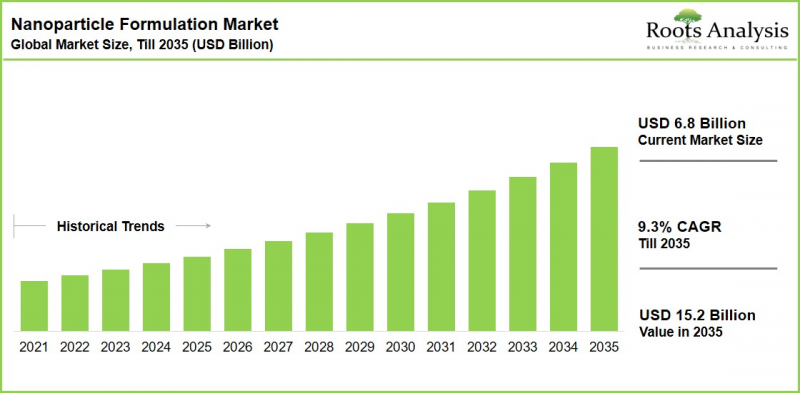
세계의 나노입자 제제 시장 규모는 올해 68억 달러에서 2035년까지 152억 달러로 확대하며, 2035년 예측 기간의 CAGR 9.3%로 성장할 것으로 추정되고 있습니다.
나노입자 제제 시장 - 성장 및 동향
나노입자란 일반적으로 수십억 분의 1미터 정도의 크기를 가진 인공 입자로, 지질, 고분자, 금속 및 기타 화합물로 제조될 수 있습니다. 그 미세한 크기와 조절 가능한 표면 특성 덕분에 체내에서 보다 효율적으로 이동하고, 표적 세포와 밀접하게 상호 작용하며, 많은 경우 인캡슐레이션된 약물을 제어된 방식으로 방출할 수 있습니다. 나노입자 제제란, 치료제물을 이러한 입자 내부 또는 표면에 봉입하여 의도된 작용 부위에 바람직한 속도와 농도로 도달시키는 과정을 말합니다.
제약 기업은 기존 제형에 수반되는 한계를 극복하기 위해 나노입자 기반 제제에 대한 관심을 점점 더 높이고 있습니다. 새로운 약물 후보의 대부분은 수용성이 낮거나, 생체 내에서 빠르게 분해되거나, 조직 전체에 무차별적으로 분포하여 전신 독성을 유발하는 등의 문제를 안고 있습니다. 나노입자 기반 전달 시스템은 유효 성분을 보호하고, 그 용해성을 향상시키며, 종양과 같은 병변 조직으로의 보다 정밀한 전달을 가능하게 함으로써 이러한 제한 사항을 해결합니다. 약물의 안정성을 높이고, 방출 동태를 최적화하며, 표적 부위에서의 국소 약물 농도를 높임으로써, 나노입자 제제는 치료 효과를 향상시키는 동시에 표적 외 독성을 저감시킬 수 있으며, 많은 경우 유효 용량의 감소와 건강한 조직의 더 나은 보호를 가능하게 합니다.
이러한 진전에도 불구하고 이 분야에는 여전히 몇 가지 해결되지 않은 과제가 남아 있습니다. 배치 간 균일성을 유지하면서 나노입자 제제를 상업적 규모로 제조하는 것은 여전히 기술적으로 어렵고, 막대한 설비 투자가 필요합니다. 몇 가지 새로운 나노테크놀러지 플랫폼에 특화된 규제 지침은 여전히 변화하고 있으며, 개발자들에게 불확실성을 야기하고 있습니다. 또한 특정 나노입자 물질이나 설계의 장기적인 생체내 거동에 대해서는 아직 완전히 규명되지 않았습니다. 신흥 시장에 기반을 둔 소규모 개발자나 기업은 이러한 후보 제품의 개발을 추진하는 데 필요한 전문 지식, 설비, 시험 인프라에 대한 접근성이 부족한 경우가 많아, 이로 인해 업계 전반의 개발 및 상용화 속도가 여전히 둔화되고 있습니다.
나노입자 제제의 적용 범위는 감염병 백신에 그치지 않고, 종양학 및 유전자 치료 분야에서도 주목을 받으며 크게 확대되고 있습니다. 이러한 변화에 대한 업계의 투자는 이미 현실화되고 있습니다. Eli Lilly가 최대 24억 달러에 제안한 Orna Therapeutics 인수는 고리형 RNA와 지질 나노입자를 기반으로 한 생체내 세포 치료 플랫폼을 강화하기 위한 것으로, 대형 제약사들에게 있으며, 나노입자를 활용한 유전자 치료 및 암 치료의 전략적 중요성이 높아지고 있음을 여실히 보여주고 있습니다.
성장 요인 - 시장 확대를 견인하는 요소
나노입자 제제 시장은 제약 업계 전반에 걸쳐 혁신적인 약물전달 시스템에 대한 수요가 증가함에 따라 성장하고 있습니다. 나노입자는 정밀한 표적 전달과 치료 효과 향상을 가능하게 하고, 약물의 용해성 향상, 방출 동태 제어, 생체 장벽 회피를 가능하게 하므로 난용성 약물의 전달에 매우 적합합니다. 이러한 능력은 표적 전달을 통해 건강한 조직에 대한 독성을 최소화할 수 있는 암 치료 분야에서 특히 가치가 있는 것으로 입증되었습니다.
시장의 성장은 나노입자 제제의 능력을 지속적으로 확대하는 약물전달 기술의 지속적인 발전에 의해 더욱 가속화되고 있습니다. 이러한 발전으로 인해 입자 크기, 표면 특성 및 인캡슐레이션 효율을 보다 정밀하게 제어할 수 있게 되어 제제의 전반적인 성능 향상으로 이어지고 있습니다. 이러한 첨단 제조 기술의 통합은 나노입자 개발 양상을 혁신적으로 변화시키고 있으며, 업계 전반의 생산 공정 정밀도와 효율성을 모두 향상시키고 있습니다.
시장이 해결해야 할 과제: 발전을 저해하는 중대한 장벽
나노입자 제제를 실험실 규모에서 상업적 규모의 생산으로 확장하는 데에는 기술적 및 운영상의 큰 과제가 존재합니다. 실험실 규모에서 양호한 약동학 및 약력학 프로파일을 보이는 제제라 할지라도, 파일럿 규모나 제조 규모로 전환할 때에는 운동량이나 물질 이동 특성의 변화로 인해 대폭적인 재최적화가 필요한 경우가 빈번합니다. 이러한 규모 확대를 통해 일관된 제품 품질을 유지하는 것은 어렵고 비용이 많이 들며, 전용 설비와 엄격한 품질관리 시스템이 필요합니다.
나노입자 기반 의약품 및 치료법에 대한 규제 당국의 승인 절차는 더욱 복잡해지고 있으며, 안전성과 유효성을 입증하기 위해 광범위한 시험과 검증이 요구됩니다. 새로운 부형제나 전달 기술을 기반으로 한 복잡한 제형에 대한 통일된 규제 지침이 존재하지 않는 것은 신제품 승인을 지연시키는 요인이 될 수 있습니다. 막대한 연구개발 비용과 더불어 이러한 규제상의 불확실성은 일부 제약사가 나노입자 기반 치료 프로그램에 자본을 투자하는 것을 주저하게 만들 수 있습니다.
나노입자 제형 시장 - 주요 인사이트
이 보고서는 나노입자 제형 시장의 현황을 상세히 분석하고, 업계내 잠재적인 성장 기회를 파악하고 있습니다. 보고서의 주요 조사 결과는 다음과 같습니다. :
- 유기 나노입자의 제형화만 보더라도 전 세계에서 70가지 이상의 서로 다른 기술이 개발되어 있으며, 이는 매우 활발하고 세분화된 혁신 상황을 반영합니다.
- 나노입자 제제 분야에서는 1,700건 이상의 특허가 출원되었으며, 그중 50% 이상이 미국에서 출원되었습니다. 이는 이 분야의 지식재산 창출에 있으며, 미국이 여전히 주도적인 위치를 차지하고 있음을 보여줍니다.
- 나노입자 제형 기술의 적용 범위는 감염병 백신에 그치지 않고, 항종양 면역 반응을 강화하도록 설계된 비장을 표적으로 하는 새로운 지질-mRNA 복합체의 등장을 배경으로 종양학 및 유전자 치료 분야로 확대되고 있습니다.
- Eli Lilly가 최대 24억 달러에 Orna Therapeutics 인수를 제안한 것은 고리형 RNA 및 지질 나노입자 기술을 기반으로 한 생체내 세포 치료 플랫폼에 대한 전략적 가치가 점점 더 높아지고 있음을 보여줍니다.
- CEPI가 POP Biotechnologies에 최대 970만 달러를 지원함에 따라 SNAP 나노입자 백신 플랫폼은 1상 임상시험을 향해 나아가고 있으며, H5N1 및 ‘디지즈 X’와 같은 유행병 위협에 대한 신속 대응형 백신을 목표로 하고 있습니다.
- 첨단 나노테라피즈(Advanced Nanotherapies)는 나노입자를 활용한 2제 병용 풍선 플랫폼 개발을 추진하기 위해 시리즈 B 라운드에서 3,100만 달러 이상을 조달했습니다. 이는 나노입자 제제에 대한 전문 지식이 심혈관 및 중재적 용도로 확대되고 있음을 보여줍니다.
- 유기, 무기 및 탄소계 나노입자를 임상 시험 활동 현황, 특허 기반 혁신, 연구 동향별로 비교 평가하는 전용 나노입자 평가 프레임워크는 전 세계 경쟁이 어디에 집중되어 있는지를 여실히 보여주고 있습니다.
- 기술 및 서비스 제공업체의 동향이 확대되고 있는 점, 지속적인 특허 활동, 그리고 파트너십, 라이선싱 계약, 자금 조달 라운드를 통한 자본 투자의 증가를 고려할 때, 나노입자 제제 시장은 2035년까지 꾸준한 성장을 이룰 유리한 위치에 있습니다.
나노입자 제제 시장의 세분화
시장 규모 및 기회 분석은 다음 매개변수를 기반으로 세분화됩니다. :
제형화되는 나노입자 유형별
- 유기 나노입자
- 무기 나노입자
- 탄소계 나노입자
배합된 유기 나노입자 유형별
- 고분자 나노입자
- 지질 나노입자
- 바이러스성 나노입자
- 단백질계 나노입자
- 기타 유기 나노입자
사업 규모별
- 전임상
- 임상
- 상용화
지역별
- 북미
- 유럽
- 아시아태평양
- 중동 및 북아프리카
- 라틴아메리카
나노입자 제제 시장: 주요 시장 세분화에 대한 인사이트
유기 나노입자가 시장을 주도
당사의 시장 평가에 따르면 지질계 나노입자, 고분자 나노입자, 미셀, 덴드리머를 포함한 유기 나노입자는 현재 나노입자 제제 시장에서 가장 큰 점유율을 차지하고 있습니다. 이러한 선도적 지위는 뛰어난 생체 적합성, 생분해성 및 약물전달 용도에서의 다용도성 덕분입니다. 또한 이 부문은 예측 기간 중 높은 연평균 성장률(CAGR)을 기록할 것으로 전망됩니다. 이러한 높은 점유율은 표적 치료제, 생물제제, 핵산 기반 의약품 및 맞춤형 의료의 개발 확대와 더불어, 생분해성 및 다기능 전달 플랫폼 분야의 지속적인 혁신에 힘입어 견인되고 있습니다.
유기 나노입자 부문에서는 지질 나노입자(LNP)가 주류를 이루고 있습니다.
당사의 예측에 따르면 지질 나노입자(LNP)는 핵산, 단백질, 펩티드, 저분자 의약품 등 광범위한 치료제의 전달에 있으며, 입증된 효능을 가지고 있으므로 현재 유기 나노입자 중 가장 큰 점유율을 차지하고 있습니다. 뛰어난 생체 적합성, 낮은 독성, 민감한 유효 성분을 분해로부터 보호하는 능력에 더해, mRNA 백신 및 치료제의 성공적인 상용화가 더해지면서 LNP는 선호되는 전달 플랫폼으로서의 입지를 확고히 하고 있습니다. 고분자 나노입자는 조절 가능한 물리화학적 특성과 제어된 지속적 약물 방출을 가능하게 하는 능력에 힘입어, 예측 기간 중 상당한 속도로 성장할 것으로 예상됩니다.
상업적 규모의 제조가 가장 큰 시장 점유율을 차지하고 있습니다.
당사의 분석에 따르면 현재 나노입자 제제 시장에서 상업적 규모의 제조가 가장 큰 점유율을 차지하고 있습니다. 이러한 높은 점유율은 승인된 나노입자 기반 치료제의 증가와 이에 따른 견고하고 확장 가능하며 규제를 준수하는 제조 공정의 필요성에 의해 주도되고 있습니다. 반면, 임상 규모 부문은 예측 기간 중 높은 연평균 성장률(CAGR)을 기록하며 성장할 것으로 예상됩니다. 이러한 유망한 성장세는 종양학, 유전자 치료, mRNA 치료제 및 표적 약물전달 분야에서 임상 평가 중인 나노입자 기반 치료제 파이프라인이 확대되고 있기 때문입니다.
북미, 나노입자 제제 시장 독점
당사의 예측에 따르면 북미는 가장 큰 시장 점유율을 차지하고 있으며, 나노입자 제제 시장에서 최대 지역 시장으로서의 지위를 유지할 것으로 전망됩니다. 이러한 우위는 고도로 발달된 제약 및 생명공학 생태계, 견고한 연구 인프라, 그리고 나노의학 및 첨단 약물전달 기술에 대한 막대한 투자에 의해 지원되고 있습니다. 또한 이 지역에는 나노입자 기반 치료제의 개발 및 상용화에 적극적으로 나서고 있는 수많은 주요 제약·바이오기술 기업, 학술연구 기관, 그리고 위탁 개발·제조 기관(CDMO)이 거점을 두고 있습니다.
아시아태평양, 가장 빠르게 성장하는 지역 시장으로 부상
아시아태평양의 나노입자 제제 시장은 예측 기간 중 가장 높은 연평균 성장률(CAGR)을 기록할 것으로 예상됩니다. 이러한 성장은 제약 연구개발에 대한 투자 증가, 생명공학 분야의 확대, 그리고 첨단 치료제에 대한 수요 증가에 의해 주도되고 있습니다. 중국, 인도, 일본, 한국 등의 국가들은 정부 주도의 노력, 인프라 구축, 연구 자금 증액을 통해 나노테크놀러지 및 바이오의약품 역량을 적극적으로 강화하고 있으며, 이는 지역내 생명공학 기업의 입지 강화와 아시아태평양 CDMO로의 제제 개발 아웃소싱 증가에 힘입고 있습니다.
나노입자 제제 시장의 주요 기업 사례
- Ascension Sciences
- DIANT Pharma
- ExonanoRNA
- Nanoform
- NanoVation Therapeutics
- NanoVelos
- NTT Biopharma
- Organoid-X BioTech
- Vaxinano
전문가 인터뷰 및 업계 분석
본 조사에서 제시된 견해와 인사이트는 여러 이해관계자와의 논의를 바탕으로 작성되었습니다. 본 조사 보고서에는 다음 업계 관계자들과의 인터뷰에 대한 상세한 기록이 수록되어 있습니다. :
- 미국의 중견 기업, 분석 과학 담당 부사장
- 덴마크의 소규모 기업 창업자
- 미국 소규모 기업의 공동 창업자 겸 이사
- 미국 소규모 기업의 공동 창업자 겸 최고경영자(CEO) 및 미국 중견 기업의 최고의료책임자(CMO)
- 미국 소규모 기업의 최고경영자(CEO) 겸 컨설턴트
- 미국, 소규모 기업의 최고경영자
- 독일의 대기업에서 초기 단계의 제제 개발 및 공정 설계 책임자를 역임했습니다
- 미국 중견 기업, 화학·전달 기술 부문 수석 이사
- 미국 대기업, 과학 이사
- 독일 대기업, 선임 과학자 겸 분석 책임자
- 연구 과학자, 노르웨이의 초대형 기업
나노입자 제형 시장: 조사 범위
- 시장 규모 및 기회 분석: 이 보고서에서는 전 세계 나노입자 제제 시장에 대해 [A] 제제화되는 나노입자 유형, [B] 제제화되는 유기 나노입자 유형, [C] 사업 규모, 그리고 [D] 지역과 같은 주요 시장 부문에 초점을 맞춰 상세한 분석을 수행하고 있습니다.
- 기술 동향: 나노입자 제형 기술의 전반적인 현황에 대한 상세한 평가로, 제형화되는 나노입자 유형, 전달되는 분자 유형, 치료 분야, 적합한 제형, 투여 경로 등 관련 여러 매개변수에 대한 정보를 수록하고 있습니다. 또한 설립 연도, 기업 규모, 본사 소재지 등의 매개변수를 바탕으로 기술 개발 기업에 대한 상세한 분석도 수록하고 있습니다.
- 서비스 제공업체 동향: 나노입자 제형 서비스 제공업체의 전반적인 동향에 대한 상세한 평가로, 서비스 제공업체 유형, 제공 서비스, 사업 규모, 응용 분야에 대한 정보를 수록하고 있으며, 설립 연도, 기업 규모, 본사 소재지를 기반으로 한 서비스 제공업체 분석도 포함되어 있습니다.
- 기술 경쟁력 분석: 북미, 유럽, 아시아태평양, MENA 및 기타 지역에 본사를 둔 소규모, 중규모, 대규모 기업이 제공하는 나노입자 제형 기술에 대한 벤치마크 분석입니다.
- 기업 경쟁력 분석: 북미, 유럽, 아시아태평양, MENA에 기반을 둔 나노입자 제형 서비스 제공업체를 대상으로 한 벤치마크 분석입니다.
- 기업 개요: 나노입자 제형 기술 및 서비스 제공에 종사하는 주요 기업에 대한 상세한 프로필입니다. 설립 연도, 본사 소재지, 기업 규모, 기술 및 서비스 포트폴리오, 최근 동향 및 향후 전망에 대한 정보를 제공합니다.
- 제휴 및 합작 사업: 2021년 이후 이 분야에서 체결된 제휴 및 합작 사업에 대해 제휴 연도, 제휴 유형, 파트너 유형, 지역(대륙 간, 대륙 내, 지역 내, 국제적 거래 포함) 등의 매개변수를 바탕으로 분석합니다.
- 특허 분석: 나노입자 제제와 관련된 출원 및 등록 특허에 대해 특허 유형, 공개 연도, 지역, CPC 기호, 출원인 유형, 특허 벤치마킹, 특허 평가와 같은 관련 매개변수를 바탕으로 분석을 수행합니다.
- 나노입자 평가 프레임워크: 임상 시험 건수, 혁신 정도, 연구 활동 동향 및 현재 세계 경쟁 상황을 바탕으로 유기, 무기 및 탄소계 나노입자에 대해 수행한 독자적인 벤치마킹 분석입니다.
- 사례 연구: 기술 라이선싱 계약: 최근 나노입자 제형 기술에 관한 라이선싱 계약에 대한 개요이며, 이러한 계약에 포함된 재무적 요소에 대한 분석도 포함됩니다.
- 경영진의 인사이트: 분석 과학, 제형 개발 및 경영진 부문의 고위 관계자 인터뷰 기록을 통해 얻은 일선 관점입니다.
이 보고서에서 다루는 주요 질문
- 나노입자 제형 시장의 주요 기업은 어디인가?
- 나노입자 제형 시장을 주도하는 지역은 어디인가?
- 나노입자 제형 시장에서 어떤 주요 동향이 관찰되는가?
- 이 시장의 향후 발전에 영향을 미칠 수 있는 요인은 무엇인가?
- 나노입자 제제 개발자들이 직면하고 있는 주요 과제는 무엇인가?
- 현재 및 향후 시장 규모는 어느 정도인가?
- 이 시장의 연평균 성장률(CAGR)은 어느 정도인가?
- 현재 및 미래의 시장 기회는 주요 시장 부문별로 어떻게 분포될 것으로 예상되는가?
이 보고서를 구매해야 하는 이유
- 이 보고서는 포괄적인 시장 분석을 제공하며, 전체 시장 및 특정 하위 부문에 대한 상세한 매출 예측을 제시합니다. 이 정보는 기존 시장 선도 기업과 신생 진입 기업 모두에게 귀중한 자료가 됩니다.
- 이 보고서는 주요 촉진요인, 장벽, 기회, 과제를 포함하여 이해관계자들에게 시장에 대한 포괄적인 개요를 제공합니다. 이 정보를 통해 이해관계자들은 시장 동향을 지속적으로 파악하고, 데이터에 기반한 의사결정을 내리며, 성장 기회를 최대한 활용할 수 있습니다.
- 이 보고서는 모든 부문에서 기업이 미래의 비즈니스 기회를 파악하는 데 도움이 됩니다. 또한 그러한 기회가 추구할 가치가 있는지 판단하는 데에도 유용합니다.
- 이 보고서는 타깃층의 요구, 선호도, 행동을 이해함으로써 고객 수요를 파악하고, 제품 및 서비스를 효과적으로 맞춤화하는 데 도움이 됩니다.
- 이 보고서는 신규 진입 기업에게 특정 시장에 관한 필수 정보를 제공하여 성공적인 사업 전략 수립을 지원합니다.
- 이 보고서는 대상 고객층과의 보다 효과적인 소통 및 견고한 비즈니스 관계 구축을 가능하게 합니다.
기타 혜택
- 무료 PPT 인사이트 팩
- 보고서내 모든 분석 모듈에 대응하는 무료 엑셀 데이터 팩
- 컨텐츠 맞춤 설정(15% 무료)
- 조사팀별 상세한 보고서 해설 세션
- 보고서 작성 후 6-12개월 이상 경과한 경우, 무료로 최신 버전으로 업데이트해 드립니다
목차
제1장 배경
제2장 조사 방법
제3장 시장 역학
제4장 거시경제 지표
제5장 개요
제6장 서론
제7장 테크놀러지 상황 개요
제8장 서비스 프로바이더의 현황
제9장 기술 경쟁력 분석
제10장 기업의 경쟁력 분석
제11장 기업 개요
제12장 파트너십과 협력 관계
제13장 특허 분석
제14장 나노입자 평가 프레임워크
제15장 시장 예측과 기회 분석
제16장 사례 연구 : 기술 라이선싱 계약
제17장 결론
제18장 경영진 인사이트
제19장 부록 1 : 표형식 데이터
KSA 26.09.09NANOPARTICLE FORMULATION MARKET: OVERVIEW
As per Roots Analysis, the global nanoparticle formulation market is estimated to grow from USD 6.8 billion in the current year to USD 15.2 billion by 2035, at a CAGR of 9.3% during the forecast period, till 2035.
Nanoparticle Formulation Market: Growth and Trends
Nanoparticles are engineered particles, typically measuring only a few billionths of a meter, that can be fabricated from lipids, polymers, metals and other compounds. Owing to their small size and tunable surface properties, they can move through the body more efficiently, interact closely with target cells and, in several cases, release an encapsulated drug in a controlled manner. Nanoparticle formulation refers to the process of packaging a therapeutic agent within or onto such particles so that it reaches the intended site of action, at the desired rate and in the desired concentration.
Drug developers are increasingly turning to nanoparticle-based formulations to overcome limitations associated with conventional dosage forms. A growing share of newer drug candidates suffers from poor aqueous solubility, rapid in vivo degradation or systemic toxicity when distributed indiscriminately across tissues. Nanoparticle-based delivery systems address these limitations by shielding the active ingredient, improving its solubility and enabling more precise delivery to diseased tissue, such as tumours. By enhancing drug stability, optimizing release kinetics and increasing local drug concentration at the target site, nanoparticle formulations can improve therapeutic efficacy while reducing off-target toxicity, often permitting lower effective doses and better preservation of healthy tissue.
Despite this progress, several unmet needs persist within the domain. Manufacturing nanoparticle formulations at commercial scale, while preserving batch-to-batch consistency, remains technically demanding and capital intensive. Regulatory guidelines specific to several newer nanotechnology platforms continue to evolve, creating uncertainty for developers, and the long-term in vivo behaviour of certain nanoparticle materials and designs is not yet completely understood. Smaller developers and companies based in emerging markets frequently lack access to the specialized expertise, equipment and testing infrastructure required to advance such candidates, which continues to slow the pace of development and commercialization across the industry.
The application scope of nanoparticle formulations is expanding well beyond infectious disease vaccines, with growing traction in oncology and gene therapy. Industry investment in this shift is already visible: Eli Lilly's proposed acquisition of Orna Therapeutics, valued at up to USD 2.4 billion, is intended to strengthen its in-vivo cell therapy platform built on circular RNA and lipid nanoparticles, underscoring the rising strategic importance of nanoparticle-enabled gene and cancer therapies to large pharmaceutical players.
Growth Drivers: Factors Propelling the Market Expansion
The nanoparticle formulation market is being propelled by the rising demand for innovative drug delivery systems across the pharmaceutical industry. Nanoparticles enable precise targeting and improved therapeutic outcomes, allowing for enhanced drug solubility, controlled release kinetics and the ability to bypass biological barriers, making them well suited to the delivery of poorly soluble drugs. This capability is proving particularly valuable in oncology, where targeted delivery helps minimize toxicity to healthy tissue.
Market growth is further supported by ongoing advancements in drug delivery technologies that continue to expand nanoparticle formulation capabilities. These improvements are enabling more precise control over particle size, surface properties and encapsulation efficiency, translating into better formulation performance overall. The integration of such advanced manufacturing techniques is reshaping nanoparticle development, improving both the precision and efficiency of production processes across the industry.
Market Challenges: Critical Barriers Hindering Progress
Scaling nanoparticle formulations from laboratory to commercial-scale production presents significant technical and operational hurdles. Formulations that show favourable pharmacokinetic and pharmacodynamic profiles at laboratory scale frequently require substantial re-optimization when transferred to pilot or manufacturing volumes, owing to altered momentum and mass transfer characteristics. Maintaining consistent product quality through this scale-up is both challenging and costly, requiring specialized equipment and stringent quality control systems.
The regulatory approval pathway for nanoparticle-based drugs and therapies adds a further layer of complexity, requiring extensive testing and validation to establish safety and efficacy. The absence of harmonized regulatory guidance for complex dosage forms built on novel excipients or delivery technologies can delay the approval of new products. Combined with substantial R&D costs, this regulatory uncertainty may discourage some pharmaceutical companies from committing capital to nanoparticle-based therapeutic programs.
Nanoparticle Formulation Market: Key Insights
The report delves into the current state of the nanoparticle formulation market and identifies potential growth opportunities within the industry. Some key findings from the report include:
- More than 70 distinct technologies have been developed globally for the formulation of organic nanoparticles alone, reflecting a highly active and fragmented innovation landscape.
- Over 1,700 patents have been filed in the nanoparticle formulation domain, of which more than 50% have been filed in the US, underscoring the country's continued leadership in intellectual property generation within this space.
- The application scope of nanoparticle formulation technologies is broadening beyond infectious disease vaccines into oncology and gene therapy, supported by novel spleen-targeting lipid-mRNA complexes designed to enhance anti-tumour immune responses.
- Eli Lilly's proposed acquisition of Orna Therapeutics, for up to USD 2.4 billion, illustrates the growing strategic premium being placed on in-vivo cell therapy platforms built on circular RNA and lipid nanoparticle technology.
- CEPI's award of up to USD 9.7 million to POP Biotechnologies is advancing the SNAP nanoparticle vaccine platform toward Phase 1 trials, targeting rapid-response vaccines for epidemic threats such as H5N1 and Disease X.
- Advanced NanoTherapies raised over USD 31 million in a Series B round to advance its nanoparticle-enabled dual-drug balloon platform, signaling the extension of nanoparticle formulation expertise into cardiovascular and interventional applications.
- A dedicated nanoparticle evaluation framework, benchmarking organic, inorganic and carbon-based nanoparticles by clinical trial activity, patent-based innovation and research momentum, highlights where global competitive intensity is concentrated.
- Given the expanding technology and service-provider landscape, sustained patent activity and rising capital deployment across partnerships, licensing deals and financing rounds, the nanoparticle formulation market is well positioned for steady growth through 2035.
Nanoparticle Formulation Market Segments
The market sizing and opportunity analysis has been segmented across the following parameters:
By Type of Nanoparticle Formulated
- Organic Nanoparticles
- Inorganic Nanoparticles
- Carbon-based Nanoparticles
By Type of Organic Nanoparticle Formulated
- Polymeric Nanoparticles
- Lipid Nanoparticles
- Viral Nanoparticles
- Protein-based Nanoparticles
- Other Organic Nanoparticles
By Scale of Operation
- Preclinical
- Clinical
- Commercial
By Geographical Regions
- North America
- Europe
- Asia-Pacific
- Middle East and North Africa
- Latin America
Nanoparticle Formulation Market: Key Segmentation Insights
Organic Nanoparticles Lead the Market
Based on our market assessment, organic nanoparticles, including lipid-based nanoparticles, polymeric nanoparticles, micelles and dendrimers, currently holds the highest share of the nanoparticle formulation market. This leadership is attributed to their excellent biocompatibility, biodegradability and versatility in drug delivery applications. Additionally, this segment is expected to grow at a higher CAGR during the forecast period. This highest share is driven by the expanding development of targeted therapeutics, biologics, nucleic acid-based drugs and personalized medicines, alongside continued innovation in biodegradable and multifunctional delivery platforms.
Lipid Nanoparticles (LNPs) Dominate the Organic Nanoparticles Segment
According to our projections, lipid nanoparticles (LNPs) currently account for the largest share among organic nanoparticles, owing to their proven effectiveness in delivering a wide range of therapeutic agents, including nucleic acids, proteins, peptides and small-molecule drugs. Their strong biocompatibility, low toxicity and ability to protect sensitive payloads from degradation, combined with the successful commercialization of mRNA vaccines and therapeutics, have cemented their position as a preferred delivery platform. Polymeric nanoparticles are expected to grow at a significant pace over the forecast period, supported by their tunable physicochemical properties and ability to enable controlled, sustained drug release.
Commercial Scale Operations Hold the Largest Market Share
Based on our analysis, commercial-scale manufacturing currently accounts for the largest share of the nanoparticle formulation market. This highest share is driven by the increasing number of approved nanoparticle-based therapeutics and the corresponding need for robust, scalable and regulatory-compliant production processes. On the other hand, the clinical-scale segment is expected to grow at a higher CAGR during forecast period. This lucrative growth is fueled by the expanding pipeline of nanoparticle-based therapeutics under clinical evaluation in oncology, gene therapy, mRNA therapeutics and targeted drug delivery.
North America Dominates the Nanoparticle Formulation Market
According to our projections, North America holds the highest share and is expected to retain its position as the largest regional market for nanoparticle formulation. This dominance is supported by a highly developed pharmaceutical and biotechnology ecosystem, strong research infrastructure and substantial investment in nanomedicine and advanced drug delivery technologies. Further, the region is home to numerous leading pharmaceutical and biotechnology companies, academic research centers and contract development and manufacturing organizations (CDMOs) actively engaged in the development and commercialization of nanoparticle-based therapeutics.
Asia-Pacific Emerges as the Fastest-Growing Regional Market
The Asia-Pacific nanoparticle formulation market is anticipated to witness the highest CAGR during the forecast period. Growth is being fueled by increasing investment in pharmaceutical research and development, expanding biotechnology sectors and rising demand for advanced therapeutics. Countries such as China, India, Japan and South Korea are actively strengthening their nanotechnology and biopharmaceutical capabilities through government initiatives, infrastructure development and increased research funding, supported by the growing presence of regional biotechnology companies and rising outsourcing of formulation development to Asia-Pacific-based CDMOs.
Example Players In Nanoparticle Formulation Market
- Ascension Sciences
- DIANT Pharma
- ExonanoRNA
- Nanoform
- NanoVation Therapeutics
- NanoVelos
- NTT Biopharma
- Organoid-X BioTech
- Vaxinano
Expert Interview and Industry Insights
The opinions and insights presented in this study were influenced by discussions conducted with multiple stakeholders. The research report features detailed transcripts of interviews held with the following industry stakeholders:
- Vice President of Analytical Sciences, Mid-sized Company, US
- Founder, Small Company, Denmark
- Co-founder, Director, Small Company, US
- Co-founder and Chief Executive Officer, Small Company; Chief Medical Officer, Mid-sized Company, US
- Chief Executive Officer, Consultant, Small Company, US
- Chief Executive Officer, Small Company, US
- Head of Early-stage Formulation Development & Process Design, Very Large Company, Germany
- Senior Director, Chemistry and Delivery Technologies, Mid-sized Company, US
- Scientific Director, Very Large Company, US
- Senior Scientist and Analytical Lead, Very Large Company, Germany
- Research Scientist, Very Large Company, Norway
NANOPARTICLE FORMULATION MARKET: RESEARCH COVERAGE
- Market Sizing and Opportunity Analysis: The report features an in-depth analysis of the global nanoparticle formulation market, focusing on key market segments, including [A] type of nanoparticle formulated, [B] type of organic nanoparticle formulated, [C] scale of operation and [D] geographical regions.
- Technology Landscape: A detailed assessment of the overall nanoparticle formulation technology landscape, featuring information on several relevant parameters, such as type of nanoparticle(s) formulated, type of molecule(s) delivered, therapeutic area(s), compatible dosage form(s) and route(s) of administration. It also features detailed analysis of technology developers, based on parameters such as year of establishment, company size and location of headquarters.
- Service Providers Landscape: A detailed assessment of the overall nanoparticle formulation service providers landscape, featuring information on type of service provider, service(s) offered, scale of operation and application area(s), along with an analysis of service providers by year of establishment, company size and location of headquarters.
- Technology Competitiveness Analysis: A benchmarking analysis of nanoparticle formulation technologies offered by small, mid-sized and large players headquartered in North America, Europe, Asia-Pacific, MENA and the Rest of the World.
- Company Competitiveness Analysis: A benchmarking analysis of nanoparticle formulation service providers based in North America, Europe, Asia-Pacific and MENA.
- Company Profiles: In-depth profiles of prominent players engaged in offering nanoparticle formulation technologies and services, featuring information on their year of establishment, location of headquarters, company size, technology / service portfolio and recent developments and future outlook.
- Partnerships and Collaborations: An analysis of partnerships and collaborations inked in this domain since 2021, based on parameters such as year of partnership, type of partnership, type of partner and geography, including intercontinental, intracontinental, local and international deals.
- Patent Analysis: An analysis of patents filed / granted related to nanoparticle formulation, based on several relevant parameters, such as type of patent, publication year, geography, CPC symbols, type of applicant, patent benchmarking and patent valuation.
- Nanoparticle Evaluation Framework: A proprietary benchmarking analysis of organic, inorganic and carbon-based nanoparticles, based on number of clinical trials, extent of innovation, trends in research activity and current global competition.
- Case Study: Technology Licensing Deals: A review of recent nanoparticle formulation technology licensing deals, including an analysis of the financial components involved in such agreements.
- Executive Insights: First-hand perspectives captured through interview transcripts with senior stakeholders across analytical sciences, formulation development and executive leadership functions.
Key Questions Answered in this Report
- Which are the leading companies in the nanoparticle formulation market?
- Which region dominates the nanoparticle formulation market?
- What are the key trends observed in the nanoparticle formulation market?
- What factors are likely to influence the evolution of this market?
- What are the primary challenges faced by nanoparticle formulation developers?
- What is the current and future market size?
- What is the CAGR of this market?
- How is the current and future market opportunity likely to be distributed across key market segments?
Reasons to Buy this Report
- The report provides a comprehensive market analysis, offering detailed revenue projections of the overall market and its specific sub-segments. This information is valuable to both established market leaders and emerging entrants.
- The report offers stakeholders a comprehensive overview of the market, including key drivers, barriers, opportunities and challenges. This information empowers stakeholders to stay abreast of market trends and make data-driven decisions to capitalize on growth prospects.
- The report can aid businesses in identifying future opportunities in any sector. It also helps in understanding if those opportunities are worth pursuing.
- The report helps in identifying customer demand by understanding the needs, preferences and behaviour of the target audience in order to tailor products or services effectively.
- The report equips new entrants with requisite information regarding a particular market to help them build successful business strategies.
- The report allows for more effective communication with the audience and in building strong business relations.
Additional Benefits
- Complementary PPT Insights Pack
- Complementary Excel Data Packs for all Analytical Modules in the Report
- 15% Free Content Customization
- Detailed Report Walkthrough Session with Research Team
- Free Updated report if the report is 6-12 months old or older
TABLE OF CONTENTS
1. BACKGROUND
- 1.1. Context
- 1.2. Project Objectives
2. RESEARCH METHODOLOGY
- 2.1. Chapter Overview
- 2.2. Research Assumptions
- 2.2.1. Market Landscape and Market Trends
- 2.2.2. Market Forecast and Opportunity Analysis
- 2.2.3. Comparative Analysis
- 2.3. Database Building
- 2.3.1. Project Commencement
- 2.3.2. Data Collection
- 2.3.3. Data Validation
- 2.3.4. Data Analysis
- 2.4. Project Methodology
- 2.4.1. Secondary Research
- 2.4.1.1. Annual Reports
- 2.4.1.2. Academic Research Papers
- 2.4.1.3. Company Websites
- 2.4.1.4. Investor Presentations
- 2.4.1.5. Regulatory Filings
- 2.4.1.6. White Papers
- 2.4.1.7. Industry Publications
- 2.4.1.8. Conferences and Seminars
- 2.4.1.9. Government Portals
- 2.4.1.10. Media and Press Releases
- 2.4.1.11. Newsletters
- 2.4.1.12. Industry Databases
- 2.4.1.13. Roots Proprietary Databases
- 2.4.1.14. Paid Databases and Sources
- 2.4.1.15. Social Media Portals
- 2.4.1.16. Other Secondary Sources
- 2.4.2. Primary Research
- 2.4.2.1. Types of Primary Research
- 2.4.2.1.1. Qualitative Research
- 2.4.2.1.2. Quantitative Research
- 2.4.2.1.3. Hybrid Approach
- 2.4.2.2. Advantages of Primary Research
- 2.4.2.3. Techniques for Primary Research
- 2.4.2.3.1. Interviews
- 2.4.2.3.2. Surveys
- 2.4.2.3.3. Focus Groups
- 2.4.2.3.4. Observational Research
- 2.4.2.3.5. Social Media Interactions
- 2.4.2.4. Key Opinion Leaders Considered in Primary Research
- 2.4.2.4.1. Company Executives (CXOs)
- 2.4.2.4.2. Board of Directors
- 2.4.2.4.3. Company Presidents and Vice Presidents
- 2.4.2.4.4. Research and Development Heads
- 2.4.2.4.5. Technical Experts
- 2.4.2.4.6. Subject Matter Experts
- 2.4.2.4.7. Scientists
- 2.4.2.4.8. Doctors and Other Healthcare Providers
- 2.4.2.5. Ethics and Integrity
- 2.4.2.5.1. Research Ethics
- 2.4.2.5.2. Data Integrity
- 2.4.2.1. Types of Primary Research
- 2.4.3. Analytical Tools and Databases
- 2.4.1. Secondary Research
- 2.5. Robust Quality Control
3. MARKET DYNAMICS
- 3.1. Chapter Overview
- 3.2. Forecast Methodology
- 3.2.1. Top-down Approach
- 3.2.2. Bottom-up Approach
- 3.2.3. Hybrid Approach
- 3.3. Market Assessment Framework
- 3.3.1. Total Addressable Market (TAM)
- 3.3.2. Serviceable Addressable Market (SAM)
- 3.3.3. Serviceable Obtainable Market (SOM)
- 3.3.4. Currently Acquired Market (CAM)
- 3.4. Forecasting Tools and Techniques
- 3.4.1. Qualitative Forecasting
- 3.4.2. Correlation
- 3.4.3. Regression
- 3.4.4. Extrapolation
- 3.4.5. Convergence
- 3.4.6. Sensitivity Analysis
- 3.4.7. Scenario Planning
- 3.4.8. Data Visualization
- 3.4.9. Time Series Analysis
- 3.4.10. Forecast Error Analysis
- 3.5. Key Considerations
- 3.5.1. Demographics
- 3.5.2. Government Regulations
- 3.5.3. Reimbursement Scenarios
- 3.5.4. Market Access
- 3.5.5. Supply Chain
- 3.5.6. Industry Consolidation
- 3.5.7. Pandemic / Unforeseen Disruptions Impact
- 3.6. Limitations
4. MACRO-ECONOMIC INDICATORS
- 4.1. Chapter Overview
- 4.2. Market Dynamics
- 4.2.1. Time Period
- 4.2.1.1. Historical Trends
- 4.2.1.2. Current and Forecasted Estimates
- 4.2.2. Currency Coverage
- 4.2.2.1. Major Currencies Affecting the Market
- 4.2.2.2. Factors Affecting Currency Fluctuations on the Industry
- 4.2.2.3. Impact of Currency Fluctuations on the Industry
- 4.2.3. Foreign Currency Exchange Rate
- 4.2.3.1. Impact of Foreign Exchange Rate Volatility on the Market
- 4.2.3.2. Strategies for Mitigating Foreign Exchange Risk
- 4.2.4. Recession
- 4.2.4.1. Assessment of Current Economic Conditions and Potential Impact on the Market
- 4.2.4.2. Historical Analysis of Past Recessions and Lessons Learnt
- 4.2.5. Inflation
- 4.2.5.1. Measurement and Analysis of Inflationary Pressures in the Economy
- 4.2.5.2. Potential Impact of Inflation on the Market Evolution
- 4.2.6. Interest Rates
- 4.2.6.1. Interest Rates and Their Impact on the Market
- 4.2.6.2. Strategies for Managing Interest Rate Risk
- 4.2.7. Commodity Flow Analysis
- 4.2.7.1. Type of Commodity
- 4.2.7.2. Origins and Destinations
- 4.2.7.3. Values and Weights
- 4.2.7.4. Modes of Transportation
- 4.2.8. Global Trade Dynamics
- 4.2.8.1. Import Scenario
- 4.2.8.2. Export Scenario
- 4.2.8.3. Trade Policies
- 4.2.8.4. Strategies for Mitigating the Risks Associated with Trade Barriers
- 4.2.8.5. Impact of Trade Barriers on the Market
- 4.2.9. War Impact Analysis
- 4.2.9.1. Russian-Ukraine War
- 4.2.9.2. Israel-Hamas War
- 4.2.10. COVID Impact / Related Factors
- 4.2.10.1. Global Economic Impact
- 4.2.10.2. Industry-specific Impact
- 4.2.10.3. Government Response and Stimulus Measures
- 4.2.10.4. Future Outlook and Adaptation Strategies
- 4.2.11. Other Indicators
- 4.2.11.1. Fiscal Policy
- 4.2.11.2. Consumer Spending
- 4.2.11.3. Gross Domestic Product
- 4.2.11.4. Employment
- 4.2.11.5. Taxes
- 4.2.11.6. Stock Market Performance
- 4.2.11.7. Cross Border Dynamics
- 4.2.1. Time Period
- 4.3. Conclusion
5. EXECUTIVE SUMMARY
6. INTRODUCTION
- 6.1. Chapter Overview
- 6.2. Introduction to Nanoparticles
- 6.3. Classification of Nanoparticles
- 6.3.1. Organic Nanoparticles
- 6.3.2. Inorganic Nanoparticles
- 6.3.3. Carbon-based Nanoparticles
- 6.4. Methods of Nanoparticle Formulation
- 6.5. Applications of Nanoparticle-based Systems
- 6.6. Challenges associated with Nanoparticle Formulation
- 6.7. Need for Outsourcing Nanoparticle Formulation
- 6.8. Concluding Remarks
7. TECHNOLOGY LANDSCAPE
- 7.1. Chapter Overview
- 7.2. Nanoparticle Formulation: Technology Landscape
- 7.2.1. Analysis by Type of Nanoparticle(s) Formulated
- 7.2.2. Analysis by Type of Organic Nanoparticle(s) Formulated
- 7.2.3. Analysis by Type of Inorganic Nanoparticle(s) Formulated
- 7.2.4. Analysis by Type of Molecule(s) Delivered
- 7.2.5. Analysis by Therapeutic Area(s)
- 7.2.6. Analysis by Compatible Dosage Form(s)
- 7.2.7. Analysis by Route(s) of Administration
- 7.3. Nanoparticle Formulation: Technology Developer Landscape
- 7.3.1. Analysis by Year of Establishment
- 7.3.2. Analysis by Company Size
- 7.3.3. Analysis by Location of Headquarters
- 7.3.4. Analysis by Company Size and Location of Headquarters
- 7.3.5. Most Active Players: Analysis by Number of Technologies
8. SERVICE PROVIDERS LANDSCAPE
- 8.1. Chapter Overview
- 8.2. Nanoparticle Formulation: Service Providers Landscape
- 8.2.1. Analysis by Year of Establishment
- 8.2.2. Analysis by Company Size
- 8.2.3. Analysis by Location of Headquarters
- 8.2.4. Analysis by Company Size and Location of Headquarters
- 8.2.5. Analysis by Location of Facilities
- 8.2.6. Analysis by Type of Service Provider(s)
- 8.2.7. Analysis by Type of Nanoparticle(s) Formulated
- 8.2.7.1. Analysis by Type of Organic Nanoparticle(s) Formulated
- 8.2.7.2. Analysis by Type of Inorganic Nanoparticle(s) Formulated
- 8.2.8. Analysis by Type of Service Provider(s) and Type of Nanoparticle(s) Formulated
- 8.2.9. Analysis by Service(s) Offered
- 8.2.10. Analysis by Company Size and Service(s) Offered
- 8.2.11. Analysis by Scale of Operation
- 8.2.12. Analysis by Application Area(s)
9. TECHNOLOGY COMPETITIVENESS ANALYSIS
- 9.1. Chapter Overview
- 9.2. Assumptions / Key Parameters
- 9.3. Methodology
- 9.4. Technology Competitiveness Analysis
- 9.4.1. Nanoparticle Formulation Technologies Offered by Players based in North America
- 9.4.1.1. Nanoparticle Formulation Technologies Offered by Small Players based in North America
- 9.4.1.2. Nanoparticle Formulation Technologies Offered by Mid-sized and Large Players based in North America
- 9.4.2. Nanoparticle Formulation Technologies Offered by Players based in Europe
- 9.4.3. Nanoparticle Formulation Technologies Offered by Players based in Asia-Pacific, Middle East and North Africa, and Rest of the World
- 9.4.1. Nanoparticle Formulation Technologies Offered by Players based in North America
10. COMPANY COMPETITIVENESS ANALYSIS
- 10.1. Chapter Overview
- 10.2. Assumptions / Key Parameters
- 10.3. Methodology
- 10.4. Company Competitiveness Analysis
- 10.4.1. Nanoparticle Formulation Service Providers based in North America
- 10.4.2. Nanoparticle Formulation Service Providers based in Europe
- 10.4.3. Nanoparticle Formulation Service Providers based in Asia-Pacific and Middle East and North Africa
11. COMPANY PROFILES
- 11.1. Chapter Overview
- 11.2. Ascension Sciences
- 11.2.1. Company Overview
- 11.2.2. Technology Portfolio
- 11.2.3. Service Portfolio
- 11.2.4. Recent Developments and Future Outlook
- 11.3. DIANT Pharma
- 11.4. ExonanoRNA
- 11.5. Nanoform
- 11.6. NanoVation Therapeutics
- 11.7. NanoVelos
- 11.8. NTT Biopharma
- 11.9. Organoid-X BioTech
- 11.10. Vaxinano
12. PARTNERSHIPS AND COLLABORATIONS
- 12.1. Chapter Overview
- 12.2. Partnership Models
- 12.3. Nanoparticle Formulation Technologies and Services: Partnerships and Collaborations
- 12.3.1. Analysis by Year of Partnership
- 12.3.2. Analysis by Type of Partnership
- 12.3.3. Analysis by Year and Type of Partnership
- 12.3.4. Analysis by Type of Partner
- 12.3.5. Analysis by Location of Headquarters of Partner
- 12.3.6. Analysis by Type of Partnership and Location of Headquarters of Partner
- 12.3.7. Most Active Players: Analysis by Number of Partnerships
- 12.3.8. Analysis by Geography
- 12.3.8.1. Intercontinental and Intracontinental Deals
- 12.3.8.2. Local and International Deals
13. PATENT ANALYSIS
- 13.1. Chapter Overview
- 13.2. Scope and Methodology
- 13.3. Nanoparticle Formulation Domain: Patent Analysis
- 13.3.1. Analysis by Publication Year
- 13.3.2. Analysis by Type of Patent and Publication Year
- 13.3.3. Analysis by Geography
- 13.3.4. Analysis by CPC Symbols
- 13.3.5. Analysis by Type of Organization
- 13.3.6. Leading Industry Players: Analysis by Number of Patents
- 13.4. Patent Benchmark Analysis
- 13.4.1. Analysis by Patent Characteristics
- 13.5. Patent Valuation Analysis
14. NANOPARTICLE EVALUATION FRAMEWORK
- 14.1. Chapter Overview
- 14.2. Key Assumptions and Methodology
- 14.3. Organic Nanoparticles
- 14.3.1. Number of Clinical Trials
- 14.3.2. Extent of Innovation
- 14.3.3. Trends in Research Activity
- 14.3.4. Current Global Competition
- 14.3.5. Nanoparticle Evaluation Framework: Organic Nanoparticles
- 14.4. Inorganic Nanoparticles
- 14.4.1. Number of Clinical Trials
- 14.4.2. Extent of Innovation
- 14.4.3. Trends in Research Activity
- 14.4.4. Current Global Competition
- 14.4.5. Nanoparticle Evaluation Framework: Inorganic Nanoparticles
- 14.5. Carbon-based Nanoparticles
- 14.5.1. Number of Clinical Trials
- 14.5.2. Extent of Innovation
- 14.5.3. Trends in Research Activity
- 14.5.4. Current Global Competition
- 14.5.5. Nanoparticle Evaluation Framework: Carbon-based Nanoparticles
- 14.5.6. Nanoparticle Evaluation Framework: Concluding Remarks
15. MARKET FORECAST AND OPPORTUNITY ANALYSIS
- 15.1. Chapter Overview
- 15.2. Key Assumptions and Forecast Methodology
- 15.3. Global Nanoparticle Formulation Services Market, till 2035
- 15.4. Nanoparticle Formulation Services Market: Analysis by Type of Nanoparticle Formulated
- 15.4.1. Nanoparticle Formulation Services Market: Analysis by Type of Organic Nanoparticle Formulated
- 15.4.1.1. Nanoparticle Formulation Services Market for Polymeric Nanoparticles, till 2035
- 15.4.1.2. Nanoparticle Formulation Services Market for Lipid Nanoparticles, till 2035
- 15.4.1.3. Nanoparticle Formulation Services Market for Viral Nanoparticles, till 2035
- 15.4.1.4. Nanoparticle Formulation Services Market for Protein-based Nanoparticles, till 2035
- 15.4.1.5. Nanoparticle Formulation Services Market for Other Organic Nanoparticles, till 2035
- 15.4.2. Nanoparticle Formulation Services Market: Analysis by Inorganic Nanoparticle Formulated
- 15.4.3. Nanoparticle Formulation Services Market: Analysis by Carbon-based Nanoparticle Formulated
- 15.4.1. Nanoparticle Formulation Services Market: Analysis by Type of Organic Nanoparticle Formulated
- 15.5. Nanoparticle Formulation Services Market: Analysis by Scale of Operation
- 15.5.1. Nanoparticle Formulation Services Market for Preclinical Operations, till 2035
- 15.5.2. Nanoparticle Formulation Services Market for Clinical Operations, till 2035
- 15.5.3. Nanoparticle Formulation Services Market for Commercial Operations, till 2035
- 15.6. Nanoparticle Formulation Services Market: Analysis by Key Geographical Regions
- 15.6.1. Nanoparticle Formulation Services Market in North America, till 2035
- 15.6.2. Nanoparticle Formulation Services Market in Europe, till 2035
- 15.6.3. Nanoparticle Formulation Services Market in Asia-Pacific, till 2035
- 15.6.4. Nanoparticle Formulation Services Market in Middle East and North Africa, till 2035
- 15.6.5. Nanoparticle Formulation Services Market in Latin America, till 2035
16. CASE STUDY: TECHNOLOGY LICENSING DEALS
- 16.1. Chapter Overview
- 16.2. Recent Technology Licensing Deals
- 16.3. Concluding Remarks