
|
시장보고서
상품코드
2125141
차세대 콘택트렌즈 및 시각 보철 시장 : 동향 및 예측(-2035년)Next Generation Contact Lenses and Visual Prostheses Market - Trends and Forecast Till 2035 |
||||||

차세대 콘택트렌즈 및 시각 보철물 시장: 개요
Roots Analysis의 조사에 따르면 세계의 차세대 콘택트렌즈 및 시각 보철 시장 규모는 올해 6억 달러에서 2035년에는 169억 7,000만 달러로 성장할 것으로 추정되고 있으며, 예측 기간 중 CAGR은 약 39.7%에 달할 전망입니다.
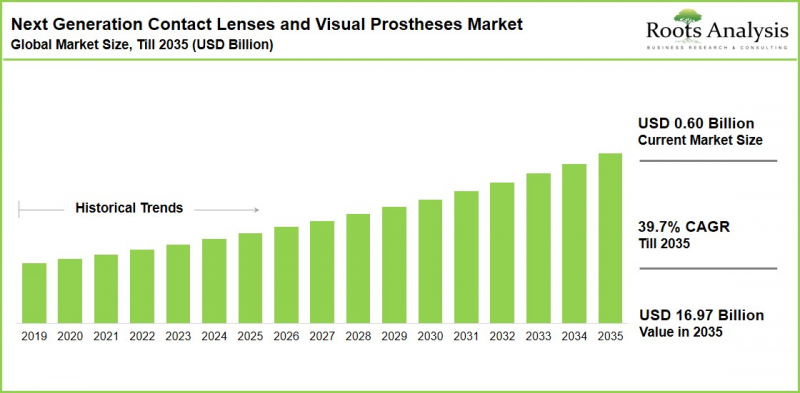
차세대 콘택트렌즈 및 시각 보철물 시장: 성장 및 동향
근시, 원시, 노안, 난시 등의 굴절 이상 발생률이 증가함에 따라 교정 렌즈에 대한 수요는 꾸준히 증가하고 있습니다. 기존의 안경은 효과적이긴 하지만 시야가 제한될 뿐만 아니라, 습도가 높은 환경에서는 안개가 끼고, 콧등이나 관자놀이에 압박감을 주는 문제가 있습니다. 이러한 요인으로 인해 환경 조건의 영향을 덜 받고, 얇고 착용감이 편안한 콘택트렌즈로의 전환이 서서히 진행되고 있습니다.
시력 교정 외에도 안과 분야의 미충족 수요가 확대되고, 첨단 바이오소재의 활용이 가능해짐에 따라 콘택트렌즈의 응용 범위는 넓어지고 있습니다. 미국 안과학회(AAO)의 보고에 따르면 미국에서는 매년 200만 건에 가까운 안구 손상이 발생하여 시력 상실로 이어지고 있습니다. 이러한 추세에 따라 안구 치료 및 보호를 목적으로 한 치료용 렌즈 개발이 가속화되고 있습니다. 지금까지 시력 교정 이외의 적응증을 가진 콘택트렌즈 기반 제품 10종이 FDA 승인을 받았으며, 그 예로 무홍채증 치료용 CUSTOMFLEX ARTIFICIAL IRIS(2018년 승인)와 녹내장 모니터링용 EYEMATE(2017년 승인) 등이 있습니다.
또한 시각장애인 및 저시력자 인구의 증가도 이와 병행하여 혁신을 촉진하는 요인이 되고 있습니다. 미국 국립안과연구소(NEI)의 추산에 따르면 미국에서만 약 130만 명이 전맹이며, 290만 명이 시력 저하로 고통받고 있으며, 이러한 수치는 2030년까지 각각 220만 명, 500만 명으로 증가할 것으로 예측됩니다. 이러한 추세에 따라 차세대 시력 회복 기술, 특히 시신경에 전기 자극을 가해 기능적인 시력을 회복시키는 시각 보철 장치(바이오닉 아이)에 대한 관심이 더욱 높아지고 있습니다. 콘택트렌즈와 시각 보철물 두 플랫폼에 대한 지속적인 투자와 기술 발전으로 인해 더 많은 솔루션이 임상 평가를 통과하여 상용화될 전망이며, 이는 시장의 대폭적인 확장을 지원할 것으로 예상됩니다.
성장의 원동력: 시장 확장을 지원하는 요인
시장 성장은 전 세계적인 굴절 이상 및 안과 질환의 증가에 더해, 노안, 노인성 황반변성, 안구 건조증, 백내장에 걸릴 위험이 높아지는 고령화 사회가 이러한 추세를 가속화하고 있습니다. 고령 환자는 점안약 투여에 필요한 손의 섬세한 동작이 어려울 수 있으며, 이러한 제약으로 인해 지속적이고 표적화된 치료제 전달을 가능하게 하는 약물 방출형 콘택트렌즈의 수요가 증가하고 있습니다. 기존 안경에 비해 콘택트렌즈가 지닌 편안함과 장점에 대한 인식이 높아지는 데 더해, 당뇨병 및 녹내장 진단용 렌즈에 대한 연구개발의 진전 또한 교정, 치료, 모니터링 등 각 용도에서의 수요를 지속적으로 견인하고 있습니다.
차세대 콘택트렌즈 및 시각 보철물 시장: 주요 인사이트
이 보고서는 차세대 콘택트렌즈 및 시각 보철물 시장의 현황을 상세히 분석하고, 특히 판매 대리점 및 채널 파트너의 관점에서 업계내 잠재적인 성장 기회를 파악하고 있습니다. 주요 조사 결과는 다음과 같습니다.
- 실리콘 하이드로겔은 산소 투과성과 착용감으로 높은 평가를 받고 있는 주요 렌즈 소재입니다. 반면, 가스 투과성 렌즈는 선명한 시야 덕분에 더 빠른 성장률이 예상됩니다.
- 현재 소매점이 유통 점유율의 가장 큰 비중을 차지하고 있으며, 경쟁력 있는 가격 책정과 프로모션 할인 제공이 이를 지원하고 있습니다. 반면, 온라인 스토어는 디지털 구매의 편의성에 힘입어 가장 높은 연평균 성장률(CAGR)을 기록할 것으로 예상됩니다.
- 차세대 콘택트렌즈 및 시각 보철과 관련된 특허는 지금까지 7,000건 이상이 출원 및 등록되었으며, 이는 이 분야의 지속적인 혁신 속도를 반영합니다.
- 구글의 AI 탑재 스마트 아이웨어 플랫폼, XPANCEO의 녹내장 관리용 AI 탑재 스마트 콘택트렌즈, FDA 승인을 획득한 Deseyne 노안용 렌즈 등 최근 동향은 콘택트렌즈의 혁신과 디지털 헬스/증강현실(AR) 생태계 간의 융합이 가속화되고 있음을 보여줍니다.
- 기존의 굴절 교정이 여전히 가장 큰 비중을 차지하는 반면, 진단 및 모니터링용 콘택트렌즈와 치료용 약물 방출형 콘택트렌즈가 가장 빠르게 성장하는 용도 하위 부문으로 부상하고 있습니다. 채널 파트너에게 있으며, 이러한 고부가가치 및 임상적으로 통합된 제품은 평균 판매 가격(ASP)이 상당히 높기 때문에 기존의 소매 마진 모델에서 지속적인 의료용품 공급 계약으로 전환할 기회를 제공합니다.
- 북미와 유럽은 조기 규제 승인 및 임상 시험 인프라 덕분에 여전히 매출 점유율의 대부분을 차지하고 있습니다. 반면, 아시아태평양은 가장 높은 연평균 성장률(CAGR)로 확대되고 있습니다. 이러한 추세는 동아시아 도시 지역의 소아 및 청년층에서 매우 높은 근시 유병률(80-90%)과 첨단 의료 전자제품 공급망의 확장에 힘입어, 아시아태평양은 지역 유통 계약에 있으며, 매우 중요한 성장 시장으로 자리매김하고 있습니다.
차세대 콘택트렌즈 및 시각 보철물 시장의 분류
이 보고서에서는 다음 매개변수를 기준으로 분류하고 있습니다.
콘택트렌즈 유형별
- 교정용 렌즈
- 치료용 렌즈
- 약물 방출형 렌즈
- 진단·모니터링용 렌즈
- 시각 보철물
적응증별
- 당뇨병
- 녹내장
- 노화성 황반변성
- 색소성 망막염
- 무홍채증
사용 형태별
- 재사용 가능
- 일회용
디자인별
- 토릭
- 다초점
- 구면
소재별
- 실리콘 하이드로겔
- 가스 투과성(오르토케라톨로지 및 공막용)
- 기타
판매 채널별
- 안과 의사
- 소매점
- 온라인 스토어
지역별
- 북미
- 유럽
- 아시아태평양
- 기타 지역
차세대 콘택트렌즈 및 시각 보철물 시장의 주요 기업 사례
- ALCON
- Bausch + Lomb
- CooperCompanies
- Contamac
- EssilorLuxottica
- Euclid Vision Group
- HOYA CORPORATION
- Johnson & Johnson
- Menicon
- Novartis AG
- SEED
- Surgical Vision
- STAAR SURGICAL
- X-Cel Specialty Contacts
이 보고서에서는 전 세계 차세대 콘택트렌즈 및 시각 보철물 시장을 조사하여, 시장 개요, 배경, 시장 영향 요인 분석, 시장 규모 추이 및 전망, 각종 분류별 상세 분석, 경쟁 구도, 주요 기업 개요 등을 정리하여 전해드립니다.
목차
제1장 서문
제2장 개요
제3장 서론
제4장 시장 개요
제5장 프로모션 분석
제6장 기술 개요
제7장 특허 분석
제8장 제휴·협력 관계
제9장 소셜미디어에서의 새로운 동향
제10장 KOL 분석
제11장 시장 규모 분석·예측
제12장 인터뷰 기록
제13장 결론
제14장 부록 1 : 표형식 데이터
제15장 부록 2 : 기업 및 조직 리스트
KSA 26.09.11NEXT GENERATION CONTACT LENSES AND VISUAL PROSTHESES MARKET: OVERVIEW
As per Roots Analysis, the global next generation contact lenses and visual prostheses market is estimated to grow from USD 0.60 billion in the current year to USD 16.97 billion by 2035, reflecting a compound annual growth rate (CAGR) of approximately 39.7% during the forecast period.
Next Generation Contact Lenses and Visual Prostheses Market: Growth and Trends
The rising incidence of refractive disorders, including myopia, hyperopia, presbyopia and astigmatism, has fueled steady demand for corrective lenses. Conventional eyeglasses, while effective, offer a restricted field of vision, fog under humid conditions and exert pressure on the nose bridge and temples. These factors prompt a gradual shift toward thin, comfortable contact lenses that are less affected by environmental conditions.
Beyond vision correction, expanding unmet needs in ophthalmology and the availability of advanced biomaterials have widened the scope of contact lens applications. The American Academy of Ophthalmology has reported nearly 2 million eye injuries annually in the United States that result in vision loss, a trend that has accelerated the development of therapeutic lenses designed to treat and protect the eye. To date, ten contact lens-based products have secured FDA approval for indications beyond vision correction, including CUSTOMFLEX ARTIFICIALIRIS for aniridia (approved 2018) and EYEMATE for glaucoma monitoring (approved 2017).
Additionally, the growing population of blind and partially sighted individuals is a parallel driver of innovation. The National Eye Institute estimates nearly 1.3 million people are blind and 2.9 million have poor vision in the US alone, with these figures projected to rise to 2.2 million and 5 million, respectively, by 2030. This trend has intensified interest in next generation vision restoration technologies, particularly visual prostheses (bionic eyes), which use electrical stimulation of the optic nerve to restore functional vision. Sustained investment and technological progress across both contact lens and visual prosthesis platforms are expected to support significant market expansion as more solutions clear clinical evaluation and reach commercialization.
Growth Drivers: Factors Fueling Market Expansion
Market growth is primarily due to the rising global burden of refractive errors and ocular disorders, compounded by an ageing population increasingly prone to presbyopia, age-related macular degeneration, dry eye and cataracts. Older patients often struggle with the manual dexterity required for eye drop administration, a limitation that favors drug-eluting lenses capable of sustained, targeted therapeutic delivery. Growing awareness of the comfort and advantages of contact lenses over conventional eyewear, along with increasing R&D on diagnostic lenses for diabetes and glaucoma, continues to drive demand across corrective, therapeutic, and monitoring applications.
Market Challenges: Critical Barriers Hindering Progress
The high cost associated with specialized lens categories, including multifocal, toric and hybrid designs, remains a meaningful barrier to broader adoption, particularly in price-sensitive healthcare markets. The continued availability of alternative vision-correction options, such as LASIK surgery and conventional eyeglasses, adds further competitive pressure. Improper handling during lens insertion and removal carries an inherent risk of ocular infection, a concern that developers must continue to address through patient education and product design. Finally, the intensity of competition among established and emerging players places sustained pressure on developers to differentiate through innovation.
Growth Trends: Technology and Application Expansion
Advances in silicone hydrogel materials that improve corneal oxygen transmission, along with blue light-filtering technologies, continue to enhance the performance and applications of next generation contact lenses. Rising demand for disposable cosmetic lenses, increasing consumer focus on eye health, and growing development activity around antimicrobial coatings and moisture-retention technologies are reinforcing category growth. The emergence of bionic eye platforms has further concentrated industry attention on vision-restoration applications, positioning visual prostheses as a distinct and fast-evolving growth avenue within the broader market.
Next Generation Contact Lenses and Visual Prostheses Market: Key Insights
The report delves into the current state of the next generation contact lenses and visual prostheses market and identifies potential growth opportunities within the industry, particularly from a distributor and channel-partner perspective. Some key findings include:
- Silicone hydrogel is the leading lens material, valued for its oxygen permeability and comfort, gas permeable lenses are expected to grow at a faster rate owing to the clarity of vision they offer.
- Retail stores presently account for the largest distribution share, supported by competitive pricing and the availability of promotional discounts, while online stores are expected to grow at the highest CAGR, driven by the convenience of digital purchasing.
- Over 7,000 patents related to next generation contact lenses and visual prostheses have been filed / granted to date, reflecting the sustained pace of innovation in the field.
- Recent developments, including Google's AI-enabled smart eyewear platform, XPANCEO's AI-powered smart contact lens for glaucoma management, and FDA clearance of the Deseyne presbyopia lens, point to accelerating convergence between contact lens innovation and digital health / augmented reality ecosystems.
- While traditional refractive correction still holds the largest foundational baseline, diagnostics/monitoring lenses and therapeutic drug-eluting contact lenses represent the fastest-growing application sub-segments. For channel partners, these high-value, clinically integrated products carry significantly higher average selling prices (ASPs) and offer opportunities to pivot from traditional retail margin models to recurring medical-supply contracts.
- While North America and Europe retain dominant revenue shares due to early regulatory clearances and clinical trial infrastructure, the Asia-Pacific region is expanding at the highest CAGR. This trajectory is propelled by alarming rates of pediatric and young-adult myopia in urban East Asia (80-90% prevalence), coupled with expanding advanced medical electronics supply chains, marking APAC as a critical expansion market for regional distribution agreements.
Next Generation Contact Lenses and Visual Prostheses Market Segments
Roots Analysis segments the global Next Generation Contact Lenses and Visual Prostheses opportunity across the following parameters:
By Type of Contact Lenses
- Corrective Lenses
- Therapeutic Lenses
- Drug-Eluting Lenses
- Diagnostics / Monitoring Lenses
- Visual Prosthesis
By Targeted Indication
- Diabetes
- Glaucoma
- Age-Related Macular Degeneration
- Retinitis Pigmentosa
- Aniridia
By Modality
- Reusable
- Disposable
By Design
- Toric
- Multifocal
- Spherical
By Material
- Silicone Hydrogel
- Gas Permeable (Orthokeratology and Scleral)
- Others
By Distribution Channel
- Ophthalmologists
- Retail Stores
- Online Stores
By Geographical Region
- North America
- Europe
- Asia-Pacific
- Rest of the World
Next Generation Contact Lenses and Visual Prostheses Market: Key Segments Insight
Market Share by Type of Contact Lens
According to our estimates, diagnostic / monitoring lenses are expected to account for the largest share of the market. This dominance is primarily driven by rapid advancements in smart contact lens technologies capable of continuously monitoring physiological and ocular biomarkers, including intraocular pressure, tear glucose, inflammatory biomarkers, and hydration status. Increasing investments in wearable biosensors, miniaturized electronics, wireless data transmission, and AI-enabled remote patient monitoring have accelerated the development of diagnostic lenses for chronic disease management. Furthermore, growing demand for non-invasive healthcare solutions and personalized medicine is expected to reinforce adoption across ophthalmology and digital health applications.
Meanwhile, drug-eluting lenses are expected to register the highest CAGR during the forecast period. Their strong growth is supported by the ability to provide sustained and localized drug delivery, improving therapeutic efficacy while reducing dosing frequency and improving patient compliance compared to conventional eye drops. Expanding clinical research involving glaucoma, dry eye disease, postoperative care, ocular infections, and retinal disorders, coupled with increasing regulatory and industry interest in sustained ocular drug delivery platforms, is expected to accelerate commercialization over the coming decade.
Market Share by Target Indication
According to our market analysis, diabetes is expected to capture the largest market share. This highest share is attributed to the continuously expanding global diabetic population and the growing prevalence of diabetic retinopathy. Significant research efforts focused on smart contact lenses capable of continuously monitoring tear glucose levels have further strengthened commercial interest in diabetes-focused ocular diagnostics. Additionally, increasing emphasis on remote patient monitoring and preventive disease management is expected to support sustained market expansion.
Conversely, glaucoma is projected to witness the fastest CAGR during the forecast period. This growth is driven by the rising incidence of glaucoma worldwide, increasing demand for continuous intraocular pressure monitoring, and ongoing development of contact lenses integrating pressure-sensing technologies and sustained ocular drug delivery systems. Since glaucoma often progresses asymptomatically, continuous monitoring solutions capable of enabling early intervention are expected to witness increasing clinical adoption.
Market Share by Modality Type
According to our analysis, disposable lenses currently account for the largest share of the market and are expected to maintain their leadership throughout the forecast period. Their widespread adoption is supported by superior hygiene, reduced maintenance requirements, improved patient convenience, and a lower risk of microbial contamination and lens-related infections compared to reusable alternatives. Growing preference for daily disposable lenses, especially among first-time and younger users, along with advances in lens materials that improve comfort and oxygen permeability, is expected to further drive segment growth.
It is important to note here that this segment is likely to register higher CAGR during the forecast period as manufacturers increasingly introduce premium single-use smart lenses incorporating sensing, therapeutic, and drug-delivery capabilities.
Market Share by Type of Design
According to our projections, spherical lenses currently account for the largest share of the market. Their leadership is attributed to the high global prevalence of refractive errors such as myopia and hyperopia, making spherical lenses the most commonly prescribed contact lens design. Further, their relatively simple manufacturing process, broad product availability, and high wearer comfort have further strengthened their commercial adoption.
However, toric lenses are expected to register the highest CAGR during the forecast period. Rising awareness and diagnosis of astigmatism, together with continuous improvements in stabilization technologies that enhance lens orientation and visual performance, are driving increasing adoption. Furthermore, manufacturers continue to expand premium toric product portfolios using advanced silicone hydrogel materials and customized fitting technologies, contributing to sustained segment growth.
Market Share by Type of Material
According to the proprietary market report, silicone hydrogel accounts for the largest market share. This dominance is primarily attributed to its superior oxygen permeability, enhanced comfort, better moisture retention, and lower risk of eye dryness and oxygen-related complications compared to conventional hydrogel materials. Continuous product innovation aimed at extending wearing time while maintaining ocular health has further accelerated adoption across both corrective and specialty contact lens applications.
On the other hand, gas permeable lenses are expected to witness the fastest CAGR during the forecast period. Increasing utilization in orthokeratology for myopia management, growing adoption of scleral lenses for irregular corneal disorders, and superior optical performance for complex vision correction are expected to drive segment expansion. Rising clinical acceptance of specialty lenses for keratoconus and post-surgical corneal conditions further supports long-term market growth.
Market Share by Distribution Channel
According to our estimates, retail stores currently generate the highest market share of the market. This highest share is due to their extensive product availability, established customer trust, professional fitting services, and immediate product accessibility. Strong partnerships between major manufacturers and optical retail chains continue to strengthen this distribution channel globally.
However, online stores are expected to register the fastest CAGR during the forecast period. Increasing healthcare digitalization, growing preference for e-commerce platforms, competitive pricing, subscription-based lens services, and convenient home delivery have significantly increased online contact lens purchases. The expanding adoption of tele-optometry and digital prescription verification is also expected to support long-term growth of online distribution channels.
Market Share by Geographical Region
According to our projections, Europe is expected to account for the largest market share. The region benefits from advanced ophthalmology infrastructure, high adoption of innovative contact lens technologies, strong research activities, and the presence of leading ophthalmic device manufacturers. Increasing prevalence of age-related ocular disorders, expanding utilization of specialty and disposable lenses, and growing investment in smart wearable ophthalmic technologies continue to support regional market leadership.
In contrast, Asia-Pacific is anticipated to witness the highest CAGR throughout the forecast period. This growth is driven by rapidly expanding healthcare expenditure, rising disposable incomes, increasing prevalence of myopia and diabetes, improving access to ophthalmic care, and growing awareness regarding preventive eye health. Moreover, expanding manufacturing capabilities, increasing R&D investments, and supportive government initiatives promoting digital healthcare and advanced medical technologies are expected to drive Asia-Pacific's rapid market growth through 2035.
Example Players in Next Generation Contact Lenses and Visual Prostheses Market
- ALCON
- Bausch + Lomb
- CooperCompanies
- Contamac
- EssilorLuxottica
- Euclid Vision Group
- HOYA CORPORATION
- Johnson & Johnson
- Menicon
- Novartis AG
- SEED
- Surgical Vision
- STAAR SURGICAL
- X-Cel Specialty Contacts
Industry Experts Insights
The opinions and insights presented in this study were shaped by discussions held with multiple stakeholders active in the next generation contact lenses and visual prostheses market. The report features detailed transcripts of interviews conducted with the following industry representatives:
- Michal Shavit, Head of Sales and Marketing, EyeYon Medical
- Mark E. Byrne, Co-Founder and Chief Technical Officer, OcuMedic
- Praful Doshi, Founder, Chief Executive Officer and Chief Technical Officer, Leo Lens Technology
NEXT GENERATION CONTACT LENSES AND VISUAL PROSTHESES MARKET: RESEARCH COVERAGE
- Market Sizing and Forecast: Detailed revenue projections for the overall market and its sub-segments by type of product / lenses, targeted indication and geography across North America, EU5 and Asia-Pacific, till 2030, under conservative, base and optimistic scenarios.
- Market Overview: A comprehensive assessment of the next generation contact lens and visual prosthesis landscape, covering type of developer, location of developer headquarters, status of development, target indication, type of product and (for visual prostheses) implant site, along with the geographical distribution of stakeholder players and key opinion leaders.
- Promotional Analysis: An analysis of the channels used for promotional campaigns by industry players, including product websites, brochure and user manual analysis, featuring dedicated assessments of marketed products such as ChromaGen, CUSTOMFLEX ARTIFICIALIRIS, EYEMATE, Hyper-CL, Implantable Miniature Telescope and SENSIMED Triggerfish.
- Technology Profiles: Profiles of novel technologies being developed to expand contact lens functionality, namely EyePrintPRO, Interscatter Communication Technology, Leo Lens Technology, Nanowafer Technology and Diamond Eye Technology, including developer overview and working mechanism.
- Patent Analysis: An analysis of patents filed / granted related to next generation contact lenses and visual prostheses since 2021, based on publication year, geography, CPC classification, emerging focus areas, leading industry and non-industry players, benchmarking and patent valuation.
- Partnerships and Collaborations: A review of partnerships established in this domain, covering type of partnership, type of organization, application area, target indication and regional (intercontinental / intracontinental) distribution.
- Emerging Trends on Social Media: An analysis of prevalent and emerging discussion trends related to next generation contact lenses and visual prostheses on Twitter, including trending words / phrases and the most prolific authors.
- KOL Analysis: Identification and benchmarking of principal investigators, sub-investigators and study directors involved in relevant clinical trials, along with detailed profiles of prominent key opinion leaders and a Roots Analysis versus third-party scoring comparison.
- Interview Transcripts: Detailed transcripts of interviews conducted with representatives of EyeYon Medical, OcuMedic and Leo Lens Technology.
Key Questions Answered in this Report
- Which companies are currently active in the next generation contact lenses and visual prostheses market?
- Which region dominates the next generation contact lenses and visual prostheses market?
- What are the key trends observed in this market?
- What factors are likely to influence the evolution of this market through 2035?
- What are the primary challenges faced by developers of next generation contact lenses and visual prostheses?
- What is the current and future size of this market?
- What is the CAGR of this market during the forecast period?
- How is the current and future market opportunity likely to be distributed across key market segments?
Reasons to Buy this Report
This report has been specifically developed to support distributors, channel partners, and business development teams evaluating entry into the next generation contact lenses and visual prostheses market.
- The report provides a comprehensive market analysis, offering detailed revenue projections of the overall market and its specific sub-segments, valuable to both established market leaders and emerging entrants.
- The report offers stakeholders a comprehensive overview of the market, including key drivers, barriers, opportunities and challenges, empowering data-driven decision-making.
- The report can aid businesses in identifying future opportunities across the value chain and assessing whether those opportunities are worth pursuing.
- The report helps identify customer demand by outlining the needs, preferences and behavior of the target audience, supporting effective product and service positioning.
- The report equips new entrants with the requisite market information to build successful business strategies.
- The report supports more effective communication with stakeholders and helps in building strong business relationships.
Additional Benefits
- Complementary Insights Pack
- Complementary PPT Insights Pack
- Complementary Excel Data Packs for all Analytical Modules in the Report
- 15% Free Content Customization
- Detailed Report Walkthrough Session with Research Team
- Free Updated report if the report is 6-12 months old or older
TABLE OF CONTENTS
1. PREFACE
- 1.1. Scope of the Report
- 1.2. Research Methodology
- 1.3. Chapter Outlines
2. EXECUTIVE SUMMARY
3. INTRODUCTION
- 3.1. Context and Background
- 3.2. An Overview of Contact Lenses
- 3.2.1. Evolution of Contact Lenses
- 3.2.2. Applications of Contact Lenses
- 3.2.3. Types of Contact Lenses
- 3.2.4. Classification of Contact Lenses
- 3.2.4.1. Therapeutic Contact Lenses
- 3.2.4.2. Drug-Eluting Contact Lenses
- 3.2.4.2.1. Mechanism of Drug Delivery through Contact Lenses
- 3.2.4.2.2. Techniques for Developing Drug-Eluting Contact Lenses
- 3.2.4.3. Diagnostic / Monitoring Contact Lenses
- 3.3. Visual Prostheses
- 3.3.1. Architecture of a Bionic Eye
- 3.3.2. Working of a Bionic Eye
- 3.4. Key Therapeutic Indications
- 3.5. Prevalent Trends and Future Perspectives
4. MARKET OVERVIEW
- 4.1. Chapter Overview
- 4.2. Next Generation Contact Lenses: Overall Market Landscape
- 4.2.1. Distribution by Type of Developer
- 4.2.2. Distribution by Location of Headquarters of Developers
- 4.2.3. Distribution by Status of Development
- 4.2.4. Distribution by Target Indication
- 4.2.5. Distribution by Type of Product
- 4.3. Next Generation Contact Lenses: Market Landscape of Therapeutic Lenses
- 4.4. Next Generation Contact Lenses: Market Landscape of Drug-Eluting Lenses
- 4.5. Next Generation Contact Lenses: Market Landscape of Diagnostic / Monitoring Lenses
- 4.6. Visual Prostheses: Overall Market Landscape
- 4.6.1. Distribution by Type of Developer
- 4.6.2. Distribution by Location of Headquarters of Developers
- 4.6.3. Distribution by Status of Development
- 4.6.4. Distribution by Target Indication
- 4.6.5. Distribution by Implant Site
- 4.7. Geographical Distribution of Stakeholder Players and KOLs
5. PROMOTIONAL ANALYSIS
- 5.1. Chapter Overview
- 5.2. An Overview of Channels Used for Promotional Campaigns
- 5.3. Channels Adopted by Industry Players for Promotional Campaigns
- 5.3.1. Product Website Analysis
- 5.3.2. Product Brochure Analysis
- 5.3.3. Product User Manual Analysis
- 5.4. ChromaGen(TM): Promotional Analysis
- 5.4.1. Product Overview
- 5.4.2. Product Website / Brochure Analysis
- 5.4.2.1. Messages for Healthcare Professionals
- 5.4.2.2. Messages for Patients
- 5.5. CUSTOMFLEX(R) ARTIFICIALIRIS: Promotional Analysis
- 5.5.1. Product Overview
- 5.5.2. Product Website / Brochure Analysis
- 5.5.2.1. Messages for Healthcare Professionals
- 5.5.2.2. Messages for Patients
- 5.5.2.3. Other Messages
- 5.5.3. Other Promotional Activities
- 5.5.3.1. Publication in Journals
- 5.6. EYEMATE(R): Promotional Analysis
- 5.6.1. Product Overview
- 5.6.2. Product Website / Brochure Analysis
- 5.6.2.1. Messages for Healthcare Professionals
- 5.6.2.2. Messages for Patients
- 5.6.3. Other Promotional Activities
- 5.6.3.1. Publication in Journals
- 5.7. Hyper-CL(TM): Promotional Analysis
- 5.7.1. Product Overview
- 5.7.2. Product Website / Brochure Analysis
- 5.7.2.1. Messages for Healthcare Professionals
- 5.7.2.2. Messages for Patients
- 5.7.3. Product User Manual Analysis
- 5.7.3.1. Other Messages
- 5.7.4. Other Promotional Activities
- 5.7.4.1. Publication in Journals
- 5.8. Implantable Miniature Telescope: Promotional Analysis
- 5.8.1. Product Overview
- 5.8.2. Product Website / Brochure Analysis
- 5.8.2.1. Messages for Healthcare Professionals
- 5.8.2.2. Patient Access Program
- 5.8.2.3. Other Messages
- 5.8.3. Product User Manual Analysis
- 5.8.3.1. Messages for Patients
- 5.8.4. Other Promotional Activities
- 5.8.4.1. Publication in Journals
- 5.9. SENSIMED Triggerfish(R): Promotional Analysis
- 5.9.1. Product Overview
- 5.9.2. Product Website / Brochure Analysis
- 5.9.2.1. Messages for Healthcare Professionals
- 5.9.2.2. Messages for Patients
- 5.9.3. Product User Manual Analysis
- 5.9.3.1. Other Messages
- 5.9.4. Other Promotional Activities
- 5.9.4.1. Publication in Journals
- 5.9.4.2. Presence in Conferences
6. TECHNOLOGY PROFILES
- 6.1. Chapter Overview
- 6.2. Next Generation Contact Lenses: Novel Technologies
- 6.3. EyePrintPRO(TM)
- 6.3.1. Developer Overview
- 6.3.2. Technology Overview
- 6.3.2.1. Working Mechanism
- 6.4. Interscatter Communication Technology
- 6.4.1. Developer Overview
- 6.4.2. Technology Overview
- 6.4.2.1. Working Mechanism
- 6.5. Leo Lens Technology
- 6.5.1. Developer Overview
- 6.5.2. Technology Overview
- 6.5.2.1. Working Mechanism
- 6.6. Nanowafer Technology
- 6.6.1. Developer Overview
- 6.6.2. Technology Overview
- 6.6.2.1. Working Mechanism
- 6.7. The Diamond Eye(TM) Technology
- 6.7.1. Developer Overview
- 6.7.2. Technology Overview
- 6.7.2.1. Working Mechanism
7. PATENT ANALYSIS
- 7.1. Chapter Overview
- 7.2. Scope and Methodology
- 7.3. Next Generation Contact Lenses and Visual Prostheses: Patent Analysis
- 7.3.1. Analysis by Publication Year
- 7.3.2. Analysis by Geographical Location
- 7.3.3. Analysis by CPC Classification
- 7.3.4. Emerging Focus Areas
- 7.3.5. Leading Industry Players by Number of Patents
- 7.3.6. Leading Non-Industry Players by Number of Patents
- 7.4. Next Generation Contact Lenses and Visual Prostheses: Patent Benchmarking Analysis (Industry Players)
- 7.4.1. Analysis by CPC Classification
- 7.4.2. Analysis by Geography
- 7.5. Next Generation Contact Lenses and Visual Prostheses: Patent Benchmarking Analysis (Non-Industry Players)
- 7.5.1. Analysis by CPC Classification
- 7.5.2. Analysis by Geography
- 7.6. Next Generation Contact Lenses and Visual Prostheses: Patent Valuation Analysis
8. PARTNERSHIPS AND COLLABORATIONS
- 8.1. Chapter Overview
- 8.2. Partnership Models
- 8.3. Next Generation Contact Lenses and Visual Prostheses: List of Partnerships and Collaborations
- 8.3.1. Analysis by Type of Partnership
- 8.3.2. Analysis by Type of Organization
- 8.3.3. Analysis by Area of Application
- 8.3.4. Analysis by Target Indication
- 8.3.5. Regional Analysis
- 8.3.5.1. Intercontinental and Intracontinental Agreements
9. EMERGING TRENDS ON SOCIAL MEDIA
- 9.1. Chapter Overview
- 9.2. Next Generation Contact Lenses and Visual Prostheses: Trends on Twitter
- 9.2.1. Social Media Analysis: Trending Words / Phrases Related to Next Generation Contact Lenses and Visual Prostheses on Twitter
- 9.2.2. Social Media Analysis: Most Prolific Authors on Twitter
10. KOL ANALYSIS
- 10.1. Chapter Overview
- 10.2. Methodology
- 10.3. Principal Investigators / Sub-Investigators / Study Directors Involved in Clinical Trials
- 10.3.1. Geographical Distribution
- 10.4. Prominent Key Opinion Leaders
- 10.5. KOL Benchmarking: Roots Analysis versus Third Party Scoring
- 10.6. Prominent Key Opinion Leaders
- 10.6.1. Profile: KOL A (Wills Eye Hospital)
- 10.6.2. Profile: KOL B (Retina Foundation of the Southwest)
- 10.6.3. Profile: KOL C (Rabin Medical Center)
- 10.6.4. Profile: KOL D (University of Oxford)
- 10.6.5. Profile: KOL E (New York Eye and Ear Infirmary)
- 10.6.6. Profile: KOL F (Fred Hutchinson Cancer Research Center)
11. MARKET SIZING AND FORECAST
- 11.1. Chapter Overview
- 11.2. Forecast Methodology
- 11.3. Overall Next Generation Contact Lenses and Visual Prostheses Market, Till 2035
- 11.3.1. Next Generation Contact Lenses and Visual Prostheses Market: Distribution by Type of Product, Till 2035
- 11.3.1.1. Next Generation Contact Lenses and Visual Prostheses Market: Distribution by Type of Lenses, Till 2035
- 11.3.2. Next Generation Contact Lenses and Visual Prostheses Market: Distribution by Target Indications, Till 2035
- 11.3.3. Next Generation Contact Lenses and Visual Prostheses Market: Distribution by Regions, Till 2035
- 11.3.1. Next Generation Contact Lenses and Visual Prostheses Market: Distribution by Type of Product, Till 2035
- 11.4. Next Generation Contact Lenses and Visual Prostheses Market in North America, Till 2035
- 11.4.1. Next Generation Contact Lenses and Visual Prostheses Market in North America: Distribution by Type of Product, Till 2035
- 11.4.1.1. Next Generation Contact Lenses and Visual Prostheses Market in North America: Contact Lenses, Till 2035
- 11.4.1.1.1. Next Generation Contact Lenses and Visual Prostheses Market in North America: Therapeutic Lenses, Till 2035
- 11.4.1.1.2. Next Generation Contact Lenses and Visual Prostheses Market in North America: Drug-Eluting Lenses, Till 2035
- 11.4.1.1.3. Next Generation Contact Lenses and Visual Prostheses Market in North America: Diagnostic / Monitoring Lenses, Till 2035
- 11.4.1.2. Next Generation Contact Lenses and Visual Prostheses Market in North America: Visual Prostheses, Till 2035
- 11.4.1.1. Next Generation Contact Lenses and Visual Prostheses Market in North America: Contact Lenses, Till 2035
- 11.4.2. Next Generation Contact Lenses and Visual Prostheses Market in North America: Distribution by Target Indication, Till 2035
- 11.4.2.1. Next Generation Contact Lenses and Visual Prostheses Market in North America: Diabetes, Till 2035
- 11.4.2.2. Next Generation Contact Lenses and Visual Prostheses Market in North America: Glaucoma, Till 2035
- 11.4.2.3. Next Generation Contact Lenses and Visual Prostheses Market in North America: Age-related Macular Degeneration, Till 2035
- 11.4.2.4. Next Generation Contact Lenses and Visual Prostheses Market in North America: Retinitis Pigmentosa, Till 2035
- 11.4.2.5. Next Generation Contact Lenses and Visual Prostheses Market in North America: Aniridia, Till 2035
- 11.4.1. Next Generation Contact Lenses and Visual Prostheses Market in North America: Distribution by Type of Product, Till 2035
- 11.5. Next Generation Contact Lenses and Visual Prostheses Market in EU5, Till 2035
- 11.5.1. Next Generation Contact Lenses and Visual Prostheses Market in EU5: Distribution by Type of Product, Till 2035
- 11.5.1.1. Next Generation Contact Lenses and Visual Prostheses Market in EU5: Contact Lenses, Till 2035
- 11.5.1.1.1. Next Generation Contact Lenses and Visual Prostheses Market in EU5: Therapeutic Lenses, Till 2035
- 11.5.1.1.2. Next Generation Contact Lenses and Visual Prostheses Market in EU5: Drug-Eluting Lenses, Till 2035
- 11.5.1.1.3. Next Generation Contact Lenses and Visual Prostheses Market in EU5: Diagnostic / Monitoring Lenses, Till 2035
- 11.5.1.2. Next Generation Contact Lenses and Visual Prostheses Market in EU5: Visual Prostheses, Till 2035
- 11.5.1.1. Next Generation Contact Lenses and Visual Prostheses Market in EU5: Contact Lenses, Till 2035
- 11.5.2. Next Generation Contact Lenses and Visual Prostheses Market in EU5: Distribution by Target Indication, Till 2035
- 11.5.2.1. Next Generation Contact Lenses and Visual Prostheses Market in EU5: Diabetes, Till 2035
- 11.5.2.2. Next Generation Contact Lenses and Visual Prostheses Market in EU5: Glaucoma, Till 2035
- 11.5.2.3. Next Generation Contact Lenses and Visual Prostheses Market in EU5: Age-related Macular Degeneration, Till 2035
- 11.5.2.4. Next Generation Contact Lenses and Visual Prostheses Market in EU5: Retinitis Pigmentosa, Till 2035
- 11.5.2.5. Next Generation Contact Lenses and Visual Prostheses Market in EU5: Aniridia, Till 2035
- 11.5.1. Next Generation Contact Lenses and Visual Prostheses Market in EU5: Distribution by Type of Product, Till 2035
- 11.6. Next Generation Contact Lenses and Visual Prostheses Market in Asia-Pacific, Till 2035
- 11.6.1. Next Generation Contact Lenses and Visual Prostheses Market in Asia-Pacific: Distribution by Type of Product, Till 2035
- 11.6.1.1. Next Generation Contact Lenses and Visual Prostheses Market in Asia-Pacific: Contact Lenses, Till 2035
- 11.6.1.1.1. Next Generation Contact Lenses and Visual Prostheses Market in Asia-Pacific: Therapeutic Lenses, Till 2035
- 11.6.1.1.2. Next Generation Contact Lenses and Visual Prostheses Market in Asia-Pacific: Drug-Eluting Lenses, Till 2035
- 11.6.1.1.3. Next Generation Contact Lenses and Visual Prostheses Market in Asia-Pacific: Diagnostic / Monitoring Lenses, Till 2035
- 11.6.1.2. Next Generation Contact Lenses and Visual Prostheses Market in Asia-Pacific: Visual Prostheses, Till 2035
- 11.6.1.1. Next Generation Contact Lenses and Visual Prostheses Market in Asia-Pacific: Contact Lenses, Till 2035
- 11.6.2. Next Generation Contact Lenses and Visual Prostheses Market in Asia-Pacific: Distribution by Target Indication, Till 2035
- 11.6.2.1. Next Generation Contact Lenses and Visual Prostheses Market in Asia-Pacific: Diabetes, Till 2035
- 11.6.2.2. Next Generation Contact Lenses and Visual Prostheses Market in Asia-Pacific: Glaucoma, Till 2035
- 11.6.2.3. Next Generation Contact Lenses and Visual Prostheses Market in Asia-Pacific: Age-related Macular Degeneration, Till 2035
- 11.6.2.4. Next Generation Contact Lenses and Visual Prostheses Market in Asia-Pacific: Retinitis Pigmentosa, Till 2035
- 11.6.1. Next Generation Contact Lenses and Visual Prostheses Market in Asia-Pacific: Distribution by Type of Product, Till 2035
12. INTERVIEW TRANSCRIPTS
- 12.1. Chapter Overview
- 12.2. EyeYon Medical
- 12.2.1. Interview Transcript: Michal Shavit, Head of Sales and Marketing
- 12.3. OcuMedic
- 12.3.1. Interview Transcript: Mark E. Byrne, Co-Founder and Chief Technical Officer
- 12.4. Leo Lens Technology
- 12.4.1. Interview Transcript: Praful Doshi, Founder, Chief Executive Officer and Chief Technical Officer
13. CONCLUSION
- 13.1. Advances in Ophthalmic Lens Technologies have Enabled the Development of Contact Lenses for Therapeutic, Bandage and Diagnostic Use
- 13.2. The Competitive Landscape Features a Mix of Industry and Academic Players; Majority of Stakeholder are based in the US
- 13.3. Rising Interest in this Domain is Evident from Increasing Social Media Chatter and the Partnership Activity
- 13.4. Technology Developers are Spearheading the Innovation, and Making Substantial Contributions to the Intellectual Capital in this Field
- 13.5. Driven by Anticipated Growth in Target Population, coupled to the Ongoing Innovation, the Market is Likely to Witness Steady Growth over the Next Decade