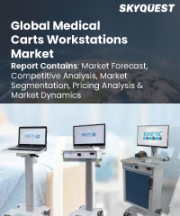
|
시장보고서
상품코드
1897572
의료용 카트 및 워크스테이션 시장 규모, 점유율, 성장 분석 : 제품별, 최종사용자별, 지역별 - 업계 예측(2026-2033년)Medical Carts And Workstations Market Size, Share, and Growth Analysis, By Product (Mobile Computing Carts and Workstations, Computer Carts and Workstations), By End Users (Hospitals, Long-Term Care Facilities), By Region - Industry Forecast 2026-2033 |
||||||

세계의 의료용 카트 및 워크스테이션 시장 규모는 2024년에 67억 4,000만 달러로 평가되며, 2025년 77억 1,000만 달러에서 2033년까지 226억 1,000만 달러로 성장할 전망입니다. 예측 기간(2026-2033년)의 CAGR은 14.4%로 예측됩니다.
의료기관에서는 효율적인 업무 수행과 중요한 환자 정보 보호를 위해 의료용 카트 및 워크스테이션에 대한 의존도가 높아지고 있습니다. 이러한 솔루션은 필수 데이터에 대한 접근을 효율화할 뿐만 아니라 환자 치료의 전반적인 질 향상에 기여합니다. 시장 확대를 견인하는 주요 요인으로는 전자의무기록(EMR/EHR) 도입 확대, 의료 현장의 IT 솔루션 통합, 그리고 의료기관의 직원 생산성 향상과 환자 결과 개선을 위한 지속적인 노력을 들 수 있습니다. 의료용 카트는 일반적으로 가볍고 다기능이며, 의약품, 소모품, 장비의 보관 및 운반 등 임상 환경에서 다양한 역할을 수행합니다. 스테인리스강, 의료용 PVC 등 의료용으로 적합한 소재로 제조되며, 전원 탭, 보관함 등 편리한 액세서리를 갖추고 있는 경우가 많습니다.
세계 의료용 카트 및 워크스테이션 시장 성장 촉진요인
세계 의료용 카트 및 워크스테이션 시장의 성장은 간호 효율성 향상에 대한 집중적인 노력과 특히 개발도상국의 의료 시스템 발전 등 몇 가지 주요 요인에 의해 주도되고 있습니다. 전자건강기록(EHR) 도입 확대와 약물 오남용을 줄이기 위한 환자 안전에 대한 노력도 시장 수요를 더욱 자극하고 있습니다. 또한 필수 의료용품의 가용성과 의료비 관리 및 억제에 대한 필요성이 높아진 것도 의료용 카트 수요 증가에 크게 기여하고 있습니다. 이러한 요소들이 결합되어 시장의 확대와 현대 의료 현장에서의 중요한 역할을 지원하고 있습니다.
세계 의료용 카트 및 워크스테이션 시장을 억제하는 요인들
세계 의료용 카트 및 워크스테이션 시장은 잘 훈련된 인력의 부족으로 인해 의료용 카트 판매에 큰 어려움을 겪고 있습니다. 이러한 카트 중 상당수는 효과적인 사용을 위해 전문 교육 및 인증이 필요한 첨단 기술을 탑재하고 있으므로 숙련된 작업자의 부족으로 인해 이러한 필수 툴에 대한 투자가 제한되고 있습니다. 이러한 상황은 카트의 부적절한 취급과 사용으로 이어져 결국 의료 현장에서 카트의 가치를 떨어뜨릴 수 있습니다. 결과적으로 이러한 제약은 시장 성장과 다양한 의료 환경에서 의료용 카트 전체 보급에 직접적인 영향을 미치고 있습니다.
세계 의료용 카트 및 워크스테이션 시장 동향
세계 의료용 카트 및 워크스테이션 시장에서는 소비자의 선호도 변화와 의료 현장의 맞춤형 솔루션에 대한 요구로 인해 맞춤형으로의 전환이 두드러지게 나타나고 있습니다. 제조업체들은 의료시설이 특정 운영 요건을 충족하면서도 비용 효율성을 유지할 수 있는 카트 및 워크스테이션을 설계할 수 있도록 맞춤형 옵션 제공을 확대하고 있습니다. 이러한 추세는 의료 환경에서의 사용자 경험 향상과 워크플로우 최적화에 대한 폭넓은 관심을 반영하고 있습니다. 의료 서비스 프로바이더들이 다양한 임상적 요구를 충족시킬 수 있는 다용도하고 적응력 있는 장비를 요구함에 따라 개인화된 의료용 카트에 대한 수요가 증가하여 업계의 미래 전망을 형성할 것으로 예측됩니다.
자주 묻는 질문
목차
서론
- 조사의 목적
- 조사 범위
- 정의
조사 방법
- 정보 조달
- 2차와 1차 데이터 방법
- 시장 규모 예측
- 시장의 전제조건과 제한
개요
- 세계 시장 전망
- 공급과 수요 동향 분석
- 부문별 기회 분석
시장 역학과 전망
- 시장 규모
- 시장 역학
- 촉진요인과 기회
- 억제요인과 과제
- Porter의 산업 분석
주요 시장 인사이트
- 주요 성공 요인
- 경쟁의 정도
- 주요 투자 기회
- 시장 에코시스템
- 시장의 매력 지수(2025년)
- PESTEL 분석
- 거시경제 지표
- 밸류체인 분석
- 가격 분석
- 기술 분석
- 규제 분석
- 특허 분석
- 사례 연구
세계의 의료용 카트 및 워크스테이션 시장 규모 : 제품별 & CAGR(2026-2033)
- 모바일 컴퓨팅 카트 및 워크스테이션
- 컴퓨터 카트 및 워크스테이션
- 전동식 컴퓨터 카트 및 워크스테이션
- 비전동식 컴퓨터 카트 및 워크스테이션
- 컴퓨팅 약제 카트 및 워크스테이션
- 문서 관리 카트 및 워크스테이션
- 원격의료용 카트 및 워크스테이션
- 모바일 컴퓨팅 카트 및 워크스테이션용 액세서리
- 특수 의료용 카트 및 워크스테이션
- 구급 카트 및 워크스테이션
- 마취 카트 및 워크스테이션
- 시술용 카트 및 워크스테이션
- 벽걸이형 워크스테이션
- 월 암
- 벽면 캐비닛 워크스테이션
- 기존형 약제 카트
- 의료용 수납 칼럼, 캐비닛 및 부속품
세계의 의료용 카트 및 워크스테이션 시장 규모 : 최종사용자별 & CAGR(2026-2033)
- 병원
- 장기요양시설
- 의사 진료소/클리닉
- 기타 최종사용자
세계의 의료용 카트 및 워크스테이션 시장 규모 & CAGR(2026-2033)
- 북미
- 미국
- 캐나다
- 유럽
- 독일
- 스페인
- 프랑스
- 영국
- 이탈리아
- 기타 유럽 지역
- 아시아태평양
- 중국
- 인도
- 일본
- 한국
- 기타 아시아태평양
- 라틴아메리카
- 브라질
- 기타 라틴아메리카 지역
- 중동 및 아프리카
- GCC 국가
- 남아프리카공화국
- 기타 중동 및 아프리카
경쟁 정보
- 상위 5사의 비교
- 주요 기업의 시장 포지셔닝(2025년)
- 주요 시장 기업이 채택한 전략
- 최근 시장 동향
- 기업의 시장 점유율 분석(2025년)
- 주요 기업의 기업 개요
- 기업의 상세
- 제품 포트폴리오 분석
- 기업의 부문별 점유율 분석
- 매출의 전년대비 비교(2023-2025년)
주요 기업 개요
- Midmark Corporation(US)
- Capsa Healthcare(US)
- Bergmann Group(US)
- The Harloff Company(US)
- Ergotron, Inc.(US)
- Altus Industries(US)
- Enovate Medical(US)
- ITD GmbH(Germany)
- AMD Global Telemedicine, Inc.(US)
- Lakeside Manufacturing, Inc.(US)
- HAT Collective(US)
- Parity Medical(UK)
- GlobalMedia Group, LLC.(US)
- JACO Inc.(US)
- AFC Industries, Inc.(US)
- Solaire Medical, LLC(US)
- Bytec Group Limited(UK)
- Herman Miller, Inc.(US)
- Omnicell, Inc.(US)
- Modernsolid Industrial Co., Ltd.(Taiwan)
결론과 제안
KSA 26.01.13Global Medical Carts and Workstations Market size was valued at USD 6.74 Billion in 2024 and is poised to grow from USD 7.71 Billion in 2025 to USD 22.61 Billion by 2033, growing at a CAGR of 14.4% during the forecast period (2026-2033).
Healthcare facilities increasingly depend on medical carts and workstations to facilitate efficient procedures while safeguarding vital patient information. These solutions not only streamline access to essential data but also enhance the overall quality of patient care. Key factors driving market expansion include the rising implementation of electronic medical records (EMR/EHR), the integration of IT solutions within healthcare settings, and ongoing initiatives by healthcare organizations to boost staff productivity and enhance patient outcomes. Medical carts, typically lightweight and versatile, serve various roles in clinical environments, including the storage and transport of medicines, supplies, and equipment. Constructed from materials suited for medical use, such as stainless steel and healthcare-grade PVC, they often feature convenient accessories like power strips and storage bins.
Top-down and bottom-up approaches were used to estimate and validate the size of the Global Medical Carts and Workstations market and to estimate the size of various other dependent submarkets. The research methodology used to estimate the market size includes the following details: The key players in the market were identified through secondary research, and their market shares in the respective regions were determined through primary and secondary research. This entire procedure includes the study of the annual and financial reports of the top market players and extensive interviews for key insights from industry leaders such as CEOs, VPs, directors, and marketing executives. All percentage shares split, and breakdowns were determined using secondary sources and verified through Primary sources. All possible parameters that affect the markets covered in this research study have been accounted for, viewed in extensive detail, verified through primary research, and analyzed to get the final quantitative and qualitative data.
Global Medical Carts and Workstations Market Segments Analysis
Global Medical Carts and Workstations Market is segmented by Product, End Users and region. Based on Product, the market is segmented into Mobile Computing Carts and Workstations, Computer Carts and Workstations, Computing Medication Carts and Workstations, Documentation Carts and Workstations, Telemedicine Carts and Workstations, Mobile Computing Cart and Workstation Accessories, Specialty Medical Carts and Workstations, Wall Mount Workstations, Conventional Medication Carts and Medical Storage Columns, Cabinets, and Accessories. Based on End Users, the market is segmented into Hospitals, Long-Term Care Facilities, Physician Offices/Clinics and Other End Users. Based on region, the market is segmented into North America, Europe, Asia Pacific, Latin America and Middle East & Africa.
Driver of the Global Medical Carts and Workstations Market
The growth of the Global Medical Carts and Workstations market is propelled by several key factors, including an emphasis on enhancing nursing efficiency and advancements in healthcare systems, particularly in developing regions. The rising integration of electronic health records (EHR) and a commitment to patient safety, aimed at reducing medication errors, further stimulate market demand. Additionally, the accessibility of essential medical supplies and the increasing necessity to manage and mitigate healthcare costs contribute significantly to the burgeoning need for medical carts. Collectively, these elements underscore the market's expansion and the pivotal role it plays in modern healthcare settings.
Restraints in the Global Medical Carts and Workstations Market
The Global Medical Carts and Workstations market is hindered by a shortage of adequately trained personnel, which poses a considerable challenge to the sales of medical carts. As many of these carts come equipped with advanced technology that demands specialized training or certification for effective use, the insufficient pool of skilled workers restricts investment in these essential tools. This reality can lead to improper handling and utilization of the carts, ultimately detracting from their value in healthcare settings. Consequently, this limitation directly affects market growth and the overall adoption of medical carts in various medical environments.
Market Trends of the Global Medical Carts and Workstations Market
The Global Medical Carts and Workstations market is witnessing a notable shift towards customization, driven by evolving consumer preferences and the need for tailored solutions in healthcare settings. Manufacturers are increasingly offering customizable options that allow healthcare facilities to design carts and workstations that meet specific operational requirements while maintaining cost efficiency. This trend reflects a broader emphasis on enhancing user experience and optimizing workflow in medical environments. As healthcare providers seek versatile and adaptable equipment to support diverse clinical needs, the demand for personalized medical carts is expected to rise, shaping the future landscape of the industry.
Table of Contents
Introduction
- Objectives of the Study
- Scope of the Report
- Definitions
Research Methodology
- Information Procurement
- Secondary & Primary Data Methods
- Market Size Estimation
- Market Assumptions & Limitations
Executive Summary
- Global Market Outlook
- Supply & Demand Trend Analysis
- Segmental Opportunity Analysis
Market Dynamics & Outlook
- Market Overview
- Market Size
- Market Dynamics
- Drivers & Opportunities
- Restraints & Challenges
- Porters Analysis
- Competitive rivalry
- Threat of substitute
- Bargaining power of buyers
- Threat of new entrants
- Bargaining power of suppliers
Key Market Insights
- Key Success Factors
- Degree of Competition
- Top Investment Pockets
- Market Ecosystem
- Market Attractiveness Index, 2025
- PESTEL Analysis
- Macro-Economic Indicators
- Value Chain Analysis
- Pricing Analysis
- Technology Analysis
- Regulatory Analysis
- Patent Analysis
- Case Studies
Global Medical Carts and Workstations Market Size by Product & CAGR (2026-2033)
- Market Overview
- Mobile Computing Carts and Workstations
- Computer Carts and Workstations
- Powered Computer Carts and Workstations
- Non-powered Computer Carts and Workstations
- Computing Medication Carts and Workstations
- Documentation Carts and Workstations
- Telemedicine Carts and Workstations
- Mobile Computing Cart and Workstation Accessories
- Specialty Medical Carts and Workstations
- Emergency Carts and Workstations
- Anesthesia Carts and Workstations
- Procedure Carts and Workstations
- Wall Mount Workstations
- Wall Arms
- Wall Cabinet Workstations
- Conventional Medication Carts
- Medical Storage Columns, Cabinets, and Accessories
Global Medical Carts and Workstations Market Size by End Users & CAGR (2026-2033)
- Market Overview
- Hospitals
- Long-Term Care Facilities
- Physician Offices/Clinics
- Other End Users
Global Medical Carts and Workstations Market Size & CAGR (2026-2033)
- North America (Product, End Users)
- US
- Canada
- Europe (Product, End Users)
- Germany
- Spain
- France
- UK
- Italy
- Rest of Europe
- Asia Pacific (Product, End Users)
- China
- India
- Japan
- South Korea
- Rest of Asia-Pacific
- Latin America (Product, End Users)
- Brazil
- Rest of Latin America
- Middle East & Africa (Product, End Users)
- GCC Countries
- South Africa
- Rest of Middle East & Africa
Competitive Intelligence
- Top 5 Player Comparison
- Market Positioning of Key Players, 2025
- Strategies Adopted by Key Market Players
- Recent Developments in the Market
- Company Market Share Analysis, 2025
- Company Profiles of All Key Players
- Company Details
- Product Portfolio Analysis
- Company's Segmental Share Analysis
- Revenue Y-O-Y Comparison (2023-2025)
Key Company Profiles
- Midmark Corporation (US)
- Company Overview
- Business Segment Overview
- Financial Updates
- Key Developments
- Capsa Healthcare (US)
- Company Overview
- Business Segment Overview
- Financial Updates
- Key Developments
- Bergmann Group (US)
- Company Overview
- Business Segment Overview
- Financial Updates
- Key Developments
- The Harloff Company (US)
- Company Overview
- Business Segment Overview
- Financial Updates
- Key Developments
- Ergotron, Inc. (US)
- Company Overview
- Business Segment Overview
- Financial Updates
- Key Developments
- Altus Industries (US)
- Company Overview
- Business Segment Overview
- Financial Updates
- Key Developments
- Enovate Medical (US)
- Company Overview
- Business Segment Overview
- Financial Updates
- Key Developments
- ITD GmbH (Germany)
- Company Overview
- Business Segment Overview
- Financial Updates
- Key Developments
- AMD Global Telemedicine, Inc. (US)
- Company Overview
- Business Segment Overview
- Financial Updates
- Key Developments
- Lakeside Manufacturing, Inc. (US)
- Company Overview
- Business Segment Overview
- Financial Updates
- Key Developments
- HAT Collective (US)
- Company Overview
- Business Segment Overview
- Financial Updates
- Key Developments
- Parity Medical (UK)
- Company Overview
- Business Segment Overview
- Financial Updates
- Key Developments
- GlobalMedia Group, LLC. (US)
- Company Overview
- Business Segment Overview
- Financial Updates
- Key Developments
- JACO Inc. (US)
- Company Overview
- Business Segment Overview
- Financial Updates
- Key Developments
- AFC Industries, Inc. (US)
- Company Overview
- Business Segment Overview
- Financial Updates
- Key Developments
- Solaire Medical, LLC (US)
- Company Overview
- Business Segment Overview
- Financial Updates
- Key Developments
- Bytec Group Limited (UK)
- Company Overview
- Business Segment Overview
- Financial Updates
- Key Developments
- Herman Miller, Inc. (US)
- Company Overview
- Business Segment Overview
- Financial Updates
- Key Developments
- Omnicell, Inc. (US)
- Company Overview
- Business Segment Overview
- Financial Updates
- Key Developments
- Modernsolid Industrial Co., Ltd. (Taiwan)
- Company Overview
- Business Segment Overview
- Financial Updates
- Key Developments