|
시장보고서
상품코드
1914016
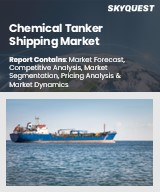
케미컬 탱커 운송 시장 규모, 점유율, 성장 분석 : 선박 유형별, 화물 유형별, 용도별, 지역별 - 업계 예측(2026-2033년)Chemical Tanker Shipping Market Size, Share, and Growth Analysis, By Vessel Type (Parcel Tankers, Product Tankers), By Cargo Type (Petrochemicals, Specialty Chemicals), By Application, By Region - Industry Forecast 2026-2033 |
||||||

세계의 케미컬 탱커 운송 시장 규모는 2024년에 371억 3,000만 달러로 평가되었고, 2025년 389억 5,000만 달러에서 2033년까지 571억 2,000만 달러로 성장할 전망이며, 예측 기간(2026-2033년) CAGR은 4.9%를 보일 것으로 예측됩니다.
해운의 고도로 전문화된 분야인 세계 케미컬 탱커 운송 부문은 벌크 석유화학제품 및 위험물을 포함한 다양한 액체화학제품의 운송을 담당하고 있습니다. 첨단 탱크 설계와 엄격한 화물 분리를 특징으로 하는 케미컬 탱커는 다양한 등급의 화물을 동시에 안전하게 운송할 수 있으며, 세계 공급망에서 필수적인 역할을 담당하고 있습니다. 산업 성장, 특히 신흥 시장의 화학 생산 증가에 따라 거래량은 기초 원료에서 특수 제품으로 이동하고 있으며, 여러 화물 등급에 대응할 수 있는 퍼셀 탱커에 대한 의존도가 높아지고 있습니다. 공급망 재편과 무역 다변화로 인한 무역 패턴의 현저한 변화는 장거리 운송과 함께 역내 운송의 중요성을 증가시켜 업계 내 톤마일 수요에 역동적인 균형을 가져왔습니다.
세계 케미컬 탱커 운송 시장 성장 촉진요인
석유화학 콤비네이션의 부상과 특수화학제품의 생산 확대는 안정적인 해상운송에 대한 수요를 크게 증가시키고 있습니다. 동시에 제약, 퍼스널케어, 농업 등의 분야에서 화학제품 소비가 증가하면서 이러한 수요를 더욱 가속화시키고 있습니다. 아시아태평양이 화학 제조의 주요 거점으로 부상하면서 장거리 운송과 역내 유조선 운송에 대한 수요가 꾸준히 증가하고 있습니다. 이러한 변화하는 상황은 세계 시장에서 이러한 중요 물자의 운송을 촉진하는 데 중요한 역할을 하는 선단 운영자에게 풍부한 기회를 제공합니다.
세계 케미컬 탱커 운송 시장 성장 억제요인
국제 규정(IBC 코드, MARPOL 등)이 선박 설계, 장비 및 화물 취급에 대한 높은 기준을 부과함에 따라 세계 케미컬 탱커 운송 시장은 심각한 제약에 직면해 있습니다. 이러한 규제를 준수하기 위해서는 고가의 도크 개조 및 전문 승무원 교육이 필요합니다. 특히 중소기업의 경우, 컴플라이언스에 대한 재정적 부담이 경쟁력 저하 및 노후 선박의 퇴역으로 이어질 수 있어 어려움이 될 수 있습니다. 그 결과, 수요는 억제될 수 있는 반면, 해운업계 전체의 운영비용은 상승하여 업계 전체 시장 역학에 영향을 미치고 있습니다.
세계 화학제품 유조선 해운시장 동향
세계 케미컬 탱커 해운 시장은 AI와 디지털화의 통합으로 큰 변화를 경험하고 있습니다. 이러한 첨단 기술은 항로 최적화 강화, 예지보전, 화물적합성 향상을 통해 운항 효율성에 혁명을 일으키고 있습니다. 또한, AI 기반 시스템의 구현은 효과적인 배출 감소 전략을 촉진하고 환경 문제에 대한 우려에 대응할 수 있도록 돕습니다. 이러한 디지털화는 데이터에 기반한 통찰력을 제공함으로써 신속한 의사결정을 가능하게 하고, 사업자가 시장 수요에 빠르게 대응할 수 있게 합니다. 그 결과, 이러한 혁신을 활용하는 기업들은 경쟁 우위를 확보하고, 효율성, 안전성, 지속가능성을 우선시하는 급변하는 산업 환경에서 리더로 자리매김하고 있습니다.
자주 묻는 질문
목차
서론
- 조사 목적
- 조사 범위
- 정의
조사 방법
- 정보 조달
- 2차와 1차 데이터 방법
- 시장 규모 예측
- 시장 전제조건과 제한
주요 요약
- 세계 시장 전망
- 공급과 수요 동향 분석
- 부문별 기회 분석
시장 역학과 전망
- 시장 규모
- 시장 역학
- 성장 촉진요인과 기회
- 성장 억제요인과 과제
- Porter의 Five Forces 분석
주요 시장 인사이트
- 중요 성공 요인
- 경쟁 정도
- 주요 투자 기회
- 시장 생태계
- 시장의 매력 지수(2025년)
- PESTEL 분석
- 거시경제 지표
- 밸류체인 분석
- 가격 분석
세계의 케미컬 탱커 운송 시장 규모 : 선박 유형별&CAGR(2026-2033)
- 소량 탱커
- 제품 탱커
세계의 케미컬 탱커 운송 시장 규모 : 화물 유형별&CAGR(2026-2033)
- 석유화학제품
- 특수화학제품
- 산류
- 식용유
- 기타 산업용 화학제품
세계의 케미컬 탱커 운송 시장 규모 : 용도별&CAGR(2026-2033)
- 의약품
- 농업
- 퍼스널케어
- 식품 및 음료
- 산업 제품 제조
세계의 케미컬 탱커 운송 시장 규모&CAGR(2026-2033)
- 북미
- 미국
- 캐나다
- 유럽
- 독일
- 스페인
- 프랑스
- 영국
- 이탈리아
- 기타 유럽
- 아시아태평양
- 중국
- 인도
- 일본
- 한국
- 기타 아시아태평양
- 라틴아메리카
- 브라질
- 기타 라틴아메리카
- 중동 및 아프리카
- GCC 국가
- 남아프리카공화국
- 기타 중동 및 아프리카
경쟁 정보
- 주요 5개사 비교
- 주요 기업의 시장 포지셔닝(2025년)
- 주요 시장 기업이 채택한 전략
- 최근 시장 동향
- 기업의 시장 점유율 분석(2025년)
- 주요 기업 개요
- 기업 상세
- 제품 포트폴리오 분석
- 기업 부문별 점유율 분석
- 전년대비 매출 비교(2023-2025년)
주요 기업 개요
- Stolt-Nielsen Limited(UK)
- Odfjell SE(Norway)
- MOL Chemical Tankers Pte. Ltd.(Singapore)
- Navig8 Group(UK)
- Hafnia Limited(Singapore)
- Bahri(Saudi Arabia)
- IINO KAIUN KAISHA, LTD.(Japan)
- Team Tankers International Ltd.(Bermuda)
- Ardmore Shipping Corporation(Ireland)
- MISC Berhad(Malaysia)
- Scorpio Tankers Inc.(Monaco)
- Christiania Shipping A/S(Norway)
- Utkilen A/S(Norway)
- Ace Tankers(Netherlands)
- HANSA Tankers(Germany)
- Seatrans Group(Norway)
- Tokyo Marine Asia Pte Ltd(Singapore)
- Ultratank(Chile)
- TORM plc(Denmark)
- Sinochem Shipping(Singapore)
결론과 제안
LSH 26.02.03Global Chemical Tanker Shipping Market size was valued at USD 37.13 Billion in 2024 and is poised to grow from USD 38.95 Billion in 2025 to USD 57.12 Billion by 2033, growing at a CAGR of 4.9% during the forecast period (2026-2033).
The global chemical tanker shipping sector, a highly specialized branch of maritime transport, caters to the diverse movement of liquid chemicals, including bulk petrochemicals and hazardous materials. Characterized by advanced tank designs and strict cargo segregation, chemical tankers ensure safe transportation of various grades simultaneously, integral to the global supply chain. As chemical production rises, driven by industrial growth, particularly in emerging markets, trading volumes shift from basic feedstocks to specialty products, enhancing reliance on parcel tankers suited for multiple cargo grades. Noteworthy changes in trading patterns, stemming from supply chain realignments and trade diversification, have heightened the significance of intra-regional movements alongside long-haul transportation, creating a dynamic equilibrium in tonne-mile demand within the industry.
Top-down and bottom-up approaches were used to estimate and validate the size of the Global Chemical Tanker Shipping market and to estimate the size of various other dependent submarkets. The research methodology used to estimate the market size includes the following details: The key players in the market were identified through secondary research, and their market shares in the respective regions were determined through primary and secondary research. This entire procedure includes the study of the annual and financial reports of the top market players and extensive interviews for key insights from industry leaders such as CEOs, VPs, directors, and marketing executives. All percentage shares split, and breakdowns were determined using secondary sources and verified through Primary sources. All possible parameters that affect the markets covered in this research study have been accounted for, viewed in extensive detail, verified through primary research, and analyzed to get the final quantitative and qualitative data.
Global Chemical Tanker Shipping Market Segments Analysis
Global Chemical Tanker Shipping Market is segmented by Vessel Type, Cargo Type, Application and region. Based on Vessel Type, the market is segmented into Parcel Tankers and Product Tankers. Based on Cargo Type, the market is segmented into Petrochemicals, Specialty Chemicals, Acids, Edible Oils and Other Industrial Chemicals. Based on Application, the market is segmented into Pharmaceuticals, Agriculture, Personal Care, Food & Beverage and Industrial Manufacturing. Based on region, the market is segmented into North America, Europe, Asia Pacific, Latin America and Middle East & Africa.
Driver of the Global Chemical Tanker Shipping Market
The rise of petrochemical complexes, along with the production of specialty chemicals, has significantly boosted the demand for reliable maritime transport. Concurrently, the growing consumption of chemicals in sectors such as pharmaceuticals, personal care, and agriculture further fuels this need. The Asia-Pacific region's emergence as a key hub for chemical manufacturing has led to a consistent surge in demand for both long-haul and intra-regional tanker shipments. This evolving landscape offers abundant opportunities for fleet operators, who play a crucial role in facilitating the transportation of these essential goods across global markets.
Restraints in the Global Chemical Tanker Shipping Market
The Global Chemical Tanker Shipping market faces significant constraints due to stringent international regulations, including the IBC Code and MARPOL, which enforce high standards related to vessel design, equipment, and cargo handling. Adhering to these regulations necessitates expensive dry-docking modifications and specialized crew training. This can pose challenges particularly for smaller operators, as the financial burden of compliance may hinder their competitiveness or force them to decommission older vessels. Consequently, while demand may be constrained, the overall operating costs for the entire shipping sector are elevated, impacting the market dynamics across the industry.
Market Trends of the Global Chemical Tanker Shipping Market
The Global Chemical Tanker Shipping market is experiencing a significant transformation driven by the integration of AI and digitalization. These advanced technologies are revolutionizing operational efficiencies through enhanced route optimization, predictive maintenance, and improved cargo compatibility. Additionally, the implementation of AI-driven systems facilitates effective emission reduction strategies, aligning with growing environmental concerns. This digital shift enhances decision-making speed by delivering data-driven insights, empowering operators to respond rapidly to market demands. Consequently, companies leveraging these innovations are gaining a competitive edge, positioning themselves as leaders in a rapidly evolving industry landscape that prioritizes efficiency, safety, and sustainability.
Table of Contents
Introduction
- Objectives of the Study
- Scope of the Report
- Definitions
Research Methodology
- Information Procurement
- Secondary & Primary Data Methods
- Market Size Estimation
- Market Assumptions & Limitations
Executive Summary
- Global Market Outlook
- Supply & Demand Trend Analysis
- Segmental Opportunity Analysis
Market Dynamics & Outlook
- Market Overview
- Market Size
- Market Dynamics
- Drivers & Opportunities
- Restraints & Challenges
- Porters Analysis
- Competitive rivalry
- Threat of substitute
- Bargaining power of buyers
- Threat of new entrants
- Bargaining power of suppliers
Key Market Insights
- Key Success Factors
- Degree of Competition
- Top Investment Pockets
- Market Ecosystem
- Market Attractiveness Index, 2025
- PESTEL Analysis
- Macro-Economic Indicators
- Value Chain Analysis
- Pricing Analysis
Global Chemical Tanker Shipping Market Size by Vessel Type & CAGR (2026-2033)
- Market Overview
- Parcel Tankers
- Product Tankers
Global Chemical Tanker Shipping Market Size by Cargo Type & CAGR (2026-2033)
- Market Overview
- Petrochemicals
- Specialty Chemicals
- Acids
- Edible Oils
- Other Industrial Chemicals
Global Chemical Tanker Shipping Market Size by Application & CAGR (2026-2033)
- Market Overview
- Pharmaceuticals
- Agriculture
- Personal Care
- Food & Beverage
- Industrial Manufacturing
Global Chemical Tanker Shipping Market Size & CAGR (2026-2033)
- North America (Vessel Type, Cargo Type, Application)
- US
- Canada
- Europe (Vessel Type, Cargo Type, Application)
- Germany
- Spain
- France
- UK
- Italy
- Rest of Europe
- Asia Pacific (Vessel Type, Cargo Type, Application)
- China
- India
- Japan
- South Korea
- Rest of Asia-Pacific
- Latin America (Vessel Type, Cargo Type, Application)
- Brazil
- Rest of Latin America
- Middle East & Africa (Vessel Type, Cargo Type, Application)
- GCC Countries
- South Africa
- Rest of Middle East & Africa
Competitive Intelligence
- Top 5 Player Comparison
- Market Positioning of Key Players, 2025
- Strategies Adopted by Key Market Players
- Recent Developments in the Market
- Company Market Share Analysis, 2025
- Company Profiles of All Key Players
- Company Details
- Product Portfolio Analysis
- Company's Segmental Share Analysis
- Revenue Y-O-Y Comparison (2023-2025)
Key Company Profiles
- Stolt-Nielsen Limited (UK)
- Company Overview
- Business Segment Overview
- Financial Updates
- Key Developments
- Odfjell SE (Norway)
- Company Overview
- Business Segment Overview
- Financial Updates
- Key Developments
- MOL Chemical Tankers Pte. Ltd. (Singapore)
- Company Overview
- Business Segment Overview
- Financial Updates
- Key Developments
- Navig8 Group (UK)
- Company Overview
- Business Segment Overview
- Financial Updates
- Key Developments
- Hafnia Limited (Singapore)
- Company Overview
- Business Segment Overview
- Financial Updates
- Key Developments
- Bahri (Saudi Arabia)
- Company Overview
- Business Segment Overview
- Financial Updates
- Key Developments
- IINO KAIUN KAISHA, LTD. (Japan)
- Company Overview
- Business Segment Overview
- Financial Updates
- Key Developments
- Team Tankers International Ltd. (Bermuda)
- Company Overview
- Business Segment Overview
- Financial Updates
- Key Developments
- Ardmore Shipping Corporation (Ireland)
- Company Overview
- Business Segment Overview
- Financial Updates
- Key Developments
- MISC Berhad (Malaysia)
- Company Overview
- Business Segment Overview
- Financial Updates
- Key Developments
- Scorpio Tankers Inc. (Monaco)
- Company Overview
- Business Segment Overview
- Financial Updates
- Key Developments
- Christiania Shipping A/S (Norway)
- Company Overview
- Business Segment Overview
- Financial Updates
- Key Developments
- Utkilen A/S (Norway)
- Company Overview
- Business Segment Overview
- Financial Updates
- Key Developments
- Ace Tankers (Netherlands)
- Company Overview
- Business Segment Overview
- Financial Updates
- Key Developments
- HANSA Tankers (Germany)
- Company Overview
- Business Segment Overview
- Financial Updates
- Key Developments
- Seatrans Group (Norway)
- Company Overview
- Business Segment Overview
- Financial Updates
- Key Developments
- Tokyo Marine Asia Pte Ltd (Singapore)
- Company Overview
- Business Segment Overview
- Financial Updates
- Key Developments
- Ultratank (Chile)
- Company Overview
- Business Segment Overview
- Financial Updates
- Key Developments
- TORM plc (Denmark)
- Company Overview
- Business Segment Overview
- Financial Updates
- Key Developments
- Sinochem Shipping (Singapore)
- Company Overview
- Business Segment Overview
- Financial Updates
- Key Developments