
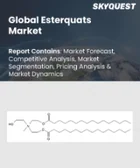
|
시장보고서
상품코드
1898574
에스테르쿼트 시장 규모, 점유율, 성장 분석 : 제품 유형별, 이온성별, 사슬 길이별, 용도별, 최종사용자별, 지역별 - 업계 예측(2026-2033년)Esterquats Market Size, Share, and Growth Analysis, By Product Type (Quaternary Ammonium Compounds, Betaines), By Ionic Nature (Cationic, Anionic), By Chain Length, By Application, By End-User, By Region - Industry Forecast 2026-2033 |
||||||

세계의 에스테르쿼트 시장 규모는 2024년에 18억 달러로 평가되며, 2025년 19억 달러에서 2033년까지 29억 4,000만 달러로 성장할 전망입니다. 예측 기간(2026-2033년)의 CAGR은 5.6%로 예측됩니다.
세계 에스테르쿼트 시장은 소비자의 인식 개선, 가처분 소득 증가, 유연제 제품의 지속적인 혁신에 힘입어 큰 폭의 성장이 예상됩니다. 기술의 발전으로 DHTDMAC와 같은 기존 대체품에 비해 우수한 성능과 비용 효율성을 달성하여 유연제 분야에서 점점 더 선호되고 있습니다. 식물 또는 동물 유래의 장쇄 지방산을 원료로 하는 에스테르쿼트는 치환된 4급 암모늄 화합물과 반응하여 생분해성 및 저독성 제품을 생산합니다. 에스테르쿼트는 섬유 관리 분야 외에도 퍼스널케어 제품, 헤어 컨디셔너, 부양 보조제 및 항균제로서 석유 및 가스 산업에서 광범위하게 활용되고 있습니다. 전반적인 추세는 다양한 산업 분야에서 지속가능하고 효율적인 배합에 대한 강한 지향성을 볼 수 있습니다.
세계 에스테르쿼트 시장 성장 촉진요인
세계 에스터쿼트 시장은 다양한 분야에서 자동화를 중시하는 혁신적인 제품 도입으로 인해 긍정적인 영향을 받고 있습니다. 예를 들어 세탁 업계에서는 기존의 손세탁에서 자동 세탁기의 보급 확대로의 전환이 두드러지게 나타나고 있습니다. 이러한 변화로 인해 섬유유연제, 세제 등 세탁 필수품에 대한 수요가 증가하고 있으며, 에스터쿼트는 이러한 제품에서 주요 계면활성제 역할을 하고 있습니다. 또한 산업용 및 시설용 세정제, 가정용 제품, 퍼스널케어 제품 등 주요 용도의 계면활성제 수요 증가가 에스테르콰트 시장의 성장을 가속할 것으로 예측됩니다. 전반적으로 계면활성제 시장의 확대는 에스테르콰트 분야에 큰 혜택을 가져다 줄 것입니다.
세계 에스테르쿼트 시장 성장 억제요인
세계 에스테르쿼트 시장은 모노트리에탄올아민, 디트리에탄올아민, 수지 또는 식물성 지방산과 같은 특정 원료의 필요성으로 인해 일정한 제약에 직면해 있습니다. 에탄올아민 제조의 주요 원료인 원유는 최근 가격 변동이 심합니다. 이러한 원유 가격의 불안정성은 에스터? 생산에 필요한 원재료 비용에 직접적인 영향을 미칩니다. 따라서 이러한 가격 변동은 에스테르? 시장의 성장 잠재력을 저해하는 중요한 요인으로 작용할 것으로 예상되며, 업계 제조업체와 이해관계자들에게 도전이 될 것으로 보입니다.
세계 에스테르쿼트 시장 동향
세계 에스테르쿼트 시장은 친환경 제품에 대한 소비자의 인식 증가, 가처분 소득 증가, 유연제 배합의 지속적인 혁신에 힘입어 괄목할 만한 성장세를 보이고 있습니다. 에스터콰트는 우수한 성능, 안전성, 높은 비용 효율성으로 주목받고 있으며, 특히 유연제를 비롯한 다양한 분야에서 채택이 확대되고 있습니다. 이러한 변화는 제조업체와 소비자 모두 저독성 및 생분해성 솔루션을 선호하고 있으며, DHTDMAC와 같은 기존 제제에서 벗어나 저독성 및 생분해성 솔루션으로의 전환으로 더욱 가속화되고 있습니다. 그 결과, 지속가능하고 효율적인 소비재에 대한 광범위한 흐름을 반영하여 시장은 지속적인 성장이 예상됩니다.
자주 묻는 질문
목차
서론
- 조사의 목적
- 조사 범위
- 정의
조사 방법
- 정보 조달
- 2차와 1차 데이터 방법
- 시장 규모 예측
- 시장 전제조건과 제한
개요
- 세계 시장 전망
- 공급과 수요 동향 분석
- 부문별 기회 분석
시장 역학과 전망
- 시장 규모
- 시장 역학
- 촉진요인과 기회
- 억제요인과 과제
- Porter의 산업 분석
주요 시장 인사이트
- 주요 성공 요인
- 경쟁의 정도
- 주요 투자 기회
- 시장 에코시스템
- 시장의 매력 지수(2025년)
- PESTEL 분석
- 거시경제 지표
- 밸류체인 분석
- 가격 분석
- 규제 상황
- 사례 연구
- 기술 분석
세계의 에스테르쿼트 시장 규모 : 제품 유형별 & CAGR(2026-2033)
- 제4급 암모늄 화합물
- 베타인류
- 이미다졸린
- 아민 옥시드
세계의 에스테르쿼트 시장 규모 : 이온성별 & CAGR(2026-2033)
- 양이온성
- 음이온성
- 비이온성
세계의 에스테르쿼트 시장 규모 : 사슬 길이별 & CAGR(2026-2033)
- 단쇄
- 중쇄
- 장쇄
세계의 에스테르쿼트 시장 규모 : 용도별 & CAGR(2026-2033)
- 대전 방지제
- 컨디셔닝제
- 분산제
- 응집제
- 유화제
세계의 에스테르쿼트 시장 규모 : 최종사용자별 & CAGR(2026-2033)
- 유연제
- 퍼스널케어 제품
- 유전용 화학제품
- 수처리
- 섬유 산업
세계의 에스테르쿼트 시장 규모 & CAGR(2026-2033)
- 북미
- 미국
- 캐나다
- 유럽
- 독일
- 스페인
- 프랑스
- 영국
- 이탈리아
- 기타 유럽 지역
- 아시아태평양
- 중국
- 인도
- 일본
- 한국
- 기타 아시아태평양
- 라틴아메리카
- 브라질
- 기타 라틴아메리카 지역
- 중동 및 아프리카
- GCC 국가
- 남아프리카공화국
- 기타 중동 및 아프리카
경쟁 정보
- 상위 5사의 비교
- 주요 기업의 시장 포지셔닝(2025년)
- 주요 시장 기업이 채택한 전략
- 최근 시장 동향
- 기업의 시장 점유율 분석(2025년)
- 주요 기업의 기업 개요
- 기업의 상세
- 제품 포트폴리오 분석
- 기업의 부문별 점유율 분석
- 매출의 전년대비 비교(2023-2025년)
주요 기업 개요
- Stepan Company(USA)
- Evonik Industries AG(Germany)
- Kao Corporation(Japan)
- Clariant AG(Switzerland)
- Akzo Nobel N.V.(Netherlands)
- BASF SE(Germany)
- Croda International Plc(UK)
- LG Household & Health Care Ltd.(South Korea)
- Dow Chemical Company(USA)
- Galaxy Surfactants Ltd.(India)
- Nouryon(Netherlands)
- Colonial Chemical, Inc.(USA)
- Venus Ethoxyethers Pvt. Ltd.(India)
- Neos Company Limited(Japan)
- Innospec Inc.(USA)
- Enaspol a.s.(Czech Republic)
- KLK OLEO(Malaysia)
결론과 제안
KSA 26.01.15Global Esterquats Market size was valued at USD 1.8 Billion in 2024 and is poised to grow from USD 1.9 Billion in 2025 to USD 2.94 Billion by 2033, growing at a CAGR of 5.6% during the forecast period (2026-2033).
The global esterquats market is set for significant growth driven by increased consumer awareness, rising disposable income, and continuous innovation in fabric softener products. These compounds are increasingly favored for fabric softening applications due to advancements in technology, which have led to their superior performance and cost-effectiveness over traditional alternatives like DHTDMAC. Esterquats, derived from long-chain fatty acids sourced from plant or animal feedstocks, interact with substituted quaternary ammonium compounds, resulting in biodegradable and low-toxicity products. Beyond fabric care, esterquats find extensive use in personal care items, hair conditioners, and the oil and gas sector as flotation aids and antibacterial agents. The overall trend indicates a strong inclination towards sustainable and efficient formulations across various industries.
Top-down and bottom-up approaches were used to estimate and validate the size of the Global Esterquats market and to estimate the size of various other dependent submarkets. The research methodology used to estimate the market size includes the following details: The key players in the market were identified through secondary research, and their market shares in the respective regions were determined through primary and secondary research. This entire procedure includes the study of the annual and financial reports of the top market players and extensive interviews for key insights from industry leaders such as CEOs, VPs, directors, and marketing executives. All percentage shares split, and breakdowns were determined using secondary sources and verified through Primary sources. All possible parameters that affect the markets covered in this research study have been accounted for, viewed in extensive detail, verified through primary research, and analyzed to get the final quantitative and qualitative data.
Global Esterquats Market Segments Analysis
Global Esterquats Market is segmented by Product Type, Ionic Nature, Chain Length, Application, End-User and region. Based on Product Type, the market is segmented into Quaternary Ammonium Compounds, Betaines, Imidazolines and Amine Oxides. Based on Ionic Nature, the market is segmented into Cationic, Anionic and Nonionic. Based on Chain Length, the market is segmented into Short-Chain, Medium-Chain and Long-Chain. Based on Application, the market is segmented into Antistatic Agents, Conditioning Agents, Dispersants, Flocculants and Emulsifiers. Based on End-User, the market is segmented into Fabric Softeners, Personal Care Products, Oilfield Chemicals, Water Treatment and Textile Industry. Based on region, the market is segmented into North America, Europe, Asia Pacific, Latin America and Middle East & Africa.
Driver of the Global Esterquats Market
The global Esterquats market is being positively influenced by innovative product introductions that emphasize automation across various sectors. For instance, there has been a noticeable shift from traditional manual washing to the increased adoption of automatic washing machines in the laundry industry. This transition has led to a heightened demand for laundry essentials, such as fabric softeners and detergents, with esterquats serving as a key surfactant in these products. Furthermore, the growing need for surfactants across major applications, including industrial and institutional cleaning solutions, home care items, and personal care products, is expected to propel the esterquats market. Overall, the surfactant market's expansion will significantly benefit the esterquats sector.
Restraints in the Global Esterquats Market
The Global Esterquats market faces certain constraints primarily due to the necessity of specific raw materials such as mono-triethanolamine, di-triethanolamine, and fatty acids sourced from either tallow or vegetable origins. A key ingredient in the production of ethanolamine is crude oil, whose prices have shown considerable volatility in recent years. This instability in crude oil pricing directly affects the costs of the required raw materials for esterquats production. Consequently, these fluctuating prices are anticipated to play a crucial role in hindering the growth potential of the esterquats market, presenting challenges for manufacturers and stakeholders in the industry.
Market Trends of the Global Esterquats Market
The Global Esterquats market is witnessing a notable surge driven by increasing consumer consciousness regarding eco-friendly products, enhanced disposable income, and ongoing innovations in fabric softener formulations. As esterquats gain traction for their superior performance, safety profiles, and cost-effectiveness, their adoption is becoming widespread in various sectors, particularly in fabric softeners. This shift is underscored by the move away from traditional agents like DHTDMAC, as manufacturers and consumers alike prioritize low-toxicity and biodegradable solutions. Consequently, the market is poised for sustained growth, reflecting a broader trend towards sustainable and efficient consumer products.
Table of Contents
Introduction
- Objectives of the Study
- Scope of the Report
- Definitions
Research Methodology
- Information Procurement
- Secondary & Primary Data Methods
- Market Size Estimation
- Market Assumptions & Limitations
Executive Summary
- Global Market Outlook
- Supply & Demand Trend Analysis
- Segmental Opportunity Analysis
Market Dynamics & Outlook
- Market Overview
- Market Size
- Market Dynamics
- Drivers & Opportunities
- Restraints & Challenges
- Porters Analysis
- Competitive rivalry
- Threat of substitute
- Bargaining power of buyers
- Threat of new entrants
- Bargaining power of suppliers
Key Market Insights
- Key Success Factors
- Degree of Competition
- Top Investment Pockets
- Market Ecosystem
- Market Attractiveness Index, 2025
- PESTEL Analysis
- Macro-Economic Indicators
- Value Chain Analysis
- Pricing Analysis
- Regulatory Landscape
- Case Studies
- Technological Analysis
Global Esterquats Market Size by Product Type & CAGR (2026-2033)
- Market Overview
- Quaternary Ammonium Compounds
- Betaines
- Imidazolines
- Amine Oxides
Global Esterquats Market Size by Ionic Nature & CAGR (2026-2033)
- Market Overview
- Cationic
- Anionic
- Nonionic
Global Esterquats Market Size by Chain Length & CAGR (2026-2033)
- Market Overview
- Short-Chain
- Medium-Chain
- Long-Chain
Global Esterquats Market Size by Application & CAGR (2026-2033)
- Market Overview
- Antistatic Agents
- Conditioning Agents
- Dispersants
- Flocculants
- Emulsifiers
Global Esterquats Market Size by End-User & CAGR (2026-2033)
- Market Overview
- Fabric Softeners
- Personal Care Products
- Oilfield Chemicals
- Water Treatment
- Textile Industry
Global Esterquats Market Size & CAGR (2026-2033)
- North America (Product Type, Ionic Nature, Chain Length, Application, End-User)
- US
- Canada
- Europe (Product Type, Ionic Nature, Chain Length, Application, End-User)
- Germany
- Spain
- France
- UK
- Italy
- Rest of Europe
- Asia Pacific (Product Type, Ionic Nature, Chain Length, Application, End-User)
- China
- India
- Japan
- South Korea
- Rest of Asia-Pacific
- Latin America (Product Type, Ionic Nature, Chain Length, Application, End-User)
- Brazil
- Rest of Latin America
- Middle East & Africa (Product Type, Ionic Nature, Chain Length, Application, End-User)
- GCC Countries
- South Africa
- Rest of Middle East & Africa
Competitive Intelligence
- Top 5 Player Comparison
- Market Positioning of Key Players, 2025
- Strategies Adopted by Key Market Players
- Recent Developments in the Market
- Company Market Share Analysis, 2025
- Company Profiles of All Key Players
- Company Details
- Product Portfolio Analysis
- Company's Segmental Share Analysis
- Revenue Y-O-Y Comparison (2023-2025)
Key Company Profiles
- Stepan Company (USA)
- Company Overview
- Business Segment Overview
- Financial Updates
- Key Developments
- Evonik Industries AG (Germany)
- Company Overview
- Business Segment Overview
- Financial Updates
- Key Developments
- Kao Corporation (Japan)
- Company Overview
- Business Segment Overview
- Financial Updates
- Key Developments
- Clariant AG (Switzerland)
- Company Overview
- Business Segment Overview
- Financial Updates
- Key Developments
- Akzo Nobel N.V. (Netherlands)
- Company Overview
- Business Segment Overview
- Financial Updates
- Key Developments
- BASF SE (Germany)
- Company Overview
- Business Segment Overview
- Financial Updates
- Key Developments
- Croda International Plc (UK)
- Company Overview
- Business Segment Overview
- Financial Updates
- Key Developments
- LG Household & Health Care Ltd. (South Korea)
- Company Overview
- Business Segment Overview
- Financial Updates
- Key Developments
- Dow Chemical Company (USA)
- Company Overview
- Business Segment Overview
- Financial Updates
- Key Developments
- Galaxy Surfactants Ltd. (India)
- Company Overview
- Business Segment Overview
- Financial Updates
- Key Developments
- Nouryon (Netherlands)
- Company Overview
- Business Segment Overview
- Financial Updates
- Key Developments
- Colonial Chemical, Inc. (USA)
- Company Overview
- Business Segment Overview
- Financial Updates
- Key Developments
- Venus Ethoxyethers Pvt. Ltd. (India)
- Company Overview
- Business Segment Overview
- Financial Updates
- Key Developments
- Neos Company Limited (Japan)
- Company Overview
- Business Segment Overview
- Financial Updates
- Key Developments
- Innospec Inc. (USA)
- Company Overview
- Business Segment Overview
- Financial Updates
- Key Developments
- Enaspol a.s. (Czech Republic)
- Company Overview
- Business Segment Overview
- Financial Updates
- Key Developments
- KLK OLEO (Malaysia)
- Company Overview
- Business Segment Overview
- Financial Updates
- Key Developments


