|
시장보고서
상품코드
1899338
초음파 센서 시장 규모, 점유율, 성장 분석 : 기술별, 유형별, 용도별, 지역별 - 업계 예측(2026-2033년)Ultrasonic Sensor Market Size, Share, and Growth Analysis, By Technology (Radio-reflective Sensors, Through-beam Sensors), By Type (Level Measurement, Distance Measurement), By Application, By Region - Industry Forecast 2026-2033 |
||||||

세계의 초음파 센서 시장 규모는 2024년에 57억 8,000만 달러로 평가되었고, 2025년 64억 2,000만 달러에서 2033년까지 149억 1,000만 달러로 성장할 전망이며, 예측 기간(2026-2033년) CAGR은 11.1%를 보일 것으로 예측됩니다.
세계 초음파 센서 시장은 다양한 산업 분야에서의 채용 확대에 힘입어 큰 폭의 성장이 예상되고 있습니다. 특히 의료 분야에서는 심초음파 검사 등의 용도에 대한 수요 증가가 새로운 기회를 창출하고 있습니다. 자동차 분야도 중요한 기여 분야로, 커넥티드카 및 자율주행차에서는 안전성을 높이기 위한 근접 감지에 초음파 센서가 필수적으로 사용되고 있습니다. 이 센서는 고체 및 액체 물체의 비접촉식 감지에 탁월하며, 오차범위를 최소화한 고정밀도를 제공합니다. 또한, 저렴한 가격과 빠른 측정 능력으로 인해 자재관리 분야에서 널리 보급되고 있습니다. 그러나 고주파가 생체 및 정밀 전자기기에 미치는 영향, 시끄러운 환경에서의 오감지 위험 등의 우려도 있어 신중한 도입이 요구됩니다. 전반적으로 응용 분야의 확대가 이 시장의 성장을 견인할 것으로 예측됩니다.
세계 초음파 센서 시장 성장 촉진요인
세계 초음파 센서 시장은 의료 분야에서의 채택 확대에 의해 크게 견인되고 있습니다. 이는 환자를 유해한 방사선에 노출시키지 않고도 고해상도 영상과 정밀한 측정을 실현할 수 있기 때문입니다. 초음파 센서는 초음파 진단 장치, 혈류 모니터, 수술 기구 등 다양한 의료기기에 내장되어 진단 정확도를 높이고 환자의 치료 결과를 향상시키고 있습니다. 또한, 기술의 발전으로 더 작고 저렴하며 다재다능한 센서가 개발되어 다양한 용도로 사용할 수 있게 되었습니다. 이러한 추세는 향후 의료기기에 초음파 센서의 통합이 유망한 궤도에 있음을 보여줍니다.
세계 초음파 센서 시장 성장 억제요인
세계 초음파 센서 시장은 감지 범위의 한계로 인해 심각한 문제에 직면해 있습니다. 물체 감지 및 거리 측정에 널리 사용되는 초음파 센서는 일정 거리를 초과하는 물체의 정확한 식별이 어렵습니다. 이 한계는 음파가 공기 중에 전파될 때 확산되는 특성에 기인합니다. 또한 온도, 습도, 기압과 같은 환경적 요인은 이러한 센서의 성능과 정확도에 악영향을 미칠 수 있습니다. 따라서 신뢰할 수 있는 물체 감지를 위해 초음파 기술에 의존하는 시스템을 개발할 때 이러한 제약조건을 고려하는 것이 매우 중요합니다.
세계 초음파 센서 시장 동향
세계 초음파 센서 시장에서는 고급 감지 기능에 대한 수요 증가를 배경으로 눈에 띄는 추세가 관찰되고 있습니다. 기존의 초음파 센서는 거리 측정이나 물체 감지 등에서 높은 정확도를 보였으나, 감지 범위의 한계로 인해 자율주행차나 드론 등의 응용 분야에서 문제가 되고 있습니다. 이러한 제약 조건으로 인해 업계 이해관계자들은 센서의 작동 범위를 확대하기 위한 연구개발에 투자하고 있습니다. 기술 혁신과 대체 구성의 모색이 진행되고 있으며, 성능 향상뿐만 아니라 다양한 분야로의 적용 범위 확대가 기대됩니다. 이러한 발전과 함께 초음파 센서의 채택이 급증하고 현대 기술 솔루션에서 초음파 센서의 중요한 역할이 더욱 강화될 것으로 예측됩니다.
자주 묻는 질문
목차
서론
- 조사 목적
- 조사 범위
- 정의
조사 방법
- 정보 조달
- 2차와 1차 데이터 방법
- 시장 규모 예측
- 시장 전제조건과 제한
주요 요약
- 세계 시장 전망
- 공급과 수요 동향 분석
- 부문별 기회 분석
시장 역학과 전망
- 시장 규모
- 시장 역학
- 성장 촉진요인과 기회
- 성장 억제요인과 과제
- Porter의 Five Forces 분석
주요 시장 인사이트
- 중요 성공 요인
- 경쟁 정도
- 주요 투자 기회
- 시장 생태계
- 시장의 매력 지수(2025년)
- PESTEL 분석
- 거시경제 지표
- 밸류체인 분석
- 가격 분석
세계의 초음파 센서 시장 규모 : 기술별&CAGR(2026-2033)
- Radio-reflective Sensors
- Through-beam Sensors
- 기타
세계의 초음파 센서 시장 규모 : 유형별&CAGR(2026-2033)
- 레벨 측정
- 거리 측정
- 장애물 감지
- 기타
세계의 초음파 센서 시장 규모 : 용도별&CAGR(2026-2033)
- 가전제품
- 자동차
- 항공우주 및 방위
- 헬스케어
- 산업용
- 기타
세계의 초음파 센서 시장 규모&CAGR(2026-2033)
- 북미
- 미국
- 캐나다
- 유럽
- 독일
- 스페인
- 프랑스
- 영국
- 이탈리아
- 기타 유럽
- 아시아태평양
- 중국
- 인도
- 일본
- 한국
- 기타 아시아태평양
- 라틴아메리카
- 브라질
- 기타 라틴아메리카
- 중동 및 아프리카
- GCC 국가
- 남아프리카공화국
- 기타 중동 및 아프리카
경쟁 정보
- 주요 5개사 비교
- 주요 기업의 시장 포지셔닝(2025년)
- 주요 시장 기업이 채택한 전략
- 최근 시장 동향
- 기업의 시장 점유율 분석(2025년)
- 주요 기업 개요
- 기업 상세
- 제품 포트폴리오 분석
- 기업 부문별 점유율 분석
- 매출 전년대비 비교(2023-2025년)
주요 기업 개요
- Pepperl+Fuchs SE(Germany)
- Keyence Corporation(Japan)
- Honeywell International Inc.(USA)
- Baumer Group(Switzerland)
- Sick AG(Germany)
- Omron Corporation(Japan)
- Murata Manufacturing Co., Ltd.(Japan)
- Balluff GmbH(Germany)
- Banner Engineering Corp.(USA)
- TE Connectivity(Switzerland)
- Robert Bosch GmbH(Germany)
- Sensata Technologies(USA)
- Texas Instruments Incorporated(USA)
- Infineon Technologies AG(Germany)
- ams AG(Austria)
- First Sensor AG(Germany)
- MaxBotix Inc.(USA)
- Migatron Corporation(USA)
- Senix Corporation(USA)
- Microsonic GmbH(Germany)
결론과 제안
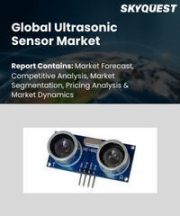
LSH 26.01.16Global Ultrasonic Sensor Market size was valued at USD 5.78 Billion in 2024 and is poised to grow from USD 6.42 Billion in 2025 to USD 14.91 Billion by 2033, growing at a CAGR of 11.1% during the forecast period (2026-2033).
The global ultrasonic sensor market is poised for substantial growth driven by rising adoption across various industries. Particularly in healthcare, increasing demand for applications like echocardiograms is creating new opportunities. The automotive sector is also a significant contributor, as connected and autonomous vehicles necessitate ultrasonic sensors for proximity detection to enhance safety. These sensors excel at non-contact detection of solid and liquid objects, offering precision with minimal error margins. Additionally, their affordability and rapid measurement capabilities facilitate widespread use in material handling. However, potential concerns regarding the effects of high-frequency waves on living organisms and sensitive electronics, as well as risks of false detections in noisy environments, underscore the importance of careful deployment. Overall, enhanced applications are expected to drive growth in this market.
Top-down and bottom-up approaches were used to estimate and validate the size of the Global Ultrasonic Sensor market and to estimate the size of various other dependent submarkets. The research methodology used to estimate the market size includes the following details: The key players in the market were identified through secondary research, and their market shares in the respective regions were determined through primary and secondary research. This entire procedure includes the study of the annual and financial reports of the top market players and extensive interviews for key insights from industry leaders such as CEOs, VPs, directors, and marketing executives. All percentage shares split, and breakdowns were determined using secondary sources and verified through Primary sources. All possible parameters that affect the markets covered in this research study have been accounted for, viewed in extensive detail, verified through primary research, and analyzed to get the final quantitative and qualitative data.
Global Ultrasonic Sensor Market Segments Analysis
Global Ultrasonic Sensor Market is segmented by Technology, Type, Application and region. Based on Technology, the market is segmented into Radio-reflective Sensors, Through-beam Sensors and Others. Based on Type, the market is segmented into Level Measurement, Distance Measurement, Obstacle Detection and Others. Based on Application, the market is segmented into Consumer Electronics, Automotive, Aerospace & Defense, Healthcare, Industrial and Others. Based on region, the market is segmented into North America, Europe, Asia Pacific, Latin America and Middle East & Africa.
Driver of the Global Ultrasonic Sensor Market
The Global Ultrasonic Sensor market is being significantly driven by the increasing adoption of these sensors in the medical sector, thanks to their capability to deliver high-resolution imaging and precise measurements without exposing patients to harmful radiation. Ultrasonic sensors are integrated into various medical instruments, including ultrasound machines, blood flow monitors, and surgical tools, which enhances diagnostic accuracy and improves patient outcomes. Furthermore, advancements in technology have led to the development of smaller, more affordable, and versatile sensors, allowing for a broader range of applications. This trend indicates a promising trajectory for the integration of ultrasonic sensors in medical devices moving forward.
Restraints in the Global Ultrasonic Sensor Market
The global ultrasonic sensor market faces significant challenges due to inherent limitations in detection range. Ultrasonic sensors, which are widely employed for object detection and distance measurement, struggle to accurately identify objects beyond a specified distance. This limitation arises from the characteristics of sound waves, which tend to disperse as they move through the air. Furthermore, environmental factors such as temperature, humidity, and air pressure can adversely impact the performance and precision of these sensors. As a result, it becomes crucial to account for these constraints when developing systems that depend on ultrasonic technology for reliable object detection.
Market Trends of the Global Ultrasonic Sensor Market
The Global Ultrasonic Sensor market is witnessing a significant trend driven by the growing demand for enhanced detection capabilities. While traditional ultrasonic sensors have excelled in accuracy for distance measurement and object detection, their limited detection range poses challenges in applications such as autonomous vehicles and drones. This limitation has prompted industry stakeholders to invest in research and development aimed at extending the operational range of these sensors. Innovations in technology and alternative configurations are being explored, which could not only improve performance but also broaden the scope of their applications across diverse sectors. As these advancements unfold, we can anticipate a surge in the adoption of ultrasonic sensors, reinforcing their vital role in modern technology solutions.
Table of Contents
Introduction
- Objectives of the Study
- Scope of the Report
- Definitions
Research Methodology
- Information Procurement
- Secondary & Primary Data Methods
- Market Size Estimation
- Market Assumptions & Limitations
Executive Summary
- Global Market Outlook
- Supply & Demand Trend Analysis
- Segmental Opportunity Analysis
Market Dynamics & Outlook
- Market Overview
- Market Size
- Market Dynamics
- Drivers & Opportunities
- Restraints & Challenges
- Porters Analysis
- Competitive rivalry
- Threat of substitute
- Bargaining power of buyers
- Threat of new entrants
- Bargaining power of suppliers
Key Market Insights
- Key Success Factors
- Degree of Competition
- Top Investment Pockets
- Market Ecosystem
- Market Attractiveness Index, 2025
- PESTEL Analysis
- Macro-Economic Indicators
- Value Chain Analysis
- Pricing Analysis
Global Ultrasonic Sensor Market Size by Technology & CAGR (2026-2033)
- Market Overview
- Radio-reflective Sensors
- Through-beam Sensors
- Others
Global Ultrasonic Sensor Market Size by Type & CAGR (2026-2033)
- Market Overview
- Level Measurement
- Distance Measurement
- Obstacle Detection
- Others
Global Ultrasonic Sensor Market Size by Application & CAGR (2026-2033)
- Market Overview
- Consumer Electronics
- Automotive
- Aerospace & Defense
- Healthcare
- Industrial
- Others
Global Ultrasonic Sensor Market Size & CAGR (2026-2033)
- North America (Technology, Type, Application)
- US
- Canada
- Europe (Technology, Type, Application)
- Germany
- Spain
- France
- UK
- Italy
- Rest of Europe
- Asia Pacific (Technology, Type, Application)
- China
- India
- Japan
- South Korea
- Rest of Asia-Pacific
- Latin America (Technology, Type, Application)
- Brazil
- Rest of Latin America
- Middle East & Africa (Technology, Type, Application)
- GCC Countries
- South Africa
- Rest of Middle East & Africa
Competitive Intelligence
- Top 5 Player Comparison
- Market Positioning of Key Players, 2025
- Strategies Adopted by Key Market Players
- Recent Developments in the Market
- Company Market Share Analysis, 2025
- Company Profiles of All Key Players
- Company Details
- Product Portfolio Analysis
- Company's Segmental Share Analysis
- Revenue Y-O-Y Comparison (2023-2025)
Key Company Profiles
- Pepperl+Fuchs SE (Germany)
- Company Overview
- Business Segment Overview
- Financial Updates
- Key Developments
- Keyence Corporation (Japan)
- Company Overview
- Business Segment Overview
- Financial Updates
- Key Developments
- Honeywell International Inc. (USA)
- Company Overview
- Business Segment Overview
- Financial Updates
- Key Developments
- Baumer Group (Switzerland)
- Company Overview
- Business Segment Overview
- Financial Updates
- Key Developments
- Sick AG (Germany)
- Company Overview
- Business Segment Overview
- Financial Updates
- Key Developments
- Omron Corporation (Japan)
- Company Overview
- Business Segment Overview
- Financial Updates
- Key Developments
- Murata Manufacturing Co., Ltd. (Japan)
- Company Overview
- Business Segment Overview
- Financial Updates
- Key Developments
- Balluff GmbH (Germany)
- Company Overview
- Business Segment Overview
- Financial Updates
- Key Developments
- Banner Engineering Corp. (USA)
- Company Overview
- Business Segment Overview
- Financial Updates
- Key Developments
- TE Connectivity (Switzerland)
- Company Overview
- Business Segment Overview
- Financial Updates
- Key Developments
- Robert Bosch GmbH (Germany)
- Company Overview
- Business Segment Overview
- Financial Updates
- Key Developments
- Sensata Technologies (USA)
- Company Overview
- Business Segment Overview
- Financial Updates
- Key Developments
- Texas Instruments Incorporated (USA)
- Company Overview
- Business Segment Overview
- Financial Updates
- Key Developments
- Infineon Technologies AG (Germany)
- Company Overview
- Business Segment Overview
- Financial Updates
- Key Developments
- ams AG (Austria)
- Company Overview
- Business Segment Overview
- Financial Updates
- Key Developments
- First Sensor AG (Germany)
- Company Overview
- Business Segment Overview
- Financial Updates
- Key Developments
- MaxBotix Inc. (USA)
- Company Overview
- Business Segment Overview
- Financial Updates
- Key Developments
- Migatron Corporation (USA)
- Company Overview
- Business Segment Overview
- Financial Updates
- Key Developments
- Senix Corporation (USA)
- Company Overview
- Business Segment Overview
- Financial Updates
- Key Developments
- Microsonic GmbH (Germany)
- Company Overview
- Business Segment Overview
- Financial Updates
- Key Developments