|
시장보고서
상품코드
1902762
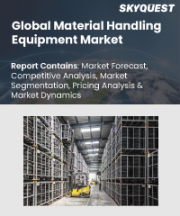
자재관리 장비 시장 규모, 점유율, 성장 분석(장비 유형별, 용도별, 지역별) : 산업 예측(2026-2033년)Material Handling Equipment Market Size, Share, and Growth Analysis, By Equipment Type (Transport Equipment, Roller), By Application (Automotive, Food & Beverages), By Region - Industry Forecast 2026-2033 |
||||||

자재관리 장비 시장 규모는 2024년에 2,519억 5,000만 달러로 평가되었고, 2025년 2,663억 1,000만 달러에서 2033년까지 4,149억 4,000만 달러로 성장할 전망이며, 예측 기간(2026-2033년) CAGR은 5.7%를 보일 것으로 예측됩니다.
산업화의 급속한 발전과 자동화 수요 증가를 배경으로 자재관리 장비 시장은 괄목할만한 성장이 예상됩니다. 팬데믹 초기에는 제품 유통의 혼란과 노동력 부족으로 창고 산업이 영향을 받았지만, 이후 산업기계에 대한 투자 전환이 진행되어 경제의 회복력을 보여주고 있습니다. 이러한 모멘텀은 작업자 안전, 효율적인 벌크 자재관리, IoT를 포함한 인더스트리 4.0 기술 통합에 대한 관심이 높아짐에 따라 더욱 가속화되고 있습니다. 혼란을 최소화하고 공급망 효율성 향상에 대한 관심이 높아지면서 시장 확대가 더욱 가속화되고 있습니다. 특히, 온라인 쇼핑의 확산과 물류 인프라의 발전에 힘입어 전자상거래 부문은 큰 폭의 성장이 예상되며, 창고 운영자는 보다 효과적인 자재관리 솔루션을 도입해야 하는 상황에 직면해 있습니다.
자재관리 장비 시장 성장 촉진요인
자재관리 장비 시장은 내구소비재와 비내구소비재 판매 증가에 힘입어 괄목할 만한 성장세를 보이고 있습니다. 이러한 수요 증가는 산업 요구 사항의 변화, 소비자 지출 증가, 경제 성장 등 여러 요인이 영향을 미치고 있습니다. 산업계가 효율적인 물류 및 공급망 관리에 대한 요구가 증가함에 따라 첨단 장비의 필요성이 더욱 부각되고 있습니다. 이러한 추세는 전자상거래가 활발한 지역에서 특히 두드러지게 나타나고 있으며, 제품 이동이 현저하게 증가하고 있습니다. 제품 판매 증가는 다양한 분야의 업무 효율화에 있어 자재관리 장비가 중요한 역할을 하고 있음을 보여줍니다.
자재관리 장비 시장 성장 억제요인
자재관리 장비 시장은 전자상거래 부문의 성장과 다양한 상품에 대한 수요 증가의 혜택을 누리고 있음에도 불구하고 현재 심각한 제약에 직면해 있습니다. 이러한 확장에는 업계 내 첨단 기술 통합의 복잡성이 수반됩니다. 자재관리에 대한 진화하는 요구사항은 자동화, 로봇 공학 및 혁신 기술과 관련된 복잡한 과제를 해결하기 위해 정교하고 통합적인 솔루션을 필요로 합니다. 기업이 업무 최적화를 목표로 하는 상황에서 이러한 복잡한 시스템을 성공적으로 통합하는 것은 효율성을 달성하고, 생산성을 향상시키며, 끊임없이 변화하는 시장 환경에서 경쟁 우위를 유지하는 데 매우 중요합니다.
자재관리 장비 시장 동향
자재관리 장비 시장에서는 인체공학 및 안전성을 향상시키기 위한 두드러진 추세를 볼 수 있습니다. 제조업체들은 작업자의 편안함, 피로 감소 및 전반적인 효율성 향상에 대한 중요성을 인식하고 인체공학적 원칙을 설계에 통합하는 것을 점점 더 우선시하고 있습니다. 이러한 인체공학에 대한 노력은 안전에 대한 강한 강조와 함께 규제 기준을 충족할 뿐만 아니라 보다 안전한 작업 환경을 조성하기 위한 첨단 기술의 통합이 이루어지고 있습니다. 이러한 측면에 집중함으로써 업계는 근로자의 건강 증진과 사고 위험을 최소화하기 위해 노력하고 있으며, 이를 통해 해당 부문의 지속 가능한 성장과 혁신을 뒷받침하고 있습니다.
자주 묻는 질문
목차
서론
- 분석 목적
- 분석 범위
- 정의
분석 방법
- 정보 조달
- 2차·1차 데이터 방법
- 시장 규모 예측
- 시장 전제조건과 제약 조건
주요 요약
- 세계 시장 전망
- 수급 동향 분석
- 부문별 기회 분석
시장 역학과 전망
- 시장 규모
- 시장 역학
- 성장 촉진요인과 기회
- 성장 억제요인과 과제
- Porter's Five Forces 분석
시장 주요 인사이트
- 중요 성공 요인
- 경쟁 정도
- 주요 투자 기회
- 시장 생태계
- 시장의 매력 지수(2025년)
- PESTEL 분석
- 거시경제 지표
- 밸류체인 분석
- 가격 분석
- 기술적 진보
- 사례 연구
세계의 자재관리 장비 시장 규모·CAGR : 장비 유형별(2026-2033년)
- 운송
- 롤러
- 체인
- 차륜
- 기타
- 수직형
- 스크류 컨베이어
- 경사 벨트 컨베이어
- 지브크레인
- 브릿지 크레인
- 갠트리 크레인
- 기타
- 해머헤드
- 신축식
- 크롤러
- 핸드 트럭
- 팰릿 트럭
- 리프트 트럭
- 기타
- 팰릿 잭
- 사이드 로더
- 보행식 스탁카
- 컨베이어
- 크레인
- 산업용 트럭
- 무인운반차(AGV)
- 기타
- 호퍼
- 회수 장비
- 핸들링 기기
- 족크레베라
- 호이스트
- 기타
- 로터리 인덱스 테이블
- 리프트/틸트/턴테이블
- 부품 공급 장비
- 바란스
- 락·보관 설비
- 자동 창고 시스템
- 선택식 팰릿 락
- 기타
- 슬라이드 락
- 스태킹 프레임
- Push-back Racks
- 기타
- 유닛 로드 형성 설비
- 식별
- 제어장치
세계의 자재관리 장비 시장 규모·CAGR : 용도별(2026-2033년)
- 자동차
- 식품 및 음료
- 화학
- 반도체 및 전자기기
- 전자상거래
- 항공
- 제약
- 기타
세계의 자재관리 장비 시장 규모·CAGR(2026-2033년)
- 북미
- 미국
- 캐나다
- 유럽
- 독일
- 스페인
- 프랑스
- 영국
- 이탈리아
- 기타 유럽
- 아시아태평양
- 중국
- 인도
- 일본
- 한국
- 기타 아시아태평양
- 라틴아메리카
- 브라질
- 기타 라틴아메리카
- 중동 및 아프리카
- GCC 국가
- 남아프리카공화국
- 기타 중동 및 아프리카
경쟁 구도
- 주요 5개사 비교
- 주요 기업의 시장 포지셔닝(2025년)
- 주요 기업이 채택한 전략
- 시장 최근 동향
- 주요 기업의 시장 점유율(2025년)
- 주요 기업 개요
- 기업 개요
- 제품 포트폴리오 분석
- 기업 부문별 점유율 분석
- 매출 전년대비 비교(2023-2025년)
주요 기업 개요
- Caterpillar Inc.(United States)
- Komatsu Ltd.(Japan)
- XCMG Group(China)
- Deere & Company(United States)
- Sany Heavy Industry Co., Ltd.(China)
- Volvo Construction Equipment(Sweden)
- Liebherr Group(Switzerland)
- Hitachi Construction Machinery Co., Ltd.(Japan)
- Sandvik AB(Sweden)
- JCB(United Kingdom)
- KION Group AG(Germany)
- Konecranes Oyj(Finland)
- Anhui Heli Co., Ltd.(China)
- Hyundai Construction Equipment Co., Ltd.(South Korea)
- Manitou Group(France)
- Terex Corporation(United States)
- Doosan Infracore Co., Ltd.(South Korea)
- Zoomlion Heavy Industry Science and Technology Co., Ltd.(China)
- Mitsubishi Logisnext Co., Ltd.(Japan)
- Cargotec Corporation(Finland)
결론과 제안
LSH 26.01.21Material Handling Equipment Market size was valued at USD 251.95 Billion in 2024 and is poised to grow from USD 266.31 Billion in 2025 to USD 414.94 Billion by 2033, growing at a CAGR of 5.7% during the forecast period (2026-2033).
The material handling equipment market is set for significant growth, fueled by rapid industrialization and a rising demand for automation. While the pandemic initially hindered the warehousing sector due to disruptions in product movement and labor shortages, there has been a subsequent shift towards investing in industrial machinery, reflecting a resilient economy. This momentum is fostered by a heightened focus on worker safety, efficient bulk material management, and the integration of Industry 4.0 technologies, including IoT. The increasing emphasis on minimizing disruptions and enhancing supply chain efficiency further supports market expansion. Notably, the e-commerce sector is anticipated to experience substantial growth, driven by the proliferation of online shopping and advancements in logistics infrastructure, prompting warehouse operators to adopt more effective material handling solutions.
Top-down and bottom-up approaches were used to estimate and validate the size of the Material Handling Equipment market and to estimate the size of various other dependent submarkets. The research methodology used to estimate the market size includes the following details: The key players in the market were identified through secondary research, and their market shares in the respective regions were determined through primary and secondary research. This entire procedure includes the study of the annual and financial reports of the top market players and extensive interviews for key insights from industry leaders such as CEOs, VPs, directors, and marketing executives. All percentage shares split, and breakdowns were determined using secondary sources and verified through Primary sources. All possible parameters that affect the markets covered in this research study have been accounted for, viewed in extensive detail, verified through primary research, and analyzed to get the final quantitative and qualitative data.
Material Handling Equipment Market Segments Analysis
Global Material Handling Equipment Market is segmented by Equipment Type, Application and region. Based on Equipment Type, the market is segmented into Transport Equipment, Roller, Chain, Wheel, Others, Jib Cranes, Hand Trucks, Conveyors, Handling Equipment, Racking & Storage Equipment and Others. Based on Application, the market is segmented into Automotive, Food & Beverages, Chemical, Semiconductor & Electronics, E-commerce, Aviation, Pharmaceutical and Others. Based on region, the market is segmented into North America, Europe, Asia Pacific, Latin America and Middle East & Africa.
Driver of the Material Handling Equipment Market
The Material Handling Equipment market is experiencing significant growth, driven by an increase in the sales of both durable and nondurable goods. This rising demand is influenced by several factors, including shifting industrial requirements, rising consumer spending, and economic expansion. As industries grapple with an escalating need for efficient logistics and supply chain management, the necessity for advanced equipment has become more pronounced. This trend is particularly evident in regions where e-commerce is thriving, leading to a remarkable rise in product movement. The heightened sales of goods underscore the essential function that material handling equipment serves in streamlining operations across diverse sectors.
Restraints in the Material Handling Equipment Market
The Material Handling Equipment market is currently facing significant constraints despite benefiting from the growth of the e-commerce sector and an uptick in demand for various goods. This expansion is accompanied by the complexities involved in integrating advanced technologies within the industry. The evolving requirements for material handling necessitate sophisticated and cohesive solutions to tackle the intricate challenges associated with automation, robotics, and innovative technologies. As businesses aim to optimize their operations, the successful integration of these complex systems is crucial for achieving efficiency, boosting productivity, and sustaining a competitive advantage in an ever-changing market landscape.
Market Trends of the Material Handling Equipment Market
The Material Handling Equipment market is witnessing a notable trend towards enhancing ergonomics and safety. Manufacturers increasingly prioritize the integration of ergonomic principles into their designs, recognizing their vital role in operator comfort, fatigue reduction, and overall efficiency improvement. This commitment to ergonomics is matched by a strong emphasis on safety, with the incorporation of advanced technologies that not only meet regulatory standards but also foster a safer work environment. By focusing on these aspects, the industry is dedicated to promoting operator well-being and minimizing accident risks, thus supporting the sustainable growth and innovation within the sector.
Table of Contents
Introduction
- Objectives of the Study
- Scope of the Report
- Definitions
Research Methodology
- Information Procurement
- Secondary & Primary Data Methods
- Market Size Estimation
- Market Assumptions & Limitations
Executive Summary
- Global Market Outlook
- Supply & Demand Trend Analysis
- Segmental Opportunity Analysis
Market Dynamics & Outlook
- Market Overview
- Market Size
- Market Dynamics
- Drivers & Opportunities
- Restraints & Challenges
- Porters Analysis
- Competitive rivalry
- Threat of substitute
- Bargaining power of buyers
- Threat of new entrants
- Bargaining power of suppliers
Key Market Insights
- Key Success Factors
- Degree of Competition
- Top Investment Pockets
- Market Ecosystem
- Market Attractiveness Index, 2025
- PESTEL Analysis
- Macro-Economic Indicators
- Value Chain Analysis
- Pricing Analysis
- Technological Advancement
- Case Studies
Global Material Handling Equipment Market Size by Equipment Type & CAGR (2026-2033)
- Market Overview
- Transport Equipment
- Roller
- Chain
- Wheel
- Others
- Vertical
- Screw Conveyor
- Inclined Belt
- Jib Cranes
- Bridge Cranes
- Gantry Cranes
- Others
- Hammerhead
- Telescopic
- Crawler
- Hand Trucks
- Pallet Trucks
- Lift Truck
- Others
- Pallet Jacks
- Side Loaders
- Walking Stackers
- Conveyors
- Cranes
- Industrial Trucks
- Automated Guided Vehicles AGVs
- Others
- Hoppers
- Reclaimers
- Handling Equipment
- Dock Leveler
- Hoist
- Others
- Rotary Index Table
- Lift/Tilt/Turn Table
- Parts Feeder
- Balancer
- Racking & Storage Equipment
- Automatic Storage/Retrieval System
- Selective Pallet Rack
- Others
- Sliding Racks
- Stacking Frames
- Push-back Racks
- Others
- Unit Load Formation Equipment
- Identification
- Control Equipment
Global Material Handling Equipment Market Size by Application & CAGR (2026-2033)
- Market Overview
- Automotive
- Food & Beverages
- Chemical
- Semiconductor & Electronics
- E-commerce
- Aviation
- Pharmaceutical
- Others
Global Material Handling Equipment Market Size & CAGR (2026-2033)
- North America (Equipment Type, Application)
- US
- Canada
- Europe (Equipment Type, Application)
- Germany
- Spain
- France
- UK
- Italy
- Rest of Europe
- Asia Pacific (Equipment Type, Application)
- China
- India
- Japan
- South Korea
- Rest of Asia-Pacific
- Latin America (Equipment Type, Application)
- Brazil
- Rest of Latin America
- Middle East & Africa (Equipment Type, Application)
- GCC Countries
- South Africa
- Rest of Middle East & Africa
Competitive Intelligence
- Top 5 Player Comparison
- Market Positioning of Key Players, 2025
- Strategies Adopted by Key Market Players
- Recent Developments in the Market
- Company Market Share Analysis, 2025
- Company Profiles of All Key Players
- Company Details
- Product Portfolio Analysis
- Company's Segmental Share Analysis
- Revenue Y-O-Y Comparison (2023-2025)
Key Company Profiles
- Caterpillar Inc. (United States)
- Company Overview
- Business Segment Overview
- Financial Updates
- Key Developments
- Komatsu Ltd. (Japan)
- Company Overview
- Business Segment Overview
- Financial Updates
- Key Developments
- XCMG Group (China)
- Company Overview
- Business Segment Overview
- Financial Updates
- Key Developments
- Deere & Company (United States)
- Company Overview
- Business Segment Overview
- Financial Updates
- Key Developments
- Sany Heavy Industry Co., Ltd. (China)
- Company Overview
- Business Segment Overview
- Financial Updates
- Key Developments
- Volvo Construction Equipment (Sweden)
- Company Overview
- Business Segment Overview
- Financial Updates
- Key Developments
- Liebherr Group (Switzerland)
- Company Overview
- Business Segment Overview
- Financial Updates
- Key Developments
- Hitachi Construction Machinery Co., Ltd. (Japan)
- Company Overview
- Business Segment Overview
- Financial Updates
- Key Developments
- Sandvik AB (Sweden)
- Company Overview
- Business Segment Overview
- Financial Updates
- Key Developments
- JCB (United Kingdom)
- Company Overview
- Business Segment Overview
- Financial Updates
- Key Developments
- KION Group AG (Germany)
- Company Overview
- Business Segment Overview
- Financial Updates
- Key Developments
- Konecranes Oyj (Finland)
- Company Overview
- Business Segment Overview
- Financial Updates
- Key Developments
- Anhui Heli Co., Ltd. (China)
- Company Overview
- Business Segment Overview
- Financial Updates
- Key Developments
- Hyundai Construction Equipment Co., Ltd. (South Korea)
- Company Overview
- Business Segment Overview
- Financial Updates
- Key Developments
- Manitou Group (France)
- Company Overview
- Business Segment Overview
- Financial Updates
- Key Developments
- Terex Corporation (United States)
- Company Overview
- Business Segment Overview
- Financial Updates
- Key Developments
- Doosan Infracore Co., Ltd. (South Korea)
- Company Overview
- Business Segment Overview
- Financial Updates
- Key Developments
- Zoomlion Heavy Industry Science and Technology Co., Ltd. (China)
- Company Overview
- Business Segment Overview
- Financial Updates
- Key Developments
- Mitsubishi Logisnext Co., Ltd. (Japan)
- Company Overview
- Business Segment Overview
- Financial Updates
- Key Developments
- Cargotec Corporation (Finland)
- Company Overview
- Business Segment Overview
- Financial Updates
- Key Developments