|
시장보고서
상품코드
1902803
방송 장비 시장 규모, 점유율, 성장 분석 : 유형별, 기술별, 주파수별, 용도별, 지역별 - 업계 예측(2026-2033년)Broadcasting Equipment Market Size, Share, and Growth Analysis, By Type (Dish Antennas, Amplifiers), By Technology (Analog, Digital), By Frequency, By Application, By Region - Industry Forecast 2026-2033 |
||||||

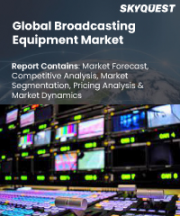
방송 장비 시장 규모는 2024년에 58억 3,000만 달러로 평가되었고, 2025년 61억 4,000만 달러에서 2033년까지 92억 9,000만 달러로 성장할 전망이며, 예측 기간(2026-2033년) CAGR은 5.3%를 보일 것으로 예측됩니다.
세계 방송 장비 시장은 몇 가지 주요 촉진요인으로 인해 괄목할 만한 성장세를 보이고 있습니다. 고품질 컨텐츠에 대한 수요 증가와 더불어 디지털 미디어 플랫폼의 급속한 확장은 방송 산업에 큰 영향을 미치고 있습니다. 영상 제작, 컨텐츠 전송, 방송 인프라의 지속적인 기술 혁신이 산업 구조를 변화시키고 있으며, 첨단 카메라, 비디오 서버, 인코더, 전송 장치 등의 혁신 기술이 주도적인 역할을 하고 있습니다. 또한, 신호 품질 향상, 효율적인 스펙트럼 활용, 보다 다양한 채널과 서비스 제공의 필요성으로 인해 많은 지역에서 아날로그 방송에서 디지털 방송으로 전환이 진행되고 있습니다. 그러나 복잡한 규제, 높은 초기 도입 비용, 기술 진화에 대응하기 위한 지속적인 업데이트의 필요성 등 시장에는 여러 가지 과제가 존재합니다.
방송 장비 시장 활성화 요인
방송 분야의 지속적인 진화는 방송 장비 수요를 견인하는 중요한 요소입니다. 이 산업은 카메라, 서버, 인코더, 컨텐츠 제작 및 전송을 강화하는 각종 장치 등 기술 측면에서 꾸준한 발전을 보이고 있습니다. 또한, 아날로그 방송에서 디지털 방송으로의 전환은 신호 품질 향상, 스펙트럼 효율 개선, 이용 가능한 채널 및 서비스 확대 등의 측면에서 이러한 성장에 크게 기여하고 있습니다. 이러한 혁신은 컨텐츠의 질을 높일 뿐만 아니라, 방송 환경에서의 유통 가능성과 소비자와의 소통 방식을 확장하고 있습니다.
방송 장비 시장 성장 억제요인
방송 장비 시장이 직면한 큰 과제 중 하나는 첨단 방송 기술 구매 및 설치에 필요한 막대한 초기 투자 비용입니다. 이 높은 비용은 신규 진입을 저해하고 기존 기업의 성장을 제한할 수 있습니다. 또한, 지역별로 복잡한 규제 상황이 존재하는 것도 장벽이 되어 대응하기 어려운 컴플라이언스 문제를 야기합니다. 이러한 규제적 장애물은 운영상의 어려움을 가중시킬 뿐만 아니라, 시장 진출기업들이 규정 준수를 위해 추가적인 자원을 투입해야 하기 때문에 시장 내 효과적인 혁신과 확장 능력에 영향을 미칠 수 있습니다.
방송 장비 시장 동향
방송 장비 시장에서는 클라우드 기반 솔루션의 도입이 두드러진 추세로 컨텐츠의 저장, 처리, 전송 방식을 변화시키고 있습니다. 이러한 기술은 방송 사업자에게 유연성, 확장성, 비용 효율성 향상을 가져다주며, 자원 활용의 최적화와 업무 효율화를 실현합니다. 또한, OTT(Over The Top) 서비스 및 온라인 스트리밍 플랫폼의 확산으로 다양한 디지털 전송 채널을 지원할 수 있는 방송 장비에 대한 수요가 증가하고 있습니다. 이러한 변화는 컨텐츠 전송을 개선할 뿐만 아니라 방송 사업자가 시청자를 더 효과적으로 끌어들일 수 있게 하고, 업계 내 혁신과 적응을 촉진하고 있습니다.
자주 묻는 질문
목차
서론
- 조사 목적
- 조사 범위
- 정의
조사 방법
- 정보 조달
- 2차와 1차 데이터 방법
- 시장 규모 예측
- 시장 전제조건과 제한
주요 요약
- 세계 시장 전망
- 공급과 수요 동향 분석
- 부문별 기회 분석
시장 역학과 전망
- 시장 규모
- 시장 역학
- 성장 촉진요인과 기회
- 성장 억제요인과 과제
- Porter의 분석과 영향
주요 시장 인사이트
- 중요 성공 요인
- 경쟁 정도
- 주요 투자 기회
- 시장 생태계
- 기술적 진보
- 규제 상황
- 밸류체인 분석
- 사례 연구 분석
- 고객과 구매 기준 분석
- PESTEL 분석
- 거시경제 지표
- 시장의 매력 지수
- 가격 분석
세계의 방송 장비 시장 규모 : 유형별·CAGR(2026년-2033년)
- 파라볼라 안테나
- 증폭기
- 스위치
- 인코더
- 비디오 서버
- 송신기 및 중계기
- 변조기
- 전력 제어 시스템
- 기타
세계의 방송 장비 시장 규모 : 기술별·CAGR(2026년-2033년)
- 아날로그 방송
- 디지털 방송
세계의 방송 장비 시장 규모 : 주파수별·CAGR(2026년-2033년)
- 저
- 중
- 고
세계의 방송 장비 시장 규모 : 용도별·CAGR(2026년-2033년)
- 라디오 변조
- 진폭 변조
- 주파수 변조
- TV 존
- 직접 방송위성(DBS)
- 지상파 TV
- 케이블 TV
- IPTV
세계의 방송 장비 시장 규모·CAGR(2026년-2033년)
- 북미
- 미국
- 캐나다
- 유럽
- 영국
- 독일
- 스페인
- 프랑스
- 이탈리아
- 기타 유럽
- 아시아태평양
- 중국
- 인도
- 일본
- 한국
- 기타 아시아태평양
- 라틴아메리카
- 브라질
- 기타 라틴아메리카
- 중동 및 아프리카
- GCC 국가
- 남아프리카공화국
- 기타 중동 및 아프리카
경쟁 정보
- 주요 5개사 비교
- 주요 기업의 시장 포지셔닝(2025년)
- 주요 시장 기업이 채택한 전략
- 최근 시장 동향
- 기업의 시장 점유율 분석(2025년)
- 주요 기업 개요
- 기업 상세
- 제품 포트폴리오 분석
- 기업 부문별 점유율 분석
- 매출 전년대비 비교(2021년-2023년)
주요 기업 개요
- Cisco Systems, Inc.(United States)
- Ericsson AB(Sweden)
- Harmonic Inc.(United States)
- Evertz Microsystems Ltd.(Canada)
- Grass Valley(Canada)
- Atomos(Australia)
- Sencore(United States)
- BirdDog(Australia)
- Chyron(United States)
- ETL Systems Ltd.(United Kingdom)
- Adtec Digital(United States)
- Artel Video Systems(United States)
- Ai-Media(Australia)
- Global Invacom Group Limited(Singapore)
- Eletec Broadcast Telecom S.A.R.L(France)
- EVS Broadcast Equipment(Belgium)
- Bittree(United States)
- ACORDE Technologies S.A.(Spain)
- ARRIS International Plc.(United States)
- AvL Technologies Inc.(United States)
결론 및 제안
LSH 26.01.21Broadcasting Equipment Market size was valued at USD 5.83 Billion in 2024 and is poised to grow from USD 6.14 Billion in 2025 to USD 9.29 Billion by 2033, growing at a CAGR of 5.3% during the forecast period (2026-2033).
The global Broadcasting Equipment Market is experiencing significant growth, fueled by several key drivers. There is a heightened demand for high-quality content, alongside the rapid expansion of digital media platforms, which has significantly impacted the broadcasting sector. Continuous technological advancements in video production, content delivery, and broadcasting infrastructure are reshaping the landscape, with innovations such as advanced cameras, video servers, encoders, and transmission devices leading the way. Furthermore, many regions are transitioning from analog to digital broadcasting, motivated by the need for improved signal quality, efficient spectrum use, and the provision of a broader range of channels and services. However, the market also faces challenges such as regulatory complexities, high initial setup costs, and the necessity for ongoing updates to keep pace with technological evolution.
Top-down and bottom-up approaches were used to estimate and validate the size of the Broadcasting Equipment market and to estimate the size of various other dependent submarkets. The research methodology used to estimate the market size includes the following details: The key players in the market were identified through secondary research, and their market shares in the respective regions were determined through primary and secondary research. This entire procedure includes the study of the annual and financial reports of the top market players and extensive interviews for key insights from industry leaders such as CEOs, VPs, directors, and marketing executives. All percentage shares split, and breakdowns were determined using secondary sources and verified through Primary sources. All possible parameters that affect the markets covered in this research study have been accounted for, viewed in extensive detail, verified through primary research, and analyzed to get the final quantitative and qualitative data.
Broadcasting Equipment Market Segments Analysis
Global Broadcasting Equipment Market is segmented by Type, Technology, Frequency, Application and region. Based on Type, the market is segmented into Dish Antennas,Amplifiers,Switches, Encoders, VideoServers, Transmitters/ Repeaters, Modulators, Power Control Systems, Others. Based on Technology, the market is segmented into Analog Broadcasting, Digital Broadcasting. Based on Frequency, the market is segmented into Low, Medium, High. Based on Application, the market is segmented into Radio Modulation (Amplitude Modulation, Frequency Modulation), Television (Direct Broadcasting Satellites (DBS), Terrestrial Televisions, Cable Televisions, IPTV). Based on region, the market is segmented into North America, Europe, Asia Pacific, Latin America and Middle East & and Africa.
Driver of the Broadcasting Equipment Market
The ongoing evolution within the broadcasting sector is a crucial factor driving the demand for broadcasting equipment. This industry is experiencing consistent advancements in technology, including cameras, servers, encoders, and various devices that enhance content production and transmission. Additionally, the shift from analog to digital broadcasting has significantly contributed to this growth, marked by improvements in signal quality, efficient use of spectrum, and a wider array of available channels and services. These innovations not only elevate content quality but also expand the possibilities for distribution and consumer engagement in the broadcasting landscape.
Restraints in the Broadcasting Equipment Market
A significant challenge facing the broadcasting equipment market is the considerable initial investment required for purchasing and setting up advanced broadcasting technology. This high cost can deter potential entrants and limit the growth of existing players. Additionally, the complicated regulatory landscapes in various regions present further obstacles, creating compliance issues that can be difficult to navigate. These regulatory hurdles not only add to the operational challenges but also require market participants to invest additional resources in ensuring adherence, ultimately impacting their ability to innovate and expand effectively within the market.
Market Trends of the Broadcasting Equipment Market
The Broadcasting Equipment market is witnessing a significant trend towards the adoption of cloud-based solutions, which are transforming how content is stored, processed, and distributed. These technologies provide broadcasters with enhanced flexibility, scalability, and cost-effectiveness, enabling them to optimize resource utilization and streamline operations. Additionally, the proliferation of Over-the-Top (OTT) services and online streaming platforms is driving a growing demand for broadcasting equipment that can support diverse digital distribution channels. This shift not only improves content delivery but also allows broadcasters to engage audiences more effectively, fostering innovation and adaptation within the industry.
Table of Contents
Introduction
- Objectives of the Study
- Scope of the Report
- Definitions
Research Methodology
- Information Procurement
- Secondary & Primary Data Methods
- Market Size Estimation
- Market Assumptions & Limitations
Executive Summary
- Global Market Outlook
- Supply & Demand Trend Analysis
- Segmental Opportunity Analysis
Market Dynamics & Outlook
- Market Overview
- Market Size
- Market Dynamics
- Driver & Opportunities
- Restraints & Challenges
- Porters Analysis & Impact
- Competitive rivalry
- Threat of substitute
- Bargaining power of buyers
- Threat of new entrants
- Bargaining power of suppliers
Key Market Insights
- Key Success Factors
- Degree of Competition
- Top Investment Pockets
- Market Ecosystem
- Technological Advancement
- Regulatory Landscape
- Value Chain Analysis
- Case Study Analysis
- Customer & Buying Criteria Analysis
- PESTEL Analysis
- Macro-Economic Indicators
- Market Attractiveness Index
- Pricing Analysis
Global Broadcasting Equipment Market Size by Type & CAGR (2026-2033)
- Market Overview
- Dish Antennas
- Amplifiers
- Switches
- Encoders
- Video Servers
- Transmitters/Repeaters
- Modulators
- Power Control Systems
- Others
Global Broadcasting Equipment Market Size by Technology & CAGR (2026-2033)
- Market Overview
- Analog Broadcasting
- Digital Broadcasting
Global Broadcasting Equipment Market Size by Frequency & CAGR (2026-2033)
- Market Overview
- Low
- Medium
- High
Global Broadcasting Equipment Market Size by Application & CAGR (2026-2033)
- Market Overview
- Radio Modulation
- Amplitude Modulation
- Frequency Modulation
- Television
- Direct Broadcasting Satellites (DBS)
- Terrestrial Televisions
- Cable Televisions
- IPTV
Global Broadcasting Equipment Market Size & CAGR (2026-2033)
- North America, (Type, Technology, Frequency, Application)
- US
- Canada
- Europe, (Type, Technology, Frequency, Application)
- UK
- Germany
- Spain
- France
- Italy
- Rest of Europe
- Asia-Pacific, (Type, Technology, Frequency, Application)
- China
- India
- Japan
- South Korea
- Rest of Asia Pacific
- Latin America, (Type, Technology, Frequency, Application)
- Brazil
- Rest of Latin America
- Middle East & Africa, (Type, Technology, Frequency, Application)
- GCC Countries
- South Africa
- Rest of Middle East & Africa
Competitive Intelligence
- Top 5 Player Comparison
- Market Positioning of Key Players, 2025
- Strategies Adopted by Key Market Players
- Recent Developments in the Market
- Company Market Share Analysis, 2025
- Company Profiles of All Key Players
- Company Details
- Product Portfolio Analysis
- Company's Segmental Share Analysis
- Revenue Y-O-Y Comparison (2021-2023)
Key Company Profiles
- Cisco Systems, Inc. (United States)
- Company Overview
- Business Segment Overview
- Financial Updates
- Key Developments
- Ericsson AB (Sweden)
- Company Overview
- Business Segment Overview
- Financial Updates
- Key Developments
- Harmonic Inc. (United States)
- Company Overview
- Business Segment Overview
- Financial Updates
- Key Developments
- Evertz Microsystems Ltd. (Canada)
- Company Overview
- Business Segment Overview
- Financial Updates
- Key Developments
- Grass Valley (Canada)
- Company Overview
- Business Segment Overview
- Financial Updates
- Key Developments
- Atomos (Australia)
- Company Overview
- Business Segment Overview
- Financial Updates
- Key Developments
- Sencore (United States)
- Company Overview
- Business Segment Overview
- Financial Updates
- Key Developments
- BirdDog (Australia)
- Company Overview
- Business Segment Overview
- Financial Updates
- Key Developments
- Chyron (United States)
- Company Overview
- Business Segment Overview
- Financial Updates
- Key Developments
- ETL Systems Ltd. (United Kingdom)
- Company Overview
- Business Segment Overview
- Financial Updates
- Key Developments
- Adtec Digital (United States)
- Company Overview
- Business Segment Overview
- Financial Updates
- Key Developments
- Artel Video Systems (United States)
- Company Overview
- Business Segment Overview
- Financial Updates
- Key Developments
- Ai-Media (Australia)
- Company Overview
- Business Segment Overview
- Financial Updates
- Key Developments
- Global Invacom Group Limited (Singapore)
- Company Overview
- Business Segment Overview
- Financial Updates
- Key Developments
- Eletec Broadcast Telecom S.A.R.L (France)
- Company Overview
- Business Segment Overview
- Financial Updates
- Key Developments
- EVS Broadcast Equipment (Belgium)
- Company Overview
- Business Segment Overview
- Financial Updates
- Key Developments
- Bittree (United States)
- Company Overview
- Business Segment Overview
- Financial Updates
- Key Developments
- ACORDE Technologies S.A. (Spain)
- Company Overview
- Business Segment Overview
- Financial Updates
- Key Developments
- ARRIS International Plc. (United States)
- Company Overview
- Business Segment Overview
- Financial Updates
- Key Developments
- AvL Technologies Inc. (United States)
- Company Overview
- Business Segment Overview
- Financial Updates
- Key Developments