|
시장보고서
상품코드
2026275
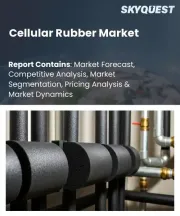
셀룰러 고무 시장 규모, 점유율 및 성장 분석 : 소재별, 구조 유형별, 제품 형태별, 최종 이용 산업별, 기능별, 유통 채널별, 지역별 - 업계 예측(2026-2033년)Cellular Rubber Market Size, Share, and Growth Analysis, By Material Base (Natural Rubber, Synthetic Rubber), By Structure Type, By Product Form, By End-Use Industry, By Functionality, By Distribution Channel, By Region - Industry Forecast 2026-2033 |
||||||

세계의 셀룰러 고무 시장 규모는 2024년에 68억 2,000만 달러로 평가되었고, 2025년 71억 9,000만 달러에서 2033년까지 109억 달러로 확대될 전망이며, 예측 기간(2026-2033년)에 CAGR 5.4%로 성장할 전망입니다.
세계 셀룰라 고무 시장은 운송 및 인프라 분야의 밀봉, 단열, 진동 감쇠, 부력 응용 분야에서 사용되는 다기능 및 경량 소재에 대한 수요 증가에 힘입어 성장하고 있습니다. 이러한 수요는 수명 연장, 에너지 효율 향상, 소음 감소를 실현하는 소재에 대한 요구로 인해 운영 비용 절감과 규제 준수에 대한 요구로 이어지고 있습니다. 셀룰라 고무가 기초 소재에서 고성능 폼으로 진화한 배경에는 특히 전기자동차 배터리 케이스와 HVAC(냉난방공조) 단열재에 대한 기준의 강화가 있습니다. 또한, 강화된 에너지 및 안전 규제에 대응하고 전동화 및 경량화 설계를 추진함에 따라 제조업체는 더 높은 성능의 폼을 채택해야 하는 상황에 직면해 있습니다. 이에 따라 아시아태평양 전체에서 바이오 소재의 활용과 첨단 제조 기술 도입에 대한 기회가 확대되고 있습니다.
세계 셀룰러 고무 시장의 성장 요인
스마트폰과 커넥티드 기기의 사용 확대에 따라 핸드헬드 기기 및 웨어러블 기술에서 탄성과 유연성을 겸비한 밀봉 부품 및 진동 흡수 부품에 대한 수요가 증가하고 있으며, 이는 셀룰라 고무의 채택 증가로 이어지고 있습니다. 제조업체들은 쿠션, 전자기 간섭(EMI) 차폐 및 견고한 환경 밀봉 기능을 제공하는 특수 고무 배합 재료를 채택하고 있습니다. 이 모든 것이 기기의 내구성과 성능 향상에 기여합니다. 제품 설계가 보다 컴팩트하고 내구성이 뛰어난 제품으로 전환됨에 따라 고성능 엘라스토머 소재에 대한 수요가 증가하고 있으며, 소재 개발자들은 끊임없이 진화하는 디바이스 요구사항과 OEM(주문자 상표 부착 생산업체)의 기대에 부응하기 위해 혁신과 생산 능력 향상에 힘쓰고 있습니다. 업계 내 협력과 확립된 표준 준수 또한 기술 발전을 촉진하는 데 있어 매우 중요합니다.
세계 셀룰라 고무 시장 성장 억제요인
세계 셀룰라 고무 시장은 필수 엘라스토머 원료와 특수 첨가제의 가용성 및 균일성에 대한 제약으로 인해 심각한 문제에 직면해 있습니다. 이러한 제약은 제조업체가 시장 수요에 효과적으로 대응하는 것을 방해하고, 생산 능력 확대를 위한 투자를 저해할 수 있으며, 궁극적으로 시장 전체의 성장을 저해할 수 있습니다. 공급망의 혼란, 재료의 긴 리드 타임, 배치 성능의 변동성은 생산 위험을 증가시키고, 높은 신뢰성이 요구되는 통신 용도의 인증 프로세스를 복잡하게 만듭니다. OEM 업체들은 조달난에 대응하기 위해 대체 설계 및 대체 재료를 고려할 수 있으며, 그 결과 셀룰라 고무 배합재에 대한 수요가 감소하고, 제조업체의 혁신 및 생산 확장성 향상에 대한 의욕을 떨어뜨릴 수 있습니다.
세계 셀룰라 고무 시장 동향
세계 셀룰러 고무 시장에서는 자동차, 산업, 소비자용도 등 다양한 분야의 다양한 요구를 충족시키기 위해 제조업체들이 맞춤형 솔루션 개발에 집중하면서 맞춤형 배합으로 전환하는 추세입니다. 셀 크기, 밀도, 폴리머 블렌드 등의 파라미터를 미세 조정함으로써 기업은 내구성을 유지하면서 감쇠, 단열, 촉감 등 특정 특성을 향상시킬 수 있습니다. 이러한 추세는 OEM(주문자 상표 부착 생산업체)과의 긴밀한 협력을 촉진하고, 이러한 재료를 복잡한 조립품에 쉽게 통합하여 제품 개발을 가속화하고 있습니다. 그 결과, 유연한 배합 플랫폼과 강력한 시제품 제작 능력을 제공하는 공급업체는 더 높은 수익률을 확보할 수 있을 뿐만 아니라, 고객 충성도를 강화하고 경쟁에서 우위를 점할 수 있습니다.
자주 묻는 질문
목차
서론
조사 방법
주요 요약
시장 역학과 전망
주요 시장 인사이트
세계의 셀룰러 고무 시장 규모 : 소재별
세계의 셀룰러 고무 시장 규모 : 구조 유형별
세계의 셀룰러 고무 시장 규모 : 제품 형태별
세계의 셀룰러 고무 시장 규모 : 최종 이용 산업별
세계의 셀룰러 고무 시장 규모 : 기능별
세계의 셀룰러 고무 시장 규모 : 유통 채널별
세계의 셀룰러 고무 시장 규모 : 지역별
경쟁 정보
주요 기업 개요
결론과 제안
LSH 26.05.26Global Cellular Rubber Market size was valued at USD 6.82 Billion in 2024 and is poised to grow from USD 7.19 Billion in 2025 to USD 10.9 Billion by 2033, growing at a CAGR of 5.4% during the forecast period (2026-2033).
The global cellular rubber market is driven by the increasing need for multifunctional, lightweight materials utilized in sealing, thermal insulation, vibration damping, and buoyancy across transportation and infrastructure sectors. This demand is fueled by the desire for materials that enhance service life, energy efficiency, and noise reduction, leading to lower operational costs and compliance with regulations. The evolution of cellular rubber from basic materials to high-performance foams has been shaped by stricter standards, particularly in electric vehicle battery enclosures and HVAC insulation. Furthermore, adherence to heightened energy and safety regulations and a push towards electrification and lightweight designs are compelling manufacturers to adopt higher-performing foams. As such, opportunities for bio-based materials and the adoption of advanced manufacturing technologies are expanding throughout the Asia Pacific region.
Top-down and bottom-up approaches were used to estimate and validate the size of the Global Cellular Rubber market and to estimate the size of various other dependent submarkets. The research methodology used to estimate the market size includes the following details: The key players in the market were identified through secondary research, and their market shares in the respective regions were determined through primary and secondary research. This entire procedure includes the study of the annual and financial reports of the top market players and extensive interviews for key insights from industry leaders such as CEOs, VPs, directors, and marketing executives. All percentage shares split, and breakdowns were determined using secondary sources and verified through Primary sources. All possible parameters that affect the markets covered in this research study have been accounted for, viewed in extensive detail, verified through primary research, and analyzed to get the final quantitative and qualitative data.
Global Cellular Rubber Market Segments Analysis
Global cellular rubber market is segmented by material base, structure type, product form, end-use industry, functionality, distribution channel and region. Based on material base, the market is segmented into Natural Rubber, Synthetic Rubber and Others. Based on structure type, the market is segmented into Open Cell Rubber, Closed Cell Rubber and Others. Based on product form, the market is segmented into Sheets and Rolls, Extruded Profiles and Strips, Die-Cut Gaskets and Others. Based on end-use industry, the market is segmented into Automotive and Transportation, Building and Construction, Electronics and Industrial, Healthcare and Sports Equipment and Others. Based on functionality, the market is segmented into Sealing and Insulation, Shock Absorption and Vibration Dampening, Sound Proofing and Others. Based on distribution channel, the market is segmented into Direct Industrial Sales, Specialized Rubber Material Wholesalers, Online Business-to-Business Platforms and Others. Based on region, the market is segmented into North America, Europe, Asia Pacific, Latin America and Middle East & Africa.
Driver of the Global Cellular Rubber Market
The expanding use of smartphones and connected devices is driving a rising demand for resilient and flexible sealing and vibration-dampening components in handheld and wearable technology, leading to increased adoption of cellular rubber. Manufacturers are turning to specialized rubber formulations that provide cushioning, electromagnetic interference (EMI) shielding, and robust environmental sealing, all of which contribute to the longevity and performance of devices. As product designs focus on becoming more compact and durable, the need for high-performance elastomeric components intensifies, prompting material developers to innovate and enhance production capabilities to align with the ever-evolving requirements of devices and the expectations set by original equipment manufacturers (OEMs). Collaboration within the industry and adherence to established standards are also crucial in driving advancements.
Restraints in the Global Cellular Rubber Market
The Global Cellular Rubber market faces significant challenges due to limitations in the availability and uniformity of essential elastomer feedstocks and specialized additives. These constraints hinder manufacturers from effectively meeting market demand and may discourage investments aimed at expanding production capacity, ultimately hindering overall market growth. Disruptions in the supply chain, extended lead times for materials, and fluctuations in batch performance raise production risks and complicate the qualification processes for telecommunications applications that necessitate high levels of reliability. In response to sourcing difficulties, original equipment manufacturers may explore alternative designs or substitute materials, which can diminish the demand for cellular rubber formulations and reduce manufacturers' motivation to innovate or enhance production scalability.
Market Trends of the Global Cellular Rubber Market
The Global Cellular Rubber market is witnessing a significant shift towards tailored formulations, as manufacturers focus on creating bespoke solutions to address the diverse needs of various sectors, including automotive, industrial, and consumer applications. By fine-tuning parameters such as cell size, density, and polymer blends, companies are able to enhance specific properties like damping, thermal insulation, and tactile sensations, all while ensuring durability remains uncompromised. This trend fosters closer collaboration with original equipment manufacturers (OEMs), facilitating the integration of these materials into complex assemblies and speeding up product development. As a result, suppliers that offer flexible formulation platforms and robust prototyping capabilities are not only able to command higher margins but also cultivate stronger customer loyalty, positioning themselves advantageously in a competitive landscape.
Table of Contents
Introduction
- Objectives of the Study
- Market Definition & Scope
Research Methodology
- Research Process
- Secondary & Primary Data Methods
- Market Size Estimation Methods
Executive Summary
- Global Market Outlook
- Key Market Highlights
- Segmental Overview
- Competition Overview
Market Dynamics & Outlook
- Macro-Economic Indicators
- Drivers & Opportunities
- Restraints & Challenges
- Supply Side Trends
- Demand Side Trends
- Porters Analysis & Impact
- Competitive Rivalry
- Threat of Substitute
- Bargaining Power of Buyers
- Threat of New Entrants
- Bargaining Power of Suppliers
Key Market Insights
- Key Success Factors
- Market Impacting Factors
- Top Investment Pockets
- Ecosystem Mapping
- Market Attractiveness Index 2025
- PESTEL Analysis
- Regulatory Landscape
Global Cellular Rubber Market Size by Material Base & CAGR (2026-2033)
- Market Overview
- Natural Rubber
- Synthetic Rubber
- Neoprene
- Ethylene Propylene Diene Monomer
- Nitrile and Silicone
- Others
Global Cellular Rubber Market Size by Structure Type & CAGR (2026-2033)
- Market Overview
- Open Cell Rubber
- Closed Cell Rubber
- Others
Global Cellular Rubber Market Size by Product Form & CAGR (2026-2033)
- Market Overview
- Sheets and Rolls
- Extruded Profiles and Strips
- Die-Cut Gaskets
- Others
Global Cellular Rubber Market Size by End-Use Industry & CAGR (2026-2033)
- Market Overview
- Automotive and Transportation
- Building and Construction
- Electronics and Industrial
- Healthcare and Sports Equipment
- Others
Global Cellular Rubber Market Size by Functionality & CAGR (2026-2033)
- Market Overview
- Sealing and Insulation
- Shock Absorption and Vibration Dampening
- Sound Proofing
- Others
Global Cellular Rubber Market Size by Distribution Channel & CAGR (2026-2033)
- Market Overview
- Direct Industrial Sales
- Specialized Rubber Material Wholesalers
- Online Business-to-Business Platforms
- Others
Global Cellular Rubber Market Size & CAGR (2026-2033)
- North America (Material Base, Structure Type, Product Form, End-Use Industry, Functionality, Distribution Channel)
- US
- Canada
- Europe (Material Base, Structure Type, Product Form, End-Use Industry, Functionality, Distribution Channel)
- Germany
- Spain
- France
- UK
- Italy
- Rest of Europe
- Asia Pacific (Material Base, Structure Type, Product Form, End-Use Industry, Functionality, Distribution Channel)
- China
- India
- Japan
- South Korea
- Rest of Asia-Pacific
- Latin America (Material Base, Structure Type, Product Form, End-Use Industry, Functionality, Distribution Channel)
- Mexico
- Brazil
- Rest of Latin America
- Middle East & Africa (Material Base, Structure Type, Product Form, End-Use Industry, Functionality, Distribution Channel)
- GCC Countries
- South Africa
- Rest of Middle East & Africa
Competitive Intelligence
- Top 5 Player Comparison
- Market Positioning of Key Players, 2025
- Strategies Adopted by Key Market Players
- Recent Developments in the Market
- Company Market Share Analysis, 2025
- Company Profiles of All Key Players
- Company Details
- Product Portfolio Analysis
- Company's Segmental Share Analysis
- Revenue Y-O-Y Comparison (2023-2025)
Key Company Profiles
- Rogers Corporation
- Company Overview
- Business Segment Overview
- Financial Updates
- Key Developments
- Armacell
- Company Overview
- Business Segment Overview
- Financial Updates
- Key Developments
- Nitto Denko
- Company Overview
- Business Segment Overview
- Financial Updates
- Key Developments
- Hutchinson
- Company Overview
- Business Segment Overview
- Financial Updates
- Key Developments
- Saint-Gobain
- Company Overview
- Business Segment Overview
- Financial Updates
- Key Developments
- Zotefoams
- Company Overview
- Business Segment Overview
- Financial Updates
- Key Developments
- Freudenberg
- Company Overview
- Business Segment Overview
- Financial Updates
- Key Developments
- Boyd Corporation
- Company Overview
- Business Segment Overview
- Financial Updates
- Key Developments
- KCC Corporation
- Company Overview
- Business Segment Overview
- Financial Updates
- Key Developments
- INOAC
- Company Overview
- Business Segment Overview
- Financial Updates
- Key Developments
- Sekisui Chemical
- Company Overview
- Business Segment Overview
- Financial Updates
- Key Developments
- Rubberlite
- Company Overview
- Business Segment Overview
- Financial Updates
- Key Developments
- Hanna Rubber Company
- Company Overview
- Business Segment Overview
- Financial Updates
- Key Developments
- Griswold
- Company Overview
- Business Segment Overview
- Financial Updates
- Key Developments
- Monmouth Rubber & Plastics
- Company Overview
- Business Segment Overview
- Financial Updates
- Key Developments
- Stockwell Elastomerics
- Company Overview
- Business Segment Overview
- Financial Updates
- Key Developments
- MTI Polyexe
- Company Overview
- Business Segment Overview
- Financial Updates
- Key Developments
- BRP Manufacturing
- Company Overview
- Business Segment Overview
- Financial Updates
- Key Developments
- Lauren Manufacturing
- Company Overview
- Business Segment Overview
- Financial Updates
- Key Developments
- Trelleborg
- Company Overview
- Business Segment Overview
- Financial Updates
- Key Developments