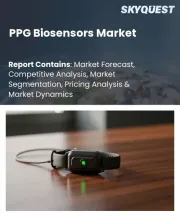
|
시장보고서
상품코드
2048935
PPG 바이오센서 시장 규모, 점유율 및 성장 분석 : 제품 유형별, 디바이스 유형별, 유통 채널별, 용도별, 최종사용자별, 지역별 - 업계 예측(2026-2033년)PPG Biosensors Market Size, Share, and Growth Analysis, By Product Type, By Device Type, By Distribution Channel, By Application, By End User, By Region - Industry Forecast 2026-2033 |
||||||

세계의 PPG 바이오센서 시장 규모는 2024년 6억 8,920만 달러, 2025년 7억 9,189만 달러에서 2033년까지 24억 561만 달러로 확대되어 예측 기간(2026-2033년)에 CAGR 14.9%를 보일 전망입니다.
광전 맥파(PPG) 바이오센서 시장은 소비자 시장과 임상 환경 모두에서 지속적이고 비침습적인 생리적 모니터링에 대한 수요가 증가함에 따라 괄목할 만한 성장세를 보이고 있습니다. 이러한 수요 급증에 따라 각 업체들은 디바이스 설계 및 상품화 전략의 혁신을 위해 노력하고 있습니다. 빛을 이용해 혈액량 변화를 모니터링하는 PPG 센서는 심박수 및 산소포화도 관리에 필수적이며, 원격의료의 기능을 강화하는 동시에 만성질환 관리 및 예방의료를 효과적으로 지원하고 있습니다. 부피가 큰 임상용 기기에서 소형 손목형 기기로 진화하면서 피트니스 트래커와 스마트 워치로 적용 범위가 넓어졌습니다. 알고리즘에 의한 신호 처리와 머신러닝의 발전으로 바이탈 사인 측정의 정확도가 향상되었습니다. 생산 효율성 향상은 비용 절감을 촉진하고, 신흥국 시장으로의 침투를 확대하며, 원격 모니터링에 대한 새로운 노력을 촉진하고 있습니다.
세계 PPG 바이오센서 시장 성장 요인
당뇨병 및 유사 질환의 유병률 증가로 인해 혈당 수치에 대한 지속적인 모니터링에 대한 수요가 증가하고 있습니다. 의료진과 환자들은 채혈에 따른 불편함 없이 간편하고 반복 가능한 측정 방법을 제공하는 기기를 점점 더 많이 요구하고 있습니다. 이러한 임상적 필요성으로 인해 제조업체들은 혁신적인 센서 개발에 투자하여 기존 의료 프로세스 및 만성 질환 관리 프로그램에 통합되는 혁신적인 센서 개발에 투자하고 있습니다. 예방적 모니터링에 대한 인식이 높아짐에 따라 편의성과 편안함으로 평가받는 PPG 기술로의 전환이 두드러지게 나타나고 있으며, 이로 인해 바이오센서 분야 시장 전망이 개선되고 있습니다.
세계 PPG 바이오센서 시장 성장 억제요인
세계 PPG 바이오센서 시장은 각 관할권마다 다른 다양한 규제 요건으로 인해 시장 승인을 원하는 제조업체들에게 큰 장벽이 되고 있으며, 심각한 문제에 직면해 있습니다. 이러한 규제를 준수하기 위해서는 광범위한 임상 검증이 필요하며, 이는 많은 시간과 비용이 소요됩니다. 기기 분류, 시험 기준, 승인 과정의 불일치는 기기 개발의 불확실성을 초래하고, 결국 시장 진입 기간을 연장시키는 요인으로 작용하고 있습니다. 또한, 중소기업의 경우 이러한 복잡한 상황을 극복하는 데 필요한 자원이 부족할 수 있으며, 이는 시장에서의 효과적인 경쟁과 사업 확장에 걸림돌이 될 수 있습니다.
세계 PPG 바이오센서 시장 동향
세계 PPG 바이오센서 시장에서는 일반 소비자와 임상 환경 모두에서 웨어러블 기술에 비침습적 연속 모니터링 솔루션을 통합하는 것이 두드러진 추세로 나타나고 있습니다. 이러한 변화로 인해 제조업체들은 인체공학적 디자인, 에너지 효율성, 헬스케어 생태계 내 원활한 연결성을 우선순위에 둘 수 있게 되었습니다. 센서 개발사, 플랫폼 제공업체, 의료 기관 간의 전략적 파트너십은 시장 출시를 촉진하는 데 필수적입니다. 센서의 장착 위치나 인터페이스 설계에 있어 사용자의 편의성에 중점을 두면서, 업계는 예방의료와 원격 만성질환 관리에 중점을 둔 비즈니스 모델로 전환하고 있습니다. 이를 통해 적시에 생리적 데이터에 대한 눈에 띄지 않는 접근을 통해 궁극적으로 환자 경험을 향상시키고자 합니다.
자주 묻는 질문
목차
서론
조사 방법
주요 요약
시장 역학과 전망
주요 시장 인사이트
세계의 PPG 바이오센서 시장 규모 : 제품 유형별
세계의 PPG 바이오센서 시장 규모 : 디바이스 유형별
세계의 PPG 바이오센서 시장 규모 : 유통 채널별
세계의 PPG 바이오센서 시장 규모 : 용도별
세계의 PPG 바이오센서 시장 규모 : 최종사용자별
세계의 PPG 바이오센서 시장 규모 : 지역별
경쟁 정보
주요 기업 개요
결론과 제안
LSH 26.06.11Global PPG Biosensors Market size was valued at USD 689.2 Million in 2024 and is poised to grow from USD 791.89 Million in 2025 to USD 2405.61 Million by 2033, growing at a CAGR of 14.9% during the forecast period (2026-2033).
The photoplethysmography (PPG) biosensors market is experiencing significant growth driven by the rising demand for continuous, non-invasive physiological monitoring across both consumer markets and clinical environments. This surge has led companies to innovate device design and commercialization strategies. PPG sensors, which monitor blood volume changes through light, are crucial for heart rate and oxygen saturation management, effectively aiding chronic disease management and preventive care while enhancing telehealth capabilities. The evolution from bulky clinical machines to compact wrist-based devices has broadened their application in fitness trackers and smartwatches. Advancements in algorithmic signal processing and machine learning have enhanced the accuracy of vital sign measurements. Increased production efficiency is facilitating lower costs and expanding market penetration in emerging economies, fostering new remote monitoring initiatives.
Top-down and bottom-up approaches were used to estimate and validate the size of the Global PPG Biosensors market and to estimate the size of various other dependent submarkets. The research methodology used to estimate the market size includes the following details: The key players in the market were identified through secondary research, and their market shares in the respective regions were determined through primary and secondary research. This entire procedure includes the study of the annual and financial reports of the top market players and extensive interviews for key insights from industry leaders such as CEOs, VPs, directors, and marketing executives. All percentage shares split, and breakdowns were determined using secondary sources and verified through Primary sources. All possible parameters that affect the markets covered in this research study have been accounted for, viewed in extensive detail, verified through primary research, and analyzed to get the final quantitative and qualitative data.
Global PPG Biosensors Market Segments Analysis
Global ppg biosensors market is segmented by product type, device type, distribution channel, application, end user and region. Based on product type, the market is segmented into Smart Watches, Fitness Bands & Smart Wristbands, Pulse Oximeters, Smart Rings & Wearable Patches, Clinical & Hospital Monitoring Devices and Others. Based on device type, the market is segmented into Wearable PPG Biosensors and Non-Wearable / Clinical PPG Systems. Based on distribution channel, the market is segmented into OEM / Device Manufacturers, Direct Sales, Online Retail and Specialty Electronics & Medical Stores. Based on application, the market is segmented into Heart Rate Monitoring, Blood Oxygen Saturation (SpO2) Monitoring, Blood Pressure Monitoring, Respiratory Rate Monitoring, Sleep & Stress Monitoring, Arrhythmia & Cardiovascular Monitoring, Fitness & Activity Tracking and Others. Based on end user, the market is segmented into Consumer Electronics, Healthcare Providers & Hospitals, Home Healthcare & Remote Patient Monitoring, Sports & Fitness Industry and Research & Academic Institutes. Based on region, the market is segmented into North America, Europe, Asia Pacific, Latin America and Middle East & Africa.
Driver of the Global PPG Biosensors Market
The rising prevalence of diabetes and similar conditions is amplifying the demand for continuous monitoring of blood glucose levels. Healthcare professionals and patients are increasingly seeking devices that offer a straightforward, repetitive measurement method without the discomfort of blood draws. This clinical necessity is prompting manufacturers to invest in the development of innovative sensors, which are being integrated into existing healthcare pathways and chronic disease management programs. As awareness of preventive monitoring grows, there is a marked shift toward PPG technology, recognized for its convenience and comfort, thereby enhancing market prospects in the realm of biosensors.
Restraints in the Global PPG Biosensors Market
The Global PPG Biosensors market faces significant challenges due to the diverse regulatory requirements that exist across different jurisdictions, which serve as obstacles for manufacturers seeking market authorization. Adhering to these regulations necessitates extensive clinical validation, which can be both time-consuming and costly. The discrepancies in device classification, testing standards, and approval processes contribute to uncertainty in the development of these devices, ultimately leading to longer timeframes for market entry. Furthermore, smaller companies may lack the necessary resources to navigate these complexities, hindering their ability to compete effectively and scale their operations within the market.
Market Trends of the Global PPG Biosensors Market
The Global PPG Biosensors market is witnessing a significant trend toward the integration of continuous, non-invasive monitoring solutions within wearable technology, catering to both consumer and clinical environments. This shift is empowering manufacturers to prioritize ergonomic designs, energy efficiency, and seamless connectivity within health ecosystems. Strategic partnerships among sensor developers, platform providers, and care organizations are essential in driving market deployments. By focusing on user comfort in sensor placement and interface design, the industry is steering towards commercial models that emphasize preventative health and remote chronic care management, ultimately enhancing patient experience through unobtrusive access to timely physiological data.
Table of Contents
Introduction
- Objectives of the Study
- Market Definition & Scope
Research Methodology
- Research Process
- Secondary & Primary Data Methods
- Market Size Estimation Methods
Executive Summary
- Global Market Outlook
- Key Market Highlights
- Segmental Overview
- Competition Overview
Market Dynamics & Outlook
- Macro-Economic Indicators
- Drivers & Opportunities
- Restraints & Challenges
- Supply Side Trends
- Demand Side Trends
- Porters Analysis & Impact
- Competitive Rivalry
- Threat of Substitute
- Bargaining Power of Buyers
- Threat of New Entrants
- Bargaining Power of Suppliers
Key Market Insights
- Key Success Factors
- Market Impacting Factors
- Top Investment Pockets
- Ecosystem Mapping
- Market Attractiveness Index 2025
- PESTEL Analysis
- Regulatory Landscape
Global PPG Biosensors Market Size by Product Type & CAGR (2026-2033)
- Market Overview
- Smart Watches
- Fitness Bands & Smart Wristbands
- Pulse Oximeters
- Smart Rings & Wearable Patches
- Clinical & Hospital Monitoring Devices
- Others
Global PPG Biosensors Market Size by Device Type & CAGR (2026-2033)
- Market Overview
- Wearable PPG Biosensors
- Non-Wearable / Clinical PPG Systems
Global PPG Biosensors Market Size by Distribution Channel & CAGR (2026-2033)
- Market Overview
- OEM / Device Manufacturers
- Direct Sales
- Online Retail
- Specialty Electronics & Medical Stores
Global PPG Biosensors Market Size by Application & CAGR (2026-2033)
- Market Overview
- Heart Rate Monitoring
- Blood Oxygen Saturation (SpO2) Monitoring
- Blood Pressure Monitoring
- Respiratory Rate Monitoring
- Sleep & Stress Monitoring
- Arrhythmia & Cardiovascular Monitoring
- Fitness & Activity Tracking
- Others
Global PPG Biosensors Market Size by End User & CAGR (2026-2033)
- Market Overview
- Consumer Electronics
- Healthcare Providers & Hospitals
- Home Healthcare & Remote Patient Monitoring
- Sports & Fitness Industry
- Research & Academic Institutes
Global PPG Biosensors Market Size & CAGR (2026-2033)
- North America (Product Type, Device Type, Distribution Channel, Application, End User)
- US
- Canada
- Europe (Product Type, Device Type, Distribution Channel, Application, End User)
- Germany
- Spain
- France
- UK
- Italy
- Rest of Europe
- Asia Pacific (Product Type, Device Type, Distribution Channel, Application, End User)
- China
- India
- Japan
- South Korea
- Rest of Asia-Pacific
- Latin America (Product Type, Device Type, Distribution Channel, Application, End User)
- Mexico
- Brazil
- Rest of Latin America
- Middle East & Africa (Product Type, Device Type, Distribution Channel, Application, End User)
- GCC Countries
- South Africa
- Rest of Middle East & Africa
Competitive Intelligence
- Top 5 Player Comparison
- Market Positioning of Key Players, 2025
- Strategies Adopted by Key Market Players
- Recent Developments in the Market
- Company Market Share Analysis, 2025
- Company Profiles of All Key Players
- Company Details
- Product Portfolio Analysis
- Company's Segmental Share Analysis
- Revenue Y-O-Y Comparison (2023-2025)
Key Company Profiles
- Apple Inc.
- Company Overview
- Business Segment Overview
- Financial Updates
- Key Developments
- Samsung Electronics Co., Ltd.
- Company Overview
- Business Segment Overview
- Financial Updates
- Key Developments
- Garmin Ltd.
- Company Overview
- Business Segment Overview
- Financial Updates
- Key Developments
- Xiaomi Corporation
- Company Overview
- Business Segment Overview
- Financial Updates
- Key Developments
- Omron Healthcare, Inc.
- Company Overview
- Business Segment Overview
- Financial Updates
- Key Developments
- Masimo Corporation
- Company Overview
- Business Segment Overview
- Financial Updates
- Key Developments
- Valencell, Inc.
- Company Overview
- Business Segment Overview
- Financial Updates
- Key Developments
- Murata Manufacturing Co., Ltd.
- Company Overview
- Business Segment Overview
- Financial Updates
- Key Developments
- Silicon Laboratories Inc.
- Company Overview
- Business Segment Overview
- Financial Updates
- Key Developments
- MediaTek Inc.
- Company Overview
- Business Segment Overview
- Financial Updates
- Key Developments
- Texas Instruments Incorporated
- Company Overview
- Business Segment Overview
- Financial Updates
- Key Developments
- Nonin Medical, Inc.
- Company Overview
- Business Segment Overview
- Financial Updates
- Key Developments
- Rockley Photonics Holdings Limited
- Company Overview
- Business Segment Overview
- Financial Updates
- Key Developments
- Empatica Inc.
- Company Overview
- Business Segment Overview
- Financial Updates
- Key Developments
- LifeQ Inc.
- Company Overview
- Business Segment Overview
- Financial Updates
- Key Developments
- MedNet GmbH
- Company Overview
- Business Segment Overview
- Financial Updates
- Key Developments
- BioTech Instruments, Inc.
- Company Overview
- Business Segment Overview
- Financial Updates
- Key Developments
- Preventice Solutions, Inc.
- Company Overview
- Business Segment Overview
- Financial Updates
- Key Developments
- CardiacSense Ltd.
- Company Overview
- Business Segment Overview
- Financial Updates
- Key Developments
- Maxim Integrated Products, Inc.
- Company Overview
- Business Segment Overview
- Financial Updates
- Key Developments