|
시장보고서
상품코드
2078489
라만 분석기 시장 : 시장 규모, 점유율 및 성장 분석 - 유형별, 용도별, 최종 사용자별, 유통 경로별, 지역별 업계 예측(2026-2033년)Raman Analyzer Market Size, Share, and Growth Analysis, By Type (Handheld Raman Analyzers, Benchtop Raman Analyzers), By Application (Pharmaceutical QC, Food Safety Testing), By End-User, By Distribution, By Region - Industry Forecast 2026-2033 |
||||||

세계의 라만 분석기 시장 규모는 2024년에 8억 8,000만 달러로 평가되었고, 2025년 9억 6,000만 달러에서 2033년까지 19억 5,000만 달러로 확대될 전망이며, 예측 기간(2026-2033년) CAGR 9.22%로 성장할 전망입니다.
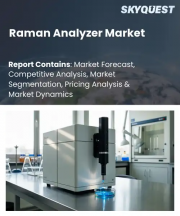
세계의 라만 분석기 시장은 다양한 규제 대상 분야에서 신속하고 비파괴적인 분자 식별에 대한 수요가 증가하고 있는 데 크게 힘입고 있습니다. 이러한 분석 장비는 진동 분광법을 이용하여 시료의 전처리가 필요 없이 화학적 조성을 파악할 수 있기 때문에 제약 품질 관리, 재료 특성 평가 및 인라인 공정 분석 분야에서 필수적인 도구로 자리 잡고 있습니다. 레이저 기술, 검출기 및 데이터 처리 능력의 발전으로 인해, 기존의 대형 벤치탑형 시스템에서 보다 콤팩트하고 현장에서 사용할 수 있는 장비로 뚜렷한 전환이 이루어지고 있습니다. AI 통합을 통해 감지 정확도가 향상되고, 신호 정제 및 특징량 추출이 개선될 뿐만 아니라, 복잡한 행렬에서 오탐을 줄이는 효과도 거두고 있습니다. 그 결과, 라만 분석기는 식품 안전, 환경 모니터링, 바이오프로세스, 첨단 제조 등 다양한 산업 분야에서 폭넓게 활용되고 있습니다.
세계 라만 분석기 시장의 성장 요인
레이저 기술, 검출기의 감도, 광학 설계의 발전, 그리고 장치의 소형화에 힘입어 라만 분석기의 기능성이 크게 향상되었습니다. 이러한 혁신을 통해 다양한 용도에 적합하고, 감도가 더 높으며, 휴대성이 뛰어나고, 사용하기 편리한 시스템이 구현되었습니다. 시료 취급 및 측정 과정이 효율화됨에 따라 도입 장벽이 낮아져, 실험실과 현장 모두에서 라만 분석기의 매력이 높아지고 있습니다. 그 결과, 사용 편의성과 성능이 향상됨에 따라 사용자들은 라만 분석 기술을 표준 워크플로우에 도입하도록 유도되고 있으며, 조사, 품질 관리 및 현장 분석을 위한 탁상형 및 휴대용 분석 장비에 대한 수요가 모두 증가하고 있습니다.
세계 라만 분석기 시장의 제약 요인
세계의 라만 분석기 시장은 첨단 라만 분석기에 따른 높은 초기 구입 비용과 유지 관리 비용으로 인해 큰 과제에 직면해 있습니다. 예산이 제한된 소규모 연구소나 조직에서는 한정된 재원과 장비의 이점을 신중하게 비교 검토해야 하기 때문에 이러한 투자를 정당화하기 어려운 경우가 많습니다. 전용 부품의 필요성, 정기적인 유지보수, 그리고 서비스 계약 체결 가능성 등으로 인해 총 소유 비용이 더욱 증가하게 되며, 이는 구형 장비의 교체를 가로막는 요인이 될 수 있습니다. 자금이 다른 중요한 인프라에 배정될 경우, 의사결정권자들은 라만 기술에 대한 투자를 연기하거나 포기할 가능성이 있으며, 이는 결국 재정적 여유가 부족한 부문에서 시장 침투를 저해하게 될 것입니다.
세계의 라만 분석기 시장 동향
세계의 라만 분석기 시장에서는 AI를 활용한 스펙트럼 분석의 통합이라는 뚜렷한 추세가 나타나고 있습니다. 고급 알고리즘과 화학계량학 모델을 통해 스펙트럼 데이터의 해석 능력이 향상되고 있습니다. 이러한 기술적 진보로 인해 물질의 식별 정확도가 향상되고 자동화된 의사결정 프로세스가 지원됨에 따라, 해당 분야의 전문가가 아닌 사용자들도 이러한 도구를 더욱 쉽게 활용할 수 있게 되었습니다. 각 벤더사는 복잡한 스펙트럼 정보를 실행 가능한 인사이트로 단순화하는 사용자 친화적인 소프트웨어를 우선시하고 있으며, 이를 통해 해석의 편차가 줄어들 뿐만 아니라 분석 효율성도 높아지고 있습니다. 이러한 추세는 실험실 정보 시스템 및 클라우드 플랫폼과의 원활한 통합을 통해 더욱 강화되어, 운영상의 복잡성을 최소화하는 동시에 예측 유지보수, 이상 감지 및 지속적인 모니터링을 촉진하고 있습니다.
자주 묻는 질문
목차
서론
조사 방법
주요 요약
시장 역학 및 전망
주요 시장 인사이트
세계의 라만 분석기 시장 규모 : 유형별
세계의 라만 분석기 시장 규모 : 용도별
세계의 라만 분석기 시장 규모 : 최종 사용자별
세계의 라만 분석기 시장 규모 : 유통 경로별
세계의 라만 분석기 시장 규모 : 지역별
경쟁 정보
주요 기업 개요
결론 및 제안
AJY 26.07.13Global Raman Analyzer Market size was valued at USD 0.88 Billion in 2024 and is poised to grow from USD 0.96 Billion in 2025 to USD 1.95 Billion by 2033, growing at a CAGR of 9.22% during the forecast period (2026-2033).
The market for global Raman analyzers is significantly driven by the increasing need for swift, non-destructive molecular identification across various regulated sectors. These analyzers utilize vibrational spectroscopy to determine chemical composition without requiring sample preparation, making them indispensable in pharmaceutical quality control, materials characterization, and inline process analytical applications. There has been a notable shift from traditional large bench systems to more compact, field-deployable instruments, thanks to advancements in laser technology, detectors, and data processing capabilities. The integration of AI enhances detection accuracy, allowing for improved signal cleaning and feature extraction, as well as reduction of false positives across complex matrices. Consequently, Raman analyzers find expansive utility in industries such as food safety, environmental monitoring, bioprocessing, and advanced manufacturing.
Top-down and bottom-up approaches were used to estimate and validate the size of the Global Raman Analyzer market and to estimate the size of various other dependent submarkets. The research methodology used to estimate the market size includes the following details: The key players in the market were identified through secondary research, and their market shares in the respective regions were determined through primary and secondary research. This entire procedure includes the study of the annual and financial reports of the top market players and extensive interviews for key insights from industry leaders such as CEOs, VPs, directors, and marketing executives. All percentage shares split, and breakdowns were determined using secondary sources and verified through Primary sources. All possible parameters that affect the markets covered in this research study have been accounted for, viewed in extensive detail, verified through primary research, and analyzed to get the final quantitative and qualitative data.
Global Raman Analyzer Market Segments Analysis
Global raman analyzer market is segmented by type, application, end-user, distribution and region. Based on type, the market is segmented into Handheld Raman Analyzers, Benchtop Raman Analyzers and Portable Raman Spectrometers. Based on application, the market is segmented into Pharmaceutical QC, Food Safety Testing, Material Identification and Forensics. Based on end-user, the market is segmented into Pharma & Biotech, Law Enforcement and Chemical Industry. Based on distribution, the market is segmented into Direct and Distributors. Based on region, the market is segmented into North America, Europe, Asia Pacific, Latin America and Middle East & Africa.
Driver of the Global Raman Analyzer Market
Advancements in laser technology, detector efficiency, optical design, and the miniaturization of instruments have significantly improved the functionality of Raman analyzers. These innovations have resulted in more sensitive, portable, and user-friendly systems suitable for diverse applications. By streamlining sample handling and measurement processes, these advancements lower the barriers to deployment, making Raman analyzers more appealing in both laboratory and field settings. As a consequence, the increased accessibility and enhanced performance encourage users to incorporate Raman techniques into their standard workflows, boosting demand for both benchtop and handheld analyzers for research, quality control, and on-site analysis.
Restraints in the Global Raman Analyzer Market
The Global Raman Analyzer market faces significant challenges due to the high initial purchase and maintenance costs associated with advanced Raman analyzers. Smaller laboratories and organizations with restricted budgets often find it difficult to justify such investments, as they must carefully weigh the benefits of the equipment against their limited financial resources. The requirement for specialized components, routine maintenance, and possible service agreements further increases the total cost of ownership, which can discourage the replacement of outdated equipment. When funding is allocated to other critical infrastructure, decision-makers may delay or abandon investments in Raman technology, ultimately hindering market penetration in less financially resilient segments.
Market Trends of the Global Raman Analyzer Market
The Global Raman Analyzer market is experiencing a significant trend towards the integration of AI-driven spectral analysis, where advanced algorithms and chemometric models enhance the interpretation of spectral data. This technological advancement facilitates improved material identification and supports automated decision-making processes, making the tools more accessible for non-expert users across various industries. Vendors are prioritizing user-friendly software that simplifies complex spectral information into actionable insights, leading to reduced interpretation variability and more efficient analysis. The trend is further reinforced by seamless integration with laboratory information systems and cloud platforms, promoting predictive maintenance, anomaly detection, and continuous monitoring, all while minimizing operational complexity.
Table of Contents
Introduction
- Objectives of the Study
- Market Definition & Scope
Research Methodology
- Research Process
- Secondary & Primary Data Methods
- Market Size Estimation Methods
Executive Summary
- Global Market Outlook
- Key Market Highlights
- Segmental Overview
- Competition Overview
Market Dynamics & Outlook
- Macro-Economic Indicators
- Drivers & Opportunities
- Restraints & Challenges
- Supply Side Trends
- Demand Side Trends
- Porters Analysis & Impact
- Competitive Rivalry
- Threat of Substitute
- Bargaining Power of Buyers
- Threat of New Entrants
- Bargaining Power of Suppliers
Key Market Insights
- Key Success Factors
- Market Impacting Factors
- Top Investment Pockets
- Ecosystem Mapping
- Market Attractiveness Index 2025
- PESTEL Analysis
- Regulatory Landscape
Global Raman Analyzer Market Size by Type & CAGR (2026-2033)
- Market Overview
- Handheld Raman Analyzers
- Benchtop Raman Analyzers
- Portable Raman Spectrometers
Global Raman Analyzer Market Size by Application & CAGR (2026-2033)
- Market Overview
- Pharmaceutical QC
- Food Safety Testing
- Material Identification
- Forensics
Global Raman Analyzer Market Size by End-User & CAGR (2026-2033)
- Market Overview
- Pharma & Biotech
- Law Enforcement
- Chemical Industry
Global Raman Analyzer Market Size by Distribution & CAGR (2026-2033)
- Market Overview
- Direct
- Distributors
Global Raman Analyzer Market Size & CAGR (2026-2033)
- North America (Type, Application, End-User, Distribution)
- US
- Canada
- Europe (Type, Application, End-User, Distribution)
- Germany
- Spain
- France
- UK
- Italy
- Rest of Europe
- Asia Pacific (Type, Application, End-User, Distribution)
- China
- India
- Japan
- South Korea
- Rest of Asia-Pacific
- Latin America (Type, Application, End-User, Distribution)
- Mexico
- Brazil
- Rest of Latin America
- Middle East & Africa (Type, Application, End-User, Distribution)
- GCC Countries
- South Africa
- Rest of Middle East & Africa
Competitive Intelligence
- Top 5 Player Comparison
- Market Positioning of Key Players, 2025
- Strategies Adopted by Key Market Players
- Recent Developments in the Market
- Company Market Share Analysis, 2025
- Company Profiles of All Key Players
- Company Details
- Product Portfolio Analysis
- Company's Segmental Share Analysis
- Revenue Y-O-Y Comparison (2023-2025)
Key Company Profiles
- Thermo Fisher Scientific (TruNarc)
- Company Overview
- Business Segment Overview
- Financial Updates
- Key Developments
- HORIBA Scientific
- Company Overview
- Business Segment Overview
- Financial Updates
- Key Developments
- Renishaw plc
- Company Overview
- Business Segment Overview
- Financial Updates
- Key Developments
- Bruker Corporation
- Company Overview
- Business Segment Overview
- Financial Updates
- Key Developments
- Kaiser Optical Systems (Endress+Hauser)
- Company Overview
- Business Segment Overview
- Financial Updates
- Key Developments
- B&W Tek (Metrohm)
- Company Overview
- Business Segment Overview
- Financial Updates
- Key Developments
- Ocean Insight (Ocean Optics)
- Company Overview
- Business Segment Overview
- Financial Updates
- Key Developments
- Rigaku Corporation
- Company Overview
- Business Segment Overview
- Financial Updates
- Key Developments
- PerkinElmer Inc.
- Company Overview
- Business Segment Overview
- Financial Updates
- Key Developments
- JASCO Inc.
- Company Overview
- Business Segment Overview
- Financial Updates
- Key Developments
- Metrohm AG
- Company Overview
- Business Segment Overview
- Financial Updates
- Key Developments
- Agilent Technologies
- Company Overview
- Business Segment Overview
- Financial Updates
- Key Developments
- Ondas Medical
- Company Overview
- Business Segment Overview
- Financial Updates
- Key Developments
- Si-Ware Systems
- Company Overview
- Business Segment Overview
- Financial Updates
- Key Developments
- Opton Laser International
- Company Overview
- Business Segment Overview
- Financial Updates
- Key Developments
- Photon Systems Instruments
- Company Overview
- Business Segment Overview
- Financial Updates
- Key Developments
- Photon etc.
- Company Overview
- Business Segment Overview
- Financial Updates
- Key Developments
- Wasatch Photonics
- Company Overview
- Business Segment Overview
- Financial Updates
- Key Developments
- Tornado Spectral Systems
- Company Overview
- Business Segment Overview
- Financial Updates
- Key Developments
- RamanBio (RamanCloud)
- Company Overview
- Business Segment Overview
- Financial Updates
- Key Developments