|
시장보고서
상품코드
2078740
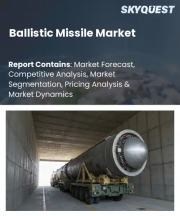
탄도 미사일 시장 : 시장 규모, 점유율 및 성장 분석 : 유형별, 추진 방식별, 탄두별, 최종 사용자별, 지역별 업계 예측(2026-2033년)Ballistic Missile Market Size, Share, and Growth Analysis, By Type (Short-Range Ballistic Missiles (SRBM), Medium-Range (MRBM)), By Propulsion (Solid-Fuel, Liquid-Fuel), By Warhead, By End-User, By Region - Industry Forecast 2026-2033 |
||||||

세계의 탄도 미사일 시장 규모는 2024년에 145억 2,000만 달러로 평가되었고, 2025년 154억 8,000만 달러에서 2033년까지 258억 5,000만 달러로 확대될 전망이며, 예측 기간(2026-2033년) CAGR 6.62%로 성장할 전망입니다.
세계의 탄도 미사일 시장은 초고속 추진 기술의 발전으로 인해 미사일의 속도와 방어망 돌파 능력이 향상되고 있는 것을 배경으로, 눈부신 성장을 이루고 있습니다. 이러한 시스템에 투자하는 국가들은 전략적 우위를 확보하게 되며, 주변국들로 하여금 대응 조치나 동등한 기술 개발을 촉진하게 됩니다. 그 결과, 조달 예산이 증가하고 국내 생산이 촉진됩니다. 이러한 역동성은 지역 내 경쟁국 간의 협력을 촉진하고, 유도 전자 장비, 복합재 기체, 발사 인프라 등 핵심 부품에 관한 계약을 이끌어내는 공동 개발 이니셔티브로 이어집니다. 그 결과, 이러한 선순환은 시장을 활성화할 뿐만 아니라 민간 투자를 유치하고, 특수 미사일 부품에 있어 수익성이 높은 수출 기회를 창출함으로써 방위 분야의 혁신과 경쟁의 선순환을 강화하고 있습니다.
세계 탄도 미사일 시장의 성장 요인
세계의 탄도 미사일 시장은 위성 항법, 실시간 데이터 처리, 자율적인 표적 포착 기능을 통합한 유도 시스템의 발전에 힘입어 크게 성장하고 있습니다. 이러한 기술적 진보 덕분에 미사일의 정확도와 운용상의 유연성이 현저히 향상되고 있습니다. 그 결과, 방위 부대는 부수적 피해를 최소화하면서 임무 성공률을 높이고 있으며, 미사일 조달에 대한 신뢰도가 더욱 높아지고 있습니다. 각국은 끊임없이 변화하는 위협 상황에 대응할 수 있는 능력을 점점 더 요구하고 있으며, 정밀 타격 능력을 확보하기 위해 첨단 유도 시스템을 탑재한 플랫폼에 대한 수요가 증가하고 있습니다. 이러한 추세가 시장의 성장을 뒷받침하며, 연구 개발 및 향후 역량 강화를 위한 지속적인 투자를 촉진하고 있습니다.
세계 탄도 미사일 시장의 제약 요인
세계의 탄도 미사일 시장은 탄도 미사일 기술의 발전과 더불어, 시험 및 배치를 엄격히 제한하는 다양한 다자간 군축 협정 및 군비 통제 조약으로 인해 중대한 제약에 직면해 있습니다. 이러한 제한은 필수 부품의 이전에 영향을 미치고, 각국의 연구 활동을 저해하며, 궁극적으로는 혁신을 억제하고 시장의 잠재력을 훼손하게 될 것입니다. 이러한 체제를 준수하려는 국가들은 외교적 파급 효과를 피하기 위해, 이러한 무기의 개발이나 조달에 대한 의지를 미루고 대신 대체 방위 체계를 선택할 가능성이 있습니다. 이러한 엄격한 규제 상황은 시장 확대를 저해하고 있으며, 국제 무역과 국내 미사일 생산 능력에 걸림돌이 되고 있습니다.
세계의 탄도 미사일 시장 동향
세계의 탄도 미사일 시장에서는 초고속 기술의 통합을 원동력으로 삼아 큰 변화가 일어나고 있습니다. 방위 기업들이 초음속 추진 기술을 활용해 미사일 설계를 강화함에 따라, 기존의 미사일 방어 시스템을 효과적으로 뚫을 수 있는 더 빠르고 기동성이 뛰어난 시스템을 제공할 수 있게 되었습니다. 이러한 융합으로 인해 개발 주기가 단축되고 기존 기술이 활용되는 한편, 완전한 재설계보다는 업그레이드가 가능한 시스템을 우선시하는 조달 관행이 촉진되고 있습니다. 항공우주 시스템 통합사업자와 미사일 제조업체 간의 공동 프로그램이 증가함에 따라, 탄도 미사일과 초음속 무기를 융합한 새로운 유형의 무기 체계가 등장하고 있으며, 이는 다용도성과 신속한 대응 능력을 중시하는 변화하는 군사 정세를 반영하고 있습니다.
자주 묻는 질문
목차
서론
조사 방법
주요 요약
시장 역학 및 전망
주요 시장 인사이트
세계의 탄도 미사일 시장 규모 : 유형별
세계의 탄도 미사일 시장 규모 : 추진 방식별
세계의 탄도 미사일 시장 규모 : 탄두별
세계의 탄도 미사일 시장 규모 : 최종 사용자별
세계의 탄도 미사일 시장 규모 : 지역별
경쟁 정보
주요 기업 개요
결론 및 제안
AJY 26.07.13Global Ballistic Missile Market size was valued at USD 14.52 Billion in 2024 and is poised to grow from USD 15.48 Billion in 2025 to USD 25.85 Billion by 2033, growing at a CAGR of 6.62% during the forecast period (2026-2033).
The global ballistic missile market is experiencing significant growth driven by advancements in hypersonic propulsion technology, enhancing missile speed and defense penetration capabilities. Nations investing in these systems gain strategic advantages, prompting neighboring countries to develop countermeasures or equivalent technologies, which in turn increases procurement budgets and encourages local production. This dynamic fosters cooperation among regional competitors, leading to collaborative development initiatives that generate contracts for essential components such as guidance electronics, composite airframes, and launch infrastructure. Consequently, this feedback loop not only stimulates the market but also attracts private investment and opens up lucrative export opportunities for specialized missile components, reinforcing a cycle of innovation and competition in the defense sector.
Top-down and bottom-up approaches were used to estimate and validate the size of the Global Ballistic Missile market and to estimate the size of various other dependent submarkets. The research methodology used to estimate the market size includes the following details: The key players in the market were identified through secondary research, and their market shares in the respective regions were determined through primary and secondary research. This entire procedure includes the study of the annual and financial reports of the top market players and extensive interviews for key insights from industry leaders such as CEOs, VPs, directors, and marketing executives. All percentage shares split, and breakdowns were determined using secondary sources and verified through Primary sources. All possible parameters that affect the markets covered in this research study have been accounted for, viewed in extensive detail, verified through primary research, and analyzed to get the final quantitative and qualitative data.
Global Ballistic Missile Market Segments Analysis
Global ballistic missile market is segmented by type, propulsion, warhead, end-user and region. Based on type, the market is segmented into Short-Range Ballistic Missiles (SRBM), Medium-Range (MRBM), Intermediate-Range (IRBM), Intercontinental Ballistic Missiles (ICBM) and Submarine-Launched (SLBM). Based on propulsion, the market is segmented into Solid-Fuel and Liquid-Fuel. Based on warhead, the market is segmented into Conventional and Nuclear-Capable. Based on end-user, the market is segmented into National Defense Forces and Strategic Command. Based on region, the market is segmented into North America, Europe, Asia Pacific, Latin America and Middle East & Africa.
Driver of the Global Ballistic Missile Market
The Global Ballistic Missile market is significantly driven by advancements in guidance systems that incorporate satellite navigation, real-time data processing, and autonomous target acquisition. These technological enhancements notably improve missile accuracy and operational flexibility. As a result, defense forces experience higher mission success rates while minimizing collateral damage, fostering greater confidence in missile procurement initiatives. Nations are increasingly seeking to address evolving threat landscapes, resulting in a growing demand for platforms equipped with sophisticated guidance systems to ensure precision strike capabilities. This trend propels market growth and stimulates ongoing investments in research, development, and future capability enhancements.
Restraints in the Global Ballistic Missile Market
The Global Ballistic Missile market faces significant constraints due to various multilateral disarmament agreements and arms control treaties that impose strict limitations on the advancement, testing, and deployment of ballistic missile technologies. These restrictions affect the transfer of essential components and hinder national research initiatives, ultimately stifling innovation and curtailing market potential. Countries aiming to adhere to these frameworks may postpone ambitions to develop or procure such weapons, opting instead for alternative defense systems to sidestep diplomatic repercussions. This challenging regulatory landscape hampers market expansion and presents obstacles to international trade and domestic missile production capabilities.
Market Trends of the Global Ballistic Missile Market
The Global Ballistic Missile market is witnessing a significant shift driven by the integration of hypersonic technologies. As defense companies enhance missile designs with hypersonic propulsion, they are able to offer faster, more agile systems that effectively penetrate conventional missile defenses. This convergence is shortening development cycles and leveraging existing technologies while encouraging procurement practices that favor upgradable systems over complete redesigns. The rise of joint programs between aerospace integrators and missile manufacturers is fostering a new category of blended ballistic and hypersonic arsenals, reflecting an evolving military landscape focused on versatility and rapid response capabilities.
Table of Contents
Introduction
- Objectives of the Study
- Market Definition & Scope
Research Methodology
- Research Process
- Secondary & Primary Data Methods
- Market Size Estimation Methods
Executive Summary
- Global Market Outlook
- Key Market Highlights
- Segmental Overview
- Competition Overview
Market Dynamics & Outlook
- Macro-Economic Indicators
- Drivers & Opportunities
- Restraints & Challenges
- Supply Side Trends
- Demand Side Trends
- Porters Analysis & Impact
- Competitive Rivalry
- Threat of Substitute
- Bargaining Power of Buyers
- Threat of New Entrants
- Bargaining Power of Suppliers
Key Market Insights
- Key Success Factors
- Market Impacting Factors
- Top Investment Pockets
- Ecosystem Mapping
- Market Attractiveness Index 2025
- PESTEL Analysis
- Regulatory Landscape
Global Ballistic Missile Market Size by Type & CAGR (2026-2033)
- Market Overview
- Short-Range Ballistic Missiles (SRBM)
- Medium-Range (MRBM)
- Intermediate-Range (IRBM)
- Intercontinental Ballistic Missiles (ICBM)
- Submarine-Launched (SLBM)
Global Ballistic Missile Market Size by Propulsion & CAGR (2026-2033)
- Market Overview
- Solid-Fuel
- Liquid-Fuel
Global Ballistic Missile Market Size by Warhead & CAGR (2026-2033)
- Market Overview
- Conventional
- Nuclear-Capable
Global Ballistic Missile Market Size by End-User & CAGR (2026-2033)
- Market Overview
- National Defense Forces
- Strategic Command
Global Ballistic Missile Market Size & CAGR (2026-2033)
- North America (Type, Propulsion, Warhead, End-User)
- US
- Canada
- Europe (Type, Propulsion, Warhead, End-User)
- Germany
- Spain
- France
- UK
- Italy
- Rest of Europe
- Asia Pacific (Type, Propulsion, Warhead, End-User)
- China
- India
- Japan
- South Korea
- Rest of Asia-Pacific
- Latin America (Type, Propulsion, Warhead, End-User)
- Mexico
- Brazil
- Rest of Latin America
- Middle East & Africa (Type, Propulsion, Warhead, End-User)
- GCC Countries
- South Africa
- Rest of Middle East & Africa
Competitive Intelligence
- Top 5 Player Comparison
- Market Positioning of Key Players, 2025
- Strategies Adopted by Key Market Players
- Recent Developments in the Market
- Company Market Share Analysis, 2025
- Company Profiles of All Key Players
- Company Details
- Product Portfolio Analysis
- Company's Segmental Share Analysis
- Revenue Y-O-Y Comparison (2023-2025)
Key Company Profiles
- Raytheon Technologies
- Company Overview
- Business Segment Overview
- Financial Updates
- Key Developments
- Northrop Grumman
- Company Overview
- Business Segment Overview
- Financial Updates
- Key Developments
- Lockheed Martin
- Company Overview
- Business Segment Overview
- Financial Updates
- Key Developments
- Boeing Defense
- Company Overview
- Business Segment Overview
- Financial Updates
- Key Developments
- L3Harris Technologies
- Company Overview
- Business Segment Overview
- Financial Updates
- Key Developments
- Aerojet Rocketdyne
- Company Overview
- Business Segment Overview
- Financial Updates
- Key Developments
- General Dynamics
- Company Overview
- Business Segment Overview
- Financial Updates
- Key Developments
- BAE Systems
- Company Overview
- Business Segment Overview
- Financial Updates
- Key Developments
- Safran Group
- Company Overview
- Business Segment Overview
- Financial Updates
- Key Developments
- MBDA Missile Systems
- Company Overview
- Business Segment Overview
- Financial Updates
- Key Developments
- DRDO (India)
- Company Overview
- Business Segment Overview
- Financial Updates
- Key Developments
- China Academy of Launch Vehicle Technology (CALT)
- Company Overview
- Business Segment Overview
- Financial Updates
- Key Developments
- OKB Fakel (Russia)
- Company Overview
- Business Segment Overview
- Financial Updates
- Key Developments
- Rafael Advanced Defense Systems
- Company Overview
- Business Segment Overview
- Financial Updates
- Key Developments
- Elbit Systems
- Company Overview
- Business Segment Overview
- Financial Updates
- Key Developments
- ROKETSAN AS
- Company Overview
- Business Segment Overview
- Financial Updates
- Key Developments
- Hanwha Defense
- Company Overview
- Business Segment Overview
- Financial Updates
- Key Developments
- LIG Nex1 Co.
- Company Overview
- Business Segment Overview
- Financial Updates
- Key Developments
- Saab AB
- Company Overview
- Business Segment Overview
- Financial Updates
- Key Developments
- Thales Group
- Company Overview
- Business Segment Overview
- Financial Updates
- Key Developments