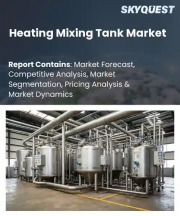
|
시장보고서
상품코드
2121172
가열식 교반 탱크 시장 규모, 점유율 및 성장 분석 : 탱크 유형별, 용량별, 소재별, 최종사용자별, 혼합 기구별, 지역별 - 업계 예측(2026-2033년)Heating Mixing Tank Market Size, Share, and Growth Analysis, By Tank Type, By Capacity, By Material, By End User, By Mixing Mechanism, By Region - Industry Forecast 2026-2033 |
||||||

세계의 가열식 교반 탱크 시장 규모는 2024년에 14억 2,000만 달러로 평가되며, 2025년 15억 5,000만 달러에서 2033년까지 30억 6,000만 달러로 확대할 전망이며, 예측 기간(2026-2033년)에 CAGR 8.9%로 성장할 것으로 전망되고 있습니다.
재생 가능 에너지 시스템으로의 전환은 가열식 교반 탱크 시장에 큰 영향을 미치고 있으며, 열 입력의 변동이나 폐열 활용과 관련하여 제조업체에 특유의 과제를 안겨주고 있습니다. 태양열 예열기나 폐열 회수 시스템 등의 기술 도입에 따라 효율적인 혼합을 유지하면서도 변동하는 입구 온도에 적응할 수 있는 탱크가 요구되고 있습니다. 예를 들어 브라질의 한 기업은 옥상의 태양전지판을 혼합 탱크에 효과적으로 통합하여 천연가스 사용량을 대폭 줄이는 데 성공했습니다. 마찬가지로 중동의 한 석유 및 가스·석유화학 시설에서는 재킷이 부착된 탱크로 교체함으로써 생산성을 향상시키고, 추가적인 연료원에 의존하지 않고도 더 높은 운영 효율을 달성했습니다. 이처럼 끊임없이 변화하는 상황은 변화하는 에너지 요구 사항과 운영상의 필요를 충족시키기 위한 혁신적인 솔루션의 필요성을 부각시키고 있습니다.
전 세계 가열식 교반 탱크 시장의 성장 동인
에너지 효율 향상은 환경적 지속가능성을 촉진하면서 운영 비용 절감을 목표로 하는 조직에게 최우선 과제가 되고 있습니다. 이러한 추세에 따라 정밀한 온도 제어가 가능한 기계에 대한 수요가 증가하고 있으며, 가열식 교반 탱크가 필수적인 솔루션으로 부상하고 있습니다. 이러한 탱크는 균일한 열 분포를 촉진하고, 열 손실을 효과적으로 최소화하며, 공정 최적화를 촉진합니다. 다양한 용도에 대한 적응성과 낮은 에너지 소비는 그 매력을 더욱 높여, 많은 산업 분야에서 선호되는 선택지가 되고 있습니다. 그 결과, 각 산업이 운영상의 요구를 충족하기 위한 효과적이고 효율적인 솔루션을 모색함에 따라 가열식 교반 탱크 시장은 인상적인 성장을 달성하고 있습니다.
전 세계 가열식 교반 탱크 시장의 제약 요인
전 세계 가열식 교반 탱크 시장은 압력 용기의 안전성, 배기가스 규제 및 재료 품질을 규정하는 엄격한 규제 기준으로 인해 큰 과제에 직면해 있습니다. 이러한 규제를 준수하기 위해서는 엄격한 시험 및 인증 절차가 필요하며, 그 결과 방대한 문서 작업과 정기적인 검사가 수반됩니다. 특정 설계 기준을 준수하는 것은 생산 비용 상승이나 제품을 시장에 출시하기까지의 기간 연장을 초래할 가능성이 있습니다. 그 결과, 제조업체는 이러한 규제적 장벽을 극복하기 위해 자원을 할당해야 하며, 이는 제품 출시 지연 및 소비자 부담 증가로 이어집니다. 이러한 복잡성은 시장 성장의 걸림돌이 되며, 특히 전 세계적인 가격 변동에 민감한 산업에 영향을 미치고 있습니다.
세계의 가열식 교반 탱크 시장 동향
전 세계 가열식 교반 탱크 시장에서는 강화된 환경 규제에 대응하기 위해 제조업체들이 친환경 솔루션을 우선시함에 따라 지속가능한 소재 채택을 향한 큰 변화가 나타나고 있습니다. 이러한 동향에는 내식 합금 및 재활용 가능한 폴리머의 채택이 포함되며, 특히 가혹한 온도 조건에서도 높은 성능 기준을 유지하면서 탄소발자국을 최소화하는 혁신적인 탱크 설계로 이어지고 있습니다. 이러한 지속가능한 노력을 도입함으로써 기업은 입찰 과정에서 경쟁력을 높일 뿐만 아니라, 그린 파이낸스 기회를 열어주는 새로운 지속가능성 기준도 준수할 수 있게 됩니다. 그 결과, 이러한 움직임은 시장 상황을 일신하고 보다 책임 있는 제조 방식을 촉진하고 있습니다.
자주 묻는 질문
목차
서론
조사 방법
개요
시장 역학과 전망
주요 시장 인사이트
세계의 가열식 교반 탱크 시장 규모 : 탱크 유형별
세계의 가열식 교반 탱크 시장 규모 : 용량별
세계의 가열식 교반 탱크 시장 규모 : 소재별
세계의 가열식 교반 탱크 시장 규모 : 최종사용자별
세계의 가열식 교반 탱크 시장 규모 : 교반 방식별
세계의 가열식 교반 탱크 시장 규모 : 지역별
경쟁 정보
주요 기업 개요
결론과 제안
KSA 26.09.08Global Heating Mixing Tank Market size was valued at USD 1.42 Billion in 2024 and is poised to grow from USD 1.55 Billion in 2025 to USD 3.06 Billion by 2033, growing at a CAGR of 8.9% during the forecast period (2026-2033).
The shift towards renewable energy systems is significantly influencing the heating mixing tank market, presenting manufacturers with unique challenges related to fluctuating heat inputs and waste heat utilization. The deployment of technologies like solar pre-heaters and waste heat recovery systems necessitates tanks that can adapt to variable inlet temperatures while maintaining efficient mixing. For instance, companies in Brazil have successfully integrated rooftop solar panels with their mixing tanks, resulting in substantial reductions in natural gas usage. Similarly, an oil and gas petrochemical facility in the Middle East enhanced its productivity by upgrading to jacketed tanks, achieving higher operational efficiency without relying on additional fuel sources. This evolving landscape emphasizes the need for innovative solutions to meet changing energy requirements and operational demands.
Top-down and bottom-up approaches were used to estimate and validate the size of the Global Heating Mixing Tank market and to estimate the size of various other dependent submarkets. The research methodology used to estimate the market size includes the following details: The key players in the market were identified through secondary research, and their market shares in the respective regions were determined through primary and secondary research. This entire procedure includes the study of the annual and financial reports of the top market players and extensive interviews for key insights from industry leaders such as CEOs, VPs, directors, and marketing executives. All percentage shares split, and breakdowns were determined using secondary sources and verified through Primary sources. All possible parameters that affect the markets covered in this research study have been accounted for, viewed in extensive detail, verified through primary research, and analyzed to get the final quantitative and qualitative data.
Global Heating Mixing Tank Market Segments Analysis
Global heating mixing tank market is segmented by tank type, capacity, material, end user, mixing mechanism and region. Based on tank type, the market is segmented into Electric Heating Mixing Tanks, Steam Heating Mixing Tanks and Thermal Oil Heating Mixing Tanks. Based on capacity, the market is segmented into Up to 500 L, 501-2,000 L and Above 2,000 L. Based on material, the market is segmented into Stainless Steel, Carbon Steel and Alloy Steel. Based on end user, the market is segmented into Food & Beverage, Pharmaceuticals, Chemicals and Cosmetics. Based on mixing mechanism, the market is segmented into Paddle, Anchor, High-Shear and Propeller. Based on region, the market is segmented into North America, Europe, Asia Pacific, Latin America and Middle East & Africa.
Driver of the Global Heating Mixing Tank Market
Increasing energy efficiency has become a priority for organizations aiming to lower operational costs while promoting environmental sustainability. This trend has led to a growing demand for machinery capable of ensuring precise temperature control, with heating mixing tanks emerging as a vital solution. These tanks facilitate uniform heat distribution, effectively minimize thermal losses, and enhance process optimization. Their compatibility with various applications and lower energy consumption further boost their appeal, making them preferred choices in many sectors. Consequently, the market for heating mixing tanks is witnessing significant growth as industries seek effective and efficient solutions to meet their operational needs.
Restraints in the Global Heating Mixing Tank Market
The Global Heating Mixing Tank market faces significant challenges due to stringent regulatory standards governing pressure vessel safety, emission control, and material quality. Compliance with these regulations necessitates rigorous testing and certification processes, resulting in extensive documentation and regular inspections. Adhering to specific design standards can elevate production costs and prolong the time required to bring products to market. Consequently, manufacturers must allocate resources to navigate these regulatory hurdles, causing delays in product launches and increasing costs for consumers. This complexity creates barriers to market growth, particularly affecting industries that are sensitive to pricing considerations on a global scale.
Market Trends of the Global Heating Mixing Tank Market
The Global Heating Mixing Tank market is witnessing a significant shift towards the adoption of sustainable materials as manufacturers prioritize eco-friendly solutions to meet rising environmental regulations. This trend involves the integration of anti-corrosive alloys and recyclable polymers, leading to innovative tank designs that minimize carbon footprints while maintaining high-performance standards, particularly in demanding temperature conditions. By embracing these sustainable practices, companies are not only enhancing their competitive edge in bidding processes but also aligning with new sustainability standards that open avenues for green financing opportunities. As a result, this movement is reshaping the market landscape, fostering a more responsible manufacturing approach.
Table of Contents
Introduction
- Objectives of the Study
- Market Definition & Scope
Research Methodology
- Research Process
- Secondary & Primary Data Methods
- Market Size Estimation Methods
Executive Summary
- Global Market Outlook
- Key Market Highlights
- Segmental Overview
- Competition Overview
Market Dynamics & Outlook
- Macro-Economic Indicators
- Drivers & Opportunities
- Restraints & Challenges
- Supply Side Trends
- Demand Side Trends
- Porters Analysis & Impact
- Competitive Rivalry
- Threat of Substitute
- Bargaining Power of Buyers
- Threat of New Entrants
- Bargaining Power of Suppliers
Key Market Insights
- Key Success Factors
- Market Impacting Factors
- Top Investment Pockets
- Ecosystem Mapping
- Market Attractiveness Index 2025
- PESTEL Analysis
- Regulatory Landscape
Global Heating Mixing Tank Market Size by Tank Type & CAGR (2026-2033)
- Market Overview
- Electric Heating Mixing Tanks
- Steam Heating Mixing Tanks
- Thermal Oil Heating Mixing Tanks
Global Heating Mixing Tank Market Size by Capacity & CAGR (2026-2033)
- Market Overview
- Up to 500 L501-2000 L
- Above 2000 L
Global Heating Mixing Tank Market Size by Material & CAGR (2026-2033)
- Market Overview
- Stainless Steel
- Carbon Steel
- Alloy Steel
Global Heating Mixing Tank Market Size by End User & CAGR (2026-2033)
- Market Overview
- Food & Beverage
- Pharmaceuticals
- Chemicals
- Cosmetics
Global Heating Mixing Tank Market Size by Mixing Mechanism & CAGR (2026-2033)
- Market Overview
- Paddle
- Anchor
- High-Shear
- Propeller
Global Heating Mixing Tank Market Size & CAGR (2026-2033)
- North America (Tank Type, Capacity, Material, End User, Mixing Mechanism)
- US
- Canada
- Europe (Tank Type, Capacity, Material, End User, Mixing Mechanism)
- Germany
- Spain
- France
- UK
- Italy
- Rest of Europe
- Asia Pacific (Tank Type, Capacity, Material, End User, Mixing Mechanism)
- China
- India
- Japan
- South Korea
- Rest of Asia-Pacific
- Latin America (Tank Type, Capacity, Material, End User, Mixing Mechanism)
- Mexico
- Brazil
- Rest of Latin America
- Middle East & Africa (Tank Type, Capacity, Material, End User, Mixing Mechanism)
- GCC Countries
- South Africa
- Rest of Middle East & Africa
Competitive Intelligence
- Top 5 Player Comparison
- Market Positioning of Key Players, 2025
- Strategies Adopted by Key Market Players
- Recent Developments in the Market
- Company Market Share Analysis, 2025
- Company Profiles of All Key Players
- Company Details
- Product Portfolio Analysis
- Company's Segmental Share Analysis
- Revenue Y-O-Y Comparison (2023-2025)
Key Company Profiles
- Paul Mueller Company
- Company Overview
- Business Segment Overview
- Financial Updates
- Key Developments
- Lee Industries, Inc.
- Company Overview
- Business Segment Overview
- Financial Updates
- Key Developments
- DCI, Inc.
- Company Overview
- Business Segment Overview
- Financial Updates
- Key Developments
- SPX FLOW, Inc.
- Company Overview
- Business Segment Overview
- Financial Updates
- Key Developments
- Alfa Laval AB
- Company Overview
- Business Segment Overview
- Financial Updates
- Key Developments
- GEA Group AG
- Company Overview
- Business Segment Overview
- Financial Updates
- Key Developments
- Tetra Pak International S.A.
- Company Overview
- Business Segment Overview
- Financial Updates
- Key Developments
- INOXPA S.A.U.
- Company Overview
- Business Segment Overview
- Financial Updates
- Key Developments
- MixMor
- Company Overview
- Business Segment Overview
- Financial Updates
- Key Developments
- Silverson Machines Ltd.
- Company Overview
- Business Segment Overview
- Financial Updates
- Key Developments
- EKATO Holding GmbH
- Company Overview
- Business Segment Overview
- Financial Updates
- Key Developments
- Charles Ross & Son Company
- Company Overview
- Business Segment Overview
- Financial Updates
- Key Developments
- Bachiller Group
- Company Overview
- Business Segment Overview
- Financial Updates
- Key Developments
- A&B Process Systems
- Company Overview
- Business Segment Overview
- Financial Updates
- Key Developments
- JBT Marel Corporation
- Company Overview
- Business Segment Overview
- Financial Updates
- Key Developments
- Apache Stainless Equipment Corporation
- Company Overview
- Business Segment Overview
- Financial Updates
- Key Developments
- SFI Stainless Fabrication, Inc.
- Company Overview
- Business Segment Overview
- Financial Updates
- Key Developments
- Zhejiang L&B Machinery Co., Ltd.
- Company Overview
- Business Segment Overview
- Financial Updates
- Key Developments
- Wenzhou Ace Machinery Co., Ltd.
- Company Overview
- Business Segment Overview
- Financial Updates
- Key Developments
- Shanghai Kaiquan Machine Valve Co., Ltd.
- Company Overview
- Business Segment Overview
- Financial Updates
- Key Developments
Conclusion & Recommendations

(주말 및 공휴일 제외)


