|
시장보고서
상품코드
1894901
적외선 센싱 용도 시장 및 브랜딩 전략(2026년)2026 Infrared Sensing Application Market and Branding Strategies |
||||||

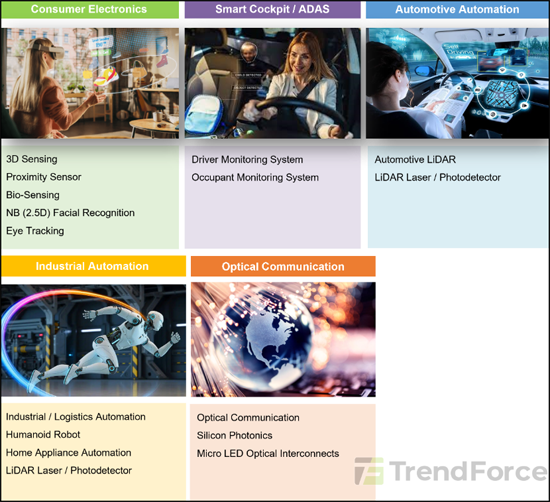
"TrendForce 2026 적외선 감지 용도 시장 및 브랜딩 전략" 보고서에 따르면, 브랜드의 전략적 계획에 힘입어 2026-2030년까지 다섯 가지 주요 테마가 꾸준히 전개될 것으로 예상됩니다.
- (1) 디스플레이 아래 3D 센싱, 디스플레이 아래 근접 센서 및 바이오 센싱을 포함한 소비자 전자 제품
- (2) 스마트 콕핏/ADAS - 운전자/탑승자 모니터링 시스템(DMS/OMS)
- (3) 자동차 자동화 - 자율 주행
- (4) 산업 자동화 및 휴머노이드 로봇
- (5) 광통신
다양한 요인들이 적외선 센싱 시장의 규모를 확대하고 있습니다. 소비자 가전, DMS/OMS, 자동차, LiDAR등 산업 자동화 용도를 기반으로 적외선 센싱용 IR LED, VCSEL, EEL의 시장 규모는 2030년까지 22억 1,400만 달러에 달할 것으로 예상됩니다.
주제 1 : 소비자 가전제품
디스플레이 내장 3D 센싱: 애플은 듀얼 접합 VCSEL을 채택하고, 성숙한 공정을 활용하여 2026년형 아이폰 프로 모델에 디스플레이 내장 3D 센싱 기술을 도입할 것으로 예상됩니다. 또한, 애플과 메타(Meta) 같은 브랜드들은 2028-2030년 사이에 3D 센싱 기술을 활용한 증강현실(AR) 안경을 출시하여 가상과 현실 환경 간의 실시간 상호작용을 가능하게 함으로써 상당한 사업 기회를 창출할 계획입니다.주제2 : 스마트 콕핏/ADAS - 운전자/숭객 모니터링 시스템(DMS/OMS)
EU의 일반 안전 규정에 따라 2026년 7월 7일부터 신규 승용차, 트럭, 버스에 ADDW 시스템 장착이 의무화됩니다. 또한, 고급차에는 ADAS/자율주행 레벨 2 이상의 시스템과 함께 사고나 사고로 이어질 수 있는 오작동을 방지하기 위한 운전자 모니터링 시스템 탑재가 의무화됩니다. 자동차 제조업체의 이러한 규제에 대한 대응은 확실히 시장에서 운전자/승객 모니터링 시스템에 대한 수요를 증가시키고 있습니다. 그러나 자동차 시장의 치열한 경쟁으로 인해 IR LED 시장의 가격 압력은 여전히 완화되지 않고 있습니다.
주제 3 : 자동차 자동화 - 자율주행
시장 경쟁에 직면한 자동차 업체들은 첨단 기술을 탑재한 고부가가치 제품(예: ADB 헤드라이트, 풀 와이드/미니 LED 테일라이트 등)의 적극적인 판매 확대를 추진하고 있습니다. 또한, 운전 안전성 향상과 자동긴급제동(AEB) 성능 강화를 목적으로 ADAS/자율주행 레벨3(예: Highway Pilot)에 LiDAR 적용을 추진하고 있습니다. 주요 기업으로는 Volvo, General Motors, Audi, Volkswagen, BMW, Hyundai, Hongqi, Changan, Li Auto, AITO, NIO, Toyota, Nissan 등을 들 수 있습니다. 자동차용 LiDAR는 주로 셔틀 운송이나 지점 간 운송을 목적으로 자율주행 레벨 4-5가 탑재된 자율주행 버스, 로보택시, 자율주행 트럭에도 적용되고 있습니다. 이를 통해 인력난 해소와 인건비 및 운송비 절감에 도움을 주고 있습니다.
주제 4 : 산업 자동화와 휴머노이드 로봇
산업용 LiDAR는 로봇, 산업 제조 공정, 물류, 안전 보호에 활용되고 있습니다. E-Commerce 산업의 급격한 성장에 따라 공장 내 유통 및 운송이 증가하는 반면, 빠르고 편리한 배송 서비스에 대한 소비자의 수요는 계속 증가하고 있습니다. 이로 인해 물류 기업에게 속도는 성공의 중요한 요소로 작용하는 한편, 라스트 마일 배송의 난이도가 높아지고 있습니다. EC 및 물류 기업들은 라스트 마일 배송 비용 절감과 효율화를 위해 배송 로봇을 강력하게 요구하고 있습니다.
따라서 2026년은 로봇 산업에서 새로운 단계를 맞이하는 해가 될 것입니다. 그 특징은 AI로 움직이는 실용적인 용도에 초점을 맞춘 휴머노이드 로봇입니다. 휴머노이드 로봇은 주변 환경과 상호 작용하기 위해 다양한 센서에 의존하고 있습니다. 구체적인 센서는 설계 요구 사항에 따라 다르지만, 이러한 센서는 인간의 감각 기능을 모방하도록 조정할 수 있습니다.
주제 5 : 광통신
생성형 AI의 부상과 함께 데이터센터에서는 전송 속도에 대한 수요가 크게 증가하고 있습니다. TrendForce에 따르면, 400Gbps 이하의 데이터 전송 속도는 이미 클라우드 서비스 제공업체(CSP)의 데이터센터에서 널리 채택되고 있습니다. 한편, 2025-2026년까지 800Gbps와 1.6Tbps가 시장 수요의 큰 성장 동력이 될 것으로 예상됩니다.
이 보고서는 적외선 센싱 용도 시장을 조사 분석하여 시장에서의 사업 전략과 마케팅 전략에 대한 종합적인 동향을 제공합니다.
목차
제1장 적외선 센싱 시장 규모 분석
- 2026년 적외선 센싱 용도 시장 - 제품 분석 개요
- 적외선 센싱 시장 규모 분석 - IR LED/VCSEL/EEL(2026-2030년)
- 적외선 센싱 기업 수익 - IR LED/VCSEL/EEL(2023-2025년)
- 소비자 가전 3D 센싱 - 모듈 vs. VCSEL(2026-2030년)
- 소비자 가전 3D 센싱 - VCSEL vs. VCSEL 칩(2026-2030년)
- 자동차/산업용 LiDAR 시장 - LiDAR vs. LiDAR 레이저(2026-2030년)
- IR LED 시장 규모 분석 - 보안 모니터링(2026-2030년)
제2장 소비자 가전
- 소비자 가전 - 적외선 센싱 기술 개요
- 소비자 가전 브랜드 전략 로드맵(2024-2030년)
제2장 1, 3D 센싱
- 3D 센싱 기술 개요
- ToF 기술 분석
- iPhone 17의 구조화 조명 - 제품, 비용, 공급망
- iPhone 17 Pro의 LiDAR 스캐너 - 제품, 비용, 공급망
- iPhone Pro(2026) - 디스플레이 하부 3D 센싱 사양 추정치
- 소비자 전자제품 3D 센싱 시장 기회
- 3D 센싱 제품 사양 및 공급망(2022-2025년)
- 모듈 시장 규모 - 소비자 가전 3D 센싱(2026-2030년)
- VCSEL 시장 규모 - 소비자 가전 3D 센싱(2026-2030년)
- VCSEL 칩 시장 규모 - 소비자 가전 3D 센싱(2026-2030년)
- VCSEL 기술 로드맵
- 3D 센싱 용도의 혁신으로 VCSEL/EEL 기술 발전
- VCSEL 칩 가격 동향(2018-2030년)
제2장 2, 근접 센서
- 근접 센서의 사양 및 가격 동향 분석(2026년)
- 근접 센서 시장 규모 분석(2026-2030년)
제2장 3, 바이오센싱
- 생리적 매개변수 측정 및 질병 분석
- 심박수와 혈중 산소 농도 - 광센싱의 원리
- 혈압과 체수분량 - 광센싱의 원리
- 바이오센싱 측정 장소 개요
- Apple Watch Series 11 - PPG 제품, 비용, 공급망
- Apple AirPods Pro 3 - 피부 감지 센서 제품, 비용, 공급망
- Samsung Galaxy Watch 8 - PPG 제품, 비용, 공급망
- Samsung Galaxy Buds 4 Pro - 피부 감지 센서 제품, 비용, 공급망
- 스마트링 바이오센싱 동향
- 바이오센싱 시스템 시장 현황
- 바이오센싱 시장 규모 분석 - 모듈(2026-2030년)
- 바이오센싱 시장 규모 분석 - 이산형 LED(2026-2030년)
- 바이오센싱 시장의 잠재력
- 단파 적외선(SWIR)
- SWIR LED 사양 분석
- SWIR LED/InGaAs 포토다이오드 가격 분석(2022-2025년)
제2장 4, NB 얼굴 인식
- 2.5D Face ID의 장점
- NB(2.5D) 얼굴 인식 - IR LED 사양 및 공급망
- NB(2.5D) 얼굴 인식에 VSCEL 기술이 탑재될 것인가?
- IR LED 시장 규모 분석 - NB(2.5D) 얼굴 인식(2026-2030년)
제2장 5, 아이트래킹
- AR/VR/MR - 광센싱 및 디스플레이 기술
- 아이트래킹의 장점 분석
- 아이트래킹 용도 시장
- 아이트래킹 브랜드 및 제품 사양
- AR/VR/MR 산업 - 자본투자, M&A, 전략적 제휴, 공급망 협력
- 아이트래킹 기술의 진화와 브랜드의 특허 전략
- AR/VR/MR 시장 출하량 분석(2026-2030년)
- IR LED 시장 규모 분석 - 아이트래킹(2026-2030년)
제3장 운전자/승객 모니터링 시스템
- 요인 분석
- 스마트 조종석 - 오늘부터 미래까지
- 액티브/패시브 센싱 분석
- 운전자 모니터링 시스템 - 규제 및 정책
- 운전자/승객 모니터링 시스템 - 기능 분석
- 운전자/승객 모니터링 시스템 - 2.5D의 사양 분석
- 운전자/승객 모니터링 시스템 - 3D 센싱의 사양 분석
- 운전자/승객 모니터링 시스템 - 센서 융합의 분석
- OEM 전략 및 공급망
- DMS/OMS - 자동차 출하량 및 보급률(2026-2030년)
- IR LED/VCSEL 시장 규모 분석 - DMS/OMS(2026-2030)
- IR LED/VCSEL 수요 시장 및 기업 수익 분석 - DMS/OMS
- IR LED 제품 사양 분석 - ams OSRAM
- VCSEL 제품 사양 분석 - ams OSRAM
- IR LED/VCSEL 제품 사양 분석 - Stanley
- 운전자/승객 모니터링 시스템 시장 상황 분석
제4장 자동차/산업 자동화
- LiDAR 응용 시장 정의
- 자동차/산업용 LiDAR 시장 규모 분석(2026-2030년)
- LiDAR 이미징 기술 개요
- LiDAR 제품 사양 및 가격 분석
- LiDAR 시장 상황 분석
제4장 1, 자동차의 자동화
- ADAS/자율주행 - OEM의 전략적 제휴 분석
- ADAS/자율주행 로드맵 및 공급망(2021-2026년)
- 자율주행 레벨 4-5의 시장 상황 분석
- 자동차 센싱 분석 - LiDAR, 레이더, 카메라
- LiDAR 제품 요구사항 - 운영 시나리오 분석
제4장 2, 산업 자동화
- 산업용 LiDAR 애플리케이션 시장
- 휴머노이드 로봇 시장 전망(2026년)
- 휴머노이드 로봇 - 적외선 센싱 솔루션
- 배송용 LiDAR
- 컨슈머 일렉트로닉스 LiDAR(로봇청소기/컴패니언 로봇)
제4장 3, LiDAR 레이저와 광 검출기
- LiDAR 레이저 시장 규모 - 응용 분석(2026-2030년)
- LiDAR 레이저 시장 규모 - 제품 분석(2026-2030년)
- LiDAR 광검출기 시장 규모 - 제품 분석(2026-2030년)
- LiDAR 레이저 - EEL/VCSEL에 대한 종합적인 분석
- 자동차용 LiDAR 레이저(EEL) 분석
- 자동차용 LiDAR 레이저(VCSEL) 분석
- 산업용 LiDAR 레이저 분석
- LiDAR 레이저 기업 - 주요 고객사 리스트
- LiDAR 광검출기 분석
- LiDAR 레이저/광검출기 기업 리스트
제5장 광통신 제품 동향 및 공급망 분석
- 데이터센터 업그레이드가 광통신 시장 수요를 자극
- 광통신 시장 발전(2025-2026년)
- CSP의 데이터센터 로드맵 - NVIDIA, Google, Amazon
- CSP의 데이터센터 로드맵 - Microsoft, Meta, Oracle
- 800Gbps vs. 1.6Tbps 트랜시버 제품 동향
- 트랜시버 vs. SiPh CPO
- SiPh CPO 기술 과제 분석
- 광통신 - 트랜시버 vs. SiPh CPO vs. Micro LED CPO
- 광통신 - Micro LED/VCSEL/CW LD(SiPh CPO)/EML
- 마이크로 LED 광 인터커넥트의 기회와 과제
- ML, CW LD, InGaAs 포토다이오드 가격 조사(2025년)
- 광통신 시장 상황 분석
According to the report "TrendForce 2026 Infrared Sensing Application Market and Branding Strategies," driven by brands' strategic planning, five key themes are projected to unfold steadily between 2026 and 2030.
- (1) consumer electronics, including under-display 3D sensing, under-display proximity sensors, and bio-sensing
- (2) smart cockpit / ADAS- driver / occupant monitoring systems (DMS/OMS)
- (3) automotive automation- autonomous driving
- (4) industrial automation and humanoid robots
- (5) optical communication
Various factors are helping to expand the market scale of infrared sensing applications. Based on consumer electronics, DMS/OMS, automotive and industrial automation applications such as LiDAR, TrendForce forecasts that the IR LED, VCSEL, and EEL market scale for infrared sensing applications will climb to USD 2.214 billion by 2030.
Topic One: Consumer Electronics
Under-Display 3D Sensing: Apple is expected to adopt Dual-Junction VCSELs, and introduce under-display 3D sensing in the 2026 model of iPhone Pro using mature processes. Moreover, brands like Apple and Meta are planning to launch AR glasses between 2028 and 2030, leveraging 3D sensing to enable real-time interaction between virtual and real environments, thereby opening up significant business opportunities.
Under-Display Proximity Sensors: By adopting LTPO panels and adjusting timings to avoid the refresh rate of OLED screens (144Hz), smartphone brands can reduce white spot artifacts. This factor also led Apple to cancel the development of its 1,130nm SWIR VCSEL under-display proximity sensor. Meanwhile, in order to improve screen-to-body ratio, the 2026 iPhone Pro will not only use under-display 3D sensing but may also place 1D/2D ToF sensors under the screen. Other brands mostly use 940nm VCSEL under-display proximity sensors, such as Samsung, OPPO, vivo, Transsion, Xiaomi, ZTE, Huawei, Honor, and Motorola.
Bio-Sensing: Apple Watch Series 11 have been incorporated with the new feature of blood pressure detection in 2025 through improvement of algorithms under the existing hardware, while AirPods Pro 3 is now included with skin-detect sensor and heart rate monitoring. Samsung's Galaxy Watch 8 and Galaxy Buds 4 Pro, under optimization on software and hardware, are maintaining the bio-sensing features from previous generations. For the long term, next-gen bio-sensing features, including body hydration, blood lipids, and blood alcohol concentration (BAC), could potentially be incorporated into smart watches of Apple and Samsung in between 2029 and 2030.
Eye Tracking: The advantages of eye tracking include intuitive visual experience, eye-triggered interactive interfaces, automatic interpupillary distance (IPD) adjustment, identity verification, and mobile payment are also expected to be integrated with Micro LED displays in AR glasses. Brands such as Apple, Meta, Samsung, Amazon, and Google are likely to adopt these technologies.
Topic Two: Smart Cockpit / ADAS- Driver / Occupant Monitoring Systems (DMS/OMS)
The EU General Safety Regulation stipulates that new passenger cars, trucks, and buses must be equipped with ADDW systems starting from July 7, 2026. Additionally, ADAS / autonomous driving Level 2 and above must be installed in high-end vehicles along with driver monitoring systems to prevent misuse that could lead to accidents and disputes. Carmakers' response to the policy has indeed driven the demand for driver/occupant monitoring systems in the market. However, due to the intense competition in the automotive market, the price pressure in the IR LED market has not eased.
Topic Three: Automotive Automation - Autonomous Driving
Automakers, facing market competition, are actively marketing high value-added products engineered with advanced technologies, such as ADB headlights, and full-width / Mini LED taillights. They have also been applying LiDAR to ADAS / autonomous driving Level 3 (e.g., Highway Pilot), aiming to enhance driving safety and autonomous emergency braking (AEB) performance. Leading players include Volvo, General Motors, Audi, Volkswagen, BMW, Hyundai, Hongqi, Changan, Li Auto, AITO, NIO, Toyota, and Nissan. Automotive LiDAR is also applied in autonomous buses, robo-taxis, and autonomous trucks with autonomous driving Level 4-5 mainly for shuttling and point-to-point transportation. This helps address labor shortages and save personnel and transportation costs.
Topic Four: Industrial Automation and Humanoid Robots
Industrial LiDAR is applied in robots, industrial manufacturing processes, logistics, and safety protection. With the rapid growth of the e-commerce industry, distribution and transportation within factories have increased, while consumer demand for fast and convenient delivery services continues to rise. This has made speed a crucial factor in determining success for logistics companies in e-commerce, while also making last-mile delivery more challenging. E-commerce and logistics companies, aiming to reduce last-mile delivery costs and improve efficiency, are increasingly demanding more delivery robots.
The year 2026 will therefore mark a new phase in the robotics industry, characterized by humanoid robots that are driven by AI and focused on practical applications. Humanoid robots rely on various sensors to interact with their surrounding environment. The specific sensors vary according to design requirements. These sensors can be aligned with the simulation of human sensory functions.
Topic Five: Optical Communications
In response to the rise of generative AI, data centers are facing a significant increase in transmission rate demands. According to TrendForce, data transmission rates of less than or equal to 400 Gbps have already been widely adopted in the data centers of Cloud Service Providers (CSPs). Meanwhile, 800 Gbps and 1.6 Tbps will be the main drivers of market demand growth from 2025 onwards and continue into 2026. NVIDIA's goals for SiPh CPO products include: 1. Low cost (< USD 0.1 / Gbps); 2. Low power consumption (< 1.5 pJ/bit); Long distance (> 1 km); Small form factor (>0.5 Tbps/mm2); High reliability (< 10 FIT). Among these, Micro LED CPO is expected to align with SiPh CPO goals in terms of low cost, low power consumption, small form factor, and high reliability.
TrendForce analyzes the market scale, opportunities and challenges, and product specifications and pricing for infrared sensing applications. These analyses are based on brand manufacturers' strategies and the latest developments across supply chains. The report aims to provide readers with a comprehensive insight into business and marketing strategies in the infrared sensing application market.
Table of Contents
Chapter 1. Infrared Sensing Market Scale Analysis
- 2026 Infrared Sensing Application Market- Product Analysis Overview
- 2026-2030 Infrared Sensing Market Scale Analysis- IR LED / VCSEL / EEL
- 2023-2025(E) Infrared Sensing Player Revenue- IR LED / VCSEL / EEL
- 2026-2030 Consumer Electronics 3D Sensing- Module vs. VCSEL
- 2026-2030 Consumer Electronics 3D Sensing- VCSEL vs. VCSEL Chip
- 2026-2030 Automotive / Industrial LiDAR Market- LiDAR vs. LiDAR Laser
- 2026-2030 IR LED Market Scale Analysis- Security Surveillance
Chapter 2. Consumer Electronics
- Consumer Electronics- Infrared Sensing Technology Overview
- 2024-2030 Consumer Electronics Brand Strategy Roadmap
2.1 3D Sensing
- 3D Sensing Technology Overview
- Time of Flight Technology Analysis
- iPhone 17 Structured Light- Product, Cost, and Supply Chain
- iPhone 17 Pro LiDAR Scanner- Product, Cost, and Supply Chain
- iPhone Pro (2026)- Under-Display 3D Sensing Specification Estimates
- Consumer Electronics 3D Sensing Market Opportunities
- 2022-2025 3D Sensing Product Specification and Supply Chain
- 2026-2030 Module Market Scale- Consumer Electronics 3D Sensing
- 2026-2030 VCSEL Market Scale- Consumer Electronics 3D Sensing
- 2026-2030 VCSEL Chip Market Scale- Consumer Electronics 3D Sensing
- VCSEL Technology Roadmap
- 3D Sensing Application Innovation Drives VCSEL / EEL Technologies
- 2018-2030 VCSEL Chip Price Trend
2.2 Proximity Sensor
- 2026(E) Proximity Sensor Specifications and Price Trend Analysis
- 2026-2030 Proximity Sensor Market Scale Analysis
2.3 Bio-Sensing
- Physiological Parameter Measurement and Disease Analysis
- Heart Rate vs. Blood Oxygen- Optical Sensing Principle
- Blood Pressure vs. Body Hydration- Optical Sensing Principle
- Bio-Sensing Measurement Location Overview
- Apple Watch Series 11- PPG Product, Cost, and Supply Chain
- Apple AirPods Pro 3- Skin-Detect Sensor Product, Cost, and Supply Chain
- Samsung Galaxy Watch 8- PPG Product, Cost, and Supply Chain
- Samsung Galaxy Buds 4 Pro- Skin-Detect Sensor Product, Cost, Supply Chain
- Smart Ring Bio-Sensing Trend
- Bio-Sensing System Market Landscape
- 2026-2030 Bio-Sensing Market Scale Analysis- Module
- 2026-2030 Bio-Sensing Market Scale Analysis- Discrete LED
- Bio-Sensing Market Potential
- Short Wave Infrared (SWIR)
- SWIR LED Specification Analysis
- 2022-2025 SWIR LED / InGaAs Photodiode Price Analysis
2.4 NB Facial Recognition
- 2.5D Face ID Advantages
- NB (2.5D) Facial Recognition- IR LED Specification and Supply Chain
- Will NB (2.5D) Facial Recognition Come with VSCEL Technology?
- 2026-2030 IR LED Market Scale Analysis- NB (2.5D) Facial Recognition
2.5 Eye Tracking
- AR/VR/MR- Optical Sensing and Display Technologies
- Eye Tracking Advantage Analysis
- Eye Tracking Application Markets
- Eye Tracking Brands and Product Specifications
- AR/VR/MR Industry- Capital Investment, M&A, Strategic Alliance, Supply Chain Cooperation
- Eye Tracking Technology Evolution and Brand Patent Strategies
- 2026-2030 AR/VR/MR Market Shipment Analysis
- 2026-2030 IR LED Market Scale Analysis- Eye Tracking
Chapter 3. Driver / Occupant Monitoring System
- Key Factor Analysis
- Smart Cockpit- From Today to the Future
- Active / Passive Sensing Analysis
- Driver Monitoring System- Regulations and Policies
- Driver / Occupant Monitoring System- Feature Analysis
- Driver / Occupant Monitoring System- 2.5D Specification Analysis
- Driver / Occupant Monitoring System- 3D Sensing Specification Analysis
- Driver / Occupant Monitoring System- Sensor Fusion Analysis
- OEM Strategies and Supply Chain
- 2026-2030 DMS/OMS- Car Shipment vs. Penetration Rate
- 2026-2030 IR LED / VCSEL Market Scale Analysis- DMS/OMS
- IR LED / VCSEL Demand Market vs. Player Revenue Analysis- DMS/OMS
- IR LED Product Specification Analysis- ams OSRAM
- VCSEL Product Specification Analysis- ams OSRAM
- IR LED / VCSEL Product Specification Analysis- Stanley
- Driver / Occupant Monitoring System Market Landscape Analysis
Chapter 4. Automotive / Industrial Automation
- Definitions of LiDAR Application Markets
- 2026-2030 Automotive / Industrial LiDAR Market Scale Analysis
- LiDAR Imaging Technology Overview
- LiDAR Product Specification and Price Analysis
- LiDAR Market Landscape Analysis
4.1 Automotive Automation
- ADAS / Autonomous Driving- OEM's Strategic Alliance Analysis
- 2021-2026 ADAS / Autonomous Driving Roadmap and Supply Chain
- Autonomous Driving Level 4-5 Market Landscape Analysis
- Automotive Sensing Analysis- LiDAR, Radar and Camera
- LiDAR Product Requirement- Driving Scenario Analysis
4.2 Industrial Automation
- Industrial LiDAR Application Market
- 2026 Humanoid Robot Market Outlook
- Humanoid Robot - Infrared Sensing Solution
- Delivery LiDAR
- Home Appliance LiDAR (Robot Vacuums / Companion Robots)
4.3 LiDAR Laser and Photodetector
- 2026-2030 LiDAR Laser Market Scale- Application Analysis
- 2026-2030 LiDAR Laser Market Scale- Product Analysis
- 2026-2030 LiDAR Photodetector Market Scale- Product Analysis
- LiDAR Laser- EEL / VCSEL Comprehensive Analysis
- Automotive LiDAR Laser (EEL) Analysis
- Automotive LiDAR Laser (VCSEL) Analysis
- Industrial LiDAR Laser Analysis
- LiDAR Laser Player- Major Customer List
- LiDAR Photodetector Analysis
- LiDAR Laser / Photodetector Player List
Chapter 5. Optical Communications Product Trend and Supply Chain Analysis
- Data Center Upgrades Stimulate Optical Communications Market Demand
- 2025-2026 Optical Communications Market Development
- CSP's Data Center Roadmap- NVIDIA, Google, Amazon
- CSP's Data Center Roadmap- Microsoft, Meta, Oracle
- 800Gbps vs. 1.6Tbps Transceiver Product Trend
- Transceiver vs. SiPh CPO
- SiPh CPO Technology Challenges Analysis
- Optical Communications- Transceiver vs. SiPh CPO vs. Micro LED CPO
- Optical Communications- Micro LED / VCSEL / CW LD (SiPh CPO) / EML
- Micro LED Optical Interconnects Opportunities and Challenges
- 2025 EML, CW LD, and InGaAs Photodiode Price Survey
- Optical Communications Market Landscape Analysis