|
시장보고서
상품코드
1481919
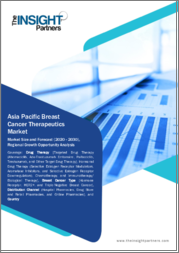
아시아태평양의 유방암 치료 시장 예측(-2030년) : 지역 분석 - 약물 요법, 유방암 유형, 유통 채널별Asia Pacific Breast Cancer Therapeutics Market Forecast to 2030 - Regional Analysis - by Drug Therapy, Breast Cancer Type, and Distribution Channel |
||||||

아시아태평양의 유방암 치료 시장은 2022년에는 69억 8,637만 달러로 평가되며, 2030년에는 158억 1,983만 달러에 달할 것으로 예측되며, 2022-2030년의 CAGR은 10.8%로 성장할 것으로 예측되고 있습니다.
다양한 진단 및 스크리닝 프로그램 출시로 아시아태평양의 유방암 치료 시장 활성화
개인맞춤형 의료, 면역요법, 병용요법, 약물전달 시스템, 액체생검, 인공지능, 환자 중심 접근법 등의 발전은 유방암 치료의 미래를 형성할 것으로 예상됩니다. 이러한 발전은 치료 결과를 개선하고, 부작용을 줄이며, 유방암 환자들의 전반적인 삶의 질을 향상시키는 것을 목표로 하고 있습니다.
질환의 조기 발견은 환자의 예후와 생존율을 개선하는 데 큰 역할을 합니다. 다양한 조직과 의료 서비스 프로바이더들은 유방암을 치료 가능한 초기 단계에서 발견하기 위해 검진 프로그램을 시행하고 있습니다. 세계보건기구(WHO)는 2013년 2월, 2040년까지 250만 명을 유방암으로부터 구하겠다는 목표를 달성하기 위한 새로운 '세계 유방암 구상 프레임워크'를 발표했습니다. 세계 암의 날 캠페인에 앞서 발표된 새로운 프레임워크는 이를 달성하기 위해 각국이 유방암의 조기 발견, 신속한 진단, 철저한 관리를 위한 건강 증진이라는 3가지 원칙을 준수할 것을 촉구하고 있습니다. 이러한 프로그램에는 유방암의 이상 징후를 발견하기 위한 유방촬영술, 유방 임상검사, 자가 유방 검진 등이 포함됩니다. 이러한 프로그램을 통해 유방암에 대한 인식과 조기 발견이 높아지면서 효과적인 치료제에 대한 수요가 증가하고 있습니다.
또한 전 세계에서 진단 기술의 발전도 많이 이루어지고 있습니다. 국립 의학 도서관은 조기 발견과 정확한 진단이 예후를 개선하는 데 필수적이라고 밝혔습니다. 디지털 유방촬영(DM), 디지털 유방촬영(DBT), 자기공명영상(MRI), 초음파(미국), 핵의학 검사 등 방사선 영상진단법이 유방암을 평가하는 데 자주 사용됩니다. 병리조직검사(HP)는 암의 유무를 판단하는 데 있으며, 가장 보편적인 방법입니다. 또한 인공지능(AI) 기술을 사용하여 의료 영상을 정량적으로 묘사하는 것은 유방암의 세분화, 진단 및 예후를 개선할 수 있는 큰 잠재력을 가지고 있습니다. 이러한 기술은 의료진이 종양의 범위와 특징을 파악하여 맞춤형 치료 계획을 수립하는 데 도움을 줄 수 있습니다. 이처럼 진단 및 검진 프로그램의 시작과 진단 기술의 발전은 아시아태평양의 유방암 치료 시장의 성장에 기여하고 있습니다.
아시아태평양의 유방암 치료 시장 개요
아시아태평양의 유방암 치료 시장은 중국, 일본, 인도, 한국, 호주, 기타 아시아태평양으로 구분됩니다. 시장 성장은 맞춤형 의료, 면역 요법, 병용 요법, 약물전달 시스템의 발전과 더불어 여성의 유방암 부담 증가 등의 요인에 기인합니다.
중국 유방암 치료 시장은 유방암 유병률 증가, 고령화 인구 증가, 라이프스타일 변화 등으로 인해 향후 수년간 상당한 성장을 보일 것으로 예상되며, 2023년 4월 14일 발표된 CDC 통계에 따르면 중국은 2020년 전 세계에서 새로 진단된 사례의 24%를 차지할 것으로 예상된다, 암 관련 사망자의 30%를 차지하고 있습니다. 지난 30년 동안 유방암의 연령 표준화 발병률은 1990년 10만 명당 17.07명에서 2019년 10만 명당 35.61명으로 증가했습니다. 치료 옵션의 발전은 중국에서 유방암 치료제에 대한 수요를 촉진하는 데 중요한 역할을 하고 있습니다.
일본에서는 여성 10명 중 1명이 유방암에 걸린다고 알려져 있으며, 10월의 핑크 리본 캠페인 및 기타 활동을 통해 일본인들의 유방암에 대한 인식이 높아져 자가 검진 및 기타 조기 발견 방법의 중요성 등 유방암에 대한 인식이 높아져 생존율이 90% 이상으로 높아졌습니다.로 높아집니다. 그러나 대표적인 위험 변수에 대한 파악은 늦어지고 있습니다. 이처럼 일본의 유방암 치료 시장은 고령화, 치료 옵션, 정부의 구상과 정책, 높은 의료비 지출, 인식 제고, 기술 발전 등으로 인해 크게 성장할 것으로 예상됩니다.
아시아태평양 유방암 치료제 시장 매출 및 2030년까지 예측(금액)
아시아태평양 유방암 치료 시장 세분화
아시아태평양의 유방암 치료 시장은 약물 요법, 유방암 유형 및 유통 채널을 기준으로 세분화됩니다.
약물 요법을 기준으로 아시아태평양의 유방암 치료 시장은 표적 약물 요법, 호르몬 약물 요법, 화학요법, 면역 요법/생물학적 요법으로 구분되며, 표적 약물 요법 부문이 2022년 더 큰 점유율을 차지할 것으로 예상됩니다. 표적 약물 치료 부문은 2022년에 더 큰 점유율을 차지했습니다. 표적 약물 치료 부문은 다시 아베마시클립, 애드트러스주맙-엠탄신, 팔보시클립, 트루스투주맙, 기타 표적 약물 치료로 세분화됩니다. 또한 호르몬 약물 치료 부문은 선택적 에스트로겐 수용체 조절제, 아로마타제 억제제, 선택적 에스트로겐 수용체 다운 레귤레이터로 세분화됩니다.
유방암 유형별로 아시아태평양의 유방암 치료 시장은 호르몬 수용체, HER2, 삼중음성 유방암으로 구분되며, 2022년에는 호르몬 수용체 부문이 더 큰 점유율을 차지할 것으로 예상됩니다.
유통 채널별로 아시아태평양의 유방암 치료 시장은 병원 약국, 드럭스토어 및 소매 약국, 온라인 약국으로 구분되며, 2022년에는 병원 약국 부문이 가장 큰 비중을 차지할 것으로 예상됩니다.
국가별로 보면 아시아태평양의 유방암 치료 시장은 호주, 중국, 인도, 일본, 한국, 기타 아시아태평양으로 분류되며, 2022년 아시아태평양의 유방암 치료 시장은 중국이 지배적이었습니다.
Eli Lilly and Co, Eisai Co Ltd, Novartis AG, AstraZeneca Plc, Pfizer Inc, Gilead Sciences Inc, Merck &Co Inc, Teva Pharmaceutical Industries Ltd, Amgen Inc 및 Amgen Inc는 아시아태평양의 유방암 치료 시장에서 사업을 운영하는 주요 기업입니다.
목차
제1장 서론
제2장 주요 요약
- 주요 인사이트
제3장 조사 방법
- 조사 범위
- 2차 조사
- 1차 조사
제4장 아시아태평양의 유방암 치료 시장 - 주요 산업 역학
- 주요 시장 촉진요인
- 유방암의 부담 증가
- 복수의 진단 및 스크리닝 프로그램의 개시
- 주요 시장 억제요인
- 진단과 치료에 드는 고비용
- 주요 시장 기회
- 정부 및 민간 단체로부터의 지원 증가
- 주요 향후 동향
- 맞춤형 의료의 이용 증가
- 영향 분석
제5장 유방암 치료 시장 : 아시아태평양 시장 분석
- 아시아태평양의 유방암 치료 시장 매출, 2022-2030년
제6장 아시아태평양의 유방암 치료 시장 - 매출과 2030년까지의 예측 : 약물 요법별
- 시장 매출 점유율, 2022년 및 2030년
- 표적 약물 요법
- 호르몬 약물 요법
- 화학요법
- 면역치료/생물학적 요법
제7장 아시아태평양의 유방암 치료 시장 - 매출과 2030년까지의 예측 : 유방암 유형별
- 시장 매출 점유율, 2022년 및 2030년
- 호르몬 수용체
- HER2+(인간 표피성장인자수용체 2)
- 삼중음성유방암
제8장 아시아태평양의 유방암 치료 시장 - 매출과 2030년까지의 예측 : 유통 채널별
- 시장 매출 점유율, 2022년 및 2030년
- 병원 약국
- 드러그스토어 및 소매 약국
- 온라인 약국
제9장 아시아태평양의 유방암 치료 시장 : 국가별 분석
- 중국
- 일본
- 인도
- 호주
- 한국
- 기타 아시아태평양
제10장 유방암 치료 시장 : 업계 상황
- 유방암 치료 시장의 성장 전략
- 유기적 성장 전략
- 무기적 성장 전략
제11장 기업 개요
- Eli Lilly and Co
- Eisai Co Ltd
- Novartis AG
- AstraZeneca Plc
- Pfizer Inc
- Gilead Sciences Inc
- Merck & Co Inc
- Teva Pharmaceutical Industries Ltd
- Amgen Inc
제12장 부록
KSA 24.05.31The Asia Pacific breast cancer therapeutics market was valued at US$ 6,986.37 million in 2022 and is expected to reach US$ 15,819.83 million by 2030; it is estimated to grow at a CAGR of 10.8% from 2022 to 2030.
Launch of Several Diagnostics and Screening Programs Fuels the Asia Pacific Breast Cancer Therapeutics Market
Advancements in personalized medicine, immunotherapy, combination therapies, drug delivery systems, liquid biopsies, AI, and patient-centric approaches are expected to shape the future of breast cancer treatment. These trends aim to improve treatment outcomes, reduce side effects, and enhance breast cancer patients overall quality of life.
Early disease detection plays a major role in improving patient outcomes and survival rates. Various organizations and healthcare providers are implementing screening programs to detect breast cancer at an initial stage when it is more treatable. The World Health Organization released a new Global Breast Cancer Initiative Framework in February 2013 that serves as a plan for fulfilling the goal of saving 2.5 million people from breast cancer by 2040. To achieve this, the new Framework, unveiled ahead of the World Cancer Day campaign, urges nations to follow the three pillars of health promotion for early detection, prompt diagnosis, and thorough management of breast cancer. These programs often include mammography, clinical breast exams, and self-breast exams to identify any abnormalities or signs of breast cancer. Implementing these programs has increased awareness and early detection of breast cancer cases, resulting in higher demand for effective therapeutics.
In addition, many advancements in diagnostic technologies have been witnessed across the globe. The National Library of Medicine states that early detection and precise diagnosis are essential for enhancing prognosis. Breast cancer assessment frequently makes use of radiographic imaging modalities such as digital mammography (DM), digital breast tomosynthesis (DBT), magnetic resonance imaging (MRI), ultrasound (US), and nuclear medicine procedures. Histopathology (HP) is the gold standard for determining the presence of cancer. Furthermore, using artificial intelligence (AI) technology to depict medical images quantitatively has significant potential for improving breast cancer segmentation, diagnosis, and prognosis. These technologies help healthcare providers identify the extent and characteristics of the tumor, allowing them to develop personalized treatment plans. Thus, the launch of diagnostic and screening programs, coupled with advancements in diagnostic technologies, contributes to the Asia Pacific breast cancer therapeutics market growth.
Asia Pacific Breast Cancer Therapeutics Market Overview
The breast cancer therapeutics market in Asia Pacific is segmented into China, Japan, India, South Korea, Australia, and the Rest of Asia Pacific. The market growth is attributed to factors including growing burden of breast cancers among women coupled with advancements in personalized medicine, immunotherapy, combination therapies, and drug delivery systems.
The breast cancer therapeutics market in China is projected to witness substantial growth in the coming years, owing to the rising prevalence of breast cancer, increasing aging population, lifestyle changes, and others. China accounted for 24% of cases with new diagnoses and 30% of cancer-related fatalities globally in 2020, as per CDC statistics published on April 14, 2023. Over the last three decades, the age-standardized incidence of breast cancer climbed from 17.07 per 100,000 in 1990 to 35.61 per 100,000 in 2019. Advancements in treatment options have played a crucial role in driving the demand for breast cancer therapeutics in China.
Also, out of 1 in 10 women in Japan will acquire breast cancer at some point. The pink ribbon campaign in October and other initiatives have raised awareness of the disease among Japanese people, including the importance of self-checks and other early detection methods that, when used, increase the survival rate to over 90%. The identification of typical risk variables, however, lags. Thus, the breast cancer therapeutics market in Japan is expected to grow significantly due to an aging population, treatment options, government initiatives and policies, high healthcare expenditure, rising awareness, and technological advancements.
Asia Pacific Breast Cancer Therapeutics Market Revenue and Forecast to 2030 (US$ Million)
Asia Pacific Breast Cancer Therapeutics Market Segmentation
The Asia Pacific breast cancer therapeutics market is segmented based on drug therapy, breast cancer type, and distribution channel.
Based on drug therapy, the Asia Pacific breast cancer therapeutics market is segmented into targeted drug therapy, hormonal drug therapy, chemotherapy, and immunotherapy/ biological therapy. The targeted drug therapy segment held a larger share in 2022. The targeted drug therapy segment held a larger share in 2022. The targeted drug therapy segment is further subsegmented into abemaciclib, ado-trastuzumab emtansine, palbociclib, trastuzumab, and other target drug therapy. Additionally, the hormonal drug therapy segment is categorized into selective estrogen receptor modulators, aromatase inhibitors, and selective estrogen receptor downregulators.
In terms of breast cancer type, the Asia Pacific breast cancer therapeutics market is segmented into hormone receptor, HER2+, and triple-negative breast cancer. The hormone receptor segment held a larger share in 2022.
By distribution channel, the Asia Pacific breast cancer therapeutics market is segmented into hospital pharmacies, drug store and retail pharmacies, and online pharmacies. The hospital pharmacies segment held a larger share in 2022.
Based on country, the Asia Pacific breast cancer therapeutics market is categorized into Australia, China, India, Japan, South Korea, and the Rest of Asia Pacific. China dominated the Asia Pacific breast cancer therapeutics market in 2022.
Eli Lilly and Co, Eisai Co Ltd, Novartis AG, AstraZeneca Plc, Pfizer Inc, Gilead Sciences Inc, Merck & Co Inc, Teva Pharmaceutical Industries Ltd, and Amgen Inc and Amgen Inc are some of the leading companies operating in the Asia Pacific breast cancer therapeutics market.
Table Of Contents
1. Introduction
- 1.1 The Insight Partners Research Report Guidance
- 1.2 Market Segmentation
2. Executive Summary
- 2.1 Key Insights
3. Research Methodology
- 3.1 Coverage
- 3.2 Secondary Research
- 3.3 Primary Research
4. Asia Pacific Breast Cancer Therapeutics Market - Key Industry Dynamics
- 4.1 Key Market Drivers
- 4.1.1 Growing Burden of Breast Cancer
- 4.1.2 Launch of Several Diagnostics and Screening Programs
- 4.2 Key Market Restraints
- 4.2.1 High Cost of Diagnosis and Treatment
- 4.3 Key Market Opportunities
- 4.3.1 Increased Support from Government and Private Organizations
- 4.4 Key Future Trends
- 4.4.1 Increasing Use of Personalized Medicine
- 4.5 Impact Analysis:
5. Breast Cancer Therapeutics Market - Asia Pacific Market Analysis
- 5.1 Asia Pacific Breast Cancer Therapeutics Market Revenue (US$ Mn), 2022 - 2030
6. Asia Pacific Breast Cancer Therapeutics Market - Revenue and Forecast to 2030 - by Drug Therapy
- 6.1 Overview
- 6.2 Asia Pacific Breast Cancer Therapeutics Market Revenue Share, by Drug Therapy, 2022 & 2030 (%)
- 6.3 Targeted Drug Therapy
- 6.3.1 Overview
- 6.3.2 Targeted Drug Therapy: Asia Pacific Breast Cancer Therapeutics Market - Revenue and Forecast to 2030 (US$ Million)
- 6.3.2.1 Asia Pacific Breast Cancer Therapeutics Market, by Targeted Drug Therapy, 2020-2030 (US$ Million)
- 6.4 Hormonal Drug Therapy
- 6.4.1 Overview
- 6.4.2 Hormonal Drug Therapy: Asia Pacific Breast Cancer Therapeutics Market - Revenue and Forecast to 2030 (US$ Million)
- 6.4.2.1 Asia Pacific Breast Cancer Therapeutics Market, by Hormonal Drug Therapy, 2020-2030 (US$ Million)
- 6.5 Chemotherapy
- 6.5.1 Overview
- 6.5.2 Chemotherapy: Asia Pacific Breast Cancer Therapeutics Market - Revenue and Forecast to 2030 (US$ Million)
- 6.6 Immunotherapy/ Biological Therapy
- 6.6.1 Overview
- 6.6.2 Immunotherapy/ Biological Therapy: Asia Pacific Breast Cancer Therapeutics Market - Revenue and Forecast to 2030 (US$ Million)
7. Asia Pacific Breast Cancer Therapeutics Market - Revenue and Forecast to 2030 - by Breast Cancer Type
- 7.1 Overview
- 7.2 Asia Pacific Breast Cancer Therapeutics Market Revenue Share, by Breast Cancer Type, 2022 & 2030 (%)
- 7.3 Hormone Receptor
- 7.3.1 Overview
- 7.3.2 Hormone Receptor: Asia Pacific Breast Cancer Therapeutics Market - Revenue and Forecast to 2030 (US$ Million)
- 7.4 HER2+ (human epidermal growth factor receptor 2)
- 7.4.1 Overview
- 7.4.2 HER2+: Asia Pacific Breast Cancer Therapeutics Market - Revenue and Forecast to 2030 (US$ Million)
- 7.5 Triple-Negative Breast Cancer
- 7.5.1 Overview
- 7.5.2 Triple-Negative Breast Cancer: Asia Pacific Breast Cancer Therapeutics Market - Revenue and Forecast to 2030 (US$ Million)
8. Asia Pacific Breast Cancer Therapeutics Market - Revenue and Forecast to 2030 - by Distribution Channel
- 8.1 Overview
- 8.2 Asia Pacific Breast Cancer Therapeutics Market Revenue Share, by Distribution Channel, 2022 & 2030 (%)
- 8.3 Hospital Pharmacies
- 8.3.1 Overview
- 8.3.2 Hospital Pharmacies: Asia Pacific Breast Cancer Therapeutics Market - Revenue and Forecast to 2030 (US$ Million)
- 8.4 Drug Store and Retail Pharmacies
- 8.4.1 Overview
- 8.4.2 Drug Store and Retail Pharmacies: Asia Pacific Breast Cancer Therapeutics Market - Revenue and Forecast to 2030 (US$ Million)
- 8.5 Online Pharmacies
- 8.5.1 Overview
- 8.5.2 Online Pharmacies: Asia Pacific Breast Cancer Therapeutics Market - Revenue and Forecast to 2030 (US$ Million)
9. Asia Pacific Breast Cancer Therapeutics Market -Country Analysis
- 9.1 Asia Pacific Breast Cancer Therapeutics Market, Revenue and Forecast to 2030
- 9.1.1 Overview
- 9.1.2 Asia Pacific Breast Cancer Therapeutics Market, Breakdown, by Country- Revenue (2022) (US$ Million)
- 9.1.3 Asia Pacific Breast Cancer Therapeutics Market, by Countries, 2022 and 2030 (%)
- 9.1.3.1 China
- 9.1.3.1.1 China Breast Cancer Therapeutics Market Revenue and Forecast to 2030 (US$ Mn)
- 9.1.3.1.2 China: Breast Cancer Therapeutics Market, by Drug Therapy, 2020-2030 (US$ Million)
- 9.1.3.1.2.1 China: Breast Cancer Therapeutics Market, For Targeted Drug Therapy by Drug Therapy, 2020-2030 (US$ Million)
- 9.1.3.1.2.2 China: Breast Cancer Therapeutics Market, For Hormonal Drug Therapy by Drug Therapy, 2020-2030 (US$ Million)
- 9.1.3.1.3 China: Breast Cancer Therapeutics Market, by Breast Cancer Type, 2020-2030 (US$ Million)
- 9.1.3.1.4 China: Breast Cancer Therapeutics Market, by Distribution Channel, 2020-2030 (US$ Million)
- 9.1.3.2 Japan
- 9.1.3.2.1 Japan Breast Cancer Therapeutics Market Revenue and Forecast to 2030 (US$ Mn)
- 9.1.3.2.2 Japan: Breast Cancer Therapeutics Market, by Drug Therapy, 2020-2030 (US$ Million)
- 9.1.3.2.2.1 Japan: Breast Cancer Therapeutics Market, For Targeted Drug Therapy by Drug Therapy, 2020-2030 (US$ Million)
- 9.1.3.2.2.2 Japan: Breast Cancer Therapeutics Market, For Hormonal Drug Therapy by Drug Therapy, 2020-2030 (US$ Million)
- 9.1.3.2.3 Japan: Breast Cancer Therapeutics Market, by Breast Cancer Type, 2020-2030 (US$ Million)
- 9.1.3.2.4 Japan: Breast Cancer Therapeutics Market, by Distribution Channel, 2020-2030 (US$ Million)
- 9.1.3.3 India
- 9.1.3.3.1 India Breast Cancer Therapeutics Market Revenue and Forecast to 2030 (US$ Mn)
- 9.1.3.3.2 India: Breast Cancer Therapeutics Market, by Drug Therapy, 2020-2030 (US$ Million)
- 9.1.3.3.2.1 India: Breast Cancer Therapeutics Market, For Targeted Drug Therapy by Drug Therapy, 2020-2030 (US$ Million)
- 9.1.3.3.2.2 India: Breast Cancer Therapeutics Market, For Hormonal Drug Therapy by Drug Therapy, 2020-2030 (US$ Million)
- 9.1.3.3.3 India: Breast Cancer Therapeutics Market, by Breast Cancer Type, 2020-2030 (US$ Million)
- 9.1.3.3.4 India: Breast Cancer Therapeutics Market, by Distribution Channel, 2020-2030 (US$ Million)
- 9.1.3.4 Australia
- 9.1.3.4.1 Australia Breast Cancer Therapeutics Market Revenue and Forecast to 2030 (US$ Mn)
- 9.1.3.4.2 Australia: Breast Cancer Therapeutics Market, by Drug Therapy, 2020-2030 (US$ Million)
- 9.1.3.4.2.1 Australia: Breast Cancer Therapeutics Market, For Targeted Drug Therapy by Drug Therapy, 2020-2030 (US$ Million)
- 9.1.3.4.2.2 Australia: Breast Cancer Therapeutics Market, For Hormonal Drug Therapy by Drug Therapy, 2020-2030 (US$ Million)
- 9.1.3.4.3 Australia: Breast Cancer Therapeutics Market, by Breast Cancer Type, 2020-2030 (US$ Million)
- 9.1.3.4.4 Australia: Breast Cancer Therapeutics Market, by Distribution Channel, 2020-2030 (US$ Million)
- 9.1.3.5 South Korea
- 9.1.3.5.1 South Korea Breast Cancer Therapeutics Market Revenue and Forecast to 2030 (US$ Mn)
- 9.1.3.5.2 South Korea: Breast Cancer Therapeutics Market, by Drug Therapy, 2020-2030 (US$ Million)
- 9.1.3.5.2.1 South Korea: Breast Cancer Therapeutics Market, For Targeted Drug Therapy by Drug Therapy, 2020-2030 (US$ Million)
- 9.1.3.5.2.2 South Korea: Breast Cancer Therapeutics Market, For Hormonal Drug Therapy by Drug Therapy, 2020-2030 (US$ Million)
- 9.1.3.5.3 South Korea: Breast Cancer Therapeutics Market, by Breast Cancer Type, 2020-2030 (US$ Million)
- 9.1.3.5.4 South Korea: Breast Cancer Therapeutics Market, by Distribution Channel, 2020-2030 (US$ Million)
- 9.1.3.6 Rest of Asia Pacific
- 9.1.3.6.1 Rest of Asia Pacific Breast Cancer Therapeutics Market Revenue and Forecast to 2030 (US$ Mn)
- 9.1.3.6.2 Rest of Asia Pacific: Breast Cancer Therapeutics Market, by Drug Therapy, 2020-2030 (US$ Million)
- 9.1.3.6.2.1 Rest of Asia Pacific: Breast Cancer Therapeutics Market, For Targeted Drug Therapy by Drug Therapy, 2020-2030 (US$ Million)
- 9.1.3.6.2.2 Rest of Asia Pacific: Breast Cancer Therapeutics Market, For Hormonal Drug Therapy by Drug Therapy, 2020-2030 (US$ Million)
- 9.1.3.6.3 Rest of Asia Pacific: Breast Cancer Therapeutics Market, by Breast Cancer Type, 2020-2030 (US$ Million)
- 9.1.3.6.4 Rest of Asia Pacific: Breast Cancer Therapeutics Market, by Distribution Channel, 2020-2030 (US$ Million)
- 9.1.3.1 China
10. Breast Cancer Therapeutics Market-Industry Landscape
- 10.1 Overview
- 10.2 Growth Strategies in Breast Cancer Therapeutics Market
- 10.3 Organic Growth Strategies
- 10.3.1 Overview
- 10.4 Inorganic Growth Strategies
- 10.4.1 Overview
11. Company Profiles
- 11.1 Eli Lilly and Co
- 11.1.1 Key Facts
- 11.1.2 Business Description
- 11.1.3 Products and Services
- 11.1.4 Financial Overview
- 11.1.5 SWOT Analysis
- 11.1.6 Key Developments
- 11.2 Eisai Co Ltd
- 11.2.1 Key Facts
- 11.2.2 Business Description
- 11.2.3 Products and Services
- 11.2.4 Financial Overview
- 11.2.5 SWOT Analysis
- 11.2.6 Key Developments
- 11.3 Novartis AG
- 11.3.1 Key Facts
- 11.3.2 Business Description
- 11.3.3 Products and Services
- 11.3.4 Financial Overview
- 11.3.5 SWOT Analysis
- 11.3.6 Key Developments
- 11.4 AstraZeneca Plc
- 11.4.1 Key Facts
- 11.4.2 Business Description
- 11.4.3 Products and Services
- 11.4.4 Financial Overview
- 11.4.5 SWOT Analysis
- 11.4.6 Key Developments
- 11.5 Pfizer Inc
- 11.5.1 Key Facts
- 11.5.2 Business Description
- 11.5.3 Products and Services
- 11.5.4 Financial Overview
- 11.5.5 SWOT Analysis
- 11.5.6 Key Developments
- 11.6 Gilead Sciences Inc
- 11.6.1 Key Facts
- 11.6.2 Business Description
- 11.6.3 Products and Services
- 11.6.4 Financial Overview
- 11.6.5 SWOT Analysis
- 11.6.6 Key Developments
- 11.7 Merck & Co Inc
- 11.7.1 Key Facts
- 11.7.2 Business Description
- 11.7.3 Products and Services
- 11.7.4 Financial Overview
- 11.7.5 SWOT Analysis
- 11.7.6 Key Developments
- 11.8 Teva Pharmaceutical Industries Ltd
- 11.8.1 Key Facts
- 11.8.2 Business Description
- 11.8.3 Products and Services
- 11.8.4 Financial Overview
- 11.8.5 SWOT Analysis
- 11.8.6 Key Developments
- 11.9 Amgen Inc
- 11.9.1 Key Facts
- 11.9.2 Business Description
- 11.9.3 Products and Services
- 11.9.4 Financial Overview
- 11.9.5 SWOT Analysis
- 11.9.6 Key Developments
12. Appendix
- 12.1 About Us
- 12.2 Glossary of Terms