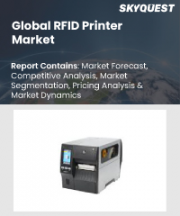
|
시장보고서
상품코드
1951319
RFID 프린터 시장 - 세계 산업 규모, 점유율, 동향, 기회, 예측 : 유형별, 인쇄 기술별, 주파수별, 용도별, 지역별&경쟁(2021-2031년)RFID Printer Market - Global Industry Size, Share, Trends, Opportunity, and Forecast, Segmented By Type, By Printing Technology, By Frequency, By Application, By Region & Competition, 2021-2031F |
||||||

세계의 RFID 프린터 시장은 2025년 47억 1,000만 달러에서 2031년까지 74억 1,000만 달러로 성장하고, CAGR 7.84%를 나타낼 것으로 예측됩니다.
세계의 RFID 프린터는 내장된 무선 주파수 식별 칩에 데이터를 인코딩하는 동시에 라벨 표면에 시각적 텍스트와 바코드를 인쇄하도록 설계된 특수 장치입니다. 시장 성장은 주로 소매 및 물류 부문공급망 투명성과 재고 정확성에 대한 요구가 증가함에 따라 뒷받침되고 있습니다. 조직은 이 기술을 활용하여 자산 추적을 자동화하고 수작업으로 인한 오류를 크게 줄이며 업무 효율성을 향상시키고 있습니다.
| 시장 개요 | |
|---|---|
| 예측 기간 | 2027-2031년 |
| 시장 규모 : 2025년 | 47억 1,000만 달러 |
| 시장 규모 : 2031년 | 74억 1,000만 달러 |
| CAGR : 2026-2031년 | 7.84% |
| 가장 성장이 빠른 부문 | 모바일 프린터 |
| 최대 시장 | 북미 |
그러나 RFID 인프라를 도입하기 위해서는 막대한 설비투자가 필요하기 때문에 중소기업의 도입을 가로막는 큰 걸림돌로 작용하고 있습니다. 이 하드웨어에 대한 수요는 필요한 소모품의 양과 밀접한 관련이 있습니다. RAIN 얼라이언스에 따르면, 2024년 전 세계적으로 출하된 RAIN RFID 태그 칩은 528억 개에 달할 것으로 예측됩니다. 이 수치는 물품 식별 범위의 확장을 지원하기 위한 인코딩 하드웨어에 대한 엄청난 수요를 뒷받침합니다.
시장 성장 촉진요인
소매 업계의 재고 정확도 확보와 옴니채널 대응을 위한 RFID 도입 가속화가 세계 RFID 프린터 시장의 주요 촉진요인으로 작용하고 있습니다. 소매업체들은 상품 단위의 태그를 인코딩하기 위해 RFID 프린터 도입을 확대하고 있으며, 온라인 구매 및 매장 수령(BOPIS) 모델에 필수적인 실시간 재고 가시성을 보장하기 위해 RFID 프린터를 도입하고 있습니다. 수동 재고관리에서 자동 추적으로 전환하면 품절 상황을 크게 줄이고 고객 만족도를 향상시킬 수 있습니다. 이 분야의 확장 모멘텀은 프린터 이용률과 직접적인 상관관계가 있는 소모품 수요에서 두드러지게 나타나고 있습니다. 2024년 10월 발표된 에이버리데니슨의 '2024년 3분기 실적'에 따르면, 지능형 라벨 부문은 의류 및 일반 소매 카테고리에서 20% 이상의 성장을 달성하여 인코딩 수요의 엄청난 규모를 입증했습니다.
실시간 공급망 가시성과 추적성에 대한 수요 증가는 특히 물류 및 운송 분야에서 시장 성장을 더욱 가속화하고 있습니다. 물류 사업자들은 RFID 프린터를 분류 시설에 통합하고, 화물 추적을 자동화하여 배송 실수와 운영 비용을 최소화하고 있습니다. 이러한 효율성 추구로 인해 기업들은 견고한 산업용 RFID 프린팅 하드웨어에 대한 대규모 투자가 이루어지고 있습니다. UPS의 '스마트 패키지 및 스마트 시설' 이니셔티브에 대한 2024년 7월 업데이트된 정보에 따르면, RFID 기술 도입으로 오적재율이 67% 감소하는 등 구체적인 운영상의 이점이 입증되었습니다. 이러한 하드웨어 투자 확대를 반영하여 Zebra Technologies는 2024년 3분기 자산 인텔리전스 및 추적 부문의 유기적 순매출이 전년 동기 대비 25.8% 증가했다고 보고했습니다.
시장의 과제
RFID 인프라 구축에 필요한 막대한 자본 투자는 세계 RFID 프린터 시장 성장에 직접적인 장벽으로 작용하고 있습니다. 많은 중소기업의 경우, 전용 인코딩 장비, 통합 소프트웨어, 리더기 등 보완 하드웨어 구매에 따른 초기 비용이 가용 예산을 초과하는 경우가 많습니다. RFID 프린터는 광범위하고 상호 의존적인 시스템의 한 요소에 불과하기 때문에 중소기업이 전체 인프라에 대한 자금을 조달할 수 없다면 이러한 인쇄 장비 구매 결정은 연기되거나 취소될 것이며, 잠재적인 고객 기반은 사실상 대기업으로 제한될 것입니다.
이러한 재정적 장벽은 대량의 물품 식별을 수반하는 운영상의 요구로 인해 더욱 복잡해집니다. 추적 요구사항의 규모가 커짐에 따라 조직은 엄청난 처리 용량을 처리할 수 있는 견고한 산업용 등급 인쇄 하드웨어에 투자해야 하며, 이는 더 높은 가격대를 수반합니다. RAIN 얼라이언스에 따르면, 2024년 RAIN RFID 태그 칩 출하량은 전년 대비 17% 증가했습니다. 이러한 급증하는 수요는 내구성이 높은 장비의 필요성을 강조하고, 예산이 제한된 조직에서 시장 보급을 가로막는 높은 진입장벽을 더욱 견고하게 만들고 있습니다.
시장 동향
RFID 프린터가 산업용 IoT 및 스마트 팩토리 생태계에 통합되면서 제조 워크플로우가 근본적으로 변화하고 있습니다. 생산시설이 완전 자동화 환경으로 전환됨에 따라 인코딩 장비는 연결 네트워크의 중요한 노드가 되어 물리적 자산과 디지털 트윈의 실시간 동기화를 실현합니다. 이러한 연결성을 통해 인쇄 과정에서 즉각적인 데이터 검증 및 오류 수정이 가능하며, 검증된 태그만 공급망에 유입되도록 보장합니다. 이러한 디지털화된 시각화 추진은 업계 전반의 전략적 투자 계획에서 명확하게 드러나고 있습니다. Zebra Technologies가 2024년 6월에 발표한 '2024 제조 비전 조사'에 따르면, 전 세계 제조업 리더의 66%가 품질 관리 최적화 및 추적성 문제를 해결하기 위해 향후 5년간 RFID 기술을 도입할 계획인 것으로 나타났습니다.
동시에 기업의 환경적 목표와 업무 효율화의 필요성으로 인해 시장에서는 지속가능성과 라이너리스 매체로의 결정적인 전환이 진행되고 있습니다. 각 제조업체들은 뒷면 용지 폐기물을 완전히 없애는 고점착성 라이너리스 라벨에 대응하기 위해 프린터 메커니즘을 재설계하고 있습니다. 이 혁신은 매립에 따른 탄소 발자국을 줄이고, 롤당 매체 용량을 최대화하여 교체 빈도를 줄임으로써 매립 폐기물의 탄소 발자국을 줄입니다. 이러한 운영상의 이점을 강조한 TSC Auto ID의 2024년 6월 보도자료 'TSC Auto ID, 종합적인 라이너리스 비즈니스 솔루션 발표'에 따르면, 라이너리스 인쇄를 통해 롤당 라벨 사용량을 최대 40%까지 증가시키고, 보관 요건을 효과적으로 최소화하면서 생산성을 향상시킬 수 있다고 밝혔습니다.
자주 묻는 질문
목차
제1장 개요
제2장 조사 방법
제3장 주요 요약
제4장 고객의 소리
제5장 세계의 RFID 프린터 시장 전망
제6장 북미의 RFID 프린터 시장 전망
제7장 유럽의 RFID 프린터 시장 전망
제8장 아시아태평양의 RFID 프린터 시장 전망
제9장 중동 및 아프리카의 RFID 프린터 시장 전망
제10장 남미의 RFID 프린터 시장 전망
제11장 시장 역학
제12장 시장 동향과 발전
제13장 세계의 RFID 프린터 시장 : SWOT 분석
제14장 Porter의 Five Forces 분석
제15장 경쟁 구도
제16장 전략적 제안
제17장 회사 소개 및 면책조항
LSH 26.03.13The Global RFID Printer Market is projected to expand from USD 4.71 Billion in 2025 to USD 7.41 Billion by 2031, reflecting a CAGR of 7.84%. Global RFID printers are specialized devices engineered to encode data onto embedded radio frequency identification chips while simultaneously printing visual text or barcodes on the label surface. Market growth is largely supported by the intensifying need for supply chain transparency and inventory accuracy within the retail and logistics sectors. Organizations leverage this technology to automate asset tracking, which significantly mitigates manual errors and boosts operational efficiency.
| Market Overview | |
|---|---|
| Forecast Period | 2027-2031 |
| Market Size 2025 | USD 4.71 Billion |
| Market Size 2031 | USD 7.41 Billion |
| CAGR 2026-2031 | 7.84% |
| Fastest Growing Segment | Mobile Printers |
| Largest Market | North America |
However, the substantial capital investment required to deploy RFID infrastructure poses a significant challenge that may hinder adoption among smaller businesses. This demand for hardware is inextricably linked to the volume of consumables required. According to the RAIN Alliance, the industry shipped 52.8 billion RAIN RFID tag chips globally in 2024. This figure underscores the massive requirement for encoding hardware to support the broadening scope of item identification.
Market Driver
The accelerated adoption of RFID in retail to ensure inventory accuracy and support omnichannel fulfillment acts as the primary catalyst for the Global RFID Printer Market. Retailers are increasingly deploying RFID printers to encode item-level tags, guaranteeing real-time stock visibility that is critical for Buy Online, Pick Up In-Store (BOPIS) models. This transition from manual counting to automated tracking drastically reduces out-of-stock scenarios and improves customer satisfaction. The intensity of this sector's expansion is evident in consumable demand, which directly correlates with printer utilization; according to Avery Dennison's 'Third Quarter 2024 Results' from October 2024, the Intelligent Labels segment delivered more than 20% growth in apparel and general retail categories, underscoring the massive scale of encoding requirements.
The rising demand for real-time supply chain visibility and traceability further amplifies market growth, particularly within the logistics and transportation sectors. Logistics providers are integrating RFID printers into sorting facilities to automate package tracking, thereby minimizing delivery errors and operational costs. This drive for efficiency compels companies to invest heavily in rugged industrial RFID printing hardware. According to a July 2024 update on the 'Smart Package Smart Facility' initiative by UPS, the deployment of RFID technology reduced misload rates by 67%, demonstrating tangible operational benefits. Reflecting this broader surge in hardware investment, Zebra Technologies reported that its Asset Intelligence & Tracking segment recorded a year-over-year organic net sales increase of 25.8% in the third quarter of 2024.
Market Challenge
The significant capital investment required for deploying RFID infrastructure presents a direct obstacle to the growth of the global RFID printer market. For many small and medium-sized enterprises, the upfront costs associated with purchasing specialized encoding devices, integration software, and complementary hardware such as readers often exceed available budgets. Since RFID printers are merely one component of a broader, interdependent system, the inability of smaller businesses to finance the complete infrastructure results in deferred or cancelled purchasing decisions for these printing devices, effectively narrowing the potential customer base to larger corporations.
This financial barrier is further compounded by the operational demands of high-volume item identification. As the scale of tracking requirements increases, organizations must invest in robust, industrial-grade printing hardware capable of handling massive throughput, which commands a higher price point. According to the RAIN Alliance, the industry witnessed a 17 percent year-over-year increase in RAIN RFID tag chip shipments in 2024. This surging volume underscores the necessity for heavy-duty equipment, reinforcing a high cost of entry that impedes widespread market adoption among budget-constrained entities.
Market Trends
The integration of RFID printers into Industrial IoT and smart factory ecosystems is fundamentally reshaping manufacturing workflows. As production facilities transition toward fully automated environments, encoding devices become critical nodes within a connected network, enabling real-time synchronization between physical assets and digital twins. This connectivity allows for immediate data validation and error correction during the printing process, ensuring that only verified tags enter the supply chain. This push for digitized visibility is evident in strategic investment plans across the sector; according to the '2024 Manufacturing Vision Study' by Zebra Technologies published in June 2024, 66% of global manufacturing leaders plan to implement RFID technology over the next five years to optimize quality management and address traceability challenges.
Concurrently, the market is witnessing a decisive shift toward sustainable and linerless media compatibility, driven by corporate environmental goals and the need for operational efficiency. Manufacturers are redesigning printer mechanisms to handle adhesive-heavy linerless labels that eliminate backing waste entirely. This innovation reduces the carbon footprint associated with landfill disposal and maximizes media capacity per roll, thereby decreasing the frequency of changeovers. Highlighting this operational advantage, TSC Auto ID's June 2024 press release, 'TSC Auto ID Unveils Comprehensive Linerless Business Solution,' noted that the adoption of linerless printing enables the usage of up to 40% more labels per roll, effectively minimizing storage requirements while enhancing productivity.
Key Market Players
- Zebra Technologies Corporation
- Honeywell International Inc.
- SATO Holdings Corporation
- Avery Dennison Corporation
- Toshiba Tec Corporation
- TSC Auto ID Technology Co., Ltd.
- Wasp Barcode Technologies
- Postek Electronics Co., Ltd.
- Godex International Co., Ltd.
- BIXOLON Co., Ltd.
Report Scope
In this report, the Global RFID Printer Market has been segmented into the following categories, in addition to the industry trends which have also been detailed below:
RFID Printer Market, By Type
- Industrial Printers
- Desktop Printers
- Mobile Printers
RFID Printer Market, By Printing Technology
- Thermal Transfer
- Direct Thermal
- Inkjet
RFID Printer Market, By Frequency
- Low Frequency (LF)
- High Frequency (HF)
- Ultra-High Frequency (UHF)
RFID Printer Market, By Application
- Manufacturing
- Retail
- Transportation & Logistics
- Healthcare
- Government
- Entertainment
- Others
RFID Printer Market, By Region
- North America
- United States
- Canada
- Mexico
- Europe
- France
- United Kingdom
- Italy
- Germany
- Spain
- Asia Pacific
- China
- India
- Japan
- Australia
- South Korea
- South America
- Brazil
- Argentina
- Colombia
- Middle East & Africa
- South Africa
- Saudi Arabia
- UAE
Competitive Landscape
Company Profiles: Detailed analysis of the major companies present in the Global RFID Printer Market.
Available Customizations:
Global RFID Printer Market report with the given market data, TechSci Research offers customizations according to a company's specific needs. The following customization options are available for the report:
Company Information
- Detailed analysis and profiling of additional market players (up to five).
Table of Contents
1. Product Overview
- 1.1. Market Definition
- 1.2. Scope of the Market
- 1.2.1. Markets Covered
- 1.2.2. Years Considered for Study
- 1.2.3. Key Market Segmentations
2. Research Methodology
- 2.1. Objective of the Study
- 2.2. Baseline Methodology
- 2.3. Key Industry Partners
- 2.4. Major Association and Secondary Sources
- 2.5. Forecasting Methodology
- 2.6. Data Triangulation & Validation
- 2.7. Assumptions and Limitations
3. Executive Summary
- 3.1. Overview of the Market
- 3.2. Overview of Key Market Segmentations
- 3.3. Overview of Key Market Players
- 3.4. Overview of Key Regions/Countries
- 3.5. Overview of Market Drivers, Challenges, Trends
4. Voice of Customer
5. Global RFID Printer Market Outlook
- 5.1. Market Size & Forecast
- 5.1.1. By Value
- 5.2. Market Share & Forecast
- 5.2.1. By Type (Industrial Printers, Desktop Printers, Mobile Printers)
- 5.2.2. By Printing Technology (Thermal Transfer, Direct Thermal, Inkjet)
- 5.2.3. By Frequency (Low Frequency (LF), High Frequency (HF), Ultra-High Frequency (UHF))
- 5.2.4. By Application (Manufacturing, Retail, Transportation & Logistics, Healthcare, Government, Entertainment, Others)
- 5.2.5. By Region
- 5.2.6. By Company (2025)
- 5.3. Market Map
6. North America RFID Printer Market Outlook
- 6.1. Market Size & Forecast
- 6.1.1. By Value
- 6.2. Market Share & Forecast
- 6.2.1. By Type
- 6.2.2. By Printing Technology
- 6.2.3. By Frequency
- 6.2.4. By Application
- 6.2.5. By Country
- 6.3. North America: Country Analysis
- 6.3.1. United States RFID Printer Market Outlook
- 6.3.1.1. Market Size & Forecast
- 6.3.1.1.1. By Value
- 6.3.1.2. Market Share & Forecast
- 6.3.1.2.1. By Type
- 6.3.1.2.2. By Printing Technology
- 6.3.1.2.3. By Frequency
- 6.3.1.2.4. By Application
- 6.3.1.1. Market Size & Forecast
- 6.3.2. Canada RFID Printer Market Outlook
- 6.3.2.1. Market Size & Forecast
- 6.3.2.1.1. By Value
- 6.3.2.2. Market Share & Forecast
- 6.3.2.2.1. By Type
- 6.3.2.2.2. By Printing Technology
- 6.3.2.2.3. By Frequency
- 6.3.2.2.4. By Application
- 6.3.2.1. Market Size & Forecast
- 6.3.3. Mexico RFID Printer Market Outlook
- 6.3.3.1. Market Size & Forecast
- 6.3.3.1.1. By Value
- 6.3.3.2. Market Share & Forecast
- 6.3.3.2.1. By Type
- 6.3.3.2.2. By Printing Technology
- 6.3.3.2.3. By Frequency
- 6.3.3.2.4. By Application
- 6.3.3.1. Market Size & Forecast
- 6.3.1. United States RFID Printer Market Outlook
7. Europe RFID Printer Market Outlook
- 7.1. Market Size & Forecast
- 7.1.1. By Value
- 7.2. Market Share & Forecast
- 7.2.1. By Type
- 7.2.2. By Printing Technology
- 7.2.3. By Frequency
- 7.2.4. By Application
- 7.2.5. By Country
- 7.3. Europe: Country Analysis
- 7.3.1. Germany RFID Printer Market Outlook
- 7.3.1.1. Market Size & Forecast
- 7.3.1.1.1. By Value
- 7.3.1.2. Market Share & Forecast
- 7.3.1.2.1. By Type
- 7.3.1.2.2. By Printing Technology
- 7.3.1.2.3. By Frequency
- 7.3.1.2.4. By Application
- 7.3.1.1. Market Size & Forecast
- 7.3.2. France RFID Printer Market Outlook
- 7.3.2.1. Market Size & Forecast
- 7.3.2.1.1. By Value
- 7.3.2.2. Market Share & Forecast
- 7.3.2.2.1. By Type
- 7.3.2.2.2. By Printing Technology
- 7.3.2.2.3. By Frequency
- 7.3.2.2.4. By Application
- 7.3.2.1. Market Size & Forecast
- 7.3.3. United Kingdom RFID Printer Market Outlook
- 7.3.3.1. Market Size & Forecast
- 7.3.3.1.1. By Value
- 7.3.3.2. Market Share & Forecast
- 7.3.3.2.1. By Type
- 7.3.3.2.2. By Printing Technology
- 7.3.3.2.3. By Frequency
- 7.3.3.2.4. By Application
- 7.3.3.1. Market Size & Forecast
- 7.3.4. Italy RFID Printer Market Outlook
- 7.3.4.1. Market Size & Forecast
- 7.3.4.1.1. By Value
- 7.3.4.2. Market Share & Forecast
- 7.3.4.2.1. By Type
- 7.3.4.2.2. By Printing Technology
- 7.3.4.2.3. By Frequency
- 7.3.4.2.4. By Application
- 7.3.4.1. Market Size & Forecast
- 7.3.5. Spain RFID Printer Market Outlook
- 7.3.5.1. Market Size & Forecast
- 7.3.5.1.1. By Value
- 7.3.5.2. Market Share & Forecast
- 7.3.5.2.1. By Type
- 7.3.5.2.2. By Printing Technology
- 7.3.5.2.3. By Frequency
- 7.3.5.2.4. By Application
- 7.3.5.1. Market Size & Forecast
- 7.3.1. Germany RFID Printer Market Outlook
8. Asia Pacific RFID Printer Market Outlook
- 8.1. Market Size & Forecast
- 8.1.1. By Value
- 8.2. Market Share & Forecast
- 8.2.1. By Type
- 8.2.2. By Printing Technology
- 8.2.3. By Frequency
- 8.2.4. By Application
- 8.2.5. By Country
- 8.3. Asia Pacific: Country Analysis
- 8.3.1. China RFID Printer Market Outlook
- 8.3.1.1. Market Size & Forecast
- 8.3.1.1.1. By Value
- 8.3.1.2. Market Share & Forecast
- 8.3.1.2.1. By Type
- 8.3.1.2.2. By Printing Technology
- 8.3.1.2.3. By Frequency
- 8.3.1.2.4. By Application
- 8.3.1.1. Market Size & Forecast
- 8.3.2. India RFID Printer Market Outlook
- 8.3.2.1. Market Size & Forecast
- 8.3.2.1.1. By Value
- 8.3.2.2. Market Share & Forecast
- 8.3.2.2.1. By Type
- 8.3.2.2.2. By Printing Technology
- 8.3.2.2.3. By Frequency
- 8.3.2.2.4. By Application
- 8.3.2.1. Market Size & Forecast
- 8.3.3. Japan RFID Printer Market Outlook
- 8.3.3.1. Market Size & Forecast
- 8.3.3.1.1. By Value
- 8.3.3.2. Market Share & Forecast
- 8.3.3.2.1. By Type
- 8.3.3.2.2. By Printing Technology
- 8.3.3.2.3. By Frequency
- 8.3.3.2.4. By Application
- 8.3.3.1. Market Size & Forecast
- 8.3.4. South Korea RFID Printer Market Outlook
- 8.3.4.1. Market Size & Forecast
- 8.3.4.1.1. By Value
- 8.3.4.2. Market Share & Forecast
- 8.3.4.2.1. By Type
- 8.3.4.2.2. By Printing Technology
- 8.3.4.2.3. By Frequency
- 8.3.4.2.4. By Application
- 8.3.4.1. Market Size & Forecast
- 8.3.5. Australia RFID Printer Market Outlook
- 8.3.5.1. Market Size & Forecast
- 8.3.5.1.1. By Value
- 8.3.5.2. Market Share & Forecast
- 8.3.5.2.1. By Type
- 8.3.5.2.2. By Printing Technology
- 8.3.5.2.3. By Frequency
- 8.3.5.2.4. By Application
- 8.3.5.1. Market Size & Forecast
- 8.3.1. China RFID Printer Market Outlook
9. Middle East & Africa RFID Printer Market Outlook
- 9.1. Market Size & Forecast
- 9.1.1. By Value
- 9.2. Market Share & Forecast
- 9.2.1. By Type
- 9.2.2. By Printing Technology
- 9.2.3. By Frequency
- 9.2.4. By Application
- 9.2.5. By Country
- 9.3. Middle East & Africa: Country Analysis
- 9.3.1. Saudi Arabia RFID Printer Market Outlook
- 9.3.1.1. Market Size & Forecast
- 9.3.1.1.1. By Value
- 9.3.1.2. Market Share & Forecast
- 9.3.1.2.1. By Type
- 9.3.1.2.2. By Printing Technology
- 9.3.1.2.3. By Frequency
- 9.3.1.2.4. By Application
- 9.3.1.1. Market Size & Forecast
- 9.3.2. UAE RFID Printer Market Outlook
- 9.3.2.1. Market Size & Forecast
- 9.3.2.1.1. By Value
- 9.3.2.2. Market Share & Forecast
- 9.3.2.2.1. By Type
- 9.3.2.2.2. By Printing Technology
- 9.3.2.2.3. By Frequency
- 9.3.2.2.4. By Application
- 9.3.2.1. Market Size & Forecast
- 9.3.3. South Africa RFID Printer Market Outlook
- 9.3.3.1. Market Size & Forecast
- 9.3.3.1.1. By Value
- 9.3.3.2. Market Share & Forecast
- 9.3.3.2.1. By Type
- 9.3.3.2.2. By Printing Technology
- 9.3.3.2.3. By Frequency
- 9.3.3.2.4. By Application
- 9.3.3.1. Market Size & Forecast
- 9.3.1. Saudi Arabia RFID Printer Market Outlook
10. South America RFID Printer Market Outlook
- 10.1. Market Size & Forecast
- 10.1.1. By Value
- 10.2. Market Share & Forecast
- 10.2.1. By Type
- 10.2.2. By Printing Technology
- 10.2.3. By Frequency
- 10.2.4. By Application
- 10.2.5. By Country
- 10.3. South America: Country Analysis
- 10.3.1. Brazil RFID Printer Market Outlook
- 10.3.1.1. Market Size & Forecast
- 10.3.1.1.1. By Value
- 10.3.1.2. Market Share & Forecast
- 10.3.1.2.1. By Type
- 10.3.1.2.2. By Printing Technology
- 10.3.1.2.3. By Frequency
- 10.3.1.2.4. By Application
- 10.3.1.1. Market Size & Forecast
- 10.3.2. Colombia RFID Printer Market Outlook
- 10.3.2.1. Market Size & Forecast
- 10.3.2.1.1. By Value
- 10.3.2.2. Market Share & Forecast
- 10.3.2.2.1. By Type
- 10.3.2.2.2. By Printing Technology
- 10.3.2.2.3. By Frequency
- 10.3.2.2.4. By Application
- 10.3.2.1. Market Size & Forecast
- 10.3.3. Argentina RFID Printer Market Outlook
- 10.3.3.1. Market Size & Forecast
- 10.3.3.1.1. By Value
- 10.3.3.2. Market Share & Forecast
- 10.3.3.2.1. By Type
- 10.3.3.2.2. By Printing Technology
- 10.3.3.2.3. By Frequency
- 10.3.3.2.4. By Application
- 10.3.3.1. Market Size & Forecast
- 10.3.1. Brazil RFID Printer Market Outlook
11. Market Dynamics
- 11.1. Drivers
- 11.2. Challenges
12. Market Trends & Developments
- 12.1. Merger & Acquisition (If Any)
- 12.2. Product Launches (If Any)
- 12.3. Recent Developments
13. Global RFID Printer Market: SWOT Analysis
14. Porter's Five Forces Analysis
- 14.1. Competition in the Industry
- 14.2. Potential of New Entrants
- 14.3. Power of Suppliers
- 14.4. Power of Customers
- 14.5. Threat of Substitute Products
15. Competitive Landscape
- 15.1. Zebra Technologies Corporation
- 15.1.1. Business Overview
- 15.1.2. Products & Services
- 15.1.3. Recent Developments
- 15.1.4. Key Personnel
- 15.1.5. SWOT Analysis
- 15.2. Honeywell International Inc.
- 15.3. SATO Holdings Corporation
- 15.4. Avery Dennison Corporation
- 15.5. Toshiba Tec Corporation
- 15.6. TSC Auto ID Technology Co., Ltd.
- 15.7. Wasp Barcode Technologies
- 15.8. Postek Electronics Co., Ltd.
- 15.9. Godex International Co., Ltd.
- 15.10. BIXOLON Co., Ltd.