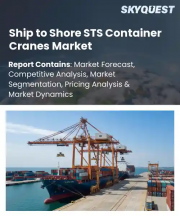
|
시장보고서
상품코드
1953665
STS(Ship-to-Shore) 크레인 시장 : 세계 산업 규모, 점유율, 동향, 기회, 예측 - 제품 유형별, 동력원별, 배포 범위별, 리프팅 능력별, 지역별, 경쟁(2021-2031년)Ship-to-Shore Cranes Market - Global Industry Size, Share, Trends, Opportunity, and Forecast, Segmented, By Product Type, By Power Supply, By Outreach, By Lifting Capacity, By Region & Competition, 2021-2031F |
||||||

세계의 STS(Ship-to-Shore) 크레인 시장은 2025년 96억 8,000만 달러에서 2031년까지 131억 9,000만 달러로 확대하며, CAGR 5.29%를 기록할 것으로 예측됩니다.
이 특수 갠트리 구조물은 항만 터미널에 설치되어 접안 선박과 부두 사이에서 컨테이너를 이송하는 역할을 합니다. 이 성장의 주요 요인은 초대형 컨테이너선의 도입입니다. 이를 위해서는 더 긴 도달 거리와 우수한 리프트 높이를 갖춘 장비가 필요합니다. 또한 항만 효율화에 대한 기본적인 요구로 인해 운영자는 선박의 처리 시간을 최소화하기 위해 더 빠른 하역 능력에 투자해야 하며, 이는 일시적인 선호가 아니라 현대 해상 무역의 구조적 요구 사항을 반영합니다.
| 시장 개요 | |
|---|---|
| 예측 기간 | 2027-2031년 |
| 시장 규모 : 2025년 | 96억 8,000만 달러 |
| 시장 규모 : 2031년 | 131억 9,000만 달러 |
| CAGR : 2026-2031년 | 5.29% |
| 가장 빠르게 성장하는 부문 | 하이브리드 |
| 최대 시장 | 아시아태평양 |
그러나 높은 설비투자 요구사항은 특히 개발도상국에서 시장의 급속한 확장을 가로막는 큰 장벽이 될 수 있습니다. 터미널 운영사는 복잡한 자금 조달 환경과 변동하는 세계 무역량을 고려해야 하며, 이것이 조달 일정에 영향을 미치는 경우가 많습니다. 이러한 인프라 투자에 대한 신중한 태도는 최근 업계 통계에서도 확인할 수 있습니다. 항만설비제조업체협회(PEMA)에 따르면 2024년 세계 시장에서 STS(Ship-to-Shore) 크레인 납품 대수는 208대였다고 합니다. 이 통계는 이해관계자들이 역량 강화와 경제적 신중함의 균형을 맞추면서 도입 속도가 신중하게 진행되고 있음을 보여줍니다.
시장 성장 촉진요인
세계 해상 무역과 컨테이너 운송량의 급격한 증가는 STS(Ship-to-Shore) 크레인 시장의 주요 구조적 동인으로 작용하고 있으며, 주요 터미널의 높은 처리 능력에 대한 필요성이 대두되고 있습니다. 컨테이너 물동량 증가에 따라 항만 운영사들은 화물 밀도 향상과 대형 선박 증가에 대응하기 위해 인프라를 확장해야 하는 상황입니다. BIMCO의 2024년 7월판 '컨테이너 운송' 보고서에 따르면 2024년 세계 컨테이너 처리량은 5.0%에서 6.0% 성장할 것으로 예측됩니다. 이러한 급격한 증가로 인해 터미널은 기존 장비를 더 빠른 사이클 타임과 확장된 도달 범위를 가진 크레인으로 교체할 필요가 있으며, 이는 Liebherr와 같은 주요 제조업체의 판매를 주도하고 있습니다. 이 회사의 2024년 4월 회계연도 연차보고서에 따르면 해양 크레인 부문의 매출은 9억 7,700만 유로를 달성했습니다.
동시에 전 세계 항만 인프라의 확장 및 현대화가 진행되면서 운영사들이 운영 효율성과 처리 시간 최적화를 우선시하는 가운데 시장 활동이 가속화되고 있습니다. 터미널은 혼잡 완화 및 경쟁력 유지를 위해 기존 선단의 적극적인 개보수 및 첨단 유닛 도입을 추진하고 있습니다. 이러한 고성능 솔루션의 추세는 최근 재무 공시에서도 확인할 수 있습니다. 코네크레인의 2024년 10월 중간 보고서에 따르면 항만 솔루션 부문은 3분기에만 3억 3,400만 유로를 수주하여 전년 동기 대비 43.2% 증가한 것으로 나타났습니다. 이러한 급격한 성장은 복잡한 물류 요건에 대응하기 위한 항만 능력의 업그레이드가 매우 중요하다는 것을 강조하고 있습니다.
시장이 해결해야 할 과제
STS(Ship-to-Shore) 크레인 도입에 필요한 막대한 자본 지출은 시장 성장을 직접적으로 저해하는 큰 장벽으로 작용하고 있습니다. 이러한 대형 설비는 막대한 선투자가 필요하므로 터미널 운영사는 세계 경제의 변동에 매우 민감한 복잡한 금융 구조에 의존할 수밖에 없습니다. 무역 예측이 불투명해지고 금리가 상승하면, 이러한 대규모 인프라 투자에 따른 재무적 위험은 많은 항만들이 감당하기 어려울 수 있습니다. 그 결과, 의사결정권자들은 유동성을 유지하기 위해 필요한 설비 업그레이드 및 확장 프로젝트를 연기하는 경우가 많으며, 이는 조달 활동의 현저한 둔화로 이어지고 있습니다.
이러한 투자 억제 경향은 경제적 신중함으로 인해 인프라 현대화가 늦어지고 있는 특정 지역 시장에서의 축소 추세에서 두드러지게 나타납니다. 항만장비제조업체협회(PEMA)에 따르면 2024년 북미 터미널에 인도된 STS(Ship-to-Shore) 크레인 물량은 28대로 감소했습니다. 이는 전년도 47기 대비 큰 폭으로 감소한 것으로, 주요 지역의 설비 도입이 재정적 제약과 신중한 재정 운용으로 인해 사실상 억제되고 있으며, 이로 인해 세계 산업의 확장 가능성이 제한되고 있는 현실을 보여줍니다.
시장 동향
원격 조작 스테이션(ROS) 및 제어실로의 전환은 STS(Ship-to-Shore) 크레인 시장의 운영 패러다임을 근본적으로 변화시키고 있습니다. 이는 인간 작업자를 기내의 물리적 위험으로부터 분리해야 할 필요성에 의해 추진되고 있습니다. 이러한 추세는 제어 기능을 중앙 집중화된 인체공학적 사무실 환경으로 전환하는 것이 특징이며, 안전성을 크게 향상시키는 동시에 첨단 지원 시스템을 도입할 수 있게 해줍니다. 터미널 운영사들은 자산 수명주기 연장과 정확도 향상을 위해 이러한 기술을 통한 기존 인프라의 개보수에 박차를 가하고 있습니다. 2025년 10월 DatamarNews 보도에 따르면 Log-In은 Vila Velha 터미널의 크레인 3대에 원격 크레인 운영 시스템(RCOS)과 3D 비전 기술을 도입하기 위해 4,200만 헤알의 투자를 완료했습니다.
동시에 엄격한 환경 규제와 기업의 탈탄소화 목표에 힘입어 전기화 및 하이브리드 저배출 파워트레인 채택이 중요한 동향으로 부상하고 있습니다. 항만에서는 디젤 유압 시스템에서 벗어나 전력망 또는 배터리 기술을 이용한 완전 전기 장치로 전환하여 부두에서 무공해 운항을 실현하고 있습니다. 이러한 변화는 지속가능성이 조달의 핵심 기준이 되는 신규 터미널 설계에서 특히 두드러집니다. 2025년 2월 WorldCargo News가 보도한 바와 같이, 신설 리예카 게이트웨이 터미널은 ZPMC의 STS(Ship-to-Shore) 크레인 4기를 도입하여 터미널 장비의 95%가 전기식이며, 재생에너지로만 운영되는 선단을 구성하고 있습니다.
자주 묻는 질문
목차
제1장 개요
제2장 조사 방법
제3장 개요
제4장 고객의 소리
제5장 세계의 STS(Ship-to-Shore) 크레인 시장 전망
제6장 북미의 STS(Ship-to-Shore) 크레인 시장 전망
제7장 유럽의 STS(Ship-to-Shore) 크레인 시장 전망
제8장 아시아태평양의 STS(Ship-to-Shore) 크레인 시장 전망
제9장 중동 및 아프리카의 STS(Ship-to-Shore) 크레인 시장 전망
제10장 남미의 STS(Ship-to-Shore) 크레인 시장 전망
제11장 시장 역학
제12장 시장 동향과 발전
제13장 세계의 STS(Ship-to-Shore) 크레인 시장 : SWOT 분석
제14장 Porter's Five Forces 분석
제15장 경쟁 구도
제16장 전략적 제안
제17장 조사회사 소개·면책사항
KSA 26.03.19The Global Ship-to-Shore Cranes Market is projected to expand from USD 9.68 Billion in 2025 to USD 13.19 Billion by 2031, registering a CAGR of 5.29%. These specialized gantry structures are anchored at port terminals to transfer intermodal containers between docked vessels and the quay. The primary catalyst for this growth is the deployment of ultra-large container vessels, which requires equipment with extended outreach and superior lifting height. Furthermore, the fundamental drive for port efficiency compels operators to invest in faster handling capabilities to minimize vessel turnaround times, reflecting structural requirements of modern maritime trade rather than transient preferences.
| Market Overview | |
|---|---|
| Forecast Period | 2027-2031 |
| Market Size 2025 | USD 9.68 Billion |
| Market Size 2031 | USD 13.19 Billion |
| CAGR 2026-2031 | 5.29% |
| Fastest Growing Segment | Hybrid |
| Largest Market | Asia Pacific |
However, high capital expenditure requirements pose a significant barrier that can impede rapid market expansion, particularly in developing regions. Terminal operators must navigate complex financing landscapes and fluctuating global trade volumes, which often dictate procurement timelines. This cautious approach to infrastructure investment is evident in recent industry figures; according to the Port Equipment Manufacturers Association, the global market recorded the delivery of 208 ship-to-shore cranes in 2024. This statistic underscores a measured pace of deployment as stakeholders balance capacity enhancements with economic prudence.
Market Driver
Escalating global seaborne trade and container traffic serve as the primary structural catalyst for the Ship-to-Shore Cranes Market, creating a necessity for higher throughput capacities at major terminals. As container traffic intensifies, port operators are compelled to scale their infrastructure to accommodate increased cargo density and larger vessel sizes. This demand is supported by recent industry projections; according to BIMCO's July 2024 'Container Shipping ', global container volumes were forecast to grow by between 5.0% and 6.0% in 2024. This surge forces terminals to replace legacy equipment with cranes capable of faster cycle times and extended outreach, driving sales for leading manufacturers like Liebherr, whose Maritime Cranes segment achieved a turnover of €977 million according to their April 2024 Annual Report.
Simultaneously, the expansion and modernization of global port infrastructure are accelerating market activity as operators prioritize operational efficiency and turnaround optimization. Terminals are aggressively retrofitting existing fleets or commissioning advanced units to mitigate congestion and maintain competitiveness. This trend toward high-performance solutions is evident in recent financial disclosures; according to Konecranes' October 2024 Interim Report, the Port Solutions segment recorded an order intake of €334 million in the third quarter alone, representing a 43.2% increase year-on-year. This sharp rise highlights the critical focus on upgrading port capabilities to handle complex logistical requirements.
Market Challenge
The high capital expenditure required to acquire ship-to-shore cranes constitutes a formidable barrier that directly restricts market growth. These massive units demand significant upfront financial commitment, forcing terminal operators to rely on complex credit structures that are highly sensitive to global economic shifts. When trade forecasts become uncertain or interest rates increase, the financial risk associated with such large-scale infrastructure investments becomes prohibitive for many ports. Consequently, decision-makers often postpone necessary equipment upgrades or expansion projects to preserve liquidity, leading to a tangible slowdown in procurement activity.
This pattern of investment reticence is evident in specific regional market contractions where economic caution has delayed infrastructure modernization. According to the Port Equipment Manufacturers Association, in 2024, the volume of ship-to-shore cranes delivered to North American terminals declined to 28 units, representing a significant drop from the 47 units recorded in the previous year. This decrease demonstrates how financial constraints and fiscal prudence effectively throttle equipment uptake in key regions, thereby limiting the broader expansion potential of the global industry.
Market Trends
The Transition to Remote Operation Stations (ROS) and Control Rooms is fundamentally altering the operational paradigm of the Ship-to-Shore Cranes Market, driven by the need to decouple human operators from the physical hazards of the cabin. This trend is characterized by the migration of control functions to centralized, ergonomic office environments, which significantly enhances safety and allows for the implementation of advanced assist systems. Terminal operators are increasingly retrofitting legacy infrastructure with these technologies to extend asset lifecycles and improve precision, as highlighted by DatamarNews in October 2025, which reported that Log-In completed a R$42 million investment to upgrade three cranes at Vila Velha Terminal with Remote Crane Operation Systems (RCOS) and 3D vision technology.
Concurrently, the Adoption of Electrified and Hybrid Low-Emission Powertrains has emerged as a critical trend, compelled by stringent environmental regulations and corporate decarbonization goals. Ports are shifting away from diesel-hydraulic systems in favor of fully electric units that utilize grid power or battery technologies to achieve zero-emission operations at the quay. This shift is particularly evident in the design of greenfield terminals where sustainability is a core procurement criterion, exemplified by WorldCargo News in February 2025, which noted that the new Rijeka Gateway terminal integrated four ZPMC ship-to-shore cranes as part of a fleet where 95% of the equipment is electric and powered exclusively by renewable energy.
Key Market Players
- Liebherr Group
- Wison Group
- SANY Group
- Anupam Industries Limited
- Kalmar Corporation
- MacGregor Industrial Supplies Limited
- Terex Corporation
- NCCCO Services, LLC
Report Scope
In this report, the Global Ship-to-Shore Cranes Market has been segmented into the following categories, in addition to the industry trends which have also been detailed below:
Ship-to-Shore Cranes Market, By Product Type
- High-Profile Cranes
- Low-Profile Cranes
Ship-to-Shore Cranes Market, By Power Supply
- Diesel
- Electric
- Hybrid
Ship-to-Shore Cranes Market, By Outreach
- Up-to 40m
- 40m to 49m
- 50m to 60m
- Greater than 60m
Ship-to-Shore Cranes Market, By Lifting Capacity
- Panamax STS Cranes
- Post Panamax STS Cranes
- Super-Post Panamax STS Cranes
Ship-to-Shore Cranes Market, By Region
- North America
- United States
- Canada
- Mexico
- Europe
- France
- United Kingdom
- Italy
- Germany
- Spain
- Asia Pacific
- China
- India
- Japan
- Australia
- South Korea
- South America
- Brazil
- Argentina
- Colombia
- Middle East & Africa
- South Africa
- Saudi Arabia
- UAE
Competitive Landscape
Company Profiles: Detailed analysis of the major companies present in the Global Ship-to-Shore Cranes Market.
Available Customizations:
Global Ship-to-Shore Cranes Market report with the given market data, TechSci Research offers customizations according to a company's specific needs. The following customization options are available for the report:
Company Information
- Detailed analysis and profiling of additional market players (up to five).
Table of Contents
1. Product Overview
- 1.1. Market Definition
- 1.2. Scope of the Market
- 1.2.1. Markets Covered
- 1.2.2. Years Considered for Study
- 1.2.3. Key Market Segmentations
2. Research Methodology
- 2.1. Objective of the Study
- 2.2. Baseline Methodology
- 2.3. Key Industry Partners
- 2.4. Major Association and Secondary Sources
- 2.5. Forecasting Methodology
- 2.6. Data Triangulation & Validation
- 2.7. Assumptions and Limitations
3. Executive Summary
- 3.1. Overview of the Market
- 3.2. Overview of Key Market Segmentations
- 3.3. Overview of Key Market Players
- 3.4. Overview of Key Regions/Countries
- 3.5. Overview of Market Drivers, Challenges, Trends
4. Voice of Customer
5. Global Ship-to-Shore Cranes Market Outlook
- 5.1. Market Size & Forecast
- 5.1.1. By Value
- 5.2. Market Share & Forecast
- 5.2.1. By Product Type (High-Profile Cranes, Low-Profile Cranes)
- 5.2.2. By Power Supply (Diesel, Electric, Hybrid)
- 5.2.3. By Outreach (Up-to 40m, 40m to 49m, 50m to 60m, Greater than 60m)
- 5.2.4. By Lifting Capacity (Panamax STS Cranes, Post Panamax STS Cranes, Super-Post Panamax STS Cranes)
- 5.2.5. By Region
- 5.2.6. By Company (2025)
- 5.3. Market Map
6. North America Ship-to-Shore Cranes Market Outlook
- 6.1. Market Size & Forecast
- 6.1.1. By Value
- 6.2. Market Share & Forecast
- 6.2.1. By Product Type
- 6.2.2. By Power Supply
- 6.2.3. By Outreach
- 6.2.4. By Lifting Capacity
- 6.2.5. By Country
- 6.3. North America: Country Analysis
- 6.3.1. United States Ship-to-Shore Cranes Market Outlook
- 6.3.1.1. Market Size & Forecast
- 6.3.1.1.1. By Value
- 6.3.1.2. Market Share & Forecast
- 6.3.1.2.1. By Product Type
- 6.3.1.2.2. By Power Supply
- 6.3.1.2.3. By Outreach
- 6.3.1.2.4. By Lifting Capacity
- 6.3.1.1. Market Size & Forecast
- 6.3.2. Canada Ship-to-Shore Cranes Market Outlook
- 6.3.2.1. Market Size & Forecast
- 6.3.2.1.1. By Value
- 6.3.2.2. Market Share & Forecast
- 6.3.2.2.1. By Product Type
- 6.3.2.2.2. By Power Supply
- 6.3.2.2.3. By Outreach
- 6.3.2.2.4. By Lifting Capacity
- 6.3.2.1. Market Size & Forecast
- 6.3.3. Mexico Ship-to-Shore Cranes Market Outlook
- 6.3.3.1. Market Size & Forecast
- 6.3.3.1.1. By Value
- 6.3.3.2. Market Share & Forecast
- 6.3.3.2.1. By Product Type
- 6.3.3.2.2. By Power Supply
- 6.3.3.2.3. By Outreach
- 6.3.3.2.4. By Lifting Capacity
- 6.3.3.1. Market Size & Forecast
- 6.3.1. United States Ship-to-Shore Cranes Market Outlook
7. Europe Ship-to-Shore Cranes Market Outlook
- 7.1. Market Size & Forecast
- 7.1.1. By Value
- 7.2. Market Share & Forecast
- 7.2.1. By Product Type
- 7.2.2. By Power Supply
- 7.2.3. By Outreach
- 7.2.4. By Lifting Capacity
- 7.2.5. By Country
- 7.3. Europe: Country Analysis
- 7.3.1. Germany Ship-to-Shore Cranes Market Outlook
- 7.3.1.1. Market Size & Forecast
- 7.3.1.1.1. By Value
- 7.3.1.2. Market Share & Forecast
- 7.3.1.2.1. By Product Type
- 7.3.1.2.2. By Power Supply
- 7.3.1.2.3. By Outreach
- 7.3.1.2.4. By Lifting Capacity
- 7.3.1.1. Market Size & Forecast
- 7.3.2. France Ship-to-Shore Cranes Market Outlook
- 7.3.2.1. Market Size & Forecast
- 7.3.2.1.1. By Value
- 7.3.2.2. Market Share & Forecast
- 7.3.2.2.1. By Product Type
- 7.3.2.2.2. By Power Supply
- 7.3.2.2.3. By Outreach
- 7.3.2.2.4. By Lifting Capacity
- 7.3.2.1. Market Size & Forecast
- 7.3.3. United Kingdom Ship-to-Shore Cranes Market Outlook
- 7.3.3.1. Market Size & Forecast
- 7.3.3.1.1. By Value
- 7.3.3.2. Market Share & Forecast
- 7.3.3.2.1. By Product Type
- 7.3.3.2.2. By Power Supply
- 7.3.3.2.3. By Outreach
- 7.3.3.2.4. By Lifting Capacity
- 7.3.3.1. Market Size & Forecast
- 7.3.4. Italy Ship-to-Shore Cranes Market Outlook
- 7.3.4.1. Market Size & Forecast
- 7.3.4.1.1. By Value
- 7.3.4.2. Market Share & Forecast
- 7.3.4.2.1. By Product Type
- 7.3.4.2.2. By Power Supply
- 7.3.4.2.3. By Outreach
- 7.3.4.2.4. By Lifting Capacity
- 7.3.4.1. Market Size & Forecast
- 7.3.5. Spain Ship-to-Shore Cranes Market Outlook
- 7.3.5.1. Market Size & Forecast
- 7.3.5.1.1. By Value
- 7.3.5.2. Market Share & Forecast
- 7.3.5.2.1. By Product Type
- 7.3.5.2.2. By Power Supply
- 7.3.5.2.3. By Outreach
- 7.3.5.2.4. By Lifting Capacity
- 7.3.5.1. Market Size & Forecast
- 7.3.1. Germany Ship-to-Shore Cranes Market Outlook
8. Asia Pacific Ship-to-Shore Cranes Market Outlook
- 8.1. Market Size & Forecast
- 8.1.1. By Value
- 8.2. Market Share & Forecast
- 8.2.1. By Product Type
- 8.2.2. By Power Supply
- 8.2.3. By Outreach
- 8.2.4. By Lifting Capacity
- 8.2.5. By Country
- 8.3. Asia Pacific: Country Analysis
- 8.3.1. China Ship-to-Shore Cranes Market Outlook
- 8.3.1.1. Market Size & Forecast
- 8.3.1.1.1. By Value
- 8.3.1.2. Market Share & Forecast
- 8.3.1.2.1. By Product Type
- 8.3.1.2.2. By Power Supply
- 8.3.1.2.3. By Outreach
- 8.3.1.2.4. By Lifting Capacity
- 8.3.1.1. Market Size & Forecast
- 8.3.2. India Ship-to-Shore Cranes Market Outlook
- 8.3.2.1. Market Size & Forecast
- 8.3.2.1.1. By Value
- 8.3.2.2. Market Share & Forecast
- 8.3.2.2.1. By Product Type
- 8.3.2.2.2. By Power Supply
- 8.3.2.2.3. By Outreach
- 8.3.2.2.4. By Lifting Capacity
- 8.3.2.1. Market Size & Forecast
- 8.3.3. Japan Ship-to-Shore Cranes Market Outlook
- 8.3.3.1. Market Size & Forecast
- 8.3.3.1.1. By Value
- 8.3.3.2. Market Share & Forecast
- 8.3.3.2.1. By Product Type
- 8.3.3.2.2. By Power Supply
- 8.3.3.2.3. By Outreach
- 8.3.3.2.4. By Lifting Capacity
- 8.3.3.1. Market Size & Forecast
- 8.3.4. South Korea Ship-to-Shore Cranes Market Outlook
- 8.3.4.1. Market Size & Forecast
- 8.3.4.1.1. By Value
- 8.3.4.2. Market Share & Forecast
- 8.3.4.2.1. By Product Type
- 8.3.4.2.2. By Power Supply
- 8.3.4.2.3. By Outreach
- 8.3.4.2.4. By Lifting Capacity
- 8.3.4.1. Market Size & Forecast
- 8.3.5. Australia Ship-to-Shore Cranes Market Outlook
- 8.3.5.1. Market Size & Forecast
- 8.3.5.1.1. By Value
- 8.3.5.2. Market Share & Forecast
- 8.3.5.2.1. By Product Type
- 8.3.5.2.2. By Power Supply
- 8.3.5.2.3. By Outreach
- 8.3.5.2.4. By Lifting Capacity
- 8.3.5.1. Market Size & Forecast
- 8.3.1. China Ship-to-Shore Cranes Market Outlook
9. Middle East & Africa Ship-to-Shore Cranes Market Outlook
- 9.1. Market Size & Forecast
- 9.1.1. By Value
- 9.2. Market Share & Forecast
- 9.2.1. By Product Type
- 9.2.2. By Power Supply
- 9.2.3. By Outreach
- 9.2.4. By Lifting Capacity
- 9.2.5. By Country
- 9.3. Middle East & Africa: Country Analysis
- 9.3.1. Saudi Arabia Ship-to-Shore Cranes Market Outlook
- 9.3.1.1. Market Size & Forecast
- 9.3.1.1.1. By Value
- 9.3.1.2. Market Share & Forecast
- 9.3.1.2.1. By Product Type
- 9.3.1.2.2. By Power Supply
- 9.3.1.2.3. By Outreach
- 9.3.1.2.4. By Lifting Capacity
- 9.3.1.1. Market Size & Forecast
- 9.3.2. UAE Ship-to-Shore Cranes Market Outlook
- 9.3.2.1. Market Size & Forecast
- 9.3.2.1.1. By Value
- 9.3.2.2. Market Share & Forecast
- 9.3.2.2.1. By Product Type
- 9.3.2.2.2. By Power Supply
- 9.3.2.2.3. By Outreach
- 9.3.2.2.4. By Lifting Capacity
- 9.3.2.1. Market Size & Forecast
- 9.3.3. South Africa Ship-to-Shore Cranes Market Outlook
- 9.3.3.1. Market Size & Forecast
- 9.3.3.1.1. By Value
- 9.3.3.2. Market Share & Forecast
- 9.3.3.2.1. By Product Type
- 9.3.3.2.2. By Power Supply
- 9.3.3.2.3. By Outreach
- 9.3.3.2.4. By Lifting Capacity
- 9.3.3.1. Market Size & Forecast
- 9.3.1. Saudi Arabia Ship-to-Shore Cranes Market Outlook
10. South America Ship-to-Shore Cranes Market Outlook
- 10.1. Market Size & Forecast
- 10.1.1. By Value
- 10.2. Market Share & Forecast
- 10.2.1. By Product Type
- 10.2.2. By Power Supply
- 10.2.3. By Outreach
- 10.2.4. By Lifting Capacity
- 10.2.5. By Country
- 10.3. South America: Country Analysis
- 10.3.1. Brazil Ship-to-Shore Cranes Market Outlook
- 10.3.1.1. Market Size & Forecast
- 10.3.1.1.1. By Value
- 10.3.1.2. Market Share & Forecast
- 10.3.1.2.1. By Product Type
- 10.3.1.2.2. By Power Supply
- 10.3.1.2.3. By Outreach
- 10.3.1.2.4. By Lifting Capacity
- 10.3.1.1. Market Size & Forecast
- 10.3.2. Colombia Ship-to-Shore Cranes Market Outlook
- 10.3.2.1. Market Size & Forecast
- 10.3.2.1.1. By Value
- 10.3.2.2. Market Share & Forecast
- 10.3.2.2.1. By Product Type
- 10.3.2.2.2. By Power Supply
- 10.3.2.2.3. By Outreach
- 10.3.2.2.4. By Lifting Capacity
- 10.3.2.1. Market Size & Forecast
- 10.3.3. Argentina Ship-to-Shore Cranes Market Outlook
- 10.3.3.1. Market Size & Forecast
- 10.3.3.1.1. By Value
- 10.3.3.2. Market Share & Forecast
- 10.3.3.2.1. By Product Type
- 10.3.3.2.2. By Power Supply
- 10.3.3.2.3. By Outreach
- 10.3.3.2.4. By Lifting Capacity
- 10.3.3.1. Market Size & Forecast
- 10.3.1. Brazil Ship-to-Shore Cranes Market Outlook
11. Market Dynamics
- 11.1. Drivers
- 11.2. Challenges
12. Market Trends & Developments
- 12.1. Merger & Acquisition (If Any)
- 12.2. Product Launches (If Any)
- 12.3. Recent Developments
13. Global Ship-to-Shore Cranes Market: SWOT Analysis
14. Porter's Five Forces Analysis
- 14.1. Competition in the Industry
- 14.2. Potential of New Entrants
- 14.3. Power of Suppliers
- 14.4. Power of Customers
- 14.5. Threat of Substitute Products
15. Competitive Landscape
- 15.1. Liebherr Group
- 15.1.1. Business Overview
- 15.1.2. Products & Services
- 15.1.3. Recent Developments
- 15.1.4. Key Personnel
- 15.1.5. SWOT Analysis
- 15.2. Wison Group
- 15.3. SANY Group
- 15.4. Anupam Industries Limited
- 15.5. Kalmar Corporation
- 15.6. MacGregor Industrial Supplies Limited
- 15.7. Terex Corporation
- 15.8. NCCCO Services, LLC