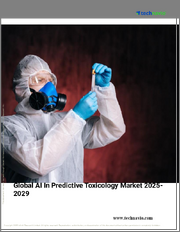
|
시장보고서
상품코드
2020625
예측 독성학용 AI 시장 : 규모, 점유율, 동향 및 성장 분석 보고서(2026-2034년)Global AI In Predictive Toxicology Market Size, Share, Trends & Growth Analysis Report 2026-2034 |
||||||

예측 독성학용 AI 시장 규모는 2025년 6억 5,000만 달러에서 2034년에는 69억 1,000만 달러에 달할 것으로 예상되고 있으며, 2026-2034년에 CAGR 30.04%로 성장할 것으로 전망되고 있습니다.
제약 및 생명공학 기업이 화학물질의 독성 및 의약품의 안전성을 평가하기 위해 인공지능을 점점 더 많이 채택함에 따라 세계의 예측 독성학 분야의 인공지능 시장은 빠르게 성장하고 있습니다. AI를 활용한 예측 모델을 통해 유해 화합물 식별이 빨라지고, 기존의 동물 실험이나 장기간에 걸친 실험실 실험에 대한 의존도를 낮출 수 있습니다. 이러한 변화는 기업이 안전성 평가를 개선하는 동시에 신약 개발 프로세스를 가속화하는 데 도움이 될 것입니다. 규제 당국이 대체 시험법을 권장하는 가운데, AI를 활용한 독성학 플랫폼에 대한 수요는 제약, 화학, 환경 연구 분야에서 지속적으로 확대되고 있습니다.
시장의 주요 촉진요인 중 하나는 효율적인 신약 개발 프로세스에 대한 필요성이 증가하고 있다는 점입니다. AI 알고리즘은 유전체, 분자, 임상연구의 방대한 데이터세트를 분석하여 독성반응을 보다 정확하게 예측할 수 있습니다. 이를 통해 개발비용을 대폭 절감하고, 개발 후기의 약물 실패를 최소화할 수 있습니다. 또한 화학물질의 안전성 및 환경 영향에 대한 규제 당국의 감시가 강화됨에 따라 업계는 개발 과정의 초기 단계에서 독성 위험을 평가할 수 있는 예측 독성학 툴의 도입을 촉진하고 있습니다.
향후 머신러닝 모델의 고도화와 데이터세트의 포괄성이 높아짐에 따라 시장이 크게 확대될 것으로 예상됩니다. 클라우드 컴퓨팅과 빅데이터 분석의 발전으로 예측 능력은 더욱 향상될 것입니다. 제약사, 연구기관, AI 기술 제공업체 간의 협력이 이 분야의 혁신을 주도할 것입니다. 산업계가 보다 안전하고 신속한 제품 개발을 우선시하는 가운데, 예측 독성학용 AI 솔루션은 독성 평가의 미래를 형성하는 데 매우 중요한 역할을 하게 될 것입니다.
목차
제1장 서론
제2장 개요
제3장 시장 변수, 동향, 프레임워크
제4장 세계의 예측 독성학용 AI 시장 : 컴포넌트별
제5장 세계의 예측 독성학용 AI 시장 : 기술별
제6장 세계의 예측 독성학용 AI 시장 : 독성 엔드포인트별
제7장 세계의 예측 독성학용 AI 시장 : 최종사용자별
제8장 세계의 예측 독성학용 AI 시장 : 지역별
제9장 경쟁 구도
제10장 기업 개요
KSA 26.05.11The AI In Predictive Toxicology Market size is expected to reach USD 6.91 Billion in 2034 from USD 0.65 Billion (2025) growing at a CAGR of 30.04% during 2026-2034.
The Global AI in Predictive Toxicology Market is experiencing rapid growth as pharmaceutical and biotechnology companies increasingly adopt artificial intelligence to evaluate chemical toxicity and drug safety. AI-driven predictive models enable faster identification of harmful compounds, reducing reliance on traditional animal testing and lengthy laboratory experiments. This shift helps companies accelerate drug discovery while improving safety assessments. As regulatory agencies encourage alternative testing methods, the demand for AI-powered toxicology platforms continues to expand across pharmaceutical, chemical, and environmental research sectors.
One of the key drivers of the market is the growing need for efficient drug development processes. AI algorithms can analyze vast datasets from genomic, molecular, and clinical studies to predict toxic responses more accurately. This significantly reduces development costs and minimizes late-stage drug failures. Additionally, increased regulatory scrutiny for chemical safety and environmental impact is encouraging industries to adopt predictive toxicology tools that can assess toxicity risks early in the development process.
Looking ahead, the market is expected to witness strong expansion as machine learning models become more sophisticated and datasets grow more comprehensive. Advancements in cloud computing and big data analytics will further enhance predictive capabilities. Collaboration between pharmaceutical companies, research institutions, and AI technology providers will drive innovation in the field. As industries continue to prioritize safer and faster product development, AI-powered predictive toxicology solutions will play a critical role in shaping the future of toxicological assessment.
Our reports are meticulously crafted to provide clients with comprehensive and actionable insights into various industries and markets. Each report encompasses several critical components to ensure a thorough understanding of the market landscape:
Market Overview: A detailed introduction to the market, including definitions, classifications, and an overview of the industry's current state.
Market Dynamics: In-depth analysis of key drivers, restraints, opportunities, and challenges influencing market growth. This section examines factors such as technological advancements, regulatory changes, and emerging trends.
Segmentation Analysis: Breakdown of the market into distinct segments based on criteria like product type, application, end-user, and geography. This analysis highlights the performance and potential of each segment.
Competitive Landscape: Comprehensive assessment of major market players, including their market share, product portfolio, strategic initiatives, and financial performance. This section provides insights into the competitive dynamics and key strategies adopted by leading companies.
Market Forecast: Projections of market size and growth trends over a specified period, based on historical data and current market conditions. This includes quantitative analyses and graphical representations to illustrate future market trajectories.
Regional Analysis: Evaluation of market performance across different geographical regions, identifying key markets and regional trends. This helps in understanding regional market dynamics and opportunities.
Emerging Trends and Opportunities: Identification of current and emerging market trends, technological innovations, and potential areas for investment. This section offers insights into future market developments and growth prospects.
MARKET SEGMENTATION
By Component
- Solution
- Services
By Technology
- Machine Learning
- Natural Language Processing
- Computer Vision
- Others
By Toxicity Endpoints
- Genotoxicity
- Hepatotoxicity
- Neurotoxicity
- Cardiotoxicity
- Others
By End User
- Pharmaceutical & Biotechnology Companies
- Chemical & Cosmetics
- Contract Research Organizations
- Others
COMPANIES PROFILED
- Benevolent AI, Berg Health, Biovista, Celsius Therapeutics, Chemaxon Ltd, Cyclica, Exscientia PLC, Insilico Medicine, Instem plc, Lhasa Limited, Recursion Pharmaceuticals
- We can customise the report as per your requirements.
TABLE OF CONTENTS
Chapter 1. PREFACE
- 1.1. Market Segmentation & Scope
- 1.2. Market Definition
- 1.3. Information Procurement
- 1.3.1 Information Analysis
- 1.3.2 Market Formulation & Data Visualization
- 1.3.3 Data Validation & Publishing
- 1.4. Research Scope and Assumptions
- 1.4.1 List of Data Sources
Chapter 2. EXECUTIVE SUMMARY
- 2.1. Market Snapshot
- 2.2. Segmental Outlook
- 2.3. Competitive Outlook
Chapter 3. MARKET VARIABLES, TRENDS, FRAMEWORK
- 3.1. Market Lineage Outlook
- 3.2. Penetration & Growth Prospect Mapping
- 3.3. Value Chain Analysis
- 3.4. Regulatory Framework
- 3.4.1 Standards & Compliance
- 3.4.2 Regulatory Impact Analysis
- 3.5. Market Dynamics
- 3.5.1 Market Drivers
- 3.5.2 Market Restraints
- 3.5.3 Market Opportunities
- 3.5.4 Market Challenges
- 3.6. Porter's Five Forces Analysis
- 3.7. PESTLE Analysis
Chapter 4. GLOBAL AI IN PREDICTIVE TOXICOLOGY MARKET: BY COMPONENT 2022-2034 (USD MN)
- 4.1. Market Analysis, Insights and Forecast Component
- 4.2. Solution Estimates and Forecasts By Regions 2022-2034 (USD MN)
- 4.3. Services Estimates and Forecasts By Regions 2022-2034 (USD MN)
Chapter 5. GLOBAL AI IN PREDICTIVE TOXICOLOGY MARKET: BY TECHNOLOGY 2022-2034 (USD MN)
- 5.1. Market Analysis, Insights and Forecast Technology
- 5.2. Machine Learning Estimates and Forecasts By Regions 2022-2034 (USD MN)
- 5.3. Natural Language Processing Estimates and Forecasts By Regions 2022-2034 (USD MN)
- 5.4. Computer Vision Estimates and Forecasts By Regions 2022-2034 (USD MN)
- 5.5. Others Estimates and Forecasts By Regions 2022-2034 (USD MN)
Chapter 6. GLOBAL AI IN PREDICTIVE TOXICOLOGY MARKET: BY TOXICITY ENDPOINTS 2022-2034 (USD MN)
- 6.1. Market Analysis, Insights and Forecast Toxicity Endpoints
- 6.2. Genotoxicity Estimates and Forecasts By Regions 2022-2034 (USD MN)
- 6.3. Hepatotoxicity Estimates and Forecasts By Regions 2022-2034 (USD MN)
- 6.4. Neurotoxicity Estimates and Forecasts By Regions 2022-2034 (USD MN)
- 6.5. Cardiotoxicity Estimates and Forecasts By Regions 2022-2034 (USD MN)
- 6.6. Others Estimates and Forecasts By Regions 2022-2034 (USD MN)
Chapter 7. GLOBAL AI IN PREDICTIVE TOXICOLOGY MARKET: BY END USER 2022-2034 (USD MN)
- 7.1. Market Analysis, Insights and Forecast End User
- 7.2. Pharmaceutical & Biotechnology Companies Estimates and Forecasts By Regions 2022-2034 (USD MN)
- 7.3. Chemical & Cosmetics Estimates and Forecasts By Regions 2022-2034 (USD MN)
- 7.4. Contract Research Organizations Estimates and Forecasts By Regions 2022-2034 (USD MN)
- 7.5. Others Estimates and Forecasts By Regions 2022-2034 (USD MN)
Chapter 8. GLOBAL AI IN PREDICTIVE TOXICOLOGY MARKET: BY REGION 2022-2034 (USD MN)
- 8.1. Regional Outlook
- 8.2. North America Market Analysis, Insights and Forecast, 2022-2034 (USD MN)
- 8.2.1 By Component
- 8.2.2 By Technology
- 8.2.3 By Toxicity Endpoints
- 8.2.4 By End User
- 8.2.5 United States
- 8.2.6 Canada
- 8.2.7 Mexico
- 8.3. Europe Market Analysis, Insights and Forecast, 2022-2034 (USD MN)
- 8.3.1 By Component
- 8.3.2 By Technology
- 8.3.3 By Toxicity Endpoints
- 8.3.4 By End User
- 8.3.5 United Kingdom
- 8.3.6 France
- 8.3.7 Germany
- 8.3.8 Italy
- 8.3.9 Russia
- 8.3.10 Rest Of Europe
- 8.4. Asia-Pacific Market Analysis, Insights and Forecast, 2022-2034 (USD MN)
- 8.4.1 By Component
- 8.4.2 By Technology
- 8.4.3 By Toxicity Endpoints
- 8.4.4 By End User
- 8.4.5 India
- 8.4.6 Japan
- 8.4.7 South Korea
- 8.4.8 Australia
- 8.4.9 South East Asia
- 8.4.10 Rest Of Asia Pacific
- 8.5. Latin America Market Analysis, Insights and Forecast, 2022-2034 (USD MN)
- 8.5.1 By Component
- 8.5.2 By Technology
- 8.5.3 By Toxicity Endpoints
- 8.5.4 By End User
- 8.5.5 Brazil
- 8.5.6 Argentina
- 8.5.7 Peru
- 8.5.8 Chile
- 8.5.9 Rest of Latin America
- 8.6. Middle East & Africa Market Analysis, Insights and Forecast, 2022-2034 (USD MN)
- 8.6.1 By Component
- 8.6.2 By Technology
- 8.6.3 By Toxicity Endpoints
- 8.6.4 By End User
- 8.6.5 Saudi Arabia
- 8.6.6 UAE
- 8.6.7 Israel
- 8.6.8 South Africa
- 8.6.9 Rest of the Middle East And Africa
Chapter 9. COMPETITIVE LANDSCAPE
- 9.1. Recent Developments
- 9.2. Company Categorization
- 9.3. Supply Chain & Channel Partners (based on availability)
- 9.4. Market Share & Positioning Analysis (based on availability)
- 9.5. Vendor Landscape (based on availability)
- 9.6. Strategy Mapping
Chapter 10. COMPANY PROFILES OF GLOBAL AI IN PREDICTIVE TOXICOLOGY INDUSTRY
- 10.1. Top Companies Market Share Analysis
- 10.2. Company Profiles
- 10.2.1 Benevolent AI
- 10.2.2 Berg Health
- 10.2.3 Biovista
- 10.2.4 Celsius Therapeutics
- 10.2.5 Chemaxon Ltd
- 10.2.6 Cyclica
- 10.2.7 Exscientia PLC
- 10.2.8 Insilico Medicine
- 10.2.9 Instem Plc
- 10.2.10 Lhasa Limited
- 10.2.11 Recursion Pharmaceuticals