
|
시장보고서
상품코드
2059553
이오노겔 및 유텍토겔의 새로운 시장 기회 : 기술과 시장(2026-2046년)Ionogel and Eutectogel Emerging Opportunities: Technology, Markets 2026-2046 |
||||||

요약
이오노겔(Ionogel)의 뛰어난 특성을 바탕으로 새로운 연구 성과가 잇달아 나오고 있으며, 대규모 시장이 형성되고 있습니다. 또한 많은 기업이 이 분야에 진출하고 있습니다. 이 보고서는 소재 및 디바이스 제조업체, 투자자, 최종사용자 등 폭넓은 시장 관계자들에게 사업 기회를 제시하는 포괄적이면서도 상업성을 중시한 내용으로 구성되어 있습니다. 이 보고서에서는 이오노겔뿐만 아니라 유텍토겔(Eutectogel)도 다루고 있습니다. 유텍트 겔은 이오노겔과 마찬가지로 이온 전도성을 가지며 휘발하기 어려운 겔 재료이지만, 지지 매트릭스 내에 이온 액체가 아닌 심공융 용매(Deep Eutectic Solvents: DES)를 사용하고 있다는 점이 특징입니다. 이를 통해 생분해성 향상, 비용 절감 등 새로운 이점이 기대되고 있습니다.
이 보고서의 제1저자이자 Zhar Research의 CEO인 피터 해롭(Peter Harrop) 박사는 다음과 같이 말했습니다. “저희 조사 결과, 이오노겔에는 매우 폭넓은 장점이 있는 것으로 밝혀졌습니다. 특히 의료 분야에서 주목받고 있는 새로운 이온트로닉스(Iontronics) 유연 전자 소자의 기반 기술이 되고 있습니다. 또한 이오노겔이 보여주는 거대한 이온 제백 효과는 열전 에너지 회수 기술을 크게 발전시킬 가능성이 있습니다. 또한 거대 자기 임피던스(Giant Magnetoimpedance) 특성을 지닌 이오노겔은 차세대 인간-기계 인터페이스(HMI)에 적용될 것으로 기대되고 있습니다. 이오노겔은 누출이 없는 고성능 배터리 전해질로서도 유력한 후보입니다. 이 외에도 자가 발전형 센서, 인공 근육, 약물전달, 소프트 로보틱스, 고성능·대면적 X선 신틸레이터 필름, 스마트 텍스타일, 스마트 윈도우, 신경모방 컴퓨팅, 수질 정화, 이산화탄소 포집 등 수많은 분야로의 응용이 기대되고 있습니다. '
현재 예상되는 용도의 약 40%는 하이드로겔이 이미 사용되고 있거나 도입이 검토되고 있는 분야입니다. 그러나 이오노겔은 건조되지 않고, 얼지 않으며, 다양한 용도에서 요구되는 작동 전압에 대응할 수 있다는 특징을 가지고 있으며, 하이드로겔 시장에서 점유율을 점차 확대해 나가고 있습니다. 또한 많은 새로운 이오노겔과 유텍토겔의 용도는 이러한 기존의 용도를 훨씬 뛰어넘어, 여러 가지 우수한 특성을 동시에 활용하는 첨단 기술 분야로 확대되고 있습니다.
목차
제1장 요약 및 결론
제2장 서론
- 정의, 특성, 새로운 용도
- 이오노겔의 주목할 만한 8가지 특성
- 두 가지 인포그래픽을 통해 비교한 주요 젤 유형
- 이오노겔과 유텍트겔의 밀접한 관계
- 이오노겔, 하이드로겔, 오르가노겔, 일렉트라겔, 메탈로겔의 비교
- 이오노겔의 유형와 용도
- 이오노겔의 이온 전도성의 중요성과 성능상의 상충 관계
- 이오노겔의 제조 예
- 성과, 장점, 과제
- 이오노겔의 SWOT 분석
제3장 이오노겔의 선택지: 매트릭스 재료별
- 개요·매트릭스 화학의 보급도 분석
- 이온-게르마늄 매트릭스 소재의 주요 선택지
- 이오노머 가교 옵션
- 셀룰로오스계 이오노겔이 주목받는 이유
- 2025년의 예
제4장 이오노겔·유텍토겔 특성의 최적화: 2025년 및 2026년의 주요 진전
- 접착성: 외과수술 및 기타
- 항균성
- 생체적합성
- 형광 특성
- 자가복원성
- 고강도·내충격성·인성 향상
- 테라헤르츠 제어
- 투명성
제5장 진화하는 이오노겔 디바이스 제조업체, 공급망, 형식, 제조 기술
- 개요 및 제조업체 분석: 지역별
- 이오노겔 원료 제조업체 및 화학 제품 공급업체
- 이오노겔 기반 장치 제조업체: 기존 및 잠재적 제조업체
- 유텍토겔 제조업체
- 이오노겔용 부품 및 장치 제조업체
- 이오노겔 장치 및 부품의 제조 기술
- 복합 이오노겔: 배합 및 제조 동향
제6장 이온트로닉스, 플렉서블 전자공학, 휴먼 인터페이스 분야의 이오노겔과 유텍트 겔
- 2025년과 2026년의 주요 진전을 포함한 개요
- 이온트로닉스와 플렉서블 전자공학
- 액추에이터와 인간-기계 인터페이스
- 이오노겔 막
- 이오노겔 센서와 휴먼 인터페이스
- 이오노겔 광학 소자
제7장 전지 및 슈퍼커패시터에서의 이오노겔
- 개요: 이오노겔이 필요한 전지, 슈퍼커패시터 및 그 파생형
- 이오노겔 반고체 전해질을 사용하는 후보에 대한 SWOT 분석
- 리튬이온 전지와 나트륨 이온 전지
- 슈퍼 커패시터
- LIC 및 기타 배터리-슈퍼커패시터 하이브리드(BSH)
- 이오노겔 또는 유텍트 겔을 이용한 슈퍼 커패시터 및 BSH
- 2025년까지 크게 발전한 배터리 분야의 이오노겔과 유텍트 겔
- 2025년과 2026년에 많은 큰 진전을 이룰 것이라는 점을 기반으로 하고 있다(자세한 내용은 후술).
- 고체 전지용 이오노겔의 SWOT 분석
- 산화물계 고체 전해질
- 황화물계 고체 전해질
- 아르길로다이트 이오노겔
- 질화물 및 할로겐화물 기반 고체 전해질
- 고분자계 전해질
- 이오노겔을 적용한 나트륨 전지
제8장 에너지수확기술 및 냉각을 위한 이오노겔과 유텍트겔
- 개요
- 에너지수확기술과 이오노겔
- 제로 에너지 기기를 위한 에너지 하베스팅 기술: 13가지 유형 비교
- 전력 출력을 이용한 에너지 하베스팅 용도
- 3가지 에너지수확기술 방식에 대한 이오노겔 평가(5개의 칼럼)
- 열전 에너지수확기술
- 이오노겔과 유텍트겔에 대한 기초 지식
- 이오노겔 열전 소재 및 관련 소재의 응용 사례
- 2025년과 2026년에 이루어진 연구의 급속한 진전
- 열전 및 열이오노겔 센서, 액추에이터, 발전기
- 이오노겔 및 유텍트 겔을 이용한 마찰 전기 에너지수확기술
- 마찰 전기 에너지수확기술: TENG의 작동 원리, 구조
- 시험 운영
- 이오노겔 TENG을 활용한 연구의 진전
- 압전 이오노겔 에너지수확기술
- 냉각용 이온 젤: 시장 수요를 충족시킬 기회
제9장 의료용 이오노겔: 2026년의 발전과 동향
- 개요
- 의료용 이오노겔의 SWOT 분석
- 범용성
- 의료 바이오일렉트로닉스와 이온트로닉스는 급속히 발전하고 있다
- 의료용 이오노겔을 통해 질감, 강도, 내환경성이 향상됨
- 마찰 전기 및 생체전자 인터페이스용 이오노겔 전극의 발전
- 성능과 재활용성 간의 상충 관계에서 진전이 2026년 이전에 실현될 전망
- 항균제로서의 이오노겔
- 약물전달 시스템(DDS)으로서의 이오노겔 활용
- 상처 치유 이오노겔 드레싱과 치료법의 큰 진전
- 조직 공학용 이오노겔
- 이오노젤 스마트 스킨
- 시각적 시간 표시
- 합성 시각 이오노겔
- 미래의 인간 통합형 지능을 위한 확장 가능한 뉴로모픽 전자 기술
제10장 이산화탄소 포집, 중금속 제거, 합성 염료 제거를 위한 이오노겔
- 개요: 이산화탄소 포집
- 탄소 포집 및 전환을 위한 이오노겔
- 수처리
Summary
Ionogel virtuosity is creating large markets powered by a flood of new research advances and companies are entering the field. The new 380-page, “Ionogel and eutectogel emerging opportunities: technology, markets 2026-2046” report reveals your opportunities from material or device supplier, investor, through to user. It is comprehensive, and commercially-oriented. It includes eutectogels, another family of ionic-conductive, non-volatile gels but with deep eutectic solvents instead of ionic liquids in their supporting matrix. This expands the capability in aspects such as biodegradability, and cost reduction.
Primary author Dr Peter Harrop, CEO of Zhar Research says, “We find that ionogels bring a formidable range of benefits, including being the basis of the new iontronics flexible electronics exciting the medical community. Ionogel giant ionic Seebeck effect will boost thermoelectric energy harvesting. Ionogels offering giant magnetoimpedance are proposed for next human-machine interfaces. Ionogel is a formidable contender for the leak-free, higher-performance electrolytes for batteries. Add new, self-powered sensors, artificial muscles, drug delivery, soft robotics, better, wider X-ray scintillator film, smart textiles and windows, neuromorphic computing, water purification, carbon capture and much more.”
About 40% of the applications are where hydrogels are used or proposed, with ionogels taking share because they do not dry out or freeze and only they meet the typically-required voltages of operation. However, most of the emerging ionogel and eutectogel applications go way beyond, typically exploiting multiple benefits. Uniquely, the report clarifies often obscure science and initiatives into roadmaps, market forecasts, SWOT appraisals, infograms, pie charts, identified gaps in the market and comparison tables, with a glossary of terms.
The Executive Summary and Conclusions (50 pages) is sufficient for those with limited time. It explains how ionogels are a class of electrically-conductive, soft materials comprising a three-dimensional network matrix (organic or inorganic) that immobilizes ionic liquids (ILs). They have drawn considerable attention due to a suite of exceptional and tunable physicochemical properties, such as nonvolatility, excellent thermal and electrochemical stability, adjustable mechanical strength and high ionic conductivity. Frequently, we can add to that self-healing, non-flammable, self-adhesive, stretchable, transparent, recyclable and tunable in physical and chemical properties to a huge variety of applications. There is even more capability than that emerging. See all the SWOT appraisals, roadmaps and forecasts after understanding the basics in pie charts, SWOT appraisals and comparison tables here. 35 key conclusions are presented.
The Introduction (38 pages) gives definitions and context, presenting 25 ionogel market sectors as examples and where hydrogels compete. Applications of ionogels by seven types of composition are compared in a table and eight properties of ionogels attracting attention are shown in an infogram. Specifics such as wearable ionogels - flexible and fabric – and ionogel smart windows are described to bring the subject alive, followed by more examples analysed fully in later chapters. The design and manufacturing issues for ionogels are introduces and then there is a SWOT appraisal of ionogels.
The following chapters give the detail, fortified by a large number of 2026 and 2025 research papers and company activities being analysed. Chapter 3. Ionogel options by matrix material (24 pages) explains why the matrix, rather than the trapped ionic liquid, controls most of the desired properties and why certain materials are particularly popular in major advances recently. Chapter 4. Optimising specific ionogel and eutectogel attributes: major advances in 2025 and 2026 (28 pages) addresses optimisation, where required, of adhesion: surgical and other, antibacterial, biocompatible, fluorescent, self-healing, strengthening, terahertz manipulation and transparency capability.
By now you have a grasp of how to make the best ionogel and eutectogel materials but who does it and how will they make the required formats such as complex 3D and 2D shapes, fibers and fabrics? Chapter 5. Evolving ionogel device manufacturers, supply chain, formats, fabrication technologies (32 pages) answers these questions, identifies the best and the future trends. It ends with composite forms including magnetic ionogels.
Chapter 6. Ionogels and eutectogels in iontronics, flexible electronics and human interfaces (52 pages) introduces ionogel-enabled iontronics, an emerging interdisciplinary field that uses ions instead of electrons as the primary signal carriers to bridge the gap between solid-state electronics and biological systems. It provides sensing, computing, and actuation. The advances in ionogel sensing, including e-skin, are both large and potentially impactful so that gets a major part of this chapter. Also see electragel ionogels, a transparent, and highly adhesive ionogel passively absorbing and screening static charges and potentially for energy harvesting. Ionogel membranes are a strong trend. See membranes for gas separation, energy storage and conversion with SWOT, human interfaces and many optical devices, all with analysis of remarkable advances in 2025 and 2026.
Chapter 7. Ionogels in batteries and supercapacitors (47 pages) presents five SWOT appraisals as it examines batteries, supercapacitors and variants needing ionogels. It finds that battery-supercapacitor hybrids and batteries have the largest value market potential for using ionogels as semi-solid-state electrolytes but there is competition. Even sodium-ion batteries partly replacing lithium may use ionogels and major advances in 2025 and 2026 are explained.
Chapter 8. Ionogels and eutectogels for energy harvesting and cooling (28 pages) finds that the giant ionic Seebeck effect they provide will have considerable success as stronger, wider-area thermoelectric harvesting. See the strong research pipeline including in 2026. It finds a gap in the market for the reverse – ionogel thermoelectric cooling. It cautions about piezoelectric and triboelectric ionogel harvesting options but fully explains them.
Chapter 9. Medical ionogels: 2026 advances and trends (52 pages) advises that this sector will be one of the most important in years to come, with a superb research pipeline and company initiatives already. Of course, earlier chapters have inevitably touched on medical and other healthcare opportunities but here the focus is a SWOT appraisal and explanation of the remarkable versatility of medical ionogels. That is followed by explanation of medical bioelectronics and iontronics advancing rapidly through 2026 and then the detail. That includes texture, strength and environmental resilience advances, ionogel electrodes for triboelectric and bioelectronic interfaces and antibacterial agents. A large section then covers ionogels as drug delivery systems because these show exceptional advances and potential. Further sections present wound healing ionogel dressings and treatments, tissue engineering, smart skin, synthetic vision, visual time indicators – all very promising and with important 2026 advances in support. The chapter ends with stretchable neuromorphic electronics for future human-integrated intelligence advancing in 2026.
Chapter 10. Ionogels for carbon capture, removing heavy metals and synthetic dyes (12 pages) finds that these opportunities are more uncertain and less broadly based than medical but they are worth watching. Capturing carbon for the whole planet is probably a bridge too far but carbon capture and even conversion at origin, using ionogels, is in prospect, with strong new research. Then there is water treatment, including removal of heavy metals but that has a weaker ionogel research pipeline. Hydrogel competition is appraised. The report, “Ionogel and eutectogel emerging opportunities: technology, markets 2026-2046” www.zharresearch. com and www.giiresearch.com.
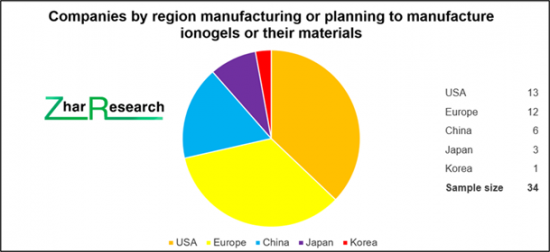
CAPTION: Companies by region manufacturing or planning to manufacture ionogels or their materials. Source: “Ionogel and eutectogel emerging opportunities: technology, markets 2026-2046” Zhar Research 2026.
Table of Contents
1. Executive summary and conclusions
- 1.1 Purpose of this report
- 1.2 Methodology of this analysis
- 1.3 Why ionogels?
- 1.4 Infogram: Primary types of gel compared
- 1.5 Examples of ionogel formulation and potential
- 1.5.1 Some ionogel types and applications being addressed
- 1.5.2 Some materials and functions involved
- 1.5.3 Stimuli‐responsive properties of ionogels
- 1.6 Ionogel SWOT appraisals
- 1.6.1 Ionogels in general SWOT
- 1.6.2 SWOT appraisal of medical ionogels
- 1.6.3 SWOT appraisal of ionogels for solid-state batteries
- 1.6.4 SWOT appraisal of ionogel proton exchange membranes
- 1.6.5 SWOT appraisal of cellulose ionogels
- 1.7 SWOT appraisal of candidates for using ionogel semi-solid electrolytes
- 1.7.1 SWOT appraisal of lithium and sodium-ion batteries
- 1.7.3 SWOT appraisal of lithium-ion capacitors LIC and other battery-supercapacitor hybrids BSH
- 1.8 35 key conclusions
- 1.8.1 Conclusions: markets for ionogel and related materials
- 1.8.2 Conclusions: ionogel technology trends
- 1.8.3 Conclusions: ionogel devices
- 1.8.4 Conclusions: Ionogel manufacturers and supply chain
- 1.9 Ionogel market, technology and industry roadmap 2026-2046
- 1.10 Roadmaps for self-healing materials in healthcare and ionogel competitor hydrogel 2026-2046
- 1.11 Ionogel market forecasts in 26 lines 2026-2046
- 1.11.1 Ionogel and allied market $ billion for three application categories 2026-2046
- 1.11.2 Ionogel value market by four regions 2026-2046
- 1.11.3 Energy storage device market battery vs batteryless $ billion 2025-2046
- 1.11.4 Batteryless storage for pulse and fastest response $ billion 2025-2046 in 7 technology lines
- 1.11.5 Battery supercapacitor hybrid BSH value market % by two Wh categories 2026-2046
- 1.11.6 BSH product life years and life of equipment to which it is fitted years 2014-2046
- 1.11.7 Self-healing materials for all applications: value market 2026-2046
- 1.11.8 Self-healing materials for healthcare value market $ billion 2026-2046
- 11.11.9 Medical hydrogel market 2026 and 2046 $ billion in 12 categories showing where ionogels compete.
2. Introduction
- 2.1 Definition, attributes and emerging uses
- 2.1.1 Definition and context
- 2.1.2 25 ionogel market sectors as examples and where hydrogels compete
- 2.1.3 Applications of ionogels by seven types of composition
- 2.1.4 Wearable ionogels: flexible and fabric
- 2.1.5 Ionogel smart windows
- 2.2 Eight properties of ionogels attracting attention
- 2.3 Primary types of gel compared in two infograms
- 2.4 Close relationship of ionogels and eutectogels
- 2.5 Ionogel, hydrogel, organogel, electragel and metallogel comparison
- 2.6 Some types and applications of ionogels in
- 2.7 Significance of ionic conductivity of ionogels and performance compromises
- 2.7.1 Overview
- 2.7.2 Choice of ionic liquids in ionogels, leakage, toxicity prevention in
- 2.7.3 Optimising ionic conductivity for electrical, electronic, ionotronics applications
- 2.8 Ionogel preparation with examples in
- 2.8.1 Overview and example
- 2.8.2 Direct mixing
- 2.8.3 Physical blending of inorganic hydrogels
- 2.8.4 In situ polymerization/gelation for ultra-strong adhesive, transparent and other forms
- 2.8.5 Solvent exchange
- 2.9 Some results, benefits and challenges
- 2.10 Ionogel SWOT appraisal
3. Ionogel options by matrix material
- 3.1 Overview with matrix chemistry popularity analysis
- 3.2 Table: Ionogel matrices simply compared
- 3.3 Infogram: Ionomers by host structure (solid matrix) in detail
- 3.4 Primary choices of ionogel matrix material
- 3.5 Ionomer cross-linking options
- 3.6 Why cellulose ionogels are popular
- 3.6.1 Overview
- 3.6.2 SWOT appraisal of cellulose ionogels
- 3.6.3 Cellulose ionogel matrices in 2025 and 2026 research advances
- 3.7 Some other examples in 2025 and
4. Optimising specific ionogel and eutectogel attributes: major advances in 2025 and 2026
- 4.1 Adhesion: surgical and other
- 4.2 Antibacterial
- 4.3 Biocompatible
- 4.4 Fluorescent
- 4.5 Self-healing
- 4.6 Strong: robust, impact resistant, toughening procedures
- 4.7 Terahertz manipulation
- 4.8 Transparent
5. Evolving ionogel device manufacturers, supply chain, formats, fabrication technologies
- 5.1 Overview and manufacturer regional analysis
- 5.2 Ionogel raw material manufacturers & chemical suppliers
- 5.3 Manufacturers of ionogel-based devices - actual and potential
- 5.4 Eutectogel manufacturers
- 5.5 Manufacturers of ionogel-enabled parts and devices
- 5.6 Ionogel device and parts manufacturing technologies including important 2025 and 2026 advances
- 5.6.1 Additive manufacturing increasingly favoured
- 5.6.2 Technology options for ionogel parts manufacture and formats produced
- 5.6.3 Fiber, fabric and wearable ionogels
- 5.6.4 3D and 4D printing of ionogels
- 5.6.5 2D and other printing and coating: screen, inkjet, aerosol, other
- 5.7 Composite ionogels: formulation and fabrication trends including important 2025 and 2026 advances
- 5.7.1 Overview
- 5.7.2 Applications
- 5.7.3 Fabrication trends
- 5.7.4 Magnetic ionogels
- 5.7.5 Multifunctional ionogels and eutectogels
6. Ionogels and eutectogels in iontronics, flexible electronics and human interfaces
- 6.1 Overview including major advances in 2025 and
- 6.2 Iontronics and flexible electronics
- 6.3 Actuators and human interfaces
- 6.4 Ionogel membranes
- 6.4.1 Basics
- 6.4.2 Proton Exchange Membranes PEM with SWOT appraisal
- 6.5 Ionogel sensors and human interfaces
- 6.5.1 Overview of sensors
- 6.5.2 Flexible and wearable sensors and latest advances in ionogels for these
- 6.5.3 Ionogel e-skin
- 6.5.4 Pressure, strain, temperature, imaging and other sensing with ionogels
- 6.6 Ionogel optical devices
- 6.6.1 Electrochromic
- 6.6.2 Birefringent
- 6.6.3 Light-emitting
7. Ionogels in batteries and supercapacitors
- 7.1 Overview: batteries, supercapacitors and variants needing ionogels
- 7.2 SWOT appraisal of candidates for using ionogel semi-solid electrolytes
- 7.2.1 SWOT appraisal of lithium and sodium-ion batteries
- 7.2.2 SWOT appraisal of supercapacitors
- 7.2.3 SWOT appraisal of lithium-ion capacitors LIC and other battery-supercapacitor hybrids BSH
- 7.3 Supercapacitors and battery-supercapacitor hybrids using ionogels or eutectogels
- 7.4 Ionogels and eutectogels in batteries with major advances in 2025 and
- 7.4.1 Basis with many several major advances in 2025 and 2026 (more later)
- 7.4.2 SWOT appraisal of ionogels for solid-state batteries
- 7.4.3 Oxide-based solid-state electrolytes
- 7.4.4 Sulfide-based solid-state electrolytes
- 7.4.5 Argyrodite ionogels
- 7.4.6 Nitride- and halide-based solid-state electrolytes
- 7.4.7 Polymer-based electrolytes
- 7.5 Sodium batteries adopting ionogels
8. Ionogels and eutectogels for energy harvesting and cooling
- 8.1 Overview
- 8.1.1 Energy harvesting and ionogels
- 8.1.2 13 energy harvesting technologies for zero energy devices compared
- 8.1.3 Energy harvesting applications by power output
- 8.1.4 Ionogel appraisal in five columns for three forms of energy harvesting
- 8.2 Thermoelectric energy harvesting
- 8.2.1 Basics with ionogels and eutectogels
- 8.2.2 Some targetted applications of ionogel thermoelectrics and allied materials
- 8.2.3 Surge of research advances in 2025 and 2026 analysed
- 8.2.4 Thermoelectric and thermal ionogel sensors, actuators and generators
- 8.3 Ionogel and eutectogel triboelectric energy harvesting
- 8.3.1 Triboelectric energy harvesting of motion: TENG operating principle, construction
- 8.3.2 Applications trialled
- 8.3.3 Research advances with ionogel TENG in 2026 and
- 8.4 Piezoelectric ionogel energy harvesting
- 8.5 Ionogels for cooling ? gap in the market that you can address
9. Medical ionogels: 2026 advances and trends
- 9.1 Overview
- 9.2 SWOT appraisal of medical ionogels
- 9.3 Versatility
- 9.4 Medical bioelectronics and iontronics advancing rapidly in
- 9.5 Texture, strength and environmental resilience advances with medical ionogels
- 9.6 Ionogel electrodes for triboelectric and bioelectronic interfaces advancing in
- 9.7 Performance-recyclability trade-off advances in 2026 and earlier
- 9.8 Ionogels as antibacterial agents
- 9.10 Ionogels as drug delivery systems DDS: many advances in 2026 and
- 9.10.1 Rationale and examples
- 9.10.2 Oral drug delivery
- 9.10.3 Buccal (cheeks or mouth) drug delivery
- 9.10.4 Transdermal drug delivery
- 9.10.5 Local drug delivery
- 9.10.6 Nose-to-brain drug delivery
- 9.11 Wound healing ionogel dressings and treatments with major advances in
- 9.12 Tissue engineering ionogels 2026 and earlier
- 9.13 Ionogel smart skin
- 9.14 Visual time indicators
- 9.16 Synthetic vision ionogels
- 9.16 Stretchable neuromorphic electronics for future human-integrated intelligence in
10. Ionogels for carbon capture, removing heavy metals and synthetic dyes
- 10.1 Overview: carbon capture
- 10.2 Ionogels for carbon capture and conversion: considerable advances in 2026 and
- 10.3 Water treatment
- 10.3.1 Ongoing challenges
- 10.3.2 Membrane filtration can be improved with ionogels
- 10.3.3 Ionogels to remove heavy metals

(주말 및 공휴일 제외)


