
|
시장보고서
상품코드
2066260
의료 분야의 이오노겔 및 유텍토겔 기회 : 기술, 시장(2027-2047년)Ionogel and Eutectogel Opportunities in Healthcare: Technology, Markets 2027-2047 |
||||||

이오노겔이라는 용어는 2005년에 처음 제조되었을 때 공식적으로 만들어졌습니다. 게다가 최근 들어, 이오노겔이 의료 분야에서 다방면에 걸쳐 매우 유용할 가능성이 인식되기 시작했습니다. 그 결과, 연구 분야의 진전이 급증했으며, 일부에서는 초기 단계의 상용화도 이미 시작되었습니다. 수십억 달러 규모의 목표 시장이 형성될 가능성이 있습니다.
본 보고서에서는 자매 기술인 유텍토겔을 포함한 사업 기회에 대해 독자적이고 최신의 상세한 분석을 제시하고 있습니다. 총 334페이지에 달하는 이 보고서는 실용성을 중시한 내용으로 구성되어 있으며, 이해하기 쉬운 로드맵, 예측, SWOT 분석, 그리고 다수의 새로운 인포그래픽이 수록되어 있습니다. 2025년과 2026년에 이루어진 수많은 연구 성과가 상업적 기회로 해석되고 있습니다.
이오노겔이란, 분자 수준에서 3차원 고체 폴리머 또는 무기 매트릭스 내에 이온 액체를 가두어 만들어지는 고체 복합재료입니다. 기계적으로는 유연한 고체처럼 행동하지만, 액체의 전기적 특성과 이온 수송 특성을 유지하고 있습니다. 이러한 장점으로는 자가 복원성, 불연성, 열 안정성 등이 있습니다. 현재 연구자들은 5가지 약물전달 방식, 전자 피부, 인체 통합형 지능 등 이오노겔의 폭넓은 응용 가능성을 입증하고 있습니다.
목차
제1장 요약 및 결론
- 본 보고서의 목적
- 조사 방법
- 왜 이오노겔인가?
- 인포그래픽 : 주요 겔 유형 비교 및 이오노겔 매트릭스 선택 사항
- 이오노겔 제제의 예와 가능성
- 이오노겔의 SWOT 분석
- 의료기기용 에너지 수확에 관한 이오노겔 평가(5편의 칼럼)
- 28가지 주요 결론
- 이오노겔 및 관련 시장
- 이오노겔의 기술 동향
- 이오노겔 장치
- 이오노겔 제조업체 및 공급망
- 이오노겔 시장, 기술, 업계 로드맵
- 자가복원 소재와 이오노겔 경쟁 하이드로겔의 로드맵
- 이오노겔 시장 전망 : 22 라인
- 3가지 용도 범주에 따른 이오노겔 및 관련 시장
- 이오노겔 시장 규모 : 지역별
- 모든 용도의 자가복구 소재 : 시장 규모
- 의료 분야의 자가치유 소재 : 시장 규모
- 의료용 하이드로겔 시장
- THz 하드웨어(의료 분야 및 기타 4개 분야)
제2장 서론
- 정의, 특성, 새로운 용도
- 이오노겔의 주목할 만한 8가지 특성
- 주요 젤 타입 비교
- 이오노겔과 유텍토겔의 밀접한 관계
- 이오노겔, 하이드로겔, 오르가노겔, 일렉트라겔, 메탈로겔의 비교
- 이오노겔의 종류와 용도
- 이오노겔의 이온 전도성의 중요성과 성능상의 상충 관계
- 이오노겔 제조법 및 그 예
- 성과, 장점, 과제
- 이오노겔의 SWOT 분석
제3장 이오노겔의 선택지 : 매트릭스 재료별
- 매트릭스 화학의 인기도 분석을 포함한 개요
- 표 : 이오노겔 매트릭스의 간단한 비교
- 인포그래픽 : 호스트 구조(고체 매트릭스)별 이오노머 상세 정보
- 이온-게르마늄 매트릭스 소재의 주요 선택지
- 이오노머 가교 옵션
- 셀룰로오스 이오노겔이 인기 있는 이유
제4장 특정 이오노겔 및 유텍토겔의 의료적 특성 최적화 : 주요 진전
- 이오노겔 또는 유텍토겔을 이용한 외과 수술 및 기타 치료
- 상처 치유, 조직 재생, 의료기기 안전성을 위한 항균제
- 생체적합성이 있어 의료용 상처 피복재 등에 적합하다
- 소프트 이오노트로닉스 등을 위한 생체모방 기술에서 유래한 형광성
- 전자 피부, 웨어러블, 의료용 센서 등의 자가 복구성
- 고강도 : 견고성, 내충격성, 강인화 기법
- 테라헤르츠파를 이용한 암의 조기 발견, 치료 및 기타
- 이온트로닉스, 센서, 광학 소자의 활용 범위를 넓히기 위한 투명 이오노겔
- 의약품 및 의료기기용 이오노겔 시각적 시간·온도 표시기
- 성능과 재활용성의 상충 관계
제5장 진화하는 이오노겔 디바이스 제조업체, 공급망, 형식, 제조 기술
- 개요 및 제조업체 : 지역별 분석
- 이오노겔 원료 제조업체 및 화학제품 공급업체
- 이오노겔 기반 장치 제조업체 : 기존 및 잠재적 제조업체
- 유텍토겔 제조업체
- 이오노겔용 부품 및 장치 제조업체
- 이오노겔 장치 및 부품의 제조 기술
- 복합 이오노겔 : 배합 및 제조 동향, 2025년과 2026년의 주요 발전 포함
- 개요
- 용도
- 제조 동향
- 자성 이오노겔
- 다기능 이오노겔 및 유텍토겔
제6장 이온트로닉스, 플렉서블 전자공학, 휴먼 인터페이스 분야의 이오노겔과 유텍토겔
- 주요 진전 및 개요
- 뇌-기계 인터페이스, 약물전달 및 기타 용도의 이온트로닉스 및 플렉서블 전자공학
- 액추에이터와 휴먼 인터페이스
- 이오노겔 막
- 이오노겔 센서와 휴먼 인터페이스
- 이오노겔 광학 소자
제7장 의료용 에너지 수확 및 냉각을 위한 이오노겔과 유텍토겔
- 개요
- 열전 에너지 수확
- 이오노겔 및 유텍토겔을 이용한 마찰 전기 에너지 수확
- 의료용 센서 등에 적용하기 위한 압전 이오노겔 에너지 수확
- 삼투압 방식 및 마찰 이온트로닉스 방식 에너지 수확기
- 의료기기 냉각용 이오노겔
제8장 의료용 이오노겔의 추가 발전, SWOT, 동향 : 개요, 약물전달, 조직 공학, 상처 치유
- 개요
- 의료용 이오노겔의 SWOT 분석
- 이오노겔의 다용도성
- 이오노겔을 약물전달 시스템(DDS)으로의 활용
- 상처 치유 이오노겔 드레싱과 치료법의 큰 진전
- 조직 공학용 이오노겔
- 미래의 인체 통합형 지능을 위한 신축성 신경모방 전자기기
l was officially coined when it was first made in 2005. Even more recently came the realisation that ionogels can be invaluable medically is many ways. A flood of research advances, and some initial commercialisation, have already resulted. A multi-billion-dollar addressable market awaits you.
The new Zhar Research report, “Ionogel and Eutectogel Opportunities in Healthcare: Technology, Markets 2027-2047” includes the sister innovation eutectogels in a uniquely up-to-date, deep analysis of your opportunities. Its 334 pages are commercially oriented, with easily-grasped roadmaps, forecasts, SWOT appraisals and many new infograms. A large number of research advances in 2026 and 2025 are interpreted into commercial opportunities.
An ionogel is a solid-state composite material made by trapping ionic liquids within a 3D solid polymer or inorganic matrix at molecular level. It behaves mechanically like a flexible solid but retains the electrical and ion-transporting properties of a liquid, Benefits include self-healing, non-flammability and thermal stability. Researchers now demonstrate ionogels for five modes of drug delivery, electronic skin, human-integrated intelligence and much more.
The Executive Summary and Conclusions (43 pages) is all you need if time is short, for here are the basics of the technologies and functions offered. Healthcare consists of medical, fitness, wellness and vetinerary but, within that, ionogels and eutectogels are most useful for human medical conditions. That will continue 2027-2047. See 25 targetted healthcare applications with 11 where the older-established hydrogels compete. There are six SWOT appraisals, many comparison tables, pie charts, infograms, 28 key conclusions and 22 lines of market forecasts with tables, graphs, explanation.
The Introduction (38 pages) shows these gels in the context of all gels and introduces the technology and market aspects deeply covered in subsequent chapters such as injectable and wearable versions. See details on preparation, including direct mixing, physical blending of inorganic ionogels, in situ polymerization/gelation for ultra-strong adhesive, transparent and other forms, solvent exchange. Understand properties of attracting attention and the close relationship between ionogels and eutectogels. Throughout this chapter, the 2026 Zhar Research analysis is supported by 20 research papers from 2025 and 2026 plus others, where-important. The up-to-date approach throughout the report is vital in this fast-moving subject. It is constantly updated so you get the latest.
Chapter 3. Ionogel Options by Matrix Material (20 pages) shows how, in addressing healthcare needs, the matrix is often more important than the ionic liquid it traps. Here are the choices and much from 2026 on cellulose matrices explaining why they are so popular. A pie chart of 159 latest advances prioritises the ten top matrix choices for ionomers relevant to healthcare.
Chapter 4. Optimising Specific Ionogel, Eutectogel Medical Attributes: Major Advances in 2025- 2026 (54 pages) addresses adhesion, antibacterial for wound healing, tissue repair, and medical device safety, biocompatible for biomedical wound dressings and more, fluorescence, self-healing for e-skin, wearable electronics, medical sensors, and improving mechanical properties. See THz disease treatment advances in 2025 and 2026 with SWOT appraisal. Understand the demand and progress with optically functional versions including transparent ionogels for more widely usable flexible healthcare electronics, sensors, optical devices. Understand ionogel fluorescence then visual time-temperature indicators for pharmaceuticals, medical devices in 2026. Finally, the overall performance-recyclability trade-off is discussed.
Chapter 5. Evolving Ionogel Device Manufacturers, Supply Chain, Formats, Fabrication Technologies (33 pages) examines 30 manufacturers and prospective manufacturers of ionogels and eutectogels. See certain hydrogel manufacturers likely to make them soon. The list includes companies making the ionic liquids and other sources. Today, most ionogels and eutectogels are made in situ but many more manufacturers of complete ionogels and eutectogels will emerge as volume sales of devices expand. Learn why additive manufacturing is increasingly favoured and fiber, fabric and wearable formats are being made. 3D and 4D printing are covered then 2D formats using screen and ink-jet printing, spin coating and other options with actual 2025/6 examples using ionogels and eutectogels including as ink. The chapter ends with a large section on composite ionogels: formulation and fabrication trends including important 2025 and 2026 advances. Multifunctional and magnetic versions in biomedical engineering are also appraised. For example, they are targetted for skin-like, flexible strain sensors for human motion monitoring, sign language recognition, medical sensors.
Chapter 6. Ionogels and Eutectogels in Iontronics, Flexible Electronics, e-Skin and Human Interfaces has 69 pages. Ionogels are particularly of interest for flexible and stretchable electronics, as favoured for medical and wearable applications. The overlap between ionogel-enabled electronics and medical devices is particularly brought into focus with the term iontronics otherwise known as ionotronics. This bridges the gap between solid-state electronics and biological systems for healthcare sensing, computing, actuation and so on. Understand electragel ionogel - transparent, highly adhesive, capturing static charges for protection and harvesting. A large section covers ionogel sensors and e-skin including for healthcare soft robotics and regenerative medicine. Membranes is also a large section explaining mimicking the many membranes in your body, and other healthcare applications such as bio-fuel cells. Ionogel and eutectogel membranes will monitor Chronic Kidney Disease (CKD).
Chapter 7. Ionogels and Eutectogels for Medical Energy Harvesting and Cooling (30 pages) prioritises ionogel boosting thermoelectric energy harvesting for powering medical devices then comes triboelectric harvesting, piezoelectric harvesting then cooling. That is because cited advances and company activity in 2026 make the authors see the market potential in that order. However, they counsel that cooling should receive more research focus and give reasons. The report then closes with Chapter 8. Roundup with More Medical Ionogels Advances, SWOT, Trends 2026-7: General, Drug Delivery, Tissue Engineering, Wound Healing (28 pages). Five modes of drug delivery with these materials are covered in subsections. Again, much from 2026 feeds these analyses.
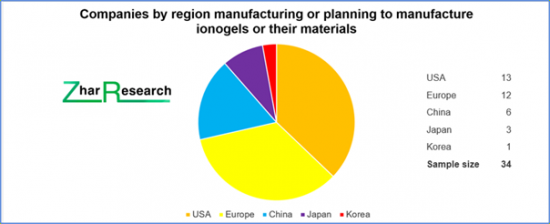
CAPTION: Companies by region manufacturing or planning to manufacture ionogels or their materials. Source, Zhar Research report, “Ionogel and Eutectogel Opportunities in Healthcare: Technology, Markets 2027-2047”.
Table of Contents
1. Executive summary and conclusions
- 1.1 Purpose of this report
- 1.2 Methodology of this analysis
- 1.3 Why ionogels?
- 1.3.1 Construction and relevance
- 1.3.2 25 ionogel and eutectogel targetted market sectors with 11 where hydrogels compete
- 1.3.3 Ten potential healthcare applications with benefits of ionogels in 6 columns
- 1.4 Infogram: Primary types of gel compared and choices of ionogel matrix
- 1.5 Examples of ionogel formulation and potential
- 1.5.1 Some ionogel types and applications being addressed
- 1.5.2 Some materials and functions involved
- 1.5.3 Stimuli‐responsive properties of ionogels
- 1.6 Ionogel SWOT appraisals
- 1.6.1 Ionogels in general SWOT
- 1.6.2 SWOT appraisal of medical ionogels
- 1.6.3 SWOT appraisal of cellulose ionogels
- 1.7 Ionogel appraisal in five columns for three forms of energy harvesting to power healthcare devices
- 1.8 28 key conclusions
- 1.8.1 Conclusions: markets for ionogel and related materials
- 1.8.2 Conclusions: ionogel technology trends including matrix chemistry matrix popularity analysis in
- 1.8.3 Conclusions: ionogel devices
- 1.8.4 Conclusions: Ionogel manufacturers and supply chain
- 1.9 Ionogel market, technology and industry roadmap 2026-2046
- 1.10 Roadmaps for self-healing materials in healthcare and ionogel competitor hydrogel 2027-2047
- 1.11 Ionogel market forecasts in 22 lines 2027-2047
- 1.11.1 Ionogel and allied market $ billion for three application categories 2027-2047
- 1.11.2 Ionogel value market by four regions 2027-2047
- 1.11.3 Self-healing materials for all applications: value market $ billion 2027-2047
- 1.11.4 Self-healing materials for healthcare value market $ billion 2027-2047
- 1.11.5 Medical hydrogel market 2027 and 2047 $ billion in 12 categories showing where ionogels compete.
- 1.11.6 THz hardware medical and four other categories, two tables/ two graphs: $ billion 2027-2047
2. Introduction
- 2.1 Definition, attributes and emerging uses
- 2.1.1 Definition and context
- 2.1.2 25 ionogel targetted market sectors with 11 where hydrogels compete
- 2.1.3 Applications of ionogels by seven types of composition
- 2.1.4 Wearable ionogels: flexible and fabric
- 2.1.5 Injectable ionogels for targetted drug delivery, wound healing, regenerative medicine
- 2.2 Eight properties of ionogels attracting attention
- 2.3 Primary types of gel compared in two infograms
- 2.4 Close relationship of ionogels and eutectogels
- 2.5 Ionogel, hydrogel, organogel, electragel and metallogel comparison
- 2.6 Some types and applications of ionogels in
- 2.7 Significance of ionic conductivity of ionogels and performance compromises
- 2.7.1 Overview
- 2.7.2 Choice of ionic liquids in ionogels, leakage, toxicity prevention in
- 2.7.3 Optimising ionic conductivity for electrical, electronic, ionotronics applications
- 2.8 Ionogel preparation with examples in
- 2.8.1 Overview and example
- 2.8.2 Direct mixing
- 2.8.3 Physical blending of inorganic ionogels
- 2.8.4 In situ polymerization/gelation for ultra-strong adhesive, transparent and other forms
- 2.8.5 Solvent exchange
- 2.9 Some results, benefits and challenges
- 2.10 Ionogel SWOT appraisal
3. Ionogel options by matrix material
- 3.1 Overview with matrix chemistry popularity analysis
- 3.2 Table: Ionogel matrices simply compared
- 3.3 Infogram: Ionomers by host structure (solid matrix) in detail
- 3.4 Primary choices of ionogel matrix material
- 3.5 Ionomer cross-linking options
- 3.6 Why cellulose ionogels are popular
- 3.6.1 Overview
- 3.6.2 SWOT appraisal of cellulose ionogels
- 3.6.3 Cellulose ionogel research 2025, 2026 : sensors, e-skin, biomedical, other
4. Optimising specific ionogel, eutectogel medical attributes: major advances in 2025-2026
- 4.1 Adhesion: surgical and other using ionogel or eutectogel
- 4.2 Antibacterial for wound healing, tissue repair, and medical device safety
- 4.3 Biocompatible for biomedical wound dressings and more
- 4.4 Fluorescence from biomimetics for soft iontronics and more
- 4.5 Self-healing for e-skin, wearable electronics, medical sensors, other
- 4.6 Strong: robust, impact resistant, toughening procedures
- 4.7 Terahertz manipulation for detecting cancers earlier , treating them, other
- 4.7.1 Ionogels for THz
- 4.7.2 THz for cancer diagnosis and treatment and more
- 4.7.3 THz disease treatment advances in 2025 and 2026 with SWOT appraisal
- 4.8 Transparent ionogels for more widely usable iontronics, sensors and optical devices in
- 4.9 Ionogel visual time-temperature indicators for pharmaceuticals, medical devices in
- 4.10 Performance-recyclability trade-off
5. Evolving ionogel device manufacturers, supply chain, formats, fabrication technologies
- 5.1 Overview and manufacturer regional analysis
- 5.2 Ionogel raw material manufacturers & chemical suppliers
- 5.3 Manufacturers of ionogel-based devices - actual and potential
- 5.4 Eutectogel manufacturers
- 5.5 Manufacturers of ionogel-enabled parts and devices
- 5.6 Ionogel device and parts manufacturing technologies including important 2025 and 2026 advances
- 5.6.1 Additive manufacturing increasingly favoured
- 5.6.2 Technology options for ionogel parts manufacture and formats produced
- 5.6.3 Fiber, fabric and wearable ionogels
- 5.6.4 3D and 4D printing of ionogels
- 5.6.5 2D and other printing and coating: screen, inkjet, aerosol, other
- 5.7 Composite ionogels: formulation and fabrication trends including important 2025 and 2026 advances
- 5.7.1 Overview
- 5.7.2 Applications
- 5.7.3 Fabrication trends
- 5.7.4 Magnetic ionogels
- 5.7.5 Multifunctional ionogels and eutectogels
6. Ionogels and eutectogels in iontronics, flexible electronics, and human interfaces
- 6.1 Overview including major advances in 2025 and
- 6.2 Iontronics and flexible electronics for brain-machine interfaces, drug delivery, other
- 6.3 Actuators and human interfaces
- 6.4 Ionogel membranes
- 6.4.1 Basics including mimicking the many membranes in the human body
- 6.4.2 Bio-fuel cells and Proton Exchange Membranes PEM with SWOT appraisal
- 6.4.3 Kidney dialysis and Chronic Kidney Disease (CKD)
- 6.5 Ionogel sensors and human interfaces
- 6.5.1 Overview of sensors
- 6.5.2 Flexible and wearable sensors and latest advances in ionogels for these
- 6.5.3 Ionogel e-skin for soft robotics, prosthetics and restorative medicine
- 6.5.4 Pressure, strain, temperature, imaging and other sensing with ionogels
- 6.6 Ionogel optical devices
- 6.6.1 Electrochromic
- 6.6.2 Birefringent
- 6.6.3 Light-emitting
7. Ionogels and eutectogels for medical energy harvesting and cooling
- 7.1 Overview
- 7.1.1 Energy harvesting and ionogels for medical and other purposes
- 7.1.2 13 energy harvesting technologies for zero energy devices compared and showing where ionogels are proposed
- 7.1.3 Energy harvesting applications by power output
- 7.1.4 Ionogel appraisal in five columns for three forms of energy harvesting for e-skin etc.
- 7.2 Thermoelectric energy harvesting
- 7.2.1 Basics with ionogels and eutectogels
- 7.2.2 Some targetted applications of ionogel thermoelectrics and allied materials
- 7.2.3 Surge of research advances in 2025 and 2026 analysed
- 7.2.4 Thermoelectric and thermal ionogel sensors, actuators and generators
- 7.3 Ionogel and eutectogel triboelectric energy harvesting
- 7.3.1 Triboelectric energy harvesting of motion: TENG operating principle, construction
- 7.3.2 Applications trialled mainly medical
- 7.3.3 Research advances with ionogel TENG in 2026 and
- 7.4 Piezoelectric ionogel energy harvesting for medical sensors etc.
- 7.5 Osmotic and tribo-iontronic energy harvesters
- 7.6 Ionogels for cooling medical devices
8. Roundup with more medical ionogels advances, SWOT, trends 2026-7: general, drug delivery, tissue engineering, wound healing
- 8.1 Overview
- 8.2 SWOT appraisal of medical ionogels
- 8.3 Ionogel versatility summarised in
- 8.4 Ionogels as drug delivery systems DDS: many advances in 2026 and
- 8.4.1 Rationale and examples
- 8.4.2 Oral drug delivery
- 8.4.3 Buccal (cheeks or mouth) drug delivery
- 8.4.4 Transdermal drug delivery
- 8.4.5 Local drug delivery
- 8.4.6 Nose-to-brain drug delivery
- 8.5 Wound healing ionogel dressings and treatments with major advances in
- 8.6 Tissue engineering ionogels 2026 and earlier
- 8.7 Stretchable neuromorphic electronics for future human-integrated intelligence in

(주말 및 공휴일 제외)


