|
시장보고서
상품코드
1421496
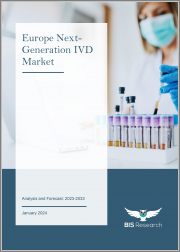
유럽의 차세대 IVD 시장 : 분석 및 예측(2023-2033년)Europe Next Generation IVD Market: Analysis and Forecast, 2023-2033 |
||||||
 BIS Research
2023년 유럽의 차세대 IVD 시장 규모는 242억 달러를 기록했습니다.
이 시장은 2023년부터 2033년까지 5.26%의 CAGR로 성장하여 2033년에는 404억 1,000만 달러에 달할 것으로 예측됩니다. 진단 분야에서 신기술과 혁신의 활용은 차세대 체외진단(IVD) 시장의 성장을 촉진하는 힘을 가지고 있습니다. 분자 진단, 유전체학, 차세대 염기서열 분석(NGS)은 이러한 성장의 주요 원동력이 될 것으로 예상되며, 질병 진단을 강화할 수 있는 새로운 기회를 제공하여 환자 결과를 재구성할 수 있는 기회를 제공할 것입니다.
| 주요 시장 통계 | |
|---|---|
| 예측 기간 | 2023-2033년 |
| 2023년 평가 | 242억 달러 |
| 2033년 예측 | 404억 1,000만 달러 |
| CAGR | 5.26% |
유럽의 차세대 체외진단(IVD) 시장은 괄목할 만한 성장과 변화를 거듭하고 있습니다. 이 시장에는 이 지역의 헬스케어에 혁명을 가져올 다양한 첨단 진단 기술과 도구가 포함되어 있습니다. 이 시장을 이끄는 주요 요인으로는 만성질환의 확산, 개인 맞춤형 의료에 대한 수요 증가, 질병의 조기 발견 및 조기 관리에 대한 중요성 증가 등이 있습니다. 분자 진단, 유전체학, 차세대 염기서열 분석(NGS)은 의료진이 환자의 상태에 대한 정확한 인사이트를 얻을 수 있도록 하는 기술 혁신의 최전선에 있습니다. 이러한 기술은 암, 감염성 질환, 유전성 질환을 포함한 다양한 질병을 진단하는 데 있어 정확성, 속도, 효율성을 향상시킵니다.
또한, 유럽 시장은 활발한 R&D 활동을 특징으로 하며, IVD 솔루션의 지속적인 발전을 촉진하고 있습니다. 규제 당국의 지원과 엄격한 품질 기준은 이러한 진단 약품의 안전성과 효능을 보장합니다. 환자 결과 개선과 의료 자원 최적화에 중점을 둔 유럽의 차세대 IVD 시장은 지속적인 성장과 혁신을 통해 이 지역의 전반적인 의료 서비스 향상에 기여할 수 있는 태세를 갖추고 있습니다.
이 보고서는 유럽의 차세대 IVD 시장을 조사하여 시장 개요와 함께 유형별, 최종사용자별, 국가별 동향, 시장 진입 기업 개요 등을 제공합니다.
목차
주요 요약
제1장 시장
- 시장 범위
- 조사 방법
제2장 시장 개요
- 서론
- 차세대 IVD 시장 전망
- 시장 규모와 성장 가능성
- 차세대 체외진단 시장별 제품 벤치마크(유형별)
- COVID-19에 의한 차세대 IVD 시장에 대한 영향
제3장 업계 분석
- 법적 요건
- 유럽의 법적 요건과 체계
제4장 시장 역학
- 개요
- 영향 분석
- 시장 촉진요인
- 시장 과제
- 시장 기회
제5장 차세대 IVD 시장, 지역별, 100만 달러, 2022-2033년
- 개요
- 유럽
- 시장 역학
- 시장 규모와 예측
제6장 기업 개요
- bioMerieux SA(BioFire Diagnostics)
- F. Hoffmann-La Roche Ltd.(Roche Molecular Systems, Inc.)
- QIAGEN N.V.
- Siemens Healthineers AG
“The Europe Next-Generation IVD Market Expected to Reach $40.41 Billion by 2033.”
Introduction to Europe Next-Generation IVD (In vitro diagnostics) Market
The Europe next-generation IVD market was valued at $24.20 billion in 2023 and is expected to reach $40.41 billion by 2033, growing at a CAGR of 5.26% between 2023 and 2033. The utilization of emerging technologies and innovations in diagnostics has the capacity to stimulate the expansion of the next-generation IVD (In Vitro Diagnostic) market. Molecular diagnostics, genomics, and Next-Generation Sequencing (NGS) are anticipated to be key drivers of this growth, offering fresh opportunities for enhanced disease diagnosis and, consequently, reshaping patient outcomes.
| KEY MARKET STATISTICS | |
|---|---|
| Forecast Period | 2023 - 2033 |
| 2023 Evaluation | $24.20 Billion |
| 2033 Forecast | $40.41 Billion |
| CAGR | 5.26% |
Market Introduction
The Europe Next-Generation IVD (In Vitro Diagnostics) Market is witnessing significant growth and transformation. It encompasses a diverse range of advanced diagnostic technologies and tools that are revolutionizing healthcare practices in the region. Key factors driving this market include the increasing prevalence of chronic diseases, rising demand for personalized medicine, and a growing emphasis on early disease detection and management. Molecular diagnostics, genomics, and Next-Generation Sequencing (NGS) are at the forefront of innovation, enabling healthcare professionals to obtain precise insights into patients' conditions. These technologies offer enhanced accuracy, speed, and efficiency in diagnosing various diseases, including cancer, infectious diseases, and genetic disorders.
Moreover, the Europe market is characterized by robust research and development activities, fostering continuous advancements in IVD solutions. Regulatory support and stringent quality standards ensure the safety and efficacy of these diagnostics. With a focus on improving patient outcomes and optimizing healthcare resources, the Europe Next-Generation IVD Market is poised for continued growth and innovation, contributing to the region's overall healthcare excellence.
Market Segmentation:
Segmentation 1: by Type
- Core Laboratory Diagnostics
- POC Testing
- Molecular Diagnostics
Segmentation 2: by End User
- Hospitals and Clinics
- Diagnostic Laboratories
- Academic and Research Institutions
- Other End Users
Segmentation 3: by Country
- Germany
- U.K.
- France
- Italy
- Spain
- Rest-of-Europe
How Can This Report Add Value to an Organization?
Product/Innovation Strategy: The Europe next-generation IVD market has been extensively segmented on the basis of various categories, such as type and end user. This can help readers get a clear overview of which segments account for the largest share and which ones are well-positioned to grow in the coming years.
Competitive Strategy: The Europe next-generation IVD market has numerous startups paving their way into manufacturing kits, panels, assays, and instruments and entering the market. Key players in the Europe next-generation IVD market analyzed and profiled in the study involve established players that offer various kinds of disease-specific panels and multiplex instruments.
Table of Contents
Executive Summary
1. Markets
- 1.1. Market Scope
- 1.1.1. Key Questions Answered in the Report
- 1.2. Research Methodology
- 1.2.1. Next-Generation IVD Market: Research Methodology
- 1.2.2. Data Sources
- 1.2.2.1. Primary Data Sources
- 1.2.2.2. Secondary Data Sources
- 1.2.3. Market Estimation Model
- 1.2.4. Criteria for Company Profiling
2. Market Overview
- 2.1. Introduction
- 2.1.1. Next-Generation IVD Market Outlook
- 2.1.1.1. POC-IVD
- 2.1.1.2. Diagnostic Expenditures
- 2.1.1.3. Pricing Patterns of Next-Generation IVD
- 2.1.2. Market Size and Growth Potential
- 2.1.2.1. Short-Term Impact (2020-2025)
- 2.1.2.2. Long-Term Impact (2026-2033)
- 2.1.3. Product Benchmarking by Next- Generation In-vitro Diagnostics Market, (by Type)
- 2.1.1. Next-Generation IVD Market Outlook
- 2.2. COVID-19 Impact on the Next-Generation IVD Market
- 2.2.1. Impact on Operations
- 2.2.2. COVID-19 Impact: Current Scenario of the Market
- 2.2.3. Pre-COVID Assessment
- 2.2.4. Post-COVID-19 Market Assessment
3. Industry Analysis
- 3.1. Legal Requirements
- 3.1.1. Legal Requirements and Framework in Europe
4. Market Dynamics
- 4.1. Overview
- 4.2. Impact Analysis
- 4.3. Market Drivers
- 4.3.1. Technological Advancements in Next-Generation In-Vitro Diagnostics Transforming Healthcare System
- 4.3.2. Rising Demand of POC Testing Boosting Next-Generation IVD Market
- 4.3.3. Growing Incidence of Chronic and Acute Diseases Demanding for Early Treatment
- 4.3.4. Boost in the Next-Generation IVD Market during COVID-19 Pandemic
- 4.4. Market Challenges
- 4.4.1. Regulatory Hurdles Related to Next-Generation IVD Technologies
- 4.4.2. Poor Reimbursement Scenario
- 4.5. Market Opportunities
- 4.5.1. Rising Number of Next-Generation IVD Companies Involved in Business Expansion
- 4.5.2. Inclination of Emerging Companies toward Next-Generation IVD
5. Next-Generation IVD Market, by Region, $Million, 2022-2033
- 5.1. Overview
- 5.2. Europe
- 5.2.1. Market Dynamics
- 5.2.2. Market Size and Forecast
- 5.2.2.1. Europe Next-Generation IVD Market (by End User)
- 5.2.2.2. Europe Next-Generation IVD Market (by Type)
- 5.2.2.2.1. Europe Next-Generation Core Laboratory IVD Market, (by Type)
- 5.2.2.3. Europe Next-Generation IVD Market (by Country)
- 5.2.2.3.1. Germany
- 5.2.2.3.1.1. Market Size and Forecast
- 5.2.2.3.1.1.1. Germany Next-Generation IVD Market (by End User)
- 5.2.2.3.1.1.2. Germany Next-Generation IVD Market (by Type)
- 5.2.2.3.2. France
- 5.2.2.3.2.1. Market Size and Forecast
- 5.2.2.3.2.1.1. France Next-Generation IVD Market (by End User)
- 5.2.2.3.2.1.2. France Next-Generation IVD Market (by Type)
- 5.2.2.3.3. U.K.
- 5.2.2.3.3.1. Market Size and Forecast
- 5.2.2.3.3.1.1. U.K. Next-Generation IVD Market (by End User)
- 5.2.2.3.3.1.2. U.K. Next-Generation IVD Market (by Type)
- 5.2.2.3.4. Italy
- 5.2.2.3.4.1. Market Size and Forecast
- 5.2.2.3.4.1.1. Italy Next-Generation IVD Market (by End User)
- 5.2.2.3.4.1.2. Italy Next-Generation IVD Market (by Type)
- 5.2.2.3.5. Spain
- 5.2.2.3.5.1. Market Size and Forecast
- 5.2.2.3.5.1.1. Spain Next-Generation IVD Market (by End User)
- 5.2.2.3.5.1.2. Spain Next-Generation IVD Market (by Type)
- 5.2.2.3.6. Rest-of-Europe
- 5.2.2.3.6.1. Market Size and Forecast
- 5.2.2.3.6.1.1. Rest-of-Europe Next-Generation IVD Market (by End User)
- 5.2.2.3.6.1.2. Rest-of-Europe Next-Generation IVD Market (by Type)
- 5.2.2.3.1. Germany
6. Company Profiles
- 6.1. Overview
- 6.2. bioMerieux SA (BioFire Diagnostics)
- 6.2.1. Company Overview
- 6.2.2. Role of bioMerieux SA (BioFire Diagnostics) in the Next-Generation IVD Market
- 6.2.3. Financials
- 6.2.4. Recent Developments
- 6.2.4.1. Corporate Strategies
- 6.2.4.2. Business Strategies
- 6.2.5. Analyst Perspective
- 6.3. F. Hoffmann-La Roche Ltd. (Roche Molecular Systems, Inc.)
- 6.3.1. Company Overview
- 6.3.2. Role of F. Hoffmann-La Roche Ltd. in the Next-Generation IVD Market
- 6.3.3. Financials
- 6.3.4. Recent Developments
- 6.3.4.1. Business Strategies
- 6.3.5. Analyst Perspective
- 6.4. QIAGEN N.V.
- 6.4.1. Company Overview
- 6.4.2. Role of QIAGEN N.V. in the Next-Generation IVD Market
- 6.4.3. Financials
- 6.4.4. Recent Developments
- 6.4.4.1. Corporate Strategies
- 6.4.4.2. Business Strategies
- 6.4.5. Analyst Perspective
- 6.5. Siemens Healthineers AG
- 6.5.1. Company Overview
- 6.5.2. Role of Siemens Healthineers AG in the Next-Generation IVD Market
- 6.5.3. Financials
- 6.5.4. Recent Developments
- 6.5.4.1. Corporate Strategies
- 6.5.4.2. Business Strategies
- 6.5.5. Analyst Perspective