|
시장보고서
상품코드
1672837
응급 의료장비 시장 : 제품 유형별, 용도별, 최종 사용자별, 지역별Emergency Medical Equipment Market, By Product Type, By Application, By End User, By Geography |
||||||

세계의 응급 의료장비 시장은 2025년에 283억 7,000만 달러로 추정되고, 2032년에는 449억 9,000만 달러에 이를 것으로 예측되며, 2025년부터 2032년까지 연평균 성장률(CAGR) 6.8%로 성장할 전망입니다.
| 보고 범위 | 보고서 세부정보 | ||
|---|---|---|---|
| 기준 연도 | 2024년 | 시장 규모(2025년) | 283억 7,000만 달러 |
| 실적 데이터 | 2020-2024년 | 예측 기간 | 2025-2032년 |
| 예측 기간 CAGR(2025-2032년) | 6.80% | 금액 예측(2032년) | 449억 9,000만 달러 |

세계의 응급 의료장비 시장은 최근 몇 년간 현저한 성장을 이루고 있습니다. 응급 의료장비는 응급 의료 현장에서 상병환자를 치료하는 데 사용되는 의료기기 및 소모품을 의미합니다. 일반적인 응급 의료장비로는 응급 호흡기, 목 브레이스 및 후면 보드와 같은 외상 기기, 환자 모니터링 장비, 제세동기, 의료 영상 장비, 들것 및 의료용 침대 등이 있습니다. 고령화 인구 증가, 만성 질환의 유병률 상승, 사고 및 상해 증가가 응급 의료장비 수요를 촉진하고 있습니다. 응급 의료장비의 기술적 진보와 응급의료 인프라 강화를 위한 관민 양 조직의 투자 증가는 앞으로도 시장 성장을 가속할 것으로 예상되는 주요 요인의 일부입니다.
시장 역학
세계의 응급 의료장비 시장을 촉진하고 있는 주요 요인으로는 세계의 심혈관 질환 및 호흡기 질환의 유병률 증가, 교통사고에 의한 사망자수 증가, 외상증 예수 증가, 의료비의 전체적인 증가 등이 있습니다. 게다가 의료상 긴급사태에 휩쓸리기 쉬운 노인들이 급속히 확대되고 있으며, 각국의 응급의료 인프라를 강화하기 위한 다양한 정부의 이니셔티브가 시장 성장을 크게 뒷받침하고 있습니다. 그러나 의료기기의 엄격한 규제 프레임워크와 품질 기준의 준수가 큰 과제가 되고 있습니다. 또한 혁신적인 의료 기술과 관련된 높은 비용은 특히 저소득 국가에서 여전히 장벽이 되고 있습니다. 좋은 면으로는 치료 결과의 개선, 기동성, 사용의 용이성을 제공하는 기술 혁신이 진행되고 있기 때문에 새로운 기회가 탄생하고 있습니다.
본 조사의 주요 특징
- 본 보고서에서는 세계의 응급 의료장비 시장을 상세하게 분석하여 2024년을 기준연도로 한 예측기간(2025-2032년) 시장 규모(10억 달러) 및 연간 평균 성장률(CAGR%)을 제공합니다.
- 또한 다양한 부문에 걸친 잠재적인 수익 성장 기회를 밝히고 이 시장의 매력적인 투자 제안 매트릭스를 설명합니다.
- 또한 시장 성장 촉진요인, 억제요인, 기회, 신제품 출시 및 승인, 시장 동향, 지역에 의한 전망, 주요 기업이 채용하는 경쟁 전략 등에 관한 주요 인사이트도 제공합니다.
- 세계 응급 의료장비 시장의 주요 기업을 기업 하이라이트, 제품 포트폴리오, 주요 하이라이트, 성과, 전략 등의 매개변수를 기반으로 프로파일링합니다.
- 주요 기업으로는 3M, Abbott, Asahi Kasei Corp., B. Braun SE, Cardinal Health, GE Healthcare, Henryker, BD, Smith &Nephew, Koninklijke Philips NV, ConvaTec Inc., Terumo Corporation, Boston Scientific Corporation, Merit Medical Systems, Medtronic, GE Healthcare, Baxter 등이 포함됩니다.
- 이 보고서에서 인사이트를 통해 마케팅 담당자와 기업 경영진은 향후 제품 출시, 유형 업그레이드, 시장 확대, 마케팅 전술에 대한 정보를 바탕으로 의사 결정을 내릴 수 있습니다.
- 세계의 응급 의료장비 시장은 투자자, 공급업체, 제품 제조업체, 유통업체, 신규 참가자, 재무 분석가 등 이 산업의 다양한 이해관계자들에 대응하고 있습니다.
- 세계의 응급 의료장비 시장 분석에 사용되는 다양한 전략 매트릭스를 통해 이해관계자들은 의사결정이 용이해집니다.
목차
제1장 조사의 목적 및 전제조건
- 조사 목적
- 전제조건
- 약어
제2장 시장 전망
- 보고서 설명
- 시장 정의 및 범위
- 주요 요약
- Coherent Opportunity Map (COM)
제3장 시장 역학, 규제 및 동향 분석
- 시장 역학
- 성장 촉진요인
- 성장 억제요인
- 기회
- 영향 분석
- 시장 동향
- 규제 시나리오
- 제조업체 수익
- 비침습성 센서 기술의 채용
- 인수 및 제휴 시나리오
- 제품 출시 및 승인
- 자금 조달 및 투자
- PEST 분석
- Porter's Five Forces 분석
제4장 세계의 응급 의료장비 : 바이러스(COVID-19) 팬데믹의 영향
- 전체적인 영향
- 정부의 대처
- COVID-19에 의한 시장에 대한 영향
제5장 세계의 구급 의료기기 시장 : 제품 유형별(2020-2032년)(10억 달러)
- 서문
- 진단용 의료기기
- 긴급 소생기기
- 개인 보호구
- 환자 이송 기기
- 기타
제6장 세계의 구급 의료기기 시장 : 용도별(2020-2032년)(10억 달러)
- 서문
- 심장 케어
- 암 치료
- 호흡 케어
- 외상
- 기타
제7장 세계의 구급 의료기기 시장 : 최종 사용자별(2020-2032년)(10억 달러)
- 서문
- 병원
- 외래수술센터(ASC)
- 기타
제8장 세계의 구급 의료기기 시장 : 지역별(2020-2032년)(10억 달러)
- 서문
- 북미
- 라틴아메리카
- 유럽
- 아시아태평양
- 중동
- 아프리카
제9장 경쟁 구도
- 기업 프로파일
- 3M
- Abbott
- Asahi Kasei Corporation
- B. Braun SE
- Cardinal Health
- GE Healthcare
- Henry Schein, Inc.
- Stryker
- BD
- Smith & Nephew
- Koninklijke Philips NV
- ConvaTec Inc.
- Terumo Corporation
- Boston Scientific Corporation
- Merit Medical Systems
- Medtronic
- GE Healthcare
- Baxter
제10장 분석가 시점
- 융성 및 쇠퇴
- 일관형 기회 맵
제11장 참고문헌 및 조사방법
- 참고문헌
- 조사방법
Global Emergency Medical Equipment Market is estimated to be valued at USD 28.37 Bn in 2025 and is expected to reach USD 44.99 Bn by 2032, growing at a compound annual growth rate (CAGR) of 6.8% from 2025 to 2032.
| Report Coverage | Report Details | ||
|---|---|---|---|
| Base Year: | 2024 | Market Size in 2025: | USD 28.37 Bn |
| Historical Data for: | 2020 To 2024 | Forecast Period: | 2025 To 2032 |
| Forecast Period 2025 to 2032 CAGR: | 6.80% | 2032 Value Projection: | USD 44.99 Bn |
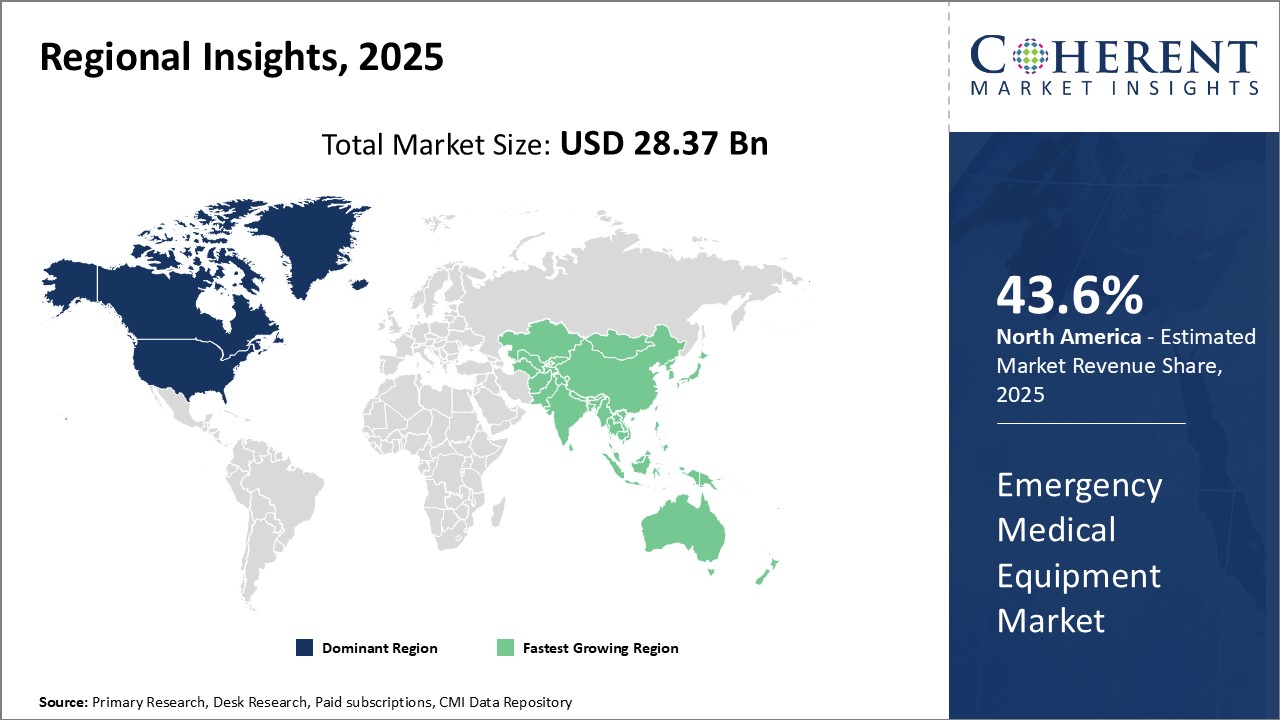
The global emergency medical equipment market has been witnessing significant growth in the recent years. Emergency medical equipment refers to the medical devices and supplies used in emergency medical settings to treat injured or ill patients. Some of the common emergency medical equipment includes emergency respirators, trauma equipment such as neck braces and backboards, patient monitoring devices, defibrillators, medical imaging equipment, and stretchers or medical beds. Growth in aging population, rising prevalence of chronic diseases and increasing number of accidents and injuries has been fueling the demand for emergency medical equipment. Technological advancements in emergency care devices and growing investments by both public and private organizations to strengthen emergency medical infrastructure are some of the key factors expected to continue driving market growth going forward.
Market Dynamics:
The key drivers propelling the global emergency medical equipment market include growing prevalence of cardiovascular and respiratory diseases globally, rising road accident fatalities, augmenting number of trauma cases, and overall increasing health expenditure. Furthermore, the rapidly expanding geriatric population susceptible to medical exigencies along with various government initiatives to strengthen emergency care infrastructure across nations has massively fueled market growth. However, compliance with stringent regulatory frameworks and quality standards for medical devices poses a major challenge. Moreover, high costs associated with innovative healthcare technologies remains a barrier, especially in low-income countries. On the positive side, ongoing technological innovations delivering improved therapeutic outcomes, mobility and ease-of-use is creating new opportunities.
Key Features of the Study:
- This report provides an in-depth analysis of the global emergency medical equipment market, and provides market size (USD Bn) and compound annual growth rate (CAGR%) for the forecast period (2025-2032), considering 2024 as the base year.
- It elucidates potential revenue growth opportunities across different segments and explains attractive investment proposition matrices for this market.
- This study also provides key insights about market drivers, restraints, opportunities, new product launches or approvals, market trends, regional outlook, and competitive strategies adopted by key players.
- It profiles key players in the global emergency medical equipment market based on the following parameters - company highlights, products portfolio, key highlights, financial performance, and strategies.
- Key companies covered as a part of this includes 3M, Abbott, Asahi Kasei Corporation, B. Braun SE, Cardinal Health, GE Healthcare, Henry Schein, Inc., Stryker , BD, Smith & Nephew, Koninklijke Philips N.V. , ConvaTec Inc., Terumo Corporation, Boston Scientific Corporation, Merit Medical Systems, Medtronic, GE Healthcare, and Baxter.
- Insights from this report would allow marketers and the management authorities of the companies to make informed decisions regarding their future product launches, type up-gradation, market expansion, and marketing tactics.
- The global emergency medical equipment market caters to various stakeholders in this industry including investors, suppliers, product manufacturers, distributors, new entrants, and financial analysts.
- Stakeholders would have ease in decision-making through various strategy matrices used in analyzing the global emergency medical equipment market.
Detailed Segmentation-
- By Product Type:
- Diagnostic Medical Equipment
- Emergency Resuscitation Equipment
- Personal Protective Equipment
- Patient Handling Equipment
- Others
- By Application:
- Cardiac Care
- Cancer Care
- Respiratory Care
- Trauma
- Others
- By End User:
- Hospitals
- Ambulatory Surgical Centers
- Others
- By Region:
- North America
- Europe
- Asia Pacific
- Latin America
- Middle East
- Africa
- Company Profiles:
- 3M
- Abbott
- Asahi Kasei Corporation
- Braun SE
- Cardinal Health
- GE Healthcare
- Henry Schein, Inc.
- Stryker
- BD
- Smith & Nephew
- Koninklijke Philips N.V.
- ConvaTec Inc.
- Terumo Corporation
- Boston Scientific Corporation
- Merit Medical Systems
- Medtronic
- GE Healthcare
- Baxter
Table of Contents
1. Research Objectives and Assumptions
- Research Objectives
- Assumptions
- Abbreviations
2. Market Purview
- Report Description
- Market Definition and Scope
- Executive Summary
- Market Snapshot, By Product Type
- Market Snapshot, By Application
- Market Snapshot, By End User
- Market Snapshot, By Region
- Coherent Opportunity Map (COM)
3. Market Dynamics, Regulations, and Trends Analysis
- Market Dynamics
- Drivers
- Restraints
- Opportunities
- Impact Analysis
- Market Trends
- Key Developments
- Regulatory Scenario
- Manufacturer Revenue
- Adoption of Non-invasive Sensor Technologies
- Acquisitions and Partnerships Scenario
- Product Launches/Approvals
- Funding and Investments
- PEST Analysis
- Porter's Analysis
4. Global Emergency Medical Equipment Market- Impact of Coronavirus (COVID-19) Pandemic
- Overall Impact
- Government Initiatives
- COVID-19 Impact on the Market
5. Global Emergency Medical Equipment Market, By Product Type, 2020 - 2032, (USD Bn)
- Overview
- Market Share Analysis, 2025 and 2032 (%)
- Y-o-Y Growth Analysis, 2020 - 2032
- Segment Trends
- Diagnostic Medical Equipment
- Overview
- Market Size and Forecast, and Y-o-Y Growth, 2020-2032, (USD Bn)
- Emergency Resuscitation Equipment
- Overview
- Market Size and Forecast, and Y-o-Y Growth, 2020-2032, (USD Bn)
- Personal Protective Equipment
- Overview
- Market Size and Forecast, and Y-o-Y Growth, 2020-2032, (USD Bn)
- Patient Handling Equipment
- Overview
- Market Size and Forecast, and Y-o-Y Growth, 2020-2032, (USD Bn)
- Others
- Overview
- Market Size and Forecast, and Y-o-Y Growth, 2020-2032, (USD Bn)
6. Global Emergency Medical Equipment Market, By Application, 2020 - 2032, (USD Bn)
- Overview
- Market Share Analysis, 2025 and 2032 (%)
- Y-o-Y Growth Analysis, 2020 - 2032
- Segment Trends
- Cardiac Care
- Overview
- Market Size and Forecast, and Y-o-Y Growth, 2020-2032, (USD Bn)
- Cancer Care
- Overview
- Market Size and Forecast, and Y-o-Y Growth, 2020-2032, (USD Bn)
- Respiratory Care
- Overview
- Market Size and Forecast, and Y-o-Y Growth, 2020-2032, (USD Bn)
- Trauma
- Overview
- Market Size and Forecast, and Y-o-Y Growth, 2020-2032, (USD Bn)
- Others
- Overview
- Market Size and Forecast, and Y-o-Y Growth, 2020-2032, (USD Bn)
7. Global Emergency Medical Equipment Market, By End User, 2020 - 2032, (USD Bn)
- Overview
- Market Share Analysis, 2025 and 2032 (%)
- Y-o-Y Growth Analysis, 2020 - 2032
- Segment Trends
- Hospitals
- Overview
- Market Size and Forecast, and Y-o-Y Growth, 2020-2032, (USD Bn)
- Ambulatory Surgical Centers
- Overview
- Market Size and Forecast, and Y-o-Y Growth, 2020-2032, (USD Bn)
- Others
- Overview
- Market Size and Forecast, and Y-o-Y Growth, 2020-2032, (USD Bn)
8. Global Emergency Medical Equipment Market, By Region, 2020 - 2032, (USD Bn)
- Introduction
- Market Share Analysis, By Region, 2025 and 2032 (%)
- Y-o-Y Growth Analysis, For Region, 2020-2032
- Regional Trends
- North America
- Introduction
- Market Size and Forecast, and Y-o-Y Growth, By Product Type, 2020 - 2032, (USD Bn)
- Market Size and Forecast, and Y-o-Y Growth, By Application, 2020 - 2032, (USD Bn)
- Market Size and Forecast, and Y-o-Y Growth, By End User, 2020 - 2032, (USD Bn)
- Market Size and Forecast, and Y-o-Y Growth, By Country, 2020 - 2032, (USD Bn)
- U.S.
- Canada
- Latin America
- Introduction
- Market Size and Forecast, and Y-o-Y Growth, By Product Type, 2020 - 2032, (USD Bn)
- Market Size and Forecast, and Y-o-Y Growth, By Application, 2020 - 2032, (USD Bn)
- Market Size and Forecast, and Y-o-Y Growth, By End User, 2020 - 2032, (USD Bn)
- Market Size and Forecast, and Y-o-Y Growth, By Country, 2020 - 2032, (USD Bn)
- Brazil
- Mexico
- Argentina
- Rest of Latin America
- Europe
- Introduction
- Market Size and Forecast, and Y-o-Y Growth, By Product Type, 2020 - 2032, (USD Bn)
- Market Size and Forecast, and Y-o-Y Growth, By Application, 2020 - 2032, (USD Bn)
- Market Size and Forecast, and Y-o-Y Growth, By End User, 2020 - 2032, (USD Bn)
- Market Size and Forecast, and Y-o-Y Growth, By Country, 2020 - 2032, (USD Bn)
- U.K.
- Germany
- Italy
- France
- Spain
- Russia
- Rest of Europe
- Asia Pacific
- Introduction
- Market Size and Forecast, and Y-o-Y Growth, By Product Type, 2020 - 2032, (USD Bn)
- Market Size and Forecast, and Y-o-Y Growth, By Application, 2020 - 2032, (USD Bn)
- Market Size and Forecast, and Y-o-Y Growth, By End User, 2020 - 2032, (USD Bn)
- Market Size and Forecast, and Y-o-Y Growth, By Country, 2020 - 2032, (USD Bn)
- China
- India
- Japan
- ASEAN
- Australia
- South Korea
- Rest of Asia Pacific
- Middle East
- Introduction
- Market Size and Forecast, and Y-o-Y Growth, By Product Type, 2020 - 2032, (USD Bn)
- Market Size and Forecast, and Y-o-Y Growth, By Application, 2020 - 2032, (USD Bn)
- Market Size and Forecast, and Y-o-Y Growth, By End User, 2020 - 2032, (USD Bn)
- Market Size and Forecast, and Y-o-Y Growth, By Country, 2020 - 2032, (USD Bn)
- GCC
- Israel
- Rest of Middle East
- Africa
- Introduction
- Market Size and Forecast, and Y-o-Y Growth, By Product Type, 2020 - 2032, (USD Bn)
- Market Size and Forecast, and Y-o-Y Growth, By Application, 2020 - 2032, (USD Bn)
- Market Size and Forecast, and Y-o-Y Growth, By End User, 2020 - 2032, (USD Bn)
- Market Size and Forecast, and Y-o-Y Growth, By Country/Region, 2020 - 2032, (USD Bn)
- North Africa
- Central Africa
- South Africa
9. Competitive Landscape
- Company Profiles
- 3M
- Company Highlights
- Product Portfolio
- Key Highlights
- Financial Performance
- Market Strategies
- Abbott
- Company Highlights
- Product Portfolio
- Key Highlights
- Financial Performance
- Market Strategies
- Asahi Kasei Corporation
- Company Highlights
- Product Portfolio
- Key Highlights
- Financial Performance
- Market Strategies
- B. Braun SE
- Company Highlights
- Product Portfolio
- Key Highlights
- Financial Performance
- Market Strategies
- Cardinal Health
- Company Highlights
- Product Portfolio
- Key Highlights
- Financial Performance
- Market Strategies
- GE Healthcare
- Company Highlights
- Product Portfolio
- Key Highlights
- Financial Performance
- Market Strategies
- Henry Schein, Inc.
- Stryker
- BD
- Smith & Nephew
- Koninklijke Philips N.V.
- ConvaTec Inc.
- Terumo Corporation
- Boston Scientific Corporation
- Merit Medical Systems
- Medtronic
- GE Healthcare
- Baxter
- 3M
10. Analyst View
- Wheel of Fortune
- Analyst View
- Coherent Opportunity Map
11. References and Research Methodology
- References
- Research Methodology
- About us and Sales Contact