|
시장보고서
상품코드
2119668
응급 의료 서비스 제품 시장 : 점유율 분석, 업계 동향과 통계, 성장 예측(2026-2031년)Emergency Medical Services Products - Market Share Analysis, Industry Trends & Statistics, Growth Forecasts (2026 - 2031) |
||||||
 Mordor Intelligence
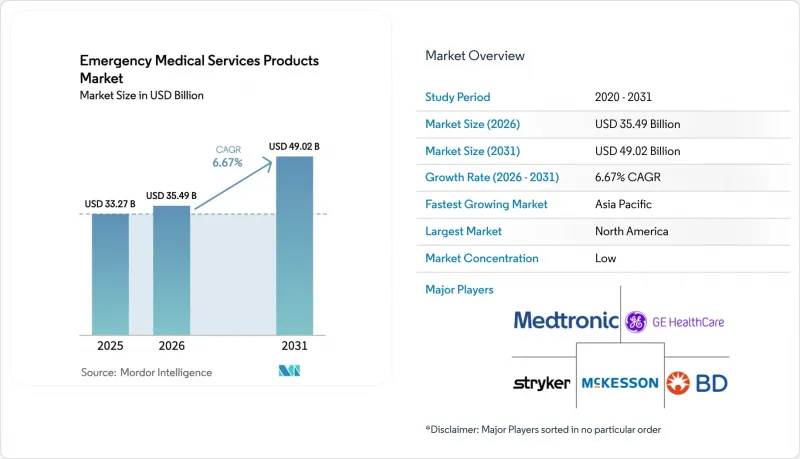
Mordor Intelligence에 의하면, 2026년 응급 의료 서비스 제품 시장 규모는 354억 9,000만 달러로 추정되고 있어 2025년 332억 7,000만 달러에서 확대해, 2031년에는 490억 2,000만 달러에 이를 것으로 예측됩니다.
2026년부터 2031년까지의 연평균 성장률(CAGR)은 6.67%를 나타낼 전망입니다.
본 보고서는 제품 유형(생명 유지·응급 소생, 환자 모니터링 시스템 등), 용도(심장 치료, 외상·부상 관리 등), 최종 사용자(병원·외상 센터 등), 지역(북미, 유럽, 아시아태평양, 중동 및 아프리카, 남미)별로 분류되어 있습니다. 시장 전망은 금액(달러) 단위로 표시되어 있습니다.
세계 응급 의료 서비스 제품 시장 동향 및 인사이트
만성 질환 및 외상 발생률 증가
심혈관 질환, 당뇨병, 외상 사례 수는 계속 증가하고 있으며, 심장 질환만으로도 EMS 제품 도입의 42.64%를 차지하고 있습니다. 암호화된 생체 신호를 병원 기록으로 직접 전송하는 휴대용 모니터는 이러한 환자의 치료 연속성을 향상시킵니다. 가정에서 만성 질환을 관리하는 지역 파라메디신 유닛은 치료 비용을 최대 30% 절감하여, 견고하고 다중 매개변수를 지원하는 기기에 대한 수요를 촉진하고 있습니다. ‘재택 병원’ 모델은 현재 입원 환자의 10%에 대해 도입이 승인되었으며, 병원 수준의 정확도를 갖춘 현장 대응형 기술에 의존하고 있습니다. 자가 보정이 가능한 장비는 생체의학 기술자가 부족한 지역에서도 기능을 보장하며, 응급 의료 서비스 제품 시장을 더욱 활성화시키고 있습니다.
OECD 지역의 구급차 및 장비 노후화
구급차는 일반적으로 12년간 사용되지만, 전자 기기는 규정을 계속 준수하기 위해 5-7년마다 교체해야 합니다. 이러한 예측 가능성 덕분에 기존 장비보다 통합형 원격 의료 콘솔이 선택되기 쉬운 교체 주기가 형성되고 있습니다. 전기 구급차는 고유한 전력 관리상의 제약을 수반하며, 저전력 인공호흡기 및 제세동기에 대한 수요를 촉진하고 있습니다. FDA 및 UKCA 규정에 따른 이중 라벨 표기는 규정 준수 비용을 증가시키기 때문에 공급업체들은 변화하는 기준에 대응할 수 있도록 원격으로 소프트웨어 업데이트가 가능한 플랫폼을 점점 더 많이 선택하고 있습니다. 위성 통신 지원 통신 모듈은 안정적인 휴대전화 네트워크가 구축되지 않은 지역에서도 데이터 통신을 보장하여, 지리적으로 분산된 지역에서의 도입을 촉진하고 있습니다.
높은 자본 비용과 복잡한 규제 승인
AI 탑재 기기의 FDA 승인을 획득하려면 개발 기간이 3년 연장되고, 단가에 1,000만-1,500만 달러가 추가될 가능성이 있어, 이는 신규 진입을 저해하고 자원이 부족한 지역에서의 도입을 지연시키고 있습니다. EU 의료기기 규정에서는 병행 기술 문서가 요구되어 서류 작성량이 2배로 늘어납니다. 소규모 응급 의료 기관은 차량 현대화를 위해 지자체의 보조금에 의존하는 경우가 많지만, 예산 상한선으로 인해 여전히 단계적인 조달을 할 수밖에 없습니다. 그 결과, 주요 도시 지역의 프로그램과 자금 부족에 시달리는 지방 서비스 간에 도입 격차가 발생하여, 가격에 민감한 부문에서 응급 의료 서비스 제품 시장의 성장을 제약하고 있습니다.
부문 분석
2025년, 응급처치 및 심폐소생용 장비는 응급 의료 서비스 제품 시장에서 35.12%의 점유율을 유지했습니다. 이러한 보급은 응급처치의 ‘골든 아워’ 동안 제세동기, 인공호흡기 및 다중 모니터가 수행하는 필수적인 역할에 힘입은 것입니다. 기계식 심폐소생술(CPR) 장치는 수동 방식에서는 종종 정확도가 떨어지기 쉬운 이송 중 흉부 압박을 일정하게 유지할 수 있어 의료 현장에 혁신을 가져오고 있습니다. LUCAS 3 및 AutoPulse 플랫폼을 뒷받침하는 임상적 근거를 바탕으로, 미국 내 여러 주의 응급 의료기관(EMS)에서 조달 정책이 수립되었습니다. 이러한 추세에 따라 자동 흉부 압박 장치는 연평균 성장률(CAGR) 7.72%로 성장할 것으로 전망됩니다.
일회용 플라스틱에 대한 규제가 강화됨에 따라 상처 관리용 소모품이 주목받고 있습니다. Verathon과 같은 제조업체들은 이에 대응하여, 석유 유래 동등 제품과 비교하여 ‘제조 시작부터 출하까지’의 탄소 발자국을 74% 줄이는 바이오 폴리머를 도입했습니다. 고령화 진행에 따라 환자 이송용 리그에 대한 수요가 높아지고 있는 한편, 병원체에 대한 경계가 지속되는 가운데 개인보호구(PPE)(PPE)에 대한 수요도 여전히 견조합니다. 약물 투여 및 기도 관리 모듈에는 현재 정확한 투여량이나 튜브 삽입 방법을 음성으로 안내하는 기능이 탑재되어 있어, 스트레스가 많은 상황에서 발생하는 조작 실수를 최소화하고 있습니다. 이러한 하위 카테고리들은 종합적으로 솔루션군을 확대하며, 응급 의료 서비스 제품 시장의 견조한 성장 궤도를 뒷받침하고 있습니다.
지역별 분석
북미는 안정적인 보험 환급 제도와 성숙한 외상 치료 네트워크에 힘입어 2025년 응급 의료 서비스 제품 시장에서 36.78%의 점유율을 차지했습니다. 미국에서는 320개 이상의 병원이 재택 병원 프로그램에 대해 CMS(미국 의료보험 및 의료보조 서비스 센터)의 승인을 받았으며, 광대역 지원 원격 측정 시스템에 대한 투자가 촉진되고 있습니다. 캐나다에서는 외딴 지역을 대상으로 위성 통신이 가능한 구급차의 서비스 범위를 확대하고 있는 반면, 멕시코에서는 의료 관광을 활용하여 장비를 국제 기준에 따라 평가했습니다. 아날로그 무전기에서 안전한 디지털 프로토콜로의 지속적인 전환이 이 지역 전체의 지출을 더욱 촉진하고 있습니다.
유럽에서는 견조한 수요와 복잡한 규제가 공존하고 있습니다. EU 의료기기 규정(MDR)에서는 상세한 임상 유효성 데이터가 요구되어 제품 출시까지의 기간은 길어지지만, 안전성은 보장됩니다. 독일과 프랑스에서는 AI 지원 모니터의 조달이 계속되고 있는 반면, 영국에서는 MDR과 UKCA의 이중 인증 요건에 대응하고 있습니다. 북유럽 국가들에서는 이송 중에 환자의 체중을 측정하고 인공호흡기 매개변수를 조정하는 스마트 들것을 통합한 종단간 원격 응급 의료(tele-EMS) 시스템이 도입되고 있습니다. 비용 효율적인 해결책을 모색하는 남유럽 국가들에서는 계약 기간 동안 자본 지출을 분산시키는 리스 모델의 도입이 시도되고 있습니다.
아시아태평양은 2031년까지 연평균 성장률(CAGR) 8.97%를 나타낼 것으로 예측됩니다. 중국에서는 농촌 지역의 구급 네트워크 확대에 따라, 외딴 마을로 드론을 활용한 AED 배송에 보조금이 투입되고 있습니다. 현재 세계 최대 인구를 보유한 인도에서는 활기찬 민간 병원 부문과 공공 구급차의 현대화를 결합하여 국제 보험사의 인증을 유지하고 있습니다. 일본에서는 신속한 체외 심폐소생술(ECPR)에 로봇 기술을 시범 운용하고 있는 반면, 한국에서는 5G 통신망을 활용해 주행 중인 구급차에서 고해상도 초음파 영상을 스트리밍으로 전송하고 있습니다. 아세안(ASEAN)의 신흥 경제국들은 구급대원의 기술을 표준화하기 위해 지역 연수 센터에 공동 투자를 진행하며, 소모품 및 내구성이 뛰어난 의료기기의 안정적인 공급을 확보하고 있습니다. 이러한 다층적인 성장 구도는 응급 의료 서비스 제품 시장에서 아시아의 역할을 추가적인 성장의 원동력으로 확고히 하고 있습니다.
기타 혜택:
- 엑셀 형식 시장 예측(ME) 시트
- 3개월간의 애널리스트 지원
자주 묻는 질문
목차
제1장 서론
제2장 조사 방법
제3장 개요
제4장 시장 구도
제5장 시장 규모와 성장 예측
제6장 경쟁 구도
제7장 시장 기회와 향후 전망
JHS 26.09.03According to Mordor Intelligence, emergency medical services products market size in 2026 is estimated at USD 35.49 billion, growing from 2025 value of USD 33.27 billion with 2031 projections showing USD 49.02 billion, growing at 6.67% CAGR over 2026-2031.
This report is Segmented by Product Type (Life Support & Emergency Resuscitation, Patient Monitoring Systems, and More), Application (Cardiac Care, Trauma & Injury Management, and More), End User (Hospitals & Trauma Centers, and More), and Geography (North America, Europe, Asia Pacific, Middle East & Africa, South America). The Market Forecasts are Provided in Terms of Value (USD).
Global Emergency Medical Services Products Market Trends and Insights
Rising Incidence of Chronic Diseases & Injuries
Cardiovascular, diabetic, and trauma cases continue to climb, with cardiac events alone driving 42.64% of EMS product deployments. Portable monitors that transmit encrypted vitals directly into hospital records improve care continuity for these patients. Community paramedicine units that manage chronic illnesses at home cut treatment costs by up to 30%, reinforcing demand for rugged, multi-parameter devices. Hospital-at-home models, now green-lighted for 10% of inpatient populations, rely on field-grade technology with hospital-grade accuracy. Equipment capable of self-calibration ensures functionality in regions lacking biomedical technicians, further boosting the Emergency medical services products market.
Aging EMS Vehicle & Equipment Fleets in OECD Regions
Ambulances typically serve for 12 years, but electronics need refreshing every 5-7 years to stay compliant. This predictability creates replacement cycles that favor integrated telemedicine consoles over legacy devices. Electric ambulances introduce unique power-management constraints, driving demand for low-draw ventilators and defibrillators. Dual labeling under FDA and UKCA rules raises compliance costs, so providers increasingly select platforms that can be software-updated remotely to meet changing standards. Satellite-enabled communication modules ensure data flow in areas lacking stable cellular networks, reinforcing adoption across dispersed geographies.
High Capital Cost & Complex Regulatory Approvals
Gaining FDA clearance for AI-embedded devices can stretch development timelines by three years and add USD 10-15 million to unit costs, deterring entrants and slowing rollout in low-resource settings. The EU Medical Device Regulation demands parallel technical files, doubling documentation. Smaller EMS agencies often rely on municipal grants to modernize fleets, yet budget ceilings still force staged procurement. The result is an adoption gap between flagship urban programs and cash-strapped rural services, constraining the Emergency medical services products market in price-sensitive segments.
Other drivers and restraints analyzed in the detailed report include:
- Government Mandates for Public-Access Defibrillators
- Expansion of Hospital-Based Community Paramedicine Programs
- Supply-Chain Disruptions for Critical Electronic Sub-Assemblies
For complete list of drivers and restraints, kindly check the Table Of Contents.
Segment Analysis
Life Support & Emergency Resuscitation gear retained a 35.12% slice of the emergency medical services products market in 2025. Adoption is anchored in the indispensable role of defibrillators, ventilators, and multi-parameter monitors during the golden hour of care. Mechanical CPR devices are transforming practice because they maintain consistent compressions during transport when the manual technique often deteriorates. The clinical evidence underpinning the LUCAS 3 and AutoPulse platforms has triggered procurement policies in multiple U.S. state EMS agencies. This trend is set to propel automated chest compressors at a 7.72% CAGR.
Wound-care consumables are under scrutiny due to mounting restrictions on single-use plastics. Manufacturers such as Verathon responded by introducing bio-based polymers that cut cradle-to-gate carbon footprints by 74% compared with petroleum-based equivalents. Patient handling rigs benefit from the aging demographic, while PPE demand persists amid ongoing pathogen vigilance. Drug-delivery and airway modules now incorporate audio prompts that coach correct dosing and tube placement, minimizing operator error in high-stress circumstances. Collectively, these sub-categories broaden solution suites and underpin the resilient trajectory of the Emergency medical services products market.
Complete Report Scope:
- By Product Type
- Life Support & Emergency Resuscitation
- Defibrillators
- Ventilators
- Laryngoscopes
- Automated Chest Compressors
- Other Systems
- Patient Monitoring Systems
- Wound Care Consumables
- Dressings & Bandages
- Sutures & Staples
- Hemostatic Agents
- Other Consumables
- Patient Handling Equipment
- Medical Beds
- Wheelchairs & Scooters
- Stretchers & Transfer Equipment
- Other Equipment
- Infection Control & PPE
- Disinfectant & Cleaning Agents
- Personal Protective Equipment
- Air Filtration & Isolation Supplies
- Other Supplies
- Drug Delivery & Airway Management
- Intraosseous Access Devices
- Bag Valve Masks
- Infusion Pumps
- Other Products
- Life Support & Emergency Resuscitation
- By Application
- Cardiac Care
- Trauma & Injury Management
- Respiratory Care
- Disaster & Mass-Casualty Response
- Other Applications
- By End User
- Hospitals & Trauma Centers
- EMS Agencies & Fire Departments
- Ambulatory Surgical Centers
- Other End Users
- By Geography
- North America
- United States
- Canada
- Mexico
- Europe
- Germany
- United Kingdom
- France
- Italy
- Spain
- Rest of Europe
- Asia Pacific
- China
- Japan
- India
- Australia
- South Korea
- Rest of Asia-Pacific
- Middle East & Africa
- GCC
- South Africa
- Rest of Middle East & Africa
- South America
- Brazil
- Argentina
- Rest of South America
- North America
Geography Analysis
North America held 36.78% of the Emergency medical services products market in 2025, buoyed by stable reimbursement and mature trauma-care networks. More than 320 U.S. hospitals have CMS approval for hospital-at-home programs, compelling investment in broadband-enabled telemetry systems. Canada expands satellite-linked ambulance coverage to remote territories, while Mexico leverages medical tourism to benchmark equipment against international standards. The ongoing replacement of analog radios with secure digital protocols further stimulates spending across the region.
Europe combines steady demand with regulatory complexity. The EU Medical Device Regulation requires detailed clinical effectiveness data, prolonging launch timelines yet guaranteeing safety. Germany and France sustain procurement of AI-capable monitors, whereas the United Kingdom navigates dual MDR and UKCA filings. Nordic systems showcase end-to-end tele-EMS, integrating smart stretchers that weigh patients and adjust ventilator parameters in transit. Southern Europe, seeking cost-efficient answers, experiments with leasing models that spread capital outlays over contract lifecycles.
Asia Pacific is projected to clock a 8.97% CAGR through 2031. China's rural emergency network expansion funnels grants into drone-assisted AED delivery in remote villages. India, now the world's most populous nation, pairs its vibrant private hospital sector with public ambulance upgrades to maintain credentialing for global insurers. Japan pilots robotics in rapid extracorporeal CPR, whereas South Korea integrates 5G coverage to stream high-definition ultrasound from moving ambulances. Emerging ASEAN economies co-invest in regional training centers to standardize paramedic skill sets, securing a pipeline of consumables and durable medical hardware. The multi-layered growth map cements Asia's role as the incremental engine of the Emergency medical services products market.
- Mckesson
- Medline Industries
- Stryker
- ICU Medical
- Cardinal Health
- Beckton Dickinson
- GE Healthcare
- Medtronic
- 3M
- B. Braun
- Zoll Medical
- Koninklijke Philips
- Hill-Rom Holdings Inc. (Baxter)
- Johnson & Johnson
- Laerdal Medical
- Teleflex
- Hamilton Medical
- Getinge
- Smiths Group
- Molnlycke Health Care
Additional Benefits:
- The market estimate (ME) sheet in Excel format
- 3 months of analyst support
TABLE OF CONTENTS
1 Introduction
- 1.1 Study Assumptions & Market Definition
- 1.2 Scope of the Study
2 Research Methodology
3 Executive Summary
4 Market Landscape
- 4.1 Market Overview
- 4.2 Market Drivers
- 4.2.1 Rising Incidence of Chronic Diseases & Injuries
- 4.2.2 Ageing EMS Vehicle & Equipment Fleets in OECD Regions
- 4.2.3 Government Mandates for Public-Access Defibrillators
- 4.2.4 Expansion of Hospital-Based Community Paramedicine Programs
- 4.2.5 Surge in Extreme-Weather Disasters Driving Pre-Positioned Kits
- 4.2.6 AI-Enabled Triage Devices for On-Scene Decision Support
- 4.3 Market Restraints
- 4.3.1 High Capital Cost & Complex Regulatory Approvals
- 4.3.2 Supply-Chain Disruptions for Critical Electronic Sub-Assemblies
- 4.3.3 Talent Shortage of Biomedical Technicians in Rural Areas
- 4.3.4 Growing Scrutiny on Single-Use Plastics in EMS Disposables
- 4.4 Porter's Five Forces Analysis
- 4.4.1 Threat of New Entrants
- 4.4.2 Bargaining Power of Buyers
- 4.4.3 Bargaining Power of Suppliers
- 4.4.4 Threat of Substitutes
- 4.4.5 Intensity of Competitive Rivalry
5 Market Size & Growth Forecasts (Value in USD)
- 5.1 By Product Type
- 5.1.1 Life Support & Emergency Resuscitation
- 5.1.1.1 Defibrillators
- 5.1.1.2 Ventilators
- 5.1.1.3 Laryngoscopes
- 5.1.1.4 Automated Chest Compressors
- 5.1.1.5 Other Systems
- 5.1.2 Patient Monitoring Systems
- 5.1.3 Wound Care Consumables
- 5.1.3.1 Dressings & Bandages
- 5.1.3.2 Sutures & Staples
- 5.1.3.3 Hemostatic Agents
- 5.1.3.4 Other Consumables
- 5.1.4 Patient Handling Equipment
- 5.1.4.1 Medical Beds
- 5.1.4.2 Wheelchairs & Scooters
- 5.1.4.3 Stretchers & Transfer Equipment
- 5.1.4.4 Other Equipment
- 5.1.5 Infection Control & PPE
- 5.1.5.1 Disinfectant & Cleaning Agents
- 5.1.5.2 Personal Protective Equipment
- 5.1.5.3 Air Filtration & Isolation Supplies
- 5.1.5.4 Other Supplies
- 5.1.6 Drug Delivery & Airway Management
- 5.1.6.1 Intraosseous Access Devices
- 5.1.6.2 Bag Valve Masks
- 5.1.6.3 Infusion Pumps
- 5.1.6.4 Other Products
- 5.1.1 Life Support & Emergency Resuscitation
- 5.2 By Application
- 5.2.1 Cardiac Care
- 5.2.2 Trauma & Injury Management
- 5.2.3 Respiratory Care
- 5.2.4 Disaster & Mass-Casualty Response
- 5.2.5 Other Applications
- 5.3 By End User
- 5.3.1 Hospitals & Trauma Centers
- 5.3.2 EMS Agencies & Fire Departments
- 5.3.3 Ambulatory Surgical Centers
- 5.3.4 Other End Users
- 5.4 By Geography
- 5.4.1 North America
- 5.4.1.1 United States
- 5.4.1.2 Canada
- 5.4.1.3 Mexico
- 5.4.2 Europe
- 5.4.2.1 Germany
- 5.4.2.2 United Kingdom
- 5.4.2.3 France
- 5.4.2.4 Italy
- 5.4.2.5 Spain
- 5.4.2.6 Rest of Europe
- 5.4.3 Asia Pacific
- 5.4.3.1 China
- 5.4.3.2 Japan
- 5.4.3.3 India
- 5.4.3.4 Australia
- 5.4.3.5 South Korea
- 5.4.3.6 Rest of Asia-Pacific
- 5.4.4 Middle East & Africa
- 5.4.4.1 GCC
- 5.4.4.2 South Africa
- 5.4.4.3 Rest of Middle East & Africa
- 5.4.5 South America
- 5.4.5.1 Brazil
- 5.4.5.2 Argentina
- 5.4.5.3 Rest of South America
- 5.4.1 North America
6 Competitive Landscape
- 6.1 Market Concentration
- 6.2 Market Share Analysis
- 6.3 Company Profiles (includes Global level Overview, Market level overview, Core Segments, Financials as available, Strategic Information, Market Rank/Share for key companies, Products & Services, and Recent Developments)
- 6.3.1 McKesson Corporation
- 6.3.2 Medline Industries, Inc.
- 6.3.3 Stryker Corporation
- 6.3.4 ICU Medical, Inc. (Smiths Medical)
- 6.3.5 Cardinal Health
- 6.3.6 Becton, Dickinson and Company
- 6.3.7 GE HealthCare
- 6.3.8 Medtronic
- 6.3.9 3M
- 6.3.10 B. Braun SE
- 6.3.11 Zoll Medical Corporation
- 6.3.12 Philips Healthcare
- 6.3.13 Hill-Rom Holdings Inc. (Baxter)
- 6.3.14 Johnson & Johnson (Ethicon)
- 6.3.15 Laerdal Medical
- 6.3.16 Teleflex Incorporated
- 6.3.17 Hamilton Medical
- 6.3.18 Getinge AB
- 6.3.19 Smith & Nephew plc
- 6.3.20 Molnlycke Health Care
7 Market Opportunities & Future Outlook
- 7.1 White-space & Unmet-Need Assessment