|
시장보고서
상품코드
2053135
STS(Ship-to-Shore) 크레인 시장 : 적재량별, 아웃리치별, 동력원별, 지역별Ship-to-Shore Cranes Market, By Lifting Capacity, By Outreach, By Power Supply, By Geography |
||||||

STS(Ship-to-Shore) 크레인 시장은 2026년에 67억 1,000만 달러에 달하고, 2033년에 92억 6,000만 달러에 이를 전망입니다. 2026-2033년 CAGR은 4.7%를 나타낼 것으로 예측됩니다.
| 보고서 범위 | 보고서 상세 | ||
|---|---|---|---|
| 기준 연도 : | 2025년 | 시장 규모(2026년) : | 67억 1,000만 달러 |
| 과거 데이터 기간 : | 2020-2024년 | 예측 기간 : | 2026-2033년 |
| 예측 기간(2026-2033년) CAGR : | 4.70% | 시장 규모 예측(2033년) : | 92억 6,000만 달러 |
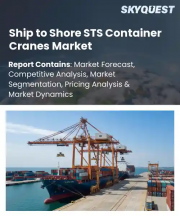
STS(Ship-to-Shore) 크레인 시장은 최근 몇 년간 꾸준히 성장하고 있습니다. STS(Ship-to-Shore) 크레인(갠트리 크레인이라고도 함)은 컨테이너선에서 화물 컨테이너를 하역하는 데 사용되는 부두에 설치된 대형 컨테이너 취급 크레인입니다. 선박의 화물창이나 갑판에서 컨테이너를 직접 들어 올려 트레일러, 철도 차량 또는 선박과 같은 운송 수단으로 옮겨 싣는 방식으로 작동합니다. 세계화의 진전과 국제 무역량의 확대에 따라 효율적인 항만 물류에 대한 수요가 크게 증가하고 있습니다. 이로 인해 선박과 육상 간 컨테이너의 신속한 이송을 가능하게 하는 STS(Ship-to-Shore) 크레인 등 전문적인 컨테이너 취급 장비의 성장이 촉진되고 있습니다. 자동화와 높은 적재량을 통해 항만 내 화물선의 선박 회전 시간을 대폭 단축할 수 있다는 점이 STS(Ship-to-Shore) 크레인 시장의 성장을 이끄는 주요 요인으로 작용하고 있습니다.
시장 역학
STS(Ship-to-Shore) 크레인 시장은 전 세계 컨테이너 무역량의 꾸준한 증가세에 힘입어 성장하고 있습니다. 세계 해상 무역량 증가에 따라 항만에서는 더 많은 물량을 효율적으로 처리해야 하는 압박이 커지고 있으며, 이는 STS(Ship-to-Shore) 크레인 등 첨단 화물 처리 설비에 대한 수요를 촉진하고 있습니다. 대형 컨테이너선의 동향 또한 이러한 추세를 따라가며, 방대한 화물을 신속하게 하역할 수 있는 대용량 STS(Ship-to-Shore) 크레인이 필요합니다. 그러나 시장은 자동화 및 디지털화에 따른 기술 비용 상승이라는 과제에 직면해 있습니다. 현대식 크레인의 구매 및 설치에 수반되는 막대한 설비 투자는 도입 속도를 저해할 가능성이 있습니다. 한편, 건화물 벌크 화물의 컨테이너화 진전과 전 세계 기존 항만의 수용 능력 확대 및 신규 항만 프로젝트에 따른 해상 무역량 증가에는 비즈니스 기회가 도사리고 있습니다.
본 조사의 주요 특징
- 본 조사에서는 각 부문의 잠재적 수익 기회를 파악하고, 이 시장에서 매력적인 투자 제안 매트릭스에 대해 설명하고 있습니다.
- 또한, 본 조사에서는 시장 성장 촉진요인, 성장 억제요인, 기회, 신제품 출시 및 승인, 시장 동향, 지역별 전망, 주요 기업이 채택하는 경쟁 전략에 관한 중요한 인사이트를 제공합니다.
- 본 조사에서는 다음의 파라미터(기업 개요, 제품 포트폴리오, 주요 특징, 재무 실적, 전략)를 바탕으로 전 세계 STS(Ship-to-Shore) 크레인 시장의 주요 기업을 분석했습니다.
- 본 보고서의 인사이트를 활용함으로써, 기업의 마케팅 담당자 및 경영진은 향후 제품 출시, 장비 유형 업그레이드, 시장 확대, 마케팅 전략에 관해 정보에 기반한 의사결정을 내릴 수 있게 됩니다.
- 전 세계 STS(Ship-to-Shore) 크레인 시장 보고서는 투자자, 공급업체, 제품 제조업체, 유통업체, 신규 진출기업, 금융 애널리스트를 포함한 이 산업의 다양한 이해관계자를 대상으로 합니다.
- 이해관계자는 세계의 STS(Ship-to-Shore) 크레인 시장 분석에 활용되는 다양한 전략 매트릭스를 통해 의사결정을 수월하게 내릴 수 있습니다.
목차
제1장 조사 목적 및 전제 조건
제2장 시장 전망
제3장 시장 역학, 규제 및 동향 분석
제4장 STS(Ship-to-Shore) 크레인 시장 : 적재량별(2021-2033년)
제5장 STS(Ship-to-Shore) 크레인 시장 : 아웃리치별(2021-2033년)
제6장 STS(Ship-to-Shore) 크레인 시장 : 동력원별(2021-2033년)
제7장 STS(Ship-to-Shore) 크레인 시장 : 지역별(2021-2033년)
제8장 경쟁 구도
제9장 애널리스트의 제안
제10장 조사 방법
KTH 26.06.17Ship-to-Shore Cranes Market is estimated to be valued at USD 6.71 Bn in 2026 and is expected to reach USD 9.26 Bn by 2033, growing at a compound annual growth rate (CAGR) of 4.7% from 2026 to 2033.
| Report Coverage | Report Details | ||
|---|---|---|---|
| Base Year: | 2025 | Market Size in 2026: | USD 6.71 Bn |
| Historical Data for: | 2020 To 2024 | Forecast Period: | 2026 To 2033 |
| Forecast Period 2026 to 2033 CAGR: | 4.70% | 2033 Value Projection: | USD 9.26 Bn |
The ship-to-shore cranes market has been growing steadily over the past few years. Ship-to-shore cranes, also known as gantry cranes, are large dockside container handling cranes used for loading and unloading cargo containers from container ships. They work by lifting containers directly from a ship's hold or deck onto another means of transport such as a trailer, railroad car or other ship. With increased globalization and expansion of international trade volumes, the demand for efficient port logistics has risen significantly. This has propelled the growth of specialized container handling equipment such as ship-to-shore cranes which facilitate faster transfer of containers between ships and shore. Their ability to significantly reduce turnaround time of cargo vessels in ports through automation and higher lifting capacities is a key factor propelling ahead the ship-to-shore cranes market.
Market Dynamics
The ship-to-shore cranes market is driven by robust growth in global containerized trade flows. Rising maritime trade volumes globally have increased pressure on ports to handle higher throughput efficiently which is benefiting the demand for advanced cargo handling equipment like ship-to-shore cranes. Growing trends of larger container vessels also necessitate high-capacity ship-to-shore cranes that can keep pace and unload immense loads speedily. However, the market faces challenges of rising technology costs associated with automation and digitization. High capital expenditures involved in buying and installing modernized cranes can inhibit faster adoption. Meanwhile, opportunities lie in increasing containerization of dry bulk commodities and growing maritime trade traffic through expansion of existing port capacities and new port projects worldwide.
Key features of the study
- It elucidates potential revenue opportunities across different segments and explains attractive investment proposition matrices for this market.
- This study also provides key insights about market drivers, restraints, opportunities, new product launches or approval, market trends, regional outlook, and competitive strategies adopted by key players.
- It profiles key players in the global ship-to-shore cranes market based on the following parameters - company highlights, products portfolio, key highlights, financial performance, and strategies.
- Key companies covered as a part of this study include Demag Cranes & Components GmbH, Doosan Infracore Co., Ltd., Guangzhou Dock Machinery Co., Ltd., Hyundai Heavy Industries Co., Ltd., Jiangsu Yangzhou Port Machinery Co., Ltd., Kalmar AB, Konecranes Plc, Kunming Machinery Plant Co., Ltd., Liebherr Group, MacGregor Industrial Oy, Manitowoc Crane Group, Mitsui Engineering & Shipbuilding Co., Ltd., Nacco Crane Group, Sany Heavy Industry Co., Ltd., Shanghai Zhenhua Heavy Industries Co., Ltd., Shanghai Zhenjiang Machinery Co., Ltd., Terex Corporation, TTS Group, Wuhu Port Machinery Co., Ltd., and Xiamen Xiangtong Heavy Industry Co., Ltd. are the major players.
- Insights from this report would allow marketers and the management authorities of the companies to make informed decisions regarding their future product launches, type up-gradation, market expansion, and marketing tactics.
- The global ship-to-shore cranes market report caters to various stakeholders in this industry including investors, suppliers, product manufacturers, distributors, new entrants, and financial analysts.
- Stakeholders would have ease in decision-making through various strategy matrices used in analyzing the global ship-to-shore cranes market.
Market Segmentation
- Lifting Capacity Insights (Revenue, USD Bn, 2021 - 2033)
- Panamax STS Cranes
- Post Panamax STS Cranes
- Super-Post Panamax STS Cranes
- Outreach Insights (Revenue, USD Bn, 2021 - 2033)
- <40
- 40-49
- 50-60
- >60
- Power Supply Insights (Revenue, USD Bn, 2021 - 2033)
- Diesel
- Electric
- Hybrid
- Regional Insights (Revenue, USD Bn, 2021 - 2033)
- North America
- U.S.
- Canada
- Latin America
- Brazil
- Argentina
- Mexico
- Rest of Latin America
- Europe
- Germany
- U.K.
- Spain
- France
- Italy
- Russia
- Rest of Europe
- Asia Pacific
- China
- India
- Japan
- Australia
- South Korea
- ASEAN
- Rest of Asia Pacific
- Middle East & Africa
- South Africa
- GCC Countries
- Israel
- Rest of Middle East & Africa
- Key Players Insights
- Demag Cranes & Components GmbH
- Doosan Infracore Co., Ltd.
- Guangzhou Dock Machinery Co., Ltd.
- Hyundai Heavy Industries Co., Ltd.
- Jiangsu Yangzhou Port Machinery Co., Ltd.
- Kalmar AB
- Konecranes Plc
- Kunming Machinery Plant Co., Ltd.
- Liebherr Group
- MacGregor Industrial Oy
- Manitowoc Crane Group
- Mitsui Engineering & Shipbuilding Co., Ltd.
- Nacco Crane Group
- Sany Heavy Industry Co., Ltd.
- Shanghai Zhenhua Heavy Industries Co., Ltd.
- Shanghai Zhenjiang Machinery Co., Ltd.
- Terex Corporation
- TTS Group
- Wuhu Port Machinery Co., Ltd.
- Xiamen Xiangtong Heavy Industry Co., Ltd.
Table of Contents
1. Research Objectives and Assumptions
- Research Objectives
- Assumptions
- Abbreviations
2. Market Purview
- Report Description
- Market Definition and Scope
- Executive Summary
- Market Snippet, By Lifting Capacity
- Market Snippet, By Outreach
- Market Snippet, By Power Supply
- Market Snippet, By Region
- Coherent Opportunity Map (COM)
3. Market Dynamics, Regulations, and Trends Analysis
- Market Dynamics
- Drivers
- Restraints
- Market Opportunities
- Regulatory Scenario
- Industry Trend
- Merger and Acquisitions
- New system Launch/Approvals
4. Ship-to-Shore Cranes Market, By Lifting Capacity, 2021 - 2033, (USD Bn)
- Introduction
- Market Share Analysis, 2026 and 2033 (%)
- Y-o-Y Growth Analysis, 2021 - 2033
- Segment Trends
- Panamax STS Cranes
- Introduction
- Market Size and Forecast, 2021-2033, (USD Bn)
- Post Panamax STS Cranes
- Introduction
- Market Size and Forecast, 2021-2033, (USD Bn)
- Super-Post Panamax STS Cranes
- Introduction
- Market Size and Forecast, 2021-2033, (USD Bn)
5. Ship-to-Shore Cranes Market, By Outreach, 2021 - 2033, (USD Bn)
- Introduction
- Market Share Analysis, 2026 and 2033 (%)
- Y-o-Y Growth Analysis, 2021 - 2033
- Segment Trends
- <40
- Introduction
- Market Size and Forecast, 2021-2033, (USD Bn)
- 40-49
- Introduction
- Market Size and Forecast, 2021-2033, (USD Bn)
- 50-60
- Introduction
- Market Size and Forecast, 2021-2033, (USD Bn)
- >60
- Introduction
- Market Size and Forecast, 2021-2033, (USD Bn)
6. Ship-to-Shore Cranes Market, By Power Supply, 2021 - 2033, (USD Bn)
- Introduction
- Market Share Analysis, 2026 and 2033 (%)
- Y-o-Y Growth Analysis, 2021 - 2033
- Segment Trends
- Diesel
- Introduction
- Market Size and Forecast, 2021-2033, (USD Bn)
- Electric
- Introduction
- Market Size and Forecast, 2021-2033, (USD Bn)
- Hybrid
- Introduction
- Market Size and Forecast, 2021-2033, (USD Bn)
7. Ship-to-Shore Cranes Market, By Region, 2021 - 2033, (USD Bn)
- Introduction
- Market Share Analysis, By Region, 2026 and 2033 (%)
- North America
- Regional Trends
- Market Size and Forecast, By Lifting Capacity, 2021-2033, (USD Bn)
- Market Size and Forecast, By Outreach, 2021-2033, (USD Bn)
- Market Size and Forecast, By Power Supply, 2021-2033, (USD Bn)
- Market Size and Forecast, By Country, 2021-2033, (USD Bn)
- U.S.
- Canada
- Europe
- Regional Trends
- Market Size and Forecast, By Lifting Capacity, 2021-2033, (USD Bn)
- Market Size and Forecast, By Outreach, 2021-2033, (USD Bn)
- Market Size and Forecast, By Power Supply, 2021-2033, (USD Bn)
- Market Size and Forecast, By Country, 2021-2033, (USD Bn)
- U.K.
- Germany
- France
- Russia
- Rest of Europe
- Asia Pacific
- Regional Trends
- Market Size and Forecast, By Lifting Capacity, 2021-2033, (USD Bn)
- Market Size and Forecast, By Outreach, 2021-2033, (USD Bn)
- Market Size and Forecast, By Power Supply, 2021-2033, (USD Bn)
- Market Size and Forecast, By Country, 2021-2033, (USD Bn)
- China
- India
- Japan
- ASEAN
- Australia
- South Korea
- Rest of Asia Pacific
- Latin America
- Regional Trends
- Market Size and Forecast, By Lifting Capacity, 2021-2033, (USD Bn)
- Market Size and Forecast, By Outreach, 2021-2033, (USD Bn)
- Market Size and Forecast, By Power Supply, 2021-2033, (USD Bn)
- Market Size and Forecast, By Country, 2021-2033, (USD Bn)
- Brazil
- Argentina
- Mexico
- Rest of Latin America
- Middle East & Africa
- Regional Trends
- Market Size and Forecast, By Lifting Capacity, 2021-2033, (USD Bn)
- Market Size and Forecast, By Outreach, 2021-2033, (USD Bn)
- Market Size and Forecast, By Power Supply, 2021-2033, (USD Bn)
- Market Size and Forecast, By Country, 2021-2033, (USD Bn)
- South Africa
- GCC Countries
- Rest of the Middle East & Africa
8. Competitive Landscape
- Company Profiles
- Demag Cranes & Components GmbH
- Company Overview
- Product Portfolio
- Financial Performance
- Key Strategies
- Recent Developments/Updates
- Doosan Infracore Co., Ltd.
- Company Overview
- Product Portfolio
- Financial Performance
- Key Strategies
- Recent Developments/Updates
- Guangzhou Dock Machinery Co., Ltd.
- Company Overview
- Product Portfolio
- Financial Performance
- Key Strategies
- Recent Developments/Updates
- Hyundai Heavy Industries Co., Ltd.
- Company Overview
- Product Portfolio
- Financial Performance
- Key Strategies
- Recent Developments/Updates
- Jiangsu Yangzhou Port Machinery Co., Ltd.
- Company Overview
- Product Portfolio
- Financial Performance
- Key Strategies
- Recent Developments/Updates
- Kalmar AB
- Company Overview
- Product Portfolio
- Financial Performance
- Key Strategies
- Recent Developments/Updates
- Konecranes Plc
- Company Overview
- Product Portfolio
- Financial Performance
- Key Strategies
- Recent Developments/Updates
- Kunming Machinery Plant Co., Ltd.
- Company Overview
- Product Portfolio
- Financial Performance
- Key Strategies
- Recent Developments/Updates
- Liebherr Group
- Company Overview
- Product Portfolio
- Financial Performance
- Key Strategies
- Recent Developments/Updates
- MacGregor Industrial Oy
- Company Overview
- Product Portfolio
- Financial Performance
- Key Strategies
- Recent Developments/Updates
- Manitowoc Crane Group
- Company Overview
- Product Portfolio
- Financial Performance
- Key Strategies
- Recent Developments/Updates
- Mitsui Engineering & Shipbuilding Co., Ltd.
- Company Overview
- Product Portfolio
- Financial Performance
- Key Strategies
- Recent Developments/Updates
- Nacco Crane Group
- Company Overview
- Product Portfolio
- Financial Performance
- Key Strategies
- Recent Developments/Updates
- Sany Heavy Industry Co., Ltd.
- Company Overview
- Product Portfolio
- Financial Performance
- Key Strategies
- Recent Developments/Updates
- Shanghai Zhenhua Heavy Industries Co., Ltd.
- Company Overview
- Product Portfolio
- Financial Performance
- Key Strategies
- Recent Developments/Updates
- Shanghai Zhenjiang Machinery Co., Ltd.
- Company Overview
- Product Portfolio
- Financial Performance
- Key Strategies
- Recent Developments/Updates
- Terex Corporation
- Company Overview
- Product Portfolio
- Financial Performance
- Key Strategies
- Recent Developments/Updates
- TTS Group
- Company Overview
- Product Portfolio
- Financial Performance
- Key Strategies
- Recent Developments/Updates
- Wuhu Port Machinery Co., Ltd.
- Company Overview
- Product Portfolio
- Financial Performance
- Key Strategies
- Recent Developments/Updates
- Xiamen Xiangtong Heavy Industry Co., Ltd.
- Company Overview
- Product Portfolio
- Financial Performance
- Key Strategies
- Recent Developments/Updates
- Demag Cranes & Components GmbH
9. Analyst Recommendations
- Wheel of Fortune
- Analyst View
- Coherent Opportunity Map
10. Research Methodology
- References
- Research Methodology
- About us and Sales Contact