|
시장보고서
상품코드
1666562
단축 태양광 추적 시스템 시장 : 기회, 성장 촉진요인, 산업 동향 분석 및 예측(2025-2034년)Single Axis Solar Tracker Market Opportunity, Growth Drivers, Industry Trend Analysis, and Forecast 2025 - 2034 |
||||||

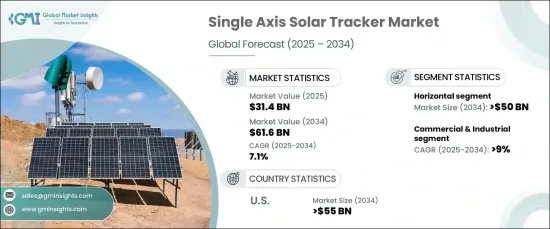
세계의 단축 태양광 추적 시스템 시장은 2024년 314억 달러에 달했으며, 2025년부터 2034년까지 7.1%의 연평균 성장률로 확대될 것으로 예상됩니다.
이 시장은 태양 에너지에 대한 수요 증가와 첨단 기술의 채택에 의해 주도되고 있습니다. 단축 태양광 추적기는 태양광 패널의 방향을 조정하여 하루 종일 태양의 경로를 따라갈 수 있도록 설계된 기계 시스템입니다. 이 동적 조정은 패널 위치를 최적화하고 에너지 출력을 향상시켜 태양 광 발전의 효율성을 높이고 태양 광 발전을 더욱 안정적으로 만듭니다.
전 세계적으로 에너지 수요가 증가함에 따라 태양광 솔루션에 대한 수요도 가속화되고 있습니다. 아시아태평양, 중동, 아프리카 등의 지역은 재생 에너지원에 대한 필요성이 증가함에 따라 빠르게 성장하고 있습니다. 대규모 태양광 발전소를 위한 정부 인센티브와 풍부한 토지는 태양광 발전 프로젝트의 확장을 더욱 촉진하고 있습니다. 또한 단축 태양광 추적 시스템와 에너지 저장 시스템을 통합하는 것이 점점 더 인기를 얻고 있습니다. 이러한 조합을 통해 태양광 발전소는 낮 동안 생산된 잉여 에너지를 저장했다가 에너지 수요가 많을 때 공급할 수 있어 태양광 발전의 간헐적인 특성을 해결할 수 있습니다. 이러한 혁신은 단축 태양광 추적 시스템 시장의 미래를 형성할 것으로 보입니다.
| 시장 범위 | |
|---|---|
| 시작 연도 | 2024년 |
| 예측 연도 | 2025-2034년 |
| 시작 금액 | 314억 달러 |
| 예측 금액 | 616억 달러 |
| CAGR | 7.1% |
태양광 시장은 또한 정부의 지원, 규제, 연구 자금 지원으로 인해 청정에너지에 대한 투자가 증가함에 따라 수혜를 받고 있습니다. 이러한 노력은 단축 태양광 추적 시스템를 비롯한 첨단 태양광 기술의 개발을 장려하기 위한 것입니다. 이러한 장치의 기능과 효율성을 개선하는 데 더 많은 연구가 집중됨에 따라 시장은 계속 상승세를 이어갈 것으로 예상됩니다.
단축 태양광 추적 시스템는 수평형과 수직형의 두 가지 주요 유형으로 제공됩니다. 수평형은 대규모 에너지 생산에 널리 채택되어 2034년까지 500억 달러를 넘어설 것으로 예상됩니다. 환경에 대한 인식이 높아지면서 탄소 배출을 줄여야 한다는 압박이 커지고 있습니다. 태양광 에너지는 이러한 전환에서 중추적인 역할을 하며 청정 발전을 위한 지속 가능한 솔루션을 제공합니다. 고급 소프트웨어와 인공 지능의 통합은 수평 추적기의 성능을 더욱 향상시켜 방향을 최적화하고 에너지 생성을 증가시킵니다.
용도별로는 상업 및 산업 부문은 2034년까지 연평균 성장률이 9%를 초과하여 가장 큰 성장을 보일 것으로 예상됩니다. 단축 태양광 추적 시스템 기술의 발전과 비용 효율성의 개선으로 인해 더 다양한 비즈니스에서 이러한 솔루션을 더 쉽게 이용할 수 있게 되었습니다. 특히 상업 부문에서는 보다 비용 효율적이고 안정적인 태양광 발전 시스템에 대한 수요가 증가하면서 단축 태양광 추적 시스템의 채택이 더욱 가속화되고 있습니다.
미국의 단축 태양광 추적 시스템 시장은 2034년까지 550억 달러를 넘어설 것으로 예상됩니다. 이 지역의 까다로운 기상 조건과 재생 에너지에 대한 수요 증가로 인해 더욱 발전된 단축 태양광 추적 시스템에 대한 필요성이 높아지고 있습니다. 이는 에너지 생산량을 향상시킬 뿐만 아니라 추가 인센티브도 받을 수 있어 소비자와 기업 모두에게 더욱 매력적입니다. 정부 정책과 보조금이 계속해서 재생 에너지 도입을 장려함에 따라 미국의 단축형 단축 태양광 추적 시스템 시장은 탄탄한 성장세를 보일 것으로 예상됩니다.
목차
제1장 조사 방법과 조사 범위
- 시장의 정의
- 기본 추정과 계산
- 예측 계산
- 1차 조사와 검증
- 1차 출처
- 데이터 마이닝 출처
- 시장의 정의
제2장 주요 요약
제3장 업계 인사이트
- 업계 생태계 분석
- 규제 상황
- 업계에 미치는 영향요인
- 성장 촉진요인
- 업계의 잠재적 위험 및 과제
- 성장 가능성 분석
- Porter's Five Forces 분석
- 공급기업의 협상력
- 구매자의 협상력
- 신규 참가업체의 위협
- 대체품의 위협
- PESTEL 분석
제4장 경쟁 구도
- 소개
- 전략 대시보드
- 혁신과 지속가능성의 전망
제5장 시장 규모와 예측 : 제품별(2021-2034년)
- 주요 동향
- 수평형
- 수직형
제6장 시장 규모와 예측 : 용도별(2021-2034년)
- 주요 동향
- 주거용
- 상업 및 산업
- 유틸리티
제7장 시장 규모와 예측 : 지역별(2021-2034년)
- 주요 동향
- 북미
- 미국
- 캐나다
- 멕시코
- 유럽
- 영국
- 프랑스
- 네덜란드
- 독일
- 스웨덴
- 스페인
- 오스트리아
- 아시아태평양
- 중국
- 호주
- 인도
- 일본
- 한국
- 중동
- 사우디아라비아
- UAE
- 요르단
- 이스라엘
- 아프리카
- 남아프리카
- 이집트
- 알제리
- 나이지리아
- 모로코
- 라틴아메리카
- 브라질
- 칠레
제8장 기업 프로파일
- Abengoa
- ArcelorMittal
- Arctech
- Array Technologies, Inc.
- DEGERENERGIE GMBH & CO. KG
- GameChange Solar
- Gonvarri Solar Steel
- Haosolar Co. Ltd
- IDEEMATEC
- MECASOLAR
- NCLAVE
- Nextracker Inc.
- Powerway Renewable Energy Co., Ltd
- PVHardware
- Scorpius Trackers
- SmartTrak Solar Systems(Pvt) Ltd.
- SOLTEC
- STI Norland
- SunPower Corporation
- Trina Solar
- Valmont Industries, Inc.
The Global Single Axis Solar Tracker Market, valued at USD 31.4 Billion in 2024, is projected to expand at a CAGR of 7.1% from 2025 to 2034. The market is driven by the rising demand for solar energy and the adoption of advanced technologies. Single-axis solar trackers are mechanical systems designed to adjust the orientation of solar panels, ensuring they follow the sun's path throughout the day. This dynamic adjustment increases the efficiency of solar installations by optimizing panel positioning and enhancing energy output, making solar power generation more reliable.
As energy needs grow globally, the demand for solar solutions is also accelerating. Regions such as Asia-Pacific, the Middle East, and Africa are experiencing rapid growth due to the increasing need for renewable energy sources. Government incentives and abundant land for large-scale solar farms are further fueling the expansion of solar power projects. Moreover, integrating single-axis trackers with energy storage systems is becoming increasingly popular. This combination allows solar plants to store surplus energy produced during the day and supply it when energy demand is high, addressing the intermittent nature of solar power. Such innovations are likely to shape the future of the solar tracker market.
| Market Scope | |
|---|---|
| Start Year | 2024 |
| Forecast Year | 2025-2034 |
| Start Value | $31.4 Billion |
| Forecast Value | $61.6 Billion |
| CAGR | 7.1% |
The market is also benefiting from the growing investments in clean energy, which are spurred by governmental support, regulations, and research funding. These efforts are designed to encourage the development of advanced solar technologies, including solar trackers. As more research is focused on improving the functionality and efficiency of these devices, the market is expected to continue its upward trajectory.
Single-axis solar trackers are available in two main types: horizontal and vertical. Horizontal trackers are anticipated to surpass USD 50 Billion by 2034, owing to their widespread adoption for large-scale energy production. As environmental awareness rises, there is increasing pressure to reduce carbon emissions. Solar energy plays a pivotal role in this transition, offering a sustainable solution for clean power generation. The integration of advanced software and artificial intelligence further enhances the performance of horizontal trackers, optimizing their orientation and increasing energy generation.
In terms of application, the commercial and industrial sector is expected to see the most significant growth, with a CAGR exceeding 9% by 2034. The advancements in solar tracker technology, along with improvements in cost efficiency, make these solutions more accessible to a broader range of businesses. The commercial sector, in particular, is driving demand for more cost-effective and reliable solar power systems, further accelerating the adoption of single-axis trackers.
In the U.S., the single-axis solar tracker market is projected to exceed USD 55 Billion by 2034. The region's challenging weather conditions and the growing demand for renewable energy are pushing the need for more advanced solar trackers. These trackers not only enhance energy production but also qualify for additional incentives, making them more attractive to consumers and businesses alike. As government policies and subsidies continue to favor renewable energy adoption, the market for single-axis solar trackers in the U.S. is poised for robust growth.
Table of Contents
Chapter 1 Methodology & Scope
- 1.1 Market definitions
- 1.2 Base estimates & calculations
- 1.3 Forecast calculation
- 1.4 Primary research & validation
- 1.4.1 Primary sources
- 1.4.2 Data mining sources
- 1.5 Market Definitions
Chapter 2 Executive Summary
- 2.1 Industry synopsis, 2021 – 2034
Chapter 3 Industry Insights
- 3.1 Industry ecosystem
- 3.2 Regulatory landscape
- 3.3 Industry impact forces
- 3.3.1 Growth drivers
- 3.3.2 Industry pitfalls & challenges
- 3.4 Growth potential analysis
- 3.5 Porter's analysis
- 3.5.1 Bargaining power of suppliers
- 3.5.2 Bargaining power of buyers
- 3.5.3 Threat of new entrants
- 3.5.4 Threat of substitutes
- 3.6 PESTEL analysis
Chapter 4 Competitive landscape, 2024
- 4.1 Introduction
- 4.2 Strategic dashboard
- 4.3 Innovation & sustainability landscape
Chapter 5 Market Size and Forecast, By Product, 2021 – 2034 (USD Million & MW)
- 5.1 Key trends
- 5.2 Horizontal
- 5.3 Vertical
Chapter 6 Market Size and Forecast, By Application, 2021 – 2034 (USD Million & MW)
- 6.1 Key trends
- 6.2 Residential
- 6.3 Commercial & Industrial
- 6.4 Utility
Chapter 7 Market Size and Forecast, By Region, 2021 – 2034 (USD Million & MW)
- 7.1 Key trends
- 7.2 North America
- 7.2.1 U.S.
- 7.2.2 Canada
- 7.2.3 Mexico
- 7.3 Europe
- 7.3.1 UK
- 7.3.2 France
- 7.3.3 Netherlands
- 7.3.4 Germany
- 7.3.5 Sweden
- 7.3.6 Spain
- 7.3.7 Austria
- 7.4 Asia Pacific
- 7.4.1 China
- 7.4.2 Australia
- 7.4.3 India
- 7.4.4 Japan
- 7.4.5 South Korea
- 7.5 Middle East
- 7.5.1 Saudi Arabia
- 7.5.2 UAE
- 7.5.3 Jordan
- 7.5.4 Israel
- 7.6 Africa
- 7.6.1 South Africa
- 7.6.2 Egypt
- 7.6.3 Algeria
- 7.6.4 Nigeria
- 7.6.5 Morocco
- 7.7 Latin America
- 7.7.1 Brazil
- 7.7.2 Chile
Chapter 8 Company Profiles
- 8.1 Abengoa
- 8.2 ArcelorMittal
- 8.3 Arctech
- 8.4 Array Technologies, Inc.
- 8.5 DEGERENERGIE GMBH & CO. KG
- 8.6 GameChange Solar
- 8.7 Gonvarri Solar Steel
- 8.8 Haosolar Co. Ltd
- 8.9 IDEEMATEC
- 8.10 MECASOLAR
- 8.11 NCLAVE
- 8.12 Nextracker Inc.
- 8.13 Powerway Renewable Energy Co., Ltd
- 8.14 PVHardware
- 8.15 Scorpius Trackers
- 8.16 SmartTrak Solar Systems (Pvt) Ltd.
- 8.17 SOLTEC
- 8.18 STI Norland
- 8.19 SunPower Corporation
- 8.20 Trina Solar
- 8.21 Valmont Industries, Inc.