|
시장보고서
상품코드
1665037
자동차 좌석용 온열 쾌적 시스템 시장 : 성장 촉진요인, 산업 동향 분석, 예측(2025-2034년)Automotive Seating Thermal Comfort System Market Opportunity, Growth Drivers, Industry Trend Analysis, and Forecast 2025 - 2034 |
||||||

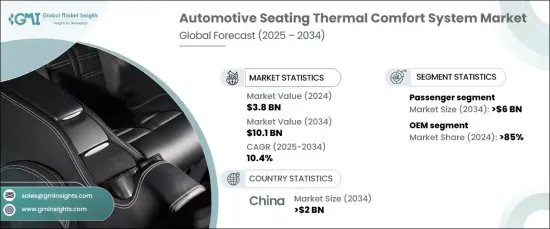
세계의 자동차 좌석용 온열 쾌적 시스템 시장은 2024년에 38억 달러로 평가되었으며, 2025년부터 2034년까지 CAGR 10.4%로 견조하게 확대될 것으로 예측되고 있습니다.
이 성장의 주요 촉진요인은 현대 자동차의 편안함과 고급 기능에 대한 소비자의 선호도 증가입니다. 과거에는 고급차 전용이었던 시트 히터, 환기 장치, 냉방 장치 등의 기능은 현재는 중급차나 이코노미 차량에도 표준 장비 되고 있습니다. 운전자와 승객이 이동 중 편안함을 높이는 데 점점 우선 순위가 높아짐에 따라 자동차 제조업체는 이러한 진화 기대에 부응하기 위해 첨단 온열 시스템을 통합하고 있습니다.

개인화된 편안함 경험에 대한 수요 증가는 혁신적인 자동차 기술의 중요성 증가와 일치합니다. 자동차 제조업체는 에너지 소비를 억제하면서 최적의 편안함을 유지하는 스마트 센서와 에너지 효율적인 시스템의 통합에 주력하고 있습니다. 이러한 진보는 사용자 만족도를 높일 뿐만 아니라 자동차 전체의 지속가능성에도 기여하고 있습니다. 기타 특전으로는 세계의 자동차 생산 대수 증가, 도시화, 장시간 통근 증가 등을 들 수 있고, 이들 모두가 보다 쾌적한 시팅 솔루션 수요를 촉진하고 있습니다.
| 시장 범위 | |
|---|---|
| 시작년 | 2024년 |
| 예측연도 | 2025-2034년 |
| 시작금액 | 38억 달러 |
| 예측 금액 | 101억 달러 |
| CAGR | 10.4% |
전기자동차와 하이브리드 자동차(EV)의 인기가 높아지고 있는 것도, 자동차 좌석용 온열 쾌적 시스템 시장의 중요한 촉진요인이 되고 있습니다. 내연 엔진을 동력원으로 하는 디존 자동차와는 달리, EV에는 엔진으로부터 발생하는 폐열이 없기 때문에 차내의 쾌적성을 유지하기 위해서는 전용의 시트 냉난방 시스템이 필수적입니다. EV에 요구되는 에너지 효율 기준을 충족하기 위해 제조업체는 최소한의 전력 소비로 뛰어난 편안함을 실현하는 혁신적인 온열 기술을 개발하고 있습니다. 이러한 변화는 자동차 제조업체가 에너지 효율을 희생하지 않고 차내 경험을 향상시키기 위해 EV 생태계 전반에 걸친 첨단 시트 솔루션의 중요성을 강조합니다.
차종별로 시장은 승용차와 상용차로 구분됩니다. 승용차는 2024년 시장 점유율의 70%를 차지했고 2034년까지 60억 달러를 창출할 것으로 예상됩니다. 이러한 이점은 세계적으로 승용차 생산량이 많고 다양한 가격 부문에서 프리미엄 기능에 대한 소비자 수요가 높아지고 있기 때문입니다. 중급차나 고급 승용차에서는 시트 히터나 시트 쿨러 등의 장비가 점점 충실해지고 있기 때문에 이 부문은 향후 수년간 주도권을 유지할 전망입니다.
판매 채널별로 시장은 상대방 브랜드 제조(OEM) 부문와 애프터마켓 부문으로 나뉩니다. 2024년에는 OEM 제조업체가 열적 쾌적성 시스템을 차량 설계에 원활하게 통합할 수 있는 능력을 활용하여 시장 점유율의 85%를 획득했습니다. 공급업체와의 강력한 파트너십을 통해 OEM은 모델 간의 신뢰성과 호환성을 보장하면서 경쟁력 있는 가격으로 고급 솔루션을 제공할 수 있습니다.
2024년 자동차 좌석용 온열 쾌적 시스템 시장은 중국이 세계 점유율의 60%를 차지했고 2034년까지 20억 달러를 창출할 것으로 예측됩니다. 이 나라의 비교할 수 없는 자동차 생산 능력과 경쟁력 있는 제조 인프라가 이 성장을 뒷받침하고 있습니다. 중국이 EV의 생산과 보급으로 계속 이어가는 것과 병행하여 첨단 온열 쾌적 시스템 수요도 증가하고 있습니다. 견고한 공급망과 비용 효율적인 생산 능력으로 중국은 세계 시장에서 매우 중요한 국가로서의 입지를 더욱 견고하게 만들고 있습니다.
보고서 내용
제1장 조사 방법과 조사 범위
- 조사 디자인
- 조사 접근
- 데이터 수집 방법
- 기본 추정과 계산
- 기준연도의 산출
- 시장추계의 주요 동향
- 예측 모델
- 1차 조사와 검증
- 1차 정보
- 데이터 마이닝 소스
- 시장 정의
제2장 주요 요약
제3장 업계 인사이트
- 생태계 분석
- 공급자의 상황
- OEM 자동차 좌석용 온열 쾌적 시스템 제조업체
- 애프터마켓 프로바이더
- 유통업체
- 최종 사용자
- 이익률 분석
- 가격 분석
- 특허 상황
- 자동차 좌석용 온열 쾌적 시스템의 비용 내역
- 기술 혁신의 상황
- 주요 뉴스와 대처
- 규제 상황
- 영향요인
- 성장 촉진요인
- 자동차의 쾌적성과 고급 기능에 대한 수요 증가
- 전기차와 하이브리드차(EV)의 채용 증가
- 온도 제어와 에너지 효율을 위한 스마트 기술의 진보
- 신흥국의 자동차 생산 확대
- 업계의 잠재적 위험 및 과제
- 고도의 온열 쾌적 시스템에 필요한 비용이 높고, 이코노미 차량에 채용이 제한됩니다.
- 애프터마켓에서의 온열 쾌적성 시스템의 개조의 복잡성과 비용
- 성장 촉진요인
- 성장 가능성 분석
- Porter's Five Forces 분석
- PESTEL 분석
제4장 경쟁 구도
- 소개
- 기업 점유율 분석
- 경쟁 포지셔닝 매트릭스
- 전략 전망 매트릭스
제5장 시장 추계·예측 : 소재별, 2021-2034년
- 주요 동향
- 가죽
- 직물
- 합성 소재
- 기타
제6장 시장 추계·예측 : 프로세스별, 2021-2034년
- 주요 동향
- 시트 히팅
- 시트 쿨링
- 시트 환기
- 통합 시스템
제7장 시장 추계·예측 : 차종별, 2021-2032년
- 주요 동향
- 승용차
- 해치백
- 세단
- SUV
- 상용차
- 소형 상용차(LCV)
- 대형 상용차(HCV)
제8장 시장 추계·예측 : 판매 채널별, 2021-2032년
- 주요 동향
- OEM
- 애프터마켓
제9장 시장 추계·예측 : 지역별, 2021-2034년
- 주요 동향
- 북미
- 미국
- 캐나다
- 유럽
- 영국
- 독일
- 프랑스
- 스페인
- 이탈리아
- 러시아
- 북유럽
- 아시아태평양
- 중국
- 인도
- 일본
- 한국
- 뉴질랜드
- 동남아시아
- 라틴아메리카
- 브라질
- 멕시코
- 아르헨티나
- 중동 및 아프리카
- UAE
- 남아프리카
- 사우디아라비아
제10장 기업 프로파일
- Adient
- BorgWarner
- Brose Fahrzeugteile
- Continental
- Denso
- Faurecia
- Gentherm
- Grammer
- Hyundai Transys
- Johnson Controls International
- Lear
- Magna International
- NHK Spring
- RECARO Automotive
- Rochling
- Tachi-S
- Toyota Boshoku
- TS TECH
- Yanfeng Automotive Interiors
- Zentex Industries
The Global Automotive Seating Thermal Comfort System Market was valued at USD 3.8 billion in 2024 and is forecasted to expand at a robust CAGR of 10.4% from 2025 to 2034. This growth is primarily driven by escalating consumer preferences for comfort and luxury features in modern vehicles. Once exclusive to high-end models, features like heated, ventilated, and cooled seats are now becoming standard in mid-range and economy cars. As drivers and passengers increasingly prioritize enhanced comfort during their journeys, automakers are integrating advanced thermal systems to meet these evolving expectations.
The rising demand for personalized comfort experiences aligns with the growing emphasis on innovative automotive technologies. Automakers are focusing on integrating smart sensors and energy-efficient systems that maintain optimal comfort while reducing energy consumption. These advancements not only enhance user satisfaction but also contribute to overall vehicle sustainability. Additionally, the market benefits from rising global automotive production, urbanization, and the increasing prevalence of long commutes, all of which drive demand for more comfortable seating solutions.
| Market Scope | |
|---|---|
| Start Year | 2024 |
| Forecast Year | 2025-2034 |
| Start Value | $3.8 Billion |
| Forecast Value | $10.1 Billion |
| CAGR | 10.4% |
The growing popularity of electric and hybrid vehicles (EVs) has emerged as another pivotal driver for the automotive seating thermal comfort system market. Unlike traditional vehicles powered by internal combustion engines, EVs lack engine-generated waste heat, making dedicated seat heating and cooling systems essential for maintaining cabin comfort. To meet the energy efficiency standards required by EVs, manufacturers are developing innovative thermal technologies that deliver superior comfort with minimal power consumption. This shift underscores the importance of advanced seating solutions in the broader EV ecosystem, as automakers aim to enhance cabin experiences without compromising energy efficiency.
In terms of vehicle type, the market is segmented into passenger and commercial vehicles. Passenger vehicles commanded 70% of the market share in 2024 and are expected to generate USD 6 billion by 2034. This dominance is attributed to the high production volumes of passenger cars globally and the rising consumer demand for premium features across various price segments. As mid-range and premium passenger vehicles increasingly include features such as heated and cooled seats, the segment is poised to maintain its leadership in the coming years.
By sales channel, the market is divided into original equipment manufacturer (OEM) and aftermarket segments. In 2024, OEMs captured 85% of the market share, leveraging their ability to seamlessly integrate thermal comfort systems into vehicle designs. Strong partnerships with suppliers allow OEMs to deliver advanced solutions at competitive prices while ensuring reliability and compatibility across models.
China dominated the automotive seating thermal comfort system market in 2024, representing 60% of the global share, and is projected to generate USD 2 billion by 2034. The country's unmatched automotive production capacity and competitive manufacturing infrastructure drive this growth. As China continues to lead in EV production and adoption, the demand for sophisticated thermal comfort systems grows in parallel. Its robust supply chain and cost-effective production capabilities further cement China's position as a pivotal player in the global market.
Report Content
Chapter 1 Methodology & Scope
- 1.1 Research design
- 1.1.1 Research approach
- 1.1.2 Data collection methods
- 1.2 Base estimates and calculations
- 1.2.1 Base year calculation
- 1.2.2 Key trends for market estimates
- 1.3 Forecast model
- 1.4 Primary research & validation
- 1.4.1 Primary sources
- 1.4.2 Data mining sources
- 1.5 Market definitions
Chapter 2 Executive Summary
- 2.1 Industry 3600 synopsis, 2021 - 2034
Chapter 3 Industry Insights
- 3.1 Industry ecosystem analysis
- 3.2 Supplier landscape
- 3.2.1 OEM Automotive seating thermal comfort system manufacturers
- 3.2.2 Aftermarket providers
- 3.2.3 Distributors
- 3.2.4 End users
- 3.3 Profit margin analysis
- 3.4 Pricing analysis
- 3.5 Patent landscape
- 3.6 Cost Breakdown of automotive seating thermal comfort systems
- 3.7 Technology & innovation landscape
- 3.8 Key news & initiatives
- 3.9 Regulatory landscape
- 3.10 Impact forces
- 3.10.1 Growth drivers
- 3.10.1.1 Increasing demand for comfort and luxury features in vehicles
- 3.10.1.2 Rising adoption of electric and hybrid vehicles (EVs)
- 3.10.1.3 Advancements in smart technologies for temperature control and energy efficiency
- 3.10.1.4 Expanding vehicle production in emerging economies
- 3.10.2 Industry pitfalls & challenges
- 3.10.2.1 High cost of advanced thermal comfort systems limiting adoption in economy vehicles
- 3.10.2.2 Complexity and cost of retrofitting thermal comfort systems in the aftermarket
- 3.10.1 Growth drivers
- 3.11 Growth potential analysis
- 3.12 Porter’s analysis
- 3.13 PESTEL analysis
Chapter 4 Competitive Landscape, 2024
- 4.1 Introduction
- 4.2 Company market share analysis
- 4.3 Competitive positioning matrix
- 4.4 Strategic outlook matrix
Chapter 5 Market Estimates & Forecast, By Material, 2021 - 2034 ($Bn)
- 5.1 Key trends
- 5.2 Leather
- 5.3 Fabric
- 5.4 Synthetic materials
- 5.5 Others
Chapter 6 Market Estimates & Forecast, By Process, 2021 - 2034 ($Bn)
- 6.1 Key trends
- 6.2 Seat heating
- 6.3 Seat cooling
- 6.4 Seat ventilation
- 6.5 Integrated systems
Chapter 7 Market Estimates & Forecast, By Vehicle, 2021 - 2032 ($Bn)
- 7.1 Key trends
- 7.2 Passenger vehicles
- 7.2.1 Hatchback
- 7.2.2 Sedan
- 7.2.3 SUV
- 7.3 Commercial vehicles
- 7.3.1 Light commercial vehicles (LCV)
- 7.3.2 Heavy commercial vehicles (HCV)
Chapter 8 Market Estimates & Forecast, By Sales Channel, 2021 - 2032 ($Bn)
- 8.1 Key trends
- 8.2 OEM
- 8.3 Aftermarket
Chapter 9 Market Estimates & Forecast, By Region, 2021 - 2034 ($Bn, Units)
- 9.1 Key trends
- 9.2 North America
- 9.2.1 U.S.
- 9.2.2 Canada
- 9.3 Europe
- 9.3.1 UK
- 9.3.2 Germany
- 9.3.3 France
- 9.3.4 Spain
- 9.3.5 Italy
- 9.3.6 Russia
- 9.3.7 Nordics
- 9.4 Asia Pacific
- 9.4.1 China
- 9.4.2 India
- 9.4.3 Japan
- 9.4.4 South Korea
- 9.4.5 ANZ
- 9.4.6 Southeast Asia
- 9.5 Latin America
- 9.5.1 Brazil
- 9.5.2 Mexico
- 9.5.3 Argentina
- 9.6 MEA
- 9.6.1 UAE
- 9.6.2 South Africa
- 9.6.3 Saudi Arabia
Chapter 10 Company Profiles
- 10.1 Adient
- 10.2 BorgWarner
- 10.3 Brose Fahrzeugteile
- 10.4 Continental
- 10.5 Denso
- 10.6 Faurecia
- 10.7 Gentherm
- 10.8 Grammer
- 10.9 Hyundai Transys
- 10.10 Johnson Controls International
- 10.11 Lear
- 10.12 Magna International
- 10.13 NHK Spring
- 10.14 RECARO Automotive
- 10.15 Rochling
- 10.16 Tachi-S
- 10.17 Toyota Boshoku
- 10.18 TS TECH
- 10.19 Yanfeng Automotive Interiors
- 10.20 Zentex Industries