|
시장보고서
상품코드
1665047
EV용 EMC 배터리 필터 시장 : 기회, 성장 촉진요인, 산업 동향 분석, 예측(2025-2034년)EV EMC Battery Filter Market Opportunity, Growth Drivers, Industry Trend Analysis, and Forecast 2025 - 2034 |
||||||

세계의 EV용 EMC 배터리 필터 시장은 2024년 13억 달러로 평가되었으며 2025년부터 2034년까지 CAGR 15.7%로 현저한 성장을 이룰 것으로 예측되고 있습니다. 이 급성장의 배경은 세계 전기차(EV)의 보급이 증가하고 있으며, EV 이용을 촉진하기 위한 환경정책의 강화와 정부의 인센티브가 뒷받침하고 있기 때문입니다. EV 수요가 지속적으로 증가함에 따라 고급 전자기 호환성(EMC) 배터리 필터 솔루션의 요구가 크게 확대되고 있습니다.

안전에 대한 우려와 엄격한 자동차 규제 기준이 시장을 더욱 강화하고 있습니다. EV에는 첨단 전자 부품이 점점 탑재되고 있으며, 전자기 간섭(EMI)으로부터 시스템을 안전하게 보호하기 위해 EMC 요구 사항을 준수하는 것이 필수적입니다. 국제전기표준회의(IEC)와 ISO 등의 규제기관은 EV 시스템의 안전성과 신뢰성을 높이기 위해 엄격한 성능 기준을 마련하고 있습니다. 이러한 규제 요구는 EMC 배터리 필터 분야의 기술 혁신과 채용을 촉진하고 견조한 시장 전망을 키우고 있습니다.
| 시장 범위 | |
|---|---|
| 시작년 | 2024년 |
| 예측연도 | 2025-2034년 |
| 시작금액 | 13억 달러 |
| 예측 금액 | 55억 달러 |
| CAGR | 15.7% |
이 시장은 로우 패스 필터, 하이 패스 필터, 밴드 패스 필터, 밴드 스톱 필터 등 필터 유형별로 구분됩니다. 2024년 시장 점유율은 로우패스 필터가 40%를 차지했으며 2034년에는 20억 달러로 성장할 것으로 예측됩니다. 로우 패스 필터는 배터리 관리 시스템 및 파워트레인과 같은 민감한 EV 구성 요소를 혼동시킬 수 있는 고주파 EMI를 완화하는 데 중요합니다. EV 설계에는 센서, 제어 시스템, 통신 기술 등 점점 더 정교한 전자 제품이 내장되어 있기 때문에 로우 패스 필터에 대한 수요가 증가하고 있습니다. 로우 패스 필터는 저주파 신호를 통과시키는 반면 파괴적인 고주파 노이즈를 차단하여 시스템 성능과 신뢰성을 향상시킵니다.
차종별로는 승용차가 2024년 시장을 선도해 73%라는 압도적인 점유율을 획득했습니다. 개인 운송에서 EV의 급속한 보급은 환경 의식 증가와 엄격한 배기 가스 규제가 배경에 있습니다. 소비자의 전기 이동성으로의 전환에 따라 승용차의 최적의 성능과 안전을 보장하기 위해 EMC 배터리 필터에 대한 수요가 증가하고 있습니다.
미국에서는 2024년 EV용 EMC 배터리 필터 시장이 지역별 점유율의 80%를 차지했습니다. 이 성장의 배경은 세금 공제, 보조금, EV 인프라 정비 투자 등 EV 도입에 대한 정부의 강력한 지원을 포함합니다. 엄격한 배출가스와 안전기준을 시행하는 규제기관이 전기차의 컴플라이언스와 원활한 기능을 확보하는 첨단 EMC 솔루션 수요를 더욱 밀어 올리고 있습니다.
목차
제1장 조사 방법과 조사 범위
- 조사 디자인
- 조사 접근
- 데이터 수집 방법
- 기본 추정과 계산
- 기준연도의 산출
- 시장추계의 주요 동향
- 예측 모델
- 1차 조사와 검증
- 1차 정보
- 데이터 마이닝 소스
- 시장 범위와 정의
제2장 주요 요약
제3장 업계 인사이트
- 생태계 분석
- 원재료 제공업체
- 부품 제조업체
- 제조업자
- 유통업체
- 최종 사용자
- 공급자의 상황
- 이익률 분석
- 기술 혁신의 상황
- 특허 분석
- 주요 뉴스 및 이니셔티브
- 규제 상황
- 비용 분석
- 영향요인
- 성장 촉진요인
- 전기자동차 수요 증가
- EMC에 관한 엄격한 규제 기준
- 전기자동차 배터리 기술의 진보
- 전력 효율과 노이즈 저감에 대한 주목의 고조
- 업계의 잠재적 위험 및 과제
- 복잡한 규제에 대응
- 기존 EV 시스템과의 통합 과제
- 성장 촉진요인
- 성장 가능성 분석
- Porter's Five Forces 분석
- PESTEL 분석
제4장 경쟁 구도
- 소개
- 기업 점유율 분석
- 경쟁 포지셔닝 매트릭스
- 전략 전망 매트릭스
제5장 시장 추계·예측 : 필터별, 2021-2034년
- 주요 동향
- 로우 패스
- 하이패스
- 밴드 패스
- 밴드 스톱
제6장 시장 추계·예측 : 용도별, 2021-2034년
- 주요 동향
- 파워트레인 EMC 필터링
- 배터리 관리 시스템
- 충전 인프라
제7장 시장 추계·예측 : 차종별, 2021-2034년
- 주요 동향
- 승용차
- 해치백
- 세단
- SUV
- 상용차
- 소형 상용차(LCV)
- 대형 상용차(HCV)
제8장 시장 추계·예측 : 배터리별, 2021-2034년
- 주요 동향
- 납축전지
- 리튬 이온 배터리
- 니켈 수소 전지
- 고체 배터리
제9장 시장 추계·예측 : 지역별, 2021-2034년
- 주요 동향
- 북미
- 미국
- 캐나다
- 유럽
- 영국
- 독일
- 프랑스
- 이탈리아
- 스페인
- 러시아
- 북유럽
- 아시아태평양
- 중국
- 인도
- 일본
- 호주
- 한국
- 동남아시아
- 라틴아메리카
- 브라질
- 멕시코
- 아르헨티나
- 중동 및 아프리카
- UAE
- 남아프리카
- 사우디아라비아
제10장 기업 프로파일
- AstrodyneTDI
- AVX
- Bourns
- Cooper
- Delta
- Eaton
- Epcos
- InTiCa
- KEMET
- Littelfuse
- MAHLE
- Molex
- Mouse
- Murata
- NXP
- STMicroelectronics
- TDK
- TE Connectivity
- Vishay
- Wurth Elektronik
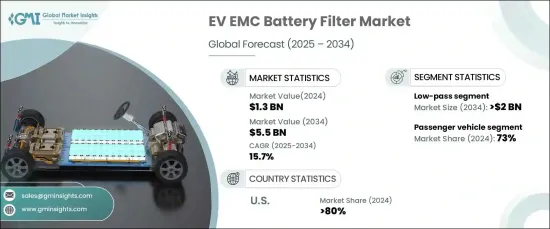
The Global EV EMC Battery Filter Market, valued at USD 1.3 billion in 2024, is projected to experience remarkable growth with a CAGR of 15.7% from 2025 to 2034. This surge is driven by the rising adoption of electric vehicles (EVs) worldwide, supported by stricter environmental policies and government incentives designed to accelerate EV usage. As the demand for EVs continues to grow, the need for advanced electromagnetic compatibility (EMC) battery filter solutions is expanding significantly.
Safety concerns and stringent automotive regulatory standards are further propelling the market. The increasing integration of advanced electronic components in EVs makes compliance with EMC requirements essential to ensure systems remain protected from electromagnetic interference (EMI). Regulatory bodies like the International Electrotechnical Commission (IEC) and ISO have established rigorous performance standards to enhance the safety and reliability of EV systems. These regulatory demands are driving innovation and adoption in the EMC battery filter sector, fostering a robust market outlook.
| Market Scope | |
|---|---|
| Start Year | 2024 |
| Forecast Year | 2025-2034 |
| Start Value | $1.3 Billion |
| Forecast Value | $5.5 Billion |
| CAGR | 15.7% |
The market is segmented by filter type, including low-pass, high-pass, band-pass, and band-stop filters. In 2024, low-pass filters held a dominant 40% market share and are anticipated to grow to USD 2 billion by 2034. Low-pass filters are critical in mitigating high-frequency EMI, which can disrupt sensitive EV components such as battery management systems and powertrains. As EV designs incorporate increasingly sophisticated electronics-spanning sensors, control systems, and communication technologies-the demand for low-pass filters continues to rise. These filters improve system performance and reliability by letting low-frequency signals to pass through while blocking disruptive high-frequency noise.
By vehicle type, passenger vehicles led the market in 2024, capturing a commanding 73% share. The rapid adoption of EVs in personal transportation is driven by heightened environmental awareness and stringent emissions regulations. As consumers transition to electric mobility, the demand for EMC battery filters to ensure optimal performance and safety in passenger vehicles is increasing.
In the United States, the EV EMC battery filter market accounted for 80% of the regional share in 2024. This growth is attributed to robust government support for EV adoption, including tax credits, subsidies, and investments in EV infrastructure development. Regulatory agencies enforcing strict emissions and safety standards further boost the demand for advanced EMC solutions, ensuring compliance and seamless functionality in electric vehicles.
Table of Contents
Chapter 1 Methodology & Scope
- 1.1 Research design
- 1.1.1 Research approach
- 1.1.2 Data collection methods
- 1.2 Base estimates & calculations
- 1.2.1 Base year calculation
- 1.2.2 Key trends for market estimation
- 1.3 Forecast model
- 1.4 Primary research and validation
- 1.4.1 Primary sources
- 1.4.2 Data mining sources
- 1.5 Market scope & definition
Chapter 2 Executive Summary
- 2.1 Industry 3600 synopsis, 2021 - 2034
Chapter 3 Industry Insights
- 3.1 Industry ecosystem analysis
- 3.1.1 Raw material providers
- 3.1.2 Component providers
- 3.1.3 Manufacture
- 3.1.4 Distributors
- 3.1.5 End users
- 3.2 Supplier landscape
- 3.3 Profit margin analysis
- 3.4 Technology & innovation landscape
- 3.5 Patent analysis
- 3.6 Key news & initiatives
- 3.7 Regulatory landscape
- 3.8 Cost analysis
- 3.9 Impact forces
- 3.9.1 Growth drivers
- 3.9.1.1 Growing demand for electric vehicles
- 3.9.1.2 Stringent regulatory standards for EMC
- 3.9.1.3 Advancements in EV battery technology
- 3.9.1.4 Increased focus on power efficiency and noise reduction
- 3.9.2 Industry pitfalls & challenges
- 3.9.2.1 Complex regulatory compliance
- 3.9.2.2 Integration challenges with existing EV systems
- 3.9.1 Growth drivers
- 3.10 Growth potential analysis
- 3.11 Porter’s analysis
- 3.12 PESTEL analysis
Chapter 4 Competitive Landscape, 2024
- 4.1 Introduction
- 4.2 Company market share analysis
- 4.3 Competitive positioning matrix
- 4.4 Strategic outlook matrix
Chapter 5 Market Estimates & Forecast, By Filter, 2021 - 2034 ($Bn, Units)
- 5.1 Key trends
- 5.2 Low-pass
- 5.3 High-pass
- 5.4 Band-pass
- 5.5 Band-stop
Chapter 6 Market Estimates & Forecast, By Application, 2021 - 2034 ($Bn, Units)
- 6.1 Key trends
- 6.2 Powertrain EMC filtering
- 6.3 Battery management system
- 6.4 Charging infrastructure
Chapter 7 Market Estimates & Forecast, By Vehicle, 2021 - 2034 ($Bn, Units)
- 7.1 Key trends
- 7.2 Passenger vehicle
- 7.2.1 Hatchback
- 7.2.2 Sedan
- 7.2.3 SUV
- 7.3 Commercial Vehicle
- 7.3.1 Light Commercial Vehicles (LCVs)
- 7.3.2 Heavy Commercial Vehicles (HCVs)
Chapter 8 Market Estimates & Forecast, By Battery, 2021 - 2034 ($Bn, Units)
- 8.1 Key trends
- 8.2 Lead acid battery
- 8.3 Lithium-ion battery
- 8.4 Nickel metal hydride battery
- 8.5 Solid-state battery
Chapter 9 Market Estimates & Forecast, By Region, 2021 - 2034 ($Bn, Units)
- 9.1 Key trends
- 9.2 North America
- 9.2.1 U.S.
- 9.2.2 Canada
- 9.3 Europe
- 9.3.1 UK
- 9.3.2 Germany
- 9.3.3 France
- 9.3.4 Italy
- 9.3.5 Spain
- 9.3.6 Russia
- 9.3.7 Nordics
- 9.4 Asia Pacific
- 9.4.1 China
- 9.4.2 India
- 9.4.3 Japan
- 9.4.4 Australia
- 9.4.5 South Korea
- 9.4.6 Southeast Asia
- 9.5 Latin America
- 9.5.1 Brazil
- 9.5.2 Mexico
- 9.5.3 Argentina
- 9.6 MEA
- 9.6.1 UAE
- 9.6.2 South Africa
- 9.6.3 Saudi Arabia
Chapter 10 Company Profiles
- 10.1 AstrodyneTDI
- 10.2 AVX
- 10.3 Bourns
- 10.4 Cooper
- 10.5 Delta
- 10.6 Eaton
- 10.7 Epcos
- 10.8 InTiCa
- 10.9 KEMET
- 10.10 Littelfuse
- 10.11 MAHLE
- 10.12 Molex
- 10.13 Mouse
- 10.14 Murata
- 10.15 NXP
- 10.16 STMicroelectronics
- 10.17 TDK
- 10.18 TE Connectivity
- 10.19 Vishay
- 10.20 Wurth Elektronik