|
시장보고서
상품코드
1998807
EV 배터리 재사용 시장 기회, 성장요인, 업계 동향 분석 및 예측(2026-2035년)EV Battery Reuse Market Opportunity, Growth Drivers, Industry Trend Analysis, and Forecast 2026 - 2035 |
||||||

세계의 EV 배터리 재사용 시장은 2025년에 7억 5,990만 달러로 평가되었고, 2035년까지 연평균 복합 성장률(CAGR) 45.8%로 성장하여 329억 달러에 달할 것으로 예측됩니다.
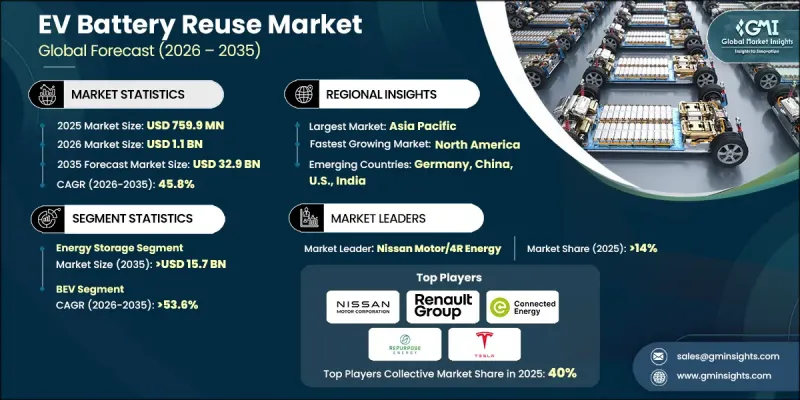
이 시장의 성장은 전기자동차의 급속한 보급과 지속 가능하고 경제적으로 실행 가능한 방식으로 배터리 수명주기를 관리해야 할 필요성이 높아지면서 성장세를 보이고 있습니다. 전 세계적으로 전기차 도입이 가속화되고 있는 가운데, 상당수의 배터리가 자동차에서 초기 사용 단계가 끝나면서 세컨드 라이프 용도에 대한 기회가 생겨나고 있습니다. 순환 경제 실천을 촉진하는 정책, 배터리 재생 기술 관련 비용 하락, 에너지 저장 솔루션에 대한 수요 증가도 시장 상황을 형성하고 있습니다. 재생 에너지 통합 및 전력 관리 용도를 지원하는 에너지 저장 시스템에서 재사용 된 EV 배터리는 점점 더 많이 도입되고 있습니다. 자동차 제조업체와 에너지 저장 기업들은 세컨드 라이프 배터리 프로그램에 많은 투자를 하고 있습니다. 이러한 노력은 배터리의 가치를 연장하는 동시에 환경에 미치는 영향을 줄일 수 있기 때문입니다. 또한, 인공지능을 활용한 진단 및 예측 분석의 발전으로 배터리 건전성 평가가 향상되어 보다 효율적인 선별, 재생 및 재사용 프로세스가 가능해졌습니다. 또한, 세계 각지의 기업들이 사용한 전기차 배터리를 2차 용도로 재사용하는 전문 사업부문을 설립하고 있으며, 이는 산업의 확장을 더욱 가속화하고 있습니다.
| 시장 범위 | |
|---|---|
| 개시 연도 | 2025년 |
| 예측 기간 | 2026-2035년 |
| 개시 연도 시장 규모 | 7억 5,990만 달러 |
| 예측액 | 329억 달러 |
| CAGR | 45.8% |
EV 충전 용도 분야는 2035년까지 연평균 복합 성장률(CAGR) 60.5%를 나타냈습니다. 전력망에 대한 피크 부하의 압력을 완화하여 급속 충전 네트워크를 지원하기 위해 충전 인프라에 재사용 배터리를 점점 더 많이 도입하고 있습니다. 이러한 저장 시스템을 통해 충전 사업자는 에너지 수요를 보다 효과적으로 조정하고, 에너지 배분 효율을 높이고, 고출력 충전 인프라 관련 운영 비용을 절감할 수 있습니다. 전기차 충전 생태계가 빠르게 확장됨에 따라 충전 네트워크의 전체 성능을 향상시키고 전력망의 안정성을 유지하기 위해 세컨드 라이프 배터리 저장 시스템의 역할이 점점 더 중요해지고 있습니다.
2025년에는 하이브리드 전기자동차(HEV)와 PHEV가 52.6%의 점유율을 차지했습니다. 그러나 이러한 차량의 배터리는 일반적으로 충방전 사이클 부하가 낮기 때문에 완전 전기차에 비해 EV 배터리 재사용 시장에 대한 기여도가 상대적으로 낮습니다. 하이브리드 차량용 배터리의 설계 개선과 차량 수명 연장으로 인해 이들 차종에서 재사용되는 배터리의 수는 감소하고 있습니다. 그 결과, HEV와 PHEV가 여전히 시장 상황에서 두드러진 점유율을 유지하고 있지만, 이 부문에서 재사용 가능한 배터리의 양은 상대적으로 제한적입니다.
2025년 미국의 전기차 배터리 재사용 시장 규모는 7,510만 달러로 평가됐습니다. 전기차 보급 확대, 야심찬 지속가능성 목표, 비용 효율적인 에너지 저장 솔루션에 대한 수요 증가는 미국 전역 시장 모멘텀을 촉진하고 있습니다. 폐기물 관리 및 지속가능성 프레임워크에 대한 규제를 포함한 순환 경제 실천을 장려하는 정부 정책은 자동차 제조업체와 에너지 기업이 배터리 재사용 이니셔티브에 투자하도록 장려하고 있습니다. 이러한 정책은 보다 광범위한 청정에너지로의 전환 속에서 세컨드 라이프 배터리의 적용을 위한 지원적인 생태계를 구축하는 데 기여하고 있습니다.
자주 묻는 질문
목차
제1장 조사 방법과 범위
제2장 주요 요약
제3장 업계 인사이트
제4장 경쟁 구도
제5장 시장 규모와 예측 : 용도별, 2022-2035
제6장 시장 규모와 예측 : 소스별, 2022-2035
제7장 시장 규모와 예측 : 지역별, 2022-2035
제8장 기업 개요
LSH 26.04.23The Global EV Battery Reuse Market was valued at USD 759.9 million in 2025 and is estimated to grow at a CAGR of 45.8% to reach USD 32.9 billion by 2035.
The market growth is supported by the rapid adoption of electric vehicles and the increasing need to manage battery lifecycles in a sustainable and economically viable manner. As EV deployment continues to accelerate worldwide, a significant number of batteries are reaching the end of their initial automotive usage phase, creating opportunities for second-life applications. Policies promoting circular economy practices, falling costs associated with battery refurbishment technologies, and the expanding demand for energy storage solutions are also shaping the market landscape. Reused EV batteries are increasingly deployed in energy storage systems that support renewable energy integration and power management applications. Automotive manufacturers and energy storage companies are heavily investing in second-life battery programs because these initiatives extend battery value while reducing environmental impact. Additionally, advancements in artificial intelligence-driven diagnostics and predictive analytics are improving the evaluation of battery health, enabling more efficient sorting, refurbishment, and repurposing processes. Companies across various regions are also establishing specialized business units focused on repurposing used EV batteries for secondary applications, which is further accelerating industry expansion.
| Market Scope | |
|---|---|
| Start Year | 2025 |
| Forecast Year | 2026-2035 |
| Start Value | $759.9 Million |
| Forecast Value | $32.9 Billion |
| CAGR | 45.8% |
The EV charging application segment is expected to grow at a CAGR of 60.5% through 2035. Reused batteries are increasingly integrated into charging infrastructure to support fast-charging networks by reducing peak load pressure on electricity grids. These storage systems allow charging operators to balance energy demand more effectively, enhance energy distribution efficiency, and lower operational costs associated with high-power charging infrastructure. As the EV charging ecosystem expands rapidly, the role of second-life battery storage systems is becoming increasingly important for maintaining grid stability while improving overall charging network performance.
The hybrid electric vehicles (HEVs) and plug-in hybrid electric vehicles (PHEVs) accounted for 52.6% share in 2025. However, these vehicles contribute relatively less to the EV battery reuse market compared to fully electric vehicles because their batteries generally experience less intensive charge and discharge cycles. Improvements in hybrid battery design and extended vehicle lifespan have reduced the number of batteries entering the reuse stream from these vehicle types. As a result, while HEVs and PHEVs maintain a notable share of the market landscape, the volume of reusable batteries from this segment remains comparatively limited.
U.S. EV Battery Reuse Market was valued at USD 75.1 million in 2025. Increasing adoption of electric vehicles, ambitious sustainability targets, and the rising need for cost-effective energy storage solutions are driving strong market momentum across the country. Government measures encouraging circular economy practices, including regulations related to waste management and sustainability frameworks, are motivating automotive manufacturers and energy companies to invest in battery repurposing initiatives. These policies are helping create a supportive ecosystem for second-life battery applications within the broader clean energy transition.
Major players operating in the Global EV Battery Reuse Market include Nissan Motor, Renault Group, Tesla, 4R Energy Corporation, Spiers New Technologies, B2U Storage, Connected Energy, Enel X, Moment Energy, BeePlanet Factory, BatteryLoop, RWE + Audi, Evyon, Element Energy, RePurpose Energy, Cactos, EcarACCU, OCTAVE, Higher Wire, Second Life EV Batteries, and Stena Metall. Companies operating in the EV Battery Reuse Market are focusing on multiple strategies to strengthen their market presence and expand their competitive position. Industry participants are investing in advanced battery diagnostics technologies, artificial intelligence-driven health assessment tools, and automated refurbishment systems to improve efficiency and scalability. Strategic partnerships between automakers, energy storage providers, and technology companies are becoming increasingly common to accelerate the development of second-life battery ecosystems. Firms are also expanding into energy storage markets by integrating reused batteries into renewable energy systems and charging infrastructure projects. Additionally, companies are establishing dedicated subsidiaries and pilot projects to refine repurposing processes and improve battery lifecycle management.
Table of Contents
Chapter 1 Methodology & Scope
- 1.1 Research design
- 1.1.1 Research approach
- 1.1.2 Data collection methods
- 1.2 Base estimates and calculations
- 1.2.1 Base year calculation
- 1.2.2 Market estimates & forecast parameters
- 1.3 Forecast
- 1.3.1 Key trends for market estimates
- 1.3.2 Quantified market impact analysis
- 1.3.2.1 Mathematical impact of growth parameters on forecast
- 1.3.3 Scenario analysis framework
- 1.4 Primary research and validation
- 1.4.1 Some of the primary sources (but not limited to)
- 1.5 Data mining sources
- 1.5.1 Paid Sources
- 1.5.2 Sources, by region
- 1.6 Research trail & scoring components
- 1.6.1 Research trail components
- 1.6.2 Scoring components
- 1.7 Research transparency addendum
- 1.7.1 Source attribution framework
- 1.7.2 Quality assurance metrics
- 1.7.3 Our commitment to trust
- 1.8 Market definitions
Chapter 2 Executive Summary
- 2.1 Industry synopsis, 2022 - 2035
- 2.2 Business trends
- 2.3 Application trends
- 2.4 Source trends
- 2.5 Regional trends
Chapter 3 Industry Insights
- 3.1 Industry ecosystem analysis
- 3.2 Regulatory landscape
- 3.3 Industry impact forces
- 3.3.1 Growth drivers
- 3.3.2 Industry pitfalls & challenges
- 3.4 Growth potential analysis
- 3.5 Porter's analysis
- 3.5.1 Bargaining power of suppliers
- 3.5.2 Bargaining power of buyers
- 3.5.3 Threat of new entrants
- 3.5.4 Threat of substitutes
- 3.6 PESTEL analysis
- 3.6.1 Political factors
- 3.6.2 Economic factors
- 3.6.3 Social factors
- 3.6.4 Technological factors
- 3.6.5 Legal factors
- 3.6.6 Environmental factors
- 3.7 Price trend analysis, 2022-2035
- 3.8 Emerging opportunities & trends
- 3.9 Investment analysis & future prospects
Chapter 4 Competitive landscape, 2025
- 4.1 Introduction
- 4.2 Company market share analysis, 2025
- 4.3 Key developments
- 4.3.1 Mergers & acquisitions
- 4.3.2 Partnerships & collaborations
- 4.3.3 New product launches
- 4.3.4 Expansion plans and funding
- 4.4 Competitive benchmarking
- 4.5 Innovation & sustainability landscape
Chapter 5 Market Size and Forecast, By Application, 2022 - 2035 (MWh & USD Million)
- 5.1 Key trends
- 5.2 Energy storage
- 5.3 EV charging
- 5.4 Base stations
- 5.5 Low speed vehicles
Chapter 6 Market Size and Forecast, By Source, 2022 - 2035 (MWh & USD Million)
- 6.1 Key trends
- 6.2 BEV
- 6.3 HEV & PHEV
Chapter 7 Market Size and Forecast, By Region, 2022 - 2035 (MWh & USD Million)
- 7.1 Key trends
- 7.2 North America
- 7.2.1 U.S.
- 7.2.2 Canada
- 7.3 Europe
- 7.3.1 UK
- 7.3.2 Germany
- 7.3.3 Italy
- 7.3.4 Spain
- 7.3.5 Russia
- 7.3.6 France
- 7.4 Asia Pacific
- 7.4.1 China
- 7.4.2 Japan
- 7.4.3 South Korea
- 7.4.4 India
- 7.4.5 Australia
- 7.5 Rest of the world
Chapter 8 Company Profiles
- 8.1 4R Energy Corporation
- 8.2 B2U Storage
- 8.3 BatteryLoop
- 8.4 BeePlanet Factory
- 8.5 Cactos
- 8.6 Connected Energy
- 8.7 EcarACCU
- 8.8 Element Energy
- 8.9 Enel X
- 8.10 Evyon
- 8.11 Higher Wire
- 8.12 Moment Energy
- 8.13 Nissan Motor
- 8.14 OCTAVE
- 8.15 RePurpose Energy
- 8.16 Renault Group
- 8.17 RWE + Audi
- 8.18 Second Life EV Batteries
- 8.19 Spiers New Technologies
- 8.20 Stena Metall
- 8.21 Tesla