

|
시장보고서
상품코드
1665302
보철용 라이너 시장 : 시장 기회, 성장 촉진요인, 업계 동향 분석, 예측(2025-2034년)Prosthetic Liners Market Opportunity, Growth Drivers, Industry Trend Analysis, and Forecast 2025 - 2034 |
||||||

세계의 보철용 라이너 시장은 2024년에 3억 1,210만 달러로 평가되었고, 2025년부터 2034년까지 5.7%의 연평균 복합 성장률(CAGR)로 견조하게 성장할 것으로 예측되고 있습니다. 이 성장의 원동력은 환자의 편안함 중시, 절단 건수 증가, 선진적 재활 솔루션에 대한 의식의 고조입니다. 보철 기술과 재료의 혁신도 시장 확대에 매우 중요한 역할을 하고 있어, 사용자에게 내구성, 기능성, 쾌적성의 향상을 제공합니다.
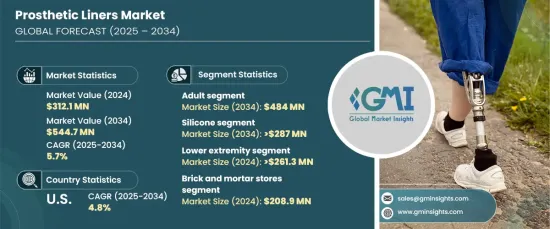
시장은 재료 유형별로 구분되며, 실리콘, 열가소성 엘라스토머, 폴리우레탄이 상위를 차지하고 있습니다. 그 중에서도 실리콘 라이너가 시장을 선도하고 있으며, 2034년까지 연평균 복합 성장률(CAGR) 5.6%로 성장할 전망이며, 2억 8,700만 달러를 창출할 것으로 예측되고 있습니다. 실리콘의 뛰어난 내구성, 빈번한 마모에 대한 내성, 비용 효과로 장기적인 보철물 사용자에게 선호되는 옵션이 되었습니다. 또한, 저 알레르기 성질과 부드러운 질감은 특히 민감한 피부와 염증이 신경 쓰이는 사람에게 비교할 수 없는 편안함을 설명합니다. 압력 하에서도 형태를 유지하는 실리콘의 능력은 활성 사용자와 신체적으로 가혹한 활동에 종사하는 사람들에게 매력을 더욱 향상시킵니다.
| 시장 범위 | |
|---|---|
| 시작 연도 | 2024년 |
| 예측 연도 | 2025-2034년 |
| 시작 금액 | 3억 1,210만 달러 |
| 예측 금액 | 5억 4,470만 달러 |
| CAGR | 5.7% |
보철용 라이너 시장은 용도별로 상지용 라이너와 하지용 라이너로 구분됩니다. 2024년에는 하지용이 큰 시장 점유율을 차지했으며, 2억 6,130만 달러를 창출했습니다. 이 높은 수요의 배경은 당뇨병, 말초 동맥 질환, 외상과 같은 질병으로 인한 다리 절단의 흐름을 포함합니다. 다리 보철 라이너는 이동성, 서스펜션 및 전반적인 사용자의 편안함을 향상시키는 데 매우 중요합니다. 다리 의족은 체중을 지탱해야 하며 충격이 크므로 이러한 라이너는 내구성과 지원을 제공하도록 설계되어 피부 손상의 위험을 줄이고, 보행, 달리기, 계단 승강 등 활동 중 사용 편의성을 향상시킵니다.
미국의 보철용 라이너 시장은 2024년 1억 5,660만 달러로 평가되었으며, 2034년까지 안정적인 CAGR 4.8%로 성장할 것으로 예상됩니다. 인구의 고령화나 보장구를 필요로 하는 사람 증가와 같은 요인이 이 성장의 주요 촉진요인이 되고 있습니다. 노화와 관련된 건강 상태와 절단으로 이어지는 만성 질환은 수요 증가에 더욱 기여합니다. 특히 하지 사용자를 위해 피트감, 쾌적성, 커스터마이즈성 향상에 중점을 둔 의지장비 설계의 기술적 진보도 시장 확대에 박차를 가하고 있습니다. 이러한 기술 혁신은 사용자의 특정 요구에 대응하고 첨단 인공 장비 라이너의 채용률을 높입니다.
목차
제1장 조사 방법 및 조사 범위
제2장 주요 요약
제3장 산업 인사이트
- 생태계 분석
- 산업에 미치는 영향요인
- 성장 촉진요인
- 다양한 사지 절단 증가
- 의지 라이너 재료 및 디자인 진보
- 첨단 의지 장비에 대한 인식 및 접근성 향상
- 정형외과적 손상 증가
- 산업의 잠재적 리스크 및 과제
- 제품 비용의 높이 및 빈번한 교환의 필요성
- 라이너의 장기 사용에 의한 피부 관련 합병증
- 성장 촉진요인
- 성장 가능성 분석
- 규제 상황
- 기술
- 상환 시나리오
- 갭 분석
- Porter's Five Forces 분석
- PESTEL 분석
- 향후 시장 동향
제4장 경쟁 구도
- 서문
- 기업 매트릭스 분석
- 기업 점유율 분석
- 주요 시장 기업의 경쟁 분석
- 경쟁 포지셔닝 매트릭스
- 전략 대시보드
제5장 시장 추정 및 예측 : 재료별(2021-2034년)
- 주요 동향
- 실리콘
- 열가소성 엘라스토머
- 폴리우레탄
제6장 시장 추정 및 예측 : 용도별(2021-2034년)
- 주요 동향
- 하지
- 상지
제7장 시장 추정 및 예측 : 연령층별(2021-2034년)
- 주요 동향
- 성인
- 소아
제8장 시장 추정 및 예측 : 유통 채널별(2021-2034년)
- 주요 동향
- 실제 점포
- 전자상거래
제9장 시장 추정 및 예측 : 최종 용도별(2021-2034년)
- 주요 동향
- 병원 클리닉
- 재활 센터
- 재택 간병 환경
제10장 시장 추정 및 예측 : 지역별(2021-2034년)
- 주요 동향
- 북미
- 미국
- 캐나다
- 유럽
- 독일
- 영국
- 프랑스
- 스페인
- 이탈리아
- 네덜란드
- 아시아태평양
- 중국
- 일본
- 인도
- 호주
- 한국
- 라틴아메리카
- 브라질
- 멕시코
- 아르헨티나
- 중동 및 아프리카
- 남아프리카
- 사우디아라비아
- 아랍에미리트(UAE)
제11장 기업 프로파일
- ALPS
- Blatchford
- college park
- Fillauer
- KARE Prosthetics and Orthotics
- ORLIMAN
- Ortho Europe
- OSSUR
- Ottobock
- SILIPOS
- ST&G
- Streifeneder
- WILLOWWOOD
The Global Prosthetic Liners Market reached USD 312.1 million in 2024 and is projected to grow at a robust CAGR of 5.7% between 2025 and 2034. This growth is driven by an increasing emphasis on patient comfort, a rise in the number of amputations, and growing awareness about advanced rehabilitation solutions. Innovations in prosthetic technologies and materials are also playing a pivotal role in market expansion, offering users enhanced durability, functionality, and comfort.
The market is segmented by material type, with silicone, thermoplastic elastomers, and polyurethane dominating the landscape. Among these, silicone liners are set to lead the market, projected to grow at a CAGR of 5.6% and generate USD 287 million by 2034. Silicone's exceptional durability, resistance to frequent wear, and cost-effectiveness make it a preferred choice for long-term prosthetic users. Additionally, its hypoallergenic properties and soft texture provide unmatched comfort, especially for individuals with sensitive skin or irritation concerns. Silicone's ability to maintain its shape under pressure further enhances its appeal to active users and those engaged in physically demanding activities.
| Market Scope | |
|---|---|
| Start Year | 2024 |
| Forecast Year | 2025-2034 |
| Start Value | $312.1 Million |
| Forecast Value | $544.7 Million |
| CAGR | 5.7% |
By application, the prosthetic liners market is segmented into upper extremity and lower extremity liners. In 2024, the lower extremity segment accounted for a significant market share, generating USD 261.3 million. This high demand is attributed to the prevalence of lower limb amputations caused by conditions such as diabetes, peripheral arterial disease, and traumatic injuries. Lower extremity prosthetic liners are crucial in improving mobility, suspension, and overall user comfort. Given the weight-bearing demands and high-impact activities associated with lower limb prosthetics, these liners are engineered to provide durability and support, reducing the risk of skin injuries and enhancing usability during activities such as walking, running, and climbing stairs.
The U.S. prosthetic liners market, valued at USD 156.6 million in 2024, is expected to grow at a steady CAGR of 4.8% through 2034. Factors such as an aging population and an increasing number of individuals requiring prosthetic devices are key drivers of this growth. Age-related health conditions and chronic diseases leading to amputations further contribute to the rising demand. Technological advancements in prosthetic design, focusing on improved fit, comfort, and customization, particularly for lower limb users, are also fueling market expansion. These innovations address the specific needs of users and enhance adoption rates of advanced prosthetic liners.
Table of Contents
Chapter 1 Methodology and Scope
- 1.1 Market scope and definitions
- 1.2 Research design
- 1.2.1 Research approach
- 1.2.2 Data collection methods
- 1.3 Base estimates and calculations
- 1.3.1 Base year calculation
- 1.3.2 Key trends for market estimation
- 1.4 Forecast model
- 1.5 Primary research and validation
- 1.5.1 Primary sources
- 1.5.2 Data mining sources
Chapter 2 Executive Summary
- 2.1 Industry 3600 synopsis
Chapter 3 Industry Insights
- 3.1 Industry ecosystem analysis
- 3.2 Industry impact forces
- 3.2.1 Growth drivers
- 3.2.1.1 Increase in number of different limb amputations
- 3.2.1.2 Advancements in prosthetic liner materials and designs
- 3.2.1.3 Growing awareness and accessibility of advanced prosthetics
- 3.2.1.4 Rise in incidences of orthopedic injuries
- 3.2.2 Industry pitfalls and challenges
- 3.2.2.1 High product cost and need for frequent replacements
- 3.2.2.2 Skin-related complications caused by prolonged use of liners
- 3.2.1 Growth drivers
- 3.3 Growth potential analysis
- 3.4 Regulatory landscape
- 3.5 Technology landscape
- 3.6 Reimbursement scenario
- 3.7 Gap analysis
- 3.8 Porter's analysis
- 3.9 PESTEL analysis
- 3.10 Future market trends
Chapter 4 Competitive Landscape, 2024
- 4.1 Introduction
- 4.2 Company matrix analysis
- 4.3 Company market share analysis
- 4.4 Competitive analysis of major market players
- 4.5 Competitive positioning matrix
- 4.6 Strategy dashboard
Chapter 5 Market Estimates and Forecast, By Material, 2021 — 2034 ($ Mn)
- 5.1 Key trends
- 5.2 Silicone
- 5.3 Thermoplastic elastomers
- 5.4 Polyurethane
Chapter 6 Market Estimates and Forecast, By Application, 2021 — 2034 ($ Mn)
- 6.1 Key trends
- 6.2 Lower extremity
- 6.3 Upper extremity
Chapter 7 Market Estimates and Forecast, By Age Group, 2021 — 2034 ($ Mn)
- 7.1 Key trends
- 7.2 Adult
- 7.3 Pediatric
Chapter 8 Market Estimates and Forecast, By Distribution Channel, 2021 — 2034 ($ Mn)
- 8.1 Key trends
- 8.2 Brick and mortar stores
- 8.3 E-commerce
Chapter 9 Market Estimates and Forecast, By End Use, 2021 — 2034 ($ Mn)
- 9.1 Key trends
- 9.2 Hospitals and clinics
- 9.3 Rehabilitation centers
- 9.4 Home care settings
Chapter 10 Market Estimates and Forecast, By Region, 2021 — 2034 ($ Mn)
- 10.1 Key trends
- 10.2 North America
- 10.2.1 U.S.
- 10.2.2 Canada
- 10.3 Europe
- 10.3.1 Germany
- 10.3.2 UK
- 10.3.3 France
- 10.3.4 Spain
- 10.3.5 Italy
- 10.3.6 Netherlands
- 10.4 Asia Pacific
- 10.4.1 China
- 10.4.2 Japan
- 10.4.3 India
- 10.4.4 Australia
- 10.4.5 South Korea
- 10.5 Latin America
- 10.5.1 Brazil
- 10.5.2 Mexico
- 10.5.3 Argentina
- 10.6 Middle East and Africa
- 10.6.1 South Africa
- 10.6.2 Saudi Arabia
- 10.6.3 UAE
Chapter 11 Company Profiles
- 11.1 ALPS
- 11.2 Blatchford
- 11.3 college park
- 11.4 Fillauer
- 11.5 KARE Prosthetics and Orthotics
- 11.6 ORLIMAN
- 11.7 Ortho Europe
- 11.8 ÖSSUR
- 11.9 Ottobock
- 11.10 SILIPOS
- 11.11 ST&G
- 11.12 Streifeneder
- 11.13 WILLOWWOOD


