|
시장보고서
상품코드
1666980
항공기 통신 시스템 시장 기회, 성장 촉진요인, 산업 동향 분석, 예측(2025-2034년)Aircraft Communication System Market Opportunity, Growth Drivers, Industry Trend Analysis, and Forecast 2025 - 2034 |
||||||

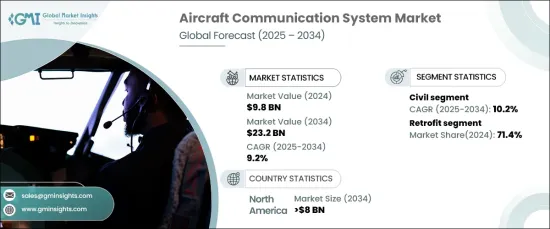
세계 항공기 통신 시스템 시장은 2024년 98억 달러로 평가되며 2025년부터 2034년까지 연평균 9.2%의 견조한 성장세를 보일 것으로 예상됩니다.
이러한 성장의 원동력은 끊김 없는 인터넷 접속, 엔터테인먼트, 비즈니스 커뮤니케이션에 대한 승객들의 기대에 힘입어 원활한 기내 연결에 대한 수요가 증가하고 있기 때문입니다. 항공사들은 여행 경험을 개선하고 디지털화 시대에 경쟁력을 유지하기 위해 위성 기반 시스템 및 고속 Wi-Fi와 같은 첨단 기술을 도입하고 있습니다.
항공 업계는 진화하는 승객의 니즈와 규제 요건을 충족시키기 위해 기내 통신 인프라 개발을 최우선 과제로 삼고 있습니다. 지상에서의 인터넷 경험에 필적하는 뛰어난 연결성이 표준이 되고 있으며, 항공사는 고객을 유치하고 유지하기 위해 최첨단 통신 시스템에 투자하고 있습니다.
| 시장 범위 | |
|---|---|
| 시작 연도 | 2024년 |
| 예측 연도 | 2025-2034년 |
| 시작 금액 | 98억 달러 |
| 예상 금액 | 232억 달러 |
| CAGR | 9.2% |
이 시장은 라인핏과 리트로핏 부문으로 분류되며, 리트로핏 부문이 2024년 71.4%의 점유율을 차지했습니다. 개조는 항공기의 수명을 연장하고 위성 기반 연결 및 고급 데이터 전송과 같은 첨단 통신 요구 사항을 준수할 수 있도록 보장합니다. 이러한 추세는 특히 민간 항공 분야에서 두드러지게 나타나고 있으며, 경쟁력을 유지하고 엄격한 규제를 충족하기 위해서는 비용 효율적인 현대화가 필수적입니다.
용도별로는 민간용과 군사용으로 나뉘는데, 민간 항공 분야가 가장 빠르게 성장하고 있으며 2025-2034년 연평균 10.2%의 CAGR을 기록할 것으로 예상됩니다. 민간 항공 분야는 항공사가 승객의 연결성 및 엔터테인먼트 향상과 함께 항공기와 지상국 간의 실시간 통신을 우선시하고 있기 때문에 시장 확대의 주요 요인으로 작용하고 있습니다. 항공 교통 관제 및 안전 통신에 대한 규제 요건의 증가는 이 분야에서 신뢰할 수 있는 첨단 기술의 필요성을 더욱 강조하고 있습니다.
북미 항공기 통신 시스템 시장은 2034년까지 80억 달러 규모의 시장을 창출할 것으로 예상됩니다. 이 지역의 성장을 뒷받침하는 것은 탄탄한 항공 산업과 최첨단 기술 인프라입니다. 미국은 민간 및 군용 항공기를 위한 차세대 통신 시스템 개발 및 도입의 선두주자입니다. 엄격한 FAA 가이드라인과 같은 규제 압력으로 인해 첨단 기술 채택이 가속화되고 있습니다. 또한, 후장 솔루션과 기내 연결에 대한 수요가 증가함에 따라 북미가 세계 시장 형성에서 매우 중요한 역할을 하고 있다는 것을 입증하고 있습니다.
목차
제1장 조사 방법과 조사 범위
- 시장 범위와 정의
- 기본 추정과 계산
- 예측 계산
- 데이터 소스
- 1차 데이터
- 2차 데이터
- 유료 정보 출처
- 공적 정보 출처
제2장 주요 요약
제3장 업계 인사이트
- 생태계 분석
- 밸류체인에 영향을 미치는 요인
- 이익률 분석
- 파괴
- 향후 전망
- 제조업체
- 유통업체
- 공급업체 상황
- 이익률 분석
- 주요 뉴스와 대처
- 규제 상황
- 영향요인
- 성장 촉진요인
- 기내 접속 솔루션에 대한 수요 증가
- 항공기용 위성통신의 진보
- 항공교통량 증가에 의한 통신 시스템 수요 증가
- 항공기 안전성과 보안에 대한 주목 상승
- 항공기 시스템으로의 AI와 IoT의 통합
- 업계의 잠재적 리스크와 과제
- 첨단 통신 시스템의 도입에 소요되는 고비용
- 엄격한 규제와 인증 컴플라이언스에 대한 과제
- 성장 촉진요인
- 성장 가능성 분석
- Porters 분석
- PESTEL 분석
제4장 경쟁 구도
- 소개
- 기업 점유율 분석
- 경쟁 포지셔닝 매트릭스
- 전략 전망 매트릭스
제5장 시장 추정과 예측 : 피트별, 2021-2034년
- 주요 동향
- 라인피트
- 레트로피트
제6장 시장 추정과 예측 : 연결성별, 2021-2034년
- 주요 동향
- SATCOM
- VHF/UHF/L 밴드 F
- 고주파
- 데이터 링크
제7장 시장 추정과 예측 : 구성요소별, 2021-2034년
- 주요 동향
- 트랜스폰더
- 트랜시버
- 안테나
- 트랜스미터
- 수신기
- 무선 튜닝 유닛
- 기타 구성요소
제8장 시장 추정과 예측 : 시스템별, 2021-2034년
- 주요 동향
- 무선 통신
- VHF 통신 시스템
- HF 통신 시스템
- SATCOM 시스템
- 인터폰 통신 시스템
- 패신저 주소 시스템
- 디지털 라디오 & 오디오 통합 관리 시스템
- 항공기 통신 통보 시스템(ACARS)
제9장 시장 추정과 예측 : 용도별, 2021-2034년
- 주요 동향
- 민간 항공기
- 내로우바디
- 와이드바디
- 리저널 제트
- 터보프롭/헬리콥터
- 군용기
- 전투기
- 수송기
- 특수 임무기
- 군용 헬리콥터
- 무인항공기(UAV)
제10장 시장 추정과 예측 : 지역별, 2021-2034년
- 주요 동향
- 북미
- 미국
- 캐나다
- 유럽
- 영국
- 독일
- 프랑스
- 이탈리아
- 스페인
- 러시아
- 아시아태평양
- 중국
- 인도
- 일본
- 한국
- 호주
- 라틴아메리카
- 브라질
- 멕시코
- 중동 및 아프리카
- 남아프리카공화국
- 사우디아라비아
- 아랍에미리트
제11장 기업 개요
- ASELSAN A.S.
- BAE Systems
- Collins Aerospace
- Elbit Systems
- Garmin Ltd.
- General Dynamics Mission Systems, Inc.
- Honeywell International Inc.
- L3Harris Technologies
- Northrop Grumman
- Orbit Communication Systems Ltd
- Raytheon Intelligence and Space
- Rohde &Schwarz
- SITA
- Thales Group
- Universal Avionics
The Global Aircraft Communication System Market reached USD 9.8 billion in 2024 and is poised to grow at a robust CAGR of 9.2% from 2025 to 2034. This growth is fueled by the rising demand for seamless in-flight connectivity, driven by passengers' expectations for uninterrupted internet access, entertainment, and business communication. Airlines are adopting advanced technologies like satellite-based systems and high-speed Wi-Fi to enhance the travel experience and stay competitive in an increasingly digital era.
The aviation sector is prioritizing the development of onboard communication infrastructure to meet evolving passenger needs and regulatory demands. Enhanced connectivity, comparable to ground-based internet experiences, is becoming a standard expectation, pushing airlines to invest in cutting-edge communication systems to attract and retain customers.
| Market Scope | |
|---|---|
| Start Year | 2024 |
| Forecast Year | 2025-2034 |
| Start Value | $9.8 Billion |
| Forecast Value | $23.2 Billion |
| CAGR | 9.2% |
The market is segmented by fit into line-fit and retrofit categories. The retrofit segment dominated, holding a 71.4% share in 2024, as operators increasingly upgrade aging systems to comply with modern safety and operational standards. Retrofitting extends the operational lifespan of aircraft while ensuring adherence to advanced communication requirements, such as satellite-based connectivity and enhanced data transmission. This trend is particularly pronounced in commercial aviation, where cost-effective modernization is essential to remain competitive and meet stringent regulations.
By application, the market is divided into civil and military segments, with civil aviation emerging as the fastest-growing category, projected to register a CAGR of 10.2% during 2025-2034. The civil aviation sector is a key driver of market expansion, as airlines prioritize real-time communication between aircraft and ground stations, along with improving passenger connectivity and entertainment. Increasing regulatory requirements for air traffic control and safety communications further emphasize the need for reliable and advanced technologies in this segment.
North America aircraft communication system market will generate USD 8 billion by 2034. The region's growth is supported by a well-established aviation industry and cutting-edge technological infrastructure. The U.S. is a leader in developing and implementing next-generation communication systems for commercial and military aircraft. Regulatory pressures, such as stringent FAA guidelines, continue to accelerate the adoption of advanced technologies. Additionally, the growing demand for retrofit solutions and in-flight connectivity underscores North America's pivotal role in shaping the global market.
Table of Contents
Chapter 1 Methodology & Scope
- 1.1 Market scope & definitions
- 1.2 Base estimates & calculations
- 1.3 Forecast calculations
- 1.4 Data sources
- 1.4.1 Primary
- 1.4.2 Secondary
- 1.4.2.1 Paid sources
- 1.4.2.2 Public sources
Chapter 2 Executive Summary
- 2.1 Industry synopsis, 2021-2034
Chapter 3 Industry Insights
- 3.1 Industry ecosystem analysis
- 3.1.1 Factor affecting the value chain
- 3.1.2 Profit margin analysis
- 3.1.3 Disruptions
- 3.1.4 Future outlook
- 3.1.5 Manufacturers
- 3.1.6 Distributors
- 3.2 Supplier landscape
- 3.3 Profit margin analysis
- 3.4 Key news & initiatives
- 3.5 Regulatory landscape
- 3.6 Impact forces
- 3.6.1 Growth drivers
- 3.6.1.1 Increasing demand for in-flight connectivity solutions
- 3.6.1.2 Advancements in satellite communication for aircraft
- 3.6.1.3 Rising air traffic boosting communication systems demand
- 3.6.1.4 Growing focus on aircraft safety and security
- 3.6.1.5 Integration of AI and IoT in aircraft systems
- 3.6.2 Industry pitfalls & challenges
- 3.6.2.1 High costs of advanced communication system implementation
- 3.6.2.2 Stringent regulatory and certification compliance challenges
- 3.6.1 Growth drivers
- 3.7 Growth potential analysis
- 3.8 Porter’s analysis
- 3.9 PESTEL analysis
Chapter 4 Competitive Landscape, 2024
- 4.1 Introduction
- 4.2 Company market share analysis
- 4.3 Competitive positioning matrix
- 4.4 Strategic outlook matrix
Chapter 5 Market Estimates & Forecast, By Fit, 2021-2034 (USD Million & Units)
- 5.1 Key trends
- 5.2 Line fit
- 5.3 Retro fit
Chapter 6 Market Estimates & Forecast, By Connectivity, 2021-2034 (USD Million & Units)
- 6.1 Key trends
- 6.2 SATCOM
- 6.3 VHF/UHF/L-Band F
- 6.4 High frequency
- 6.5 Data link
Chapter 7 Market Estimates & Forecast, By Component, 2021-2034 (USD Million & Units)
- 7.1 Key trends
- 7.2 Transponders
- 7.3 Transceivers
- 7.4 Antennas
- 7.5 Transmitters
- 7.6 Receivers
- 7.7 Radio tuning units
- 7.8 Other components
Chapter 8 Market Estimates & Forecast, By System, 2021-2034 (USD Million & Units)
- 8.1 Key trends
- 8.2 Radio communication
- 8.2.1 VHF communication system
- 8.2.2 HF communication system
- 8.2.3 SATCOM system
- 8.3 Interphone communication system
- 8.4 Passenger address system
- 8.5 Digital radio & audio integrating management system
- 8.6 Aircraft communications addressing and reporting system (ACARS)
Chapter 9 Market Estimates & Forecast, By Application, 2021-2034 (USD Million & Units)
- 9.1 Key trends
- 9.2 Commercial aircrafts
- 9.2.1 Narrow-body
- 9.2.2 Wide-body
- 9.2.3 Regional jets
- 9.2.4 Turboprop/helicopters
- 9.3 Military aircrafts
- 9.3.1 Fighter aircraft
- 9.3.2 Transport aircraft
- 9.3.3 Special mission aircraft
- 9.3.4 Military helicopters
- 9.3.5 Unmanned aerial vehicles (UAVs)
Chapter 10 Market Estimates & Forecast, By Region, 2021-2034 (USD Million & Units)
- 10.1 Key trends
- 10.2 North America
- 10.2.1 U.S.
- 10.2.2 Canada
- 10.3 Europe
- 10.3.1 UK
- 10.3.2 Germany
- 10.3.3 France
- 10.3.4 Italy
- 10.3.5 Spain
- 10.3.6 Russia
- 10.4 Asia Pacific
- 10.4.1 China
- 10.4.2 India
- 10.4.3 Japan
- 10.4.4 South Korea
- 10.4.5 Australia
- 10.5 Latin America
- 10.5.1 Brazil
- 10.5.2 Mexico
- 10.6 MEA
- 10.6.1 South Africa
- 10.6.2 Saudi Arabia
- 10.6.3 UAE
Chapter 11 Company Profiles
- 11.1 ASELSAN A.S.
- 11.2 BAE Systems
- 11.3 Collins Aerospace
- 11.4 Elbit Systems
- 11.5 Garmin Ltd.
- 11.6 General Dynamics Mission Systems, Inc.
- 11.7 Honeywell International Inc.
- 11.8 L3Harris Technologies
- 11.9 Northrop Grumman
- 11.10 Orbit Communication Systems Ltd
- 11.11 Raytheon Intelligence and Space
- 11.12 Rohde & Schwarz
- 11.13 SITA
- 11.14 Thales Group
- 11.15 Universal Avionics