|
시장보고서
상품코드
1685122
항공우주용 복합재료 시장 기회, 성장 촉진요인, 산업 동향 분석, 예측(2025-2034년)Aerospace Composites Market Opportunity, Growth Drivers, Industry Trend Analysis, and Forecast 2025 - 2034 |
||||||

세계의 항공우주용 복합재료 시장은 2024년 294억 달러에 달했고, 경량화와 동시에 항공기 성능을 향상시키는 첨단 재료에 대한 수요 증가로 2025년부터 2034년까지 연평균 복합 성장률(CAGR) 12.8%를 나타낼 것으로 예측되고 있습니다.
항공사와 방위 계약자가 더 효율적인 연료 솔루션을 추구하는 동안 항공우주 제조업체는 항공기 설계에 경량 복합재료를 통합합니다. 이러한 재료는 연비를 개선하고 부품 수명을 연장하며 엄격한 환경 규제 준수를 보장합니다. 업계는 급속한 혁신을 목격하고 있으며, 연구자들은 우수한 내구성, 열 안정성, 내충격성을 제공하는 차세대 복합재를 개발하고 있습니다. 지속가능성에 대한 관심 증가는 시장 동향을 형성하고 있으며, 재활용 가능하고 환경친화적인 복합재료 탐구를 기업에 촉구하고 있습니다. 세계 항공 수요 증가와 방위기관의 차세대 항공기 투자로 고성능 재료에 대한 요구가 계속 증가하고 있으며, 항공우주용 복합재료 산업은 향후 10년간 크게 확대될 전망입니다.
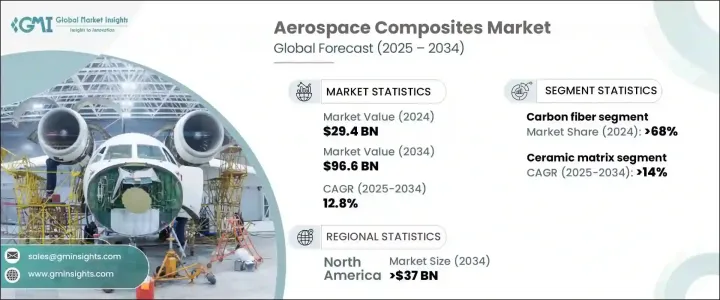
시장은 섬유 유형별로 분류되며 탄소 섬유, 유리 섬유, 세라믹 섬유가 부문을 이끌고 있습니다. 탄소섬유가 이 분야를 지배해 2024년에는 68%의 점유율을 차지했습니다. 이 소재는 비교할 수 없는 강도 대 중량비로 인해 항공기의 주요 날개, 몸통 및 구조 보강에 이상적이며 여전히 선호됩니다. 항공사가 효율성을 우선시하고 항공기 제조업체가 보다 가볍고 강한 설계를 추진하는 가운데 탄소섬유 복합재료의 채용은 가속될 것으로 예상됩니다. 이 추세는 탄소섬유 제조의 기술적 진보에 의해 더욱 향상되고 항공우주 응용 분야에서 비용 효율성과 사용 편의성이 향상되었습니다.
| 시장 범위 | |
|---|---|
| 시작 연도 | 2024년 |
| 예측 연도 | 2025-2034년 |
| 시작 금액 | 294억 달러 |
| 예측 금액 | 966억 달러 |
| CAGR | 12.8% |
또한 업계는 폴리머, 세라믹, 금속 매트릭스가 복합 성능에 중요한 역할을 하는 등 매트릭스 유형별로 세분화되어 있습니다. 세라믹 매트릭스 복합재료(CMC) 분야는 2034년까지 연평균 복합 성장률(CAGR)이 14%를 나타낼 것으로 예측되어 가장 빠른 성장이 예상되고 있습니다. 이 재료는 고온 환경이 우수하며 제트 엔진, 배기 시스템 및 기타 열에 민감한 부품에 필수적입니다. 극초음속 항공기, 군용 제트기, 우주 탐사 기술에 대한 투자가 증가함에 따라 CMC 수요는 증가의 길을 따라가고 있습니다. 개발 업체는 내열성과 기계적 강도를 향상시키고 가혹한 조건에서도 최적의 성능을 발휘하는 차세대 CMC를 적극적으로 개발하고 있습니다.
북미는 2034년까지 370억 달러를 창출해 항공우주용 복합재료 시장의 지배적인 지위를 유지할 것으로 전망됩니다. 이 지역의 성장의 원동력이 되고 있는 것은 계속적인 군사 근대화에의 대처와 국방비 증가입니다. 차세대 전투기, 무인 항공기(UAV), 우주 탐사 프로그램에 중점을 두고 있기 때문에 첨단 복합재료에 대한 수요는 계속 견조합니다. 고도로 발전한 제조 생태계와 함께 항공우주 부문의 기술 혁신에 대한 추진력은 이 시장에서 북미의 리더십을 확고하게 하고 있습니다. 국방과 민간항공이 진화를 계속하고 있는 가운데 고성능 복합재료에 대한 이 지역의 투자는 향후 수년간 업계의 성장을 가속할 것으로 예상됩니다.
목차
제1장 조사 방법과 조사 범위
- 시장 범위와 정의
- 기본 추정과 계산
- 예측 계산
- 데이터 소스
- 1차 데이터
- 2차 자료
- 유료 소스
- 공적 소스
제2장 주요 요약
제3장 업계 인사이트
- 생태계 분석
- 밸류체인에 영향을 주는 요인
- 이익률 분석
- 파괴적 혁신
- 향후 전망
- 제조업체
- 유통업체
- 공급업체 상황
- 이익률 분석
- 주요 뉴스
- 규제 상황
- 영향요인
- 성장 촉진요인
- 고강도 및 경량 복합재료에 대한 왕성한 수요
- 탄소 섬유 및 열가소성 복합재와 같은 복합 소재의 지속적인 혁신
- 3D 프린팅 및 적층 제조 기술의 사용 증가
- 특히 신흥 시장에서 항공 여행의 급성장과 군용기의 현대화
- 항공기 인테리어에 복합재를 사용하는 경향 증가
- 업계의 잠재적 위험 및 과제
- 높은 재료비와 제조 비용
- 기존 재료와의 통합
- 성장 촉진요인
- 성장 가능성 분석
- Porter's Five Forces 분석
- PESTEL 분석
제4장 경쟁 구도
- 서론
- 기업 점유율 분석
- 경쟁 포지셔닝 매트릭스
- 전략 전망 매트릭스
제5장 시장 추계·예측 : 섬유 유형별(2021-2034년)
- 주요 동향
- 유리 섬유
- 탄소 섬유
- 세라믹 섬유
- 기타
제6장 시장 추계·예측 : 매트릭스별(2021-2034년)
- 주요 동향
- 폴리머 매트릭스
- 열경화성 폴리머 매트릭스
- 에폭시
- 페놀
- 폴리아미드
- 기타
- 열가소성 폴리머 매트릭스
- 폴리에테르 에테르 케톤(PEEK)
- 폴리설폰(PSU)
- 폴리에테르이미드(PEI)
- 기타
- 열경화성 폴리머 매트릭스
- 세라믹 매트릭스
- 금속 매트릭스
제7장 시장 추계·예측 : 항공기 유형별(2021-2034년)
- 주요 동향
- 상업용
- 협동체
- 광동체
- 비즈니스 제트기
- 터보프롭
- 군용 및 방위용 항공기
- 기타
제8장 시장 추계·예측 : 용도별(2021-2034년)
- 주요 동향
- 외관
- 동체
- 엔진
- 날개
- 로터 블레이드
- 테일 붐
- 인테리어
- 좌석
- 객실
- 샌드위치 패널
- 환경 제어 시스템(ECS) 덕트
제9장 시장 추계·예측 : 지역별(2021-2034년)
- 주요 동향
- 북미
- 미국
- 캐나다
- 유럽
- 영국
- 독일
- 프랑스
- 이탈리아
- 스페인
- 러시아
- 아시아태평양
- 중국
- 인도
- 일본
- 한국
- 호주
- 라틴아메리카
- 브라질
- 멕시코
- 중동 및 아프리카
- 남아프리카
- 사우디아라비아
- 아랍에미리트(UAE)
제10장 기업 프로파일
- Absolute Composites
- Aernnova Aerospace
- Avior Integrated Products
- Collins Aerospace
- FDC Composites
- General Dynamics
- Hexcel
- Lee Aerospace
- Materion
- Mitsubishi Chemical
- SGL Carbon
- Solvay
- Spirit Aerosystems
- Teijin
- Toray
The Global Aerospace Composites Market reached USD 29.4 billion in 2024 and is projected to expand at a CAGR of 12.8% between 2025 and 2034, driven by the increasing demand for advanced materials that enhance aircraft performance while reducing weight. As airlines and defense contractors seek more fuel-efficient solutions, aerospace manufacturers are integrating lightweight composites into aircraft designs. These materials help improve fuel economy, extend component lifespans, and ensure compliance with stringent environmental regulations. The industry is witnessing rapid innovation, with researchers developing next-generation composites that offer superior durability, thermal stability, and impact resistance. The rising focus on sustainability is also shaping market trends, pushing companies to explore recyclable and eco-friendly composites. As global air travel demand increases and defense agencies invest in next-gen aircraft, the need for high-performance materials continues to grow, positioning the aerospace composites industry for substantial expansion over the next decade.
The market is categorized by fiber type, with carbon fiber, glass fiber, and ceramic fiber leading the segment. Carbon fiber dominates the sector, holding a 68% share in 2024. This material remains the preferred choice due to its unmatched strength-to-weight ratio, making it ideal for aircraft wings, fuselages, and structural reinforcements. As airlines prioritize efficiency and aircraft manufacturers push for lighter, stronger designs, the adoption of carbon fiber composites is expected to accelerate. This trend is further supported by technological advancements in carbon fiber production, making it more cost-effective and accessible for aerospace applications.
| Market Scope | |
|---|---|
| Start Year | 2024 |
| Forecast Year | 2025-2034 |
| Start Value | $29.4 Billion |
| Forecast Value | $96.6 Billion |
| CAGR | 12.8% |
The industry is also segmented by matrix type, with polymer, ceramic, and metal matrices playing a critical role in composite performance. The ceramic matrix composite (CMC) segment is poised for the fastest growth, with a projected CAGR of 14% through 2034. These materials excel in high-temperature environments, making them essential for jet engines, exhaust systems, and other heat-sensitive components. With growing investments in hypersonic aircraft, military jets, and space exploration technologies, the demand for CMCs continues to rise. Manufacturers are actively developing next-generation CMCs that offer improved thermal resistance and mechanical strength, ensuring optimal performance under extreme conditions.
North America is set to remain the dominant force in the aerospace composites market, generating USD 37 billion by 2034. The region's growth is fueled by continuous military modernization efforts and increasing defense expenditures. With a strong emphasis on next-generation fighter jets, unmanned aerial vehicles (UAVs), and space exploration programs, the demand for advanced composites remains robust. The aerospace sector's drive toward innovation, coupled with a highly developed manufacturing ecosystem, cements North America's leadership in this market. As defense and commercial aviation continue to evolve, the region's investment in high-performance composites is expected to propel industry growth for years to come.
Table of Contents
Chapter 1 Methodology & Scope
- 1.1 Market scope & definitions
- 1.2 Base estimates & calculations
- 1.3 Forecast calculations
- 1.4 Data sources
- 1.4.1 Primary
- 1.4.2 Secondary
- 1.4.2.1 Paid sources
- 1.4.2.2 Public sources
Chapter 2 Executive Summary
- 2.1 Industry synopsis, 2021-2034
Chapter 3 Industry Insights
- 3.1 Industry ecosystem analysis
- 3.1.1 Factor affecting the value chain
- 3.1.2 Profit margin analysis
- 3.1.3 Disruptions
- 3.1.4 Future outlook
- 3.1.5 Manufacturers
- 3.1.6 Distributors
- 3.2 Supplier landscape
- 3.3 Profit margin analysis
- 3.4 Key news & initiatives
- 3.5 Regulatory landscape
- 3.6 Impact forces
- 3.6.1 Growth drivers
- 3.6.1.1 Robust demand for high strength and lightweight composite materials
- 3.6.1.2 Continuous innovations in composite materials, such as carbon fiber and thermoplastic composites
- 3.6.1.3 Growing use of 3D printing and additive manufacturing technologies
- 3.6.1.4 Rapid growth in air travel, particularly in emerging markets, and the modernization of military fleets
- 3.6.1.5 Growing trend of using composites in aircraft interiors for applications
- 3.6.2 Industry pitfalls & challenges
- 3.6.2.1 High material and manufacturing costs
- 3.6.2.2 Integration with traditional materials
- 3.6.1 Growth drivers
- 3.7 Growth potential analysis
- 3.8 Porter’s analysis
- 3.9 PESTEL analysis
Chapter 4 Competitive Landscape, 2024
- 4.1 Introduction
- 4.2 Company market share analysis
- 4.3 Competitive positioning matrix
- 4.4 Strategic outlook matrix
Chapter 5 Market Estimates & Forecast, By Fiber Type, 2021-2034 (USD Million & Tons)
- 5.1 Key trends
- 5.2 Glass fiber
- 5.3 Carbon fiber
- 5.4 Ceramic fiber
- 5.5 Others
Chapter 6 Market Estimates & Forecast, By Matrix, 2021-2034 (USD Million & Tons)
- 6.1 Key trends
- 6.2 Polymer matrix
- 6.2.1 Thermoset polymer matrix
- 6.2.1.1 Epoxy
- 6.2.1.2 Phenolic
- 6.2.1.3 Polyamide
- 6.2.1.4 Others
- 6.2.2 Thermoplastic polymer matrix
- 6.2.2.1 Polyether Ether Ketone (PEEK)
- 6.2.2.2 Polysulfone (PSU)
- 6.2.2.3 Polyetherimide (PEI)
- 6.2.2.4 Others
- 6.2.1 Thermoset polymer matrix
- 6.3 Ceramic matrix
- 6.4 Metal matrix
Chapter 7 Market Estimates & Forecast, By Aircraft Type, 2021-2034 (USD Million & Tons)
- 7.1 Key trends
- 7.2 Commercial
- 7.2.1 Narrow-Body
- 7.2.2 Wide-Body
- 7.2.3 Business Jet
- 7.2.4 Turboprop
- 7.3 Military & defense aircraft
- 7.4 Others
Chapter 8 Market Estimates & Forecast, By Application, 2021-2034 (USD Million & Tons)
- 8.1 Key trends
- 8.2 Exterior
- 8.2.1 Fuselage
- 8.2.2 Engine
- 8.2.3 Wings
- 8.2.4 Rotor blades
- 8.2.5 Tail boom
- 8.3 Interior
- 8.3.1 Seats
- 8.3.2 Cabin
- 8.3.3 Sandwich panels
- 8.3.4 Environmental Control System (ECS) Ducting
Chapter 9 Market Estimates & Forecast, By Region, 2021-2034 (USD Million & Tons)
- 9.1 Key trends
- 9.2 North America
- 9.2.1 U.S.
- 9.2.2 Canada
- 9.3 Europe
- 9.3.1 UK
- 9.3.2 Germany
- 9.3.3 France
- 9.3.4 Italy
- 9.3.5 Spain
- 9.3.6 Russia
- 9.4 Asia Pacific
- 9.4.1 China
- 9.4.2 India
- 9.4.3 Japan
- 9.4.4 South Korea
- 9.4.5 Australia
- 9.5 Latin America
- 9.5.1 Brazil
- 9.5.2 Mexico
- 9.6 MEA
- 9.6.1 South Africa
- 9.6.2 Saudi Arabia
- 9.6.3 UAE
Chapter 10 Company Profiles
- 10.1 Absolute Composites
- 10.2 Aernnova Aerospace
- 10.3 Avior Integrated Products
- 10.4 Collins Aerospace
- 10.5 FDC Composites
- 10.6 General Dynamics
- 10.7 Hexcel
- 10.8 Lee Aerospace
- 10.9 Materion
- 10.10 Mitsubishi Chemical
- 10.11 SGL Carbon
- 10.12 Solvay
- 10.13 Spirit Aerosystems
- 10.14 Teijin
- 10.15 Toray