|
시장보고서
상품코드
1698234
불면증 치료 시장 : 시장 기회, 성장 촉진요인, 산업 동향 분석, 예측(2025-2034년)Insomnia Therapeutics Market Opportunity, Growth Drivers, Industry Trend Analysis, and Forecast 2025 - 2034 |
||||||

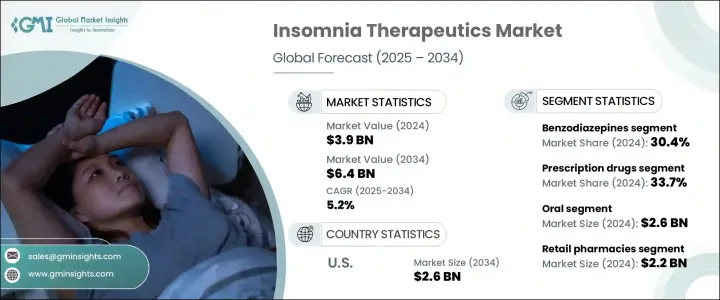
세계의 불면증 치료 시장은 2024년 39억 달러로 평가되었으며, 2025-2034년 연평균 복합 성장률(CAGR) 5.2%로 성장할 것으로 예측됩니다.
불면증 치료에는 수면장애, 특히 입면 장애 및 수면 유지 장애로 고통받는 사람들을 돕기 위해 고안된 다양한 치료가 포함됩니다. 현대의 스트레스 요인, 라이프 스타일 변화, 인구 고령화 등을 배경으로 세계적으로 불면증 유병률이 증가하고 있는 것이 효과적인 치료 솔루션에 대한 수요에 박차를 가하고 있습니다. 수면장애가 건강 전반에 미치는 영향에 대한 인식이 높아지는 가운데 불면증 치료 시장은 급속히 확대되고 있으며, 제약회사, 의료 제공자, 디지털 헬스 플랫폼에 큰 성장 기회를 가져오고 있습니다.
만성 불면증의 증례가 증가하고 있다는 것은 의약품 개발과 대체 요법의 기술 혁신을 뒷받침하고 있습니다. 도시화, 장시간 노동, 스크린 이용 시간 증가로 스트레스 관련 수면장애가 급증하고 처방약 및 일반용 의약품(OTC)에 대한 수요가 높아지고 있습니다. 불면증에 대한 인지 행동 치료(CBT-I)의 발전과 수면 관리 솔루션에서 인공지능의 통합은 시장을 더욱 재구성하고 있습니다. 또한, 새로운 불면증 치료에 대한 연구 자금 증가와 규제 당국의 승인이 시장 확대를 뒷받침할 것으로 예상됩니다. 또한 맞춤 치료 계획 및 정밀의료가 중시되어 개별 환자의 요구에 맞는 맞춤형 솔루션이 가능해지고 있습니다.
| 시장 범위 | |
|---|---|
| 시작 연도 | 2024년 |
| 예측 연도 | 2025-2034년 |
| 시작 금액 | 39억 달러 |
| 예측 금액 | 64억 달러 |
| CAGR | 5.2% |
시장은 약물 등급별로 분류되며, 주요 부문에는 벤조디아제핀계, 비 벤조디아제핀계, 오렉신 수용체 길항제, 항우울제, 항히스타민제, 멜라토닌 보충제 및 기타 약이 포함됩니다. 벤조디아제핀계 약제는 2024년 전체 시장의 30.4%를 차지하며 최대 점유율을 차지했습니다. 이러한 약제는 수면 시간을 효과적으로 단축하고 수면의 질을 높이기 위해 스트레스나 불안에 동반되는 불면증에 널리 처방되고 있습니다. 그 지속적인 인기는 즉효성과 널리 입수 가능한 것에 기인하고 있으며 불면증 치료에 있어서 압도적인 선택지가 되고 있습니다.
불면증 치료 시장은 더 나아가 판매 채널별로 구분되어 처방약 및 OTC약이 2대 카테고리가 되고 있습니다. 2024년에는 의료용 의약품이 시장 전체 매출액의 33.7%를 차지했습니다. 원격 의료 및 온라인 헬스케어 진찰의 대두로 개인이 시의적절한 진단과 적절한 치료를 받는 것이 용이해져 처방약의 매출 증가에 기여하고 있습니다. 게다가 수면 부족의 건강 리스크 및 정신 질환과의 관련성에 관한 소비자 의식의 고조가, 의료 개입을 요구하는 개인의 증가를 재촉하고 있습니다.
미국의 불면증 치료 시장은 2024년에 16억 달러를 창출하였고, 2034년에는 26억 달러에 이를 것으로 예측되고 있습니다. 주요 제약 기업의 존재와 더불어 강력한 조사 이니셔티브 및 규제 당국의 지원이 이 나라의 시장 성장을 뒷받침하고 있습니다. 미국을 거점으로 하는 헬스케어 조직은, 수면 위생의 중요성을 계속 강조해, 연구 자금의 증가와 혁신적인 치료 솔루션의 제창을 계속하고 있습니다. FDA의 불면증 치료제 신약 및 개량약 승인은 시장 확대를 더욱 가속화시켜 미국을 세계 불면증 치료 업계의 주요 기업으로 확고히 하고 있습니다.
목차
제1장 조사 방법 및 조사 범위
제2장 주요 요약
제3장 업계 인사이트
- 생태계 분석
- 업계에 미치는 영향요인
- 성장 촉진요인
- 불면증 유병률의 상승
- 연구개발 진전
- 수면장애에 대한 의식 고조
- 세계 노인 인구 증가
- 업계의 잠재적 위험 및 과제
- 생물학적 제제 및 첨단 치료제의 고비용
- 부작용 및 컴플라이언스 문제
- 성장 촉진요인
- 성장 가능성 분석
- 규제 상황
- 갭 분석
- 특허 분석
- 파이프라인 분석
- Porter's Five Forces 분석
- PESTEL 분석
제4장 경쟁 구도
- 서문
- 기업 점유율 분석
- 기업 매트릭스 분석
- 주요 시장 기업의 경쟁 분석
- 경쟁 포지셔닝 매트릭스
- 전략 대시보드
제5장 시장 추계 및 예측 : 약제 클래스별(2021-2034년)
- 주요 동향
- 벤조디아제핀계
- 비벤조디아제핀계
- 오렉신 수용체 길항제
- 항우울제
- 항히스타민제
- 멜라토닌 보충제
- 기타 약제 클래스별
제6장 시장 추계 및 예측 : 판매 채널별(2021-2034년)
- 주요 동향
- 일반용 의약품
- 처방약
제7장 시장 추계 및 예측 : 투여 경로별(2021-2034년)
- 주요 동향
- 경구
- 주사
- 경피
- 경비
제8장 시장 추계 및 예측 : 유통 채널별(2021-2034년)
- 주요 동향
- 병원 약국
- 소매 약국
- 전자상거래
제9장 시장 추계 및 예측 : 지역별(2021-2034년)
- 주요 동향
- 북미
- 미국
- 캐나다
- 유럽
- 독일
- 영국
- 프랑스
- 스페인
- 이탈리아
- 네덜란드
- 아시아태평양
- 중국
- 일본
- 인도
- 호주
- 한국
- 라틴아메리카
- 브라질
- 멕시코
- 아르헨티나
- 중동 및 아프리카
- 남아프리카
- 사우디아라비아
- 아랍에미리트(UAE)
제10장 기업 프로파일
- Eisai
- Eli Lilly and Company
- Meiji Seika Pharma
- Merck &Co.
- Neurocrine Biosciences
- Pfizer
- Sanofi
- Takeda Pharmaceutical Company Limited
- Teva Pharmaceutical Industries
- Vanda Pharmaceuticals
- Woodward Pharma Services
The Global Insomnia Therapeutics Market was valued at USD 3.9 billion in 2024 and is projected to grow at a CAGR of 5.2% between 2025 and 2034. Insomnia therapeutics encompass a broad spectrum of treatments designed to help individuals struggling with sleep disorders, particularly those who have difficulty falling asleep or maintaining sleep. The increasing prevalence of insomnia worldwide, driven by modern-day stressors, shifting lifestyles, and aging populations, is fueling the demand for effective treatment solutions. With growing awareness of the impact of sleep disorders on overall health, the market for insomnia therapeutics is expanding rapidly, providing significant growth opportunities for pharmaceutical companies, healthcare providers, and digital health platforms.

Rising cases of chronic insomnia are propelling innovation in drug development and alternative therapies. Stress-related sleep disorders have surged due to urbanization, long working hours, and increased screen time, leading to a higher demand for prescription and over-the-counter (OTC) medications. Advancements in cognitive behavioral therapy for insomnia (CBT-I) and the integration of artificial intelligence in sleep management solutions are further reshaping the market. Additionally, increased research funding and regulatory approvals for novel insomnia treatments are expected to bolster market expansion. The emphasis on personalized treatment plans and precision medicine is also gaining traction, enabling tailored solutions that cater to individual patient needs.
| Market Scope | |
|---|---|
| Start Year | 2024 |
| Forecast Year | 2025-2034 |
| Start Value | $3.9 Billion |
| Forecast Value | $6.4 Billion |
| CAGR | 5.2% |
The market is categorized by drug class, with key segments including benzodiazepines, non-benzodiazepines, orexin receptor antagonists, antidepressants, antihistamines, melatonin supplements, and other medications. Benzodiazepines held the largest share of the market in 2024, accounting for 30.4% of total sales. These drugs are widely prescribed for insomnia associated with stress and anxiety, as they effectively reduce sleep onset time and enhance sleep quality. Their continued popularity stems from their fast-acting results and widespread availability, making them a dominant choice in insomnia treatment.
The insomnia therapeutics market is further segmented by sales channels, with prescription and OTC drugs as the two primary categories. In 2024, prescription drugs accounted for 33.7% of total market sales. The rise of telemedicine and online healthcare consultations has made it easier for individuals to receive timely diagnoses and appropriate treatment, contributing to increased prescription medication sales. Additionally, growing consumer awareness about the health risks of sleep deprivation and its link to mental health disorders has encouraged more individuals to seek medical intervention.
The U.S. Insomnia Therapeutics Market generated USD 1.6 billion in 2024 and is expected to reach USD 2.6 billion by 2034. The presence of leading pharmaceutical companies, coupled with robust research initiatives and regulatory support, is driving market growth in the country. U.S.-based healthcare organizations continue to emphasize the importance of sleep health, advocating for increased research funding and innovative treatment solutions. FDA approvals for new and improved insomnia drugs are further accelerating market expansion, solidifying the U.S. as a key player in the global insomnia therapeutics industry.
Table of Contents
Chapter 1 Methodology and Scope
- 1.1 Market scope and definitions
- 1.2 Research design
- 1.2.1 Research approach
- 1.2.2 Data collection methods
- 1.3 Base estimates and calculations
- 1.3.1 Base year calculation
- 1.3.2 Key trends for market estimation
- 1.4 Forecast model
- 1.5 Primary research and validation
- 1.5.1 Primary sources
- 1.5.2 Data mining sources
Chapter 2 Executive Summary
- 2.1 Industry 3600 synopsis
Chapter 3 Industry Insights
- 3.1 Industry ecosystem analysis
- 3.2 Industry impact forces
- 3.2.1 Growth drivers
- 3.2.1.1 Rising prevalence of insomnia
- 3.2.1.2 Advancements in research and development
- 3.2.1.3 Growing awareness of sleep disorders
- 3.2.1.4 Increasing global geriatric population
- 3.2.2 Industry pitfalls and challenges
- 3.2.2.1 High cost of biologic and advanced therapies
- 3.2.2.2 Side effects and compliance issues
- 3.2.1 Growth drivers
- 3.3 Growth potential analysis
- 3.4 Regulatory landscape
- 3.5 Gap analysis
- 3.6 Patent analysis
- 3.7 Pipeline analysis
- 3.8 Porter’s analysis
- 3.9 PESTEL analysis
Chapter 4 Competitive Landscape, 2024
- 4.1 Introduction
- 4.2 Company market share analysis
- 4.3 Company matrix analysis
- 4.4 Competitive analysis of major market players
- 4.5 Competitive positioning matrix
- 4.6 Strategy dashboard
Chapter 5 Market Estimates and Forecast, By Drug Class, 2021 – 2034 ($ Mn)
- 5.1 Key trends
- 5.2 Benzodiazepines
- 5.3 Non-benzodiazepine
- 5.4 Orexin receptor antagonists
- 5.5 Antidepressants
- 5.6 Antihistamines
- 5.7 Melatonin supplements
- 5.8 Other drug classes
Chapter 6 Market Estimates and Forecast, By Sales Channel, 2021 – 2034 ($ Mn)
- 6.1 Key trends
- 6.2 Over-the-counter (OTC) drugs
- 6.3 Prescription drugs
Chapter 7 Market Estimates and Forecast, By Route of Administration, 2021 – 2034 ($ Mn)
- 7.1 Key trends
- 7.2 Oral
- 7.3 Injectable
- 7.4 Transdermal
- 7.5 Intranasal
Chapter 8 Market Estimates and Forecast, By Distribution Channel, 2021 – 2034 ($ Mn)
- 8.1 Key trends
- 8.2 Hospital pharmacies
- 8.3 Retail pharmacies
- 8.4 E-commerce
Chapter 9 Market Estimates and Forecast, By Region, 2021 – 2034 ($ Mn)
- 9.1 Key trends
- 9.2 North America
- 9.2.1 U.S.
- 9.2.2 Canada
- 9.3 Europe
- 9.3.1 Germany
- 9.3.2 UK
- 9.3.3 France
- 9.3.4 Spain
- 9.3.5 Italy
- 9.3.6 Netherlands
- 9.4 Asia Pacific
- 9.4.1 China
- 9.4.2 Japan
- 9.4.3 India
- 9.4.4 Australia
- 9.4.5 South Korea
- 9.5 Latin America
- 9.5.1 Brazil
- 9.5.2 Mexico
- 9.5.3 Argentina
- 9.6 Middle East and Africa
- 9.6.1 South Africa
- 9.6.2 Saudi Arabia
- 9.6.3 UAE
Chapter 10 Company Profiles
- 10.1 Eisai
- 10.2 Eli Lilly and Company
- 10.3 Meiji Seika Pharma
- 10.4 Merck & Co.
- 10.5 Neurocrine Biosciences
- 10.6 Pfizer
- 10.7 Sanofi
- 10.8 Takeda Pharmaceutical Company Limited
- 10.9 Teva Pharmaceutical Industries
- 10.10 Vanda Pharmaceuticals
- 10.11 Woodward Pharma Services