|
시장보고서
상품코드
1698596
의약품 포장 시장 - 기회, 성장 촉진요인, 산업 동향 분석, 예측(2025-2034년)Pharmaceutical Packaging Market Opportunity, Growth Drivers, Industry Trend Analysis, and Forecast 2025-2034 |
||||||

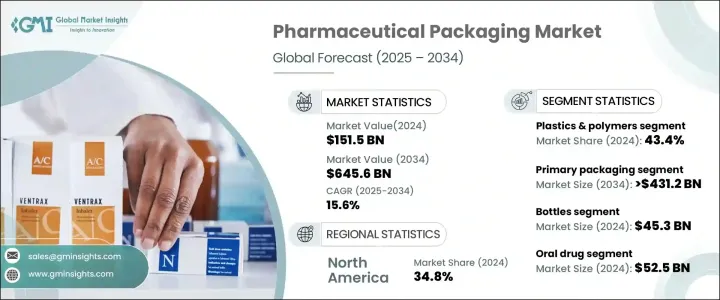
세계의 의약품 포장 시장은 2024년에 1,515억 달러로 평가되었으며, 2025년부터 2034년까지 15.6%의 연평균 복합 성장률(CAGR)로 확대될 것으로 예측되고 있습니다.
바이오 의약품에 대한 수요 증가와 변조 방지 및 소아 내성 포장이 중시되는 것이 성장을 가속하는 주요 요인입니다. 안정성과 효능을 보장하는 특수한 포장 솔루션의 필요성을 가속화하고 있으며, 그 결과 기업은 엄격한 규제 요건에 맞는 혁신적인 소재와 형식을 도입하기 위한 연구 개발을 강화하고 있습니다.
제약 업계에서는 복잡한 생물학적 제제를 보존하기 위한 첨단 패키징에 대한 의존도가 높아지고 있어, 제조업체에 새로운 기회를 가져오고 있습니다. 환자의 안전에 대한 관심과 엄격한 규제가 오음을 방지하는 보호 포장 컨셉에 대한 투자를 기업에 촉구하고 있습니다.
| 시장 범위 | |
|---|---|
| 시작 연도 | 2024년 |
| 예측 연도 | 2025-2034년 |
| 시작 금액 | 1,515억 달러 |
| 예측 금액 | 6,456억 달러 |
| CAGR | 15.6% |
시장은 1차 포장, 2차 포장, 3차 포장으로 분류됩니다. 1차 포장은 2034년까지 4,312억 달러 이상에 달할 것으로 예측되고 있습니다. 변조 방지 솔루션과 같은 스마트한 대화식 패키징에 대한 수요가 증가하고 있습니다.
재료별로 보면 시장은 플라스틱, 폴리머, 종이, 판지, 유리, 금속으로 나뉩니다. 지속가능성에 대한 우려는 환경에 미치는 영향을 줄이고 진화하는 규제 기준을 충족시키기 위해 바이오, 재활용 가능 및 생분해 성 플라스틱의 채택을 촉진합니다.
시장은 제품 유형별로 구분되어 있으며, 병, 주사기, 블리스터 팩, 바이알 앰플, 사쉐, 파우치, 투약 튜브 등이 있습니다. 그리고 사용의 용이성에서 고체 및 액체 의약품 포장에 병을 선호하고 사용하고 있습니다.
용도별로는 경구약, 주사약, 외용약, 점비약, 정맥주사약 등이 있습니다. 가장 많이 사용되고 있습니다. 소아에 대한 내성을 강화한 설계나 복용량을 추적하기 위한 내장 인디케이터가 인기를 끌고 있어, 복약 준수와 안전성을 지지하고 있습니다.
북미는 2024년에 34.8%의 점유율로 세계의 의약품 포장 시장을 선도했습니다.
목차
제1장 조사 방법과 조사 범위
제2장 주요 요약
제3장 업계 인사이트
- 생태계 분석
- 업계에 미치는 영향요인
- 성장 촉진요인
- 새로운 의약품 포장 시스템의 기술 혁신 증가
- 바이오 의약품에 대한 수요 증가
- 만성 질환 증가
- 고도 약물전달 시스템의 사용 증가
- 포장의 소아 내성과 변조 방지 기능에 대한 수요 증가
- 업계의 잠재적 위험 및 과제
- 위조 의약품과 위조 포장
- 양질의 의료에 대한 접근성의 제한 또는 불충분
- 성장 촉진요인
- 성장 가능성 분석
- 규제 상황
- 기술 동향
- 미래 시장 동향
- 갭 분석
- Porter's Five Forces 분석
- PESTEL 분석
제4장 경쟁 구도
- 소개
- 기업 점유율 분석
- 주요 시장 기업의 경쟁 분석
- 경쟁 포지셔닝 매트릭스
- 전략 대시보드
제5장 시장 추계 및 예측 : 제품 유형별, 2021-2034년
- 주요 동향
- 블리스터 팩
- 병
- 주사기
- 바이알 및 앰플
- 사쉐
- 파우치
- 투약 튜브
- 기타
제6장 시장 추계 및 예측 : 재료별, 2021-2034년
- 주요 동향
- 플라스틱
- 폴리에틸렌(PE)
- 폴리에틸렌테레프탈레이트(PET)
- 폴리프로필렌(PP)
- 폴리스티렌(PS)
- 폴리염화비닐(PVC)
- 기타
- 종이 및 판지
- 유리
- 금속
제7장 시장 추계 및 예측 : 포장 유형별, 2021-2034년
- 주요 동향
- 1차 포장
- 2차 포장
- 3차 포장
제8장 시장 추계 및 예측 : 용도별, 2021-2034년
- 주요 동향
- 경구 의약품
- 주사제
- 외용약
- 경비약
- 정맥주사제
- 기타
제9장 시장 추계 및 예측 : 지역별, 2021-2034년
- 주요 동향
- 북미
- 미국
- 캐나다
- 유럽
- 독일
- 영국
- 프랑스
- 스페인
- 이탈리아
- 네덜란드
- 아시아태평양
- 중국
- 인도
- 일본
- 호주
- 한국
- 라틴아메리카
- 브라질
- 멕시코
- 아르헨티나
- 중동 및 아프리카
- 사우디아라비아
- 남아프리카
- 아랍에미리트(UAE)
제10장 기업 프로파일
- Adelphi
- Amcor
- Aptar CSP Technologies
- Berry Global
- Catalent
- CCL Industries
- Comar
- Constantia Flexibles
- Drug Plastics & Glass
- DS Smith
- Eastman Chemical
- Gerresheimer
- Huhtamaki
- Mayr-Melnhof Karton
- Nipro
- Origin Pharma Packaging
- ProAmpac
- Schott Pharma
- SGD Pharma
- Silgan
- Sonoco
- West Pharmaceutical
- WestRock
The Global Pharmaceutical Packaging Market was valued at USD 151.5 billion in 2024 and is anticipated to expand at a CAGR of 15.6% from 2025 to 2034. The rising demand for biopharmaceuticals and the increasing emphasis on tamper-evident and child-resistant packaging are key factors driving growth. Advances in biologics and the surge in personalized medicine are accelerating the need for specialized packaging solutions that ensure stability and efficacy. As a result, companies are ramping up research and development efforts to introduce innovative materials and formats that align with stringent regulatory requirements.
The pharmaceutical industry's growing reliance on advanced packaging to preserve complex biological formulations presents new opportunities for manufacturers. Cryogenic and temperature-sensitive packaging solutions are gaining traction to address the storage and transportation needs of biopharmaceuticals. Additionally, the heightened focus on patient safety and stringent regulations are pushing companies to invest in protective packaging concepts that prevent accidental ingestion. Pharmaceutical firms are incorporating smart features such as RFID-enabled tracking and temperature indicators to improve drug traceability and adherence.
| Market Scope | |
|---|---|
| Start Year | 2024 |
| Forecast Year | 2025-2034 |
| Start Value | $151.5 Billion |
| Forecast Value | $645.6 Billion |
| CAGR | 15.6% |
The market is categorized into primary, secondary, and tertiary packaging. Primary packaging is projected to surpass USD 431.2 billion by 2034. The demand for smart and interactive packaging, including child-resistant and tamper-proof solutions, is increasing as manufacturers prioritize drug safety and compliance. The expansion of biologics and personalized medicine is further fueling the need for high-barrier materials that maintain product integrity.
Based on material, the market is divided into plastics and polymers, paper and paperboard, glass, and metal. Plastics and polymers accounted for 43.4% of the total market share in 2024, serving as the preferred choice due to their versatility, lightweight nature, and durability. Sustainability concerns are driving the adoption of bio-based, recyclable, and biodegradable plastics to reduce environmental impact and meet evolving regulatory standards.
The market is also segmented by product type, including bottles, syringes, blister packs, vials and ampoules, sachets, pouches, and medication tubes. Bottles led the segment, generating USD 45.3 billion in 2024. The pharmaceutical industry continues to favor bottles for solid and liquid drug packaging due to their convenience and ease of use. The shift toward sustainable alternatives, including recycled and bio-based plastic bottles, reflects growing efforts to minimize ecological footprint.
By application, the market includes oral drugs, injectable drugs, topical drugs, nasal drugs, and intravenous drugs. Oral drug packaging reached USD 52.5 billion in 2024, with blisters, bottles, and sachets remaining the most utilized formats. Enhanced child-resistant designs and built-in indicators to track dosages are gaining popularity, supporting medication adherence and safety.
North America led the global pharmaceutical packaging market with a 34.8% share in 2024. The United States alone contributed USD 46.1 billion, driven by strict regulatory frameworks and substantial investments in medicine production and healthcare advancements.
Table of Contents
Chapter 1 Methodology and Scope
- 1.1 Market scope and definitions
- 1.2 Research design
- 1.2.1 Research approach
- 1.2.2 Data collection methods
- 1.3 Base estimates and calculations
- 1.3.1 Base year calculation
- 1.3.2 Key trends for market estimation
- 1.4 Forecast model
- 1.5 Primary research and validation
- 1.5.1 Primary sources
- 1.5.2 Data mining sources
Chapter 2 Executive Summary
- 2.1 Industry 3600 synopsis
Chapter 3 Industry Insights
- 3.1 Industry ecosystem analysis
- 3.2 Industry impact forces
- 3.2.1 Growth drivers
- 3.2.1.1 Increasing innovation in novel drug packaging systems
- 3.2.1.2 Rising demand for biopharmaceuticals
- 3.2.1.3 Increasing prevalence of chronic diseases
- 3.2.1.4 Increasing use of advanced drug delivery systems
- 3.2.1.5 Rising demand for child-resistant and tamper-evident features in packaging
- 3.2.2 Industry pitfalls and challenges
- 3.2.2.1 Counterfeit drugs and fake packaging
- 3.2.2.2 Limited or Inadequate access to quality medical care
- 3.2.1 Growth drivers
- 3.3 Growth potential analysis
- 3.4 Regulatory landscape
- 3.5 Technology landscape
- 3.6 Future market trends
- 3.7 Gap analysis
- 3.8 Porter's analysis
- 3.9 PESTEL analysis
Chapter 4 Competitive Landscape, 2024
- 4.1 Introduction
- 4.2 Company market share analysis
- 4.3 Competitive analysis of major market players
- 4.4 Competitive positioning matrix
- 4.5 Strategy dashboard
Chapter 5 Market Estimates and Forecast, By Product Type, 2021 – 2034 (USD Bn & Kilo Tons)
- 5.1 Key trends
- 5.2 Blister packs
- 5.3 Bottles
- 5.4 Syringes
- 5.5 Vials & ampoules
- 5.6 Sachets
- 5.7 Pouches
- 5.8 Medication tubes
- 5.9 Others
Chapter 6 Market Estimates and Forecast, By Material, 2021 – 2034 (USD Bn & Kilo Tons)
- 6.1 Key trends
- 6.2 Plastics
- 6.2.1 Polyethylene (PE)
- 6.2.2 Polyethylene terephthalate (PET)
- 6.2.3 Polypropylene (PP)
- 6.2.4 Polystyrene (PS)
- 6.2.5 Polyvinyl chloride (PVC)
- 6.2.6 Others
- 6.3 Paper & paperboard
- 6.4 Glass
- 6.5 Metal
Chapter 7 Market Estimates and Forecast, By Packaging Type, 2021 – 2034 (USD Bn & Kilo Tons)
- 7.1 Key trends
- 7.2 Primary packaging
- 7.3 Secondary packaging
- 7.4 Tertiary packaging
Chapter 8 Market Estimates and Forecast, By Application, 2021 – 2034 (USD Bn & Kilo Tons)
- 8.1 Key trends
- 8.2 Oral drugs
- 8.3 Injectable drugs
- 8.4 Topical drugs
- 8.5 Nasal drugs
- 8.6 Intravenous (IV) drugs
- 8.7 Others
Chapter 9 Market Estimates and Forecast, By Region, 2021 – 2034 (USD Bn & Kilo Tons)
- 9.1 Key trends
- 9.2 North America
- 9.2.1 U.S.
- 9.2.2 Canada
- 9.3 Europe
- 9.3.1 Germany
- 9.3.2 UK
- 9.3.3 France
- 9.3.4 Spain
- 9.3.5 Italy
- 9.3.6 Netherlands
- 9.4 Asia Pacific
- 9.4.1 China
- 9.4.2 India
- 9.4.3 Japan
- 9.4.4 Australia
- 9.4.5 South Korea
- 9.5 Latin America
- 9.5.1 Brazil
- 9.5.2 Mexico
- 9.5.3 Argentina
- 9.6 Middle East and Africa
- 9.6.1 Saudi Arabia
- 9.6.2 South Africa
- 9.6.3 UAE
Chapter 10 Company Profiles
- 10.1 Adelphi
- 10.2 Amcor
- 10.3 Aptar CSP Technologies
- 10.4 Berry Global
- 10.5 Catalent
- 10.6 CCL Industries
- 10.7 Comar
- 10.8 Constantia Flexibles
- 10.9 Drug Plastics & Glass
- 10.10 DS Smith
- 10.11 Eastman Chemical
- 10.12 Gerresheimer
- 10.13 Huhtamaki
- 10.14 Mayr-Melnhof Karton
- 10.15 Nipro
- 10.16 Origin Pharma Packaging
- 10.17 ProAmpac
- 10.18 Schott Pharma
- 10.19 SGD Pharma
- 10.20 Silgan
- 10.21 Sonoco
- 10.22 West Pharmaceutical
- 10.23 WestRock